Tag Archives: Church

Jesus, Mary and Martha in the Valley of Dry Bones

John 11:1-45
When Martha heard that Jesus was coming, she went and met him, while Mary stayed at home. Martha said to Jesus, “Lord, if you had been here, my brother would not have died. (Read the whole thing)

Ezekiel 37:1-14
The hand of the Lord came upon me, and he brought me out by the spirit of the Lord and set me down in the middle of a valley; it was full of bones. He led me all around them; there were very many lying in the valley, and they were very dry. (Read the whole thing)

Our lenten journey has been pointing us to this place since we came down the mountain of transfiguration 5 weeks ago. We marked our foreheads in dust and ash to begin Lent. Then we were driven out into the wilderness with Jesus to meet the tempter. With Nicodemus we came to Jesus by night with deep questions of faith. At the well in the noon day heat, we met with Jesus the isolated Samaritan woman. In the dirt and mud, we went with the Blind man to wash and have our eyes opened, only to discover everyone else was still blind.

And all along, we saw from different places and different angles the new thing that God was doing. Jesus is moving towards us. Staying the course in the wilderness, but adjusting when Nicodemus needed a new approach. Persisting when the Samaritan woman needed her the walls holding in her dead water burst open with living water, and coming back to the blind man when he couldn’t bear the torch of faith on his own, and filling him up again with gospel.

All these moves and stops along the way have led us here. Not to the that stretch of road before Bethany, the home of Lazarus… but rather with Ezekiel, it is valley of the dry bones that we have arrived at. It is this valley that is at the bottom of the mountain of Transfiguration and it is this valley that will lead us to the mountain of Golgatha.

Ezekiel’s vision the valley of dry bones that sets the backdrop of the story of Jesus, Martha, Mary and Lazarus that we hear on this 5th Sunday in Lent. We cannot help but hear this story of Jesus’ friends without Ezekiel’s vision framing it all.

As Jesus receives word that his good friend Lazarus is ill, we get the sense that something is up, but still Jesus waits 3 days. When Jesus finally goes to see his friends, he knows that Lazarus is dead.

When Martha hears that Jesus on his way she goes out to meet him. She goes out being led by the hand of the Lord She goes out and the spirit sets Martha down in the middle of a valley; it was full of bones…there were very many lying in the valley, and they were very dry. And there among them she can see the bones of her brother Lazarus.

Standing on the edge of this vast valley covered in bones, her grief causes her to lash out at her friend Jesus, “Lord if you had been here, my brother would not have died.”

Jesus looks at her and responds, “Mortal, can these bones live?”

Martha looks at her friend and answers, “O Lord God, you know.”

And Jesus knowing Martha’s storming grief needs to be calmed says, “Prophesy to these bones, and say to them: O dry bones, hear the word of the Lord. Thus says the Lord God to these bones: I will cause breath to enter you, and you shall live. I will lay sinews on you, and will cause flesh to come upon you, and cover you with skin, and put breath in you, and you shall live; and you shall know that I am the Lord.”

And so Martha recites the tenets of faith, she knows that Jesus has come for a great purpose, to bring life to all creation… but she still cannot see the breath in the bones.

On this 5th Sunday in Lent, we are finally and openly confronting the thing that has been beneath all these stories of Jesus’ encounters with the tempter, Nicodemus, the Samaritan woman and the blind man. Just as Martha’s grief has brought her to edge to the valley of dry bones, so does our grief bring us there.

Martha’s valley of dry bones is on the road to Bethany. We might find ours when we look over at the empty pew where someone we loved used to sit. It might be that missing voice behind us that used to ring in our ears as we sung our favourite hymns. It might be that missing familiar voice that use to hand us the bulletin or kneel next to us at the communion rail. It might be that empty spot in bed that we wake up to in the morning. It might be that empty spot in the weekly calendar that used to be reserved for that outing with a best friend. It might be that empty chair at the dinner table at home, or the lunch table at work.

The signs and places of valleys of dry bones surround us just as much as they surround Martha and Jesus today. And like Martha we know the promises of God, we know that we are supposed to have hope and trust in God’s future for us. Yet, we just cannot see the breath. In fact, our grief and sorrow makes us ever more attentive to the fact that these dry bones around us, clearly, have no breath. Like Martha, we just see the bones.

And then Mary comes to join Martha and Jesus on the edge of the valley of dry bones. And unlike Martha whose grief makes her defiantly accuse Jesus, Mary falls at his feet in grief. “Lord if you had been here, my brother would not have died.”

But there are no words to calm Mary this time.

Instead, this is the moment of Jesus’ final move of Lent.

In this moment, standing before the valley of dry bones, with Martha at is side, with Mary at his feet, with Lazarus’ bones laid before him… Jesus himself is broken open.

The grief of God bursts open into the world.

Grief like ours that only sees the empty places, and the dry bones and desolate valleys.

Yet, unlike our grief, which is our clearest sign that death has ultimate power in the world.

The grief of God…even the grief of God brings new life into the world.

Because suddenly there is a noise, a rattling, and the bones came together, bone to its bone… there were sinews on them, and flesh had come upon them, and skin had covered them; but there was no breath in them.

Even the grief of God brings life into creation.

And Jesus says, to Martha and Mary, Jesus speaks to the rotting bones of Lazarus laying before him,

“Prophesy to the breath, prophesy, mortal, and say to the breath: Thus says the Lord God: Come from the four winds, O breath, and breathe upon these slain, that they may live.” And just as Jesus commands, the breath came into them, and they lived, and stood on their feet, a vast multitude.

And our grief laying beneath temptations in the wilderness and questions in the dark of night. Beneath self-imposed isolation in the noon day heat and blindness buried under dirt and mud and religious certainty. Our grief that is exposed here in the lifeless valley of dry bones… meets the grief of God. The grief of the God of life, the grief that brings life into the world. Even grief that cannot help but make all things new.

Our grief meets God’s grief. In the empty pews, and hymns missing a voice, and missing faces that used to greet us on our way to worship.

Our grief meets God’s grief, in cold and empty spots next to us in bed, in empty spots on our calendar, and empty chairs and dinner and lunch tables.

Our grief meets God’s grief here in the body of Christ. Even grief that cannot help but make all things new.

And there with Martha and Mary, on the edge of the dry valley, Jesus stands before the bones.

“Mortal, these bones are the whole house of Israel [These bones are the whole Body of Christ] They say, ‘Our bones are dried up, and our hope is lost; we are cut off completely.’

And there the bones of Martha and Mary’s brother, and all of our beloved Lazarus’s now covered in flesh and sinew, finally stand before us with breath and new life.

And Jesus says to us to them and says to us,

“Thus says the Lord God: I am going to open your graves, and bring you up from your graves, O my people; and I will bring you back to the land of Israel. And you shall know that I am the Lord, when I open your graves, and bring you up from your graves, O my people. I will put my spirit within you, and you shall live, and I will place you on your own soil; then you shall know that I, the Lord, have spoken and will act,” says the Lord.”

Amen.

Clerical Collars and Ecclesiastical Titles: 5 Reasons they are needed in the Church

“Just call me Erik”

I have never said these words out loud in the context of pastoral ministry.

Sometime just before or during my childhood, there was a movement toward informality in the church. Many pastors stopped going by “Reverend Last Name” or “Pastor Last Name” and started going by just “First Name.” At the same time, there was movement away from clergy attire (although for many Lutherans, collars and vestments had only been reclaimed a few decades earlier).

When I began seminary in 2005 and graduated in 2009, it was more-or-less the norm that clergy would expect to be called by their first name by parishioners, church goers from other churches and colleagues. Wearing a clerical collar was a hotly debated option for many seminary students.

I often got the sense that my desire to be called “Pastor” seemed stodgy and formal to some. And while seminary students of all stripes often liked to experiment with wearing clerical collars, it was not uncommon for veteran pastors having been active for 20+ years would come and drop off collars and vestments for students… yet, these pastors were not intending to retire or resign… they just had no need to clerical attire any longer.

“They create a barrier” was the common refrain when speaking of titles and collars. And real ministry can only be done through personal relationships. And you can only have relationships where people feel like they know you and trust you with personal relationships, which means first name basis and casual clothes.

Once I began serving, colleagues twenty years my senior would tell stories of their own childhood experience in church. They remembered having “Reverend Last Name” teach confirmation, and he was a real strict, no-fun, jerk who always wore his clerical collar. But then “(Pastor) First Name” came to town, and he was lots of groovy fun in his bell-bottom jeans and t-shirts. So now, every pastor should go by their first name because being old and traditional and stodgy is not good ministry. And being fun, and casual and cool is good ministry.

But even at 22 when I started seminary and 26 when I graduated, I thought that going by “Pastor” and looking like a pastor made sense.

The thing is, I was worried about being considered a kid or too young. The average age of pastors in my denomination is well in to the 50s, and here I was, half the average age. And I was about to lead a congregation on my own. Going by “Pastor” was just a small way that I could project the office to which I was called. Looking the part would disguise my youthfulness. Just maybe the people I was serving might see me as a pastor – and not some entitled millennial – if they visualized me as and called me “Pastor.”

In the eight years since, I have learned a few things about what it means to project the symbol of pastor, and to get by on the virtue of personal relationships and charm.

And there are reasons that the church has used titles and clerical collars to identify pastors, reasons that still hold water today. Here are some of them:

1 Pastors are Symbols

Like many vocations and callings in our world, we become public symbols when ‘on the job.’ Like police officers or fire fighters who symbolize safety and protection, like doctors or nurses who symbolize caregiving, like teachers or professors who symbolize learning, pastors are symbols to the people that we work with. We are symbols of God’s and the Church’s public voice in community. When we speak we speak not has individuals but as representatives of someone or something other than ourselves.

The symbol is visualized in the collar or other clerical attire. People can see the symbol in the uniform of pastors, just as safety is presented in firefighter’s gear, or healthcare is by hospital scrubs.

The symbol is verbalized in the title. When people address pastors by the title “Pastor” the symbol and its existence are intentionally articulated, rather than unintentionally assumed.

2 Using titles and collars provides clarity

Here is how pastors who wear collars and go by “Pastor” know that the two are important. When a funeral home, for example, calls me looking for a generic pastor for a funeral, they don’t tell the family that some guy named “Erik” will be doing the service. Rather by calling me “Pastor”, the nature of the relationship I will have with this grieving family is understood. When I show up in a collar, it is clear who I am.

Imagine walking into an ER and everyone was dressed in street clothes, and some person in jeans and t-shirt asked what your symptoms were, and then told you that Jimmy would be with you in a minute? You would be confused wouldn’t you.

Now imagine the same in a church. A person walks in looking for spiritual help, and a member says, let me get Erik to help you.

Collar and titles provide clarity.

3 Privilege

The varied ways in which we bear privilege is coming into our social awareness. And the option to decline the visual symbols and verbal cues of pastoring are a privilege, in particular a white and a male privilege. It takes a certain amount of privileged assurance to decline being called “Pastor” and to forego looking to still be confident that those you serve will assume and understand the full nature of the pastoral relationship. It takes privilege to assume that people won’t confuse your person with you vocation. And that is because whiteness and maleness are not characteristics about that might lead people to assume that one couldn’t be or wouldn’t be a pastor.

Yet, it is often assumed that women who are pastors are not pastors, whether it is sales people looking for the pastor over the phone, or visitors new to the church, or staff at hospital questioning the legitimacy of a visit.

The same goes for people of colour whom are often likely to be disbelieved that they are who they say are.

Worst of all, is that when white men, like me, decline the title and clothing of pastors, we undermine our colleagues who are women and people of colour, because we send the unconscious message that it is our whiteness and maleness that allows us to be pastors. Yet, if we used titles and wore the garb, we would clarify that we are filling office of pastor by looking like clergy and being addressed as clergy. It would also help if we insisted that all of our colleagues, regardless of gender or race or orientation were addressed by their titles.

4 Order over hierarchy

Often the objection to titles, or collars are that they symbolize a hierarchy in the church. Only special people get to wear the special clothing and have the special titles.

But in fact, titles and collars help to minimize the hierarchical nature of the church when understood correctly. When the visual and verbal symbols are not used by pastors, we subconsciously convey that it is for other reasons that we occupy the office of ministry. Perhaps it is that we are more spiritual or moral, that we are smarter or more competent.

Instead, it should be understood that it is “putting on the uniform” that symbolizes taking on the office. It is because through people I serve that God has called to serve, and this why they call me “Pastor.” Titles and collars are the things that are put on in order to serve, rather than service rooted in virtue and specialness. They identify the fact that we are called to particular ministry in the Church, some for this ministry, some for that ministry.

5 Titles and Collars are reminders.

Just as I thought as a 26-year-old starting out in ordained ministry, it is still the case that going by “Pastor (First Name)” and wearing a collar are helpful reminders of the office I fill. And I have noticed over the years that when I wear the collar, people treat me differently. Not with more respect, but less as my particular self. I am more the office than I am Erik. And I have also noticed that whether subconsciously or not, when people address me as “Pastor Parker” or “Pastor Erik” or “Pastor” or “Erik” that is says something about their relationship to the office of pastoral ministry (and secondarily to me). Sometimes how we are addressed is sign of comfort or discomfort, security or insecurity. Those who call me just “Pastor” are often those who are the most comfortable in their relationship to me as their pastor. Those who use my last name are often the least familiar and from outside my particular church community. Those who use just my first name are either very comfortable and familiar, or sometimes are uncomfortable with my relationship to them as their pastor (for likely complicated reasons).

But the reminder is not just for those that I encounter and serve in the course of ministry. Titles and collars are probably most importantly reminders for me. When I put on the black shirt and slide that white tab into my collar, I am reminded that my personal identity takes a back seat to my vocational identity – I am a clergy person and pastor first and foremost to the people I interact with.

And when someone calls me pastor, it is small and constant reminder of who I am to them and the nature of my relationship and responsibilities. That I am called to announce the Good News of Jesus Christ in whatever way possible in this particular moment with this particular person.

Titles and clerical collars are symbols and tools for ministry which, I think, all clergy should consider. But wether not you prefer your suits and ties and go by your first name, or whether you want your pastor to be in a collar every time you see him or her and call them “Pastor”… The symbols we use, visual and verbal are important and they speak to nature of our call to serve in God’s Kindgom.

So let’s all think about the symbols and cues that we use that help us to understand and do ministry… titles and collars included.


Share in the comments, or on the Facebook Page: The Millennial Pastor or on Twitter: @ParkerErik

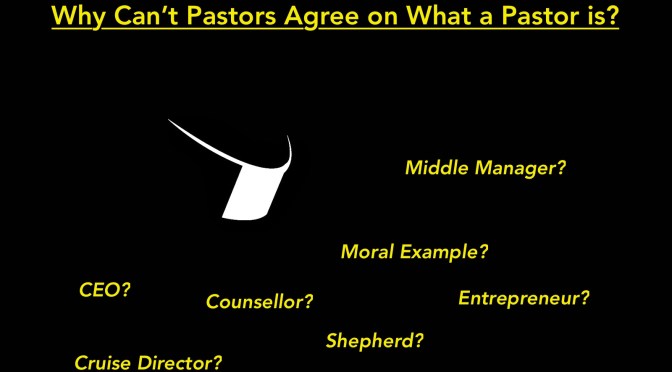
Why Can’t Pastors Agree on What a Pastor is?

What DOES a pastor do anyways?

Ask 10 pastors what a pastor is, and you will get ten different definitions. Read 10 different blog articles on what a pastors is and should be doing, and you will get ten different opinions. The job title and ecclesiological office of pastor is one that encompasses a variety of definitions, often confusing and contradictory ones.

This vagueness around the job description and theological concept of being a pastor is one of the most frustrating parts of my vocation. The debate lately seems to be between the pastor as CEO vs. pastor as Shepherd. Just check out the titles of some relatively recent blog posts:

Why you should be thankful if your pastor behaves like a CEO by Carey Nieuwhof
CEO-style pastorates all the rage but offer little to those seeking deeper faith by Jim Brumley
Quit Telling Pastors We Have to Stop Pastoring to Have a Successful Church: Great churches don’t need spiritual enablers or high-achieving CEOs. by Karl Vaters

The current debate raging online, and probably in churches and among colleagues, about what a pastor is and does is nothing new. It is simply a symptom of the church facing the changing world and some dim sense that part of facing that change means pastors and churches updating their understandings of each.

Even in my short millennial life-time, I have seen pastors of different generations try to live up to different and changing ideas of what it means to be a pastor.

A different time, a different pastor

In my first congregation, a small farming community where the church had been the central focus for nearly a century, pastors were understood to be something akin to the “community professional.” In the early part of the 20th century, pastors were often called upon not only to shepherd the flock, but also provided medical knowledge, taught school children, provided legal and mediation services among other things.

In my Grandfather’s generation in the 40s and 50s, pastors were public moral paragons. They were (supposed to be) living examples of moral living who were required to lead the faithful in their own moral living and a disciplined faith full of regular devotion and study. Pastors were expected to be public moral authorities whose credibility was rooted in their character and leadership position. They were called upon to serve on public boards, public offices and positions and were often in the public eye.

And then in the 60s and 70s, Clinical Pastoral Education and a trend towards psychology and therapy transformed again the role of the pastor. No longer was the pastor a voice for morality and divine authority, but now a counsellor, therapist even. Someone to hear your troubles (sometimes on God’s behalf) and direct you to the help you need. And pastors started using as much the language of psychology as theology.

And then 80s and 90s, when, despite the early signs of decline, the trend was for established and growing congregations to program their ministry. This meant large facilities and increased staff positions. Pastors became middle managers, overseeing growing churches that had become corporatized. Business language become the vernacular at board meetings and for church leadership.

And then in the 2000s, pastors were called upon to become entrepreneurial CEOs, revitalizing the unwieldy and declining organizations that had been started by the community professionals and moral paragons, grown by the pastoral care providers, and managed into decline by the middle managers. Pastors were and are expected to be the source of mission and vision renewal for churches longing for a return to the glory days. The glory days of course depend on which of the previous eras felt the most glorious for a given person. And the new glory days also include incorporating all the new technology of a changing digital and online world.

These are, of course, not the only dominant forms of pastor that have risen up recently. There are several of other images and ideas about what the primary role of a pastor is:

There is the social justice warrior, who leads their faith community in striking out to address all the evils of the world. This pastor strives to lead people in activism and to organize communities of resistance beyond congregations who will fight for justice among all the injustices that exist in the world.

And there is the cruise director / country club pro who is the omni-present social glue that holds the many activities and programs and fellowship events that a congregation plans. The pastor will likely make an appearance at everything: every meeting, every breakfast, every golf or curling fundraiser. The pastor is more mascot than spiritual leader.

And there is the coach and cheerleader. The person encouraging the laity in their calling by passing off the bulk of the responsibilities of the pastoral office. A pastor’s job is to put themselves out of a job is mantra of this style.

So which of these is the right style or idea of the core of pastoral ministry is? Should pastors need to choose?

Jack-of-all-trades pastoring?

Picking one version of pastoral ministry over another actually misses the point. Of course all of the responsibilities are, at times, part of what a pastor does. Sometimes you will be the community expert, other times you will inspire your people to faithfulness, sometimes you be called upon to provide counsel and care for people in need, other times you will be the one checking the boiler and booking rentals, sometimes you will be hiring and firing people. And of course in the midst of all these things there is preaching and leading worship / the liturgy, studying and teaching the bible, prayer and helping people grow in faith.

But none of these shifting ideas about what it means to be a pastor are core to pastoral ministry as it has been understood for most of the church’s history. Pastors or priests have always been tasked with preaching the word, administering the sacraments and tending to God’s people. And throughout the millennia, this has put various responsibilities on the shoulders of pastors, managing and tending to groups of people wherever they are is complicated.

Yet, whatever trend or style of ministry is current, and even whatever denomination or part of the world  a pastor serves in… the essential of what is a pastor is the same.

Pastors bring the Church to the church.

Whether it is the through high church smells and bells liturgy or someone standing alone on a staff with just a bible in their hands, whether it is providing expertise, modelling faithfulness, caring for those in distress, managing complicated communities, or revitalizing declining churches pastors are the connection through which a particular faith community (a church) encounters the faithful of all times and places (The Church).

The Office of Ministry is how The Church enters into the life a church or congregation. In all those things that the debates suggest that pastors should be spending their time on, the underlying purpose of doing any of those things is to help local and particular communities be connected to the body of Christ. To help local congregations participate in the mission of the whole Church, to proclaim the gospel of Jesus Christ to the world. And we don’t do this in vacuums, rather we serve this mission in consort with all the congregations and communities doing the same around us and around the world.

When pastors, or lay people, or the church as a whole debates what a pastor is or does, the reality is that in some sense there is still agreement. The different ideas or styles still fit within the scope of a pastor.  And yet, all the debates fail to return and remind us of the core.

Pastors bring the Church to the church.


Share in the comments, or on the Facebook Page: The Millennial Pastor or on Twitter: @ParkerErik

Dead Water becoming Living Water

John 4:5-42

Jesus came to a Samaritan city called Sychar, near the plot of ground that Jacob had given to his son Joseph. Jacob’s well was there, and Jesus, tired out by his journey, was sitting by the well. It was about noon.

A Samaritan woman came to draw water, and Jesus said to her, “Give me a drink.” (His disciples had gone to the city to buy food.) The Samaritan woman said to him, “How is it that you, a Jew, ask a drink of me, a woman of Samaria?” (Jews do not share things in common with Samaritans.) Jesus answered her, “If you knew the gift of God, and who it is that is saying to you, ‘Give me a drink,’ you would have asked him, and he would have given you living water.” (Read the whole passage)

Sermon

Out of the darkness and into the furnace. Through the season of Lent so far we have gone with Jesus into the wilderness of temptation. We have come with Nicodemus in the darkness to ask our questions of faith that we wouldn’t dare ask in the light. And now we walk with the Samaritan woman to the well in the noonday heat.

This story from the John gospel isn’t quite as famous as John 3:16 was last week, but this season of Lent is not about hearing the obscure stories of scripture. It is about stories that we know and remember, stories we have heard many times in our lives… stories that make it into our literature and language.

Jesus is travelling today, outside the safety of Jewish lands, into Samaria. Not quite gentile territory, as Samaritans were also descended from the line of Abraham – like cousins to the Jews. But Samaritans worshipped differently than their Jewish cousins and therefore were found to be unclean by Jewish law.

Jesus and the disciples arrive in Sychar around noon, in the hottest and brightest time of the day. While the disciples go to find food, Jesus stops at the famous well of Jacob (the grandson of Abraham). As he sits, tired from his journey a Samaritan woman arrives to draw water. Now proper protocol would have been for the two to pretend like each other didn’t exist, but since when has Jesus cared about what is proper.

So he asks for a drink.

And the woman is shocked by this request.

She has come to the well to draw water alone, and likely never expected to encounter a Jew… and almost certainly would never think that this Jew would talk to her, a samaritan and a woman… Jesus would be forbidden by law to strike up a conversation. You might almost imagine the woman laughing with shock and nervousness.

Yet, Jesus persists.

“You really should be asking me for a drink. And I will give you living water,” he says.

And now the woman knows that this strange man at the well is nuts.

“This is Jacob’s well buddy, and you are just a strange guy lurking about,” she responds.

Yet, Jesus won’t give up.

“I will give you water that gushes up to eternal life.”

At this, this woman starts to know that something really is up with Jesus.

“Give me this water,” she says.

And then things get weird.

“Go and tell your husband and I will give you both water”, Jesus says.

“I have no husband,” she answers.

And then somehow Jesus knows that this woman has had five husbands. And the one she is now with is not her husband.

Now, in case we begin making assumptions about the virtue of this woman… let’s not forget that women in Jesus’ day were no different than property like land or animals. And so this woman likely was either widowed by her first husband or tossed to the curb. And her “husbands” after that were probably his brothers or cousins who were obliged by religious law to care for her. However, adding another mouth to feed is not simple. And she is passed into the care of one family after another. The last might be a very distant relative or even a wealthy gentile willing to care for this woman.

And these circumstances are not this woman’s fault, she has no control over these things. But despite this, being five time married still carries a stigma of being damaged goods. So this Samaritan woman comes to the well in the heat of the day, while all the other women come in the early morning and late evening when it is cool. And she comes alone, to avoid the gossip. She is living in open isolation.

This woman is probably not exactly someone we can identify with. While we have all had moments in life, where we have felt powerless in the face of the circumstances of our lives, where we have wanted to avoid everyone around us and their comments, or their whispers and stares… we probably are not quite as extreme in our life story as the Samaritan woman that Jesus speaks with at the well.

Yet, together as a community this woman’s story feels a little more like ours. As a church, either as Lutherans across Canada or our community right here, we may feel like half of ourselves is missing or gone. It might feel like we have been kicked to the curb, in favour of something better. And all those who were supposed to care about us, or care for us next, are turning their backs. And now we too are living in open isolation, it might feel like we go to the well in the middle of the day. Maybe the church is out in the light, but going to the water on our own while everyone else is busy at home.

When Jesus offers the Samaritan woman living water, it is meant as a contrast to the well water. Living water was understood by the ancients to be moving water, like streams or rivers or bubbling springs. And the movement was a sign of power, often of divine power. Yet, well water doesn’t move, it is dead water. The dead water of the well, in many ways symbolizes the woman. She is alive, but her life story and isolation could hardly be called living.

Yet, Jesus reaches out to this woman. First by asking for a drink, but then offering her Living Water. Living Water that begins to crack open the walls of this woman’s dead water.

“…the water that I will give them will never be thirsty”

*crack*

“The water that I will give will become in them a spring of water gushing up to eternal life”

*crack*

“You are right in saying, ‘I have no husband’; for you have had five husbands”

*crack*

“…for the Father seeks such as these to worship him”

*crack*

And now this woman who was just on her way to get water at her ancestor Jacob’s well, whom Jesus has been talking to despite the fact that she is woman and a Samaritan, whom Jesus has been offering living water, the mercy of God, whom Jesus has accepted and not condemned despite the stigma of her life story, whom Jesus has said is exactly who God is seeking…

This woman whose water has been dead like well water, says,

“I know that Messiah is coming” (who is called Christ). “When he comes, he will proclaim all things to us.”

“I am he, the one who is speaking to you.”

“I am he” Jesus says.

And the well walls burst open and life rushes back into this woman. She immediately runs back to her village, she runs back to the very people she has been trying to avoid…she runs to tell them her story, the one she has been trying to hide… she runs to bring them to Messiah. Her life is so broken open, so transformed by simply talking to Jesus at the well.

And so it is with us.

When we feel that we have been kicked to the curb, left by the people who were supposed to care for us next, ignored by a world too busy to see even see us out in the open daylight…

Jesus is reaching out to us. Reaching out into our lives when we feel like the Samaritan woman, and reaching out to a church that feels like our water is dead. And the living water of Jesus laps against our walls, forming cracks, weakening our supports, threatening to break us open.

And just at the moment when we will be certain that we are only alive but not living, just when all we think there is left is to go to the dead water well in isolation… Jesus will meet us and break us open.

Jesus will return us to community. In fact, Jesus is already doing this. Jesus is restoring us to a world that all that ignores us. And after a conversation with Jesus, we too, will find ourselves running out into the world, proclaiming that we have met the Messiah, telling our story, bringing our community to meet the Messiah

Jesus is doing all of this, with simple living water.

Amen.

The Temptation to Avoid Lent Altogether

Matthew 4:1-11

Jesus was led up by the Spirit into the wilderness to be tempted by the devil. He fasted forty days and forty nights, and afterwards he was famished. The tempter came and said to him, “If you are the Son of God, command these stones to become loaves of bread.” But he answered, “It is written,

‘One does not live by bread alone,
but by every word that comes from the mouth of God.’” (Read the whole passage)

Last week, the story of Transfiguration concluded with Jesus, Peter, James and John, leaving the spectacular experience of the mountain behind to go back down. And by Wednesday, we were surely in the valley… the valley of the shadow of death. We confessed our sin, we were marked with ash and reminded that we are dust and to dust we shall return.

And now, one week from the transfiguration mountain top and 4 days from the ashes, we go out into the Lenten wilderness with Jesus. Like Jesus, we are about to spend 40 days in a wilderness of sorts, and like Jesus it is a wilderness about temptation. During the season of Lent, the tradition is to give something up, like meat, or chocolate or coffee, or TV, or Facebook. Sometimes people take something on, like daily bible readings, prayer or devotion.

But our Lenten journey is not all that different from Jesus’, in that during the next 40 days, the temptation will be to hold our ground and not to the lenten stories into our lives. The reason people give things up in Lent is only a little bit about disciplining oneself, and so much more about making room in our hearts and lives for the story of Jesus. To make room so that Jesus’ story starts getting air time in our minds and hearts, not just on Sunday morning, but each day. We practice making space for 40 days throughout Lent, so that when the story of Christ’s passion and resurrection finally come during Holy Week, there is room for us to hear it, to take it in, to be transformed by it as people of faith.

So, the 40 days of the Lenten season are about making space for the story of Jesus in our lives, and the temptation will be to hold our ground, keep our lives full with the other stuff. Perhaps some years we do better than others, but each Lent begins with this story of Jesus in the wilderness to remind us of just what our own wilderness experience is about.

The story of Jesus temptation is an interesting yet uncomfortable one for us. It is one of the few instances in scripture where people are not part of the story. There are no crowds or disciples, no pharisees or scribes or temple priests. Just Jesus in the wilderness fasting and praying. And then a figure who is called three different names appears in order to tempt Jesus. The devil, the tempter and Satan. And while we might imagine some kind of demonic presence, or half goat-man with red skin… the accuser or the Ha Satan is much different in scripture. The accuser is a figure who represents the prosecutor of God’s heavenly courtroom.

So after Jesus has been in the wilderness 40 days, the tempter arrives thinking that he can get Jesus to abandon the identity given him just before his wilderness excursion, the identity that God voice thundered from the heavens as Jesus is baptized, “This is my son, the beloved, with him I am well pleased.”

And so the tempter begins, “If you are the son of God…”

And yet something seems off.

The temptations aren’t quite right. Stones into bread, leaping from the pinnacle of the temple, power in exchange for worship. Jesus seems hardly phased. In fact, he almost seems annoyed with each passing attempt the accuser makes.

The tempter has misread his target, he has made assumptions that don’t hold with Jesus. The tempter thinks that Jesus will be just like all those people of faith who have gone before. The Old Testament is full of stories of the people of God falling from their identities, back into a pattern of sin and failure. Like Abraham and Sarah who doesn’t believe in God’s promises, the Israelites who complained to Moses to take them back to the better life as slaves in Egypt, like King David who couldn’t resist a beautiful woman… God’s people have the habit of falling off the bandwagon into sin and then crying to God for help. God tells the people to repent and then re-establishes their identity.

The tempter thinks Jesus will fall into sin just like the rest, when he is in his wilderness, he will turn from the identity given him in baptism and turn to consumption, spectacle and power.

And yes, the tempter understands people quite well.

These temptations aren’t temptations for us as well, but not in the same way they aren’t for Jesus.

They aren’t temptations because you can’t be tempted to do something you are already doing. We are happy and voracious consumers of the world around us. Perhaps not stones into bread, but minerals and glass into phones, we line up with our money. Fossil fuels into energy for cars, homes, batteries and we defend our right to oil like it is free speech. Sweat labour into cheep products that we buy, use and throw away – the parking lots of the discount retailers are rarely empty.

But it doesn’t end there.

We love a good spectacle. It might not be jumping off a temple, but funny impersonations of floundering presidents, envelope gaffs at the Oscars, sports championships with great comebacks… or even the local gossip about our neighbours whose marriage is on the rocks, that family member with the addiction or that co-workers who doesn’t know they are about lose their job. We love a good spectacle… we might not jump from the temple, but if someone was and there would be angels to catch them, we would be setting up chairs and selling popcorn to watch.

And of course there is power and worship. We have always known that power and its misuse makes our world go round… striving for power is not so much a temptation but a sport in our world.

And so if Jesus was like the rest of us, the tempter would have succeeded. The pattern of God’s people falling away into sin from the identity given to them by God would have continued as it always had.

But Jesus is different and the tempter doesn’t see it yet.

And so when the tempter tries to push Jesus into old patterns, Jesus won’t have it. His identity was announced and declared in his baptism, and there is no going back.

So when the tempter offers bread, Jesus reminds him that bread alone does not nourish, but instead the word of God.

And when the tempter offers a spectacle, Jesus counters with a refusal to be tested.

And then when the tempter just offers power, plain and simple, Jesus has had enough and shoos the tempter away.

Jesus knows who he is… and that this new baptismal identity cannot be left behind or forgotten. There is no turning away this time, God’s plan is the redemption of all creation. God is not leaving it up to the people, up to us to repent and turn back to God. God has come in flesh to go with us wherever we go, whether we fall or whether we repent, God will be there.

The tempter has no clue that Jesus is about to establish a new pattern for God’s people. A new way for us to be in relationship with God.

A pattern that is not about falling to sin, repentance and return.

But instead a pattern that begins with forgiveness and mercy. And that continues with this word of God that is better than bread, that fills us with hope and life. A pattern that isn’t a spectacle but that is a ritual. Not something that we gawk at individually, but that we practice and experience collectively and in community. A liturgy that takes us out of ourselves, and closer to God.

It is a new pattern that isn’t about us and our ability to get it or figure it out. God realized that humanity will never stop falling away into sin. So in Christ and in the Church, God established a new pattern for us. One that forgives us of our sin, that fills us with real food and real life, one that takes out of ourselves and away from our own hype and spectacle, so that we can make room for God and God’s story of good news in our lives.

The temptation of Lent is to not really experience it at all. The temptations of the tempter is to keep being what we always have been and to stay in the same patterns we know well.

But Jesus takes us into the wilderness to break our old ways and establish new ones. Jesus strips our old patterns and habits away in order to make room. To make room for God’s story, to make us ready for the passion and resurrection story to come, to transform us in ways that we can barely see and know, but that alter us right at the core of our being.

Jesus is helping us to give-up our old selves this Lenten season, to make room for new identities which we cannot leave behind as God declares us “Beloved Children of God.”


Photo credit: http://klskorner.blogspot.ca/2015/02/things-i-suck-at-lent-2015-version.html