Tag Archives: Church

COCO and the God who Remembers All The Saints

Matthew 5:1-12
When Jesus saw the crowds, he went up the mountain; and after he sat down, his disciples came to him. Then he began to speak, and taught them, saying:
“Blessed are the poor in spirit, for theirs is the kingdom of heaven.
“Blessed are those who mourn, for they will be comforted.
(Read the whole passage)

Reformation Day, Halloween, All Saints. These are the signposts of the end. They are way stations on our journey towards the end of the Church year. Soon it will be Advent again, and soon we will be singing of the coming birth of Christ. All Saints Sunday is one of those yearly celebrations that remind us of the cyclical nature of the church, of how we tell and retell the story of God in Christ.

All Saints Sunday also speaks to a different kind of end and different kind of waiting. It is a reminder of the big ending, of Christ coming again to gather up all the faithful, to make all creation new. All Saints is also a very specific reminder and opportunity to remember loved ones who have died. Those who have been drowned and brought to new life in the waters of baptism, and those who have taken their last breaths here on earth. And in a way, we are waiting on this day too. Waiting for that moment when all the saints will be together, in Christ, robed in white before the Lamb. We wait with hope and anticipation of God’s fulfillment of the resurrection promise.

The opportunity of All Saints is also the problem. To remember loved ones, is to revisit our grief and our suffering. It is to remember that we are lonelier without them, and that no matter how long their lives were, they left us too soon. 

This year All Saints is intensely local and personal and intimate as we remember those who have died in our community, those whom we have been unable to gather to remember and mourn and celebrate as we normally would. 

All Saints is also intensely global as we grieve and mourn those who have died here in our province: 62 people, 42 just in October. And 10,000 across Canada. And almost 1.2 million people around the world who have died during this global pandemic. And among the dead are our most vulnerable: the elderly, the poor, minorities and those on the margins.

Yet no matter whether All Saints Sunday comes on a year when we can be grateful there are only a few to remember or whether it comes when there is too much remembering to bear… our task is the same. To pray and to remember. To give thanks for saints and to entrust them again into God’s care. To trust and hope in the promise of God given to all the saints. 

And as we take up this task, we hear two stories about crowds. The first crowd is a crowd gathered around Jesus to hear the sermon on the mount. 

A sermon that forces us to deal with the tensions of grief and hope. Jesus proclaims blessing for things that really aren’t blessing. Things that we might assume we should strive for in order to be holy… poverty of spirit, meekness, righteousness, to be merciful, to be persecuted. Yet Jesus is not reciting a formula on how to be blessed or prescribing new life style choices. Rather, Jesus is making a radical statement, an outrageous reversal of how we understand the world. Jesus is describing a God, whose world is upside down from ours. Jesus tells us that God sees the poor, the suffering, the hungry, the thirsty, the mourning and the persecuted…. God see us… and declares that we are blessed.

The second crowd is the great multitude gathered before the throne of God at the end of time. A great crowd robed in white, clothed in Christ, and worshipping the lamb of God. A great crowd joined to the heavenly worship of the Kingdom of God. The great multitude of the saints who have gone before us in faith, who remind us just how big this body of Christ is, to which we belong in faith. 

Two crowds, one living and one dead. Yet forever connected to one another in the Body of Christ. 

(Pause)

For the past few years, our family has had the tradition of watching an All Saints movie together. Pixar’s movie Coco. Coco tells the story of Miguel. A young boy in Mexico who loves music but whose family has banned music for generations since his great-grandfather left his wife and daughter to pursue a career music. This point of  family conflict comes into tension right around Dia de Meurtos, the day of the dead or All Saints. 

In search of information about his grand-father, Miguel goes to the tomb of Mexico’s favourite singer, where he is magically transported to the world the dead, which is bridged to the mortal world on Dia de Meurtos. 

Along the way Miguel encounters Hector, a kind, musical grifter, who helps him.

The hinge point of the story comes because the people living in the land of the dead only continue to exist when they still remembered by the living, and Hector is in danger of being forgotten and fading away in what is called the last death. Hector’s daughter, his last living relative that knows him, is forgetting in her old age. 

Eventually Miguel, with Hector’s help, manages to reconcile with his family in both the land of the dead and the living world – with a few plot twists along the way. 

Coco is ultimately a story about the power of memory and love of family – important lessons at any time. But Coco is strongly connected to a thread that ties the movie and its story to the root of faith that Christians claim on All Saints. 

Memory. 

Being Remembered. 

Miguel’s family encouraged him to learn the stories of his ancestors, to keep vigil for them at the family ‘Ofrenda’ or offering – an altar with photos of loved ones used for Dia de Meurtos.

And we gather today with candles and photos to remember our loved ones. 

The root of All Saints in found in memory. 

And while we remember today, it is not our memory that is the most important. 

All Saints is ultimately about God’s memory. 

About God re-membering the two great crowds that we hear about day. 

The crowd listening to Jesus’ sermon on the mount and the crowd gathered before the throne at the end of time. 

Two crowds, one from the living world and one from the land of the dead. 

Made one Christ. One Body in Christ. 

A living crowd whose upside down blessings, whose world is up-ended and signal the coming Kingdom of God. 

And crowd at the end time, a crowd of the gathered faithful, crow of the poor and rich, the joyful and mourning, the hungry and the full, the merciful and merciless. 

Sinners AND Saints. 

Brought finally the throne of that same Kingdom of God that Jesus witnessed to. 

A crowd born in the memory of God. 

God who remembers us from before creation was spoken into being.

God who remembers us from before we were in our mother’s womb. 

God who remembers us throughout our lives, in our poverty, in our mourning, in our meekness, our hunger and thirst, in our need of mercy. 

God who re-members us by making us members of the body of Christ  

God whose memory puts us back to together, builds us up and assures us that we are known. 

God who re-members us, to the great multitude robed in white, unforgotten at the end of time, gathered before the throne, worshipping the lamb. 

All Saints is a promise that we are not forgotten, but that the God of life remembers us. 

And so as we gather to remember the saints, as we are joined here on this signpost day pointing to the end of the year, we are reminded that whether we remember or whether we forget, we are known.

That whether it is is year to remember just a few who have died, or like this year to remember and pray for too many – God always remembers us. 

That God remembers all the saints to the New Life that is found in Christ, to New Life promised to each one of us in the waters of baptism and New life that wraps us in the white and pure robes of Christ. 

New Life for those in the world of the living and those Brough to new life in the land of dead. 

Today, God Remembers us all – as saints belonging to the body of Christ. 

Amen. 

[James Baldwin, who was an African American writer and civil rights activist wrote, in his book Go Tell it on the Mountain powerful words that paint us a picture of what God’s promise of New life will look like: 

Then John saw the river, and the multitude was there. And a sweetness filled John as he heard the sound of singing: the singing was for him. . . . No power could hold this army back, no water disperse them, no fire consume them. They wandered in the valley forever; and they smote the rock, forever; and the waters sprang, perpetually, in the perpetual desert. They cried unto the Lord forever, they were cast down forever, and lifted up their eyes forever. No, the fire could not hurt them, and yes, the lions’ jaws were stopped; the serpent was not their master, the grave was not their resting-place, the earth was not their home. Job bore them witness, and Abraham was their father, Moses had elected to suffer with them rather than glory in sin for a season. Shadrach, Meshach, and Abednego had gone before them into the fire, their grief had been sung by David, and Jeremiah had wept for them. Ezekiel had prophesied upon them, these scattered bones, these slain, and, in the fullness to time, the prophet, John, had come out of the wilderness, crying that the promise was for them. They were encompassed with a very cloud of witnesses: Judas, who had betrayed the Lord; Thomas, who had doubted Him; Peter, who had trembled at the crowing of a cock; Stephen, who had been stoned; Paul, who had been bound; the blind man crying in the dusty road, the dead man rising from the grave. And they looked unto Jesus, the author and the finisher of their faith, running with patience the race He had set before them; they endured the cross, and they despised the shame, and waited to join Him, one day, in glory, at the right hand of the Father.]

Bubonic Reformation & COVID-19 Reformation

John 8:31–36
Then Jesus said to the Jews who had believed in him, “If you continue in my word, you are truly my disciples; 32and you will know the truth, and the truth will make you free.” 33 (Read the whole passage)

A sure sign for Lutherans that the end of the church year is just around the corner, is the Sunday when we break out A Mighty Fortress, put out the red paraments and vestments, and remind ourselves from whence we came – Reformation Sunday. 

And here in 2020, we are 503 years on from the commemoration of the day when Martin Luther went to the church in Wittenberg where he nailed to the door his 95 Theses regarding the sale of indulges and the abuses of the Roman Catholic Church. While some might argue the Reformation was already on its way, this moment is often remembered as the spark that began the period of great change in the way Christians around the world would gather, worship and ultimately understand salvation and faith. 

And interestingly enough, the reformation also took place during a plague. The bubonic plague had been cropping up around Europe for decades and in 1527 it came to Wittenberg. Martin Luther wrote to a friend with some advice about how to minister and care for his people during that time. He said, 

“I shall ask God mercifully to protect us. Then I shall fumigate, help purify the air, administer medicine and take it. I shall avoid places and persons where my presence is not needed in order not to become contaminated and thus perchance inflict and pollute others and so cause their death as a result of my negligence. If God should wish to take me, he will surely find me and I have done what he has expected of me and so I am not responsible for either my own death or the death of others. If my neighbor needs me however I shall not avoid place or person but will go freely as stated above. See this is such a God-fearing faith because it is neither brash nor foolhardy and does not tempt God.”

So it seems that Reformation and pandemic go hand in hand. And with all that we as the church have endured and adapted to during the past months of the COVID-19 Pandemic,  one might wonder if we too are experiencing a reformation of sorts, a transformation in the way we gather, worship and ultimately understand salvation and faith. 

As we sort out just what is going in our world and in our community faith, it is perhaps appropriate that today we contemplate the Reformation. On this day, we remember Martin Luther standing up against the injustices of the pope and the church – the selling of salvation, the abuses by church leaders, the exploitation of the faithful. We remember that our faith and our beliefs are important. Important enough to die for, important enough to defend. 

But on Reformation Sunday we also remember the division that change caused. We remember those who died as a result of the the protests of the Reformers. We remember that between 125,000 to 250,000 people died in the peasants war that was inspired by Luther’s writings. We remember that after Martin Luther nailed his 95 theses to the door the church in Wittenberg, Christianity was split from 2 denominations (Roman Catholic and Eastern Orthodox) into as many as 25,000 today. And these divisions have caused violence, chaos, oppression, abuse, suffering and death for 500 years.

Reformation Sunday is day of two realities. Of promise, hope and freedom, contrasted by division, conflict and oppression.

Today, as you notice the red paraments that adorn the chancel you may know that red is one of the 5 liturgical colours, but only used a handful of Sundays each year. Red is the colour we use to symbolize the Holy Spirit. The changing, transforming, reforming work of the holy spirit among us. Red is used on Pentecost when we celebrate the Holy Spirit coming to the disciples, red is used for the spirits call names in the ordination of clergy and today Red is for spirit moving in the reformation Reformation. 

And Red is also used to remember martyrs in the church. 

The red reminds us of this mixed experience of Reformation. A moment of change and hope and renewal. A moment of struggle, suffering and death. 

Our observance of Reformation speaks to our time. It speaks to great change we are undergoing from how we worship, gather and build community as a church, to our understanding and attitudes of race, racism and oppression, to the re-working of our social safety nets, to how we will care for a suffering climate. 

And it speaks to the suffering and struggle that is still ongoing. To those who are sick and dying during this pandemic, those who giving every ounce of strength to care for strangers and their community, in hospitals, schools, grocery stores and so many more places. To how this moment has exposed the vulnerability of poor who are both most affected by the virus and who are forced to work the front lines our society in order to make ends meet. 

Fittingly, Reformation Sunday is about all of these things and more. About the conflicting experiences of division, conflict and war that accompanied the Reformation, as well as the striving for justice, the proclamation of grace and mercy, the hope we have in God’s promises. 

God’s promises like we hear Jesus utter today, promises like, 

“So if the Son makes you free, you will be free indeed.”

And if there is anything to remember today it is that. 

Even as Canada and the world struggles with this pandemic while considering the opportunity for radical change. Even as Reformation Sunday demands that we recall hope and the struggle: the gospel proclamation of Martin Luther and the reformers, the bold declaration of grace through faith alone, that there is nothing we can do to earn God’s love and that this belief is important enough to stand up for contrasted with the division, conflict, violence and suffering caused by the reformation. Even as these realities of both 2020 and 1517 sit with us, they are ultimately still the second most important things today. 

Because even Reformation Sunday it is still about what each Sunday is about for Christians. 

Today is firstly about Christ. 

Today is about God and God’s mighty deeds among God’s people. Today is a reminder we simply cannot save ourselves on our own. 

Just as in today’s Gospel readings the Jews said that as descendants of Abraham they were slaves to no one (even though they had been slaves to the Egyptians, Babylonians, Persians and now Romans). Just as Martin Luther declared that he and we we were not slaves to law and freed by God’s grace (even though he was threatened by the Pope and others). Just as we try to declare ourselves slaves to no virus or pandemic restrictions (even though cases, hospitalizations and deaths rise)…

We are still slaves to all of those things. We still must mask and social distance. We are still declared unrighteous by the law. We are slaves to fear, fear for our safety, fear of losing more, fear for being forgotten by God. 

No matter what our leaders declare, no matter the bravery we display, the sacrifices we make, the peace we try to uphold. We simply cannot save ourselves. We simply cannot free ourselves. 

We are slaves to sin, slaves to suffering, slaves to death, and there is nothing we can do about it. 

But that is why today is ultimately about Christ. 

Today is about the promise that God gives to slaves. To those enslaved by sin, those enslaved by suffering, to those enslaved by death. Today, is about the promise that God gives to us. The promise that despite our condition, despite our slavery, that God is showing us mercy, God is giving us grace, God is making us free. Free in the son. 

And this promise of freedom comes to us first in baptism. In baptism where we drown and die to sin, and where we rise to new life in Christ. 

So it is fitting today, that of all the things that Reformation might have us consider, the good and that bad, the hopeful and depressing… that the most important truth is God’s promise given to us first in the waters of baptism. The promise we belong to God, and that God’ names and claims us as God’s children. That no matter what befalls us, plague or war, violence or hate, suffering or tribulation, that God’s promise for us will hold: 

That God is our Mighty Fortress
That God is our Refuge and Strength
That God is redemption from sin
That God is freedom found in Christ
That God is our God and we are God’s people. 

And this promise is a powerful act of defiance against fear and violence, against oppression and powerlessness for us to proclaim this gospel truth today. That this gospel proclamation, that this reminder of what is central in our chaotic world, that our worshiping together in faith is an act of hope. That God is passing on through us, through the Body of Christ, this hope and this promise of grace to the world. 

Even while we are slaves to sin, to suffering and most of all to death, we pass on our hope for the future. A future promised by God in the midst of slavery. A future given by grace and mercy, even though we are dead. A future found with New Life in Christ. 

Even enough for the dogs

GOSPEL: Matthew 15:[10-20] 21-28
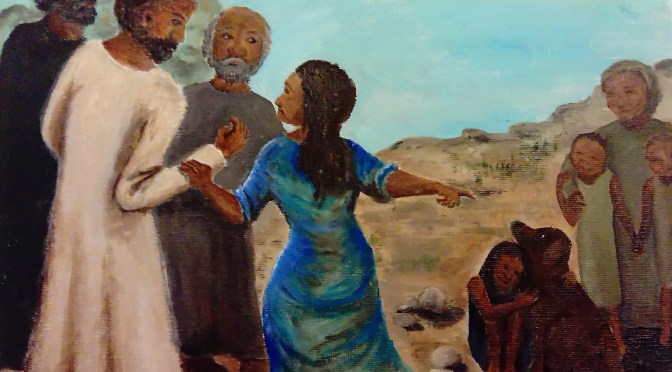
 23But he did not answer her at all. And his disciples came and urged him, saying, “Send her away, for she keeps shouting after us.” 24He answered, “I was sent only to the lost sheep of the house of Israel.” 25But she came and knelt before him, saying, “Lord, help me.” 26He answered, “It is not fair to take the children’s food and throw it to the dogs.”… (Read the whole passage)

Six months ago yesterday – March 15th – was the last time that we gathered in-person for worship. At that time, we imagined a few weeks of lockdown and then a return to normal. Six months later, social distancing is still a thing, lockdowns and restrictions of various degrees are sill  in force. And this pesky little virus continues to overtake our attention. Even as protests over police killings continue to erupt, even as political scandals make headlines, even as hockey resumes only to disappoint (sorry Winnipeg and Edmonton and Toronto), even as Tornados tear through the province, even as a woman of colour is historically named to the ticket of an American presidential candidate… the coronavirus still is the most important issue in our world. This month case numbers are rising, and the daily death toll remains tragically high. Many stress over going back to school and going back to work. Six months of the world still turning with all of the usual turmoil and historic events, that by themselves would make 2020 a memorable year… and the Coronavirus pandemic has gripped us all that entire time putting everything else in the back seat. 

Throughout this summer we have been hearing the story of Abraham and Sarah and their descendants. Today, we finally her the last story of our Genesis wanderings. Sarah and Abraham’s great grand-son Joseph, who had been sold into slavery because of the jealousy of his brothers, has risen to power in the court of Pharaoh. And when famine comes into the land of Jacob, his family and herds, he sends his sons to find help in Egypt. There they meet Joseph, though not knowing it is him, and Joseph plans to recuse his starving family by bringing them to the abundance of Egypt. 

This story of Joseph rescuing his family may not seem on the surface to have much to do with the story of Jesus that we hear today, as he encounters a persistent Canaanite woman who is advocating for her sick daughter. And yet how Jesus and the disciples came to be standing in gentile territory to be annoyed by the persistence of Canaanite woman is deeply connected to the Israelites picking up and moving into Egypt at Joseph’s direction. 

For you see, soon after the story of Joseph, we start Exodus and story of Moses and the Israelites slavey in Egypt. As foreigners living under oppression, God promises Moses and God’s people that he will deliver them to the promised land. When the Israelites escape Pharaoh and Egypt, they wander the desert for 40 years only to eventually settle in the land of Cana. The land of Canaanites. 

Centuries later, as Jesus and the disciples stand in gentile territory, annoyed by the presence of this gentile woman pressing Jesus for a miracle, they have forgotten that their ancestors were themselves granted reprieve and salvation by a foreign nation. They once were a lost people wandering the deserts only to come to the land they were now in, as outsiders looking for hope and promise. 

Instead, the disciples insist that this Canaanite woman be sent away, as she is an unclean outsider and foreigner, unworthy of their attention. And at first, Jesus almost seems to agree with his followers. 

“I was sent only to the lost sheep of the house of Israel.” He declares. 

That doesn’t sound like the Jesus we usually hear from in the gospels. 

And still the woman presses Jesus. He responds in a most un-christlike manner comparing her to a dog stealing food meant for children. 

This does’t sound like the caring and compassionate Jesus we usually know and hear in the gospels. Yet, there is also something about Jesus’ response to this woman… something almost comfortable. 

The disciples probably felt like they finally understood what was happening and weren’t clueless. Jesus was falling in line with how they understood the world, with how they expected the rules to be followed, with how they saw the boundaries between peoples, nations, tribes and religions. 

And there is a certain guilty comfort and security that we probably don’t want to admit. Because we too know what our first instinct is in similar situations. We too like clear distinctions and boundaries, we like knowing who is in and who is out. And finally Jesus is giving us some clue about who can be counted out from God’s love… even if we don’t actually know any Canaanites personally, we do know that we aren’t them and they aren’t us. And feels like we are on the inside. 

That first thought, that first instinct, that first reaction to set the boundary, to call some people worthy and others not… that is what is getting us, the whole world, in heaps of trouble these days. From the new, almost daily uncovering of racist, sexist, homophobic and transphobic institutions, to the way we police and protect our world, to the way we engage in political discourse. This first thought and instinct has led us to create bloated city police departments across the continent. It has given way to racist attacks against the first woman of colour named as vice-presidential candidate for a major US party. It is why the Canadian Museum for human rights (of all places) needs to hire a new CEO to fix racism and sexism in their workplace. It is why here in Manitoba there has been so much shame heaped on those in our community of who have tested positive for COVID-19. 

Whether we like it or not, we are those disciples asking Jesus to send that Canaanite woman – and her troubles – away. 

We are human beings whose first instinct is to set the boundary and do our best to make sure no one crosses it.  

We are people simply casting about for some certainty in a difficult and chaotic world, even if it sometimes comes at the expense of others. 

But then just as Jesus has put her down and in her place, the Canaanite woman makes one final appeal for her daughter. 

“Yes, Lord, yet even the dogs eat the crumbs that fall from their masters’ table.”

Surely by this point our hard hearts have been exposed, the disciples’ annoyance with this persistent Canaanite woman, our first instinct to set the boundary and keep the undesirables out are revealed. 

Would the disciples still want Jesus to send her away at this point? Would we?

Whether we know the answer or not, Jesus responds. 

Jesus responds and he is back to his compassionate if not scandalous self. 

He commends the woman for her faithfulness. A gentile, a woman, a Canaanite of all people… full of faithfulness. 

But Jesus doesn’t just open up a spot on the edge of the kingdom of God, he doesn’t just do the bear minimum for her. 

Jesus opens the Kingdom wide, Jesus expands the space for this woman to be more than just a charity case, more than a forgettable instance of healing. Jesus commends the woman for her faith, for her insistence on proclaiming her trust in God. Jesus elevates her to the level of disciples, to those tasked with going out and proclaiming the word, to preacher and proclaimer of the good news. In one short line this woman, seeing the need of her own daughter and discerning God’s presence in her midst, proclaims the coming of God. 

She proclaims that God has enough for all, enough for the down trodden and lowly of the world, enough for even the dogs. 

And we cannot help but wonder if Jesus was holding our first thought, our first instinct up for us too see. To show us just how cruel a world is that makes distinctions about who is in and who is out to determine who has access to God’s mercy. To see the cruelty of turning a person in desperate need away because they didn’t belong to the right tribe, the right political party, practice the right religion, work in the right job, come from the right country, speak the right language, bear the right colour of skin. 

And after holding up our first thought for us to see, Jesus holds up God’s first thought about us. God who chooses to be revealed in the most unlikely of places. In the Canaanite cities of Tyre and Sidon, through a Canaanite woman pleading for the healing of her daughter. In this gentile, this woman, this brand new follower of Jesus, God preaches the gospel of grace and mercy. 

God’s first thought is the good news given for us, for all of us, for the most unlikely of us. The grace of God given even to the dogs eating the table scraps from the floor. 

God ’s first thought is to use methods and people we would never expect to preach the gospel of mercy and grace. God gives us the promise of mercy anew in church structures built on Facebook, Youtube and Zoom. And God has given us all the people and more that we once hoped would come back to us – but not how we imagined. God proclaims the good news for us and for the world with new voices that we wouldn’t have heard from within our walls and boundaries.

And so here we are in this August of pandemic… and all too often our first thought turns us to set boundaries and declare some to be on the outside of God’s love. And yet God is surprising us in the most extraordinary ways, by sending us the most extraordinary people to proclaim to us the good news of God’s mercy, given in such abundance that even the dogs have enough. 

And through this Canaanite woman, through these unexpected means of pandemic realities, God is preaching the good news to the world in new and unexpected ways. Six months ago, back in Egypt it all seemed so unimaginable to us… and here we are in Cana and God is revealing to us a promised land that we have yet to fully understand… but where the Good News is given anew for us and for all, even for the dogs eating table scraps.

The Kingdom of Heaven Isn’t In Hidden Places But In Surprising Places Meant to be Found

GOSPEL: Matthew 13:31-33, 44-52
{Jesus] put before [the crowds] another parable: “The kingdom of heaven is like a mustard seed …
He told them another parable: “The kingdom of heaven is like yeast that a woman took and mixed in with three measures of flour until all of it was leavened.”
“The kingdom of heaven is like treasure hidden in a field, which someone found and hid; then in his joy he goes and sells all that he has and buys that field.

It was a month ago that I last preached a sermon to you. And a lot can change in a month’s time. 

A month ago COVID-19 was slowly but surely being socially distanced out of our communities (although with some alarming rising case numbers in the US). Our province of Manitoba was talking a lot about restarting economies and lifting restrictions. The protests of May were falling out of the public awareness and the end of school and summer plans were on the minds of most. 

Today, surging case numbers across Canada and a tsunami of cases numbers and deaths are crashing into our neighbours to south. Our Manitoba government’s plan to further lift restrictions to near normal levels of activity was met with swift push back from citizens. Political leaders in Canada are under ethics violations for possibly giving wealthy government contracts as favours to a cozy with politicians WE charity. And south of border an unstable President with strong facist tendencies is sending in secret police to escalate non-violent protests and punish protestors all while looking like the “law and order” candidate to his electoral base of support.

No to mention the persistent issues of racism, discrimination (such as recent attitudes towards Hutterites in Manitoba in response to covid outbreaks) police brutality, the unavailability of childcare for working parents, questions about a safe return to school in the fall, the outsized effect of this economic downturn on women and the recovery being put on the back of essential workers who are often the poorest among us. 

Phew… does that about cover the last month?

Nothing in 2020 has been normal or expected and each day, week, month brings with it things that we wouldn’t imagine being possible. 

And somehow in the midst of this unimaginable world we are living in, we are left to sort through what God might have to say about all of it, and just where the good news of the Kingdom of God might be. 

Today, we continue along into our season of green Ordinary Time. Jesus again is speaking in agricultural terms and in parables. And the people of Genesis, the descendants of Abraham and Sarah continue to navigate their way through the world with God’s covenant promise along side them. Their complicated story continues with Abraham and Sarah’s grandson Jacob making agreements for marriage only to be tricked into having to do twice as much work in order to get the woman he wants to marry. 

And somewhere in the collision of our COVID world and Jacob, Leah and Rachel’s reality, we find something of our story being retold in the biblical witness. Somewhere in the parables of Kingdom that Jesus tells today, we are reminded of where the Kingdom of heaven is revealed. 

Today, Jacob sets out to make a deal Laban for marrying his daughter Rachel. Jacob as you recall is Abraham and Sarah’s grandson, son of Isaac and Rebekah. Jacob we already know is a trickster. He has tricked his older brother Esau out of his inheritance and wrestled with God. Yet, when it comes time to negotiate with Laban he meets his match and Laban tricks Jacob into marrying both of his daughters for 14 years of work. 

But of course there is a back story here. Laban is not some vague relative as the story suggests, but the brother of Jacob’s mother… Laban is Jacob’s uncle. And when Laban was younger, Abraham sent his favourite servant to find a wife of Jacob’s father Isaac. Laban was in charge of that negotiation too. But the clever servant managed to trick Laban to giving Rebekah away for less than he wanted, by appealing to divine Providence. 

So this time Laban is ready to negotiate, maybe even to get back with interest what he lost out on by negotiating harder and tricking Jacob. 

So now let’s set aside. The problematic aspect of this story. The close family relationships, the sale of women as if they are chattel to be owned and traded for. 

This family is a complicated system and web of relationships. And we know that after this Jacob ends up fathering children from 4 women, Leah and Rachel and their two maids, Bilhah and Zilphah. And the 12 sons that result become the forebears of the 12 tribes of Israel, with the most famous son, Joseph, whom after being sold in slavery by his brothers saves his family from slavery by bringing them into Egypt… which then leads us to the story of Moses and so on. 

In fact, the twists and turns of the story of the family of Sarah and Abraham feel awfully familiar. Jacob puts in the time and work with the promise of getting what he wants at the end, only to find out he has to start all over sounds a lot like what many of us are feeling after months of staying home only have to a resurgence of the virus. 

What Jacob imagined for his life and what he ended up getting in Rachel and Leah and his many children sound an awful lot like the expectations we hold for coming out on the other side of this pandemic wanting things to go back to normal while at the same time knowing that 2020 is going to change our lives and world forever in ways we cannot imagine. 

As the new coronavirus surprises at each turn,

As we grow tired of restricting our lives for what can feel like an invisible benefit,

As we juggle keeping people safe, healthy both physically and economically during this pandemic, 

As politicians make messy promises and make self-serving decisions,

And as the people of the world having unimaginable stressors placed on us…

Maybe we are just an extension of the story of Abraham and Sarah’s family. 

And maybe as they did, we might wonder what does God has to do with us? What does God have planned for us? Where is the good news of the Kingdom of heaven?

As Jesus speaks in parables today, he describes the Kingdom of God over and over again. The Kingdom of God is like… Like mustard seed, like yeast, like a treasure in a field, like a fine pearl and so on. 

And we might wonder, why is that the Kingdom seems to be in hidden places? 

But I think that it isn’t about where the Kingdom is hidden, but that the Kingdom is found. Found in unexpected places, founds where we wouldn’t usually think to look, found in the messy and surprising places of life. 

The message of these parables isn’t that God’s kingdom is hidden from us, but that it is constantly being found. Found where? Amongst our complicated and twisting and turning lives. And boy do we know about complicated, twisting, turning life, don’t we?

The Kingdom of heaven is constantly showing up in places we never imagined it would be, so that in our complicated, twisting and turning lives, the good news of God’s love and life given for us keeps finding us. 

The Kingdom of heaven that was promised to Abraham and Sarah in the covenant at the beginning of their story, and that God keeps bringing back to this family, this chosen people over and over again as they cast about in the wilderness. 

The Kingdom that we got used to hearing promised to us in person, at church, and next to our neighbour, at the font and at the table, has been finding us through computer screens, through zoom calls, text messages and over the phone. 

The Kingdom of God that is hard to see, hard to know, hard to believe some days, is finding us unexpectedly and surprisingly the care that we have been giving to one another in hard and difficult times of which we don’t when the ending will come. 

Today, our story, like Jacob, Leah and Rachel’s seems to start and stall. Our world, like theirs, is a world with twist and turns and challenges and surprises. And yet in the midst of that, the promise that God made in beginning, the promise of the covenant, the promise of the Kingom, the promise of love and live given for us…. That promise somehow keeps finding us. The God of that promise keeps finding us, keeps showing up where wouldn’t expect to find God, or to be found by God. 

And God promises that the complications of this life won’t overwhelm us, that the surprises of this world will not define us… but rather the Kingdom of Heaven will. 

God promises that when we wonder where God is in this messy world of ours, that God is coming and finding us in the Kingdom of God. 

WIlderness and Pandemic – Doubting the Promise with Sarah and Hagar

Genesis 21:8-21
8The child [Isaac] grew, and was weaned; and Abraham made a great feast on the day that Isaac was weaned. 9But Sarah saw the son of Hagar the Egyptian, whom she had borne to Abraham, playing with her son Isaac. 10So she said to Abraham, “Cast out this slave woman with her son; for the son of this slave woman shall not inherit along with my son Isaac.” (Read the whole passage)

My son, with all the gravitas that a 6-year-old can muster, frequently refers to the COVID-19 Pandemic as the “Time Period.” 

“When this time period ends,” he will say, “we can see our friends again.”

While his confusion with pandemic terminology is smile inducing, there is a heartbreaking earnestness as well.

I also think there is something to his unintentional term… While many others have referred to this pandemic experience as an extended Lent, an extended time of sacrifice, I am not so sure that is what we are experiencing. 

Not all experiences of sacrifice and loss are the same, and this pandemic isn’t a short, defined time of sacrifice with a known end point like Lent is. 

It is a time period, a new way of being people and being communities and being society that we are going to have to live with for quite some time to come. A time period indeed. 

This is a transitional time period, a time when everything is being changed around us, whether we agree or not. 

Last week, we set out into the Wilderness with Abraham and Sarah. Their journey was not a short one. In fact, they began a journey that kept on going for generations, as Sarah laughed at the prospect of giving birth, yet then saw the fulfillment of God’s promise in Isaac. 

This wilderness journey of Abraham and Sarah feels like it is a story that is telling our story today. When so many of the familiar stories we hear on TV or in books or in movies fail to speak to this pandemic yet, this story of faith is an ancient version of our current reality. 

No, they weren’t trying to avoid a plague, but they were people who were set out into the unknown with no map, no instructions other than occasional updates from God, on what to do and where to go. And things that they never imagined possible happened to them. It was messy and complex and things often didn’t go right and they often showed a lack of trust or faith in the covenant, the promise that set them out on their journey in the first place. 

Their story sounds a lot of like ours doesn’t it? A story where we can see the same feelings, emotions, fears and anxieties that we are bearing. An immediacy that they were forced to live in… not knowing the plan for the future means you have to live in the moment. And living in the moment, just surviving day-to-day can make it hard to trust God.

Today, as we hear the next chapter in their journey, we are reminded that the promised Isaac who arrived last week was not, in fact, Abraham’s first son. Ishmael, whom Abraham conceived with Sarah’s handmaid, Hagar, was Abraham’s first born. 

And Sarah who laughed at the absurdity of bearing a son in her old age, is fearful that the child of promise would not receive God’s promise made. 

So she implores her husband to send Hagar and Ishamel away. 

Which Abraham does by God’s direction. 

And so cast out in the wilderness, Hagar and Ishmael go. But it isn’t long before they are in dire trouble… and facing an impossible choice, to die with her son, or to at least have one of them survive, Hagar leaves her son under a bush and walks away. 

Filled with unimaginable grief at her impossible choice, Hagar implores God to least spare her watching her son die. 

Two women in the wilderness discover new complications, new unimaginable circumstances, new impossibilities, new absurdities. They are in not just in the wilderness, but wilderness upon wilderness, complication upon complication, mess upon mess. 

How could either Sarah or Hagar be expected to carry on in faith, to trust that God’ promises would hold true? They were both human beings. 

Like Sarah, we too have been living in wilderness upon wilderness. Even though it seemed like the whole world was put on pause in the early stages of this pandemic we soon discovered it was not. Violence, house fires, gun shots and a shooter dressed like the RCMP in Nova Scotia cracked open the heart of a nation. George Floyd was murdered underneath the knee of a police officer, causing protests to erupt around the world. Accusations of racism and discrimination have tarnished the reputation of one of the crown jewels of our city at the Canadian Museum for Human Rights. And the one party leader of colour in Canada was kicked out of the house of commons after he called another MP a racist after that MP scuttled the passage of bill declaring the existence of systemic racism in the RCMP. 

Wilderness upon wilderness. Complication upon complication. Mess upon mess. 

Even though Sarah had been given a child of the promise, she couldn’t keep up the faith. She was human after all. 

Even though Hagar had been given a child of the promises she couldn’t keep up the faith. She too was human. 

And even though we are made children of the promise in the Waters, even though we are given a new identity and belonging in the bread and wine, even though we are given forgiveness and new life in the Word, we too cannot believe the promise, day after day, week after week, year after year. It is simply not in us to keep the faith that way…. The wilderness gets us every time. Ever since the garden of Eden, ever since Adam and Eve trusted themselves above God. We hear the promise, but cannot keep up the faith. 

And yet, the promise does not depend on us. 

When Sarah laughed, God still brought new life into a barren womb. 

Almost casually, God waltzes into Sarah and Abraham’s wilderness and declares that the promise will be fulfilled. 

When Hagar was at the limit and prepared to give up, God answers Hagar’s pleas with gentle assurance, with water and the renewed covenant.  

When these women cannot keep the faith, God’s promise does not rely on their ability to believe it. 

Instead God’s promise holds true, God promises includes wilderness moments, wilderness upon wilderness moments. God’s plan for Sarah and Hagar, for Isaac and Ishmael extends beyond their present wilderness into future generations. God’s plan for these first families of faith begin in wilderness, in transition, in wandering through the unknown. 

And the convent extends through generations, through kingdoms, through exodus and exile, from judges and prophets, all the way to Messiah. And Messiah’s promise of Good News comes through fledgling communities to empires, institutions and faithful generations upon generations to us. 

And even with all of that. 

Even as we laugh at the absurd promise that we are God’s Body, knit together in water, bread and wine, when we cannot even be in each other’s presence, let alone share these things… God comes into our wilderness with the Word, the Word of promises given for us, week after week. 

Even as we are prepared to give up, unable to keep the faith in the face of pandemics, and shootings, and police brutality. In the face of generations of racist systems, and hypocritical institutions, hypocritical leaders who do not get it… God deals gently with us, granting promise  in the word, relief for parched and cracked souls nearing death. 

And in the wilderness that keeps us from seeing beyond the present, God’s declares that God has plans for our future, plans that span generations and that include multitudes more numerous than the stars in the sky. 

God promises that God is not done with us, wether we believe it or not, whether our wilderness upon wilderness is more than we can bear or not. 

And in this wilderness, this transition, God reminds us again our story is being told again, told in ancient stories of faith, told in the present moment that we can see today. 

And so like Sarah and Hagar we fail to keep the faith…

We cannot help it. 

But God can.

And God does. 

And God declares that God’s promises will bring us through the wilderness, through the wilderness upon wilderness, to when this Time Period is over and we will see our friends again. 

In the meantime, God’s promises will still hold true, even when we don’t believe them…

Promises that will carry us through the wilderness to the promised land.