Category Archives: Sermon

A Lament for Jerusalem, a Lament for Addis Ababa, Christchurch and the Red River

Luke 13:31-35

31At that very hour some Pharisees came and said to [Jesus,] “Get away from here, for Herod wants to kill you.” 32He said to them, “Go and tell that fox for me, ‘Listen, I am casting out demons and performing cures today and tomorrow, and on the third day I finish my work. 33Yet today, tomorrow, and the next day I must be on my way, because it is impossible for a prophet to be killed outside of Jerusalem.’ 34Jerusalem, Jerusalem, the city that kills the prophets and stones those who are sent to it! How often have I desired to gather your children together as a hen gathers her brood under her wings, and you were not willing! 35See, your house is left to you. And I tell you, you will not see me until the time comes when you say, ‘Blessed is the one who comes in the name of the Lord.’ ”

The Lenten wilderness is real today. A couple of weeks ago on the mountain of Transfiguration and then out in the wilderness of temptation, there was an abstract sense to things… not quite connected to our experience. But today the wilderness is very real and familiar. Jesus is in Jerusalem, the holy city… but not in the royal courtyards or temple. He is in amongst the crowds, on the streets, in the centre of human activity. He is where humanity is, where we are. And it is indeed in the middle of humanity’s messiness and chaotic existence, where true wilderness is found.

The thing that we were reminded of this week is that Lent is by no means just a spiritual exercise divorced from the rest of the life. Just when we are close to forgetting how real this struggle of wilderness is, the world brings us back to harsh reminders. This week, we received harsh reminder after harsh reminder.

Another plane crash, another tragedy measured in numbers that we cannot imagine. This is what wilderness is.

Another terrorist attack on mosques, shock and grief and the feeling helplessness. This is what wilderness feels like.

Another report reminding us just how much society failed a young woman missing and murdered in our community. This is the wilderness where we live.

Today, Jesus has moved from mountain to desert to city street. He has come to Jerusalem, the holy city of Israel. We can imagine the scene. Jesus makes his way down a crowded street, bustling with marketplace activity. People jostling and bumping him, as if he isn’t even there. There are beggars on one side, vendors and hawkers on the other. People are bartering and milling about. Some clump together on street corners to listen to religious zealots, while other groups stand together talking and gossiping. As Jesus wanders invisible, a group of Pharisees finally notice and call out to him. “Go away or you’ll be killed” they warn or threaten… it is difficult to know which.

Jesus retorts back telling the Pharisees to run back to Herod the Fox and tell him that Jesus is not afraid.

As Jesus this scene around him, the bustling and oblivious crowd, it can be hard to believe that all of this began as a promise made between God and Abram who became Abraham. As Abraham complained to God that he had no heirs, no offspring, God made a promise: That Abram’s descendants would be as numerous as the stars in the sky. A promise made out in the same desert that Jesus has just wandered, has now become the chaotic family turned nation centred together in Jerusalem. And this chaotic group in the centre of human activity, human chaos and messiness, the centre of sin and death… they don’t even notice as the very same God who made that covenant with Abram and Sarai, who walked with their ancestors in the desert is now standing in their midst, Word made flesh, Messiah come to save.

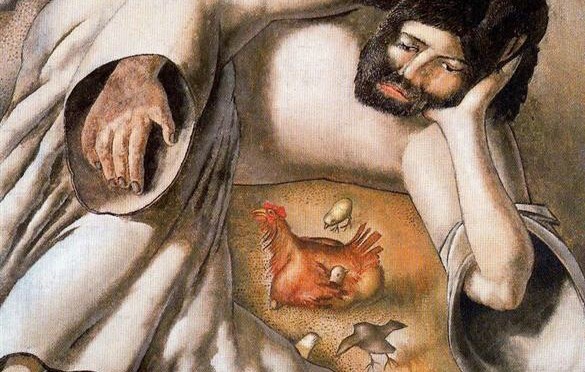
And so Jesus laments… Jesus laments for God’s people. Just as God looked up into the starry night sky with Abram and imagined descendants for Abram… Jesus looks around Jerusalem with the same tender compassion and care. Jesus wants to gather these lost and desperate masses together, just like mother hen gathering her chicks.

And yet, God’s people are unwilling. Unwilling to be gathered, unwilling even to see. To see the Word made flesh walking among them.

Unwillingness is central to the human condition, it is central to how we are in the world. Its is perhaps our most powerful tool and trait. Even cats and foxes, dogs, horses and cows can show great unwillingness. Unwillingness to be moved, unwillingness to obey, unwillingness to be distracted. And with all creation, humanity is the best at saying no, the best at choosing ourselves first. The unwillingness of creation towards God is powerful. We are unwilling to have a God other than ourselves, and therefore unwilling to be loved by the true creator of the universe. As God moves to love us, to be close to us, we push back, we say no, we want to be our own God, we want to be in control.

Unwillingness overtakes us in so many forms. Today, the people of Jerusalem are unwilling. They are unwilling to be see God present before them, to see God casting out demons and performing cures in their midst, just as Jesus says. And their unwillingness will eventually lead them to nail Jesus to the cross.

For us, unwillingness my strike us in different ways. Perhaps it is unwillingness to set aside our rage or grief or distraction. Or maybe our unwillingness to care just a little more for those around us. Perhaps it is the unwillingness to be comforted or consoled, to be vulnerable to a community but instead to choose hatred and violence, to place skin colour above human kinship. Perhaps it is unwillingness to see possibilities and hope for the future, but instead only see with fear a future of loss and destruction.

And our unwillingness, either individual or collective, leads us always to wilderness. Always to the harshest realities, that we are imperfect and flawed people, that our unwillingness leads to death.

158 in Addis Ababa, 50 in Christchurch, 1 in the Red River.

And it is for this unwillingness that Jesus laments. Jesus laments over Jerusalem and he sees see where their unwillingness will lead them. It won’t be long until the people of the holy city are getting ready to lay down their coats and palm branches on the highway. They will shout “Blessed is He who comes in the name of the Lord”, the blessing shouted for David and Solomon and for every king of Israel. As Jesus rides in on a donkey, being expected as King, the people want a conqueror. They want the Romans ousted and they want to be powerful as they once were. But the shouts of “Blessed is He” will turn to shouts of “crucify him”.

Jesus knows how the unwillingness of humanity will respond to God. Jesus knows that it won’t be until the third day that people might begin to see, and even then it will not come easily to us. And even with this knowledge that our unwillingness will torture and execute God like a criminal, Jesus longs to gather us in, to gather all people in as mother hen gathers in her chicks. Even as a mother hen protects her children in the face of the fox.

Jesus laments over Jerusalem, longing to protect her from harm, to protect us from ourselves. Jesus laments in Addis Ababa, in Christchurch and on the banks of the Red River. And even there, even in the midst of the harshest examples of human unwillingness. God is gathering us up. Gathering us beneath his wings to protect us with tender care, to love us away from sin and death.

And even as our unwillingness will lead Jesus to the cross,

nailing his hands and feet

with the final blows of our rejection of God.

It will be beneath these outstretched arms,

beneath these the wings of Christ that we are gathered.

Gathered as one creation,

gathered as God’s unwilling children.

And beneath this cross, God begins the work of three days.

The work that is completed, that is revealed to the world on that easter morning.

Yes, today Jesus laments our unwillingness, but today God also gathers and protects us.

Today, in the quietness of Lent, in the middle of bustling and obvious human wilderness, God is gathering. God is gathering us into Christ. Gathering us to be protected from the power of sin and death, the power of our own unwillingness. And while soon we will chant, “Blessed is he who comes…” and then “crucify him”, God will be quietly covering us with his love. Quietly working in the world to bring life from death, quietly reminding us what is truly important despite our unwillingness. Jesus the mother hen stands in front of the fox today, stands in front of death, in order that as God’s little chicks we might know what it is to be beneath God’s open arms, beneath the cross of Christ.


Image source: https://www.wikiart.org/en/stanley-spencer/christ-in-the-wilderness-the-hen

It is Not Jesus’ Temptation but ours

GOSPEL: Luke 4:1-13

1Jesus, full of the Holy Spirit, returned from the Jordan and was led by the Spirit in the wilderness, 2where for forty days he was tempted by the devil. He ate nothing at all during those days, and when they were over, he was famished. 3The devil said to him, “If you are the Son of God, command this stone to become a loaf of bread.” 4Jesus answered him, “It is written, ‘One does not live by bread alone.’ ” (Read the whole passage)

Even though it doesn’t feel like it, today we enter into the wilderness. The hot, dry, windy, sun soaked wilderness of Lent.

Last week we were on top of the mountain with Peter, James and John. We watched as Jesus was transfigured and was greeted by Moses and Elijah. We were awed as God spoke, declaring who Jesus is, the Chosen one. And then we confused as Jesus headed down the mountain.

Yet by Wednesday, we were down into the valley. The valley of the shadow of death. The valley of ashes, the valley of nothingness. Our brows were marked with ashes and we were reminded that we are dust and to dust we will return.

And today we have been cast into the wilderness with Jesus. Cast into the place of testing and temptation, far away from the comforts daily life.

Each year on the first Sunday in Lent we journey into the wilderness with Jesus. We hear how Jesus is tempted by the Devil. Matthew, Mark and Luke each tell the story a little differently, but the purpose is the same. This is the place where our Lenten journeys begins. In the wilderness, on the road to Jerusalem and Good Friday. We are being made ready for a transformed life in Christ. But this is only the beginning.

We stand by while Jesus and the devil interact. We watch as Jesus is offered things that the devil hopes will divert Jesus from his mission. We hear Jesus respond with steadfast faith as he quotes scripture in order to hold back the Devil and his attempts to siphon off a little bit of Jesus’ will power.

This familiar story of Jesus life is often upheld as a formula for Christian living. Jesus is an example to us of how to resist those worldly and devilish temptations to satisfy ourselves, to obtain power, to take the easy way out. This story seems like a guide for us. If tempted with food, quote passage A. If tempted with land and power, quote passage B.

But this is no manual on avoiding temptation, and Jesus is not some moral paragon demonstrating the right techniques.

In fact, as we hear this familiar story today there is a strange tension about these temptations. They are things that have caused all the prophets who have come before to fall:

Moses who committed murder,

Elijah who stuck his neck out and then last all hope,

And Abaraham, Isaac, and Jacob,

And King David and Solomon…

even God’s chosen prophets, especially God’s chosen prophets and kings fell for one reason or another.

And yet, Jesus is different. It isn’t that Jesus has some kind of super human will power, it is that these temptations for Jesus, the son of God, the prophet of the most high God, are not really temptations at all.

The Devil has forgotten or doesn’t really understand just who he is speaking with.

God has just declared Jesus to God’s chosen, God’s son. The Devil thinks he is just dealing with another prophet perhaps, he does not understand that this Prophet is not just who speaks with God’s voice, but is the very Word of God made flesh.

The devil is trying to sell power that the devil does not have to give and Jesus knows it. The devil is really doing something that we do on a regular basis. The devil is trying to act as God, trying to be God in God’s place. To control and handle God. To make his will, God’s will.

The devil asks God to bend to creaturely demands, to the whims and desires of the finite and created. The devil’s temptations are not offers of power, but demands that God act according to his desire. And just like the devil, the sinful self, the original sinner part of us wants that too.

In fact, if we are honest… those temptations that the devil offers aren’t really temptations to us either. If we could command the angels, we would! It would be a virtue, we would feel like superheroes. And power… we well know that the pursuit of power in this world is constant, it is the game of the rich and the powerful, but also ours too. And stones into bread, the most seductive temptation of them all, the temptation to survive at all costs, to put ourself first above all others… this is often touted as one of the most important virtues of all.

And so there is tension in the temptations, between how we would hear them and how Jesus does.

There in the hot, dry, sandy landscape of the wilderness. There standing beside a tired, hungry, thirsty, chapped lip, windblown, dusty Jesus stumbling through the sand, the Devil offers bread. The devil offers rocks as bread to the creator of the universe. To the same God who spoke all of creation into being from nothing by saying, “Let there be”… and it was so.

The Devil says, if you are God, turn this rock into bread and Jesus says, “One does not live by bread alone”. God in Christ reminds the devil that nothing has come into existence apart from the Word of God, the Word that is standing there in the flesh.

And then from the hot, dry desert, to the top of world, the devil offers Jesus power over all the nations if would only bow down to chaos and confusion personified. The devil offers earthly power to the God of all creation, the same God who has just been born in a manger as powerless baby, who has come to live in the created world, to play in the mud and sleep over at the neighbour’s house, to stub his toes and hug his parents, to go to weddings and learn the torah in the temple as a teenager.

The Devil says worship me, and Jesus says “Worship the Lord your God and serve only him”. God in Christ reminds the devil that being God is not about power, but rather about giving power up in order to love and to love deeply. That being worshiped is not about being on top, but worship is about serving one another.

And then from the top of the world to the temple of Jerusalem. The devil ask Jesus to prove who is. The devil asks Yahweh Elohim, the God of Abraham and Sarah, of Isaac and Jacob, and Joseph. The God of Moses and Elijah. The devil asks this God to prove who he is on top of his own house, on top of the place that God’s chosen people come to worship the one true God.

The Devil says throw yourself from this temple, and Jesus says, “Do not put the Lord your God to the test”. God in Christ reminds the devil that there is no need to prove who he is, that this is not about people choosing to believe in God, but about God choosing to love us, about God giving Godself to the creation that has come into being in the Word.

____________________________________________

This story is not about how good Jesus is at resisting temptation. Rather its about Jesus telling the devil and telling us who God is. And telling us who God thinks we are.

This is not Jesus’ own private wilderness. It is is our wilderness, our temptation, our darkness. Jesus has not come to prove that he can make it without giving into temptation, Jesus has come to show us that the God of the Universe, the God of creation. To show us that God has come into the world to be with us, to go with us into our wilderness.

We live in the wilderness of Lent, the wilderness of temptation grasping for material things, for power and for worship. We live in the wilderness trying our best to be like Jesus, but failing at every turn. And yet, we also live as an Easter people, people who are loved and forgiven by God. We live in a world where death has been over come by resurrection and new life. We live each day in both Lent and Easter, both wilderness and mercy. God reminds us each day that we are Baptized sinners, clean sinners, loved sinners.

And it is into this world, this wilderness, that the creator of Universe, that the God of all meets us. The God we fail to recognize, the God who shares in our joys and sorrows, who goes with us, even when would rather do other things. This God sets out with us, on our Lenten journey today, knowing that we will forget who Jesus really is, but never forgetting who we are.

Nothing but Ashes

Joel 2:1-2,12-17

Return to the Lord, your God,

for he is gracious and merciful,

slow to anger, and abounding in steadfast love,

and relents from punishing. (Read the whole passage)

Tonight we stand at the bottom of the mountain, down in the valley and our perspective has changed. Just a few days ago on top of the Mountain of Transfiguration, Jesus stood between Moses and Elijah as Peter, James and John looked on. And there, Peter wanted to set up shop up on the mountain. You see, the perspective from the mountain top makes everything look great. The world below looks idyllic, like a perfect paradise in every direction. Yet, the story ends as Jesus sets off down the mountain with his disciples in tow.

And now that we are down from the mountain, and the idyllic view of the world is no more. Up close, down in the valley things are less paradise and more real, more authentic. There is no veneer, there is no benefit of distance, there are no flaws that can be glossed over. In the valley, there is brutal honesty.

Jesus didn’t take us up the mountain to be dazzled and amazed. Jesus took us up so that we can witness the prophet of the most high named by God and then sent to God’s people. Sent down to the valley of humanity and death. Down to us.

And down in the valley, down with humanity, the truth is revealed. We are revealed for what we are.

And down in the valley, our worst fears are confirmed. All that we thought about ourselves, all that we thought we could accomplish, all that we thought had meaning, all that we thought was significant is not what we thought at all.

Down in the valley of Ashes, we aren’t just sinners needing forgiveness.

We aren’t just the suffering needing consolation

We aren’t just dying needing good news.

We aren’t just the dead needing new life.

Down in the valley of Ashes, we are nothing. Just like the ash that will mark our brows

We are nothing.

Sin and death turns our lives, our beings, our selves into nothing.

All our living and our doing and our being will mean nothing once we are dead and gone.

This is what this valley of Ashes reveals:

A process that we have no control over, no power to stop.

And so just as the prophet Joel tells us how the people of Israel faced destruction and desolation, faced being blotted out from the earth by conquering armies… they gathered together in worship, gathered around the only real and honest thing they knew.

We too gather around the ashes, gather around prayer and the Word of God.

We gather before the One who brought us down from the mountain.

Before the One who stands beside us in the valley of Ash.

Before the One whose cross gives shape to the nothingness that will mark us.

And we confess and repent and pray and hope that this One will do the thing that we cannot do.

That this holy One of God, this prophet of the most high, this Messiah sent to save…

We hope that this One will turn our nothing into something.

And just as the prophet Joel tells us how the people of Israel faced destruction…

They were met by the One who is gracious and merciful,

The One who is slow to Anger.

The One who is abounding in steadfast love.

And this One did what they could not.

This One turned their nothingness into something. Their ash into a cross. Their death into life.

And this One who met the people of Israel comes also to meet us.

This Christ comes down the mountain and finds us in our valley of Ashes,

and reminds us that this cross stamped on our forehead was first stamped in baptism.

This Christ comes down the mountain and gathers here with us, here in this moment of brutal honesty, this moment of our final hope in the face of destruction.

And this Christ declares that our nothingness is not the end.

The Christ declares that our death is not the end.

This Christ declares that our sin is not the end.

This Christ declares that our suffering is not the end.

This Christ declares that we are not the end.

This Christ declares that God IS our end

And our life

And our hope

And our meaning

And that this Ash that marks our brows, that the flaws and imperfections and humanity that mark our being… they are no longer signs of our ending, but signs that we are not alone, signs that we are loved, that we are beloved of God.

This Christ reminds us that our creation began in the very dust and ash we are smeared with. And that out of the dust and ash, out of the mud and the dirt God formed and shaped nothing into something, God formed and shaped the Adam, the dirt creature, the muddling, the first of creation. And then God reformed the Christ out of the dust and dirt of grave, into a new creation.

And that Remembering that we are dust and to dust we shall return is not just to reminder that in our humanity we shall all die and turn to nothing…

but that returning to dust we will return to the God of life.

Love your enemies, do not judge, and be merciful – just like God

GOSPEL: Luke 6:27-38

[Jesus said:] 27“But I say to you that listen, Love your enemies, do good to those who hate you, 28bless those who curse you, pray for those who abuse you…

37“Do not judge, and you will not be judged; do not condemn, and you will not be condemned. Forgive, and you will be forgiven; 38give, and it will be given to you. A good measure, pressed down, shaken together, running over, will be put into your lap; for the measure you give will be the measure you get back.” (Read the whole passage)

This is the last green Sunday of this season after Epiphany. Soon we will go up the mountain of transfiguration next Sunday, and down into the valley of Ashes on Ash Wednesday. All along the way, we have been hearing stories that reveal to us the divine son of God. Stories like the Wedding of Cana where Jesus turned water in wine, stories like Jesus taking Simon Peter out fishing and almost sinking the boat with nets so full of fish. And now today, before the journey from the Lenten Wilderness to the cross gets moving, Jesus finishes a sermon began last week. This is the next part of the Sermon on the Plain that began with the Beatitudes.

The Beatitudes we heard last week, were a direct address to the crowds. Blessed are you, Jesus repeated over and over. And we heard that our idea of blessing is not about things bestowed upon us – wealth, health, happiness – but rather God’s presence in all the parts of life.

And then today, Jesus continues. “I say to you that listen, love your enemies” and so on. Love, mercy, forgiveness. Offer the other cheek, give up your coat. Do not judge, do not condemn. Be merciful.

These sound like quite the instructions. Everything sounds aspirational and nice… but honestly, who could really live like this?

Yet, as Jesus speaks to the crowds gathered on the plain, poor, hungry, grieving and seeking masses, looking for salvation… these instructions are more than a check-list of nice ways to treat those around you.

Jesus has been setting his audience up. He began with the Beatitudes, reminding people of their own liturgical understanding of blessing, of naming God’s presence in the world. And now he is challenging the law… the rules of righteousness that the people Israel lived by. Rules that governed work, relationships, cleanliness, food, crime, economics and politics. Rules that, if followed, provided a path to righteousness and salvation.

And Jesus is turning those rules on their head. Because those rules were all about holding people to account, measuring sin against a measuring stick, knowing where you stood with God, where you stood in the community. And Jesus is undoing that sense of knowing and security.

Jesus is telling those who are normally on the outside, those who are unrighteous, to love and forgive and be generous. Not things you do when you are trying to measure up to the law.

And almost certainly Jesus’ words caused unrest. Because letting go of the system that the world runs on is hard… even if the system is keeping you down.

Love, mercy and forgiveness simply don’t mesh very well with keeping the law… how do you measure up and hold people to account if you cannot judge and condemn, but should be forgiving and merciful.

Having rules to measure ourselves, and others, by is something we know all too well. We aren’t above grabbing for magic bullet quick-fix solutions to our struggles. We often stick to the rules we know well and have always followed in the hopes they will keeping seeing us through, even when things start to be hard or fall apart. We like structures that tell us where we stand, and tell us where others have failed. We keep those rules for generations, just like the people of Israel did.

“The way we do things” is a phrase we know well whether it is at work, at home, or at church. Showing mercy, forgiveness and love is not how the real world works we might say in response to Jesus. In the real world you get what you deserve and pay what you owe, you live with consequences and accept that that is life.

Except when the world changes and the way do things seem to fall of the track… and the rules and traditions and steps to success that we have trusted for years don’t seem to work anymore. The measuring and judging and condemning stop being way to salvation, the way to righteousness, the way to know where we stand and they become burdensome… forcing us to become constantly reactive. When we spend more time bemoaning that the rules we love are no longer followed or cared about, when we complain that there aren’t enough of us to maintain the traditions, when look about for someone to blame because our system of knowing and security doesn’t work anymore.

It is almost as if Jesus is saying something about that… something about the burden of following rules that don’t work anymore.

Jesus isn’t giving us a new set of rules to replace the old set. Jesus isn’t telling that they are the new things we need to do be righteous, to be successful, to be faithful.

Jesus is describing something much beyond all of that.

Jesus not telling us how we ought to be with one another, but how God is with us.

God is the one who loves. God is one who forgives. God is the one who is merciful.

God does not judge.

God does not comdemn.

God gives us Godself completely, from being born in manger to dying on a cross.

Jesus is describing God and God’s Kingdom, a Kingdom of Love, mercy and forgiveness.

And Jesus is talking true freedom. Freedom from rules that don’t work. From laws we cannot keep. From traditions we cannot maintain.

The freedom of love, is the freedom to stop holding the world around in our wrath and anger because our rules don’t work.

The freedom of mercy, is the freedom to let go of standards that have stopped helping long ago.

The freedom of forgiveness is not be bound us by judgement. Not to react to every transgression. Because if God did not forgive, God would be in a constant state of judgment over humanity, constantly condemning us for our constant failure.

And so love, and mercy and forgiveness… these are the freedom of God.

No, they are not a new list of things we need to start doing… they are the things that will free us from the burdens of the rules of righteousness, the burden of saving ourselves.

Because here is the thing about love and mercy and forgiveness… even these we cannot bring to fruition. We cannot be as loving, forgiving and merciful as we should… and that is the point.

God’s kingdom of love, forgiveness and mercy comes to us because we cannot do it on our own.

This the revelation that has been unfolding for seven weeks, the revealing of God’s Kingdom, God’s Messiah come to us because we cannot do it on our own… and even if we did keep the law, it would not save us… if we could keep up our old rules, we would still be right where we are now.

Jesus gives us this vision of the Kingdom to make us ready. Ready for what comes next.

For a mountain top experience like no other with a bright and shining Jesus appearing to frightened disciples… for a pathway that leads us down into the valley of ashes, into Lent.

Because from here on in, we are on our way. On our way with Jesus through the wilderness, the wilderness that will strip us of the rules and laws that we thought would make us righteous… and along the way we will find out that we have never been righteous by our own effort. That the rules we love never were the thing that was saving us.

Instead we have always needed God to intervene. And intervene God will, on a cross and out of an empty tomb.

Love your enemy, Jesus says… because God first loves you.

Forgive and bless those who hate you, Jesus says… because God has forgiven you.

Be merciful, Jesus says… because God’s mercy has been there all along.

Because God’s love, forgiveness and mercy has always been our righteousness and salvation.

It is not the things that are #blessed anyways

GOSPEL: Luke 6:17-26

17[Jesus] came down with [the twelve] and stood on a level place, with a great crowd of his disciples and a great multitude of people…
20Then he looked up at his disciples and said:
“Blessed are you who are poor,
for yours is the kingdom of God.
21“Blessed are you who are hungry now,
for you will be filled.
“Blessed are you who weep now,
for you will laugh.

Today, our journey into this long season of Epiphany comes to an unusual place… the 6th Sunday after the Day of Epiphany. Most years, we are already heading into Transfiguration, Ash Wednesday and Lent by this point, Epiphany is being put into the rear view mirror of the journey into the Lenten wilderness. But because of when the first full moon, happens after the spring equinox (yes, that is how the date of Easter is calculated), we are six weeks into this season with still one more Sunday to go.

And so on this unusual Sunday, we hear a familiar story out of place. The Sermon on the Plain from Luke, also known as the Beatitudes. We often hear the Beatitudes on All Saints Sunday or in the summer… at times when they speak to who we are. But this time after Epiphany is about revealing Christ and who Jesus is, as we have heard in the stories of Jesus’ baptism, the wedding of Cana, Jesus preaching in the synagogue, Jesus almost getting hurled off a cliff after preaching in the synagogue, and Jesus almost sinking Peter’s boat with a net full of fish in the middle of the lake last week. And so with different ears to hear Jesus’ familiar sermon on the plain, they reveal to something unexpected about who and where Jesus the Messiah is in the world.

“Blessed are you who are poor” Jesus begins.

And we immediately begin to conjure up ideas of what it means to be blessed. To have, to obtain, to be given things of value and worth. We believe we are blessed with health, wealth, and happiness. “In the world of social media, one of the ways to communicate is through the use of hashtags, also known as the pound symbol, or the number sign. It’s a way of categorizing posts, so one can look up what other people are saying about a particular topic. One might look up #wpgjets or #mbroads or any number of other topics. As you might imagine, #blessed is pretty popular. On instagram, as of the time of this writing, there were 106 million posts featuring #blessed. It was [just] Valentine’s Day, so most of them were love related – feeling blessed for romantic love, family, friends, chocolate! Or to be the blessing to others by providing something as a sign of one’s love: flowers, cards, food… chocolate! But there were literally a million other things people felt #blessed about. And that’s not even counting all the other social media venues. To be #blessed in almost all of these situations is to have [or to own, or to possess] something, or someone.”

And yet, even as the people of Israel may have treated blessings in this way in daily life, the bible and ritual practice Ancient Israel did not. The thing or person most frequently blessed in the prayers of the Israelites was not themselves, but God. “Blessed are you O, Lord our God, King of the Universe” was a common way to begin a prayer.

And in Christian tradition it is the same, in fact the most familiar prayer of our worship begins this way, “Our Father in Heaven, Hallowed (or Blessed) is your name.”

To bless something is to name it holy. To declare that God is present in something or someone. To say a blessing is simply to say, “God is here.”

And so to hear the beatitudes in this way, changes them.

God is with you who are poor…

God is with you are hungry…

God is with you are weeping…

Yet this understanding of blessing does not change the upside down sense of the beatitudes. To think of being poor, or hungry or weeping as being blessed is strange… but maybe it is even harder to imagine just how it is that God is with those who are suffering.

And isn’t that the problem, no matter how we hear the beatitudes or who they are about. The way in which they turn the world upside down is just hard to grasp.

Every other message that we hear in this world tells the opposite story. Those 106 million instagram posts are probably not showing pictures of poor, hungry and grieving people. And who among us really believes that it would woeful to be rich, to be full – even after Christmas dinner, or to be laughing.

We just cannot escape thinking that blessings are things we can have, posses and own. Things that will fix our problems, make our lives easier, bring us happiness. Things that we have and that others don’t. And to be poor, hungry and weeping in our view is to not have the things.

So what is Jesus getting at? What is “Blessed are you – God is with you – who are poor”, really about?

Well, the clue is in who Jesus is talking to today.

In the other version of the Beatitudes, the Sermon on the Mount version from Matthew, Jesus says, “Blessed are the poor in spirit, for theirs is the Kingdom.”

But here on the plain in Luke, Jesus says, “Blessed are you who are poor.”

Blessed are you.

You.

Jesus is speaking directly to his audience. And he is not philosophizing about some abstract poor. But speaking to us.

Blessed are you. God is with you. I am with you.

You are the poor, you are hungry, you are weeping, you are the hated.

And You… you are also the rich, the full, the laughing, the well-liked.

It is a much richer and broader understanding of these blessing and woes than we might first think.

You might NOT be poor in terms of your bank account, but we are all poor in some way. Maybe poor in relationships, in energy, in community, in time, in health. And we are also all rich… maybe rich in relationships, in energy, in community, in time, in health. And maybe we are both at the same time.

These beatitudes seem to go in a circle. They don’t provides categories or PREscriptions, but rather DEscriptions. They describe the complexity of life, the messiness of it all. Because we are never just one thing or another, we are all these things.

And in the midst of all these things. Poverty and riches, hunger and satisfaction, weeping and laughing, hatred and acclaim… Jesus is there. God is with us.

It is not the things that are blessed anyways.

It is you.

You are blessed. Blessed are you, Jesus says.

Standing there on the plain, looking out and the crowds and his disciples, looking out at the masses, full of complicated and messy people, looking out at a group of people not any different than us… And Jesus proclaims, “Blessed are you.”

Blessed are you, when it is God who is most often blessed.

Blessed are you in the messy, complicated parts of life.

Blessed are you in your poverty and riches, hunger and fullness, weeping and laughing. Because in the midst of all that, you are not alone. God is with you, wherever you are, whatever is happening.

Here in this sixth week after Epiphany, these Beatitudes from Luke speak to us in a new way. They bring us before the Messiah, the Christ, standing on the plain, standing right before us, speaking directly to us. And this Messiah, this Christ tells us something completely different than we hear anywhere else… this Messiah reminds us that our neither our poverty nor our riches are signs of God’s absence or presence. In fact, these things get in our way. When we think God has abandoned us in our want, or that we do not need God in our abundance. Jesus declares that it not these things that tell us where God is among us and what God is doing. Rather, Jesus stands before us and tells us, reveals to us just where God is among us.

And of all the radical things that the Beatitudes seem to proclaim about God’s vision of the world… blessings for things that we don’t see as blessed, woes for things that we usually consider blessings… the most radical thing of all is that none of those things are the most important. The radical thing is that God has come into the world in the flesh of the Messiah, the Christ. That the one whom the wisemen sought, the one for whom the a voice from heaven thundered, the one who turned water in wine, the whom Isaiah was speaking of, the one who filled the empty fishing nets… that this one is here, right here with us, calling us blessed.

Jesus says, blessed are you.