
This week has been a difficult week for my family. At the end of last week, my father was contending with what appeared to be a summer flu. Over the weekend, his symptoms worsened, to the point where he needed to be admitted to the hospital. While in the ambulance, he experienced a cardiac arrest.
For the past week, he was being treated for an infection for which the medical staff have struggled to determine the source. Because of complications along the way and a limited response to treatment, the decision was made to move him to palliative care. His heart was strong, but much of the rest of his body was failing.
His family prayed and sang with him, and told him that we loved him.
Courtenay and I prayed the commendation of the dying with him, and we entrusted him into God’s care. On Saturday night, around supper time, my Dad breathed his last.
Requiescat in pace, Dad.

In the midst of a lot of texts, phone calls and FaceTime with family, I have been thinking (again) about my recent trip to Germany.
A subtle theme in the story of Martin Luther’s life, and for all of society in the Late Middle Ages, was death. One of the most popular books in the 1400s and 1500s was a book called Ars Moriendi, written by unknown authors. The title translates into English as the “Art of Dying.” That was a time when the plague or Black Death was ravaging European populations. Death became seen more clearly as a regular part of life. Often parents did not give children a name until they were about five years of age, just to be sure that they would survive. Many believed that the opportunity to “die well” was a blessing. This meant to have one’s affairs in order, to be allowed to reconcile with anyone with whom one had a grievance, to say goodbye to beloved family and, most importantly, to face death knowing the promises of God’s salvation given in Christ.
It is important to keep in mind that the Church at that time was selling indulgences as protection against sin and Hell, often using the fear of these things to keep people forking over their money. So dying well was one way to counteract the persistent fear of what might come after death.
Of course, any pastor is familiar with being around a family’s journey of death and dying. But it still has hit me differently when the dying is happening to my family’s loved one. One of the struggles is in how the dying process can make one feel so lonely. Yet, I realize it is a journey that we all end up taking alone, even with others around us.
In 1519, Martin Luther wrote a sermon entitled “Preparing To Die.” In it he emphasized the importance of trusting in God’s promises, that the forgiveness of sins found in the Sacraments of Baptism and the Lord’s Supper are signs that God has conquered sin, death and the Devil, so that we ought not fear.
In the sermon, you can hear Luther’s foundational premise that God’s plan for salvation was for all people. Luther began addressing something that people knew well – death – an important topic of the day, and then he pointed to the Good News found in God’s promises.
Ten years later, the plague came to Wittenberg. Luther refused to leave his congregation. Also during that time, Elizabeth Luther was born to Katie and Martin. She was a sickly child who died at six months of age. It is believed that during this time of plague and personal tragedy, Luther wrote the famous hymn A Mighty Fortress is Our God.
Though we often sing it as a rallying cry and anthem of the Reformation, its words take on a different feel as a hymn of hope and comfort, especially the fourth verse, when one considers these as the words of a grieving father:
God’s Word forever shall abide,
no thanks to foes, who fear it;
for God himself fights by our side
with weapons of the Spirit.
Were they to take our house,
goods, honor, child, or spouse,
though life be wrenched away,
they cannot win the day.
The kingdom’s ours forever!
Text: Martin Luther, 1483-1546; tr. Lutheran Book of Worship
Text © 1978 Lutheran Book of Worship, admin. Augsburg Fortress
P.S. Photo(s) from my trip to Germany: Luther was born and died in Eisleben. The first photo is of the baptismal font of the church where he was baptized. In recent decades the font was built into the floor as a large pool right in the chancel of the church. A tangible and visible image of dying and rising in baptism, by going into the ground and coming up out again. A sign of the resurrection promised in Christ when we will brought out of our graves into new life.
The second photo is a copy of Luther’s death mask. Medieval death masks were taken because it was believed they could “determine the state of one’s soul at the time of death.” A calm expression implied that one was welcomed by God.
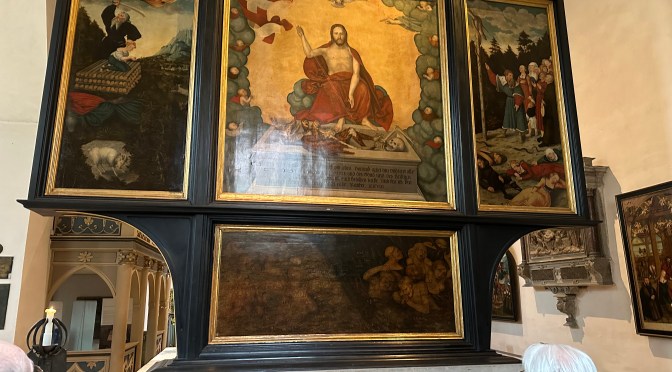
Header Photo: The back panel of the altar piece at the Stadtkirche in Wittenberg. A depiction of Christ defeating the powers of sin and death.


 The Millennial Pastor
Sue and I are sending our sincere condolences 🙏 ❤️
LikeLike
May you be comforted, even while you grieve, with God’s promises.
LikeLike
I am sorry to hear of your fathrs illness and death
LikeLiked by 1 person
I’m so sorry, Erik. I’m holding you in my heart and in my prayers
LikeLiked by 1 person