Category Archives: News on the home front

The ‘Autistic’ Millennial Pastor?

A few weeks ago, after several sessions with a clinical autism assessor, I received a diagnosis. I met the clinical threshold for a diagnosis of Autism Spectrum Disorder (ASD). 

This is something that I have been exploring and wrestling with for a number of months. (Let’s be honest, doing several months of extensive research). 

Autism isn’t something I have, but Autistic is what I am. It is certainly not my entire identity, but it is a lens that explains a lot of my life and experiences. 

So I guess that makes me the Autistic Millennial Pastor? Maybe. 

Is this a new reality? Kind of. I have always been Autistic; I just did not know that the way I experienced the world was with an Autistic brain, with a medically defined neurodevelopmental disorder, and a sociologically defined difference in neurotype. 

In every other way, I am still me and the same as I always have been. I just have language and understanding of how my brain works and the sensory differences that I experience. 

Below is a much longer reflection on how I arrived at this place and what it means for me to be autistic. Beware if you read on, and thank you if you do. 

_____________

Twenty years ago, in my second year of seminary, I remember sitting in my faculty advisor’s office. We were meeting to talk about my progress in my program. My grades were great; I was doing well in my courses. In fact, my advisor was gently trying to suggest that I was doing too well. I had been studying history and theology through my undergraduate degree, and two years into my Master of Divinity, his concern was that I needed a more diverse experience of studies. As our conversation progressed, we got into a discussion of my social skills and self-perception. This line of thought threw me off, as social skills were something that I had worked on my whole life through constant observation. I had created a complex set of rules and responses to use in social interactions that by this time in my life seemed to be working reasonably well. I didn’t really get why they might be an issue. 

Yet, there was also a part of me that was deeply worried. Maybe there was something, some important social behaviour that I hadn’t figured out. I have always had the feeling of being alien in the world. I often did not know what the correct social responses were, or could sense in social situations that I was missing something that everyone else seemed to understand. From a young age, I coped by being quiet. My 3rd grade teacher called me the gentle giant. Nearly all of my grade school report cards included the comment, “Erik is a conscientious and shy student.” Being quiet was a way to hide the fact, even from myself, that I was missing a lot in social situations. By being quiet, I could get by. 

Thinking back, I suspect my faculty advisor sensed that there was something different about me. I think he was concerned that a socially awkward kid who was good at theology but didn’t like making eye contact or reciprocal small talk might run into challenges in ministry. 

In 2006, the awareness of things like Asperger’s or Autism was still relatively new. Though around since the 50s, it took well into the 80s and 90s for Asperger’s and Autism to be fully included in the Diagnostic Manuals used by psychiatrists and psychologists. Still, each update was dramatically changing the definition. 

It wasn’t until 2013, when several neurodevelopmental conditions were combined into Autism Spectrum Disorder in the Diagnostic and Statistical Manual of Mental Disorders, Fifth Edition (DSM-5). Sheldon Cooper wasn’t on TV until 2008. Asperger’s, Pervasive Developmental Disorder – Not Otherwise Specified, and Autism were not well known.

Still, my faculty advisor was probably on to something. I don’t think I presented like those obvious little boys who act like little fussy professors when we think of Asperger’s. But for those who watched closely, I must have been giving off some kind of vibe of strangeness. I guess I could be a little bit fussy about some things (just ask my wife). 

Thankfully, despite whatever my faculty advisor may have been worried about,  I have managed 17 years of ordained ministry. Certainly, there have been struggles and challenges, usually around social-communication problems. I know that I just did not pick up what people have been trying to communicate at times. But for the most part, ministry has gone well.  

Now, with a lot more awareness and resources available in the world in 2026, Autism Spectrum Disorder is a lot easier to find information on. After realizing that there might be something more than just being quiet and awkward that explains what has been going on with me for the last 40 or so years of my life, I sought out an Autism diagnosis earlier this year. Through a clinician’s formal assessment, I was given a diagnosis of Autism Spectrum Disorder (ASD). 

It turns out that I am Autistic.

Back in my faculty advisor’s office in 2006, I found myself sharing things that I had never shared with anyone else before. I talked about how I often felt like an observer when interacting with others. Keeping track of facial expressions, posture, and gestures while closely monitoring others for the same so that I could correctly respond to social cues. In that moment, I realized how odd this sounded. Yet, I was quite certain that this was how everyone navigated social situations but never talked about out loud.

I assumed that everyone was watching TV to learn social interactions, that everyone scripted conversations ahead of time, that small talk was just a social nicety and not enjoyable, that being sociable meant following very structured rules of conversation and that socializing was like being a character in a play where you don’t know the lines or plot ahead of time. You just try to fit the role as best you can. 

Turns out this is NOT how most people do social interactions. Turns out most people just intuitively know the rules and can interact and respond without thinking about it much at all. 

When most people think of Autism these days, the images we have to rely on are ones like Sheldon Cooper from the TV show The Big Bang Theory, or Raymond from the movie Rain Man. The image of non-verbal children who struggle to communicate at all also comes to mind: the children whose disability is blamed on vaccines or other unscientific reasons. Love on the Spectrum, Atypical, and a host of other Autistic coded characters are out there in media, portraying different versions of Autism, either explicitly or implicitly. 

But knowing exactly what Autism is can be hard to parse. Ask the stressed, frustrated and grieving parent of a non-verbal child, and you get one version. Or find the reels of an ASD level 1 late-diagnosed adult with sensory issues and a certain kind of blunt communication style who is advocating for Autism to be treated as a difference and not a disability, and you get a very different version. Both are Autism, and both are difficult to hold as examples of the same condition. 

Autism Spectrum Disorder is a neurodevelopmental condition, likely caused by genetics. It is a multifaceted diagnosis and heterogeneous condition. This means that those with ASD can present very differently and can require very different support needs and accommodations.

Funnily enough, and maybe something that should have been an early clue about my Autism, is that back in 8th grade, I had diagnosed my father with Asperger’s. I was doing a research project on Tourette’s Syndrome for school, a condition that also runs in my family. In whatever resource I had found at the public library, there was a ’see Asperger’s Syndrome’ note at the bottom of the Tourette’s entry. After looking into Asperger’s, I could see that it described my father accurately. My father was diagnosed about 20 years later by a psychologist. 

Even though Autism is genetic, I was strongly committed to not being like my father, who struggled with sensory and emotional regulation, and executive function, among other things. Not wanting to be like him, I discounted the idea that I could have Asperger’s/ be Autistic as well. 

These days there is a lot more information available online about Autism, some helpful, some not as much (see some links at the end of this post). Autism can be such a broad set of symptoms that it can be unhelpful to say that autistic people are like this or that. There is even the saying that “If you have met one Autistic person, you have met one Autistic person.” 

So rather than trying to describe all people with autism, I will share some of what Autism (or being Autistic) looks like for me:

Sensory issues: Fundamentally, autism is a nervous system condition or difference. Autistic nervous systems filter information differently than the norm. 

I have discovered that I don’t filter out sound the way most folks do. Loud venues or busy restaurants can make following conversation difficult. Noise-cancelling headphones are something I can’t live without these days; sometimes I don’t even listen to anything while wearing them. 

I have challenges with finding comfortable shoes, which I now see as a sensory issue with the bottoms of my feet. I am hypersensitive to heat, which makes me sweaty, tired and irritable almost instantly. I am hypo-sensitive to cold, which is why I generally only wore a hoodie (or two) as my winter jacket in Winnipeg. Certain fabrics and textures can make my skin crawl, and if clothing feels good, I will wear a lot of it. Also, thank goodness transition lenses are cool these days, because sunglasses are a must for me outside, and even great inside in some places like the grocery store. 

Lastly, I am relatively hypo-sensitive to pain. I have often thought that the people around me were exaggerating their injuries over the years. I think I have probably given a few people the impression that getting a tattoo is not very painful at all. I guess it might not be if you have a diagnosed sensory difference. 


Communication: When I was younger, I was told I lacked tact or was too direct. ‘Intimidating’ was also a word used often. I tend to be specific and pedantic at times, but I really appreciate when people are explicit and clear. I often over-explain things or miss jokes. I ask questions, seeking more information when asking questions can be perceived as challenging authority. 

I know that I can sound formal in the way that I speak and write. My wife likes to jokingly call me Professor Parker (maybe the joke is on her, as I am teaching at the seminary this fall!). I like to use formal titles and greetings in emails; I probably can give off the impression that I am fussy about those things. I just like being precise. 

Social cues: Eye contact is difficult for me. I can do it, but it feels like staring into someone’s soul and is incredibly intimate. Don’t be surprised if I am staring off into the distance while I talk. As some autistic folk say, you can have my eye contact or have my attention, not both. 

I am not good at small talk; I really have to mentally script out responses rather than naturally knowing to ask questions. But I am a good listener; as a good rule follower, I will patiently listen until someone else is done talking. I have learned through Clinical Pastoral Education not to respond to someone sharing their experience with my own experience, but sometimes I forget myself. I will miss hints and subtle non-verbal cues. Don’t invite me out for lunch by asking me if I am hungry… I won’t get it!

Living life on Manual Mode: I realized my brain doesn’t have an autopilot function. Everything I do requires me to think and choose each step, from brushing my teeth to cooking breakfast for my kids to driving somewhere. For example, when cooking, I have to think about each utensil I use, which drawer they are in, how to open the drawer, which pot to use, how to get the pot drawer open, which stovetop burner to use, etc… Every step in any process requires me to manually follow; I cannot just do things without thinking. 

I also learned that it is unusual to have a constant inner monologue. Every thought in my brain comes out in complete sentences and paragraphs, like a narrator is saying out loud every idea, always bringing order to the chaos, systematizing everything. Writing for me is not putting vague thoughts into coherent language, but simply transcribing the narration that is already happening. 

Routines and inflexibility, concrete and literal thinking: I generally try to hide it, but I like things predictable. Changes or surprises can really throw me for a loop. I like to eat the same breakfast every day, wear the same kind of clothes, and keep my wallet, keys and phone in the same pockets. 

I never thought of myself as a literal thinker, but I realize it is the preference of my brain. Anytime I hear an idiom, I picture the image in my brain: needle in a haystack, rock and a hard place, piece of cake, spill the beans. etc.. Even though I know these are expressions, every time I hear them, the literal image appears in my mind. 

Special Interests: Autistic special interests are often imagined as little boys playing with trains or dinosaurs, lining up toys in a particular order. However, special interests can be all kinds of things. They can change over time, or they can last a lifetime. Mine is, as you can guess, theology/lLutheranism/church/pastoring. I thought everyone was thinking about their favourite topic during all waking hours… no wonder I got those weird looks from parishioners when I would tell them I thought about church stuff all day and night…

Masking and 2e: We all behave in certain socially acceptable ways, but Autistic masking is hiding all the above traits to appear more socially acceptable out in the world. Wearing sunglasses in the grocery store can look a little weird. Practicing and learning to use social cues manually, instead of intuitively, is very cognitively draining. Getting frustrated by having to respond to too many demands placed upon us can seem selfish, so we just suffer through the nervous system static. Being too weird about having a favourite spot like Sheldon Cooper, or about using a certain spoon, or being unable to accept changes to a plan came across as being “too much,” so we just deal with the discomfort. Talking about Martin Luther all the time can be seen as being obsessive, so I hold it in. 

Masking takes energy, and the more complicated life gets, the more responsibilities need to be balanced; the older we get, the harder it is to spend all the effort to keep up appearances of having it together. 

In reviewing my childhood history for my Autism assessment, I discovered that as a child I had been assessed for giftedness and had my IQ measured, which I wasn’t aware of before. I was identified as Gifted then. Giftedness and Autism occurring together are called being twice exceptional (my pietistic upbringing is struggling with the possibility of sounding too braggy by sharing this information). 

As I have explored and researched Autism, I have also researched Giftedness. It is difficult to disentangle one from the other, as Gifted children are also reported to experience sensory issues and social-communication challenges. While many Autistic people can report delayed processing, especially of verbal processing, that has never been an issue for me. If there is something that likely allowed me to mask more than many other Autistic/Asperger’s boys of my age, it was that I think I could pick up pretty quickly that people were noticing I was being weird. I didn’t know why, but I could figure it out fast enough to stop. 

I was able to get by in school without having to put in a lot of effort; I don’t think I wrote a single paper during my undergraduate degree sooner than the night before. This freed me to watch and learn the social rules and keep from being too much of a strange kid. To hide and suppress my Autistic traits. 

I know that there were other Autistic (or ADHD) kids around during my childhood, and I would feel bad for them as they couldn’t suppress their sensory issues or their frustration with changing routines or plans. I had figured out that incessantly talking about whatever thing I was obsessed with at the time seemed to annoy most people. I felt bad for those kids who didn’t have this figured out. 

In my 20s and 30s, as life got more complicated, I was still able to use my cognitive capacity to mask. To learn how to blend in, to play a socially acceptable role, even when I was missing a lot in social settings.

However, in my 40s, juggling all the balls of family, work and social relationships in combination and now realizing that I was masking my Autistic traits, things were getting harder. Hiding the things my nervous system needed in order to regulate was taking all my energy. I couldn’t just push through the nervous system static distortion anymore. That’s when I started wondering what was wrong with me, and eventually stumbled onto Autism. 

There is a lot of debate online about whether Autism, or Neurodiversity more generally, is a disability or a difference. I am not sure they are mutually exclusive concepts. I certainly struggle with the idea of my Autism being disabling, and yet the reason I sought a diagnosis is that I realized that I couldn’t push through the struggles anymore. I needed to make changes and adaptations that would allow me to continue to function. At the same time, I cannot imagine doing all the things that I have done in my life without being autistic – it is part of what makes me me. 

Maybe there is a useful theological lens here. As Lutherans, we acknowledge that we are imperfect and flawed creatures. Some imperfections and flaws are easy to identify; others are more difficult to separate from the essence of our being. Our experiences and stories make us who we are. When Jesus appeared to the disciples in the upper room, he still bore the scars of crucifixion. Jesus could not be disambiguated from his history; his experience had become integral to who he was, even in the resurrection. 

I am not sure if my experience of Autism is inherently a flaw, or if the world and people around me are also imperfectly structured so as to make the differences that I bear cause me additional struggle and suffering. Most likely, as with everything about us and this world, it is a combination of both. 

Even though being Autistic is now a part of my identity, a lens through which my understanding of my experiences in life makes a lot more sense, I recognize it is only one part of a greater whole. Though it touches all the other parts of who I am, I still confess that at my core I am a beloved child of God. This external declaration of my identity, given by God in Christ, has not changed. 

But now, knowing that I am an Autistic beloved child of God, is sure helping to explain a lot of things in life, and also helping me to understand and adapt myself going into the future. 

____________________________

Links to some further information about Autism
Autism BC
Canadian Psychology Association


If you have questions or want to share you own experiences, feel free to post in the comments or email me at millennialpastor@gmail.com
Dying Well – Grieving My Father

This week has been a difficult week for my family. At the end of last week, my father was contending with what appeared to be a summer flu. Over the weekend, his symptoms worsened, to the point where he needed to be admitted to the hospital. While in the ambulance, he experienced a cardiac arrest.

For the past week, he was being treated for an infection for which the medical staff have struggled to determine the source. Because of complications along the way and a limited response to treatment, the decision was made to move him to palliative care. His heart was strong, but much of the rest of his body was failing. 

His family prayed and sang with him, and told him that we loved him.

Courtenay and I prayed the commendation of the dying with him, and we entrusted him into God’s care. On Saturday night, around supper time, my Dad breathed his last.

Requiescat in pace, Dad.

In the midst of a lot of texts, phone calls and FaceTime with family, I have been thinking (again) about my recent trip to Germany. 

A subtle theme in the story of Martin Luther’s life, and for all of society in the Late Middle Ages, was death. One of the most popular books in the 1400s and 1500s was a book called Ars Moriendi, written by unknown authors. The title translates into English as the “Art of Dying.” That was a time when the plague or Black Death was ravaging European populations. Death became seen more clearly as a regular part of life. Often parents did not give children a name until they were about five years of age, just to be sure that they would survive. Many believed that the opportunity to “die well” was a blessing. This meant to have one’s affairs in order, to be allowed to reconcile with anyone with whom one had a grievance, to say goodbye to beloved family and, most importantly, to face death knowing the promises of God’s salvation given in Christ. 

It is important to keep in mind that the Church at that time was selling indulgences as protection against sin and Hell, often using the fear of these things to keep people forking over their money. So dying well was one way to counteract the persistent fear of what might come after death. 

Of course, any pastor is familiar with being around a family’s journey of death and dying. But it still has hit me differently when the dying is happening to my family’s loved one. One of the struggles is in how the dying process can make one feel so lonely. Yet, I realize it is a journey that we all end up taking alone, even with others around us. 

In 1519, Martin Luther wrote a sermon entitled “Preparing To Die.” In it he emphasized the importance of trusting in God’s promises, that the forgiveness of sins found in the Sacraments of Baptism and the Lord’s Supper are signs that God has conquered sin, death and the Devil, so that we ought not fear. 

In the sermon, you can hear Luther’s foundational premise that God’s plan for salvation was for all people. Luther began addressing something that people knew well – death – an important topic of the day, and then he pointed to the Good News found in God’s promises. 

Ten years later, the plague came to Wittenberg. Luther refused to leave his congregation. Also during that time, Elizabeth Luther was born to Katie and Martin. She was a sickly child who died at six months of age. It is believed that during this time of plague and personal tragedy, Luther wrote the famous hymn A Mighty Fortress is Our God

Though we often sing it as a rallying cry and anthem of the Reformation, its words take on a different feel as a hymn of hope and comfort, especially the fourth verse, when one considers these as the words of a grieving father:

God’s Word forever shall abide,
     no thanks to foes, who fear it;
    for God himself fights by our side
    with weapons of the Spirit.

    Were they to take our house,
    goods, honor, child, or spouse,
     though life be wrenched away,
     they cannot win the day.

The kingdom’s ours forever!

Text: Martin Luther, 1483-1546; tr. Lutheran Book of Worship
Text © 1978 Lutheran Book of Worship, admin. Augsburg Fortress

P.S. Photo(s) from my trip to Germany: Luther was born and died in Eisleben. The first photo is of the baptismal font of the church where he was baptized. In recent decades the font was built into the floor as a large pool right in the chancel of the church. A tangible and visible image of dying and rising in baptism, by going into the ground and coming up out again. A sign of the resurrection promised in Christ when we will brought out of our graves into new life.

The second photo is a copy of Luther’s death mask. Medieval death masks were taken because it was believed they could “determine the state of one’s soul at the time of death.” A calm expression implied that one was welcomed by God.

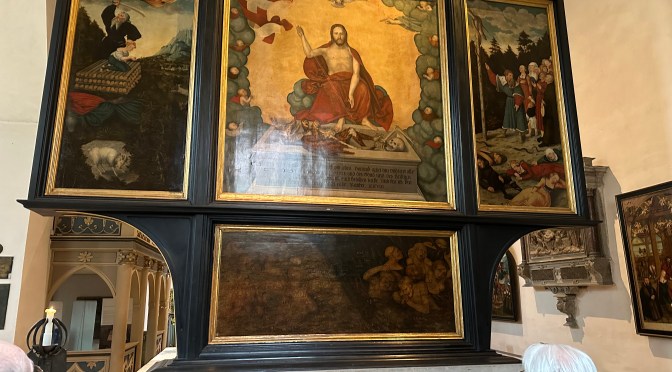
Header Photo: The back panel of the altar piece at the Stadtkirche in Wittenberg. A depiction of Christ defeating the powers of sin and death.

A Contextual and Practical Theologian – Pastor Thoughts

For 9 days in September, I was at the Lutheran Theological Seminary in Saskatoon, with 8 other Doctor of Ministry students beginning a journey together. The cohort of students was comprised of people from BC, Saskatchewan, Manitoba, Ontario and even Tanzania. There are Lutherans, Anglicans, United Church and Evangelical folks. 

As I have been already talking and writing about the program, I still had a lot to learn and understand myself. For instance, what is a Doctor of Ministry in Contextual and Practical Theology all about?

Well, now I can say that I have a much better sense of what this program of study will actually entail. And that is to become a Practical Theologian. Practical Theology is a relatively new field of study – only 150 years old! Compared to Systematic Theology or Biblical Studies, which can trace their roots back to the early days of Christianity, Practical Theology is just coming onto the scene as a formal discipline.

And yet, it really isn’t new. Theologians, clergy and even ordinary people of faith have been taking insights from Scripture and the Tradition of the Church and bringing them into conversation with the lived practices of everyday faith. Reflection on how what we believe and confess to be true and how that impacts the things we do in faithful community – and vice versa – has always been something that is happening among congregations and faith communities. 

As Lutherans, we have a strong example of a practical and contextual theologian in Martin Luther. So much of what he wrote and did was about bringing his understanding of scripture and the theology of the church into conversations about how the church of his day practiced the sale of indulgences (tickets to heaven), how the mass or Holy Communion was celebrated and observed, who could read the bible, how faith was passed on and so much more. 

Modern Practical Theology goes a little further using the tools and methods of the social sciences to do research that provides qualitative data. Surveys, focus groups, interviews, asset mapping, appreciative inquiry, and more generate data about the practices of real-life communities. It is a way to bring theological reflection into the real and ordinary things that we do in our faith community. 

What does this mean for the research I will be doing? Well, Practical Theologians do their research not to or on, but with the community. So I will be doing aspects of my research together with my congregation and folks in our area, with the goal that reflection and new understandings will bring about real transformation. 

There is a part of me that is nervous about this. What might happen if we intentionally seek transformation through learning and reflecting together? I don’t know… and that is the point.

Because I am also very excited… for what we might discover and how that might change us along the way. 

Starting New Things This Fall – Pastor Thoughts

My children keep asking me how much longer Spring Break will be. They haven’t really distinguished yet between Spring Break and Summer Break.

They are true COVID children in that their experience of their first few years of school has been marked by several extended breaks or pauses of in classroom learning. So Summer Break has yet to take concrete shape in their minds. And different than my childhood longing that summer breaks would last forever, they are looking forward to seeing their friends and teachers again. They have lived through the experience of not knowing when they might suddenly without warning not be returning to school for a week or month or even longer. 

So we have been preparing them for how long summer break is and when school will start again, going over the schedule of family trips, days camps, visits from friends and family, and so on. 

As the kids look forward to going back to school already, I find myself in the same boat. I announced a few weeks ago that I am going back to school this fall too, to begin a Doctor of Ministry (DMin) degree program at the seminary in Saskatoon. Since graduating in 2009, I will admit that I have enjoyed being free from the unique pressures of going to school, as I went straight from grade school to university to seminary. In fact, I still have the occasional bad dream where I haven’t prepared for an exam or written a paper that is due. 

But the seminary that I am going back to is quite different than the one I graduated from in 2009. My four years of seminary, like my four years of undergraduate study, were fairly traditional. In person, on-campus learning in a semestered format. 

Now, the seminary has shifted to an intensive and often online format. Courses are taken one at a time in the span of two to three weeks, one after another, rather than three to five courses at a time over a three-month semester. Courses are also offered either in person or over Zoom, which the seminary started long before the pandemic. This was done to accommodate students who couldn’t uproot families or cease working, but who could be in Saskatoon for a week or two and could study at home. 

In addition to the changed intensive, online option format, the Doctor of Ministry Degree program will also be a new kind of study experience for me. The DMin program is similar to a PhD program in that it is a terminal degree meant to help students delve deeply into un-researched topic areas. But it is different than a PhD, which is a purely academic degree intended to focus on theoretical research; the DMin has a professional component. It might be a compared to a specialization in Medicine or in Law. A DMin is intended to be done while a student is working, and research is meant to be conducted in the context that the student is serving in. So it is not just that you *can* work full time while doing a DMin program, you *must* be working full time in ministry.

Because the DMin is done in short intensive spurts along side the regular rhythms and duties of ministry, this summer I have already begun readings and coursework. I used to get truly annoyed by the mature students in university or seminary who were always reading and working ahead, and here I am doing the same! And at this stage of my life, I now get why those olderstudents were like that. It is the same reason why sleeping in these days means getting up at 7 am, rather than 6:00. 

Thankfully, there is still more than a month until school starts and almost two months until I head off to Saskatoon for my first week of DMin work. Yet, this year, like my kids, I am looking forward to school starting in the fall and the new journey that it will bring⎯but not too far forward! 

Recency Bias, Laughing at God, and Birthing New Possibilities

Genesis 18:1-15 [21:1-7]
And Sarah was listening at the tent entrance behind him. 11Now Abraham and Sarah were old, advanced in age; it had ceased to be with Sarah after the manner of women. 12So Sarah laughed to herself, saying, “After I have grown old, and my husband is old, shall I have pleasure?” (Read the whole passage)

This is the first Sunday of green. Which means that the green banners and paraments are out, and I have put on my green stole. A number of other clergy online remarked about the change. Keeping track of time in the church isn’t always measured by the same calendars. And in this case, many folks noted that the last time we gathered for in person worship it was in Lent, and the colour was purple. Since then we have worn Red, White, Red and white again, and now finally green. And for many this new season of green will be another few months of online only worship. 

In that realization there is lament. Lament at what has been lost, lament at what is now, lament at what might not be recovered when and if things “go back to normal.” 

And so we enter into the next season of the church, the long season of green or ordinary time. A time for hearing the stories of the bible and hearing our own stories in them. Because while we have been experiencing something that no one alive has really known, we are certainly not the first people of faith to face trial and tribulation… in fact there are more stories about that than just normal boring everything-is-fine stories in the bible. 

This season begins with the story of Abraham and Sarah. Abraham and Sarah, then Abram and Sarai, who were called by God to pack up everything they had and follow God’s call into the wilderness. 6 chapters later the pair are well into their journey when they are met by three strangers asking for hospitality. So Abraham and Sarah welcome these passing strangers into their tent. Abraham and Sarah care for their visitors — mysterious messengers from God, with a message to deliver. 

Once the strangers have received the good grace and care of this wandering couple, one stranger promises to Sarah that she will bear a son in due season. 

At this Sarah laughs. 

Sarahs laughs because it is an absurd promise. She is old, she is past her child bearing years. She cannot have a child at this point in her life, that ship as sailed. 

Yet, when Sarah laughs, the stranger hears it and he wonders why. She denies it but stranger says, “Oh yes, you did laugh.”

It is mean to be heard as  comical interaction with between an elderly couple in the desert and unknown strangers. 

Sarah and Abraham, remind us of ourselves. As they follow God’s call to faith, God’s call to go out into the world, they give of themselves trusting that God will care for them as they go. At the same time, they struggle to trust that God’s promises of them are true, that there is something more for them than just waiting for the end of their lives. So as this stranger and unknown messenger promises something unimaginable happening, Sarah cannot help but laugh.

Their past, their experiences of life thus far are telling them that new life in this way, in Sarah’s body in impossible. They believe that the things that have just recently happened to them will continue to happen forever. 

There is a name for this phenomenon , it is called recency bias. 

We as human being tend to think that whatever has just happened to us will continue to happening forever. Sarah knows she cannot bear children because her body is no longer fertile. 

Recency bias affects us too. 

It is the reason why change is so difficult, our brains convince us that our recent experiences will be our truth forever. It is why people so often buy high and sell low on the stock market despite the adage. It is why when our favourite sports team wins a few games at the beginning of the season we start planning the championship parade. Or why when we have a bad meal at our favourite restaurant we might choose to stop eating there altogether.  

It is why we had such trouble believing the coronavirus was much worse than a flu, when the flu is what we already know as respiratory virus. It is also why with a few days and weeks of low case numbers,  we think we are quickly on our way back to normal and the end of this pandemic. 

We simply cannot stop ourselves from believing that whatever our most recent experience of something is will become the new truth forever.

And it is one reason why we  struggle so much with change and we struggle to anticipate what is coming next for us.

And it is also why declining churches cannot seem to turn things around despite trying “everything,” because they believe that their recent decline is their only future.

We simply assume that whatever has just been happening to us will keep happening forever. 

But now, like Sarah, we are being confronted with a different promise for our future… we are being told that what will come next for us cannot be determined by what just happened, but instead it is mostly unknown to us and rather known only to God. 

Only 6 chapters into the story of their call,  Sarah and Abraham have already forgotten the covenant. The covenant with God, where God made promises to Abraham. The promise of blessing, a relationship with God. The promise of land, a promised land for God’s people. And the promise of descendants. 

Descendants more numerous than the stars in the sky. 

A promise that was going to have to start somewhere. Start in someone’s body, someone’s womb. 

Even when Sarah and Abraham cannot imagine a different future, God has already set it into motion. Even when it seems as though all possibility for life has been taken away and all there is left is faithfulness to death… 

God has different plans. 

God brings the promise of a nation into the world from Sarah’s frail and old body. God brings new life into existence when all there seemed to be was waiting for death. God brings Isaac into the world to be the next generation to receive the promised covenant. 

And all of sudden, everything is different. Sarah and Abraham’s recent past no longer determines their future (it never really did…), instead everything is unknown, unpredictable and impossible to anticipate… but also life-filled and hopeful and on the way to something new. 

Yet, it took taking Abraham and Sarah away from everything they knew, to unknown places and unknown path… 

And in that place of the unknown, in that place where the even the past was left behind, God begins the first steps of the new thing. The first steps towards the birth of a nation, to a chosen people constantly turning and returning to God, and to the eventually sending of the Messiah, to the one sent to save God’s people and all creation. 

And so here we are in our own wilderness. Here were are with our own laughter at the idea that God might have something new and unexpected in mind us for… 

And even as world longs for our recent past, for those pre-covid halcyon days when the world was great…. (it wasn’t that great).

And even as our recent past as the church makes us believe that slow decline is our only future because nothing we have tried has got the young people to come back…

We are discovering that in this moment, when so much has been put on hold, taken way and changed, that our future is unknown to us. That the people we will become on the other side is known only to God. 

And in this opportunity when we are in unknown places and on unknown paths, God just may be planning to birth something new and totally unexpected in us, in the church. 

And yes, this is laughably absurd. 

But look at what happened to Sarah and Abraham. 

That in the just a few faithful servants waiting to die, God began a chosen people, a promised and chosen people to whom the Messiah – the savour of all – would come. 

If Sarah’s laughter and this pandemic have taught us anything, it is not to trust our recency bias, not to trust our limited vision of our future… but to expect that in this moment of unknowns God just might be making us ready for the next thing. God just might be beginning in us something so new and unexpected that we too might laugh. 

So today, on this first Sunday of green, as our way forward is as uncertain and unknown as it may ever have been, and when all there seems to be is lament about what is lost…

God is inspiring us to laugh… to laugh at the absurdity of it all… And God is also beginning in us, something new and unexpected that will change us and change the world.