Tag Archives: Pastor Thoughts

Dying Well – Grieving My Father

This week has been a difficult week for my family. At the end of last week, my father was contending with what appeared to be a summer flu. Over the weekend, his symptoms worsened, to the point where he needed to be admitted to the hospital. While in the ambulance, he experienced a cardiac arrest.

For the past week, he was being treated for an infection for which the medical staff have struggled to determine the source. Because of complications along the way and a limited response to treatment, the decision was made to move him to palliative care. His heart was strong, but much of the rest of his body was failing. 

His family prayed and sang with him, and told him that we loved him.

Courtenay and I prayed the commendation of the dying with him, and we entrusted him into God’s care. On Saturday night, around supper time, my Dad breathed his last.

Requiescat in pace, Dad.

In the midst of a lot of texts, phone calls and FaceTime with family, I have been thinking (again) about my recent trip to Germany. 

A subtle theme in the story of Martin Luther’s life, and for all of society in the Late Middle Ages, was death. One of the most popular books in the 1400s and 1500s was a book called Ars Moriendi, written by unknown authors. The title translates into English as the “Art of Dying.” That was a time when the plague or Black Death was ravaging European populations. Death became seen more clearly as a regular part of life. Often parents did not give children a name until they were about five years of age, just to be sure that they would survive. Many believed that the opportunity to “die well” was a blessing. This meant to have one’s affairs in order, to be allowed to reconcile with anyone with whom one had a grievance, to say goodbye to beloved family and, most importantly, to face death knowing the promises of God’s salvation given in Christ. 

It is important to keep in mind that the Church at that time was selling indulgences as protection against sin and Hell, often using the fear of these things to keep people forking over their money. So dying well was one way to counteract the persistent fear of what might come after death. 

Of course, any pastor is familiar with being around a family’s journey of death and dying. But it still has hit me differently when the dying is happening to my family’s loved one. One of the struggles is in how the dying process can make one feel so lonely. Yet, I realize it is a journey that we all end up taking alone, even with others around us. 

In 1519, Martin Luther wrote a sermon entitled “Preparing To Die.” In it he emphasized the importance of trusting in God’s promises, that the forgiveness of sins found in the Sacraments of Baptism and the Lord’s Supper are signs that God has conquered sin, death and the Devil, so that we ought not fear. 

In the sermon, you can hear Luther’s foundational premise that God’s plan for salvation was for all people. Luther began addressing something that people knew well – death – an important topic of the day, and then he pointed to the Good News found in God’s promises. 

Ten years later, the plague came to Wittenberg. Luther refused to leave his congregation. Also during that time, Elizabeth Luther was born to Katie and Martin. She was a sickly child who died at six months of age. It is believed that during this time of plague and personal tragedy, Luther wrote the famous hymn A Mighty Fortress is Our God

Though we often sing it as a rallying cry and anthem of the Reformation, its words take on a different feel as a hymn of hope and comfort, especially the fourth verse, when one considers these as the words of a grieving father:

God’s Word forever shall abide,
     no thanks to foes, who fear it;
    for God himself fights by our side
    with weapons of the Spirit.

    Were they to take our house,
    goods, honor, child, or spouse,
     though life be wrenched away,
     they cannot win the day.

The kingdom’s ours forever!

Text: Martin Luther, 1483-1546; tr. Lutheran Book of Worship
Text © 1978 Lutheran Book of Worship, admin. Augsburg Fortress

P.S. Photo(s) from my trip to Germany: Luther was born and died in Eisleben. The first photo is of the baptismal font of the church where he was baptized. In recent decades the font was built into the floor as a large pool right in the chancel of the church. A tangible and visible image of dying and rising in baptism, by going into the ground and coming up out again. A sign of the resurrection promised in Christ when we will brought out of our graves into new life.

The second photo is a copy of Luther’s death mask. Medieval death masks were taken because it was believed they could “determine the state of one’s soul at the time of death.” A calm expression implied that one was welcomed by God.

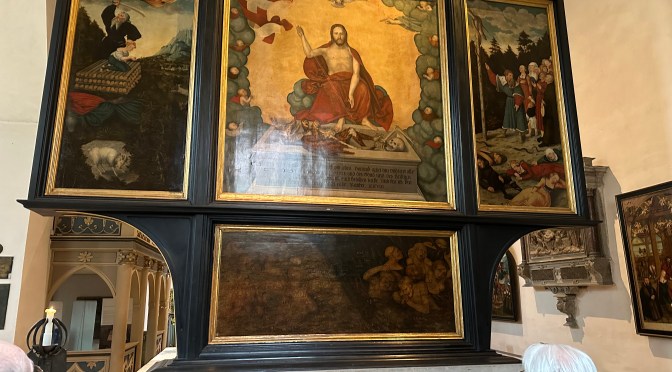
Header Photo: The back panel of the altar piece at the Stadtkirche in Wittenberg. A depiction of Christ defeating the powers of sin and death.

15 years – Pastor Thoughts

This week we observed those two beginning of summer milestones: Canada Day and American Independence Day. While both days have muted observations in Canada (the 4th of July for obvious reasons and July 1st for colonial ones), these two statutory holidays are signs of the beginning of summer.

The 4th of July is of particular significance to me for personal reasons – I was ordained to the ministry of Word and Sacrament on a hot and muggy day in Edmonton, Alberta in 2009. I was 26 years old, having just completed my Master of Divinity from Lutheran Theological Seminary in Saskatoon, and my Bachelor of Arts in History and Theology prior to that. It had been eight years of post-secondary schooling and I was ready to join the working world full-time. 

It was hard to believe that I was about to go from years as a long-time student to being given charge of the care of a congregation all by myself. As a student, my biggest responsibilities were getting assigned readings done, writing papers on time, and trying not to spend all of my student loans before the end of the term. In those first years of ministry, I certainly wasn’t the only person who was taken aback by someone so “young” serving as a pastor. I didn’t fit the usual stereotype of a grey-haired near retirement-age man that many expect pastors to be.

Now, I am fifteen years into this life of ordained ministry. While I know the joke is often that congregations think the ideal pastor is 30 years old with twenty-nine years of experience, at 41 years old and 15 years of experience, I have seen my fair share of things. I have served open country, small town, and urban/suburban congregations, big and small churches, across two different Synods in the ELCIC. Still, along with Pastor Courtenay, we are the youngest actively serving pastors in the MNO Synod. 

When I think back to that time before being ordained, I had begun my theological education at a Roman Catholic faculty at the University of Alberta. Studying theology in a non-Lutheran environment forced me to consistently research the Lutheran perspective – my perspective. Shifting to the seminary environment meant that my wondering evolved into what it means to be a Lutheran Pastor. 

That question has remained with me since. Many of you know that the heart of my Doctor of Ministry research is asking the same question. 

A few weeks ago, I wrote about how travelling to the places where Martin Luther lived and served brought a new perspective. Understanding what Luther did and wrote takes on a fresh new meaning when you go and walk the streets of Wittenberg, imagining Luther walking the same streets, dropping in on friends for a talk, gathering guests around his dining room table, preaching in the Town Church of St. Mary’s. 

Similarly, 15 years on the frontlines of ministry offers a perspective that you cannot get elsewhere. So much of what I learned prior to ordination has new meaning now when I imagine the communities, people and relationships that I have encountered serving. For some, this might feel like seminary doesn’t provide the right kind of learning for parish ministry, that it isn’t practical enough.  I think I see things differently. Just because things make better sense with some experience under your belt doesn’t mean you throw out the theoretical knowledge that you learn beforehand, rather it provides a deeper and richer understanding. 

At this 15-year mark, my hope is to keep learning from all that I experience AND from further studies. Just as understanding Luther by being where he lived AND reading what he wrote goes hand in hand, so does experience and study, 

We will see where this takes me and us, in 5,10 and 15 years from now.

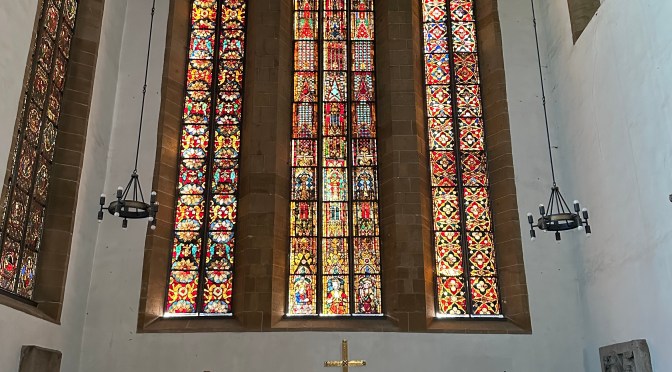
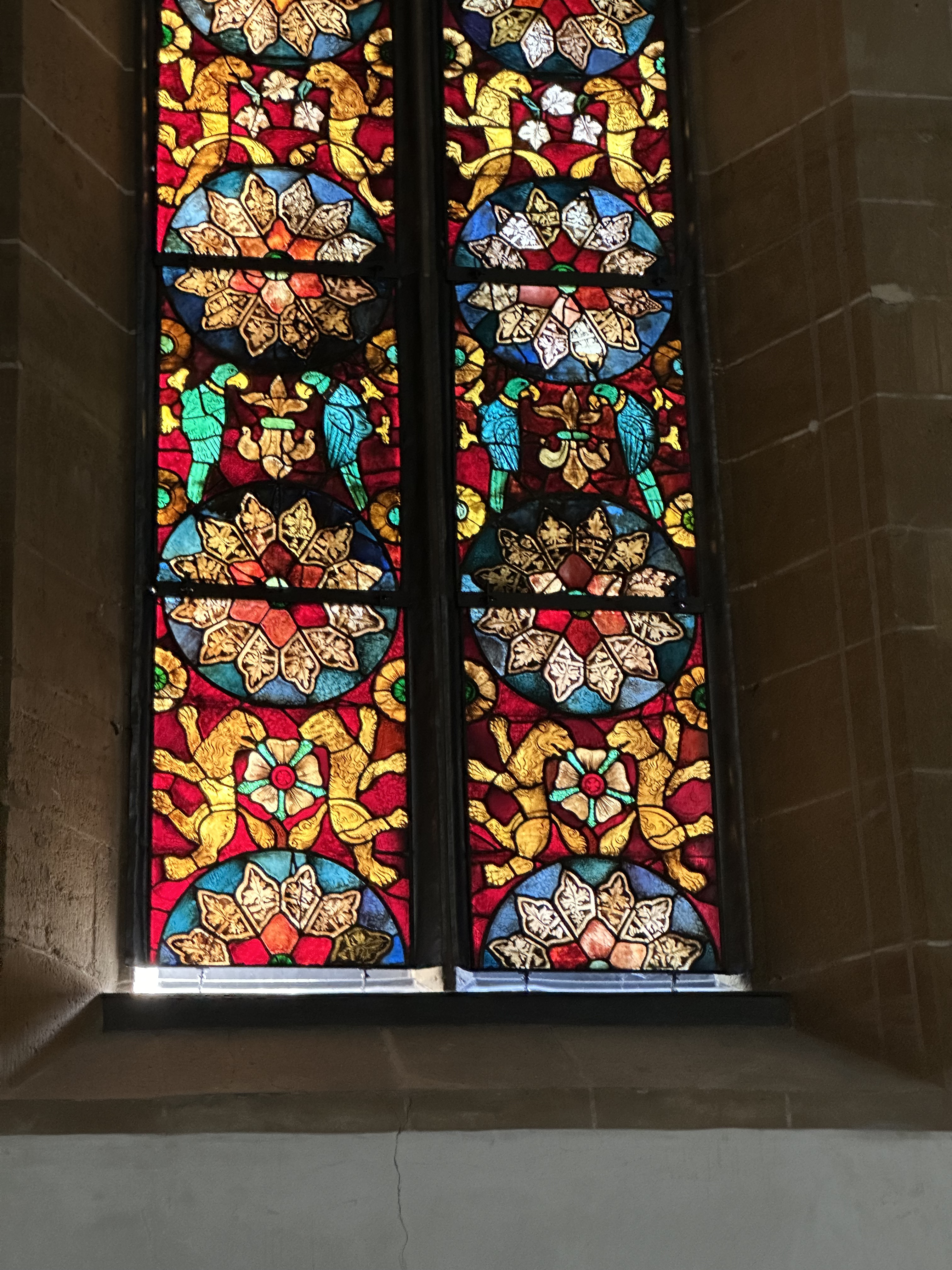
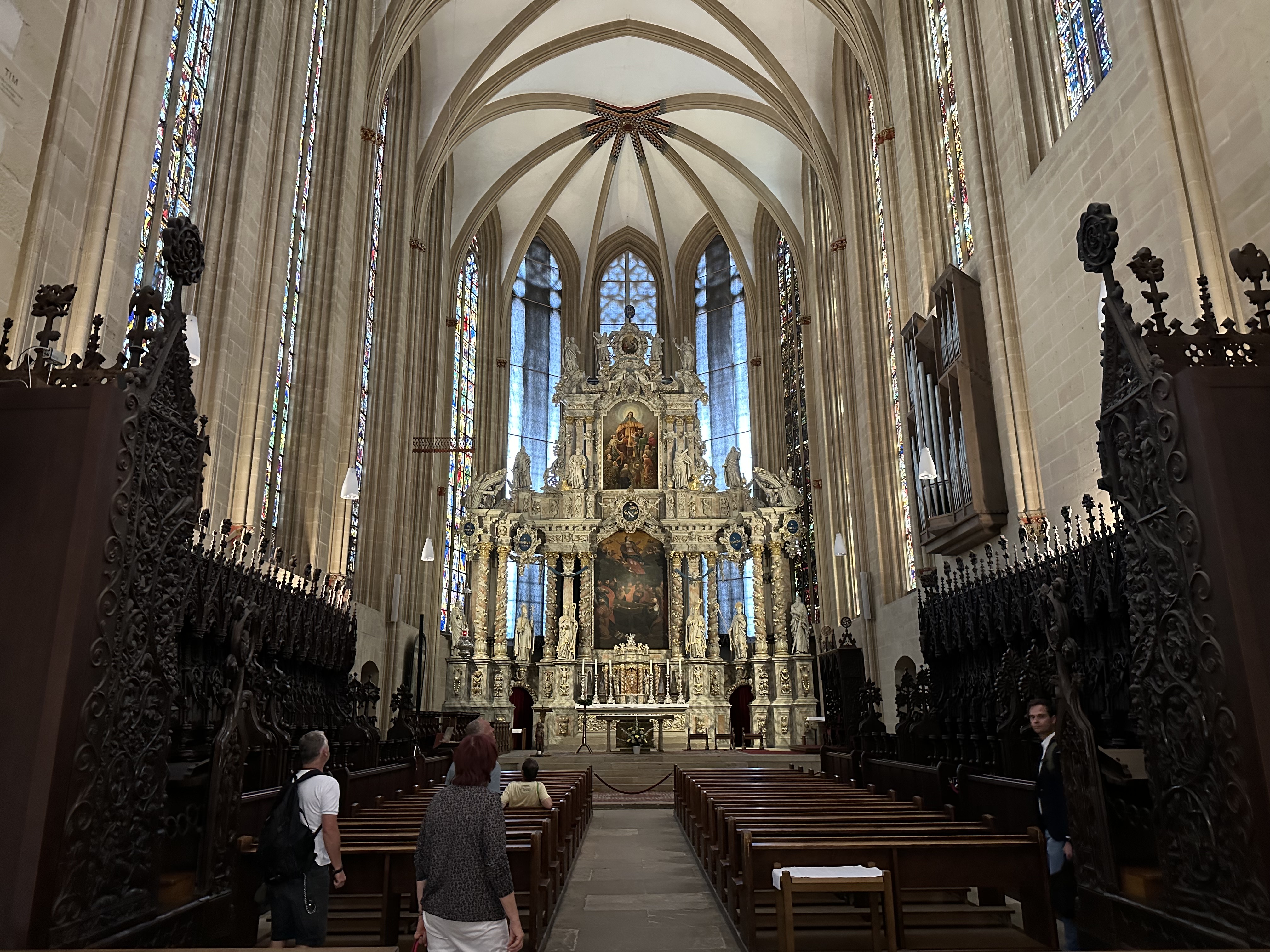
PS Photo(s) from my trip to Germany: [Above] The monastery chapel at Erfurt where Luther would have worshipped as a Monk. [Below] The stained glass was his inspiration for the Luther rose. The Cathedral in Erfurt where Luther would have been ordained a priest. My own ordination in 2009 and posing in a Luther cutout in Wittenberg.

Standing on History Unawares – Pastor Thoughts

This week the school year ended for school kids across the land. The crew of parents that typically meets at the bus stop for our street each morning for 8:08 AM pick-up has been counting the days until no more school lunches need to be made, no more rousing sleepy kids for breakfast and no more needing to climb the rest of the getting-ready-for-school mountain each day. I joked that we would all regret wanting an end to the school year in about 10 days when we start counting the days until school starts again! 

Of course, for now, it is nice to have a break in routine and some down time. 

Yet, with my mind still swimming between the 16th Century and today, I couldn’t help but remind myself that the real reason we are all trudging to this bus stop each day is… you guessed it… Martin Luther.

One of the things that we were reminded of frequently in Germany is Martin Luther’s influence on public life, not just on the Church. His translation of the Bible from Hebrew and Greek into German became the foundation of a lot of present-day written German or High German. Luther also introduced the concept of the public chest, as a means for communities to care for those in need. In addition, Luther advocated for public education funded by the State for all, including girls, which was radical at the time. He believed it was the state’s responsibility to provide education for all, as Luther scholar Franklin Painter describes it:

 1. In his writings he laid the foundation of an educational system which begins with the popular school and ends with the university.

2. He exhibited the necessity of schools both for the Church and the State, and emphasized the dignity and worth of the teacher’s vocation.

3. He set up as the noble ideal of education a Christian [person], fitted through instruction and discipline to discharge the duties of every relation of life.

4. He impressed on parents, ministers, and civil officers their obligation to educate the young.

5. He brought about a reorganization of schools, introducing graded instruction, an improved course of study and rational methods.

6. In his appreciation of nature and child-life, he laid the foundation for education science.

7. He made great improvements in method; he sought to adapt instruction to the capacity of children, to make learning pleasant, to awaken mind through skillful questioning, to study things as well as words, and to temper discipline with love.

8. He advocated compulsory education on the part of the State.

It is astounding to consider that many of the ways we simply organize ourselves in our common life, including sending our kids to grade school, were imagined first by Luther. 

On the day that we went to the Castle Church (Schlosskirche) in Wittenberg, there were also several school groups on field trips (similar to how school groups here might go to The Forks or the Museum for Human Rights). The Castle Church is also where Luther is buried. As we stood around Luther’s grave plaque, some of the students approached us to ask us a question. They were doing a scavenger hunt of sorts, looking for the answers to a set of questions. They were trying to figure out when the Castle Church had been built. They, of course, didn’t really understand that they were asking a group of Canadian pastors and students, including a world-renowned Luther scholar this question, as we all stood around the grave of the man who essentially invented public school! Our professor, Gordon Jensen, answered at the top of his head, and we all had a good chuckle. 

All of this to say that, as the school year comes to an end or as communities of faith like the one in Wittenberg or like ours here in Winnipeg, Canada, North America or wherever we are strive to live faithfully in the world, we seldom fully grasp all that it took to bring us to where we are today, or how the decisions we make today will impact generations to come. 

Somewhere in all of that is the working of the Spirit, sometimes hardly noticed or seen, but walking with us, nudging us in the directions of God’s call to live lives of faith, caring for our neighbour. 

Pastor Erik+

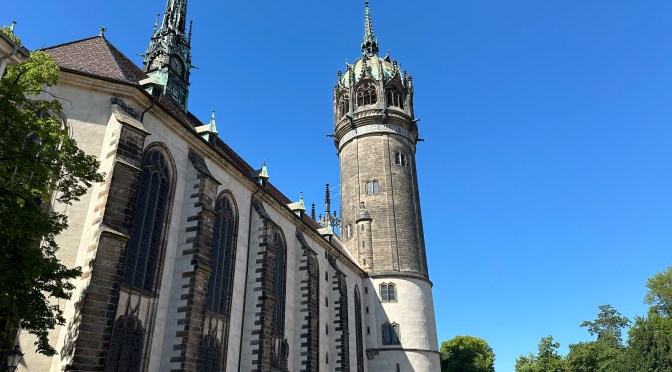
P.S. Photos from my trip to Germany: The outside of the Castle Church in Wittenberg and Martin Luther’s grave plaque, just under the pulpit in the Castle Church. 


1 Franklin V.N. Painter, Luther on Education (Philadelphia: Lutheran Publication Society, 1889, no copyright) 166-168.

A home I didn’t know I had – Pastor Thoughts

It has been almost 3 weeks since I returned from the Reformation Study Tour to Germany that I was on in the first half of May. 

While I have told a few stories of my trip here and there and many photos of the trip were posted to Facebook, I am still processing and unpacking all that I had the chance to see and experience.  I had a busy few weeks immediately after my return, and it has only been the past few days that have had some time to reflect and ponder. 

I have been fortunate enough to travel some in my life. I have been lucky to be able to explore a fair bit of western Canada, to travel to the US for school, family holidays and work conferences. But it is my two high school band trips to Europe and my seminary cross-cultural trip to Peru that stand out. They were chances to be immersed in rich cultures, languages and histories different than my own (to a degree). 

There was something different about this trip to Germany, particularly to many of the important sites of the Reformation and to Martin Luther’s life. Even though I don’t have an ounce of German heritage, there was something familiar, something known that felt like I was connected to these places. 

After three connecting flights and three connecting trains, as we walked from the train station into the town of old Wittenberg, our tour leader and professor kept exclaiming, “I feel like I am home!”

Wittenberg is just a small town of 44,000 people, smaller than Brandon, Manitoba. Other than in 2017, it certainly isn’t the most sought-after tourist destination. Like so much of Europe, when you walk into the town, the buildings and architecture span the centuries in ways that we usually don’t see as Canadians. Buildings that are five, six or seven hundred years old might be right next to other structures built only in recent decades. 

But Old Wittenberg is much more of a time warp. Within five minutes of leaving the very modern train station, it feels like you step into the 16th century. Within moments our tour leader was pointing out various sites: Luther’s house, the University of Wittenberg where Luther was a professor, St. Marien’s Church where Luther was the pastor, etc…

We finally wound up at the Colleg Wittenberg, a dorm-style residence across the alley from the Lutheran World Federation office in Wittenberg. Two fairly unassuming buildings just around the corner from St. Marien’s and across the street from a donair shop.

It all felt so surreal. 

The history and origin story that is so central to my Lutheran identity, yet for me that had always been one found in books, lecture halls, church basements and in my imagination, was now real. The history and theology that have been so central to my academic, vocational and professional life for the past 20 years came alive in a way I did not anticipate. I was standing where Luther had lived. I was walking the streets where he walked, looking in on the church he served, just like he was an old seminary friend that I had come to visit. 

I couldn’t help but feel, just like the professor leading the trip, that this place was home too. A home that I didn’t know that I had until now. 

PS Here are photos from Germany: Some of the paintings of Lucas Cranach the Elder, who was the court painter of Fredrich the Elector of Saxony and a good friend of Luther’s. He was the most prolific artist of his day, credited with doing much to promote the Reformation through his art and art house which mass-produced his work.

Cranach’s art

Electing Bishops in a time of change – Pastor Thoughts

Just as my congregation is in a time of discerning God’s future for us, so it is with many of our sibling congregations, synods and the Evangelical Lutheran Church in Canada (ELCIC) as a whole. 

In fact, over the coming weeks and months, four of the five ELCIC Synods will be electing bishops. In all but ours, the incumbent bishops have announced they will not be serving another term.  Stepping down will be Bishop Larry Kochendorfer in Alberta and Bishop Sid Haugen in Saskatchewan who have each served 12 years and Bishop Michael Pryse of the Eastern Synod who has served 26 years! Additionally, after 18 years National Bishop Susan Johnson will be stepping down as National Bishop after the National Convention next summer. 

By next summer, four of six Bishops will be in the first year of their first terms. Bishop Kathy Martin of BC will have been serving for three years and Bishop Jason will be the old experienced hand with six years of service. 

This will represent a significant change in leadership among Lutherans in the ELCIC, especially so in a time of significant change for the church.

Unlike the calling of a pastor, where a congregation or ministry enters into an intentional time of discernment through an extensive call process, where candidates are considered and interviewed before being voted on, Bishops are elected in the space of a few days at a Synod or National Convention. In the ecclesiastical election process, any pastor on the roster of the church is eligible to be elected. 

In advance of these upcoming elections, materials for discernment have been provided and some synods are soliciting nominations ahead of time – though still any pastor can be nominated on the first ballot. After that, successive rounds of balloting occur with only the top vote-getters proceeding to the next round. It is similar to processes used by political parties electing leaders except without campaigning and hopefully more of the Holy Spirit. 

The task of stepping into the leadership roles of newly elected Bishops (and relatively recently elected ones) will be to help guide the church through the rough waters ahead. It won’t be enough to simply keep our ship of the church steady ahead, as we already know that we need to change and adapt. Bishops will be called to lead the transformation of the church, envisioning new directions, lifting up and amplifying innovators, and making space for those who have been historically excluded from leading. 

The task of conventions discerning and electing new bishops will be to avoid seeking safe and comfortable choices. When it feels like we are in crisis, we long for things that make us feel comfortable and safe. We long for easy and known choices. When faced with the need to change, options that feel like the least amount of change or the easiest path to change can be very tempting. 

But the reality is that God is calling us to transformation that will not be easy or comfortable. Bishops and other leaders who will guide us through will need to be willing to push us to uncomfortable and difficult places. 

They will need to help us seek faithfulness. And faithfulness will mean giving up a lot of ourselves and a lot of our baggage as the church. 

But faithful is what God continues to call us to be, even in this changing world. 

And faithful is what God promises to be, especially in the time of change ahead. 

Pastor Erik+

PS The MNO Synod has prepared some materials for discernment here: