Tag Archives: Pastor Thoughts

The In-Between of Easter Still to Come

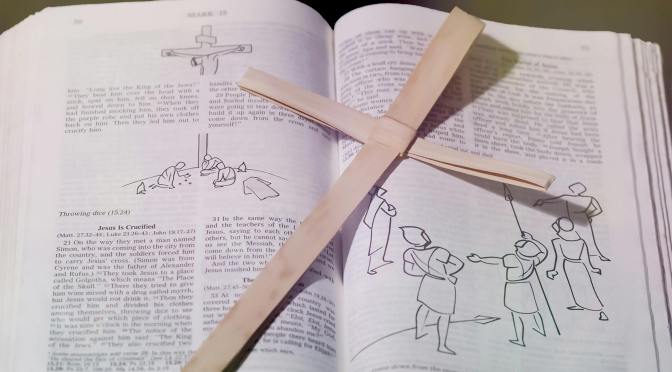
Palm Sunday, Maundy Thursday, and Good Friday are behind us, yet Easter morning is still to come. This in-between moment is one where two realities exist at the same time. Christ has died and Christ has risen, but neither is fully here. 

While uncomfortable, this is the place where we live as the Church, as people of faith. We are always in-between realities. We are always becoming and on our way to something new. 

As we approach the Easter morning scene, the Resurrection moment, we are like the women who are the first on their way to the tomb. Everything they know, everything they have witnessed, every possibility they can imagine tells them that what they are about to find is going to be one sure thing⎯death. 

They had no concept of what was possible with God, of what they were actually on their way to see and witness. Their minds and hearts could not fathom it. 

Easter is like that. Our crucified and risen God is like that. Everything we see and understand around us says that one thing is true, when a totally different thing is about to happen. 

Resurrection and New Life are always surprising and unexpected. God has a way of surprising us with empty tombs and new realities that change everything. Easter has a way of showing up when there is no way we could have predicted it. 

That’s why we proclaim and emphasize the mystery part of the mystery of faith⎯Christ has died, Christ is risen, Christ will come again.

The Collision of Holy Week

The first Palm Sunday I can remember I was six or seven. A Sunday school teacher shoved a palm branch into my hands and told me to be happy; we were going to welcome Jesus. The Sunday school and adult choir paraded into the sanctuary singing a happy song as the congregation watched. I remember not being sure what was going on. But I knew that happy people were laying down their coats and palm branches to make a welcome mat for Jesus, who was parading into town. 

Palm Sunday is an odd event seen through this lens. Why is there a party for Jesus at the end of Lent and before Maundy Thursday and Good Friday? And it is not just my home congregation that bought into the party idea. The celebratory emphasis of Palm Sunday is a theme that can be seen in artwork, music and many passion plays throughout history. 

But Palm Sunday wasn’t a party or celebration, not really. Jesus’ ride into Jerusalem was something else. 

This year, many congregations in the United States are including protest signs in their Palm Sunday processions, as a way to protest their current government. Seeing Palm Sunday as a protest is probably closer to what the moment represented, but not quite. 

Processions are important social symbols in our world as they were 2000 years ago. We might not think about it much, but processions occur in a lot of places. A celebratory parade is an obvious one. But processions occur also at weddings, funerals, graduations, political and state ceremonies, military ceremonies, and in religious practice. Though it is understated, our worship begins with a procession and ends with a recession every week. From a practical standpoint, it is a matter of getting the people who have a role to play in worship into and out of the space. But, symbolically, processions draw attention and focus. They help to communicate that something important is about to happen.

This is what the procession of the triumphal entry was about. In the gospels, prior to the triumphal entry, much of Jesus’ ministry resulted in conflict with the religious authorities, the political authorities and the demonic authorities⎯the Kingdoms of Religion, Politics and Satan. The purpose of Jesus’ ride into Jerusalem was to draw attention and focus to the in-breaking of the Kingdom of God.

Palm Sunday is the event where the Holy Messiah, God-In-Flesh, arrives to meet human centres of power.  The Temple at the heart of Jerusalem was the symbol of power for the Kingdoms of Religion, Power, and Satan⎯the Kingdoms opposed to the Kingdom of God. The crowds shouting “Hosanna! believed that Jesus was coming as a conquering king⎯more like that scene from the movie Gladiator where Caesar rides into Rome as a war hero or like the Allied troops marching into a liberated Holland in World War II. The conflicts in both cases were not resolved, but only beginning. 

At the end of the triumphal entry, Jesus presents himself at the temple, preaching and teaching that God’s Kingdom had arrived, calling humanity to repent and to return to God. In that moment, the response to Jesus’ arrival was silence. 

On Palm Sunday, the kingdoms at odds had yet to collide. That collision comes later in the week, during the Great Three Days from Maundy Thursday to Easter morning. 

A Responsibility to Repent?

It is only the third week of Lent, and already, the themes of the season have been remarkably difficult. The temptation of Jesus was a glimpse into the clashing of kingdoms in the first week. Jesus’ lamenting for Jerusalem and wanting to gather in God’s chosen people was really about the unwillingness of human beings and the destruction of Jerusalem temple.

In this third week, the Lenten theme is less convoluted. Jesus is asked by the people who followed him around tragedies that loomed large in the minds of the Israelites: a group of pilgrims unceremoniously killed by Pilate and a civil construction project that fell on 18 workers. One might assume that these followers of Jesus are wondering: Where is God in the midst of these tragic moments? 

But the followers aren’t wondering about that. Rather, they are asking if the pilgrims or workers were worse sinners who deserved their deaths. 

Ouch… that is not the kind of question you are supposed to ask out loud! Especially not of Jesus. That feels like the kind of insensitive question that a parent would scold a child for asking. Or, at the very least, there should be some tacit acknowledgement that it is inappropriate to blame victims for their suffering. 

Of course, this kind of victim blaming happens all the time in our world, but rarely in circumstances so tragic. It is not uncommon in our time for victims of sexual harassment or assault to be blamed for wearing inappropriate clothes, or for the poor to be blamed for their poverty, and for us to wonder if those who develop an illness did something to cause it. But we wouldn’t look at a pedestrian hit by a car and think, “Oh, they were probably a tax cheat who deserved to be hit.”

In Jesus’ day, however, it wasn’t uncommon for people to believe that any kind of suffering was the result of sin or unrighteousness.

The reality is that we also know there are degrees of sin to some extent. We know that some things are worse sins than others. We know that the Nazis who claimed to be just following orders during the Holocaust are not the same as speeders. That fighting with my sister as a kid is not the same as dealing drugs. That clandestinely appropriating some of my children’s Easter chocolate is not the same as wealthy CEOs hoarding hundreds of times more salary than their employees earn. 

We know that some things are worse sins than others, but in this season of Lent when we take time to step back and consider our lives, our identity and even our sins… what are we to do with this knowledge? What are we to do with Jesus’ response to his followers?

Jesus’ response sounds pretty pious, “No, I tell you; but unless you repent, you will all perish as they did.”

Is Jesus warning them, and us, that if they and we don’t get our acts together, we might suffer the same fate as the pilgrims and construction workers?

I don’t think so. Even if it sounds like Jesus is saying that if we don’t repent we are going to suffer. 

Martin Luther would remind us that, in regard to repentance, God has commanded us to confess and repent. Our response to our sin is not to worry about our degree of sin, not to worry about who among us has sinned the most, but to confess and repent of our sin. 

In fact, the only thing that we can do in response to our sin is to confess and repent. 

And how does God respond to sin? Well, that is something we will explore throughout the Lenten season.

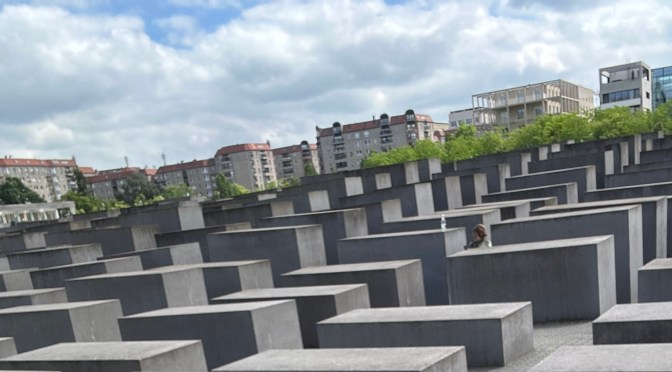
Photo: The Holocaust Memorial in Berlin

The conflict at the heart of the Lenten Wilderness

Our Lenten wilderness continues to stretch out before us. With questions of when we might find stable footing in all the uncertainty around us, we were reminded last week that God’s claim on us in Baptism is something that we can cling to. 

This week we hear how Jesus goes from his own wilderness to the towns and villages of Galilee, where the Pharisees confront him about the treachery of Herod. In hearing this warning, Jesus laments for Jerusalem and all the ways in which the powers and authorities of this world stand in the way of the work of God. 

About a year ago, I was doing a deep dive (class paper) into the Gospel of Mark, looking at how the oldest Gospel treats conflict. In doing that work, I learned that we cannot read the Gospels without seeing the conflict that is at the core of our existence as human beings. 

The Kingdom of God coming into the world as proclaimed by Jesus in the Gospels isn’t just about a kingdom coming to claim empty uncontested territory. The Kingdom of God coming into the world means that the other powers of this world⎯King Herod, the Romans, the religious authorities in the Gospels⎯are confronted and contested. It also means that the Kingdom of God entering into our world contests and confronts the powers here, too⎯political powers, authoritarians, injustice and inequality, all those who would seek to harm God’s creation. 

By Holy Week, we will be reminded that Jesus’ power isn’t one of armies and soldiers, violence and coercion. Yet, the confrontation is the same. The Kingdom of God is at work undoing the ways we use power, violence and force to control and harm one another. How and where God is doing this will be topics for reflection later in Lent. But that “conflict” is at the core of our very being and speaks to our experiences in this world. Conflict isn’t something we can compartmentalize, put into a box and set aside. It is always lurking in the background of relationships and communities. Conflict is often behind our suffering, our failure and selfishness, our desire to be different and our inability to enact the changes needed in our lives, our relationships and our world. 

As Christians, we recognize this reality within us. This involves a wrestling between the old sinner within us and God’s work of shaping and moulding us into new creations. We also recognize this reality in the world around us. In fact, it might be the best way to explain both the brokenness and the beauty we see in the world. Our capacity to love and care for each other is only matched by our capacity to harm and destroy. Our very existence is marked by contested kingdoms fighting over us. The powers and principalities of sin, death and the devil push against the encroaching Kingdom of God that is working to claim us as God’s own. 

This can be a difficult experience to reconcile and to accept. Yet, when we take an honest assessment of our world, it is the only explanation that makes sense. And it is what we are called to remember this Lenten season on our way with Jesus through the wilderness. 

Will Lent Never End?

Each year, as the Lenten season arrives, I try to think of a theme or image that expresses the feelings we bring into the season. Wilderness, valleys, journeys, and deserts are often images that I imagine for the season. 

This year it might be that Lent feels like we are being pushed off a cliff, or all alone in a world of threatening danger. Which is saying something, given what the world has been through in the past few years. 

The threats that we are navigating globally and locally are both nothing new for this world of ours and also more intense than the dangers that most of us have had to deal with in our lifetimes before 2020. 

We arrive at this Lenten season already tender and aching, still traumatized from the pandemic, from ongoing wars in Ukraine and then Gaza, and then have had to contend with the consequences of an incomprehensible trade war with our closest neighbour and ally that may very directly impact our lives as Canadians. There are many personal and familial wildernesses that many of us have been wandering as well. This wilderness is going to form into something new and different than what we are now. 

Many of these wilderness journeys are ones we have been in on for years as communities of faith, as Manitobans, Canadians and people living in the world in 2025. Having been walking in the wilderness for as long as we have, our destination remains unclear. What is around the next corner is unclear. Our wilderness vision is foggy and opaque. 

We have begun looking at the Catechism in these past months and there is a very Lenten reason for it. In the early Church, the Lenten season was the one during which new converts to Christianity were taught the faith in preparation for their baptism which would happen at the Easter Vigil. Often, baptized Christians would join in this catechetical experience in Lent. Bishops and priests took this time to teach the mysteries of faith to these new converts preparing to be baptized. What are these mysteries of faith? The Creed, the Lord’s Prayer and the Ten Commandments. These, along with the Sacraments of Baptism and the Lord’s Supper, are the main topics in the Catechism. 

So in this Lenten wilderness where we find ourselves this year, there is a reminder passed on to us from the saints who have gone before us. When we cannot see what comes next, and when our vision and pathway forward is hard to see, we cling to the promises and truths found in these mysteries of faith. God is calling us to remember our Baptismal identity. In the Commandments, we hear the Law that declares that we are sinners on our way to death. In the Creed, we hear the Gospel promise that God in Christ was sent to save sinners through the Holy Spirit. In the Lord’s Prayer, we are given a faith to live out in community with our siblings in Christ. 

These Baptismal mysteries ground us in things that truly matter, with truths big enough to confront the threats and dangers around us. Suddenly, the wilderness feels less daunting and overwhelming.  Knowing where we might end up at the end of our journey feels less anxiety-producing when we are reminded of God’s claim on us, that the One who has already brought us out of the waters from death to life will not abandon us in the wilderness either.

So as we begin this very Lenty Lent, let us remember that we are God’s, and that God has already promised us life on the other side.