Tag Archives: Pastor Thoughts

Emmaus and Hockey Night in Canada – Pastor Thoughts

Hello Canada and Hockey fans in the United States and Newfoundland.

I am not anywhere close to old enough to have heard Forster Hewitt utter that iconic phrase live, but I have heard the recordings. As many of us turn our attention to the NHL playoffs this week, (to watch the Jets, Oilers and Maple Leafs), it is easy to think back and remember stories of hockey games past and the Canadian cultural ritual that is watching hockey together on Hockey Night in Canada (HNIC).

I remember the old HNIC Theme Song – the one written by Delores Claman that ran from 1968 to 2008. (TSN owns it now, maybe you still hear it if you watch the Jets regularly). Click here to listen: Hockey Night In Canada Theme Song Original – YouTube. Those first few notes of the low brass fanfare that swells into the full band always remind me of watching Oilers’ playoff games in the 90s. (I am a little too young to remember the Gretzky dynasty years very well.) 

When I was going to the University of Alberta, I played in the Cosmopolitan Community Band. One year for a Christmas concert we played the HNIC Theme Song. It was so cool to play that iconic song and for it to sound almost exactly like it did on TV. 

Whenever I hear that song, it immediately stops me from whatever I am doing. I am transported back to Saturday nights watching hockey with family and friends. It feels like Canada’s second national anthem, or at least it did. It has the power of connecting you to all the other people humming along from wherever they are watching the game.

For a whole host of reasons, that song will always hold a special place in my heart and mind. And whenever I hear it, it will immediately bring back cherished memories and feelings. Maybe you aren’t a big hockey fan, but we all have songs or sounds, foods or smells, books or movies that, whenever we see them or hear them or taste them or smell them, transport us back to another place and another time. Memories that hold on to us as much as we hold onto them. 

This week, we hear one of my favourite stories from all Scripture, The Road to Emmaus story. The climactic moment of the story is kind of like my HNIC Theme Song moment. The disciples are pre-occupied with all that has gone on, trying to understand their new world. And then Jesus takes some bread and begins to bless it. 

For the disciples, it was as if the HNIC Theme Song started playing. A memory that held them as much as they held it. A memory that woke them up from all their preoccupations. And they were transported back to that moment when their teacher and friend was sitting with them, reminding them of who they were – who God had declared them to be. 

For us as people of faith, each time we gather for worship, we are surrounded by the sights and sounds, smells and tastes, words, songs and actions that break us free from all those pre-occupations that take up our focus. Memories, symbols and images that hold us. And in those things, God reminds us who we are and who God has declared us to be. 

So as we sit down to watch hockey this week or hear the story of the Road to Emmaus, remember that God is there, finding ways to cut through the noise of our lives and break through into our hearts and minds. Breaking through and transforming us into Easter people.  

Christ is Risen Indeed! Alleluia!

Holy Saturday and Vigils – Pastor Thoughts

We are nearly through Holy Week. 

We have gathered at the Lord’s Table on Maundy Thursday.

We have worshipped at the foot of the cross of Good Friday.

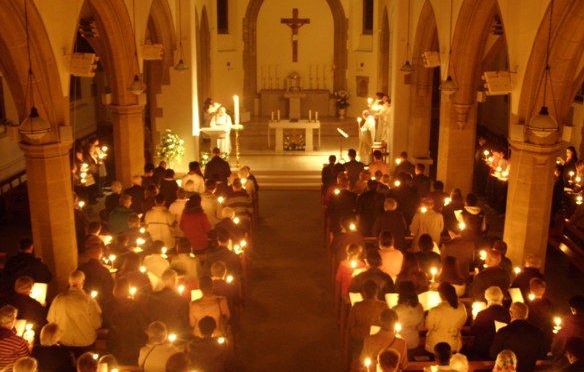
On Holy Saturday the Church has traditionally gathered at the Great Vigil of Easter – considered the most important time of worship in the whole calendar. 

In the 20th century the Vigil fell out of favour with Lutherans, mostly for being too Roman Catholic. But the Vigil, for the better part of 2000 years, has been when Christians have gathered together to tell all the stories of faith at once. 

On the evening of Holy Saturday, the vigil begins around the new fire, where the new Paschal (or Easter) Candle is blessed for the coming year (the big candle that we have at the front of the sanctuary. The candle is blessed and the year is imprinted in wax on the side. And then a deacon sings the Exultet, the an extended litany extolling God’s praises, welcoming the assembly into the keeping of the Vigil. 

This is followed by 12 readings from across the Old Testament, with 12 accompanying psalms. The readings span from Creation, to Noah’s Ark, to the Burning Bush, to King David and the Prophets. Stories are read and sung, reminding us of how God has walked with God’s people throughout the ages. This is the part of the service that gives the Vigil its name – since it often took all night to do in the early church. Though modern Vigils are usually only one to two hours.

Once the stories of God’s people have been told, those assembly remembers their baptism (or anyone needing baptism is baptized) as the presider sprinkles water on worshippers with green boughs dipped in the font. 

Then follows the Resurrection Gospel and often the ancient Easter Sermon of St. John of Chrysostom. Then the Eucharist blends into a great feast that lasts until morning. This is where the tradition of the Easter Breakfast comes from. 

And then everyone goes home to sleep.

Easter Vigils have started making a comeback among some Lutherans, and are much more common among Anglicans and Catholics. 

But sometimes just knowing the story of the Easter Vigil is enough to understand the drama of the three days – Maundy Thursday, Good Friday, Easter Vigil. 

This year the MNO Synod is inviting anyone who wants to attend an Easter Vigil to go to the one at St. John’s College, 92 Dysart Road, University of Manitoba, at 4:30 pm on Saturday. If you haven’t experienced an Easter Vigil at least once, it is definitely worth it. 

But of course we will also be having our usual Easter Worship service on Sunday at 10:30am, where we will gather to announce the Resurrection and hear the Good News of the Empty Tomb together. 

Taking time for Holy Week – Pastor Thoughts

We have just about made it through our long wilderness journey in Lent. With Holy Week nearly upon us, our Lenten pathway has not been easy nor straightforward. Instead, Lent is a season where we are challenged to offload our baggage, to re-think our assumptions and prepare to be changed. 

There is a lot about life in the Church that has Lenten vibes these days and it is NOT just since the pandemic. If I am honest, I can see the “Lentiness” all the way back to the beginning of my time in ministry. Things have felt scarce. There has been a sense that something is lost. In my first call interview in 2009, people were talking about “getting people back” and returning to what the Church once was. These refrains have only gotten louder over the 14 years following. It is the perspective of a community knowing that they have entered a spiritual wilderness and are looking to go back to where they came from. 

The thing is, we need this wilderness time. We need the wilderness journey. We need to let a lot of our baggage go. We need to learn how to trust that God is leading even if we cannot see the way. We need to be reshaped for the Kingdom again, as we have had a habit of falling out of shape for that work. 

Now that we complete our Lenten journey for this year, we still have to walk the walk of Holy Week. Lent doesn’t land on Christmas Day the way Holy Week lands on Easter Sunday. Instead Lent arrives at the most important week of the year for Christians, and the most difficult. 

The Holy Week story is hard and long and tiring, but it is necessary. We tend to compress the story into short phrases most of the year: “Christ has died. Christ is risen. Christ will come again.”

But Holy Week takes the time to live the narrative. 

We stand along the road waving palms as Jesus rides into Jerusalem. 

We hear the Passion According To Matthew, Mark or Luke to begin the week. 

We gather with the disciples at the table of the of the Last Supper, with feet washed, and bread and wine shared. 

We try to stay awake through the night of betrayal and we go with Jesus as he is arrested, tried and sentenced. 

We help to carry the cross to Golgatha and we weep with mother and son as Jesus breathes his last. 

We hear the Passion According To John on Good Friday and wait for the first day of the week to go with the women to the tomb. 

We do this to remember the long story during all those other weeks of the year. We take our time so that, when we worship a crucified God, that we know what that means. So that we know who washes us at the baptismal font, and who feeds us at the Lord’s Supper. We linger in the stories so that they come to mind when we skim through the details in the Creed, or the Pastor references them in a sermon some time in November, or when we are sitting in Bible study trying to unpack just what God’s promises are rooted in. 

Holy Week imprints the story of the Passion into our bones. It becomes a part of us and we of it. So that when we become Easter people on that First Day of the Week at the empty tomb, we know how we got there. It wasn’t easy and it wasn’t quick. But Lent and Holy Week do transform us – each year – into the Body of Resurrection that we are called to be. 

Pastor Erik+

Call the midwife and Why Serve? – Pastor Thoughts

As we round into the final Sunday and week of Lent, we are coming to our last Soup+Bread study session – “Why Serve?”

We have been asking the “why” questions, beginning with the broad issue of “Why Faith?”. As we have gone along we have narrowed down the topics from Faith, to Christianity, to the Word, to Worship. Along the way we have been building a foundation for understanding why we do this thing called “Church” together. 

Now as we ask the question, “Why Serve?”, we are trying to get at what this foundation means for us in terms of how we ought to live our lives. But to get the answer to that question, you will have to come to the study on Sunday!

However, as a tangent to the question of “Why Serve?”, I will admit that I have often been interested by the monastic life. I cannot say that I would have ever really considered becoming a monk, but the idea of living in a community whose life together is gathered around a singular purpose and governed by ritual, rhythms and patterns has a certain appeal. In some ways I got a parallel taste of that life in my five summers of working at various bible camps. 

For quite a while now, one of my favourite TV shows has been Call the Midwife. It is a British drama set in the 1950s and ‘60s following a group of Anglican nuns and National Health Service (NHS) nurses/midwives serving the fictional community of Poplar in London’s East End. Of all the depictions of Christianity on TV, Call the Midwife has to be one of the best. 

The nuns and nurses live together in Nonnatus House, and from there they serve the community around them. Primarily they serve as midwives during the Baby Boom of the post-war era, helping women to safely give birth to the many children born during this time. Throughout the show, they cover several of the various health crises that marked the time, including the Thalidomide crisis and the Polio epidemic.

Interwoven with stories of their personal lives and those of particular characters in the community, the nuns and nurses live lives of service. The nuns punctuate their busy days of births, pre- and postnatal clinics and general medicine with daily prayer – morning, noon, evening and night. 

Several poignant moments of the show have shown the nuns praying the prayers of Vespers (evening) and Compline (night): “Into your hands I commend my spirit” with moments of Birth, Life and Death that go along with the practice of midwifery and medicine. 

I encourage you to check the show out. But the way Christianity is portrayed is so different from what is usual for Hollywood dramas. There are no Bible-quoting villains, neither are there heroes sitting in a church praying to an unknown God in a moment of desperation. God and the Church aren’t some foil for misguided virtue or judgmentalism. Faith, as a part of life, informs the care that the nuns offer to the community around them. God isn’t some outside force to be appealed to in a moment when all hope is lost; instead, God is a part of every moment of life. When the skills of midwifery and nursing fail to bring a new child into the world safely or to extend the life of someone sick, there are traditional prayers that remind the nuns, the people of Poplar and us that, in Life and in Death, God is there. 

Service, Caring and Empathy are the main themes of the show. And while not all of us can live such lives of service, the show provides a template for what it looks like to be bound by something larger than ourselves that calls us into the world as people of faith. As we ask the question, “Why Serve?”, an important place to begin answering that question is to explore all the “why” questions we have explored already, to know why Faith is important to us and how to take that Faith is the foundation holding our feet to the ground and turn it into a way of life. 

Pastor Erik+

More Lenten “Why?” Questions

This Lent has been centered around the question of “Why?”

We have been sharing in Soup+Bread Lenten studies following worship and it has been invigorating – at least for me! As a pastor, I really enjoy the opportunities to teach that come along from time to time. But I hope that participants have been getting as much out of our sessions as I have. Our conversations have been lively and I think I have seen moments when people have been opened up to new ideas and understandings. 

So far we have explored the ideas of “Why Faith?” and “Why Christianity?”.

This week we will explore the questions, “Why the Word? Why do we read the Bible?”

Now, if you want to know why we read the Bible as Christians, how we understand it together, why we read it and not other books, you will have to come to our study on Sunday!

But for the past number of months, I have been asking my own “why?” questions about the Bible. Particularly, I have been wondering about how we listen to the Word in worship. How I listen to the Word in worship. 

Now this might seem a like a strange thing to wonder about. Isn’t the answer obvious? Someone reads the reading and the rest of us listen/read along, right? On the surface that is true, but there is a lot more to it than that. 

In fact, in our liturgy class in seminary there was a lot of time devoted to understanding just what we were doing when we read from the Scriptures in worship. 

We talked about how Scripture is read. Does the reader read it like a Shakespearian actor delivering a soliloquy? Or like Ferris Bueller’s teacher taking attendance, with the flattest affect possible? Do you look up to make eye contact or look at the words continuously so as not to lose your place?  

We talked about whether the Sunday readings are for learning and study or for edification and exhortation. 

We talked about how to listen to the readings. For example, the presider should model listening by looking at the reader rather than busily looking at the worship plan. Should we read along with the words or simply use our ears to hear the reading? When we read along, our brains switch into matching the words we are reading to what we are hearing, while deprioritizing comprehension. Simply listening is ideal. And yet making the readings accessible for those who are hard of hearing is important as well. 

And then there are deeper questions about what the readings are for. We tend to think the Word portion of worship is like a Bible study where we learn about each reading. Yet, cramming in a deeper understanding of all four readings each week is a lot to ask in the seven or eight minutes we spend hearing the Word. Similarly, shifting to a system like the Narrative Lectionary is a challenge because it disconnects the readings from the larger liturgical calendar and the ways in which in each Sunday’s set of readings support one another to tell the narrative of each season.

More and more I am coming to the view that it takes a certain kind of skill and attention to hear the Word in worship. Rather than following closely, word matching or studying the Word as if for a test, hearing Scripture in worship is something like going to the symphony. 

At the symphony, there might be a lecture on the music before the concert. There might be things about the history of the music to learn at home. But in the moment, during the concert, we listen attentively. We let the music wash over us catching the emotion, the harmonies and dissonance that evoke different responses or feelings within us. 

Similarly when hearing the Word in worship, we listen best to whatever words inspire or comfort, challenge or compel. We listen for things that God might be saying to us in that moment, and then we let the readings go, as we contemplate what message the Spirit has gifted us with. 

At least for me, this has been a change in how I hear the Word and how I have found myself connected with the readings. I invite you to try it, too. Don’t worry if you remember the story from Sunday school, or whether you know anything about the prophet whose book the reading is from or about which letter of Paul’s the reading is from. Just let the Word of God wash over you as you would a beautiful symphony, and see what God might be saying to you this week.