Tag Archives: ministry

What have you to do with us Jesus?

Mark 1:21-28

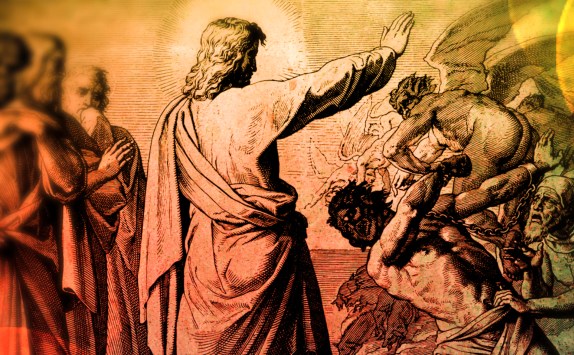
… a man with an unclean spirit, and he cried out, “What have you to do with us, Jesus of Nazareth? Have you come to destroy us? I know who you are, the Holy One of God.” But Jesus rebuked him, saying, “Be silent, and come out of him!”… (Read the whole passage here.)

Sermon

Today, we pick up in Mark’s gospel where we left off last week. Jesus has preached his first sermon, “The Kingdom of God has come near” and called Simon and Andrew, James and John to be disciples.

Now the group of them head to Capernaum, which becomes the home-base for Jesus’ ministry. It is the Sabbath, the day of worship, and they go to the synagogue. Jesus begins teaching, as was the right of any circumcised Jewish man. Usually, it was local scribes or rabbis who preached but sometimes travelling preachers like Jesus would come by to teach.

As Jesus begins, the congregation notices something different. Jesus is not teaching like the scribes. The scribes who were like walking encyclopedias of religious knowledge. The scribes were experts in the law, in the teachings and interpretations of the Jewish faith. The scribes didn’t innovate or interpret, they simply memorized what had been interpreted and written down by rabbis and other authorities long ago. New teaching was dangerous and probably heretical. It was important to stick to what they knew to be tried and true.

Yet, Jesus was preaching something new. Something different. Jesus was preaching from his own authority. Preaching like he had some special access to Moses, Elijah and the other prophets. Like he had special access to God.

While most people weren’t sure what to make of this Jesus guy, who he was or where his authority came from, one person did. Or rather an unclean spirit did. While regular humans don’t see who Jesus really is, the supernatural unclean spirit knows. And the spirit knows that Jesus is a threat to the established order. The spirit knows that Jesus has come to turn things upside down. The spirit knows the world that he and the people around him are stuck in is the past. The comfortable systems, traditions and ways of being that they are used to are over. Jesus is going wreck things.

The spirit is the one who speaks.

What have you to do with us? I know who you are!

The man with a spirit might just be a man with an unclean spirit. But for Mark the man might also represent the ways in which that community, that world, was possessed by tradition. Stuck in past. Unable to introduce any change that threatens the status quo.

Sound familiar?

Churches these days often struggle with this issue. We often long for things to be as they once were. We long to have Sunday schools with 100 kids every Sunday, and services that are standing room only. We long for offering plates to beoverflowing, we hope for more baptisms than funerals. We long for the past, or at least the way we remember things to be.

As a faith community or as individuals we can be possessed by our past. We can fear change, block anything new, strive to keep things the same. As the old joke goes,

How many Lutherans does it take to change a lightbulb?

Change!??! That lightbulb was good enough for my grandfather, so it is good enough for us.

When the unclean spirit names the threat that Jesus is not only to the good deal that the spirit has possessing some poor man, but also the threat that Jesus represents the whole world of the people of Capernaum and beyond, Jesus will have none of it.

Be silent and come out of him!

Jesus will not be deterred by the anxiety and fears, or the unwillingness of the spirit or people to let go. Jesus is preaching a new world, Jesus is calling the people around him into the future, into a new way of living. Jesus’ new teaching is astonishing, radical, unheard of. And it comes from a place that people don’t understand, but that the unclean spirit gets. The unclean spirit knows that the old ways, that the established approved way of doing things is safe, is comfortable, it is known. The spirit knows that people would so often rather be possessed by trying to maintain the past than face the unknown future.

Be Jesus knows that God is calling us into something new and unknown. And Jesus knows that we need to be exorcized of our fears and worries if we are going to see God’s future. Because we are often possessed by maintaining our past, by trying to recreate what we once were. We hold onto the traditions, systems, and ways to doing things that were good for our grandparents and so, we believe, are good enough for us.

Now don’t hear Jesus wrongly. Jesus is not saying that the past is wrong or bad. Jesus is not saying that God wasn’t active in the past, or that God wasn’t working through the ways we used to do things. Often when churches and individuals face change, letting go of what we once were is so hard because it feels like we are dishonouring our forebears. It feels like we are saying our parents and grandparents were wrong, that they weren’t being faithful.

That is not what Jesus is saying. Jesus knows that God has been present among the people, among us the whole time. Jesus isn’t exorcizing us of our past. Jesus is exorcizing us of our holding on, of our resistance to change, of our need for safety and comfort. Of our fears and anxieties.

It is not the past that keeps us from seeing God’s future, it is our efforts to keep things the same, to recreate what once was, what we once were.  And Jesus’s new teaching is really about showing us that new world. Showing us God’s future. Showing that God is coming to, meeting us in the future. God knows we cannot go backwards.

And that is what is so radical to the people in the synagogue in capernaum, so radical for us today. God is not a God of the past, God is not about keeping things, keeping us the same. God is about resurrection, about turning death and forces that hold us back, into new and abundant life.

Let us pray,

O God, you have called your servants to ventures of which we cannot see the ending, by paths as yet untrodden, through perils unknown. Give us faith to go out with good courage, not knowing where we go, but only that your hand is leading us and your love supporting us; through Jesus Christ our Lord.

Amen.

Is Unfriending the Christian thing to do?

We have all heard the advice. “Don’t feed the trolls.”

And yet, many of us complain about the content that gets shared on our social media timelines. We have all followed or friended that third cousin, twice-removed who posts the most annoying content just to get a rise out of us. Or worse yet, he/she actually believes that nonsense. As social media evolves and changes, figuring out what to do about people we don’t actually want to hear from has created a new buzz activity in 2015.

Unfriending.

Last week, I heard an interesting interview on CBC Radio’s “The Current,” which made me think of my social media experience. The interview was about the Unfriending Movement in Germany. In our social media world, unfriending/unfollowing has new meaning. It used to be that ending a relationship meant “breaking up”, or just ceasing to spend time and energy on people who drained, annoyed, angered, or frustrated you. Now we can just click that button to unfriend or unfollow.

Jimmy Kimmel has even made a video giving us the rules for how to unfriend.

And sure, social media is full of people who post too much, post too inanely, post pictures of food too often, post too many selfies, live tweet things we don’t care about or post cryptic statuses inviting “concerned” friends to beg to know what is going on.

But the heart of the unfriend movement in Germany is about unfriending those who have a particular type of political view, particularly those who oppose the presence of Islamic immigrants in their country.

And that has made me think.

Is it a good idea to unfriend people who have different opinions and views than we do?

Social media is a place to interact with friends, both IRL ones and online ones. It is a place to see that cute kitten video that has gone viral today, or find out trending pop-culture news. It is increasingly becoming a place to share and read articles, blog posts, watch videos and obtain information. I was glued to Twitter during the shooting in Ottawa a few months ago… and I confess I muted the World Cup hashtag from earlier in 2014.

In the early internet, primitive social media, like chat rooms and message boards, use to be places to find in niche groups of like-minded, like-interested people. But as social media use becomes more ubiquitous, and it is the norm for people to be present on social media, it is now about connecting to diverse groups that cut across socio-economic and geographical/national boundaries.

UnknownUnfriending those with whom we disagree means we limit our exposure to different ideas and opinions. And yes, sometimes muting, blocking, unfollowing or unfriending that person who posts a lot of offensive content is necessary. It isn’t worth seeing their content clog up your feeds.

Yet, I think there is a caution in being too zealous about unfriending those who have different politics, faith practices/beliefs, or opinions than we do.

(Full disclosure: I regularly cull the list of people I follow on Twitter. Less often for Facebook, but I still unfriend on occasion. I also mute people on Twitter and unfollow people on Facebook.)

Do we really want to create social media worlds where we only interact with like minded people? Do we only want to hear others share content, ideas and opinions that confirm what we already think?

twitter-mute3-550x280Unfriending may be the new buzz activity of 2015, and it may even become an effective social change movement. But our In-Real-Life worlds are not limited to only those who think and act the same as we do. Limiting our social media worlds (which are becoming more and more important social circles) to only like minded folk will limit our exposure to a diversity of ideas and opinions.

As a christian and a pastor, my thinking about the world and my understanding of my ecclesiological neighbours, my cultural and international neighbours has increased dramatically because of social media. It used to be that I only talked to Americans or other world citizens when I was travelling. It used to be that I only interacted with clergy from other faith traditions once a month, at best. It used to be that I lived in a pretty white, Canadian, Lutheran world. Now I read, talk and interact with people from all over the world and from all over the map of Christianity everyday.

And I am better for it.

As our social media behaviour becomes more and more integrated with everyday life, the temptation to mute, unfriend or block-out the diversity of the world might be high. We all have limited energy to spend these days. Yet, I seem to recall a guy we like to talk about in church, who often broke down barriers and took the time to seek out those who were different than he was. Those with whom he disagreed, those whom practised different religions, those who took time and energy to deal with.

What was his name again?

Oh yeah…

Jesus.

image source -http://www.communicatejesus.com/2010/12/cartoon-jesus-actually-wants-you-to-follow-him/

Does it mean that Jesus took the abuse and never called anyone out? Hardly, in fact Jesus fed the trolls on more than one occasion in order to make a point. But he knew where his limits where.

So in 2015, think twice about unfriending those who disagree with you… and then when you are quite sure you don’t need that drama in your life – click away!

But don’t unfriend just because people think differently than you do.


What do you think about unfriending? Do you block or mute people on social media because of their politics or opinions? Share in the comments, or one the Facebook Page: The Millennial Pastor or on Twitter: @ParkerErik

‘Course Jesus isn’t safe. But he’s good.

It has been a while since my last post, but I am hoping to get back into posting after a few weeks of holidays. Welcome to 2015 on The Millennial Pastor. In the meantime, here is my sermon from today. See you around. 

Mark1:14-20

Now after John was arrested, Jesus came to Galilee, proclaiming the good news of God, and saying, “The time is fulfilled, and the kingdom of God has come near; repent, and believe in the good news.”… (read the whole reading here).

Sermon

“Then he isn’t safe?” said Lucy.

“Safe?” said Mr Beaver; “don’t you hear what Mrs Beaver tells you? Who said anything about safe? ‘Course he isn’t safe.

Today, we pick up the story just 14 verses into the Gospel of Mark. In the last two weeks we have heard the story of Jesus’ Baptism, and last week Jesus called Philip and Nathaniel. Today, he continues the call to Andrew and Simon, to James and John sons of Zebedee.

As this story comes 3 weeks after Epiphany, it seems to continue with the Epiphany theme. Epiphany tells the second half of the Christmas story. At Christmas, Christ is revealed to us as the child born in a manger – Christ revealed in flesh. On Epiphany Jesus is revealed to the Wisemen come to meet the Messiah born in Bethlehem – Christ revealed as the Son of God. Today, as Jesus calls these new disciples, he seems to be continuing his Epiphany journey, revealing himself as the Son of God.

But before Jesus calls these fishermen to follow him, he does something else interesting. He preaches his first sermon. The first words that Jesus speaks in the gospel of Mark are:

“The time is fulfilled, and the kingdom of God has come near; repent, and believe in the good news.”

The Kingdom of God has come near.

That sounds simple enough to our modern Christian ear.

But for the Jews that Jesus was preaching to, it was radical. And it was radical because the Kingdom of God was something that didn’t feel near. God was NOT close by. God was far away. God was too righteous, too holy, too big and powerful, to come near to sinful human beings. That was the whole point of the temple of Jerusalem. God lived in the centre, in the holy of holies, and people needed to be purified in order to come near to, to access God. God was dangerous, unsafe. Being in the presence of God would make anyone of us drop dead. The annual tradition of Yom Kippur, the day of atonement, was based on this idea. Some poor priest was send to the Ark of the Covenant at the centre of the temple to purify it of the sin of the people that had accumulated over the year. The priest was sent with a rope tied around his foot, in case he dropped dead being in God’s presence, so that his body could be pulled out.

This holy and righteous God was unsafe and dangerous, being near to God was not necessarily something to be sought out.

And yet Jesus comes preaching, “The Kingdom of God has come near.”

Jesus preaches a radical and dangerous message. One that upset the way the people understood their world, one that made their world unsafe. One with God near by.

eye-of-aslan“Is he a man?” asked Lucy.

“Aslan a man!” said Mr Beaver sternly. Certainly not. I tell you he is King of the wood and the son of the great emperor-beyond-the-sea. Don’t you know who is the King of the Beasts? Aslan is a lion – the Lion, the great lion.”

“ooh!” said Susan, “I’d thought he was a man. Is he – quite safe? I shall feel rather nervous about meeting a lion.”

“That you will, dearie, and no mistake” said Mrs Beaver; “if there’s anyone who can appear before Aslan without their knees knocking, they’re either braver than most or else just silly.”

“Then he isn’t safe?” said Lucy.

“Safe?” said Mr Beaver; “don’t you hear what Mrs Beaver tells you? Who said anything about safe? ‘Course he isn’t safe.”

Most of don’t worry about dropping dead when we come forward for communion, or when we walk behind the Altar. Yet, like the Ancient Hebrews, we too feel far away from God in our own way.

For the Ancient Hebrews, it was that God was too big, too righteous, too holy for human beings.

But for us, it is that we are too unrighteous, too small, too unholy for God.

As a pastor, one of the most common concerns that pastors hear from church people and non-church people alike is about not being good enough. We might not think that God is too good, but we often think we are too bad, too sinful, too flawed for God. So many of us sit in the pews and wonder if God would listen to our prayers. We wonder if God cares about someone like us and all the things we have done in our life. We believe that we have done things that are unforgiveable.

For many Lutherans, it is why we prefer pastors to pray, just incase God ignores a sinner like me. It part of why we hesitate to have communion more than 4 times a year, just incase it becomes corrupt by having regular contact with us. It is why we wait for children to be confirmed before they commune, in case they aren’t good enough.

But most of all, we worry that the selves we present to the world, the selves that we hide – our flaws and imperfections, our history and our baggage, the selves that cover up our shame and weakness… we worry that God sees our true selves. The naked, vulnerable, shameful versions of our selves.

And so while we might not be frightened of dropping dead in front of God, God is just as unsafe for us. For us it is not dropping dead, but dying of shame. Of being vulnerable and exposed in front of God.

This God. This God who is bringing the Kingdom near in a wild and untamed kind of way, is unsafe.

And still Jesus preaches his message.

“The Kingdom of God is near to you.”

And for the people of Ancient Israel, the wild, untamed, unsafe Jesus of Mark, declaring that the Kingdom is near is also declaring a world changing, life altering message. The Kingdom of God is near, not hidden away in the holy of holies of the temple. The King is near, the King who is too holy, too righteous for sinful humanity is coming near anyway. The King doesn’t care about holy or unholy, clean or unclean, this King wants to be with the people.

And so while the Kingdom coming near might have been unsafe, it might have resulted in death, it was also radical, transformational, it was incredible. The great king wanted to be near to humans, to you, to me. This is a King who cares about and is concerned with people. One who breaks the rules of clean and unclean, breaks the rules of lawful and unlawful, of righteous and unrighteous.

It is no wonder the disciples just drop their nets and follow. They were experiencing the presence of God like never before. Maybe they didn’t know in their heads just who Jesus really was, but in their hearts they must have been seized by nearness of God.

6a00d8341ec10c53ef00e54f60744f8834-800wi“Is he a man?” asked Lucy.

“Aslan a man!” said Mr Beaver sternly. Certainly not. I tell you he is King of the wood and the son of the great emperor-beyond-the-sea. Don’t you know who is the King of the Beasts? Aslan is a lion – the Lion, the great lion.”

“ooh!” said Susan, “I’d thought he was a man. Is he – quite safe? I shall feel rather nervous about meeting a lion.”

“That you will, dearie, and no mistake” said Mrs Beaver; “if there’s anyone who can appear before Aslan without their knees knocking, they’re either braver than most or else just silly.”

“Then he isn’t safe?” said Lucy.

“Safe?” said Mr Beaver; “don’t you hear what Mrs Beaver tells you? Who said anything about safe? ‘Course he isn’t safe. But he’s good. He’s the King, I tell you.”

Course he isn’t safe. 

But he’s good. 

He’s the King, I tell you. 

Here is the thing about being safe. It is safe to God stay in the holy of holies, to keep God at distance. And it is safe to keep God contained in neat and cozy Sunday morning church services.

But this morning, God isn’t safe.

Jesus is not preaching a safe sermon. Jesus is preaching a dangerous sermon.

The Kingdom of God has come near.

The Kingdom is near and we are left exposed, sins and all.

The Kingdom is near and God can see our shame and weakness.

The Kingdom is near and we cannot hide our true selves.

And so we come together, come to this place to meet the King who has come near to us. And we confess our sins, we reveal our need for love and forgiveness. We openly admit that we do not have life figured out, that we need God’s Word of eternal life. We declare that we are the hungry masses, that we need to fed by God’s body and blood.

And Jesus comes near to us.

Untamed, wild, unsafe, lion-like Jesus comes near.

And our lives, our worlds are changed.

Jesus comes near and changes us. Transforms us.

Jesus comes near and forgives us.

Jesus comes near and speaks a word of life to us.

Jesus comes near and feeds us with the Body of Christ.

Today, we hear Jesus’ first sermon. We hear Jesus revealed again and again to us. Revealed in flesh, revealed as the son of god, revealed as coming near. Today, we hear an unsafe sermon, one that threatens to knock us dead, or least to make us die of shame.

‘Course he isn’t safe.

But Jesus is Good.

Jesus is the King I tell you.

And this unsafe, untamed God might just make us die, but also shows us untamed and wild New Life.

Amen. 

6 Things Pastors Actually do Love about Christmas

It seems odd to be writing a post on Christmas Eve day, and yet as we approach what are likely the biggest services of the year, it is hard not to think about all the stress and all the preparation that has been undertaken over the past few weeks.

As a pastor, Advent and Christmas can be seasons to dread as everything ramps up, as the struggle to keep Christmas from overtaking Advent is a daily chore, as the Christmas parties, visits and extra planning fill all available time slots. Pastors work longer hours in an already busy time of year, pastors are called on to provide extra services and find ourselves at centre of the Christmas rituals of many, rituals that are often full of demands and expectations about the perfect Christmas.

I have written about my frustrations with Christmas and there are other pastors out there blogging and writing about the struggle of trying to provide the most wonderful time of year to a lot of people with high expectations.

And yet, Christmas still is a time to love. Despite all the extra work and high expectations, there are still are a few surprising things that Pastors do love about Christmas.

1 Getting to tell the real Christmas story.

For roughly 2 months before Christmas proper, the world is full of sweet Christmas carols, sentimental nativity scenes, nostalgic holiday movies that paint an idyllic version of the Christmas story: A gentle Joseph and Mary giving a painless and calm birth in the most sterile and picturesque of barns stalls, with friendly animals and shepherds. Yet, the real Christmas story is full of scandal like teenage moms, and unmarried couples having babies, and homeless immigrants squatting in the same place that animals east, sleep and empty their bowels.

2 Preaching to a full house.

Even if church is full because grandma wants the grandkids in church at least once a year, or that people have come just for Silent Night by candlelight or to see the kids dressed up like shepherds, angels and animals, seeing a full house when looking out from pulpit is just a little satisfying. Knowing that what you are about to preach is going to be heard by such a large crowd reminds us that we haven’t totally faded into obscurity.

3 Finally saying ‘Merry Christmas’ for the 12 days season.

One of my favourite things it to offer a Merry Christmas until January 5th. When you get to greet people with Merry Christmas well after New Years, it is a fun way to catch people off guard and use the opportunity to remind people just when the actual season of Christmas is. It is allows us to plan fun things like 12th night parties, complete with Christmas tree bonfires.

4 Getting a zillion cards.

While Christmas cards themselves can be a little cheesy or corny at times, the fact that many, many people take the time to write kind messages and show they are thinking of you is nice, especially considering that pastors aren’t the only busy and stressed people at Christmas.

5 The music, the decor, the festive spirit.

Sometimes church can be routine or sombre. Some Sundays just feel like the same old same old. It is nice for pastors, too, to sing those familiar carols, see the sanctuary decorated, to enjoy friends and family in this long season of darkness (for us northern hemisphere folks). Even when we try to make everyone observe Advent, when Christmas does finally roll around (Dec. 24th, not November 1st), it is a special time of year to enjoy.

6 Spending time with family.

Pastors have family and traditions too. We open our presents at certain times, cook certain meals, do certain activities with extended family. And once the Christmas Eve and Christmas day services are over with, it is nice to take some time (when usually no one at church is needing your time) to enjoy the Holy-days.

I know that sometimes I can come across like a Christmas grinch to those around me. And I know from colleagues and pastor friends, that Christmas is a super stressful time of year. And yes, there are moments when I, and I am sure others, just want it over with.

Yet, just like anyone else, Christmas is a special season for us. Even with the all the stress and extra work that comes along with being a pastor at Christmas.


Are you a Pastor with strong feelings about Christmas? Have wondered what Christmas is like for your Pastor? Share in the comments, or one the Facebook Page: The Millennial Pastor or on Twitter: @ParkerErik

Do Not be Afraid – Christmas will survive Advent

Advent is my favourite season of the church year. 

In fact, I weirdly start longing for Advent sometime in September most years. I get tired of the long season of Green or Ordinary Time. Usually by Thanksgiving (celebrated the 2nd Sunday of October in Canada), I am ready for anything but more parables from the Gospels. I ready to see anything but same-old, same-old green paraments hanging from the chancel furnishings. I am ready for the deep, rich blues of advent to begin. Don’t tell anyone, but by that time of year, I sometimes even long for snow!

As a kid, Advent always bore this mysterious quality for me. The church I grew up in used to hang this huge advent wreath from the 50ft. sanctuary ceiling – like seriously, it was the size of a small kitchen table. And this elderly usher would lower it down using a pulley system during the children’s message so that we could light the appropriate number of candles. The shaky old usher often looked like he was about to let the whole thing go and the wreath would come crashing down on our heads. That was part of the fun for sure.

Yet, I also remember the little seen blue stole that the pastor wore for just a few weeks. I remember the haunting verses of O Come, O Come Emmanuel that we would sing in anticipation of Messiah. I remember hearing the stories of that interesting figure “John the Baptist” and the camel’s hair clothes he wore, and the locusts or giant grass hoppers he ate. I remember the wild sermons he preached, and how the drama of his words seemed to echo in the sanctuary:

       Prepare the way of the Lord
      Make his paths straight

But the exciting images of Advent lessons didn’t end there. The best story of Advent – and one of the best of the whole year – was the story of the Angel coming to Mary. I loved hearing those fist words the angel speaks, I could imagine a young girl just going about her business in her room and suddenly somthing, someone beyond worlds appeared to her:

        Do not be afraid

Of course! Of course, the Angel would say that! Because meeting an angel would be the coolest and most terrifying thing ever!

Advent has the best stories, and they have stuck with me since being a kid. These days as a pastor, I start getting excited weeks ahead of when I have to preach them. I start letting those words of John, those words of the Angel and words of Mary percolate in my mind so that I am ready to preach them when the time comes.

Increasingly the past few years, Christmas has been creeping into Advent. Sure there have always been Christmas parties during advent, and choir/band/orchestra christmas concerts, and Christmas displays in malls. But Christmas seems to more ubiquitous than ever and before Advent even starts.

And maybe I didn’t notice it as much as kid, but it feels like the whole world is joining in the generic Christmas celebration. Almost everyone celebrates Christmas these days, whereas Christmas used to be a mostly churchy thing to do… or at least not a very big deal to non-religious folk.

And who am I to judge? If the secular world needs a cultural celebration to fend off the darkness of winter, to spread joy and cheer, to make an excuse to give and receive gifts, than great! Christians appropriated Christmas from pagan winter solstice traditions, why can’t the secular world borrow Christianity’s holy day in order turn our dark time of year into a celebratory time?

It is even interesting to watch the secular world work out how the commercial and cultural celebration works for it and I am fine with that. This year there was a movement in Canada to keep stores from putting out the Christmas displays until after Remembrance Day (Nov. 11th). Many stores start their Christmas campaign November 1st, right after the halloween campaign has been put to bed with a candy hangover.

Despite my willingness to share Christmas, the people I don’t get are the Christians who start fighting this fictitious “War on Christmas” around November 1st or 12th. Even government officials are capitalizing on this unfounded fear that the phrases “Happy Holidays” or “Season’s Greetings” are going to take the Christ out of Christmas. Or that Xmas isn’t a long held Christian short hand. I think we are afraid of losing something and so we hold on more tightly.

The idea that Christians are in any way persecuted in Canada is about as absurd as saying Canadians don’t care about Hockey. But I will leave the persecution bit for another post.

What bothers me about the War on Christmas is that its real opponent seems to be Advent.

Christians seem to forget that Advent even exists. Maybe instead of being offended by Happy Holidays, we should be correcting Merry Christmas with Happy Advent.

Because here is the thing: Christmas needs Advent.

We need Advent.

Christmas without Advent is like giving birth without pregnancy. It is like opening a novel in the middle of the story. It is like skipping the first half of every movie you watch.

It is like Easter without Good Friday, or the story of the Fall in Genesis without the story of Creation and paradise, or the story of the Israelites coming to the promise land without the story of leaving Egypt.

So often we want to make Christmas about idyllic manger scenes with little drummer boys, sheep and donkeys, angels and shepherds, when Christmas is about un-wed mothers, the oppression of Empire, and the slaughter of children.

I think we want to imagine Christmas an unblemished perfect little story, because we are afraid of the darkness.

Advent reminds us Christmas is not about nostalgia and sentimentalism. It isn’t just singing Silent Night while holding a candle on Christmas Eve.

We need Advent because it tells us the whole story. It tells us the deeper story. John the Baptist, the Angel and Mary are not just cool characters in rich narrative. They are powerful symbols and reminders that we are still Advent people.

Advent reminds us that Christmas – that the birth of Messiah – is for a world still waiting in darkness, still waiting for justice, still waiting for healing. Advent tell us that Messiah isn’t just a cute baby born in a barn to poor parents. Advents tells us that Messiah is God’s answer to human darkness. God’s light sent to people living under the thumb of the Roman Empire, people living under the oppression of white privilege in Ferguson and Staten Island, people living in the systemic poverty imposed on the Indigenous people of Canada, women living under the constant threat of sexism, misogyny and sexual violence, people who practice a religion different than the empire’s being forced to celebrate holy-days that the White Christian Empire accuses them of taking away.

The symbols of Advent still draw me in just like they did as a kid. Even though I am the one putting on the blue stole, and reading the words of John the Baptist, the Angel and Mary. And even when I get crochety because Christmas music is playing in the malls in the middle of November and my Facebook feed is full of people worried that Christmas might lose Christ because someone wished them Happy Holidays, Advent reels me in.

Because I need Advent too.

I need Advent and its promise of a new world, its hope given to a world that feels hopeless too often and because of those four little lights that push away the darkness in order to make room – to make room for Messiah.

Messiah who is already here, but still on the way.

So do not be afraid.


What does Advent mean to you? How do you observe Advent? Share in the comments, on the Facebook Page: The Millennial Pastor or on Twitter: @ParkerErik