Tag Archives: ministry

Do Not be Afraid – Christmas will survive Advent

Advent is my favourite season of the church year. 

In fact, I weirdly start longing for Advent sometime in September most years. I get tired of the long season of Green or Ordinary Time. Usually by Thanksgiving (celebrated the 2nd Sunday of October in Canada), I am ready for anything but more parables from the Gospels. I ready to see anything but same-old, same-old green paraments hanging from the chancel furnishings. I am ready for the deep, rich blues of advent to begin. Don’t tell anyone, but by that time of year, I sometimes even long for snow!

As a kid, Advent always bore this mysterious quality for me. The church I grew up in used to hang this huge advent wreath from the 50ft. sanctuary ceiling – like seriously, it was the size of a small kitchen table. And this elderly usher would lower it down using a pulley system during the children’s message so that we could light the appropriate number of candles. The shaky old usher often looked like he was about to let the whole thing go and the wreath would come crashing down on our heads. That was part of the fun for sure.

Yet, I also remember the little seen blue stole that the pastor wore for just a few weeks. I remember the haunting verses of O Come, O Come Emmanuel that we would sing in anticipation of Messiah. I remember hearing the stories of that interesting figure “John the Baptist” and the camel’s hair clothes he wore, and the locusts or giant grass hoppers he ate. I remember the wild sermons he preached, and how the drama of his words seemed to echo in the sanctuary:

       Prepare the way of the Lord
      Make his paths straight

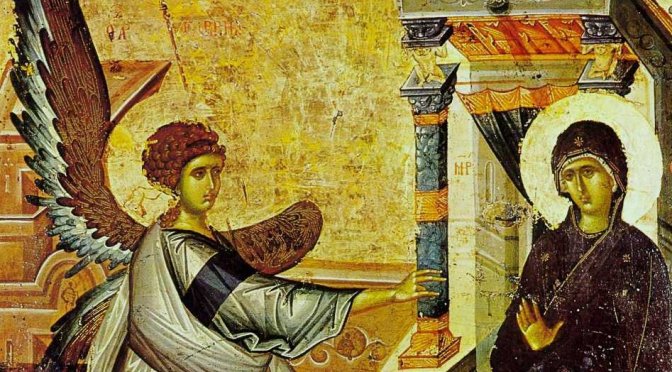
But the exciting images of Advent lessons didn’t end there. The best story of Advent – and one of the best of the whole year – was the story of the Angel coming to Mary. I loved hearing those fist words the angel speaks, I could imagine a young girl just going about her business in her room and suddenly somthing, someone beyond worlds appeared to her:

        Do not be afraid

Of course! Of course, the Angel would say that! Because meeting an angel would be the coolest and most terrifying thing ever!

Advent has the best stories, and they have stuck with me since being a kid. These days as a pastor, I start getting excited weeks ahead of when I have to preach them. I start letting those words of John, those words of the Angel and words of Mary percolate in my mind so that I am ready to preach them when the time comes.

Increasingly the past few years, Christmas has been creeping into Advent. Sure there have always been Christmas parties during advent, and choir/band/orchestra christmas concerts, and Christmas displays in malls. But Christmas seems to more ubiquitous than ever and before Advent even starts.

And maybe I didn’t notice it as much as kid, but it feels like the whole world is joining in the generic Christmas celebration. Almost everyone celebrates Christmas these days, whereas Christmas used to be a mostly churchy thing to do… or at least not a very big deal to non-religious folk.

And who am I to judge? If the secular world needs a cultural celebration to fend off the darkness of winter, to spread joy and cheer, to make an excuse to give and receive gifts, than great! Christians appropriated Christmas from pagan winter solstice traditions, why can’t the secular world borrow Christianity’s holy day in order turn our dark time of year into a celebratory time?

It is even interesting to watch the secular world work out how the commercial and cultural celebration works for it and I am fine with that. This year there was a movement in Canada to keep stores from putting out the Christmas displays until after Remembrance Day (Nov. 11th). Many stores start their Christmas campaign November 1st, right after the halloween campaign has been put to bed with a candy hangover.

Despite my willingness to share Christmas, the people I don’t get are the Christians who start fighting this fictitious “War on Christmas” around November 1st or 12th. Even government officials are capitalizing on this unfounded fear that the phrases “Happy Holidays” or “Season’s Greetings” are going to take the Christ out of Christmas. Or that Xmas isn’t a long held Christian short hand. I think we are afraid of losing something and so we hold on more tightly.

The idea that Christians are in any way persecuted in Canada is about as absurd as saying Canadians don’t care about Hockey. But I will leave the persecution bit for another post.

What bothers me about the War on Christmas is that its real opponent seems to be Advent.

Christians seem to forget that Advent even exists. Maybe instead of being offended by Happy Holidays, we should be correcting Merry Christmas with Happy Advent.

Because here is the thing: Christmas needs Advent.

We need Advent.

Christmas without Advent is like giving birth without pregnancy. It is like opening a novel in the middle of the story. It is like skipping the first half of every movie you watch.

It is like Easter without Good Friday, or the story of the Fall in Genesis without the story of Creation and paradise, or the story of the Israelites coming to the promise land without the story of leaving Egypt.

So often we want to make Christmas about idyllic manger scenes with little drummer boys, sheep and donkeys, angels and shepherds, when Christmas is about un-wed mothers, the oppression of Empire, and the slaughter of children.

I think we want to imagine Christmas an unblemished perfect little story, because we are afraid of the darkness.

Advent reminds us Christmas is not about nostalgia and sentimentalism. It isn’t just singing Silent Night while holding a candle on Christmas Eve.

We need Advent because it tells us the whole story. It tells us the deeper story. John the Baptist, the Angel and Mary are not just cool characters in rich narrative. They are powerful symbols and reminders that we are still Advent people.

Advent reminds us that Christmas – that the birth of Messiah – is for a world still waiting in darkness, still waiting for justice, still waiting for healing. Advent tell us that Messiah isn’t just a cute baby born in a barn to poor parents. Advents tells us that Messiah is God’s answer to human darkness. God’s light sent to people living under the thumb of the Roman Empire, people living under the oppression of white privilege in Ferguson and Staten Island, people living in the systemic poverty imposed on the Indigenous people of Canada, women living under the constant threat of sexism, misogyny and sexual violence, people who practice a religion different than the empire’s being forced to celebrate holy-days that the White Christian Empire accuses them of taking away.

The symbols of Advent still draw me in just like they did as a kid. Even though I am the one putting on the blue stole, and reading the words of John the Baptist, the Angel and Mary. And even when I get crochety because Christmas music is playing in the malls in the middle of November and my Facebook feed is full of people worried that Christmas might lose Christ because someone wished them Happy Holidays, Advent reels me in.

Because I need Advent too.

I need Advent and its promise of a new world, its hope given to a world that feels hopeless too often and because of those four little lights that push away the darkness in order to make room – to make room for Messiah.

Messiah who is already here, but still on the way.

So do not be afraid.


What does Advent mean to you? How do you observe Advent? Share in the comments, on the Facebook Page: The Millennial Pastor or on Twitter: @ParkerErik

The Crime of the Parable of the Talents

Matthew 25:14-30

Then the one who had received the one talent also came forward, saying, `Master, I knew that you were a harsh man, reaping where you did not sow, and gathering where you did not scatter seed; so I was afraid, and I went and hid your talent in the ground. Here you have what is yours.’ But his master replied, `You wicked and lazy slave!… (Read the whole passage here).

Sermon

This parable of the talents is a familiar stewardship parable for us. It has been preached that talents are gifts of time, money and abilities that we are to give to the Church. We all have been told that God gives us gifts that we should return to the church, and not just return to the church, but return twice fold. This is stewardship we are told, stewardship at its best. God has given us all that we have and so as good little Christians we should give back twice as much. We should give back twice the amount that God gives us. We limited, finite, terminal creatures of creation must give back to the Almighty creator, twice what we have been given. Surely some of us must be wondering how on earth this will work.

Perhaps it is that preachers seem to like this parable too much. Maybe the chance to use Jesus’ words to scold the poor folks in the pew for not giving enough simply cannot be resisted. Maybe the chance to say something that sounds like good pastoral care advice for those who come asking how they can participate in the life of the church is an opportunity that this parable provides, and an opportunity that should never be wasted. Maybe the chance to guilt those who only take and take from congregations, into giving a little back, is just too tasty to let be.

But, is this parable really about a God who guilts us into giving? Does the God of stable mangers, the God of nail pierced hands and feet, the God of empty tombs and being known in breaking bread really operate with guilt trips? Does this God really say “look at all I have given to you… and now you owe it back twice over… or at least give me the going interest rate”. Is God really like this harsh master who steals from his neighbours, who makes threats like: “For to all those who have, more will be given, and they will have an abundance; but from those who have nothing, even what they have will be taken away.”

The reality of this parable is that it is about real money and not so much about talents  like playing the organ, or hammering nails, knitting sweaters, or public speaking. And making this parable about our gifts and skills is a disservice to the meaning of this parable. The Greek word, “Talonton” can only be understood as a large sum of money. Its measured in gold or silver, its 10 to 15 years wages, one talent can be anywhere from one thousand to a million dollars…  And the rich man who gives talents to his servants seems to be so rich that he is able to play around with millions of dollars. It is estimated that the 5 talents given to the 1st servant could have been worth anywhere from 1.2 million to 5 million dollars today. The rich man is so rich that money has become a toy for him, not to mention the lives of his servants.

Sounds a lot like how God treats us?

No, not really.

This rich landowner can only be passed off as God-like when we make greed and power true God-like qualities. We can only call this money a gift when we imagine money to be more important than anything else in our world. We can only see this parable as having something to do with stewardship when making money is something noble and divine, no matter how we make it.

Like last week’s parable of the 10 Bridesmaids, the parable of the talents cannot be reduced to straight forward comparisons. God is not the rich man, and we are not the servants of varying financial ability. In fact, if we really think about where God is in this parable it is not so easy to see. To demand profit, to make money on the backs of others, to worship greed and power and the almighty dollar are such human qualities.

And yet, when we consider the 3rd servant. The one who buries the 1 talent in the ground in fear… there is more to his story when we take the time to consider it. The 3rd servant is portrayed as a coward, yet he is the only one who refuses to participate in the system of greed, wealth and power. He is the only one who speaks honestly and boldly to the rich man. He is the only one who names the truth, that the rich man is harsh, that he steals and he is judgemental. And what does all this get the 3rd servant? It is gets him cast into the outer darkness with nothing.

Sounds familiar doesn’t it?

In fact, it is the story of the chapter of Matthew that follows this parable. It is the story of Good Friday. The story of another servant we know, one who speaks truth to human power, and who is killed and then buried in the ground, in the tomb, just like that 1 talent.

The parable of the talents when preached as if it were lesson in stewardship is a crime against the people sitting in the pews. Preaching that talents are something we ought to return to two-fold to God does not do justice to the story of God among us, the story of the creator come down to creation.

Earning money or interest has nothing to do with the story of God who entered into our grieving, to grieve with us, to share his own broken body and shed blood, but also to proclaim the unearthing to come. To proclaim that the true things of great value that we bury in ground shall be raised up, with New Life and with New Joy.

The idea of doubling our money for God makes no sense to the God who proclaims us, proclaims all of creation to be of the greatest value and worth. Today, instead of telling us to give our talents, gifts and time to God, God is declaring that the unearthing Christ, the one buried and then raised from the dead is not interested in wealth and power, but instead interested in us. Christ is interested in showing a nothing, failing dead humanity, that even when we are dead and buried, there is New Life unearthed for us.

Amen. 

A Reformation Sermon for Canada and the Ottawa Shooting

John 8:31–36

36So if the Son makes you free, you will be free indeed. (Read the whole passage here)

Sermon

This week our nation has endured great tragedy.

On Monday two soldiers were run down with a car, and one of the them, Patrice Vincent died of his injuries. And then on Wednesday we all heard the news come over the radio, tv or internet. There had been a shooting on Parliament hill, a solider had been killed at the National War Memorial, and then there were shots fired inside Parliament. Security officials and police locked down Ottawa for hours as the rest of us waited to hear if there was going to be more… more gunmen, more bullets, more violence, more chaos.

In the days following, we learned just how dangerous this situation was. We learned that shots were fired just outside of the rooms where many of the members of our federal government were meeting. We learned that the gunman had passed by dozens of bystanders and had easily gained access to heart of Canadian democracy and government.

And since then, all Canadians have been shaken to some degree. And we have already seen the beginnings of over-reaction to this incident. We have heard our political leaders declare that our enemies will be punished and that our resolve to defend our freedoms will not be shaken. We have seen increased security measures across the country. We have even seen vandalism of a mosque in Cold Lake, Alberta.

As we are left to sort out what to make of these events, it is perhaps appropriate that today we gather on Reformation Sunday. Reformation Sunday is the day we set aside each year as Lutherans to remembers our 500 year history, and where we came from. We remember the catholic monk Martin Luther, whom we are named after, standing up against the injustices of the pope and the church – the selling of salvation, the abuses by church leaders, the exploration of the faithful. We remember that our faith and our beliefs are important. Important enough to die for, important enough to defend.

But on Reformation Sunday we also remember the division that change caused. We remember that people did die because of Martin Luther’s actions. We remember the between 125,000 to 250,000 people that died in the peasants war that resulted. We remember that after Martin Luther nailed his 95 theses to the door the church in Wittenberg, Christianity was split from 2 denominations (Roman Catholic and Eastern Orthodox) into as many as 25,000 today. And these divisions have been caused violence, chaos, oppression, abuse, suffering and death for 500 years.

Reformation Sunday is day of two realities. Of promise, hope and freedom, contrasted by division, conflict and oppression.

Today, you might notice the red parents that adorn the chancel area. Red is one of the 5 liturgical colours, but it is only used a handful of Sundays each year. Red is the colour we use to symbolize the Holy Spirit. The changing, transforming, reforming work of the holy spirit among us. Red is used on Pentecost when we celebrate the Holy Spirit coming to the disciples, and today Red is for Reformation. However, as Canadians, we might take some liturgical and theological license and think that Red reminds us of our national colour and of the the reality of tragedy, fear and death in our midst. And lastly, Red is used to remember martyrs in the church.

And while the gunman may or may not have considered himself a martyr, we have discovered that Cpl. Nathan Cirillo is in fact the martyr this week, the one who died for principles and for a cause.

Even still, as we are left to make sense of tragedy, Canadians have discovered signs of courage and honour this week. Even as the events of Wednesday unfolded, we saw our news broadcasters deliver calm, respectful, accurate reports of the events, rather than sensationalism. And then the courage of Sergeant at Arms Kevin Vickers was revealed, recounting his dramatic actions that ended the danger and prevented more violence. Then there are the residents of Cold Lake who showed up to clean, repair and show support for the mosque that was vandalized only hours earlier. Then there was the political cartoon from Halifax that captured the emotions of a nation, as it depicted one of the bronze world war one statues on top the of the tomb of the unknown soldier stepping down to Nathan Cirilo below, where only the recognizable feet and argyle socks of his uniform could be seen. It was as if those soldiers from a hundred years ago was saying, “You belong here with us.”

https://twitter.com/sladurantaye/status/525264341168185345

And overwhelmingly, the rhetoric since Wednesday has been for Canadians to remember who we are. To remind us not to lose ourselves to grief and fear, to remember that we are a nation of peace and openness, that our values are about tolerance and freedom.

It was been a week of mixed emotions, of conflicting experiences, of hard-to-make- sense of events. And fittingly, Reformation Sunday is about that too. About the conflicting experiences of division, conflict and war that accompanied the Reformation, as well as the striving for justice, the proclamation of grace and mercy, the hope we have in God’s promises.

God’s promises like we hear Jesus utter today, promises like,

“So if the Son makes you free, you will be free indeed.”

And if there is anything to remember today it is that.

Even as Canada struggles with tragedy and celebrates the heroism born out of it. Even as Reformation Sunday demands that we recall the both the gospel proclamation of Martin Luther and the reformers, the bold declaration of grace through faith alone, that there is nothing we can do to earn God’s love and that this belief is important enough to stand up for contrasted with the division, conflict, violence and suffering caused by the reformation. Even as these realities both this week and 500 years old sit with us, ultimately today is not about those things. Today is about what each Sunday is about for Christians.

Today is firstly about Christ. Today is about God and God’s mighty deeds among God’s people. Today is a reminder we simply cannot save ourselves on our own.

Just as in today’s Gospel readings the Jews said that as descendants of Abraham they were slaves to no one (even though they had been slaves to the Egyptians, Babylonians, Persians and now Romans). Just as Martin Luther declared that he and we we were not slaves to law and freed by God’s grace (even though he was threatened by the Pope and others). Just as Canadians declare that we will not loose ourselves to fear, to revenge, and hate.

We are still slaves to all of those things. We are slaves to enemiy nations. We are slaves to the law. We are slaves to fear, fear of the other, fear for our safety, fear of losing power.

No matter what our leaders declare, no matter the bravery we display, the sacrifices we make, the peace we try to uphold. We simply cannot save ourselves. We simply cannot free ourselves.

We are slaves to sin, slaves to suffering, slaves to death, and there is nothing we can do about it.

And that is why today is ultimately about Christ.

Today is about the promise that God gives to slaves. To those enslaved by sin, those enslaved by suffering, to those enslaved by death. Today, is about the promise that God gives to us. The promise that despite our condition, despite our slavery, that God is showing us mercy, God is giving us grace, God is making us free. Free in the son.

And this promise of freedom comes to us first in baptism. In baptism where we drown and die to sin, and where we rise to new life in Christ.

So perhaps it is fitting today, that we are going to extra lengths to celebrate those promises of baptism, because confirmation is really about baptism, about these young people in our midst recognizing their baptism, recognizing the promises made to them in water and word, made by God.

And just perhaps it is a powerful act of defiance against violence, against oppression, against fear for us to bless and support our confirmands. Perhaps it is beautiful act of hope that not only do we welcome again these young people into the Body of Christ, but we pass on this church, this faith, these promises to them. Even while we are slaves to sin, to suffering and most of all to death, we pass on our hope for the future to these young confirmands. A future promised by God in the midst of slavery. A future given by grace and mercy, even though we are dead. A future found with New Life in Christ.

Amen.

A Sermon for a Confirmation Class that isn’t Coming Back to Church

Matthew 22:15-22

…Then he said to them, “Whose head is this, and whose title?” They answered, “The emperor’s.” Then he said to them, “Give therefore to the emperor the things that are the emperor’s, and to God the things that are God’s.”… (Read the whole passage here).

Sermon

This morning, after hearing 10 faith statements from our confirmands, we hear Jesus and the Pharisees having a discussion. They are debating how to be someone who has faith in God, and someone who lives in a world full of political and economic powers that divide our attention and allegiances. Do we ally ourselves with God, or Caesar, the symbol of world power. It is all part of our journey through the Gospel of Matthew that began last year, but particularly through the summer we have been hearing Jesus’ teaching along side of our human desire for control, power, easy answers, black and white categories and so on.

And it would seem natural at this point to tie confirmation or affirmation baptism that we will celebrate next week with some kind of choice to stand up for faith, for you confirmands to become “adult Christians.” Kind of like the choice between God and Caesar that Jesus is talking about today. And yes, confirmation has that aspect to it. There is something distinctly adult about standing in front of the church and sharing out loud what Jesus means to you. And some think that confirmation is about making the adult choice to stand up for Jesus.

So confirmands, I think it is important to recognize what you have just done. You have been bold and brave to share your faith and to do it in front of the whole church. But not only have you done that, but you have shared your faith statements after more than two years of study and learning, of classes and community, of coming to this strange place with these strange people while most if your peers and friends were sleeping in on Sunday mornings.

Now your bravery this morning is certainly an example to the rest of us, and we are all proud to see you, our young people, standing among us sharing your faith. But some honesty in this moment is called for as well.

This may be difficult to hear, but bear with me. After the last two years of classes and studying and learning about faith, a lot of you, maybe even most of you will not come back to church very often after next Sunday. A few of you might become regular and active church members, but likely not many. And after today, there will be a lot of things, a lot of other options that will pull you, and that pull all of us away from church and away from faith.

But the options and other things to do on Sunday mornings are not the only thing that will pull you away. And again bear with me.

The things that we talked about in confirmation God, faith, church and the bible, are probably not things that your parents talked much about with you. And studies show that if faith is not talked about in the home, the chance of youth staying involved in church is very low. But this is not about blame. Your parents didn’t talk about faith to you, because their parents didn’t talk to them about faith. And your grandparent’s parents didn’t talk to them about faith.

And even though the small catechism that we used in confirmation to help us learn about the ten commandments, lord’s prayer, apostle’s creed, baptism and communion was written by Martin Luther for parents, particularly fathers to use to teach their children about faith… the church for hundreds of years has been making people think that God and the bible can only be talked about and learned about at church. And that is our fault – pastors and church leaders fault – we are to blame for why parents are not teaching the faith to their children.

So confirmands, (and families), you have now heard me say that most of you will probably not be back to church after next Sunday. But I want to be clear that this is not to make you feel bad. In fact, if the reason you and your families come to church is because you feel like you should… then I don’t want you to come. Church is not a should. Faith is not a should. God is not a should. But back to that in a second.

Remember the debate that Jesus has today about the Emperor on the coin, giving to God what is God’s and giving to Caesar what is Caesars. This is not an easy task. If we feel like we should come to church, but we want to sleep in, or do homework, or go shopping, or play sports, or dance, or whatever… we might try to go to church like good little girls and boys should… but that will last only a while until what we want to do seems much more interesting.

Giving to God what is God’s sounds nice, but let me tell you, giving to Caesar what is Caesar’s is a lot more fun.

And here is the thing about church.

If you are looking for great music, the radio will always have something that sounds better. If you are looking for an entertaining sermon, tv and movies will always be more appealing. If you are looking for food that tastes better than bread and wine, any restaurant has better. If you are looking for fun youth events, family programming, or seniors groups, the YMCA, the mall or and most community groups can do more than we can.

The church is just not as cool as the world, as cool as Caesar’s stuff and so the church won’t be entertaining enough to make you come. Guilt won’t be enough to get you out of bed on Sunday mornings. Becoming regular church attenders after next Sunday is something you will have to want to do. And our responsibility is to make this place somewhere that you would want to be.

And so what does the church have offer? What would make you want to come instead of feel like you should?

Remember Jesus talking about Caesar and God. When the Pharisees asked Jesus about paying taxes with Roman coins, he asked for a coin because it has the picture of the Caesar, the emperor on it. And next to emperor’s picture two words were printed – “Caesar God”. The romans thought that their Emperor was God, and so when Jesus said, give to Caesar what is Caesar’s and give to God what is God’s, he wasn’t really talking about this choice between God and the world. Caesar and his image on the coin represented humanity’s desire for control, our desire to be powerful, our desire to define God and Godly power. Jesus is reminding us that this is not true. Jesus is saying that we don’t always get to decide who we are, nor do we get to say who God is.

The world, things like school, sports, shopping, tv, dance. Things like power, money, security, control, black and white answers etc… these things are trying to tell us that we get to decide who we are. That we can be anything we want. A rock star, an NHL hockey player, a marine biologist, a doctor, that we can be rich, young, never sick, famous and powerful.

So what does the church, what does God tell us? Here at church God doesn’t let  us decide who we are, but tells us who we are. God tells is in Baptism that we belong to God. That we are children of God and that is the most important identity we have. In communion, God tells us what we are members of the Body of Christ, of this family of faith that gathers here at Good Shepherd and that gathers as Christians all over the world. God tell us who our family is, God gives us brothers and sisters in faith, who are there for us when we struggle, there for us when we celebrate, there for us in daily life.

In God’s church, we are welcome no matter what. We don’t have to be anyone special, we don’t have to be achieve anything, or commit to anything. In God’s church, we are not told us that we should do anything. In church we hear what God has done for us, we hear how Jesus is working in our lives, and we are promised that when we fail, when we are broken and suffering, and when we die, that God is there putting us back together, giving us new life.

So confirmands, today you have given us your faith statements in front of family, friends and the congregation. You have been brave and bold to speak, and we are proud. And while I reminded you that confirmation is not graduation from church, meaning after next Sunday you are not done church, but invited to engage church more. Don’t hear the message today that you should come to church. Faith, church and God are not things you should do.

Instead, hear today that in this place, with these people, with this God you are welcome no matter what, that you are a part of this family and that you belong here and belong to God. And when all those Caesar things, those world things fail to turn you into the things you want to be, here you will always belong, always be family, always be loved. Here, God will always tell you who you are.

Amen. 


Have thoughts on should go to church vs. want to come to church? Share in the comments, on Facebook: The Millennial Pastor or on Twitter: @ParkerErik

Confessions of a High Church Millennial

I have a confession to make. It will probably be surprising for many to hear from a millennial:

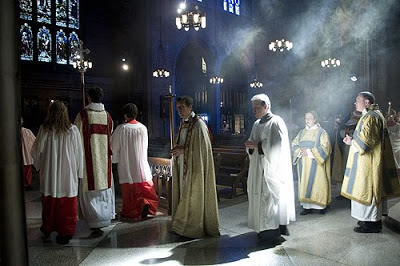
I am a high-church liturgy nerd.

For many of my 31 years in the church, I have been told that my generation is a group of moths attracted to the glitz and glamour of projections screens showing videos in church, electric guitars and drum kits playing the music we can hear on Christian radio and cool, hip preachers who speak “authentically.” And sure, I have been to my fair share of churches, campfires, and youth services that cater to the “youth.” I have even enjoyed them greatly!

Somewhere along the way, this has led to the assumption by everyone (and no one) that my generation’s desire is only for the new. And this desire is often held up along side our narcissistic tendencies to take selfies, post our dinner plans on twitter, and live in our parent’s basements.

It just so happens that these same lazy narcissistic millennials are currently the concern of so many church members. Churches spend a lot of energy worrying about what interests us and wondering why we don’t come to church (anymore).

I know millennials are not the first generation to be the object of the church’s and society’s attention. When I was a little, churches were trying to be contemporary then too… trying to attract boomers and their young families with 70s folk music. As a child of the 80s, my church had more than a few 30-40 something guys standing behind lecterns with guitars, singing special music that sounded like an Eagle’s song with Christian lyrics.

And then Generation X got its 15 minutes of attention…During my tween and teen years, the Gen-Xers were doing Friday night youth services once a month with songs from artists like Brian Doerksen, Petra, Amy Grant, and Third Day. The Gen-Xers, we were told, would come for this. As a teen watching this unfold, I hadn’t quite processed what it meant for the church to be so concerned with making sure 20 somethings stayed in church. I didn’t understand why Friday night youth services, token 20 somethings on church council and money for expensive sound systems and projectors was going to keep the young adults, just a little older than me, in church.

Yet, despite all the catering to what the young people supposedly want, what I do remember from church of my childhood is liturgy.

image source - http://ultraspike.blogspot.ca
image source – http://ultraspike.blogspot.ca

When we were all together as a community, when we gave up as much as we could trying to cater to what will attract the youth, or appease the seniors, or keep the young families interested, or make the boomers happy, we did simple Lutheran liturgy. 

Now don’t get me wrong, it was low-churchly Lutheran liturgy.  Which is to say our worship felt a bit like eating vegetables; it was good for us, but no one really liked it. Or at least we acted like we didn’t like it.

Our worship was billed as being everything from “Bach to Rock,” but the liturgy was more of a timeless aspect of our worship. As a kid and then teen, I could feel the prayers, the liturgical songs, the actions of standing, sitting, praying, responding, receiving were starting to ingrain themselves in my very body. I remember myself starting to set the hymnbook down more and more. I would simply pray or sing or respond. The phrases like “And also with you” or “Thanks be to God” or “Amen” started to come naturally and unbidden.

Interestingly, our low church Lutheran liturgy, that felt like eating vegetables, connected our whole congregation much more deeply than any of the things that we did to attract different generations. Weirdly, we all liked it. We all shared in it. In fact, we came to the same worship service because of it. Liturgy doesn’t distinguish between generations. It’s kind of like how I don’t play Xbox with my grandma, and she doesn’t knit with me. But we both know how to sit down and share a family meal.

Liturgy ties us together, rather than emphasizing our personal or generational experiences. Liturgy is timeless and when we can get past whether we like the tunes or instruments playing them or not, we can realize that these things we do, and repeat together, are biblical, rooted in the ancient Church and are about God. In fact, liturgy at its best makes us forget it is liturgy and instead helps us see God in out midst.

In a recent blog post, Rachel Held Evans, who is an Evangelical trying out Episcopalian worship, writes:

I am folding laundry, its starched, orderly scent a sort of incense, as the hymn rises to my lips. 

“Glory to God in the highest, and peace to his people on earth. Lord God, heavenly King, almighty God and Father, we worship you, we give you thanks, we praise you for your glory…”

I can’t remember the rest of the words exactly, and the tune meanders a bit, so I improvise, prompting Dan to shout from the other room, “Hon?  You okay? You crying about something?” which happens just about every time I burst into spontaneous song because, apparently, my version of a joyful noise remains indistinguishable from a sob.

Still, I sing on.

“….For you alone are the Holy One, you alone are the Lord, you alone are da da da da la la la la.” 

It is a season of new songs.

(Read the rest here…)

Like me, she is a millennial and a Christian (if you haven’t discovered her blog, you are probably living under a rock). If the two of us were to sit down for coffee, I would tell her that this will only get worse (or better). Way worse.

When you become a liturgy person, all those familiar texts like the Gloria (which is what Rachel was singing) start to come to your mind like the baseball stats that so many dads seem to know – they come automatically. Worship starts to take on a rhythm and pattern that you can’t escape. You will eventually find that worship is something where you always know what is going to happen next, or that your body knows what to do next. The things that change start to rise to the surface and catch your attention. After the familiar Kyrie and Gloria, which are the same week after week, the collect and scripture readings, which change each week, stand out. Liturgy helps you to identify the new and changing things of worship, by keeping you grounded with the constants.

And still, it gets worse. When you are a liturgy person, you can show up for Anglican, Episcopalian, Roman Catholic or Lutheran worship and generally know what is going on. You might even find yourself singing songs you have never sung before because you already know the words.

In my development as a liturgy person, my low-church, eating-our-vegetables, experience of liturgy as a child and teen morphed and grew into something more as I went to university and then to seminary. As I learned more and more about the meaning and history of the symbols, I fell in love with the richness of it all. I became high-church. I became a liturgy nerd.

And I am going to make a bold claim because of this.

Liturgy can engage the young people.

I am not saying that non-liturgical worship is wrong, or won’t “attract” millennials. In fact, I know many of my generational cohort who have abandoned liturgy for praise bands. But like Rachel Held Evans shows, some are coming the other way. Contemporary worship is not something I am looking to critique, but rather I am suggesting that all those criticisms of liturgical worship is simply unfounded.

I am a millennial and I am drawn to tradition, to wrote prayers, to words passed on to me from generations before. The symbols and ritual actions point to God in ways that nothing else has in my experience, not sunsets or Christian radio, not preachers with graphic T-shirts and 45 minute sermons. I don’t think I am alone. I am not saying that every millennial wants what I want. Liturgy is what it is, it doesn’t really sell itself. And I think many of my generation are not interested in being sold faith.

So to my liturgically minded brothers and sisters in faith: Let’s stop worrying about being something we are not. Let’s not try to be contemporary like the Baptists down the street while still somehow still being us. And for heaven’s sake, lets not do liturgy like it is eating vegetables. Let’s see liturgy as the beautiful meal of diversity and rich flavours that it can be.

We will never be the mega-church contemporary worship that we think all the millennials have left for. And the narrative that we need to be that to “attract” the young people only shows them that we have an identity crisis, and that what we are, is not worthy of our youth. I am sure many millennials find that off-putting… I do, and I am a pastor in a denomination with an identity crisis.

Instead, let’s be what we are. Let’s use the tools that we know how to use. Let’s preach the Gospel and point to God at work in our world with the liturgy we have been given.

And remember, as surprising as it may be to hear that one millennial is a high church liturgy nerd… it might be even more surprising that there are a lot more out there.


Are you a liturgy nerd? Do you think liturgy can engage millennials? Share in the comments, on the Facebook Page: The Millennial Pastor or on Twitter: @ParkerErik

As usual, thanks to my wife, Courtenay for her edits and insight. Follow her at @ReedmanParker on Twitter.

PS

If you like what you read on The Millennial Pastor, you can vote for this blog on Christian Piatt’s list of top 25 Christian Blogs of 2014. You might have to scroll down the list a bit, but as of this post, I am in the top 50.