Tag Archives: ministry

The Widow’s Dead Son and Interrupting Jesus

Luke 7:11-17

When the Lord saw her, he had compassion for her and said to her, “Do not weep.” Then he came forward and touched the bier, and the bearers stood still. And he said, “Young man, I say to you, rise!” The dead man sat up… (Read the whole passage)


In this third Sunday of Ordinary Time, we hear the second part of a story that really began last week. Jesus was simply minding his own business when the Centurion sent for him to come and heal his beloved slave. Jesus was surprised to find such faith in this Roman Officer – a gentile and an enemy, but the slave was healed.

Today, the story is much the same. The focus is on a grieving loved one. A widow whose only son has died, is processing with the community to the grave where she will say goodbye to her son.

But beyond this shared grief over the death of a loved one, the widow and Centurion do not share much else. The Centurion was a man of power and control. He existed almost entirely outside of Israelite society, other than to command the military force occupying the land.  The Centurion was faced with the loss of a slave, someone who served him.

The Widow is a person of weakness and dependance. She is completely dependent on the structures of society around her. She would have first been a servant to her husband, and then to her son. She would not have been permitted own land or to make money on her own. Without her son to provide for her, she would be left destitute, reduced to begging on the streets, dependent on the charity of society around her.

And yet, before they encounter Jesus, the Centurion and the Widow are equals before death, there is nothing they can do about it on their own. Perhaps that is why the Centurion, being a man of power, tries anything, reaching out to a local rabbi and healer knowing that this something outside his control. Perhaps that is why the widow is simply accompanying he son to the grave, here again is another confirmation that she no power in her world.

And so with no other recourse, the Widow is doing the only thing that she and her community know how to do. They turn to the rituals that can add the tiniest bit of dignity to the death of a loved one. They have gathered for worship, they weep and mourn, they console one another and pray. And now they are marching to the grave of this dead son. They are doing the only thing that they can do at a time like this.

But the widow is not just marching her son to the grave. She has marched her husband before her son. And now that her only son has predeceased her, her life as she knows it over, and she will soon become a forgotten widow surviving on scraps in the streets. She is marching to her own grave too.

Like the Centurion, like the widow, we too occupy the same place in life. When we stand before death, we have no power over it. It happens to all of us, weak or strong, powerless or powerful.

And like the widow today, we have the same response. When we are faced with death in our community, we gather together to do what we can to add some dignity to tragedy. We gather for worship, we weep, we mourn. We console one another and we pray. We offer hugs and casseroles, we do all that we can. And do these things without question, because these things are all we have in the face of death. This is what powerless creation, powerless humanity can do in the face of death.

And so the widow and her community do that know, they take this dead son to his grave as best they can.

Yet… while they are focused on the task grieving and mourning, of doing the last things for a loved one… Jesus does something that neither that the widow and her community would ever expect.

Jesus interrupts.

As the widow walks with her dead son to his grave, Jesus interrupts the whole funeral procession. There is no mention of a request for healing, there is no mention of the faith of the son or widow, no mention that they even knew who Jesus was.

Jesus interrupts and raises the dead son to life.

Jesus interrupts this community focused on the task of attending to and adding the smallest dignity to the death of one of their own… Jesus interrupts in an almost playful, even flippant, manner.

Yet he is touched by the widow’s hopelessness and helplessness. “Do not weep” he says.

It is out of compassion he walks up to this woman who has not seen him. He walks into the widow’s broken community and reaches out to death.

Jesus interrupts the flow of the last things and brings the steady march of the inevitable to a halt. The pallbearers stop in their tracks.

Death stops.

Death stands still.

And then Jesus does the unimaginable: he commands the widow’s son to rise.

Death hears the Word of God speaking.

Death hears the words of the Lord of Life:

‘Young man, I say to you, rise!’

And the dead man sits up.

Jesus’ compassion for the widow, his compassion for the community turns their world upside down. Jesus shows up at this funeral and interrupts the un-interruptible. Jesus stops the most powerful force known to humanity, and Jesus sends death away.

And Jesus raises not only the son, but the mother. But not only the mother, but the whole community. But not only the community, but us too.

Jesus raises us from the dead, just as the son was raised. Jesus raises us in this community week after week in the words of forgiveness and mercy, in the Word of God that we proclaim to one another, in holy baths where we are washed with grace, in holy meals where we are fed with love. In this community, with the very things that we fall back to when faced with death, with tears and prayer, casseroles and consolation, Jesus us raises from the dead.

Today, Jesus interrupts. Jesus interrupts the widow on the way to her grave. Jesus interrupts the ritual of the last things that consumed all the attention of the community and turns their words upside down, turns the finality of death into the beginning of new life.

And Jesus interrupts us too. Jesus interrupts us at our graves, Jesus interrupts our deaths. When we are powerless in the face of death, when we are consumed with the last things. Jesus comes along, interrupts our community and makes us sit up with the command:

People of God, I say to you, Rise!
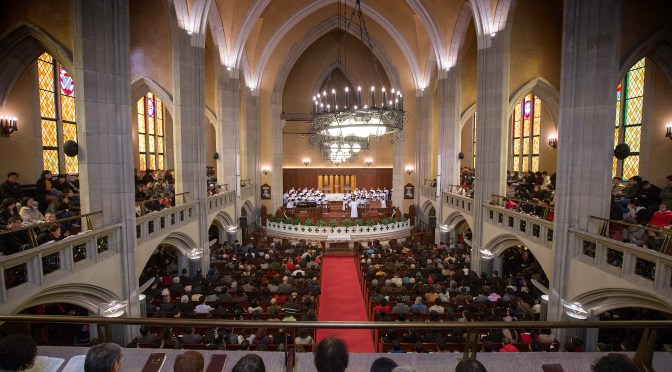
A Full Church is not Measured by the Number of People

John 10:22-30

At that time the festival of the Dedication took place in Jerusalem. It was winter, and Jesus was walking in the temple, in the portico of Solomon. So the Jews gathered around him and said to him, “How long will you keep us in suspense? If you are the Messiah, tell us plainly.” Jesus answered, “I have told you, and you do not believe.

(Read the whole passage)

Today is Good Shepherd Sunday. Each 4th Sunday in the Season of Easter is reserved to hear about Jesus the Good Shepherd. And here at Good Shepherd Lutheran Church, we could consider this Sunday an opportunity to celebrate our congregation. Just as congregations with names like St. Matthew’s, or St. John’s often celebrate on the feast days of their saints.

But this year we get short changed in the shepherd department. We are in the 3rd year of our 3 year cycle of readings for each Sunday. And last year and the year before, Good Shepherd Sunday got the good readings. “I am the Good Shepherd” readings. Today we get a passing reference to sheep and that is it.

In fact, as we encounter Jesus, it is an entirely different celebration. The festival of Dedication. Or more commonly known as Hanukkah – nothing to do with shepherds.

Instead of Shepherds, sheep, meadows and spring, we get the dead of winter. Jesus is walking through the temple, the Portico of Solomon. A space along the East wall where crowds would have gathered to celebrate Hanukkah – a winter festival of lights. It was an 8 day celebration to commemorate how the temple had been liberated 200 years earlier from oppression by the Seleucids – the empire of Alexander the Great. The liberating rebels found the temple defiled and the only undefiled thing was a sealed bowl of olive oil, enough to light a lamp for one day. But the oil lasted 8 days, long enough to complete the ritual cleansing.

Hanukkah, this winter festival of lights was a time for families to gather, to remember how they had been freed from oppression and how the nation of Israel had been restored. But by Jesus’ day, the celebration would have been bitter-sweet. The people now lived under different oppressors – the Roman Empire.

And so the crowds gathered at the temple for Hanukkah see Jesus, and they are looking for liberation again. They want to be saved, restored to former greatness, they want control of their destiny and future. They press in on Jesus wanting answers. They long for the day when their nation would be their own again – they want a Messiah to come and lead them to greatness, just like the rebels had done 200 years before. “Tell us plainly” they demand of Jesus, give us the quick and easy answer to our problems.

Jesus doesn’t give them answer they are looking for, instead he talks about sheep knowing his voice and people being snatched out of his hands. A cryptic non-answer for a crowd wanting a plain and straight forward response.

In many ways, the bitter-sweetness of celebrating liberation while living under oppression is something we know too. No we haven’t needed liberation from anything here in Canada. Nor do we know what it is like to live under oppression.

But we do know what it is like to feel like for our identity and place in the world to be taken away. On a day when we could be celebrating Good Shepherd, it is easy to carry concerns about the future. It is easy to feel like an older, thinner and more tired version of ourselves. It easy to feel like those crowds did, like we are celebrating something that is already gone from us.

This week as the ACTS group met for bible study and considered this gospel lesson, it was Jesus’ answer to the crowds that generated questions. One question in particular stuck with me throughout the week, “If Jesus says he won’t let us be snatched from God’s hand, what does being snatched out look like.”

What I think our group was really asking was, “If Jesus is the Messiah, why does it feel like our church is shrinking and dying. Why does it feel like the world doesn’t care about us anymore? Why do people who were once here, once parts of our family, once parts of our community, no longer come? What about all the people who are gone? Have they not been snatched away?”

The question that the ACTS group asked is most certainly on the minds of Christians all over. And it is one we consider lots here at Good Shepherd too.

And we get frustrated too when we just want a plain answer from Jesus, but he gives us something vague and cryptic. Or at least he gives an answer that doesn’t satisfy our questions.

When the crowds demand to know if Jesus is the Messiah, he rejects the premise of their question. “I have told you, and you do not believe”

The crowds are asking for their temple and nation to be restored. They want a Messiah who will bring back the glory days, who will make Israel great again (as some politicians these days are fond of saying). The crowds are looking to return to the glory of Hanukkah… to relive the story of human triumph in the world. Of one group overcoming and having power over another.

But this is not about God’s work in the world. They are not remembering the covenant with Abraham, God delivering them from Egypt, nor God giving them a King in King David (despite God’s objections). They remembering their own glory.

And Jesus is not talking about a Messiah King, or Messiah warlord or Messiah President. Jesus is talking about a Messiah who has been sent for God’s work in the world.

So what are we asking of the Messiah? What do we want Jesus to tell us plainly? Sometimes we get wrapped up in asking the Messiah to restore our church, to build our membership, to increase our attendance. Sometimes, without thinking, we can equate how we feel about church with how we talk about God. We say that our church is shrinking, dying, getting smaller, becoming tired, a shell of what it once was… we say that God seems to be shrinking, dying, getting smaller, becoming tired, a shall of what God once was in our world. How we feel about church is how we talk about God.

Jesus is reminding us that it is actually the other way around. How God feels and acts towards us is how we should be talking about church.

Who is here and who is not hear is not a measure of whether or not we have been snatched out of God’s hand. How many people keep up weekly attendance is not a measure of the church or the Good Shepherd.

Jesus is telling us today the fullness of the church, that the aliveness of the church is about what God is doing here.

The church is full because the Word of God fills it with the Good News of God’s love for sinners, for the broken, for the forgotten and marginalized. The church is full of God’s love for us.

The church is full because the waters of baptism overflow here with grace and mercy. Just as Jaxson is baptized this morning, so to are we reminded that because we are baptized too, that God’s grace is overflowing here, filling this place. The church is full of God’s hope for us.

The church is full because the bread and wine of new life are in abundance here. Because when the Body of Christ gathers, we become bread for the world and we are send out with good news for the world. The church is full God’s gifts for us.

Like those crowds gather for Hanukkah, we can easily can get wrapped up in wanting to restore former glory, with wondering what God is doing with a seemingly shrinking, dying place, with measuring our fullness by who is here and who is not. We can starting talking about God using the language of how we feel.

But Jesus reminds us of how God feels and acts towards us.  That the Messiah is about doing God’s work. And that God’s work fills this place, not with us, but with God. God fills this place with love and mercy and grace – God’s work done here and done for us.

Amen. 

Two weeks after the empty tomb – What now?

John 21:1-19

Jesus showed himself again to the disciples by the Sea of Tiberias; and he showed himself in this way. (Read the whole passage)

Sermon

My first day of being a pastor was a Sunday. There was a big celebratory service with special music, excited friends and family to cheer me on and a happy congregation. The day before I had been ordained, another big celebratory service with special music and crowds of family and friends. I took Monday as my day off. And then on Tuesday morning, with nothing in my schedule and as the only employee, I wandered over to the church building. I stood in my office wondering, “Okay, now what do I do?”

The third Sunday of Easter is a bit like that moment. Two weeks ago was the big service and celebration with special music and crowds. Last Sunday things died down, but it was still the after-party with Jesus appearing to the disciples and then to Thomas. But today, while resurrection is still heavy on our minds, we are left wondering now what?

John’s gospel tells us about the disciples who were in the same boat… literally. The disciples to whom Jesus has appeared to twice in the span of a week and empowered them for the ministry of the kingdom decide that fishing is the obvious next step. Peter, to be precise decides that now after following Jesus around for 3 years, witnessing miracles and teachings, the triumphal entry, the crucifixion, and the empty tomb that going back to what he knows is best. And few of the others agree, James and John sons of Zebedee, along with of all people scholars Thomas and Nathanael.

On the other hand, in Acts we hear about Saul on the road to Damascus. He is not two week removed from the resurrection, but about 10 years. Yet, the events of Easter have inspired him to zealously and murderously persecute Christians. And Ananias, the fearful follower of the way is hiding in fear, precisely of people like Paul.

All of these disciples, or soon-to-be followers of Jesus, have been affected by the events of Easter differently. They all make different choices in how to react to the resurrection, but they also share a similar experience. They are struggling to make sense of what the Risen Christ means for them and for their world. They have heard the Easter stories, they have lived them in fact, but they are as lost as anyone in how to move on from that world changing moment.

This odd collection of followers of the way of Jesus, are just like any group of people who gather to become the church. They are just like us. Perhaps we are like Peter, bold to risk it all in one moment, and then timidly back to business as usual in the next. Perhaps we are like Paul, concerned that everyone around keep the rules just as we do. Perhaps were are like Ananias, faithful yet fearful of showing that faith. Perhaps we are like James and John, Thomas and Nathanael, interested and engaged, but easy influenced to try the next thing that comes along.

Like those varied disciples, often the only thing that binds us all together as followers of the way, as the body of Christ gathered here, is our common belief in the Christ and the resurrection. Follow by our shared struggled with just what to do with this good news.

The early church called themselves followers of the way rather than Christians. They wanted to emphasize that they followed the way of a living person, which is not always easy or clear. Kind of like following someone in a busy crowd, it easy to get jostled and shoved about, to lose sight of the one we are following.

Today, two weeks out from Easter, the reality of the Risen Christ is a confusing struggle. It was all a big party on that Easter morning, but today we are left to sort out just what happens next. And considering pillars of the faith like Peter and Paul, James and John, Ananias, Thomas and Nathanael struggled to sort it out… what chance do we have? Are we supposed to go knock on doors to ask people if they have heard the good news? Should we all find ten friends to bring to church? Do we need to pray in public more often? Should we be preachy and pious like Christians on TV?

Being followers of the way is not easy two weeks out from Easter.

As Saul marched down the road to Damascus, on his way to enforce the rules he thought were right, Jesus met Saul where he was.  Jesus didn’t just meet Saul, but Jesus blindsided him, blinded him literally. Jesus met him on the way and redirected his path. The encounter with Jesus changed the course of Saul’s life. Saul became Paul.

As Ananias hid away in fear, Jesus met Ananias where he was and encouraged him to go despite his fears. Jesus called Ananias to be the hands and feet of Christ, to help Saul become Paul, to welcome Paul into the body of Christ. Ananias’s life was changed.

As Peter returned to the fishing boat not knowing what to do next after the resurrection, Jesus called to him from the shore. Jesus met Peter where he was.  Jesus asked him to feed my sheep. Jesus reminded Peter what it means to tend to the body of Christ, that Peter couldn’t walk away from it all. Peter’s life was now forever tied to the fortunes of the followers of the way.

As James and John, Thomas and Nathanael shrugged their shoulders and follow Peter to go fishing, Jesus met them where they were. He showed them that he was still the one to follow, still they who knew where to cast their nets for fish, and where to cast their nets in fishing for people.

Jesus meets each of his followers as they struggle with how to proceed, with how to make sense of the Risen Christ. Jesus finds them in their Easter confusion, and gives them what they need. He makes them blind, he encourages, he has hard conversations he shows them abundance. Jesus meets them and points them back to the way. He points them to the way he showed them before Easter and reminds them that they are still followers of the way afterwards.

And in the same way Jesus meets us. Jesus meet us as we struggled with how to proceed, Jesus meets us in our diversity of struggles whether we are like Paul, like Peter, like Ananias, like Thomas and Nathanael, like Jame and John. Whether we are unsure, afraid, bold one moment timid the next, whether we just go along to get along, whether we are confused and struggling. Jesus meets is here.

Jesus meets us in all the other struggling and confused sisters and brothers in faith that gather here week after week.

Jesus meets us in the word of God. In the stories of faith of all those disciples and followers who have struggled before us along the way. In the stories of faith and life that we share with each other, around cups of coffee here, at the water cooler at work, over backyard fences with neighbours, at kitchen tables with family and friends. Jesus meets us in the words we share as the body of Christ.

Jesus meets us in the waters of baptism. In the forgiveness, life and salvation that we hear every time we confesses our sins and receive forgiveness, every time we welcome and new member into the body of Christ, every time we gather on the banks of Red, the banks of the Mississipi, the Amazon, the Nile and anywhere God’s people are together, being washed in the name of Father, Son and Holy Spirit. Jesus meets in the water we share as the body of Christ.

Jesus meets us in Bread and Wine. In the meal of life where we gather at God’s table, where we are nourished in faith. Jesus meets in the Body of Christ we are given to eat, Jesus makes the Body of Christ the Church, Jesus sends us to the Body of Christ, food for the world. Jesus meets us in the meal we share as the body of Christ.

Jesus meets us wherever, whenever, whomever we are.

And at this point in the sermon, it would be easy at this point to tell you now that Jesus meets you, go and bring ten people to church, go and convert your neighbour, pray on the street corner, be pious and rule followers, evangelize whenever you get the opportunity.

But that isn’t the good news, and that is not what Jesus is telling the disciples, Peter, Paul and the others.

The Good News is simply that Jesus comes to meet us. That Jesus finds us and meets us and shows us the way. That no matter how much we struggle with what comes next, no matter how fearful, or uncertain, or wishy washy, or ardent we are. The Good News is that Jesus is the one coming to us.

That we are followers of the way, because Jesus shows us the way.


Doubting Thomas is not a scientist looking for evidence

John 20:19-31

Then he said to Thomas, “Put your finger here and see my hands. Reach out your hand and put it in my side. Do not doubt but believe.”

Every year we get Thomas. Every year, on the 2nd Sunday in the season of Easter we hear his story. And it can be a little tiresome, especially as the preacher. It can be tiresome to think of something new to say about this skeptic and his disbelief. And maybe for you hearing about Thomas year after year is boring or frustrating, hearing a message about believing despite evidence, or about having faith in the witness of those who tell you the story.

But this year the Thomas story seems different. In fact, this year the whole story, the story of Jesus from beginning to end, feels different. Maybe it started last fall with the Paris attacks and the shadow they cast over Advent and Christmas. Perhaps it is the shooting and violence we hear about non-stop, or maybe it is the racism and sexism that seems to hit the airwaves daily with people like Donald Trump and Jian Ghomeshi making the headlines.

The Thomas story seems different because it feels harder to care about the evidence like he seems to. We are used to doubting everything these days, including the evidence. There was a time before the World Trade Centre Towers fell on 9/11, back when Jean Chretien was Prime Minister, only one Bush had been president, the internet was only for computer nerds and Canadian teams had recently won the Stanley cup. Back then the world was relaxed enough and people had enough time to question whether or not Jesus even existed, Thomas’ question seemed like a legitimate challenge to faith and the church.

But not so these days. It is hard these days to worry about such frivolous objections to Christianity, when much bigger ones are out there, like politicians who use faith for political gain, along with racism and sexism. When the church has endured sex scandals, the fallout from residential schools, discriminatory policies about LGBT people and so on.

So it is hard to make the energy to be invested in Thomas’ desire for evidence, for evidence that the risen Christ was actually risen. Or least, it is hard to make the energy for this story in the way that we have become used to telling it.

But as usual, just because we are used to a story being told in one way, doesn’t mean we have it right.

On this second Sunday of Easter, we are transported back to the first Easter evening. That morning, the women had gone and reported that the tomb was empty (just as we heard last week). The disciples didn’t believe the reports, because they never believed what women had to say. And instead they are hiding away. Hiding because they are frightened of those in power and the authorities. Those same authorities, the temple priests, King Herod, Pontius Pilate… the ones that killed Jesus and who might be coming for his followers next.

And then Jesus appears among them. He offers them his peace, and breathes on them the holy spirit and goes on his merry way. But Thomas misses the whole thing. And when he does re-join the others, he will have none of their story. He wants to see Jesus himself, to touch his hands and side. Thomas seems to want evidence.

Or at least we think.

The world that Thomas lives in is less like the world of 20 years ago and more like our world today. We used to have trust for those in power and authority. We used to feel safe and protected, we use to trust that politicians had our best interests at heart, that our employers wanted to see use succeed, that our neighbours were trustworthy, that churches were places that proclaimed truth.

For Thomas, the powers and authorities of his world were dangerous, the governors and rulers were not only untrustworthy but likely wouldn’t hesitate to kill any one they found inconvenient. The market places were full of cheaters and jobs were hard to come by. People living under oppression wouldn’t hesitate to get in good with the Romans by betraying this silly band of Jesus followers. And religious rulers – well they orchestrated Jesus’ death in the first place.

Like Thomas, we feel less and less sure of our political leaders – especially with the Donald Trumps of the world vying for power. We know employers are trying to make the most profit, which means cutting costs at every corner. We don’t trust our neighbours because they are too different, they speak different languages, worship in different ways, they don’t seem to hold our values. And of course even though we are attending a church and seeking truth today, we know that churches and religious leaders often have agendas.

And so living in a world much more like Thomas’s than we ever have before, maybe we can see Thomas’ objection in a new way.

Maybe Thomas isn’t asking about the evidence, about scientific proof.

When Thomas says that he need to put his hands on Jesus’ hands, in Jesus’ side, in order to believe – ‘believe’ isn’t the best word to use for the greek. The best word would be trust.

And having problems with trust is something we know well.

Thomas wants to know who he can trust. In his world full of dangerous powers and authorities, full of people he isn’t sure care for him…. Thomas wants to know if he can trust Jesus.

And isn’t that what we want to know too. Not whether can we believe that someone was raised from the dead. But is Jesus someone we can trust? Is this message of the Kingdom of God coming near, of the call to go preach the good news, of resurrection and new life being given to us… are these things we can trust? Things we can stake our life and well being on? Are they safe?

We are coming to know what an unsafe world feels like more and more, and so maybe we now understand Thomas’s real objection better than we ever have before.

And so Thomas wants to know who he can trust in a world were there isn’t much trustworthiness to be found.

Yet in a world severely lacking in trust, Jesus shows up.

Jesus shows up to show God’s trustworthiness.

Jesus shows up and offers Thomas the very things that Thomas needs in order to trust.

Jesus shows up and offers the holes in the hands and in his side.

These wounds and scars are important details. It isn’t that just that Jesus has shown up. The wounds and scars tell the story of where Jesus has come from.

For Thomas the wounds and scars tell him that Jesus has encountered the dangerous powers and authorities. Jesus has been betrayed and killed.

But Jesus hasn’t been destroyed. The dangerous powers and the authorities did not overcome.

Jesus is trustworthy because all the untrustworthy things of the world did not have the final say.

Jesus is trustworthy because not only did he overcome the dangerous powers and authorities, but he came back for the disciples. He came back so that they, so that Thomas, so that all of us would be shown the way through – they way through the danger and peril. They way that is worth the risk and uncertainty. The way through that is not safe, but that ends with life.

Jesus shows that he is trustworthy, that all those things that he said about dying and rising on the third day, about the Kingdom of God coming near, about God’s love and forgiveness for sinners are worth the risk, worth trusting in a world where there is precious little to trust in.

And when he sees Jesus, when Jesus offers his hands and side, Thomas has his answer. Not the evidence we tend to think this story is about, but his answer to his fears and worries, to his uncertainty and insecurity.

Because Jesus shows that he knows the way to the other side of this messy and terrifying world we live in.

And today, when our world is so much like Thomas’s and our fears and questions and worries are like Thomas’s Jesus gives us our answer.

We too are shown the wounds and scars of the body of Christ. Jesus gives us a body, a community that has lived with the dangerous powers and authorities. The Body of Christ has been living its way through a world with precious little to trust for 2000 years. And the risen Christ comes to us again and again, week after week, year after year to show us that the wounds and scars of crucifixion, did not destroy us. That the Kingdom of God is always near to us, that God’s love and forgiveness are for given for us, that death will not be the end of our stories, but that Jesus’ resurrection is our resurrection too.

Every year we get Thomas, and it can feel a bit tiresome… until the world changes and we change… and all of sudden it is like hearing it again for the fist time… it is like being there with Thomas, as Jesus comes showing us hand and side, reminding us of God’s trustworthiness.

Amen. 

The Prodigal Son and his Self-Righteous Jerk of a Brother

Luke 15:1-3, 11b-32

All the tax collectors and sinners were coming near to listen to Jesus. And the Pharisees and the scribes were grumbling and saying, “This fellow welcomes sinners and eats with them.”

So Jesus told them this parable:

“There was a man who had two sons… (Read the whole passage)

Sermon

The definition of the word prodigal is: a person who spends money in a recklessly extravagant way. Or someone who is wastefully extravagant.

The story of the prodigal son is a familiar story that most of us could probably retell the if we were we put on the spot. In fact, the term “prodigal son” can be applied to a person or situation, and most people will know the meaning. Even if most Christian images and symbols are being forgotten in culture, the prodigal son and his story endures. There must be something about this story that bears familiarity to our own experience and lives.

But the problem with familiarity is that meaning can be reduced and simplified. The power of the parable can be lost. And the prodigal son, like all good parables that Jesus tells, is not meant to be a simplistic, straight across comparison where the Father equals God, and the sons equal humanity. Instead, good parables demand that we put ourselves in the shoes of all the characters, that we put God in the shoes of all the characters, and even consider that we or God might not be any of the characters.

A few years ago, a good friend who is also a pastor, shared about his experience teaching his confirmation class the parable of the prodigal son. To help the class embody the parable, he had the students act out the story. They found it easy to play the son who goes out to have a party on his father’s dime. And the dutiful yet indignant older son was also easy to play. But when it came time to be the father who ran out to welcome home his lost son, the students would stand and wait with hands on hips, a frown on their face. Or they would scold the returning son for making his father worry. Some even grounded the son when he returned. They just couldn’t imagine a parent who welcomed a delinquent child home without some kind of reprimand. I am not sure what this says about us as parents, but at least says something about the average teenager’s view of their parents.

Yet, this story only goes to show that no matter how well we think we know this parable, it carries far more depth and meaning than at first glance. And it is far more radical than it appears. It is easy to assume that the parable of the Prodigal Son is a moralism about doing the right thing. Older son good, younger son bad. Don’t be a younger son, we think is the moral of this tale. But that judgement is not one the text actually makes and to really hear what the parable is saying, we have to step away from the morals and lessons that we assume from the get go.

As with all the parables of Jesus, we need to consider the audience. There are two very different groups that Jesus is speaking to. The first is tax collectors and sinners. Those who owed debts and those who collected, but both of whom were believed to be excluded from God’s forgiveness and mercy. Contrast them with the second group, the Pharisees and scribes, the virtuous religious authorities and leaders who controlled access to God forgiveness and mercy. An audience who represented two very different experiences of God’s love.

With these two groups in mind, Jesus tells three parables about lost things, the third being about a man with two sons. The younger son asks for his share of his inheritance to strike out on his own in the world. But before we can set to the task of judging this son for his dissolute living, it is important to understand Jewish inheritance practice. In Jesus’ day, it was the norm that the elder son would inherit a double portion of his father’s wealth. The older son in this story would get two thirds of the inheritance, while his younger brother just one third. But not all things were divided this way. As land belonged to families or tribes, the older son would become the one in charge of all the land of his father. He would control not only two thirds of his father’s wealth, but all of his father’s land, his father’s tenants, workers and slaves. And this would include his younger brother. So while we assume that the younger brother is some party animal or that he can’t for his father to die to get his hands on his money, it might actually be the case that the younger brother just doesn’t want to spend the rest of his life working under his self-righteous jerk of an older brother.

And while it might be easy to assume, like his older brother did, that the younger son went and lost his inheritance by immoral living, we don’t really know. It could have been a combination of circumstances, such as poor choices, famine, or being alone in a foreign land.

Yet, to put the weight of the parable’s meaning on the younger son’s repentance and return home is to miss a key feature of good Hebrew story telling. The last part of the story is often the point.

And the last part of the story is all about the older son.

The older son’s refusal to celebrate his brother’s return is more than a mere attitude problem. This older son has fundamentally missed the point. As his father invites him to the banquet, the older son stands in judgement of both his brother and his father. He is indignant. He believes that he is the righteous one. He believes that he has earned his rightful place in his father’s house. He thinks his hard work and obedience entitles him to his father’s wealth and lands, to his father’s position and power. He complains that his father hasn’t recognized his virtue, not even with a modest young goat to enjoy with his friends. Yet, his father has killed the fatted calf for his delinquent brother. The injustice! Never mind that every goat and calf, every robe and ring, every slave and servant (including the younger brother) will one day belong to him.

It is easy to see the parable of the Prodigal Son about one good son and one bad, yet when we set our assumptions aside and unpack the depths of the story, we can see that it is both sons who are equally lost. And we can see it is isn’t about trying to be more like one son over the other. Instead, we see that there are times in our lives where we have felt self-righteous and indignant, like we have earned our place in the world and more. And there might be other times where we have felt unworthy and unloveable, like we couldn’t possibly be shown mercy and compassion.

Still, even with a perspective shift in how we see the sons, we are just as unable as those confirmation students to see the radical love of a parent, who loves without reprimand or condition. Yet, the newly understood lostness of both sons helps to sharpen for us just how loving this father is.

The name western Christians have given this son says much about how we understand this parable: The Prodigal or Wasteful with Money Son. But the Eastern Orthodox church calls this parable the Loving Father.

Whether it is the son who thinks he is unworthy and undeserving of his Father’s love or it is the son who is indignant and believes that he has earned more than he has received, the father seeks out his sons. Both sons. The well-to-do land-owner father runs down the road in a very undignified fashion welcome his lost younger son home. The generous and compassionate father still goes out to plead with his ungrateful and resentful older son, despite his son’s rejection. This father does not judge, this father does not reprimand, this father does not set condition on his generosity.

Even when younger takes advantage of his father and loses all that he has been given. Even when older cannot see that he has not actually earned anything, but that his father has freely given all that he has to his son. Both sons are given love and mercy and grace by their father. If anyone is prodigal, if anyone is wastefully extravagant it is the father who is lavish with his love.

What a radical image of God’s love and forgiveness for Jesus’ audience? A reminder to the Pharisees, Scribes and those of us who think we have earned it, that God’s love cannot be earned because it is already given freely. A reminder to the tax collectors, sinners and those of us who feel unworthy or undeserving, that God’s love is given freely and does not need to be earned.

This Lenten season we have been confronted again and again with the relationship of love and power. Today, we are shown an image of God’s love that is more generous than we can imagine.

Today, our Prodigally loving God shows us just how far God will go to find us.

Amen

* This sermon was co-written with my amazing wife, Courtenay. Follow her on Twitter: @ReedmanParker