Tag Archives: ministry

Sermon for Advent 3 – Messiah’s Winnowing Spoon

Luke 3:7-18
As the people were filled with expectation, and all were questioning in their hearts concerning John, whether he might be the Messiah, John answered all of them by saying, “I baptize you with water; but one who is more powerful than I is coming; I am not worthy to untie the thong of his sandals. He will baptize you with the Holy Spirit and fire. His winnowing fork is in his hand, to clear his threshing floor and to gather the wheat into his granary; but the chaff he will burn with unquenchable fire.”

So, with many other exhortations, he proclaimed the good news to the people.

Stir up the wills of your faithful people, Lord God.

Advent is normally my favourite season of the church year. I don’t think that is uncommon for pastors. 

Christmas is of course the Super Bowl (or Grey Cup) of the church year. Christmas is like the most popular chain restaurant in town, everyone goes there and it is a big party. But Advent is more like that hole-in-the-wall family run restaurant with the most delicious food you can find, that most people seem to pass by without much notice.

The rich flavour of Advent is found in the images that we hear – the way of Lord, valleys filled up, mountains made low, crooked paths made straight that we heard about last week. This week it is the spicy brood of vipers, the fiery winnowing fork burning the chaff. Next week it will be angels and virgins, and promises and hints of Messiah. Advent’s beauty is in the blending of hints and promises of Messiah together with real life. With the messiness of people looking for something better. 

Real people like the crowds in the desert going to John the Baptist, looking and hoping for something different than what they know. Real people like the hypocritical religious and political leaders that we know as well as 1st century Israel did. Real people like a girl dealing with an unplanned pregnancy and the reality of impossible life choices. 

Advent speaks to the real circumstances that people – everyday, average people – deal with all the time.

And Advent weaves the coming of Messiah through it all. Christmas tells us of the extraordinary. Advent brings God close to the ordinary.

Normally, we prefer to focus on the light of the coming Messiah shines brightly through the cracks of our Advent images. We love to see Messiah bursting into our world.

Given all that we have experienced in these long couple of years, this Advent feel more Advent-y than usual. All the messy and broken stories of God’s people that we hear in Advent follow along side our story these days more than feels comfortable.

Stories and images of burning chaff speak less to farm hands separating wheat on the threshing room floor and more to the struggles of our communities trying to get a handle on public health measures, about believing science over misinformation, about putting the well being of all ahead of our own personal perceptions of inconvenience. 

Stories about King Herod’s willingness to kill infant boys to protect his own power and the violent world of occupied Israel of Jesus’ day reminds us all too much violence that has become a constant refrain in our world. Murder trials, hate crimes, and school shootings encouraged by delinquent parents.  

Stories about the innkeepers who turned away the holy family remind us too much of people fleeing floods and atmospheric rivers, essential supplies stuck in shipping containers in ports and warehouses, warnings that something must be done now to protect our planet’s future. 

Stories like the possible stoning that Mary could have endured had Joseph chosen to dismiss her sound too much like violence against women simply because they are women reminds us of the anniversary of Ecole Polytechnic and the violence against women still taking place today. 

Advent stories are coming at us in the news and daily life as often as they are coming from the bible.

Advent is our reality. Waiting for Messiah is what we are doing this year.

As John the Baptist declares, “You brood of vipers! Who warned you to flee from the wrath to come?” We are living out Advent in real time.

We are the ones standing on the riverbanks hoping that this wild hermit preacher named John can give us some hope. And all he seems to be talking about is wrath. Axes waiting to cut down trees. Warnings to start living better lives. Threats of burning with the chaff unless we get it together. 

At least that is what John seems to be talking about.

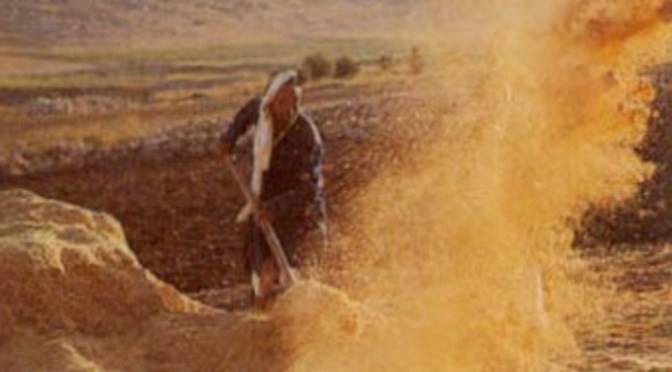
John describes the Messiah standing on a threshing room floor, the place where grain is brought in once it is harvested from the land. And the Messiah has his mighty winnowing fork in hand. A winnowing fork is used to separate a wheat stock from the grain itself. As the fork lifts the grain from the pile, the heavy grain falls to the floor, and the lighter useless chaff is blown into the fire to be burned away.

John’s message today sounds harsh but fitting for our world.

As Advent-y as things seem this year, as full of strife and struggle our world seems to be… maybe throwing us all into the chaff isn’t what John is getting at.

Because a pitchfork is not what Messiah is holding, for a fork would be a useless tool to clear a threshing room floor. And nor is the word fork used in the original greek of this text. No, the tool that the messiah is holding is more of a winnowing spoon… or more precisely a shovel. The winnowing shovel is not a tool of separating but a tool for gathering. 

Maybe just maybe, Messiah is gathering us up. Gathering us all up. Gathering up our broken and suffering and dying world so that we can finally begin to see the light. 

Maybe that is how God is reminding us that the Good News isn’t just reserved for Christmas.

As bad as the world seems to be, Messiah is already a work around us. Messiah has his winnowing shovel and is gathering. Messiah’s is bringing light to our Advent world.

Messiah is gathering us up as children and seniors roll up their sleeves to be vaccinated, adding more layers of protection to this pandemic weary world. As healthcare workers, education staff, businesses and community leaders, neighbours and families keep the inconvenient but essential public health measures day after day, week after week. 

Messiah is pulling us together in the many hands working tirelessly to rebuild and repair water logged homes, washed out roads and bridges, caring for now homeless flooding victims.  

Messiah is scooping us up off the floor as we recommit again to the work of social justice and caring for community, welcoming the stranger, providing for those in need. Just as our SLAW youth did in dropping a tremendous haul of Christmas supplies to the Urban this week. 

And Messiah is building us up as National church committed to the work of ending domestic violence against women with the Thursday in Black campaign. 

And Messiah is scooping us up off the threshing room floor here at Sherwood Park as we find new ways to gather for worship, to meet as small groups, to safely make music together, to reconnect with families and households, to find new ways of being the same body of christ that we have long been. 

Messiah is gathering us up, all the mess and all the struggle of our real life Advent so that we can see that God is really coming to us in incarnation, God in flesh among us.

So sure, John the Baptist may sound a little harsh today. Advent might feel extra Advent-y this year. But the promised Messiah is gathering us up today, scooping us off the threshing room floor with his winnowing spoon, making us ready for the in-breaking of light and hope among us. 

Stir up your power Lord Christ and come.

Thoughts for Advent 3 – Perspective Shift

When my grandfather’s family immigrated from Norway, my understanding is that they landed first in Minnesota, where a lot of Scandinavian immigrants settled. But before long, many of these immigrants were longing for home, particularly for the Fjords of Norway. So a group of them decided to pick up and move to a place that reminded them of home the most. From Minnesota they moved to the coast of BC, to a place called Bella Coola. A tiny community nestled in the Fjords of BC. A community on the water but also among the mountains. A place where  sometime in late fall the sun would fall behind the mountains, not to be seen again until the end of winter. 

I always thought this was a strange decision and I wondered why my ancestors made it. 

Then I moved to the Red River Valley myself. Most Manitobans probably don’t think about this much, but there are virtually no hills here, no variation to the topography. If you know where to look you can find a hill, but they are not common. And no, driving over the Disraeli bridge does not count as a hill. 

The uncommon hills here are nothing compared to the hills and valleys found around Edmonton where I grew up, or the rolling prairie to the east, or mountains to the west. 

There are times when I long for a hill or two. And certainly there is strong sense of belonging whenever I am in the mountains – I think it is my Nordic blood. 

A few years ago, on one of our trips to see family out west, we were coming into the mountains just outside of Calgary when our daughter Maeve started complaining that she couldn’t see. We thought she meant she couldn’t see because of a pillow or blanket blocking her window, but we quickly sorted out that it was in fact the mountains themselves that were blocking her view of the sky (I think we are raising a real Manitoban…). 

Maeve is not the first prairie person to get panicky driving a mountain highway. I also know a few folks from BC who find the open skies of the prairies unnerving. 

As we navigate our way through the mountains, valleys, and flat places of Advent, I think there is something to the way God is working in and through our different perspectives. 

Flattened mountains and filled in valleys and straight paths don’t particularly excite me, but they might be a relief for some. 

The short days and long nights of winter might be something to be endured for some, but a sun that falls behind the mountains might feel like home for others. 

Advent is all about shifting our perspective. The stories we tell demand that we re-think the way we see the world. 

The End becomes the Beginning. 

John the Baptist’s bombastic preaching to wilderness crowds points us to a baby born in quiet and out-of-the-way manger. 

A young teenager, getting pregnant out of wedlock becomes the one in whom God is birthed into the world. 

The Messiah joins in with the life of creation in order to overcome death on the cross, and show us to new life. 

And finally, when we are tired, achy, slowing down, feeling as though we might be dying… when our lives, when the church, when the world feels as though things are falling apart… it might actually be something else. 

We just might be pregnant with new possibilities, soon to be entering into our world, changing our perspective on just what God is doing with us. 

The Kingdom is not in us. We are in the Kingdom.

Mark 4:26-34
Jesus said, “The kingdom of God is as if someone would scatter seed on the ground, and would sleep and rise night and day, and the seed would sprout and grow, he does not know how. The earth produces of itself, first the stalk, then the head, then the full grain in the head. But when the grain is ripe, at once he goes in with his sickle, because the harvest has come.”

Today, our journey into Mark’s gospel continues. Last week, we started this long season of green by hearing how Jesus’ family thought he was crazy. But we also heard that in the middle of all the human chaos, and the divided messy nature of human relationships, Jesus stays the course of bringing new life to us and to the world. 

Today, we return to more familiar parables: Parables of the Kingdom. And while this teaching may be familiar for us, it wasn’t for those to whom Jesus was teaching and preaching. When Jesus tells parables of the Kingdom, lessons that often begin, “The Kingdom of God is like…” we hear them with 2000 years of Christian tradition that has made us ready to hear them. But to the people of 1st century Israel, their understanding of the Kingdom of God was very different from ours. Before unpacking what Jesus said, it is important to know what the people would have expected. 

The Kingdom of God for the people of ancient Israel had a very specific form. As we are reminded each Advent, the Israelites were waiting for the Messiah, the Saviour King who would free them from foreign oppressors like the Egyptians, Babylonians, Persians, and Romans. And this Messiah King would establish an earthly Kingdom with divine approval – a powerful kingdom with powerful armies – maybe even powerful enough to do some oppressing itself. A wealthy kingdom with abundance – maybe with enough abundance that other nations would come begging to it. This Kingdom would keep Israel from ever again being ruled over by foreigners. This Kingdom would find favour with God, and would therefore be a holy and righteous Kingdom. This Kingdom would be centered in Jerusalem, with the temple, God’s dwelling place, as its symbol of power. The Kingdom of God was long hoped for but also had to live up to very specific criteria. 

Into this expectant time Jesus showed up. And he started telling parables about the Kingdom of God being like unknown seeds scattered in a field, with the sower having no clue how they would grow. Jesus told parables of how the Kingdom of God was like the humble mustard seed, the 

smallest of seeds that would grow into the most unruly of garden weeds. 

These parables would not have described a Kingdom like that which the crowds would have expected. This was not the Kingdom of God they were looking for. 

Even though we have heard all the Kingdom parables, we too can have a pretty narrow definition of what the Kingdom of God should look like. We too often want a Kingdom of power, security and predictability. We expect that God will fit into our narrow vision of what the Kingdom should look like. 

These days, just like those first century followers of Jesus, we too are in a moment of expectation. The world is waiting for things to get back to normal, for our pandemic misery to end, for all our pent-up desires for our favourite outings and gatherings to finally happen. 

But we are also reeling. Reeling from the discovery at Kamloops Residential school two weeks ago. Reeling from the next tragedy and reminder that we are a broken and divided house in Canada.  Reeling from the terror attack on a Muslim family in London, Ontario. Reeling from day after day of multiple COVID deaths in our province, including the death of a teenager this week. 

And this experience of tragedy pushes us to ask for, to demand, to expect something of our leaders, of those in charge. To demand and expect a response from God. 

Our hopes for the future, our hopes for the present can look a lot like the hopes and expectations of the crowds listening to Jesus today, wanting some very specific things because of our world in need, because of the cries for justice from the oppressed, grieving, and marginalized. 

Yet, today, we know that this parable of Jesus’ is about defying expectations, about doing the unexpected. God is asking us, in the middle of the chaos, to step back and consider just what the Kingdom of God might look like. 

So let me ask a question. And it is for the gardeners among us, in particular. 

Does anyone know of a seed that looks like the plant it produces?

I can’t think of any. 

You might never guess what plant a seed turns into until you plant it. In fact, many seeds also look very similar to each other and it can be hard to tell them apart without labels. Planting seeds is a bit of a guessing game. And churches, like all human beings, don’t like facing the unknown. 

In the best of times, churches often prefer to know that the things they do, the ministries, outreaches, projects or programs that they start will be predictable, identifiable, manageable.

As human beings in this moment, most of us are longing to regain some predictability into our lives (every day might feel the same as the last, but our weeks and months feel impossible to plan for). We want to go back to a world that is predictable and safe. We long for a world that isn’t blindsiding us every week with another tragedy or another big news story or another thing to get all worked up about.

But the Kingdom of God is simply not that way. 

God is up to something that is not safe or predictable or manageable. Scattering seeds is not predictable, or safe. Scattering seeds is not easily managed. Scattering seeds is a bit of a guessing game. And sometimes God ends up planting mustard seeds in the middle of the field – mustard seeds that grow into wild, weed-like over-powering bushes. 

This is what Jesus says the Kingdom of God is like: A sower who scatters seeds, but who isn’t sure just what will grow or how it turns from seed into a living plant. 

And yet again, this is what Jesus says the Kingdom of God is like: A small unassuming mustard seed, planted in a garden and threatening to take over. 

As people of faith, as workers and tenders of God’s garden, we declare that the Kingdom of God is near to us. That it is here. But sometimes we imagine that it is only here. That the Kingdom is contained only within the Church. And then God has other ideas, seizing opportunities to throw us out of our comfort zones, to call us to find new and unexpected ways of being. God demands that we give up our narrow vision of the world, and instead embrace the wide-open, possibility-filled vision that God has for us. 

We forget that the Kingdom of God is not contained within our imagination and expectations. The Kingdom of God appears and grows in unexpected places from surprising seeds. 

The Kingdom is not in us. We are in the Kingdom.

To people who have a very narrow view of what the Kingdom of God looks like, to the Israelites of the 1st Century, and to Christians of the 21st century who often have equally narrow views, Jesus reminds us that the Kingdom of God is so much more than what we know.

Jesus tells of how the Kingdom of God is spread with seed that is scattered all over.

Jesus tells of how the Kingdom is sprouting in un-expected places.  

Jesus tells of how the Kingdom of God is growing into life that we would never have predicted from the seed. 

Jesus tells of how the Kingdom of God is teeming with life where we would have only imagined barrenness. 

The Kingdom of God is meeting us on our screens, in our social media pages, in the outpouring of righteous outrage and compassionate support for survivors of residential schools and Indigenous communities, for the family and community of victims of the London terror attack, and for Muslims across the country. 

And in the scattered seeds of the Kingdom, God is reminding us that there is more work for us to do in order to achieve reconciliation – the work of justice, education, and change is upon us. God is reminding us that there is a new and unknown way of being the Church and a community of faith ahead for us, even if we don’t know what that will look like. 

New plants growing from the most surprising of places.

So as we struggle in this moment to find a world that meets our expectations, that conforms to a controllable, manageable state… we are reminded that God is busy with other plans. 

God is scattering seeds of the Kingdom all over. God is growing plants that we would never have guessed from the seeds. And God’s Kingdom is showing up, taking over, filling the fields with life. 

The Unmet Expectations of This Advent Season

John 1:6-8,19-28
This is the testimony given by John when the Jews sent priests and Levites from Jerusalem to ask him, “Who are you?” He confessed and did not deny it, but confessed, “I am not the Messiah.” (Read the whole passage)

Keep Awake!
Prepare the way of the Lord!
I am not the Messiah!

Each week of Advent seems to brings a them of waiting and preparing with it. Each week taking us closer to the coming of Messiah, even in the midst of all the darkness around us. 

We have now crossed into the back half of Advent. We started the season by hearing Jesus proclaim the end of time, to keep awake for God’s coming. Last week, we heard the beginning of the good news, we heard of Mark’s straight the point interpretation of the incarnation, the in flesh God among us. 

Today we hear the Advent twist on the story of John the Baptist. And for that we take a little detour from Mark’s gospel, to the gospel of John. John the Baptist is a familiar, if not odd, figure from the Gospels. A wild hermit preacher dressed in camel hair furs, eating locusts or giant grasshoppers for food. And for the people of ancient Israel, John fits the profile of a prophet, one sent to preach God’s message for the people.

And as John is preaching, teaching and baptizing in the desert, the authorities take notice. The priest and levites, the religious authorities send representatives to find out who this hermit preacher, this potential preacher is.

And so they ask, ‘Are you the Messiah?” A loaded question, a question about their expectations. Is John the one who has come to bring about the Kingdom of Heaven, the one who to destroy the enemies and oppressors of Israel, to establish a divine Jewish kingdom on earth. 

But John says, “I am not the Messiah”

And so they ask again, “Are you Elijah?” Is John the one who will herald the end, the one who is the precursor, the advance party, the warning shot of the Messiah. 

But John says, “I am not.”

And so they ask a third time, “Are you the prophet?” Is John the prophet like Isaiah, maybe not the one who will establish the Kingdom of Heaven, but at least establish a new, powerful, and restored-to-former-glory Israel.

But John says, “No”

The Levites, Priests went to hear John the Baptist preach on the banks of the Jordan with expectations. Expectations about who he might be and what he might bring into their world. The were worried about the disruption he might cause, the over turning the of the status quo, the systems of power that privileged a few and caused suffering for many. 

The crowds too went to hear John preach with expectations. Expectations about who he might be and what he might bring into their world. The hope and light he might reveal, the overturning of the established orders, the oppressors who kept the people under their thumbs. 

And we too might hear John with expectations today. Expectations about who he might be and what might bring into our world. Expectations that our current circumstances can be undone, that there is some quick fix for our current predicament on its way to us. 

As our community, as our world, as we hunker down for a Christmas like none before, it is hard not to be longing for things the way they used to be, for things to go back to normal, for even a little reprieve from restrictions and orders that are keeping us from the Holidays as we know them. From celebrating with family and friends as we usually do, as we have been desperate to do for months now. 

And our expectations and hopes are only pushing towards disappointment and resentment.

And here as we wait for Messiah, halfway through Advent, expectations are everywhere. And while normal Advent and Christmas expectations centre around a lack of time and energy, about family gatherings going sideways, about creating perfect memories… This year we wait for things like case numbers, test positivity and hospitalizations to drop, for vaccines to be distributed and something that looks even a little bit like normal life. 

In 2020, we come to the John, asking he is the Messiah in a world that feels, at times, not too different than the world of those people standing on the banks of the Jordan, listening to John the Baptist. We see darkness, suffering, struggle and hardship in new ways. We understand being powerless and hoping for change in new ways. We know what it means to be waiting and focused on salvation like never before. 

And we come too, wondering if John the Baptist can tell us something about dealing with all of this.  

And John says, “NO”

Instead John says, “I am the voice of one crying in the wilderness.”

And that voice in the wilderness is not the Messiah. This desert preacher is not the Messiah, he is not the one who will solve our problems, he is not even the one who to whom we should be looking. John the Baptist is simply a messenger. 

“The voice of one crying in the wilderness, Make straight the way of the Lord.”

But John is pointing elsewhere. 
Proclaiming another. 
Revealing someone else. 

John is here to tell the Pharisees and Scribes and crowds… here to tell us that there is another who is coming. There is one coming who will address injustice, oppression, suffering and death. There is one coming into our world who is God in flesh – God with us. And this one, this Messiah is coming to change the world in ways that we cannot imagine, who will transform us beyond our wildest expectations, who will flatten the hills of oppression, straighten the paths of injustice, fill the valleys of suffering, and grant us new life. 

This Messiah isn’t coming to give us Christmas back, to unlock our lives tomorrow.

This Messiah is not here to fix us or take our problems away and make things normal again. 

But rather, this Messiah is coming to fill our hearts, 
and bring us light. 

To light our path through the dark ways ahead.
To lead us through these difficult days with the promise of new life. 
To show us the way to the grace, mercy and love of God.

Half way through Advent, we might be focused on the things we won’t have this Christmas. 

Yet whether we see it or not, whether we realize is to not, 
the light of promise is beginning shine a little brighter. 
The darkness is being pushed away one candle, one light at a time. 

And as much as we carry expectations about a Christmas we cannot have, about a quick fix to world’s problems that won’t come on our timelines, and about the God who we wish was a great problem solver… 

we are getting to that part of the story when all our expectations are blown away.
When the unimaginable happens… 
when to an unmarried immigrant couple, 
when to a young virgin teen, 
when to the most unexpected people
a long hoped for yet unexpected Messiah is born… 

A Messiah born to save us all. 

This is what… who… John the Baptist is talking about.

Amen. 

COCO and the God who Remembers All The Saints

Matthew 5:1-12
When Jesus saw the crowds, he went up the mountain; and after he sat down, his disciples came to him. Then he began to speak, and taught them, saying:
“Blessed are the poor in spirit, for theirs is the kingdom of heaven.
“Blessed are those who mourn, for they will be comforted.
(Read the whole passage)

Reformation Day, Halloween, All Saints. These are the signposts of the end. They are way stations on our journey towards the end of the Church year. Soon it will be Advent again, and soon we will be singing of the coming birth of Christ. All Saints Sunday is one of those yearly celebrations that remind us of the cyclical nature of the church, of how we tell and retell the story of God in Christ.

All Saints Sunday also speaks to a different kind of end and different kind of waiting. It is a reminder of the big ending, of Christ coming again to gather up all the faithful, to make all creation new. All Saints is also a very specific reminder and opportunity to remember loved ones who have died. Those who have been drowned and brought to new life in the waters of baptism, and those who have taken their last breaths here on earth. And in a way, we are waiting on this day too. Waiting for that moment when all the saints will be together, in Christ, robed in white before the Lamb. We wait with hope and anticipation of God’s fulfillment of the resurrection promise.

The opportunity of All Saints is also the problem. To remember loved ones, is to revisit our grief and our suffering. It is to remember that we are lonelier without them, and that no matter how long their lives were, they left us too soon. 

This year All Saints is intensely local and personal and intimate as we remember those who have died in our community, those whom we have been unable to gather to remember and mourn and celebrate as we normally would. 

All Saints is also intensely global as we grieve and mourn those who have died here in our province: 62 people, 42 just in October. And 10,000 across Canada. And almost 1.2 million people around the world who have died during this global pandemic. And among the dead are our most vulnerable: the elderly, the poor, minorities and those on the margins.

Yet no matter whether All Saints Sunday comes on a year when we can be grateful there are only a few to remember or whether it comes when there is too much remembering to bear… our task is the same. To pray and to remember. To give thanks for saints and to entrust them again into God’s care. To trust and hope in the promise of God given to all the saints. 

And as we take up this task, we hear two stories about crowds. The first crowd is a crowd gathered around Jesus to hear the sermon on the mount. 

A sermon that forces us to deal with the tensions of grief and hope. Jesus proclaims blessing for things that really aren’t blessing. Things that we might assume we should strive for in order to be holy… poverty of spirit, meekness, righteousness, to be merciful, to be persecuted. Yet Jesus is not reciting a formula on how to be blessed or prescribing new life style choices. Rather, Jesus is making a radical statement, an outrageous reversal of how we understand the world. Jesus is describing a God, whose world is upside down from ours. Jesus tells us that God sees the poor, the suffering, the hungry, the thirsty, the mourning and the persecuted…. God see us… and declares that we are blessed.

The second crowd is the great multitude gathered before the throne of God at the end of time. A great crowd robed in white, clothed in Christ, and worshipping the lamb of God. A great crowd joined to the heavenly worship of the Kingdom of God. The great multitude of the saints who have gone before us in faith, who remind us just how big this body of Christ is, to which we belong in faith. 

Two crowds, one living and one dead. Yet forever connected to one another in the Body of Christ. 

(Pause)

For the past few years, our family has had the tradition of watching an All Saints movie together. Pixar’s movie Coco. Coco tells the story of Miguel. A young boy in Mexico who loves music but whose family has banned music for generations since his great-grandfather left his wife and daughter to pursue a career music. This point of  family conflict comes into tension right around Dia de Meurtos, the day of the dead or All Saints. 

In search of information about his grand-father, Miguel goes to the tomb of Mexico’s favourite singer, where he is magically transported to the world the dead, which is bridged to the mortal world on Dia de Meurtos. 

Along the way Miguel encounters Hector, a kind, musical grifter, who helps him.

The hinge point of the story comes because the people living in the land of the dead only continue to exist when they still remembered by the living, and Hector is in danger of being forgotten and fading away in what is called the last death. Hector’s daughter, his last living relative that knows him, is forgetting in her old age. 

Eventually Miguel, with Hector’s help, manages to reconcile with his family in both the land of the dead and the living world – with a few plot twists along the way. 

Coco is ultimately a story about the power of memory and love of family – important lessons at any time. But Coco is strongly connected to a thread that ties the movie and its story to the root of faith that Christians claim on All Saints. 

Memory. 

Being Remembered. 

Miguel’s family encouraged him to learn the stories of his ancestors, to keep vigil for them at the family ‘Ofrenda’ or offering – an altar with photos of loved ones used for Dia de Meurtos.

And we gather today with candles and photos to remember our loved ones. 

The root of All Saints in found in memory. 

And while we remember today, it is not our memory that is the most important. 

All Saints is ultimately about God’s memory. 

About God re-membering the two great crowds that we hear about day. 

The crowd listening to Jesus’ sermon on the mount and the crowd gathered before the throne at the end of time. 

Two crowds, one from the living world and one from the land of the dead. 

Made one Christ. One Body in Christ. 

A living crowd whose upside down blessings, whose world is up-ended and signal the coming Kingdom of God. 

And crowd at the end time, a crowd of the gathered faithful, crow of the poor and rich, the joyful and mourning, the hungry and the full, the merciful and merciless. 

Sinners AND Saints. 

Brought finally the throne of that same Kingdom of God that Jesus witnessed to. 

A crowd born in the memory of God. 

God who remembers us from before creation was spoken into being.

God who remembers us from before we were in our mother’s womb. 

God who remembers us throughout our lives, in our poverty, in our mourning, in our meekness, our hunger and thirst, in our need of mercy. 

God who re-members us by making us members of the body of Christ  

God whose memory puts us back to together, builds us up and assures us that we are known. 

God who re-members us, to the great multitude robed in white, unforgotten at the end of time, gathered before the throne, worshipping the lamb. 

All Saints is a promise that we are not forgotten, but that the God of life remembers us. 

And so as we gather to remember the saints, as we are joined here on this signpost day pointing to the end of the year, we are reminded that whether we remember or whether we forget, we are known.

That whether it is is year to remember just a few who have died, or like this year to remember and pray for too many – God always remembers us. 

That God remembers all the saints to the New Life that is found in Christ, to New Life promised to each one of us in the waters of baptism and New life that wraps us in the white and pure robes of Christ. 

New Life for those in the world of the living and those Brough to new life in the land of dead. 

Today, God Remembers us all – as saints belonging to the body of Christ. 

Amen. 

[James Baldwin, who was an African American writer and civil rights activist wrote, in his book Go Tell it on the Mountain powerful words that paint us a picture of what God’s promise of New life will look like: 

Then John saw the river, and the multitude was there. And a sweetness filled John as he heard the sound of singing: the singing was for him. . . . No power could hold this army back, no water disperse them, no fire consume them. They wandered in the valley forever; and they smote the rock, forever; and the waters sprang, perpetually, in the perpetual desert. They cried unto the Lord forever, they were cast down forever, and lifted up their eyes forever. No, the fire could not hurt them, and yes, the lions’ jaws were stopped; the serpent was not their master, the grave was not their resting-place, the earth was not their home. Job bore them witness, and Abraham was their father, Moses had elected to suffer with them rather than glory in sin for a season. Shadrach, Meshach, and Abednego had gone before them into the fire, their grief had been sung by David, and Jeremiah had wept for them. Ezekiel had prophesied upon them, these scattered bones, these slain, and, in the fullness to time, the prophet, John, had come out of the wilderness, crying that the promise was for them. They were encompassed with a very cloud of witnesses: Judas, who had betrayed the Lord; Thomas, who had doubted Him; Peter, who had trembled at the crowing of a cock; Stephen, who had been stoned; Paul, who had been bound; the blind man crying in the dusty road, the dead man rising from the grave. And they looked unto Jesus, the author and the finisher of their faith, running with patience the race He had set before them; they endured the cross, and they despised the shame, and waited to join Him, one day, in glory, at the right hand of the Father.]