Tag Archives: ministry

The community built at funeral lunches – Pastor Thoughts

This week I did something that I have not done in quite a while as a pastor. I presided at a funeral proper.

I was covering for a colleague on holidays. Something that pastors do for each other in case of just such an occurrence.

The day included a viewing, the service, a lunch and interment at the cemetery. While the pandemic has mostly eliminated this kind of extended gathering, it was long before 2020 that these full funeral days were becoming less common. Cremation and memorials have changed the rhythms and patterns of these events, in addition to unchurched families planning services for churched loved ones. 

A funeral with all the traditional pieces often takes the whole day. There is a lot of lingering and waiting throughout, as the whole gathered community moves from ritual moment to moment. There are the condolences and greeting of the family at the viewing, there is the remembrance and stories in the service, there is the visiting and community building during the lunch, there is the final goodbye at the graveside, maybe even mourners shovelling dirt over the casket themselves.

The day reminded me of funerals at my first call, a rural community outside of Edmonton that I began serving in 2009, but that was still frozen in a time period of a much earlier era. 

Part of me thought back nostalgically. Funerals for many congregations and communities are about community, fellowship and connection as much as they are about mourning and grief. Funeral lunches can get quite raucous with laughter!

And for a certain generation of church goer, this a familiar pattern of life. Coming together at a time of death has a way of pushing aside everything else: all the to-do lists that occupy our time most days, all the crises in the world (that are ultimately about avoiding death). When that casket arrives, when death itself enters the room, even things like pandemics and wars take a backseat to grief. 

For much of my time as a pastor, I have been serving congregations and communities who are grieving the slow degradation and loss of these familiar rituals of community. As these once common parts of communal life together continue to disappear, building and maintaining community within the church and beyond becomes more and more challenging. 

Maybe this week for the first time, I felt that twinge of loss too. Or maybe I glimpsed just what so many folks have been grieving for a long time in the church. The generations before us used to know how to come together as a community – often with sandwiches and coffee – and support one another through the ups and downs of life. Before the pandemic it was often a struggle to pull off a funeral and lunch. Now, we may be close to losing that capacity entirely. 

Or more accurately, all the habits and skills we had for being communities of support and care are going by the wayside right at a time when we could use them the most. Being church together does not and will not just happen organically or unintentionally as it once did. 

Today in 2022, community takes work. Community takes intentionality. Community happens when we do it on purpose, it will not happen by accident. 

Yes, there is a certain comfort and nostalgia for a community that knows how to walk through a day of mourning together without a lot of planning. 

There is also a certain part of us that doesn’t like that community takes more planning. We don’t like appointments and schedules and lists. We long for the days when people just showed up without notice and neighbourly intrusions were welcomed (except when you actually do show up at someone’s house unannounced these days, and they are mortified!).

Day long funerals were and are lovely ways for communities to come together and care for each other but they are increasingly relics of times past. 

Zoom meetings, doodle polls, Facebook events, texting to schedule phone calls and limited availability are here to stay. 

Community will only happen on purpose. Community will only be built through planning and intentionality. 

As we continue our Lenten journey through the wilderness, I cannot help but see that churches and communities are walking through a wilderness of community now that is calling on us to find new ways to come together, new ways to offer that care and support for each other, new ways to be the Body of Christ for each other and for the world.


Love that couldn’t care less for power

Luke 13:31-35
Some Pharisees came and said to Jesus, “Get away from here, for Herod wants to kill you.” He said to them, “Go and tell that fox for me, ‘Listen, I am casting out demons and performing cures today and tomorrow, and on the third day I finish my work. Yet today, tomorrow, and the next day I must be on my way, because it is impossible for a prophet to be killed outside of Jerusalem.’ Jerusalem, Jerusalem, the city that kills the prophets and stones those who are sent to it! How often have I desired to gather your children together as a hen gathers her brood under her wings, and you were not willing! See, your house is left to you. And I tell you, you will not see me until the time comes when you say, ‘Blessed is the one who comes in the name of the Lord.’”

King Herod was not a well liked King. 

He was a puppet King for the Roman who didn’t really care about who was King over the backwater province of the empire, Judea. The people of Israel didn’t care for Herod, knowing that he was all about power. But like most people in power, Herod made the right allegiances; with Rome and with Hebrew the religious authorities. 

So when the Pharisees come to Jesus with a Message, he knows they too are puppet authorities, doing the puppet King’s dirty work in order to hold on to their own power and privilege. 

Today, on the second Sunday of Lent we continue with Jesus who can’t help but be confronted by people who think they have power. Last week, it was the Devil tempting Jesus to misuse the power of incarnation, the power that comes along with being God and being God in flesh. The Devil’s temptations set the stage for the recurring theme that Luke’s gospel holds up for us this Lenten season. The Devil tries to offer Jesus power. And now the Pharisees come to Jesus with a warning. They sound sympathetic, maybe even concerned for Jesus. Herod is out to get you, they warn. And it just so happens that getting rid of Jesus might also be convenient for them. 

Herod, the unpopular King and the righteous yet conspiring Pharisees, are concerned about their power. They are concerned about Jesus’s impact on their power and privilege. They have worked to build alliances, with their unpalatable overlord Romans, and with each other. Their power is tenuously held and only maintained by fear and division. With soldiers who intimidate, with control over money, over the temple, over the city of Jerusalem. 

Yet, no matter their work to maintain their power, they cannot gain the confidence and support of the people. Yet, Jesus who doesn’t seem to be looking for any power, is wandering the countryside, living off the generosity of others. Jesus is popular and therefore powerful in the eyes of Herod and the Pharisees. And while he hasn’t made a play for their power yet, they know it will come. And so they conspire. They will frighten Jesus off. Just as they frighten the people with soldiers or unrighteousness. They see Jesus as a threat who must be dealt with. 

Like the Pharisees, our world too is full of misuse of power. As we watch an awful and tragic invasion of Ukraine, we see a desperate despot casting about for power and former glory. Closer to home we also see politicians and corporations pandering to our consumerist desires in the hopes of acquiring our votes and our dollars. We also look about and see our unhappy neighbours, friends and families lashing out at the world, frustrated by all the ways they feel their power and freedom slipping from their grasp. We look at this community and other churches like it, and we see something that once occupied a place of central power and importance in the world, being slowly sapped of energy and resources, crumbling before our very eyes. 

Power does that. Power makes the powerful manipulate and play games. The loss of power splits, divides and demoralizes. 

And in all of that, the powerful King Herod, the power hungry Pharisees and we who feel as though we are leaking power, all share in one thing:

We all feel threatened by Jesus. 

There is a something inside of all of us that gets anxious and concerned when Jesus starts talking about what God wants for us. A thing inside of us that is tangled and twisted. That thought in the back our minds, that feeling that makes our blood pressure rise. It is the thing inside of us that makes us fearful of our neighbours. It it the thing that makes us resentful of having to change our lives for the sake the world around us. It is the thing that inside of us that closes us off to people who think differently than we do. The twisted tangled thing makes us shout our opinion louder, makes us wall ourselves off to the other, makes us fear difference, makes us angry when we feel aggrieved. 

The twisted, tangled thing is what Martin Luther called the Old Adam, the Old Sinner.

It is sin. 

And the sinner inside of us bristles when Jesus starts talking about the first being last, and losing our lives to save them. The sinner doesn’t like the idea that God’s forgiveness isn’t deserved, that we aren’t entitled to it.  

The twisted tangled sinner is the part of us that thinks power will save us. That controlling the world around us will keep us from being hurt. That protecting ourselves from anyone different from us is the way to be safe. 

And when Jesus starts talking about giving up power, the old sinner feels threatened. And when Jesus starts talking about prophets being stoned and hinting at crucifixion, the old sinner will have none of it. Like the Devil who thought power was the purpose last week, the old sinner thinks power is our salvation. 

The pharisees warn Jesus that Herod is willing to kill Jesus for the sake of power. 

Herod is worried that his power could be taken by the popular preacher Jesus. 

How wrong can Herod and the Pharisees be?

How completely off the mark can the twisted, tangled sinner inside of us get?

Jesus has come in weakness, not power. 

Jesus has come to be open, not closed off. 

Jesus has come to be vulnerable, not fearful. 

Jesus has come to show love. 

Love that will change us. 

Love that will undo the twisted, tangled thing inside of us. 

Love that risks being hurt, being unsafe, being weak in order to come close and near. Love that gathers and holds us together under its wings. 

Love that couldn’t care less for power. 

Herod and the Pharisees don’t live in a world of love. They don’t know how to let go of the little power that they have. They can’t see that Jesus hasn’t come for power, they cannot see how Jesus is trying to show God’s love to the world. 

And Jesus knows this. Jesus knows that the same crowds will chant “Blessed is He who comes in the same of the Lord” on Sunday, will shout crucify by Friday because they want a King of power, not a King of love. 

Jesus knows that the Pharisees who are warning him to get away will soon cry to Pilate to do their dirty work. 

Jesus knows that the King Herod will defer to the power of Rome to finally rid his Kingdom of this popular preacher. 

Jesus knows that their desire for power will lead to death. 

It is the way of the Old Sinner. 

But Herod and the Pharisees don’t know that Jesus is willing to die for the sake of love, willing to die to save the world. 

But we do. 

And still this Jesus who saves the world, who endures our greatest power of death to show love, still threatens us. 

Because the old sinner within us who pushes us to fear, to resent, to be closed off, to divide and to control… this old sinner, this twisted and tangled thing knows that the love of Jesus will change us. That love will untwist and untangle. That love will forgive and show grace. 

And Jesus knows that love makes us anxious, that old sinner, the twisted and tangled thing doesn’t want to be loved. Jesus knows that loving us will transform us. Jesus knows that loving us will make us care less about ourselves and more about others. Jesus knows that love will make us less afraid, less closed off, less divided, less controlling, worry less. 

Jesus knows love will make us let go of power… 

Herod wasn’t a well-liked King and the Pharisees weren’t well-liked religious rulers. We are people threatened by love.  

And Jesus isn’t either of these things either. Not puppet King, nor religious overlord, nor symbol of power and influence. 

Jesus is a mother hen with nothing but love to give. Love for sinners who feel threatened. Love for tangled and twisted people who get anxious. 

And just like stubborn chicks who need their mother hen, Jesus love will gather and change us too.

What keeps you up at night? – Pastor Thoughts

“What keeps you up at night?”

I was listening to a leadership podcast from Luther Seminary in St. Paul that asked this question. (Find the podcast here)

“What keeps you up at night?”

Once I get past Ukraine, the Pandemic, inflation and economic inequality the thing that keeps me up at night is the present and future of the church. Sherwood Park, the MNO Synod, the ELCIC and Christianity around the world. 

But lately, it has been on my mind about how pivotal this moment in history is for us. It is a moment that I have been anticipating for quite some time and a moment that I expect to be looking back at in 15 years and reflecting on the choices made and courses of action followed now. 

I say this often, so excuse me if I have written it before: In my first few weeks of being pastor, it hit me like a ton of bricks, the overwhelming sense that I would be spending my entire career in ministry helping congregations navigating change. In fact, at that time my exact thoughts were “I am going to be cleaning up the messes of predecessors for the next 40 years.”

Of course by now, I know that things aren’t that cut and dry. The “messes” have really more to do with a rapidly changing world and church than the failures of those who have served before me. 

In the same podcast, the main theme of the episode was on challenges. I talked with council this week about this idea. We usually think that we have a pretty good idea of what the challenges we face are, whether at home, in the neighbourhood, at work, at church, in our country and in our world. I asked council to quickly identify the challenges facing Sherwood Park. 

We immediately came up with financial challenges, declining and aging membership challenges, building and maintenance challenges, transition out of pandemic (or into the next phase) challenges. I named that the MNO Synod is looking at clergy shortage challenge (we have to call from outside Manitoba to fill vacancies and have few or no candidates of our own – even Courtenay and I are not original Manitoba clergy). 

But the podcast episode pushed back at the idea that we actually do know the challenges we face. We are very good at identifying surface challenges, we know what our presenting issues are. But often our deep challenges are not that clear to us. 

For Sherwood Park and Lutherans in the MNO Synod, financial problems and declining membership is the story everywhere. And we have all been chasing after these problems for a long time. The church I grew up in, with 250 attending on Sundays, 50 to 100 kids in Sunday School, 75 college and careers that also attended every Sunday…. They too in the mid-90s were convinced that they had a finances and declining membership problem!

The deeper issue we face is about our identity as a community of faith. It was getting hard to continue being a community in 2019. Today, it is just that much harder. 

The deeper challenge is whether the way we choose to be a church and do ministry still makes sense. Does Winnipeg need 14 Lutheran churches (and more than twice that in Anglican churches) all working mostly independently from one another? Our shared youth program, which is certainly the largest in Winnipeg, if not the ELCIC, suggests that there is a significant benefit to working together. 

The deeper question is how committed are we to continuing to be a community of faith, followers of Jesus together in the longer term?

When I think about our challenges in this way, finances and people stop really being concerns in my mind. Yes, the budget is tight and it is going to take work to remember how to come together again. 

But as I sat at our council meeting, I was struck by just how committed the 9 of us were to the ministry of Sherwood Park. And know there are so many others beyond council who feel the same. I know that we have the capacity within our community to meet our budget this year, to fill our volunteer roles, and to continue to provide all the different kinds of ministry and community opportunities that have been central for us. 

Our deeper challenges, about understanding and knowing who we are and what we are about as a community is the more difficult question. But it is a question that comes with an opportunity. A survey came out this week saying that overwhelmingly Canadians feel more disconnected and divided than ever. Our sense of belonging and community has been degraded during these past 2 years. 

Well, hold on! Isn’t that exactly what we as the church are best at? Being a place where people can find community? Being a place where people can belong?

As we find ourselves in the pivotal moment for the future of the church, there ARE deep challenges that we face. But challenges also bring opportunities. And I think God is calling us to step into these new places: To explore who and what we are as a community of faith; to invite the world around us into that community of hope and promise, that community of belonging. 

I thought at first that discerning our challenges would be scary. But taking the time to unpack what the challenges are that we actually face, reveals whole new ways to approach our common life together as people of faith. Things stop being scary and start becoming exciting.

God is calling us into the challenging but exciting world, with an unknown but promise-filled future. 

Why we need this 3rd Pandemic Lent – Pastor Thoughts

The season of Lent began this week with Ash Wednesday. This is the 3rd Lent to take place during the pandemic. 

There are many similarities between Advent and Lent, both are seasons of preparation that culminate with one of the two most important celebrations or feast days of the church year. 

I love Advent. Everything about it speaks to me. The shades of blue, big and small stories from the bible, images of light and dark, the hopeful anticipation in the midst of struggle. Advent is an exercise in contrasts. 

Lent on the other hand is not nearly as playful or vivid… sigh…

While Advent arrives with winter when it is new and exciting, Lent usually comes when we are ready to say goodbye to the snow. And before Lent takes us to Easter, we have to go through Holy Week. Holy Week which is intense, emotional and draining. 

Lent is less like preparing for the Holidays and more of a spiritual spring cleaning or exercise regime. 

Last year, as our second pandemic Lent arrived, many commented on how it felt like Lent had never ended. We had simply wandered in the wilderness for most of 2020 and the beginning of 2021. 

Yet today in March of 2022 when the pandemic that has dominated our attention for the better part of 2 years, it is about 4th place in terms of headline news right now.

Someone on Twitter commented that if the Four Horsemen of the Apocalypse were in a horse race, Famine and Death would have been strong for a long time. But Pestilence made a big comeback 2 years ago, only to have War surprise everyone in this homestretch. 

With all that is happening in our world these days – war, protests, economic disaster, disease and more – it can be hard to feel like our small Lenten practices are of any impact. It is a lot easier to watch, listen to, or read the news and feel hopeless about the world. 

And yet, I wonder if taking on a Lenten practice this year might be just what we need more than ever. It can look like giving something up like chocolate, coffee, tv or meat. It can be taking something on like daily prayer and scripture reading, giving alms, or watching mid-week Lenten services (Wednesdays at 7PM on the Facebook Page). 

Having something small and out of our usual routines to focus on each day as a way to draw our attention back to God may be just what is needed these days. When the problems of the world are too much to bear, those small reminders that we do not walk in this wilderness alone can carry us through to the promise of Easter. 

In the early church, Lent wasn’t just a season to wallow in the wilderness waiting for Good Friday. Lent was (and is) the season when catechumens (essentially adult confirmation students) would finalize their preparation for baptism at the Easter Vigil. And usually all those already baptized would join in the preparation as a reminder of their own baptism. 

Lent and its seasonal practices are meant to provide little disruptions in our lives. Moments and practices that wake us up from the rest of life, and turn us back to God. Turns us back to the promises of God found in baptism of forgiveness, life and salvation. 

Promises that we certainly need reminding of right now, week to week and day to day. 

And so I invite you to consider what your Lent will look like this year and what it might include for you.

Pastor Erik+

Following Jesus into the Deep

Luke 5:1-11
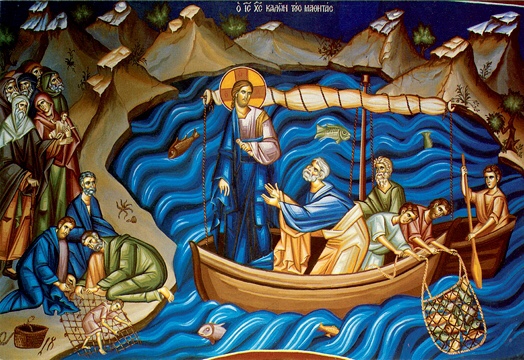
… For he and all who were with him were amazed at the catch of fish that they had taken; and so also were James and John, sons of Zebedee, who were partners with Simon. Then Jesus said to Simon, “Do not be afraid; from now on you will be catching people.” When they had brought their boats to shore, they left everything and followed him.

Last weekend, we decided to take drive across town to check in on the lot, or ditch patch as we  call it, where our new house is going to be built this year. On our way, we drove through downtown and encountered a large collection of tractor trailer, pick up trucks and SUVs with Canadian flags adorning them and lots of “freedom convoy” labels. It was a some unexpected drama that has captured our national attention. Last week, as Jesus confronted us as we were tired and edgy, he reminded us that no matter the messes that human communities find themselves in, that God continues to come and meet God’s people. This journey through this season after Epiphany has taken us from the the banks of the river Jordan, to the wedding at Cana, to the synagogue in Nazareth for the past two weeks. But now we end up in the boat with Jesus and his disciples. 

Today, the drama of this scene in Jesus’ story can be lost on us prairie dwellers. Last week Jesus was almost thrown off a cliff, while today he seems to go for a gentle boat ride. We are used to snow plows and SUVs, to eating beef, pork and chicken. And so when we hear that Jesus gets Simon to take his boat out and fish, and then Jesus provides overflowing nets, it seems like a nice story, a quaint story about Jesus making life a little easier for Simon and his companions. But dig a little deeper, and we begin to see that this is not just about Jesus providing fish. Today, Jesus is just as offensive as he was a week ago, and today, Jesus isn’t the only one in danger of losing his life.

As Jesus begins to get more famous, people begin to follow him around. The crowds press in on him to hear what he is saying. And this time they press him right to the edge of the Lake, so when Jesus can walk no further, he hops in a boat, into Simon who will later be named Peter, and continues to teach. Simon has caught nothing and is going home for the day. Yet when Jesus hops in his boat, he obligingly takes him out a few feet. Simon would have seen that Jesus was an important teacher with all these people coming to hear what Jesus had to say. 

Yet, when the sermon ends, Jesus doesn’t ask to go back to shore, instead he tells Simon to go out into the middle of lake. The preacher in the boat tells Simon the experienced fisherman to do exactly what fisherman don’t do. They do not go out on the lake in the middle of the day. They fish at night, near the shore by lantern light. This is how they have fished for generations. Simon is not impressed with this teacher fellow sitting in his boat. In fact he begins to refuse, 

“Look teacher, we have been fishing all night, our nets need repair, maybe you should stick to speeches and let us do the fishing” Simon has just met Jesus, but it doesn’t take him long to use that impulsive mouth that he will become known for. But then, Simon changes his mind part way through his refusal and says, “Well I guess it won’t hurt, so if you say so Jesus”. 

We aren’t too different than Simon, we often wonder if God actually knows what is going on. Like Simon, we find it easy to stick to the routines and to stick to what we know. Even when sticking to the routines leaves us with empty nets. Yet, God is calling us away from the safety of the shore, out to the deep water, out the unknown.

The unknown is scary and terrifying. And these days we only have a certain level of tolerance for anything different, anything that demands something of us. The issue at the core of the freedom convoy and any protest against COVID-19 restrictions or mandates has often begun with the resistance to this calling into the unknown, the unfamiliar. Masks are uncomfortable. Staying home is boring and lonely and hard. Getting vaccinated might cause uncertainty. 

But our resistance to the deep water, to following Jesus away from the shore, to allowing ourselves some discomfort comes at a cost. Sometimes it might be missed opportunities, as a church it could mean missing out on reaching new people in new ways, and as we are discovering during this pandemic… refusing to do that unexpected, unknown thing is resulting in more people getting sick, more ending up in the hospital and more people dying… all for the stated reasons of freedom, but for the real reason of being unwilling to be uncomfortable for a while or give up something of ourselves for the sake of our neighbour. 

God’s call to the deep waters can feel so risky that we would rather starve doing what we know. 

But with Jesus in his boat, Simon decided to listen to the teacher in the boat. And imagine his surprise as he lets down his nets into the deep water and then begins to haul them back in. The weight of the net pulling back more than Simon ever expected, maybe more than he had ever experienced. And Simon tries to the get the net — and all the fish — in the boat, there is so much that he must call to his friends, James and John before the nets break, and still there is so much fish that they both begin to sink. If there was excitement at catching a lot of fish, it would have disappeared when the boats began to sink, in the middle of lake. The wandering preacher might have guessed where the fish were, but it wasn’t going to do Simon any good, if he drowned first. And yet, they catch an abundance of fish that they had never seen before. 

But fish isn’t Jesus purpose. Jesus has so much more in mind for Simon… And though Simon doesn’t feel worthy, Jesus speaks the words that angels have spoken to those being called by God into something new, time and time again, “Do not be afraid.”

Along with Simon, Jesus is calling us out to the deep water today. And today, that call seems as crazy to us as it did to Simon, who knew better than to go far from the shore. And yet, God is doing something totally unexpected. Something that does not make sense to us. God calls us to die. God calls us to die in the waters of Baptism… but the call does not stop in death. God also calls us out of our ruts, out of our routines, out of the water, out of death and into life.

To a people stuck in the ruts, in the routine of what is safe and known, Christ’s call to risk everything in the deep water seems like too much to ask. But there in the deep water, Christ is giving us life. Life in the form of fish for fisherman with nothing, and today, life for communities contending with far too much sickness and death, life for people who are feeling caged up and alone.  

Out in those deep waters God calls to us from those first promises made to us at the font “By the baptism of his own death and resurrection, [God’s] beloved Son has set us free from the bondage to sin and death, and has opened the way to the joy and freedom of everlasting life”. Out of death, God brings life. Out of drowning in the deep waters of baptism, God forces the breath of life back into our lungs and joins us into a community of newly alive people.

Certainly our instinct is to resist this call, to push back against the dangers that we think we see and feel in the unknown, in the loss that we believe will come with giving something of ourselves. 

But like with Simon, Jesus says, “Do not be afraid.”

Because we do not follow this call alone. We do not go out into the deep waters alone. We are not in this boat called the church all alone. Jesus is with us in the boat and Jesus has much bigger purposes for us. Jesus is preparing us things that entirely new. 

We don’t know what is far from shore, what is out in the deep water, but Jesus does. Jesus knows where we need to go, and what path we need to follow. Jesus knows what must be done for the sake of a hungry and dying world. 

So no, this story today is not a quaint story about a little boat ride and catching fish. It is about the fear and uncertainty that come with following Jesus, with stepping out of what is comfortable and known, of being willing to risk, to be uncomfortable, to give of ourselves. 

But it also the story that always comes after, “Do not be afraid.” 

It is the surprising story of God’s surprising abundance given for us, nets full of fish, salvation found in the waters of our baptism, new opportunities out in the deep water. 

It is about following God’s call into unknown AND of God’s promise that wherever we God, Jesus is in this upside down boat with us.