Tag Archives: Jesus

Holding on to Truth in a Post-Truth World


1 Corinthians 1:18-31

The message about the cross is foolishness to those who are perishing, but to us who are being saved it is the power of God. For it is written,

“I will destroy the wisdom of the wise,
and the discernment of the discerning I will thwart.” (Read the whole passage)

Have you ever been asked by a curious family member or friend, or even skeptical  or non-believing co-worker or neighbour why you show up here on Sunday morning? Have you ever been challenged to explain by a person who simply cannot and will not understand why you believe the outrageous claims about God that we Christians make? Maybe they were inviting you away for the weekend, or to play golf on Sunday morning, or out for Sunday brunch and you had to explain that you could not come along or it would have be later on in the day because you go to church. Maybe you were talking to some friends having a conversation over coffee when the topic of religion came up and you simply said nothing, because nothing seemed better than embarrassing yourself.

Most of us have probably experienced, at some point in our lives, that sheepish feeling of not knowing what to say or do when confronted with the challenge to explain why we believe in these things that we cannot explain or prove. Maybe you tried to give faith an explanation that you thought made sense or that seemed reasonable, but in the end all that came out is something like, “I can’t explain it, but I just know that its true somehow”. Reasons and explanations seem to only fall flat in the face of unflinching skepticism…At least this foolishness of faith can be somewhat justified because it is only a couple hours each week on Sunday mornings when the rest of the world is sleeping in anyways. Yet, at the same time the power of coming to this place is something that wish we could share, instead of humming and hawing when someone asks us what we do on Sunday mornings.

Unfortunately, the problem and the foolishness of the Gospel is that it does not jive with all the competing truths out there. It doesn’t make sense that God who created the universe would come to live with us as a peasant carpenter in the backwater of the known world two thousand years ago. It doesn’t make any more sense that God would willingly die at the hands of the people God created. And the thing that makes the least sense of all is that once creation had clearly done its best to finally get rid of Jesus by crucifying him on the cross, he comes back three days later.

Believing in the truth of God found in Jesus Christ is a minority opinion these days. Today in Canada there are more people sleeping in on Sunday morning than are showing up to church. This is not of course surprising in our post-truth world with alternative facts. We at one time are free to believe any crazy story we come across, while being skeptical of everything we hear. Evidence and facts are easily changed. Holding to truth to like the truth of Jesus’ work of saving dead sinners by making us alive is a fools endeavour.  There are many other truths that could portray us in a better light and give us a whole lot more power and importance.

And yet here in the foolish Church we have been proclaiming for weeks now the second coming of God in Christ during Advent, the birth of the divine Christ over Christmas, the revelation of Christ the Savior on Epiphany and soon we will proclaim the death of Christ the King on Good Friday. We have been singing about how Jesus is God, and we have been reading about how God has come in flesh and we have been praying about God working in ways that we cannot understand…. Yet, with all the ways we tell the story, it seems the Church doesn’t take the time to stop and ask, “Does this make sense?”

In perhaps one of the few places in scripture that might be considered an attempt to answer the skeptical question of “Does this make sense?” Paul writes, “For the message about the cross is foolishness to those who are perishing, but to us who are being saved it is the power of God”. Paul seems to be saying that this whole faith thing does not make any sense… except by faith. Only by experiencing of the power of God is our willingness to believe in this foolish proposition of the cross possible.

Look no further than what Jesus does today. As if Jesus is trying to show us the foolishness in action he preaches a sermon on a mountain to his disciples and crowds arounds, saying that things we would call curses are actually blessings.

And Paul takes the foolishness of faith even further. He says that we, the ones who are called by this foolish God to spread the gospel… he says that we are not wise, we are not powerful and we are not noble. We not only believe in a foolish God, but this foolish God has chosen us to be followers… a ridiculous choice.

But it is this ridiculousness that catches our attention. Its maybe even this ridiculousness that makes us show up to church on Sunday morning when most others are getting an extra sleep in day each week. This ridiculousness draws us here despite everything so that at least for a couple hours we can hear again the foolish story of God’s love for us.

In our world where truth is whatever we decide we want it to be… as people of faith we hold to a truth that roots us in a God who is not made in our image but we in God’s. And this God continues holding to the same story, even when it sounds foolish and silly. And because of that, we come here and we share with each other this ridiculous story about a peasant carpenter turned wandering homeless preacher. This story that tells us of a God who does everything backwards to the way we are told to do it. And the more we hear God’s story, the more it starts to break down and strip away all the fake truths and alternative truths of our world. And this foolish truth at odds with all the other truths start to root and ground us in our post-truth world. The Gospel gives us something to hold on to, when there doesn’t seem to be anything else. This story of radical grace and radical love from God that begins with the call to follow of a wandering preacher tells us that God is doing things that don’t make sense to rest of the world. Instead of offering proof, God offers love. Instead of offering explanation, God offers freedom. Instead of answering our questions, God invites us to follow.

Jesus calls us not only to set aside wisdom and power, but to set aside our mistrust, our cynicism, and reluctance to believe any so-called truth. And Jesus does it by simply saying, as we heard two weeks ago, “Come and See” and last week by saying “Follow Me, I will make you fishers of men”. This is the power of the Gospel that Paul was talking about. The power to turn our worlds inside out with a few simple words. This power allows us to trust in possibilities and opportunities of God’s working in the world in ways we cannot know. This power challenges our desire to be our own God while at the same allowing us to let of go of the burden trying to be God.

And so when we keep coming back here on Sunday morning, where we foolishly gather to hear the call of God to a new way of being in the world. Except that the more we come to hear this story about a God who comes to be born, to live, to die and to show us new life in resurrection, the more this story starts to be the only thing that makes sense during the rest week. Yet still our answer to those skeptics who ask us, “Why do you bother with that faith thing?” is the same. “We don’t know why, it just makes sense somehow”. And maybe this is why Paul doesn’t explain it to us but reminds us that the Gospel will only ever sound like foolishness. And maybe this is why God doesn’t offer any spin or alternative facts, because it is an unchanging foolishness of the call to “Come and see”, to “Follow me”, its in the foolishness of God’s unexplainable love, that truth is found.

Where is Jesus’ in our Globalized yet walled up world?

Floating Down the River with Jesus

Matthew 3:13-17

Jesus came from Galilee to John at the Jordan, to be baptized by him. John would have prevented him, saying, “I need to be baptized by you, and do you come to me?” But Jesus answered him, “Let it be so now; for it is proper for us in this way to fulfill all righteousness.” Then he consented. And when Jesus had been baptized, just as he came up from the water, suddenly the heavens were opened to him and he saw the Spirit of God descending like a dove and alighting on him. And a voice from heaven said, “This is my Son, the Beloved, with whom I am well pleased.”

Sermon

Imagine wading knee deep into the water. The water swirls around our feet. It is cool, and refreshing. The movement is gentle and easy. It feels good to be in the water.

We have been floating down the river for a while now. Each year, we hop into the boat together and start the trip all over again in Advent. We float towards Christmas and through Epiphany. It is a journey that is familiar yet also new each time we take it. It is a Journey that begins with end times, that stops to hear John’s sermons and questions. Then it makes its way, with Mary and Joseph to the stable manger. The journey flees with the Holy Family to Egypt to avoid Herod’s murderous actions, and we also come with the Magi to worship this baby revealed as God.

Today we pick up speed and fast forward 30 years, we float down the river Jordan where Jesus is baptized by John. Jesus’ baptism is an unusual story, an uncomfortable scene for Christians. Why does Jesus need to be baptized? For forgiveness of sins? Repentance? What does it say about John as he baptizes instead of being baptized? In many ways the story of Jesus’ baptism invites more questions as we hear it again.

In Advent, we heard John’s preaching on the river bank. His stiff condemnation of the crowds and his warnings of the Messiah. This time, when Jesus shows up, John seems very different. The confidence and boldness are gone. He is indecisive and questioning. Jesus insists on being baptized. And so John relents, without a fight. This doesn’t sound like the John of a few weeks ago.

But John and the crowds do not see what is going on. They are hoping for a powerful Messiah. A warrior who will end injustice and who will remove foreign powers from control in Israel, but Jesus is not those things. It is the beginning of the problems that John, the disciples, the crowds, the Pharisees, scribes and temple authorities will have with Jesus. Some will want an ally, some will want a powerful warlord, some will want Jesus to go away. But Jesus simply refuses to fit their categories. Jesus is going to show us God in ways that don’t see.. that we can’t see… that we refuse to see.

Remember the feeling of standing in the water, feeling the cool fresh flow around our legs? Well the further we float, the more the current picks up. The gentleness is replaced by force and weight. The water doesn’t smoothly pass by. It pushes and grabs, it pulls and drags. The cool gentle stream that cooled our feet now pulls us in and drag us along. The power of the river is more than we could have ever imagined.

Like the crowds who gathered along the banks of the Jordan, we gather to wait also. We are waiting for the world to get better. But it doesn’t.

As we tried to pause and rest over Christmas, Life and Death soldiered on in the world. There were still tragedies, shootings, war and illness. The news of violence still bombarded us from our newspapers, radios and TVs.

The world hasn’t changed all that much since John and Jesus met in the river. Sure, we drive cars, live in heated houses and can talk to anyone on the other side of the planet instantly. But, like the crowds who stood listening to John, our world still is filled with violence and death. More shootings in the news, violence in Turkey and Syria, scandal among political leaders.

The weight of all of this threatens to drown us in the inability to care any more. We hear the reports, read the news articles and it is too much to take, too much to grieve for. Not only is it hard to see what is going on as Jesus is baptized by John, it is hard to see where God is at all.

Today, it might feel like the cool refreshing water of the river has pulled us in and dragged us under. The current is churning and spins us about. We bounce in all directions, sputtering for air, aimed over the cliff, over the waterfall.

This is not what the river journey begun in Advent is supposed to be like.

This is not what God is supposed to allow to happen in the world.

We are not supposed to drown in the waters of grief and apathy!

(Pause)

And a voice pierces the chaos.

“You are my beloved. With you I am well pleased”.

Words of promise, words of hope.

As John dunks Jesus down into and then brings him up out of the water, as breath and air flood back into empty lungs, God speaks. God speaks in a way that hasn’t been heard since the beginning of creation. God speaks and the world is transformed.

We tumble over the waterfall, we plunge into the deep pool at the bottom. We are squeezed and crushed under the weight, we can’t tell which direction is up. Death under the waters seems imminent.

And then all of a sudden, while we are tossed about in the churn, not knowing which direction is up or down, we pop up and out of the water. The rushes back into our lungs. This is where God’s action begins. In drowning, in death. This is as strange a place as we can imagine God to be working. And yet, God speaks as Jesus comes out of the water “You are my beloved children and with you I am well pleased”. What a weird and wonderful God who can push us below the surface in order to make us His own. In order to give us new names as child of God, as Christian, as beloved.

This is why John doesn’t know what is going on when Jesus asks to be baptized. This is why we cannot see God working in the world. It is too radical, too unbelievable.

And yet, this is promise that was made to us in the waters of Baptism, and it is the promise that is renewed each day and remembered each time we witness another child being drowned AND raised in these waters of life. It is a promise made that in the place we lease expect it, in death God is showing us something new, something life filled, something surprising. Something that can come only from a God like ours.

A God who comes into the world as baby born to a unwed teenage mother,

a God who lives a poor carpenter in 1st century Israel,

a God who died on a Roman cross as a common criminal,

a God who was raised from the dead and who in turn calls us to be drowned and then raised,

New life can only come from a God who does not act like we believe God should.

The radical God of water and Baptism comes to us in ways that are so unimaginable and so crazy, that we can hardly make them out. The journey that God is promises is not easy or gentle. The results of God’s work in the world is rarely what we imagine or hope for. Yet, as this unexpected God meets us in our world, and on our terms, we cannot help but be drawn in to this unexpected God whose story has become our story. Whose story we tell over and over again.

As we float down the river of Advent and Christmas, as we pass by Jesus and John in the river, we see again and anew the marvel of God’s love for us. We see a God who not only pushes us below the water to die, but who pulls us out again so that we may rise into new life. And today, we hear a God who speaks through chaos

“You are my beloved Children. With you I am well pleased.”

Amen.

The world has been forever changed in the past two weeks

Luke 23:33-43

The people stood by, watching Jesus on the cross; but the leaders scoffed at him, saying, “He saved others; let him save himself if he is the Messiah of God, his chosen one!” The soldiers also mocked him, coming up and offering him sour wine, and saying, “If you are the King of the Jews, save yourself!” There was also an inscription over him, “This is the King of the Jews.” (Read the whole passage)

So… the world is very different place than it was two weeks ago…

Today, is Chris the King Sunday, the day on which we name and celebrate the fact that Jesus is our King, the one in control over all things, who holds us and all creation in his hands.

Christ the King is also the last Sunday of the church or liturgical year, kind of like New Year’s Eve. In many ways, Christ the King Sunday stands between two worlds. The world of the past and the world of the future. The world of the past that we are leaving behind began last Advent we began a journey that took us from the announcement of the coming of Messiah, to the birth of Christ in a Manger, to the visit of the magi at Epiphany. We kept on moving into Ash Wednesday and the path of Lent, the path to the cross. We were surprised by an empty tomb on Easter morning, and yet again by the coming of the Holy Spirit in tongues of fire at Pentecost. After that we heard the teachings of Jesus again and anew.  Just a few weeks ago we remembered the reformation and how it shapes who we are, and we remembered loved ones who have died on All Saints Sunday. Along side all of that, we baptized new Christians, we confirmed young adults, we witnessed weddings, we celebrated anniversaries and we grieved at grave sides.

The world of the future begins in much the same way that last year began. We will begin the story of Advent, with waiting for Messiah to come.

And yet, Christ the King is not just a flip of the calendar page from one year to the next. Things don’t just continue on in the cycles and patterns of life that we are used to. Christ the King is no ordinary year end. Christ the King also carries with it a view of the end of all things, the big ending that our world is headed towards.

In many ways, the world has been preparing us to glimpse the grand scale of Christ the King. This year our world feels like it is teetering on the edge of chaos, we have seen terror attacks, we have seen mass migrations of people fleeing war and violence. We have seen whole nations grow in discontent, with fear and anxieties rising, with division and strife popping up right on our door steps. We have seen people reject the ruling class in favour of populist leaders and outcomes.

And all of a sudden the part of Christ the King Sunday that harkens to the end of time doesn’t seem so far off. What is coming next for us in our little part of the world and for all peoples of the earth feels uncertain and foggy at best, ominous and terrifying at worst. Our world feels like it is standing in a doorway… we are leaving a way of being that was comfortable and familiar, and we are about to enter a new space, a new more dangerous and unknown world. Christ the King is a doorway of sorts, a space between, neither fully in one space or the other.

And so perhaps oddly or fittingly, we don’t hear a gospel passage that is about the beginning or the end, but a story that is in the middle of Jesus’ story.

Today, we return to the cross.

We turn to a moment when Jesus is named as King, but in the least King-like of circumstances. It is an odd moment from Jesus’ story to choose to remember when we are celebrating Christ as our King. Yes, technically Jesus is talked about as a King, but only in the most mocking and sarcastic way.

(And as an aside: If there is any lesson to those who are our leaders and rulers, it that those who promise great change to devoted legions of followers looking for someone to turn their suffering around, it is that you can be hailed and worshipped as a King on Sunday only to be tried and crucified by the same crowds by Friday).

And so the moment of the cross is not really a Kingly moment, and neither is it the beginning or the end of the story.

But the cross IS a doorway moment.

The cross is moment between two worlds.

A moment where all creation stands between two worlds.

Everything that leads to the cross… from creation, to God’s covenant with the people of Israel, to the birth and ministry of Jesus was all shadowed by the reality of the Garden of Eden. That sin and death had taken hold of humanity and creation, and that no matter how much God had called us and creation to repent and return… we did not.

And so the threshold, the doorway of the cross was that Jesus along with all creation stood between the power of death and the power of the God of life.

And everything that was upside-down about the world was exposed to us. That humanity believed that power comes from the ability to control and to kill. That the one who was our king was who we were putting to death. That we suffered in a world that was more dark than light. The cross exposed all those things to us, while showing us what was to come. That true power is found in love and compassion, in the ability to make alive. That the one we were putting to death is the one who would save us all. That the world was about to be flooded with light that would overcome the darkness.

And this is the moment that we stand at today still.

Christ the King is the same threshold moment of the cross.

Our world feels like is spiralling out of control. Division and conflict seems to have won. Fear and judgement and hate seems to be growing. Terror, violence and war feels nearby and out of control. Our world feels so much different than it did just two weeks ago, just one year ago, just a decade ago.

And yet, precisely at the moment when we feel as though we are about to be swallowed up by all the darkness… Precisely at this doorway moment of Christ the King where we are about to step out of one world into the next…

This is precisely the moment when God will turn our world right side up.

God will turn us around to begin the story of life all over again.

And God will begin quietly in the stories of Advent. In the story of God coming into the world, like a match being lit in a dark room, God will remind us again and again and again that just when the world feels the most lost, the most hopeless, the most dark it can be… that light is being born in the most unexpected places.

Light that comes not from Kings or Presidents, not in bold and brash and loud and overwhelming ways.

But light birthed to teenage mothers and old carpenters, in stables and forgotten places.

Christ the King is a doorway to that world. To a world where the light is being born. Christ our King is the one who comes to us as the light of our dark world, who comes to us again and again each Advent… each time we think the darkness is about to win.

Today, God is pulling us through the threshold, through the doorway found on the cross. Christ the King Sunday is how we end one year and begin another. But Christ our King is the one in whom our God meets us on a cross, in a stable, in the dark of the world.

And today, God takes from cross to empty tomb, from stable to lavish feast around the throne, from darkness into light, from death into life.

See, the world is very different place than it was few weeks ago… because today is the doorway into God’s world.

Amen

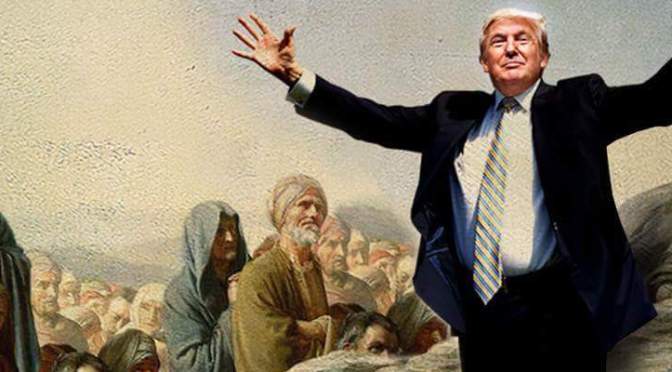
The Beatitudes According to Trump

Luke 6:20-31

Jesus looked up at his disciples and said:

“Blessed are you who are poor,for yours is the kingdom of God. (Read the whole passage)

We find ourselves coming near the end of church year. All Saints Sunday is a herald of the closing year and the coming of Advent. In only two weeks, comes Christ the King Sunday, the final Sunday of this church cycle. And so in this regard, All Saints takes us to places of beginnings and ends, birth and old age, life and death.

In the past two weeks, we have already marked the occasion of All Saints as we laid to rest members of our community. And today, we will broaden the occasion. We will remember both with joy and grief, those saints who have gone before us, those loved ones who have died. But it is not just the saints whom we have buried in the ground, but also those whom we have drowned in the waters of baptism this past year that we remember and pray for as well.

Saints, so to speak, can be a fairly broad category. The Church of Rome, has compiled their list of saints under strictly maintained standards. Other protestant churches often avoid saint talk all together. Lutherans have a favourite phrase to identify ourselves: ‘ Sinner and Saint’.

All these different definitions of who and what saints are, muddy our understanding of what a saint is. But probably we could agree that a saint is someone holy, or in other words a blessed person. And blessings is what Jesus is talking about today.

For All Saints Sunday, we hear Jesus’ famous Sermon on the Plain. It is a sermon that is well known and often quoted. Blessings and Woes. And these are not the heavenly minded blessings of Matthew’s Sermon on the Mount which reads: Blessed are the poor in spirit.  Luke is concrete and direct. Blessed are you who are poor, for yours is the Kingdom of God. These are concrete blessings that have to do with rich and poor, hungry and filled, laughing and weeping, hate and respect. And more specifically, they have to do with you… and me, and us… they are not about some abstract group of people.

The thing is, that lately, the version of the blessings and woes that we have been hearing in our world are quiet different than Jesus’. As the US elections looms over the entire world, we all know the version of blessings and woes that one particular candidate seems to be preaching. But just for fun, maybe we could imagine them going something like this:

“The poor are a bunch of losers,
for they deserve to be poor. Get a job! Which I alone can give.

“The hungry, what a bunch of lazy bums,
just get some food, I mean c’mon.

“Sad people, the worst, the worst,
sad poeple haven’t done anything for the world, let me tell you.”

“But rich people, I love rich people,tremendous.
I love just ‘em. I am really rich, by the way.

“And people with lots to eat,We gotta protect people with lots to eat.
We gotta do something for them.

“And happy people, happy people are the best
I will be the greatest president for happy people. No one else will be a better president for happy people”

“Now listen, we are going to make things great again, trust me.”

The beatitudes according to today.

But before we feel too smug because we would never preach this version, this perspective on what it means to be blessed and cursed is one that we all have the capacity to believe. The old sinner within each of, the part of us that carries our fears and anxieties and desire for security and control, that part of us want to hold on to what we have, even if that means those around us go without. The part of us is controlled by fear and anxiety worries that sharing with others who don’t have as much might make us miss out.

And yet, the world’s version of the beatitudes are held up to us like a mirror,  and we start to see how destructive they truly are. We begin to see that a world that operates according to this version is not a world we want to live in.

And so when Jesus offers his version of blessings and curses, it challenges this accepted version of things that exists in our world. It challenges the idea that the rich and happy are blessed, while the poor and persecuted are cursed. So what are we to do Jesus’ version?

Unlike the world’s version of the beatitudes which tell us what should try for – try to be rich and avoid being poor.

Jesus’ beatitudes are not a prescription on how to be blessed. Rather they are descriptive. They are poetic words about life. They are a painting of joy and suffering. They are music that speaks to our hearts and minds. They are reminders of where God is through the blessings and woes of life.

When Jesus talked about blessing, he is naming God’s presence. Jesus is telling where God shows up in life.

We can hear what it means to be blessed in the words that are proclaimed at the end of every service:

The Lord bless you and keep you.
The Lord’s face shine upon you with grace and mercy.
The Lord look upon you with favour and give you peace.

We bless each other to say that God is with us. We pronounce blessings at baptisms, confirmations, weddings, funerals, on normal green Sundays, on Christmas Eve and Easter Morning, at the beginning and end of the day. We bless each other in times of joy and sadness, in times of celebration and grief. Because God goes with us at all these times.

Yet, God does not stop there. God does not simply promise to be with us. God shows us the way through the blessings and woes of life. God, through Jesus, comes down from heaven and into flesh to be blessed by us. To bring us close to the divine. As Jesus preaches blessings and woes, he points to the cross. He points to the cross, as he foreshadows the weeping and mourning and persecution to come. The cross is where Jesus earns our sainthood. Our sainthood is earned in Christ’s death and resurrection.

On the cross, Christ declares us saints. Because to be saints, is not really about being holy as far as God is concerned. It is not about being rich or full or happy. It is not about security and power and control. Because one of the truths about the world’s beatitudes is that the longer and louder they are preached, the more obvious it becomes that no amount of wealth, power and security will actually make us feel blessed enough. And in fact, it becomes clear that we all belong to the cursed group. We all need to be blessed, we all need something, someone bigger than ourselves to bring us real hope and real grace and mercy.

The truth of the Beatitudes is that they are are not about blessings as we usually think of them. To be blessed by God, is to be loved. And it is divine love that we discover on the cross. It is the Crucified God who blesses us and claims us as his own. The poor, the hungry, the weeping, the persecuted… they are blessed because God is with them. God is with us.

The beatitudes of Jesus that we read today are the true hope of All Saints Sunday. As we remember, and as we continue to grieve all those who have died, God blesses us and keeps us. As we struggle with being poor or being rich, with being blessed or being cursed, God shines his face upon us with grace and mercy. As we search for peace in a troubled world, God looks upon us with favour.  And God promises peace that will carry us and all the saints until the end.


Header Image: https://onehundredbillionsuns.com/2016/08/05/the-beatitudes-by-donald-trump/