Tag Archives: Doctor of Ministry

The Gimli Glider and Leading the Church

Throughout the summer, I intend to share some of my reflections on my trip to Germany and reformation sites. However, I promise I won’t write about Luther and Germany every week. 

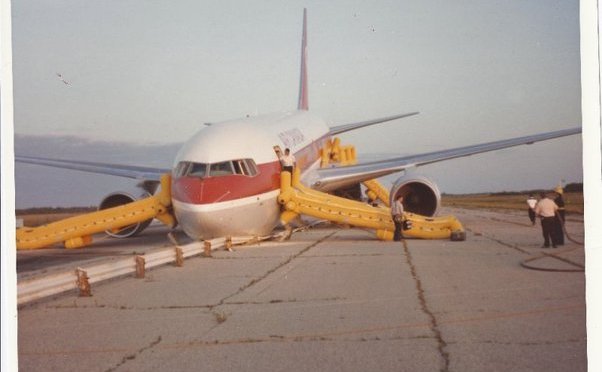
Rather, this week I have some thoughts about the clergy study conference that I attended in Gimli, Manitoba this week. For folks of a certain age, there is one thing above all else that Gimli is well known for. No, it is not the Crown Royal Distillery, not the big Viking statue. No, Gimli is known for the Gimli Glider. 

Our keynote presenter, Rev. Dr. Kyle Schiefelbein-Guerrero, Professor at Lutheran Theological Seminary in Saskatoon (AND my Doctor of Ministry thesis advisor!) began his keynote by talking about his love of plane crash documentaries. What a happy accident that our conference was in Gimli and our hotel even contained the official Gimli Glider museum!

But it wasn’t just for the sake of coincidence that Dr. KSG (as his students often call him) shared with us the fact that he has seen several documentaries about the Gimli Glider, it was to note that there is something important to learn from plane crashes. Something important for leaders in the church. 

Now that isn’t to say that the church, in its current state, is akin to a plane about to crash. But in these days of struggle and challenge, the church isn’t totally unlike a plane headed for disaster. 

Rather, two factors contribute the most to how serious plane crashes end up being. The first is “crew resource management” which is how well the crew can organize in a crisis. The second is “plan continuation bias.” This is the ability of leadership to adapt in the face of changing circumstances around them.

And certainly, there is something in those two factors that feels true about those things for the church in this moment. We can easily think of moments when churches have failed to organize and tend to the community they serve. And we can easily think of churches that have stuck to the plan at all costs, even when they were headed for doom. 

But in the converse, we see what things help us navigate the crisis moment – tending and caring for community while adapting to changing circumstances and innovating new pathways into the future. 

In the case of the Gimli Glider, the crew assured the passengers while preparing them for what was about to happen, while the pilot and co-pilot prepared to fly a plane like a glider while landing on a long-forgotten RCAF runway. 

In the case of the church, we have yet to fully prepare ourselves for what is happening. New pathways or alternate plans are still being worked out. Yet, even in free fall, God’s call to us is to continue sharing the gospel in word, sacrament and in our care for one another. Maybe we will be surprised with a landing as surprising and miraculous as the Gimli Glider’s. 

A Contextual and Practical Theologian – Pastor Thoughts

For 9 days in September, I was at the Lutheran Theological Seminary in Saskatoon, with 8 other Doctor of Ministry students beginning a journey together. The cohort of students was comprised of people from BC, Saskatchewan, Manitoba, Ontario and even Tanzania. There are Lutherans, Anglicans, United Church and Evangelical folks. 

As I have been already talking and writing about the program, I still had a lot to learn and understand myself. For instance, what is a Doctor of Ministry in Contextual and Practical Theology all about?

Well, now I can say that I have a much better sense of what this program of study will actually entail. And that is to become a Practical Theologian. Practical Theology is a relatively new field of study – only 150 years old! Compared to Systematic Theology or Biblical Studies, which can trace their roots back to the early days of Christianity, Practical Theology is just coming onto the scene as a formal discipline.

And yet, it really isn’t new. Theologians, clergy and even ordinary people of faith have been taking insights from Scripture and the Tradition of the Church and bringing them into conversation with the lived practices of everyday faith. Reflection on how what we believe and confess to be true and how that impacts the things we do in faithful community – and vice versa – has always been something that is happening among congregations and faith communities. 

As Lutherans, we have a strong example of a practical and contextual theologian in Martin Luther. So much of what he wrote and did was about bringing his understanding of scripture and the theology of the church into conversations about how the church of his day practiced the sale of indulgences (tickets to heaven), how the mass or Holy Communion was celebrated and observed, who could read the bible, how faith was passed on and so much more. 

Modern Practical Theology goes a little further using the tools and methods of the social sciences to do research that provides qualitative data. Surveys, focus groups, interviews, asset mapping, appreciative inquiry, and more generate data about the practices of real-life communities. It is a way to bring theological reflection into the real and ordinary things that we do in our faith community. 

What does this mean for the research I will be doing? Well, Practical Theologians do their research not to or on, but with the community. So I will be doing aspects of my research together with my congregation and folks in our area, with the goal that reflection and new understandings will bring about real transformation. 

There is a part of me that is nervous about this. What might happen if we intentionally seek transformation through learning and reflecting together? I don’t know… and that is the point.

Because I am also very excited… for what we might discover and how that might change us along the way. 

Starting New Things This Fall – Pastor Thoughts

My children keep asking me how much longer Spring Break will be. They haven’t really distinguished yet between Spring Break and Summer Break.

They are true COVID children in that their experience of their first few years of school has been marked by several extended breaks or pauses of in classroom learning. So Summer Break has yet to take concrete shape in their minds. And different than my childhood longing that summer breaks would last forever, they are looking forward to seeing their friends and teachers again. They have lived through the experience of not knowing when they might suddenly without warning not be returning to school for a week or month or even longer. 

So we have been preparing them for how long summer break is and when school will start again, going over the schedule of family trips, days camps, visits from friends and family, and so on. 

As the kids look forward to going back to school already, I find myself in the same boat. I announced a few weeks ago that I am going back to school this fall too, to begin a Doctor of Ministry (DMin) degree program at the seminary in Saskatoon. Since graduating in 2009, I will admit that I have enjoyed being free from the unique pressures of going to school, as I went straight from grade school to university to seminary. In fact, I still have the occasional bad dream where I haven’t prepared for an exam or written a paper that is due. 

But the seminary that I am going back to is quite different than the one I graduated from in 2009. My four years of seminary, like my four years of undergraduate study, were fairly traditional. In person, on-campus learning in a semestered format. 

Now, the seminary has shifted to an intensive and often online format. Courses are taken one at a time in the span of two to three weeks, one after another, rather than three to five courses at a time over a three-month semester. Courses are also offered either in person or over Zoom, which the seminary started long before the pandemic. This was done to accommodate students who couldn’t uproot families or cease working, but who could be in Saskatoon for a week or two and could study at home. 

In addition to the changed intensive, online option format, the Doctor of Ministry Degree program will also be a new kind of study experience for me. The DMin program is similar to a PhD program in that it is a terminal degree meant to help students delve deeply into un-researched topic areas. But it is different than a PhD, which is a purely academic degree intended to focus on theoretical research; the DMin has a professional component. It might be a compared to a specialization in Medicine or in Law. A DMin is intended to be done while a student is working, and research is meant to be conducted in the context that the student is serving in. So it is not just that you *can* work full time while doing a DMin program, you *must* be working full time in ministry.

Because the DMin is done in short intensive spurts along side the regular rhythms and duties of ministry, this summer I have already begun readings and coursework. I used to get truly annoyed by the mature students in university or seminary who were always reading and working ahead, and here I am doing the same! And at this stage of my life, I now get why those olderstudents were like that. It is the same reason why sleeping in these days means getting up at 7 am, rather than 6:00. 

Thankfully, there is still more than a month until school starts and almost two months until I head off to Saskatoon for my first week of DMin work. Yet, this year, like my kids, I am looking forward to school starting in the fall and the new journey that it will bring⎯but not too far forward!