Tag Archives: Church

Not the Christmas we want but the Christmas we need

Luke 2:1-14(15-20)

In those days a decree went out from Emperor Augustus that all the world should be registered. This was the first registration and was taken while Quirinius was governor of Syria. All went to their own towns to be registered. Joseph also went from the town of Nazareth in Galilee to Judea, to the city of David called Bethlehem… (Read the whole Christmas Gospel)

Sermon

You may be expecting a story tonight.

For the past three years, Christmas Eve has been a chance to tell the story of Christmas in a fresh way, with modern versions of the Christmas story. However, tonight will be a bit different. Rather than something that sounds like a Vinyl Cafe story (Lake Wobegon for American readers), we are going to tell and hear the Christmas story with new ears to hear and new eyes to see. As the angels said to the Shepherds:

Do not be afraid; for see– I am bringing you good news of great joy for all the people

Like a lot of the world, 2016 has been a rough year for us. Politics has been messy and ugly. We have been subjected to constant news of war and violence and terror attacks around the world. There are near daily stories about the effects of climate change. Our culture and society is having conflicts around issues of race, gender, religion, and ethnicity. We never know when there will be another mass shooting, another earthquake or hurricane or forest fire. Any moment, another celebrity death will stream across social media feeds when we least need hear it.

And here at Good Shepherd we have born the weight of more than our share of illness, tragedy and death.

So maybe for you Christmas is just the same old, same old time for family, traditions and memories this year.

But it is probably the case that for most of us, Christmas lacks a little something. It feels a little duller and subdued. The magic just isn’t quite there for all the reasons that 2016 has been so difficult.

And we think that Christmas is supposed to have that special quality, that feeling of being different than the normal and mundane things of every day life. Christmas is supposed to lift our spirits, remind us of better things, be a time for sentimentalism and warm fuzzies. It is like that Christmas Card with Mary gazing lovingly down at newborn Jesus – it should melt our hearts. It should feel like special moment when we all sing silent night to candlelight, – glowing faces all around.

But this year it hasn’t been those things. Maybe tonight was supposed to be the chance to reclaim what Christmas is supposed to be…

So here is the thing.

The Christmas story that we know, the one that goes along with silent night, kids dressed up in cute outfits, family traditions waiting at home and presents under the tree… is not exactly the real version.

At the risk of sounding like the pastor grinch…

All the nostalgia is less about Christmas than we think. In fact, all those things that we listed earlier that made 2016 such a hard year… they speak more to Christmas than we want to think about.

When we hear that familiar story from Luke that we just read… it is easy to imagine the Christmas pageant or TV version.

But the very first line of story takes us to something a little more 2016 than we might be comfortable with.

“In those days a decree went out from Emperor Augustus that all the world should be registered.”

We have political leaders talking about a registering certain kinds of citizens, talking about values tests and ways of sorting us into good and bad.

Mary and Joseph were part of that group that was called upon to register, because of their religion, the colour of their skin, because of where they came from – they were part of a group that those in power wanted to track and monitor.

And so, like so many migrants forced to move their homes, regardless of age, health, ability or even whether or not they were pregnant, Mary and Joseph were forced to pack up their lives and move across country.

Perhaps for the first time in decades, we have a better understanding of what the Emperor was doing by announcing a registration, and it wasn’t good.

Like the millions of refugees around the world or like so many who live in poverty on our planet, Mary and Joseph had no safe place to stay. There was no refugee camp or shanty town to go to. There was no kind soul to take pity of them. All they could find was essentially a place to squat out of necessity.

And so Mary gave birth in a stable… but not the sweet and sanitary stable that we might imagine. But probably a cold and dark cave where the animals were kept. Imagine a refugee family hiding in an abandoned building or out in the woods… none of us would consider this a good place to spend the night, let alone have a baby. But this is where the mother of God was forced to give birth.

Then once the ordeal of child birth is over, a gang of Shepherds show up. Not the cute ones wearing bathrobes that we imagine. But shepherds who were the dregs of society, more like drug dealers and addics, not good and polite neighbours bringing casseroles, not well meaning aunts who stop by the hospital with flowers. But the kind of people that most of us would cross the street to avoid…. these misfits are the ones who show us first to worship this new born child.

But just to top it all off, Jesus is born to a teenage mom with an older man looking after her and her child despite not being the baby’s father. Jesus is born into the kind of situation where would we expect child and family services to intervene and remove the child. Yet, this is the family that God chooses to care for the Messiah.
Once the baby is born and somehow the holy family has survived everything from being forced from their homes to register, travelling across country, giving birth in squalor, being visited by the riffraff of society…. Mary and Joseph are left on their own. Left in a world where they have no home, where soldiers would be looking for them soon in order to kill the baby boy, where foreign powers and corrupt kings controlled their lives, where there was no safe place to live or hide, but the only safety was to keep moving out on the open road…

Hardly sounds like Christmas, does it?

Except this is the Christmas story.

And it is important that this is the Christmas story.

Because the warm fuzzy version is not what our world needs. The traditions and carols and movies and light strung up might make us feel good, they may even bring a certain joy and hope to our dark December…. but the TV version of the Christmas story will not save the world. It will not save us from all the things we need saving from.

In fact, in a world where we can name three major tragedies just this week in the Christmas Market in Germany, the war in Aleppo and fireworks explosion Mexico, the fact that the first century world of Mary and Joseph, the world of Caesar Augustus full of registrations and soldiers and refugees and danger…. that this world of 2000 years ago is very much like our world today…

This fact means that if God can be born to a teen mom and a step dad in 1st century occupied Israel, means that surely God can be born in our world.

That Jesus is found in Christmas markets struck by tragedy.

That Jesus is born in the bombed out rubble of Aleppo.

That the holy family passes through fireworks markets while on the road.

As much as we want the magic of Christmas,

The world needs the Messiah to be born,

The Christ who is willing to go and be found in the real Christmas places.

God in Christ is willing to be born among us in order that we can see that God has come near. Near to us in the ways and places that we need most. God comes near, God joins in creation, taking on our flesh to show us that we are not left alone to sort out this crazy world. That we go into the night with God along side us, that God is facing the dangers with us, that surviving our world, that confronting sin and death is precisely where God comes to meet us.

The good news of great joy at Christmas is that the God of light and life has not left us on our own, but comes into our world to live life with us, to give the small but enduring hope found in a baby that changes the world.

2016 might not feel much like Christmas as we know it, but it just might be the closest to the first Christmas we have ever been.

The story that we tell tonight is so much bigger and so much deeper than the feelings we try to recreate time of year. The real Christmas story, the real story of Jesus’s birth in our world is about all the feelings that we don’t want to have this time of year. It is about the fact that God comes to into a world that needs joy and hope and light.

So just as those Angels proclaimed: Do not be afraid.

Do not be afraid if Christmas doesn’t feel like we think if should this year…. because it is precisely into this world of ours full of difficulty, hardship and struggle that Jesus is born. Born in the city of David, born here among us

Amen.


John the Baptist, Rejecting Society and Honest Preaching

Matthew 3:1-12

In those days John the Baptist appeared in the wilderness of Judea, proclaiming, “Repent, for the kingdom of heaven has come near.” This is the one of whom the prophet Isaiah spoke when he said,

“The voice of one crying out in the wilderness:
‘Prepare the way of the Lord,
make his paths straight.’

Now John wore clothing of camel’s hair with a leather belt around his waist, and his food was locusts and wild honey. Then the people of Jerusalem and all Judea were going out to him… (Read the whole passage)

As we journey deeper into the Advent season we hear from John the Baptist. John gets to make his appearance each year on the second Sunday in Advent, preaching to us from the wilderness about the coming to the Messiah.

John’s place in the arc of Advent comes after we started with the end of time last week, as Jesus implored the disciples to Keep Awake, as the Son of Man was near. While John the Baptist appears at the beginning of Jesus’ earthly ministry, we tell his story as the prelude to the story of Jesus’ birth. And that John always comes after warnings about the end of time isn’t coincidence. John’s preaching serves to re-orient us from the end times talk to the new thing about to happen with Messiah’s coming.

John is framing the beginning of the story. John is setting the stage for us. John helps us to see the world as it is and our need for Messiah to come.

The figure that John strikes is definitely that of a unique character. John is a hermit living in wilderness, living and eating off the land. The details of his clothing and food might sound funny or interesting, but they tell us something deeper about John and what he is about. John is a hermit certainly, but why? Probably because he has walked from society and the problems he sees with it. John was not always a hermit preaching in the desert, rather he was born into the priestly cast, his father Zechariah being a priest in the temple. If John had followed the plan as he was born into, he would have served in the temple making sacrifice and administrating God’s righteousness to the masses. The temple was the centre of Israel’s power and influence, the priests who served were people in positions of power. John was born into power.

But instead John walks away from all of that. And John doesn’t reject the power he inherited in birth. John could have chosen a route like his cousin Jesus who choose to hang out with the poor, sinners and tax collectors over the rich and powerful. But John walks away from it all, from rich and poor, from righteous and sinner.

John chooses the great empty wilderness instead.

And yet in a twist of irony, as John tries to leave the centres of power and privilege behind, he goes into the wilderness and finds the very people he is trying to avoid. John finds himself preaching to the masses looking for salvation, and to the religious authorities watching his every move. Despite walking away from his priestly duties in the temple, John finds himself filling the same role in the wilderness. He is leading rituals that help make people righteous – baptisms. And he is preaching from the law the prophets.

“The voice of one crying out in the wilderness:
‘Prepare the way of the Lord,
make his paths straight.’

Despite John’s best efforts to avoid the world of his day, the structures of power, the inequality and unfairness around him, the powerless and powerful… John finds himself addressing and naming the realities of his world. The crowds have come to him hoping for change, hoping for fixes to their difficult and suffering lives. The religious authorities have come to watch him and make sure he doesn’t cause trouble or threaten their power.

Instead, John preaches what no one wants to hear. He names the dark places of the world. He points to the brokenness and struggles of the world. He preaches that a Messiah is coming to straighten things out… which means that things are crooked. He preaches the need for repentance and forgiveness of sins… which means that people are broken. He preaches that it is not enough to rely on being Children of Abraham or Lutherans, or members of a church… which means that who we think we are will not save us.

And yet John does something unusual for someone in his position. He admits that he is not  the solution. In a turn to honest and authentic preaching and prophetic words, John says that someone else, a Messiah, is coming to straighten the world out… which means that John himself is not the one the crowds are waiting for. What an unusual thing for a popular person to admit in front of a crowd of eager people wanting to throw their devotion to a possible saviour.

John might be preaching to the problems of his day, but he could be just as well be speaking today. Much like John’s world, our world is full of desperate people who are suffering and need a change. People who are looking for the next strong man to show up and smash all the problems and make things the way they are supposed to be. Or like the religious authorities, there are those in the world who are very invested in keeping things as they are, because they are benefitting greatly at the expense of most others.

But John is naming the reality that none of us really wants to admit. And that is that the world is dark and broken and suffering. That there is so much crookedness and self-centredness and injustice that there is no way that we can fix it on our own. And John’s assessment is not a judgmental one, but a realistic one. A statement about how things just aren’t right in the world, that no matter how hard we try, something is off. We know this is not the way the world should be… but we don’t know how to do anything about it.

We can look around and see that the world isn’t as it should be. We see people we know and love being diagnosed with unfair illnesses and disease. We see our children or grandchildren being bullied at school. We see our neighbours getting laid off, or families torn apart in relationship breakups. We see that we just cannot help fighting and misunderstanding and judging and fearing each other. We turn on the news and hear about violence, corruption and tragedy.

We see all of this, and we know that this is not how the world is supposed to be. This isn’t right.  And so we get why John has just left everything behind to go live in the wilderness, a place of emptiness that might be missing the comforts of life, but hopefully is also devoid of the tragedies and suffering and conflict.
But there is something else that John tells us without words or preaching. Something about what God is up to in the dark and empty places.

John, with all his flaws and contradictions and weirdness, is doing God’s work of announcing the Good News. God is using John of all people, to tell crowds who are looking for someone else, and religious authorities who don’t want to listen, that the Messiah is on the way. God is bringing Messiah’s light to the world through John, one of the most unexpected people imaginable.

The fact that God is working in surprising and unexpected ways cannot be understated.

That God chooses flawed and contradiction filled and weird people to announce that the good news is something that we need to be reminded of.

That God is heralding the Messiah’s coming with someone like John the Baptist shows us that God is willing to use people that we might never consider for God’s mission.

That God is sending Messiah to straighten out our crooked places, to Baptize us with the Holy Spirit, to transform us and our world… and that this is happening now is the Good News.

And with this news, that the Messiah is coming to make straight paths, all the dark things that we see in our world, the sick loved ones, the struggle neighbours, the vulnerable children, the conflict and fear…. all these dark things start to have a little less weight. They are pushed back in favour of a new world, in favour of Messiah’s world. A world that we practice bringing about here, just like John in the wilderness. Look around and you will see fellow strange, weird and unique preachers and prophets to the good news. People who confess and forgiven sins. Who sing and praise God, pray and speak the word. People who baptize and are baptized, people who share in the bread and wine of life. People who bring about the Kingdom of Heaven simply by being together. Unlikely people who are God’s hands and feet in the world.

On the second Sunday in Advent, the arc of the advent story takes us from the end of time to the beginning of God’s making all things new. And Messiah cannot come sooner into our dark world. Yet, the way that God draws our eyes and our attention to this new light coming alive in world, is through John the Baptist. John the Baptist who is at one time one of the most important figures of faith and also the least likely prophet and preacher of the good news. In so many ways John the Baptist is very much like us, or we like him. Because we too are the flawed and unlikely preachers and prophets that God is using to announce the coming of the light.

God is using John and using us to speak from the wilderness, from unlikely places, to unlikely listeners, about the light that is coming into the darkness, the Messiah that is to come.

It is no wonder that we began worship today by praying:

Stir up our hearts, Lord, to prepare the way.

Adjusting to the darkness of Advent

Matthew 24:36-44

Keep awake therefore, for you do not know on what day your Lord is coming. (Read the whole passage)

It is time to begin again. Advent is here. The wreath is set out, the colour blue adorns the sanctuary, we are dusting off the advent portion of the hymnbook and we are settling in for 4 weeks of waiting and watching, of “keeping awake” as Jesus would say, for the coming of Messiah. But Advent is not an annoying countdown for Christmas invented by pastors to keep people from singing Christmas Carols in December (although we might be tired of Joy to the World and Silent Night by Christmas Eve if we did).

Advent is a complete idea or season unto itself. Advent reminds us of where we began as Christians, as God’s people waiting for salvation in a dark world. And it is not about what comes at the end of the waiting, but about what waiting means for us. About how waiting for that which is not here, waiting for justice and peace in the world compels us to strive for those things. Advent is about how we wait for God to come to rescue us, and it is about how God is waiting for our eyes adjust to the darkness so that we can see that God is, in fact, bringing light and hope into our world.

Today, we are reseting the church’s cycle of telling the story of Jesus. A cycle that has been continuing in some form or another for nearly 2000 years. And in the 3 year cycle of readings that we follow Sunday after Sunday, today is beginning of year A, the first year of the cycle. Which means, that today we have heard the first 4 readings of the first Sunday of the first year of the cycle.

And isn’t it strange that the first words chosen for us to hear from the bible are passages about the end of time?

Last week on Christ the King Sunday, we ended the church year by going to the middle of the story, the crucifixion. And today, on the first Sunday of the New Year, we start by going to end. Sometimes the church can do things a little backwards.

But there is a reason to start at the end… or at least, as Jesus tells his disciples that no one knows the day nor the hour when the Son of Man will come but the Father, Jesus is trying to get us to see something important. Jesus is trying to tell us something about what it means to be ready for the end of all things.

Now, given that we are in the season of Advent, the season of preparation, the notion that no one knows the day or hour of coming of the son Man has always seemed more of technicality to me. Sure we don’t have the moment marked down in the calendar, but we are ready just the same. Jesus wants us to be prepared, right? The issue here seems to be one about knowing and not knowing the time.

Well, not so fast.

The examples that Jesus gives of unreadiness are more than just about failing to live up to the boy scout motto. It isn’t just that people didn’t know the exact moment of the return of the son of man. The people of Noah’s day had no idea what was coming. The two working in the field were oblivious, otherwise they probably wouldn’t have been working in the fields. The same for the women grinding meal. The owner of the house is robbed because he wasn’t awake.

Jesus doesn’t say be ready because you don’t know the day or hour.

Jesus says keep awake

Or in other words, maybe all of our Advent preparations are not actually not what Jesus is talking about. Maybe as we are about to put a lot of our attention and focus into trips to the mall for gift buying, putting up lights and baking Christmas cookies, filling our calendars with Christmas parties and concerts, getting ready for Messiah by getting ready for the holidays… maybe Jesus is talking about something different.

Keeping awake.

Keeping awake to the world around us is more than a matter of not knowing the exact moment. It is about awareness, about being attentive to the world around us. Letting our eyes adjust to dark places, to the people and circumstances around us who really need light and hope and salvation. Because keeping awake might mean paying attention to the hard stuff, to the suffering of our neighbours. Keeping awake might be opening our eyes to the crisis of fentanyl overdoses that has landed in our province this fall. Keeping awake to the plight of Indigenous people protesting for their water rights at Standing Rock. Keeping awake to the increase in racism, sexism and bigotry and accompanying violence that has erupted in the US and Canada since the election. Keeping awake to the plight of the Syrians living with daily bullets and bombs, children and families with no safe place to go. The more we open our eyes, the farther out into the world we see more suffering.

Keeping awake is hard and painful. We would much rather watch Christmas movies and drink egg nog. It is much easier to be distracted and on auto-pilot with Christmas preparations than it is to sit, rest and be awake in Advent.

Still as Jesus implores us to be awake, the examples he uses are ones where people are still sleeping. The people around Noah did not see the flood coming. The ones working in the field, the ones grinding meal did not know the time was coming. The owner of the house wasn’t expecting to be robbed. They were not awake. They were sleeping at the wheel.

And each time, the Son of Man came anyways.

For you see, Jesus might tell us to keep awake with the disciples and to watch for the coming of Messiah into our world, but Messiah’s coming doesn’t depend on our wakefulness.

In fact, Jesus knows that we will almost certainly be asleep when Messiah comes.

Yet,

Messiah comes because the world needs Messiah.
Messiah comes because we are waiting for salvation.
Messiah comes because we need hope.

Keeping awake isn’t about making Messiah come, but about seeing where Messiah already is.
Keeping awake isn’t just about seeing the bad stuff, but letting us see the light.
Keeping awake is letting our eyes adjust to the dark, so that we begin to see that there is light.

Messiah’s light is appearing as communities rally together to support those affected by addictions.
Messiah’s light grows as people all over the world begin standing with Standing Rock.
Messiah’s light multiplies as friends and neighbours stand up and speak out against racism, sexism, violence and hate.
Messiah’s light shows up wearing white hats in Syria, running to the danger and working to recuse and save victims wherever possible.

And Messiah’s light is born here among us, as we gather to tell the story of Jesus, to pray and sing, to share a meal and to fellowship. As we strive for justice and peace in our communities and the world around us.

The end is coming, the son of man arrives at an unexpected day and hour.

And Jesus says, Keep Awake.

Keep awake for Advent.
Keep awake in a dark world.
Keep awake even though it is hard.

And even though we are sleeping, Messiah comes.

And here in our dark world,

Messiah’s light is born.
Messiah’s light grows.
Messiah’s light is here.

Messiah is the story of Advent, the story that we are beginning over again today. Messiah is the one who is that small light in a dark world, the light that is hard to see until our eyes adjust, but that is there, pushing back the darkness, allowing us to see a glimpse of the Kingdom of God.

Keep Awake, Jesus says,

because you do not know on what day your Lord is coming,
but you do know that Messiah in on the way.

What President Trump could mean for Mainline Christianity

Since that fateful early morning announcement on 11/9 that Donald Trump had been elected president, I have felt like we have been living in the opening scenes of one of those movies. You know, the ones where oblivious and unassuming people are living in a world that is about to be completely changed for the worse, but no one believes it. You know, a disaster movie.

And in the days since the election, news continues flooding out with so many scandals relating to the Trump transition (he isn’t even in office yet) it is hard to know what to focus on, from Trump’s White Supremacist Chief Strategist, to an unhinged National Security Advisor, to global uncertainty, to Obama having to deal with a flood of concerned world leaders, to Trump’s ties to Russian interference in the election, to Trump’s insane list of conflicts of interests, to Trump’s inexcusable treatment of the press, to even suggestions of vote rigging (he did say it was rigged!). And let’s not forget his pre-election scandals like the misogynist Trump Tapes and Trump University law suits.

It is surreal to say the least.

With this hurricane of insanity around us, I keep coming back to the question of what this means for the church, specifically for mainline Christianity. For the portion of Evangelicals that elected trump, I actually think this was the final step in turning White Evangelicalism into a nationalist political movement. While many evangelicals may still be believers, Evangelicalism can no longer claim to follow the Triune God of the Bible.

American Evangelicalism is no longer Christian by any meaningful measure. 

But for mainline Churches, whose American members may or may not have voted for Trump, but whose leadership did not lineup behind him for a chance at power, Donald Trump may transform us in ways we would never have imagined.

If the Trump administration’s transition to power continues down this rocky and convention defying path, taking the next government deeper into racist behaviour and policy, isolationist attitudes, questionable ethics and attempted censorship complete with Orwellian double speak, we can only imagine what the world will look like after January 20th.

People are already afraid as the incidence of race related attacked and violence increases. Protests have been going on since the election and people are talking about how to survive the new regime. Many political and public leaders are advocating a wait and see approach, but many others simply don’t want to make the same mistake that the appeasement period before World War Two did and are already speaking out.

And so as Churches and communities of faith, where does this leave us?

To imagine how this new world might collide with the church consider this example I have been using for a while now:

Imagine going back to a church in 50s or 60s. If you told the average person in the pew that in 50 years many churches would be shells of their former selves with aging and declining membership, you would be laughed at. Churches were full of young families and programs. Families had 4.2 kids and church attendance was socially required.

But why were they full? Because people were better Christians back then?

Or was it that the world had just come through two world wars and the Great Depression? Was it that society had collectively stood at the brink and glimpsed our collective demise for 5 years straight before the first good news for the allies on D Day? 

Church was a place where hope was found, where grief, anxiety, struggle, pain and fear could be handed over to something bigger than ourselves. Churches proclaimed that there was something more powerful than huge armies marching over nation after nation, than governments who were sending millions of husbands and sons to war, than the threat of oppression and even extinction. 

Churches didn’t have to do anything special other than be communities that proclaimed the Good News as they had been for nearly 2000 years. They were naturally what so many people needed in that world.

Now imagine telling anyone who has regularly been in a pew for the past 15 years that it is possible that our currently declining and aging church may be full and bustling again in a few decades. They will laugh at you.

Well, maybe they would have laughed before November 8th.

But now all the things we thought were important in reversing decline like flashy worship, entertaining sermons, lattes for sale in the lobby, Nickelodeon night for the youth and all the other things we think will “attract” people mean nothing now. 

Churches, especially mainline ones, will need to focus again on the core things that we have always been: 

We will need to be communities of refuge because people will have fewer and fewer safe spaces.

We will need to be communities of resistance in a world that is demanding division, conflict and violence.

We will need to be communities of hope because we cannot just go back to sleep and pretend the government will have our backs while we spend our time mindlessly consuming stuff and entertainment.

We will need to be proclaimers of the gospel.

Of course, God has always called us to be all these things. But lately we have been delinquent in that call because we couldn’t see all that which we needed saving from. The world told us that our only problem was not having enough.

But now the threats and dangers, both external and internal will be obvious. We will now see what it is that we need saving from more clarity.

And we will see how God is using us to proclaim that salvation with more clarity.

And this new world will make what the church has always done subversive to the established order. Just by being the church we will declare that bigotry, hatred and self interest are not virtuous.

Just by doing what we have always done we will be seen as contrarians who believe that forgiveness of sins, life and salvation are given to us freely by God. Things that didn’t seem to mean much when the world’s biggest problem was not having enough stuff. But now are things that will mean everything to people suffering under a kleptocratic regime.

Just by being people of Word and Sacrament, we will birth a reality completely different than the one dictated by power.

A reality grounded in Christ and rooted in defiant hope. 

For a while now, many churches, church leaders and Christians have been wringing our hands over decline, wondering what it might take to get people back. And we foolishly thought it would be trendy programs and music selection.

Now, we are discovering what may actually drive a resurgence in mainline Christianity and what will be truly important for the church to be about.

Are we ready for the kind of world that will finally give us what we have been longing for?

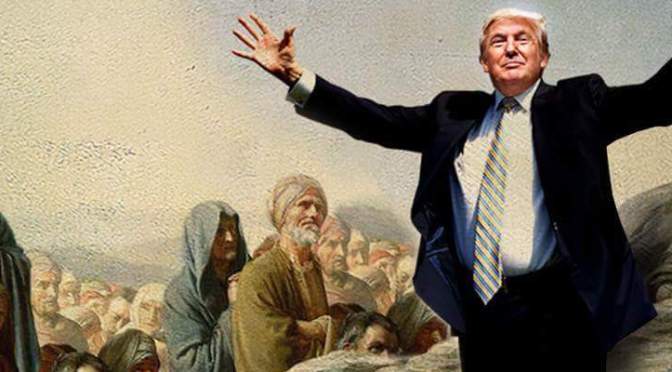
The Beatitudes According to Trump

Luke 6:20-31

Jesus looked up at his disciples and said:

“Blessed are you who are poor,for yours is the kingdom of God. (Read the whole passage)

We find ourselves coming near the end of church year. All Saints Sunday is a herald of the closing year and the coming of Advent. In only two weeks, comes Christ the King Sunday, the final Sunday of this church cycle. And so in this regard, All Saints takes us to places of beginnings and ends, birth and old age, life and death.

In the past two weeks, we have already marked the occasion of All Saints as we laid to rest members of our community. And today, we will broaden the occasion. We will remember both with joy and grief, those saints who have gone before us, those loved ones who have died. But it is not just the saints whom we have buried in the ground, but also those whom we have drowned in the waters of baptism this past year that we remember and pray for as well.

Saints, so to speak, can be a fairly broad category. The Church of Rome, has compiled their list of saints under strictly maintained standards. Other protestant churches often avoid saint talk all together. Lutherans have a favourite phrase to identify ourselves: ‘ Sinner and Saint’.

All these different definitions of who and what saints are, muddy our understanding of what a saint is. But probably we could agree that a saint is someone holy, or in other words a blessed person. And blessings is what Jesus is talking about today.

For All Saints Sunday, we hear Jesus’ famous Sermon on the Plain. It is a sermon that is well known and often quoted. Blessings and Woes. And these are not the heavenly minded blessings of Matthew’s Sermon on the Mount which reads: Blessed are the poor in spirit.  Luke is concrete and direct. Blessed are you who are poor, for yours is the Kingdom of God. These are concrete blessings that have to do with rich and poor, hungry and filled, laughing and weeping, hate and respect. And more specifically, they have to do with you… and me, and us… they are not about some abstract group of people.

The thing is, that lately, the version of the blessings and woes that we have been hearing in our world are quiet different than Jesus’. As the US elections looms over the entire world, we all know the version of blessings and woes that one particular candidate seems to be preaching. But just for fun, maybe we could imagine them going something like this:

“The poor are a bunch of losers,
for they deserve to be poor. Get a job! Which I alone can give.

“The hungry, what a bunch of lazy bums,
just get some food, I mean c’mon.

“Sad people, the worst, the worst,
sad poeple haven’t done anything for the world, let me tell you.”

“But rich people, I love rich people,tremendous.
I love just ‘em. I am really rich, by the way.

“And people with lots to eat,We gotta protect people with lots to eat.
We gotta do something for them.

“And happy people, happy people are the best
I will be the greatest president for happy people. No one else will be a better president for happy people”

“Now listen, we are going to make things great again, trust me.”

The beatitudes according to today.

But before we feel too smug because we would never preach this version, this perspective on what it means to be blessed and cursed is one that we all have the capacity to believe. The old sinner within each of, the part of us that carries our fears and anxieties and desire for security and control, that part of us want to hold on to what we have, even if that means those around us go without. The part of us is controlled by fear and anxiety worries that sharing with others who don’t have as much might make us miss out.

And yet, the world’s version of the beatitudes are held up to us like a mirror,  and we start to see how destructive they truly are. We begin to see that a world that operates according to this version is not a world we want to live in.

And so when Jesus offers his version of blessings and curses, it challenges this accepted version of things that exists in our world. It challenges the idea that the rich and happy are blessed, while the poor and persecuted are cursed. So what are we to do Jesus’ version?

Unlike the world’s version of the beatitudes which tell us what should try for – try to be rich and avoid being poor.

Jesus’ beatitudes are not a prescription on how to be blessed. Rather they are descriptive. They are poetic words about life. They are a painting of joy and suffering. They are music that speaks to our hearts and minds. They are reminders of where God is through the blessings and woes of life.

When Jesus talked about blessing, he is naming God’s presence. Jesus is telling where God shows up in life.

We can hear what it means to be blessed in the words that are proclaimed at the end of every service:

The Lord bless you and keep you.
The Lord’s face shine upon you with grace and mercy.
The Lord look upon you with favour and give you peace.

We bless each other to say that God is with us. We pronounce blessings at baptisms, confirmations, weddings, funerals, on normal green Sundays, on Christmas Eve and Easter Morning, at the beginning and end of the day. We bless each other in times of joy and sadness, in times of celebration and grief. Because God goes with us at all these times.

Yet, God does not stop there. God does not simply promise to be with us. God shows us the way through the blessings and woes of life. God, through Jesus, comes down from heaven and into flesh to be blessed by us. To bring us close to the divine. As Jesus preaches blessings and woes, he points to the cross. He points to the cross, as he foreshadows the weeping and mourning and persecution to come. The cross is where Jesus earns our sainthood. Our sainthood is earned in Christ’s death and resurrection.

On the cross, Christ declares us saints. Because to be saints, is not really about being holy as far as God is concerned. It is not about being rich or full or happy. It is not about security and power and control. Because one of the truths about the world’s beatitudes is that the longer and louder they are preached, the more obvious it becomes that no amount of wealth, power and security will actually make us feel blessed enough. And in fact, it becomes clear that we all belong to the cursed group. We all need to be blessed, we all need something, someone bigger than ourselves to bring us real hope and real grace and mercy.

The truth of the Beatitudes is that they are are not about blessings as we usually think of them. To be blessed by God, is to be loved. And it is divine love that we discover on the cross. It is the Crucified God who blesses us and claims us as his own. The poor, the hungry, the weeping, the persecuted… they are blessed because God is with them. God is with us.

The beatitudes of Jesus that we read today are the true hope of All Saints Sunday. As we remember, and as we continue to grieve all those who have died, God blesses us and keeps us. As we struggle with being poor or being rich, with being blessed or being cursed, God shines his face upon us with grace and mercy. As we search for peace in a troubled world, God looks upon us with favour.  And God promises peace that will carry us and all the saints until the end.


Header Image: https://onehundredbillionsuns.com/2016/08/05/the-beatitudes-by-donald-trump/