Tag Archives: Church

Turning Cornerstones into Stumbling Blocks

Matthew 16:21-28

And Peter took him aside and began to rebuke him, saying, “God forbid it, Lord! This must never happen to you.” But he turned and said to Peter, “Get behind me, Satan! You are a stumbling block to me; for you are setting your mind not on divine things but on human things.”

Then Jesus told his disciples, “If any want to become my followers, let them deny themselves and take up their cross and follow me. (Read the whole passage)

We would all like to believe that we would have been smart enough. That we would seen what the others missed. We hope that had we been the ones those following Jesus around the backwoods of Galilee, that when he would speak of his impending suffering, we would have been able to keep our mouths shut, or even agree with him. If we had been standing in Peter’s shoes, maybe we wouldn’t have tried to stop Jesus from coming to harm and instead we would have known that Jesus’ life on earth necessitated the cross.

To hear Jesus speak to us today, means we must take a moment  to imagine Peter’s humiliation in front of his friends. Jesus calls him a stumbling block. A stumbling block simply because Peter showed concern for his teacher and his friend. Jesus seems to be a little a hard on Peter. Jesus is hard on this poor guy that just moments before he had been praising. Praising Peter for his faith and his sight.

You see, just before the conversation we hear today, Peter recognizes Jesus as the Messiah. And Jesus responds by changing Peter’s name, which was Simon, to Peter. Petros. Rock. “On this rock, I will build my church”. This is what Jesus has just proclaimed to Peter, and then Jesus turns that rock and foundation, into a stumbling block. How quickly Jesus turns things on their head.

But why is Peter rebuked so? What is so wrong with having concern for one’s friend and teacher. It is not as if Peter was acting maliciously. It is not as if Peter was trying to trip Jesus up. He was simply showing concern. He was trying to be the good guy. Poor Peter, always speaking first and only later thinking through was he has said and done, seems to be the victim of a moody Jesus. Or at least that is the way it may seem. But with Jesus there is always something else going on.

We all hope that we would see the world more clearly than Peter did, yet we know that we are not much different. Most of us know that we would have responded in the same way to Jesus when he spoke of his coming suffering. Most of us have spoken to loved ones that way, we have warned those we care about of impending danger and we have warned against taking dangerous risks.

And how can we help it? We live in a world that desires above all else, safety and security. We are bombarded by media that tells us to buy more insurance, to invest more for our retirement, to drive safer cars, to lock our doors and install home security systems. We drive our kids to school, even its only a few blocks. We do not go out alone at night. We strive to keep ourselves and our loved ones safe. And why shouldn’t we. Are we not caring for those we love when we keep them safe?

Certainly it is because we care that we strive for safety and security. We care for our loved ones, and we do not wish them to come to harm. Most of us would give our own lives to save the life of someone we cared about.

And yet, somewhere in the desire to care for our own, there is also the desire to be in control. At the root of our search for safety and security is the selfish desire to control the world around us, to shape things in our vision. To make the world according to our own image. Because deep down, we know that the only way to be truly safe and secure… is to be in control. If we can be in control, there are no surprises, nothing unexpected, no one will get hurt… and no one will be free.

When Jesus rebukes Peter and calls him a stumbling block, you can imagine there must have been sadness in his voice. A sadness about Peter’s inability to understand, a sadness for the people for whom Jesus would suffer. Peter doesn’t see the bigger picture, the divine picture. Instead, Peter is looking to control the situation, to control Jesus, and Jesus is frustrated with him because of it. Jesus is trying to get at something bigger, something more important than what Peter is worried about. Jesus is pointing to the end of the story.

When Jesus tells his disciples to take up their cross it is not a command or an order. Taking up the cross to follow Jesus is not about following a noble cause, or a sign of our great faith. Rather, Jesus’ words are an invitation to see the world anew, to set aside our fears about being unsafe and not in control, and to see a world where God is at work. Where God is doing things, where God is creating life, where God is loving God’s creation.

Jesus’ invitation to take up our crosses and follow are also a promise. A promise that is staked in the ground, a promise on which Jesus hangs. The promise that the violence and death found on the cross is not the end of life. Suffering and death do not define our existence, they are not the powerful entities out there. Death is not the end of our story. Rather with God there is the promise resurrection, there is the promise of New Life and a New Creation.

We are often stumbling blocks like Peter, stumbling blocks that hinder ourselves more than anyone else. And again like Peter and the disciples, we usually don’t get what Jesus means when he says, “take up your cross and follow me”. But when we do get the point, its is when we remember that we do know the end of the story, that we do know what happens on Easter Sunday.

Jesus’ invitation shows us that we cannot take up our cross on our own. For us, the cross is insurmountable, death is insurmountable. But for God the cross is transformed. It is transformed from the greatest tool of control and power than humanity has ever wielded, into God’s greatest sign of love, grace and mercy. God proclaims loudly in Christ’s birth, death and resurrection, that death shall be no more and that is God is the end of the story. To take up the cross, is to live at its foot knowing what God has made of the cross’s power. To follow Jesus, is to be loved by God and to be given New Life in God’s New Creation. To live by the Holy Spirit is to be the stumbling blocks that God uses to build His church.

Today, Jesus speaks to Peter, Jesus speaks to us and says, “Let go, give control. I have got this. It will be okay.”

And because of this, we are set free, set free to live in the world in which God is in control.

Set free because Jesus carries our cross, our cross on which death no longer hangs, but instead New Life in Christ.

Why White Supremacy is a Sin

Update: this post was written in August 2017, but still applies today in 2020

The events of Charlottesville, VA over the weekend were truly tragic and deplorable. One of the things that struck me was just how groundless and arbitrary the reasons were for white nationalists to gather for a rally. How pointless was the violence and death inflicted on people over a statue?

Even here in Canada, this kind of open display of hatred evoked a visceral reaction. To see nazis and klan members taking the streets was surreal. This is something that used to belong only in historical source footage and fictionalized movies. And yet there it was, in my newsfeed along side the regular photos of friends on holidays, recipe videos, cat pics and other news articles.

As a white Christian, I cannot help but feel outraged and shamed by the images and videos of white men who look just like me “rallied” thinking they were standing up for themselves. There is simply no excuse or moral justification for what took place in Charlottesville.

As a pastor, I struggled with how to address the events of the weekend. And I confess, that I did not re-write or change my sermon to address the issue of white nationalism (I did address Charlottesville in the intercessory prayers). But still I agreed with the many calls for pastors – white pastors in particular – to name the sin of white supremacy and racism. This article in particular named the need for pastors to speak out very well.

But one thing I noticed that was largely absent or only briefly address are the reasons why white supremacy is a sin. And while it may seem obvious to many or most people that this kind of hatred is sinful, I don’t think it is understood by or obvious to all.

In fact, I quite honestly doubt that those who espouse white supremacy and Christian faith understand why the two are incompatible. While some may choose to hate knowing that it is ‘wrong,’ I think many simply don’t understand that this hatred is, in fact, wrong and sinful.

So hopefully to add some clarity to the call to name white supremacy as a sin, here is the  why:

Sin

To begin with, we need to understand what is sin. So often we think of sins as “bad things” that we do. This is only a surface and passing understanding. To better understand sin, it needs to be more deeply understood in two ways. First, sin is distortion in our relationship with God. Second, sin is distortion in our relationships with other people and creation.

Sin is when we put ourselves first. When we put ourselves above God, trying to be God in God’s place (Commandments 1-3 in the Lutheran order). It is also when we put ourselves above others and creation, tying to be God over others and creation (Commandments 4-10 in the Lutheran order).

The sin of hierarchy

White supremacy is a sin because it elevates some people above other people for arbitrary reasons. It attempts to claim that some (white people) are more fully human, while others (people of colour) are less human. This is a violation of commandments 4-10 meant to keep our relationships with others and creation in balance. This is also a violation of commandments 1-3 meant to remind us of who is God, and that God alone defines our humanity.

The sin of trying to be like God

White supremacy is also a sin because it also tries to claim who is worthy of God’s love and favour, saying that God has arbitrarily chosen some people (white people) over others (people of colour). God alone chooses who is worthy of God’s love and favour, and God has chosen all peoples and all nations.

The sin of limiting the Gospel

And finally, the most important, white supremacy is a sin a because it tries to constrain and control the gospel, and ultimately to control and constrain God. God in Christ has declared that grace is given for all people. To restrict the Gospel or the Good News is to attempt to confine and control God, to be God in God’s place.

Trying to be God in God’ place is at the root of all sin.

The Gospel overcomes sin and death

God became incarnate in flesh to show us (all humanity) that the New Life given in Christ is given for all people. And there is no ideology based on arbitrary differences (like skin colour) that can constrain that Good News.

And in the face of racism and white supremacy, the Good News is that Christ is not controlled or restricted by white supremacists (not matter what they claim) or any others who would claim to limit Christ’s saving act of dying on the cross and rising to New Life so that New Life may be given for all.

The Gospel of Christ’s death and resurrection is something that God has given to all peoples and no one can change that.

So as pastors and other leaders in faith continue on through this week and into next Sunday naming and condemning the sin of white supremacy, my hope is that we also take the time to say why.

Because in saying why white supremacy is sinful, we also remind people that God’s love, mercy and grace is given for all.

Setting aside our mustard seed dreams for a mustard bush Kingdom

Matthew 13:31-33,44-52
Jesus put before the crowds another parable: “The kingdom of heaven is like a mustard seed that someone took and sowed in his field; it is the smallest of all the seeds, but when it has grown it is the greatest of shrubs and becomes a tree, so that the birds of the air come and make nests in its branches.” (read the whole passage)

To consider the immensity God’s kingdom usually defies our imaginations. For those sorts of people who ponder the mysteries of life, thinking about the Kingdom of God, about heaven, is as attractive as it is frustrating. There are so many possibilities, yet few particulars. Dreaming big comes pretty easy for most of us. We are taught to dream about the future at an early age. “What do you want to be when you grow up? A Hockey Player, an astronaut, a rock star, prime minister or maybe all of the above! But the motivation to dream big doesn’t end in childhood, but rather it is ramped up and stakes are higher as we grow older. Imagine life with that new car, with that new house, with no debt, with a wealthy retirement, with that new and better paying job.

We like our big stuff in this part of the world. And to dream big about the Kingdom of God, about Heaven is fair game. To imagine a lavish wedding banquet, or a cloudy paradise where friends and family greet you, or perhaps dozens of golf courses all empty and waiting to be played on nice sunny days.

There is no shame in dreaming big, and yet there is the inevitable downer of not having these dreams realized, of our hopes and dreams always and only being only hopes and dreams. All too often, our expectation, our anticipation is of something big and exciting happening in our lives. We spend a lot of time waiting for the next mountaintop experience by simply glossing over the rest. Weekdays are for getting us to weekends, school is for getting us jobs, jobs are for making money to spend on weekends and to save for retirement… retirement is about waiting to die? I hope not.

Jesus presents us with a scandal today, but we may have glossed it over waiting to get to the good part. For Jesus, the Kingdom of heaven is like a mustard seed, like a treasure small enough to bury in a field, like pearl only worth a lowly merchants wages, like a net that catches fish. For Jesus, the Kingdom of heaven seems to be nothing like we have imagined it. The Kingdom of heaven is more like these mundane and trivial objects, than the great golf course we imagined. We almost should ask, “What are you talking about Jesus?”

But Jesus is the one who has asked us first, “What are you talking about?” Jesus sees through our dreaming, and addresses us at our deepest insecurities, at our fears. Our fears that are hidden by our dreaming. Our fears about what we are capable or incapable of accomplishing in life, our fears about our futures, our fears about death. The Kingdom God is stripped from our dreaming and replaced with something that we don’t like, something that we want to avoid. Jesus names and points to the Kingdom of God, right here in the mundane boringness of everyday life.

Jesus’ examples of the Kingdom of God challenge everything we have been taught. It challenges each incidence where we were asked, “What do you want to be when you grow up?” “What school do you want to go to?” “Where do you want to retire to?” Jesus’ proposal about the Kingdom is not the way we are supposed to imagine things, it challenges our constant future orientation, our glossing over of the present, our displeasure with reality. For to imagine a Kingdom of God in the future is to deny that this world has much meaning and importance, this unsatisfying existence is not what our selfishness nature desires. And for Jesus to see the Kingdom of God in small, inconsequential things is to go against our desire for always something bigger and better.

And yet, when Jesus names the Kingdom right here and right now in the world, it changes and transforms this reality that we are constantly wanting more from. The world becomes something that we do not expect, something that we have never anticipated or dreamed of. It becomes God working among us.

To see this small thing, this small mustard seed is to see the Kingdom of God at work. What Jesus is getting at today, indeed, initially challenges our dreams of bigger and better. But once we those dreams are set aside, we see that what Jesus is describing is a dream much bigger than we can imagine. It is to see God’s Kingdom right here among us, right here among in the unsatisfying and undesirable conditions of life. Right here among us turning the tiny and trivial into life changing and life altering experiences.

God’s Kingdom comes to us in the present, it comes to us where we are. And it comes in forms that we do not expect, in ways that we cannot imagine. It comes to us in the flesh of Christ, in God as a lowly human being. It comes to us in small seeds, hidden treasures, and fishing nets. God’s promise of love and grace for us small and insignificant sinners will be made known the Baptism that we will see this morning. In the Holy Bath that we all share, in simple water that changes who we are and that makes us members of the Body of Christ, of God’s Kingdom.

Jesus says today, the Kingdom of Heaven is like a mustard seed, the smallest of all seeds bringing about the fullness of God.

Reformation 500 – The Next 500 years for Lutherans, Protestants and the Church

This year is the 500th anniversary of Martin Luther’s famous act of nailing his 95 theses to the church door in Wittenberg on October 31st.

This act is considered by many as the beginning of the Reformation.

For Lutherans, Martin Luther’s particular witness to the gospel of Christ forms the basis of our confession and understanding of the Christian faith.

So as Reformation 500 approaches this year, Lutherans all over the world are commemorating the anniversary (as opposed to celebrating) and we are trying to include brothers and sisters of other denominations, particularly Roman Catholic, where possible.

As I attended the National Convention of the denomination in which I serve, the Evangelical Lutheran Church in Canada, we have been asked to consider what the next 500 years will bring for Lutherans, and all Christians.

This question has been rumbling around in my mind for a long time and in a renewed way this 500th anniversary year.

This is not an easy question to answer. It is deeply related to the biggest struggles of European and North American churches, most notably it relates to our experience of decline. Before getting to what I think the next 500 years will hold for us, the issue of delcine needs to be addressed.

Humans have this habit of thinking that what just happened will continue happening indefinitely. We, in this North American context of Lutheranism and wider Christianity, have been experiencing churches that are dropping in membership and attendance, budgets that are getting bigger while giving is shrinking and the average age of those still in the pews and contributing is getting older. And because this is our most recent experience we assume that the future holds more of the same.

But this is actually a really poor prediction model.

Let me put it in different terms.

50 years ago, the same kind of convention that I attended for my denomination would have looked like this: The-American-Lutheran-Church-Constituting-Convention_2-18-13

Now imagine going to someone standing in that crowd and telling them that in a mere 50 years, that the 3 or 4 Lutheran bodies that each look like the above picture will be merged together and look like this when they gather:

19800617_10159029420640541_3990159967040986153_o
Photo Credit – https://www.facebook.com/CanadianLutherans/

Thousands reduced to less than 200.

Those people back in the 50s and 60s would have laughed and laughed and laughed… But this is where we are now. So what would make people today laugh and laugh and laugh… not a prediction of more of the same. But perhaps a predication that churches will be filled once again… filled with a new spirit and new vitality that we would have never dreamed or imagined. It won’t be the 50s again, but it will be something unexpected and new.

You see, we also have to think back 100 years to gain perspective. Much of North American Christianity looked similar to where we are now. There were some large and thriving groups, but lots of small communities barely able too keep up buildings, barely able to pay pastors, barely able to fund seminaries or missionaries or wider church structures. Many church groups were marginal to larger society and many churches didn’t make it and were lost to history.

But think about it, society was in a time of great transition. Conflict was the story of global politics (WW1), immigration was high (settling the western part of the continent), new technologies were changing the way people lived (electricity, telephones, automobiles, modern medicine etc…). And it remained messy for nearly the entire first half of the 20th century.

But this chaotic situation eventually led to many, many people seeking a truth greater than themselves, finding solace in the promises of a God who was in control when the world seemed ready to end, finding comfort in faith despite the rapid pace of new technology constantly changing the world.

We don’t have to think about our current world situation very long to see the similarities, to see that our political and economic world which once seemed to provide a stability for people to live their lives on, is turning into an instability that is only going to get worse before it gets better.

Most predications that I hear about the next 500 or 50 or 5 years tell us that decline will simply continue indefinitely and we are just going to have to accept that.

I don’t.

I don’t think that the antidote to decline is to simply be better sales people for church with flashiest and shiniest features to entice largest slice of a shrinking pie of interested people into church.

I think the church is about to be one of the few places of hope that many people will have to turn to in our increasingly chaotic world. I think that some political leader may just push that red button (and no it will not be like an apocalypse movie) or some aspect of climate change will be pushed over the edge, or some hacker will decide that it is time to empty everyone’s bank account… or most likely I think that through difficult struggle and resistance the average people of the world – who are sick of living under systems that privilege a small few – will decide this is not acceptable anymore.

And a paired down church will have to be ready. Ready to welcome the masses who have no where else to turn for hope. The masses who no longer rely on the invisible forces of the world (governments, international organizations, corporations and civil society) to care for them.

Over the coming years and decades, as most church leaders anticipate more decline, the world is going to surprise us. The world is going to surprise us by needing what the church has to offer.

Let me offer and example.

In 2015,  the National Church Council of the denomination that I serve in the Evangelical Lutheran Church in Canada wanted to challenge our church body to 4 different ways of commemorating Reformation 500. We were encouraged to raise $500,000 for the Lutheran World Federation (LWF), to provide 500 scholarships for students in Jordan and the Holy Land, to plant 500,000 trees and to sponsor 500 refugees.

As the story goes, the intial idea was the above with one fewer zero on each number. But a particular council member said, “let’s slap a zero on these challenges.”

Of course the council did not expect us to meet those goals, but swinging for the upper deck was better than just going for a base hit.

Two years later, we have raised 150,000 for the LWF (3 times the pre “slap a zero on it goal”), we have provided 160 scholarships (3 times the original goal), and we have planted 80,000 trees (almost two times the original goal.

But here is where it gets interesting.

Since 2015, and with several months to go before Oct 31, we have sponsored 540 refugees exceeding the “slap a zero on it” goal and more than 10 times the original goal!

How did we do that?

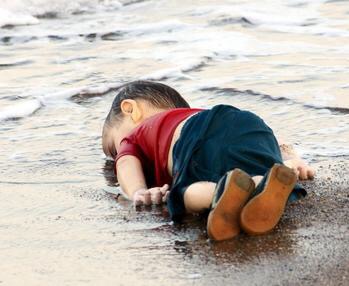
Well just a couple months after our 2015 national convention, the body of a young Syrian boy named Alan Kurdi washed up on a beach in Turkey. A boy who had been denied entrance to Canada. A boy whose tragic death mobilized the world. 

So did we meet our “slap a zero on it goal” because we are a church of expert refugee sponsors? Hardly.

But rather the world needed what we had to offer. Which was communities small enough to care for families who needed help, but large enough to mobilize enough money, furniture, and volunteers to settle newcomers in our commmnities.

All we needed to do was let our anxieties about decline die just long enough to see that God was bringing about tangible new life through us. God is using us for real resurrection.

It is in this intersecting place that a declining church meets a world in need of hope.

The decline of North American churches in the past few decades is not a never ending trend. But I do think God is using this time to help us shed our baggage. God is letting us struggle so that we can get all the wrong fixes and solutions to decline out of our system. So that we can try trendy music and flashy tech and hip pastors. So we can try to reincarnate the knitting groups and service clubs and curling bonspiels of the past. So that we can get all the complaining and shaming of our family, friends and neighbours over with. So that we can see that nothing we come up with will be the solution to our problems.

God is letting us experience decline long enough to finally die to our memories and nostalgia of the glory days and realize that the only thing the church ever had was the good news of Christ’s death and resurrection. All we ever were at our best are communities grounded in Christ’s new life given for us.

To be honest, I think in many ways the next 500 years for Lutherans and for North American Christianity will look a lot like the last 500. We will continue to be communities where the gospel is preached and where the sacraments are administered. Sometimes we will be strong in number and power. Other times we will be weak and marginalized. But in the end, neither of those realities matter.

That God is answering all the sin and death in the world with resurrection and new life proclaimed in churches just like us does.

Abraham failed the test… and so did God

Genesis 22:1-14

When they came to the place that God had shown him, Abraham built an altar there and laid the wood in order. He bound his son Isaac, and laid him on the altar, on top of the wood. Then Abraham reached out his hand and took the knife to kill his son. (Read the whole text)

Here we are back into the long season of green, the chance to explore the various stories the bible. The Gospel readings of this season tell about Jesus’s teachings and ministry. The Epistle readings take us through the various letters of the New Testament to explore what was happening in the early church. And the Old Testament readings give us the stories of God’s people.

Today, the story of Abraham and Isaac is simply too tempting to avoid exploring.

The story of Abraham and Isaac is one we know well. It is a story that is not only familiar when we hear it, it is one whose themes are used over and over in literature, movies  and TV. How often is the hero in a movie faced with an impossible choice involving the sacrifice of someone that they love?

The reason that Christians know this story of Abraham so well is that it is often used as an example of faithfulness. Abraham is an example of unwavering faith, so the idea goes. And on the surface it is an idea that makes sense.

In order that Abraham demonstrate his faith, God orders Abraham to put his faith before everything. Before the love he has for Sarah and their only son. Before  the love that Abraham has for Isaac, the son who will be person who carries Abraham’s legacy into the future. Without Isaac, Abraham and Sarah are simply people who will be forgotten to the sands of time.

And Abraham delivers. He shows us what it means to be faithful. Abraham’s faith is so powerful an example that even the authors of the New Testament point to it as a model to follow.

Abraham is willing to sacrifice his own son if God asks. Unwavering faith.

Or perhaps blind faith.

Or perhaps radical faith.

Radical fanaticism even.

Because we don’t usually call people willing to kill for their faith great examples… we have other words for those people don’t we?

And what about God? In this story, God asks his chosen disciples and follower to sacrifice his son, the very son that is the fulfillment of the covenant.

Have we read this story right? Christians have been using Abraham as an example of faith for hundreds of years, and the Hebrew people for thousands before that.

But blind faith or radical fanaticism is not normally the kind of faith that we are trying to help grow in people, in ourselves.

And a God who toys with us simply to “test” our faith doesn’t seem very loving or caring.

So what is going on in this story?

Well, to understand how Abraham and Isaac arrive at this moment, we need to go back to the beginning.

The oldest part of the bible is not found in the stories of creation or the garden of Eden or in Noah’s flood. Rather Abraham’s is the oldest. And ten chapters before Abraham and Isaac, the story begins. Back when Abraham was Abram, and Sarah was Sarai, God called these two to take up everything they had to go to the land that God would show them.

Abraham’s story begins with a 3 part covenant made with God. God promises Abraham land, descendants and a relationship. And this 3 fold promise becomes the focus of the rest of the book of Genesis, and to some degree the rest of the Old Testament.

So Abraham and Sarah pack up everything and go. And when God says, “Go” Abraham is really good at going. He is always willing to go when God calls.

But it is this other part of the promise… the descendants one that Abraham has trouble with. Going is easy… when God commands it, Abraham does it either out of faithfulness or perhaps fear. But the promise of descendants is tougher. Faith in this promise cannot be rooted in obedience out of fearfulness. Believing that God will provide this barren couple with children takes hope, it takes faith in the future, and faith in the third promise, that Abraham and Sarah are indeed God’s chosen.

And so Abraham goes, but as soon as he encounters the powerful Pharaoh of Egypt he gives Sarah away to be a part of Pharaoh’s harem, claiming Sarah is his sister, not his wife. So God has to intervene to save the day.

And then Sarah, fearing that she will not provide a son, tells Abraham to have a child with the servant Hagar, who gives birth to Ishmael… but he is not the son that God promised.

Next God tells Abraham directly that Sarah will bear a son, and all Abraham can do is fall to the ground in laughter.

And two weeks ago we heard the story of God showing up again to tell Abraham and Sarah that she will bear a son and this time Sarah laughs.

And after all this, Abraham gives Sarah to King Abimelech for his harem, again requiring God to intervene.

So finally, after 9 chapters of Abraham’s struggle to believe the promise of children, Sarah gives birth to Isaac.

And the long awaited, hard to believe promise has come to fruition.

Yet still Abraham still struggles to believe in the promise, in hope for a future. Even with Isaac in his arms now.

Some Rabbis suggest that the test that God gives Abraham is not one of obedience. That it isn’t a game of chicken that God is playing. In fact, God knows that Abraham will follow the commands, he has always been willing to go when called.

But does Abraham have faith in God’s future? Does he believe that God will make him the father of God’s chosen people?

So just one chapter after Isaac’s birth, God gives the command to sacrifice Isaac.

So Abraham goes and for three days – without a word of protest – walks to the mountain with Isaac. And when they arrive, Isaac asks where the lamb to be sacrificed is… and Abraham says something about God providing it, knowing full well that there isn’t a lamb. Abraham then leaves his servants and pack animals behind, and goes to the ritual place with Isaac. There he ties up his son, binds his son like lamb to be slaughtered and places him on the altar.

And without hesitation raises the knife.

In that moment, when you take into account everything that has happened in the ten chapters before this… Abraham has not passed the test.

He has failed.

And so has God.

For ten chapters, through rescuing Abraham from himself, from proving wrong Abraham’s laughter at what he and Sarah thought was impossible, God must have thought that Abraham would finally believe that promise, the promise of descendants, the promise of hope and a future.

And yet for 3 days Abraham marched to mountain without a word of protest. Abraham looked his son in the eye and lied about what or who would be sacrificed. Abraham tied up his son and placed him on an altar of sacrifice. God must have expected that Abraham would protest or bargain, just as he had for the people of Sodom. God must have thought that Abraham would demand that God live up to the covenant, that God certainly wouldn’t just arbitrarily take away Abraham’s future. God waited for the protest. But nothing.

And so Abraham fails the test… but so does God, for a good test is one a student can pass.

And yet there on mountain, standing above Isaac with his knife in hand… just maybe it is Abraham who teaches God something, maybe it is Abraham who tests God.

Perhaps after 10 chapters of trying to get Abraham to believe in the covenant, in the promise of hope and future that God makes with Abraham, God realizes that Abraham cannot have faith… only fear. Fear that drives him to go when God commands, but fear that prevents him from having hope.

So God intervenes.

God caries the hope for the future that Abraham cannot.

God upholds God’s part of the covenant… even if Abraham cannot have faith in the promise…

God will have hope in Abraham, even when all the signs say that God shouldn’t.

God sends a ram.

God sends a ram who is a sign that God will not give up on us.

God sends a lamb who will be not a sign of death on an altar, but life on a cross.

A lamb whose coming into our world will signify God’s unwavering faith in us.

A lamb who is God’s promise of hope and future in the flesh.

For you see, we are just like Abraham.

In fact we are Abraham.

We too find the promises of God laughable, we find the threats to our future too much to confront, we too have difficulty seeing our hope and our future… even when God plunks signs right in our arms.

And so God sends us the lamb who will save us.

The Christ who is found in the thicket of the church.

The Christ who is mercy and reprieve from the knives that we threaten our hope with.

The Christ who is life, when there is surely and only death in store for us.

The Christ who is God’s promise in flesh.

Abraham’s faithfulness is nothing to be marvelled at, he isn’t a model to aspire to…

Abraham is a model of the faith we already have.

As too is Abraham’s fear the same fear that we carry. Fear that is dispelled each and every time we gather around God’s word of promise and hope for us.

Abraham reminds us that God knows we cannot be faithful on our own… and so God is faithful for us. God knows that the promise of Christ is our hope and our future.

God is one the passes the test for us.