Tag Archives: Church

Do not be afraid… Christ has been Raised!

Mark 16:1-8

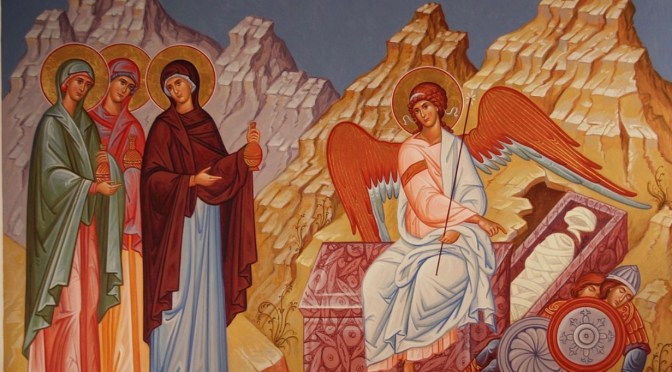
When the sabbath was over, Mary Magdalene, and Mary the mother of James, and Salome bought spices, so that they might go and anoint Jesus. And very early on the first day of the week, when the sun had risen, they went to the tomb. They had been saying to one another, “Who will roll away the stone for us from the entrance to the tomb?” When they looked up, they saw that the stone, which was very large, had already been rolled back. As they entered the tomb, they saw a young man, dressed in a white robe, sitting on the right side; and they were alarmed. But he said to them, “Do not be afraid; you are looking for Jesus of Nazareth, who was crucified. He has been raised; he is not here. Look, there is the place they laid him. But go, tell his disciples and Peter that he is going ahead of you to Galilee; there you will see him, just as he told you.” So they went out and fled from the tomb, for terror and amazement had seized them; and they said nothing to anyone, for they were afraid.


“And they said nothing to anyone, for they were afraid.”

This is not the ending of the story that we usually tell. In fact, nothing about the stories from the Gospel of Mark is usual. The Gospel of Mark has never done things the way we expect. Of all the Gospels, Mark is the shortest and perhaps the strangest, expecting things of us, expecting that we will put the pieces together and be moved to a deeper discipleship.

Mark’s Easter story is perhaps the strangest of all.  In the 3 other gospels, we normally here about Jesus appearing to the women and disciples at the empty tomb. Jesus speaks with Mary in the Gospel of John. He bring greetings to all the women in the Gospel of Matthew. In Luke, Jesus meets two of his disciples on the road of Emmaus.

But in Mark there is none of that. And it makes us uncomfortable. And not just us today, but Christians for centuries have been so uncomfortable with Mark’s ending, that they added to it. Hundreds of years later, shorter and longer endings to the Gospel of Mark were added just to try and wrap things up.

So what is it about the Gospel of Mark and his ending that doesn’t sit well with us?

“And they said nothing to anyone, for they were afraid.”

Failure.

Easter isn’t suppose to be a story of failure. The women hear the good news, they are given clear instructions to tell people about Jesus being risen, and they tell no one.

In fact, this is the story all the way through the Gospel of Mark. The disciples, the ones who are supposed to know and understand who Jesus is what he is about never do. And the people who do know are unreliable. It is unclean spirits and demons who recognize Jesus as God’s son. It is the blind man who never actually sees Jesus who knows he has been healed by the Messiah. All the way through the gospel of Mark, not a single reliable soul figures it out.

But here is the thing, Mark knows that we know that it didn’t end with the women being afraid. We all know the story of the resurrection. We are reading it in Mark’s gospel. We proclaim that Christ is risen from the dead every Sunday we gather for worship, Christians all over the world have been doing so for 2000 years!

So Mark expects that we can figure out that the women didn’t run from the tomb afraid… but Mark is also including us in the story, in the command to go and tell the world of the resurrection. Because if the women are too afraid to speak, that only leaves us, the reader. We are called to be ones who are not afraid to speak.

It is a big calling.

Because it was only on Good Friday that we stood below the cross and we proclaimed that this instrument of torture and violence, of humiliation and death is God’s transformed tool of life.

Because now today at the empty tomb with the women who are too afraid to say anything that we are just as afraid as they were. Afraid to announce this news to world. Afraid of that no one will believe our incredible, unbelievable story.

But this Easter morning and Easter story reminds us something else more than our fear and failure.

We are reminded that it is always in our fears and failures that Christ meets us. It is when we are too weak, too afraid, too focused on ourselves, when we are too much intent on our sin, on our selfishness, that Christ comes and meets us.

There is no Easter without sin and death, there is no resurrection without humanity’s greatest failure, without our trying to be God in God’s place.

And in the midst of our failures, big and small, the Risen Christ meets us. The Risen Christ reveals himself to us and brings us into the new reality of a world where sin and death are no longer the end. Yet still, our fear overcomes us and this new world that God is creating is too much for us. And like the women at the tomb we are too afraid to speak, too afraid to act, too afraid even look at how things are different.

“Do not be afraid, you are are looking for Jesus for Nazareth, who was crucified. Has has been raised.”

Do not be afraid.

Across the old and new testament, these words always precede good news.

Do not be afraid.

And even still the good news can be terrifying.

We stand before an empty tomb today, on this day of the Resurrection. And even when everything is supposed to be perfect, and when death is finally defeated, and Christ is raised from the dead. We are reminded that we still fail. We are reminded that we are still imperfect, sinful and selfish people who are frozen in the face of God’s amazing work in our world.

And we are also reminded again, that it is in our frozen failure that we are met by the Risen Christ.

The Risen Christ who has overcome the cross.

The Risen Christ who has conquered death.

The Risen Christ who has entered in our lives, our joys and our sorrows and has made our life his own.

The Risen Christ who has shown us a new reality, where death is no longer the end, where we are no longer defined by our failures, and where our sin no longer has control of us.

We are met today by the The Risen Christ and we are shown that God’s love for us is alive and there is no place we can go to escape it, and there is no way that would could fail and make God stop loving us.

Even when are afraid to speak a word to anyone, the Risen Christ meets us with the words “Do not be afraid!”

Hearing the Holy Week story anew… again.

GOSPEL: Mark 14:1–15:47 (Read the whole passion text here)


Today, we enter into Holy Week.

We step out of the wilderness into the chaos.

Don’t mistake the palms for some kind of party or excuse to celebrate. This is the tension filled moment of at the beginning of a thriller. Every detail, every action, every face in the story should be sign that things are not as they seem. This coronation moment on the road in the Holy City will not last, the crowds will not see the one riding a donkey as a king who will save for much longer.

Humanity puts Christ on the throne today…. a human throne of power.

But the throne at the end of the week, the throne of suffering and death is where Christ will end up is the opposite moment of today.

Today, we begin the story. The story we have told so many times, the story that has been imprinted on our foreheads in baptism, the story that our bodies take in when we eat of the bread and drink of the cup… this story is one that we cannot help but tell. A story told each Sunday in the words of scripture, in our worship, in our gathering as a community.

And yet, this week, this passion week, this holy week, the story is told anew. The story of Christ’s passion and crucifixion is told as though we have not heard it before. It is told in old and ancient ways to new ears.

It is new because we still need salvation from sin and death, it is new because God continues to come into our world saving us from sin and death.

No, we do not relive the story, and Christ is not nailed to cross again and again… yet we continually die to sin. We die each day, deaths in a million small ways, the deaths of failures and brokenness, deaths because of the things we have done to ourselves and others, and the things others do to us.

The story is new because we keep experiencing death in this world.

But the story is also new because of what God is doing with us.

God keeps showing us the empty tomb. God keeps pulling up and out of the waters, breathing new air, a new spirit, a new life into our lungs.

The story is new because even with all the death in the world around us, God is meeting and confronting all those millions of ways we die. And God promising us resurrection, God is pulling us up out of the tomb.

The story is new, because God is making us new.

God is making us new creations in the risen one, in the Christ whose exit from the grave becomes our way out too.

So let us begin this week anew, this passion week, the holy week. Let us hear the story that we know so well as if it is new.

Because it is new.

Because God is making us new… again.

Looking for Jesus in the wrong places

John 12:20-33

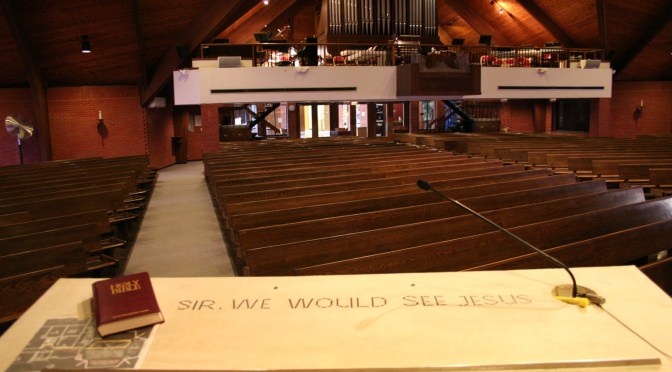
Now among those who went up to worship at the festival were some Greeks. They came to Philip, who was from Bethsaida in Galilee, and said to him, “Sir, we wish to see Jesus.” Philip went and told Andrew; then Andrew and Philip went and told Jesus. Jesus answered them, …And I, when I am lifted up from the earth, will draw all people to myself.” He said this to indicate the kind of death he was to die. (Read the whole passage)

This is our final step along the way in our wilderness journey. We have heard the story of Lazarus, watched as Peter objected to Jesus watching the disciples feet, and then we spent two weeks with Jesus on trial. Today, we hear again a story from Holy Week, but we are not so deep into the story this time. We preview what is coming next Sunday on Palm Sunday. Jesus and his disciples are in Jerusalem. They are there for the passover festival. They are there on Sunday, the first day of the week, first day of Holy Week. This piece of John’s gospel takes place just after Jesus rides into Jerusalem on a donkey. It should really be told next Sunday, sometime in the afternoon. But we hear it today, on the last Sunday of Lent, for a reason.

It begins with Greeks. Greek who are from elsewhere. Jews who speak greek because they live in greek lands, far from Jerusalem. And they have come for passover, they have come to have their sins forgiven, they have come to see the great spectacle of Jerusalem at festival time. But the way these greeks approach Philip suggest they are looking for something more, something that is more than entertainment or show.

“Sir, we wish to see Jesus”.

Sir they say to a lowly fisherman. Sir they say a pilgrims wealthy enough to travel far just for a festival.

We wish they say. We hope. We long. We Yearn. We desire. We need. They express their want to see Jesus as wishing. Wishing which implies a need for change, a hope for something different.

Sir, we wish to see Jesus. They want to see and know Jesus. The man who’s name means God Saves. The man who has been healing people, exorcizing unclean spirits, who has been teaching and preaching. The man who raised someone from the dead in Lazarus.

The greeks have come looking for something, someone. And maybe they don’t know what or why or who. But Jesus might fit the bill, fit their need for something deeper, something mysterious, something bigger than themselves.

The polite request by the Greeks to see Jesus is a feeling we know well. We too long for something more. For things to be different. We hope that our lives could be other than the way they are.

As human beings, we have this longing deep within us. We want to know that there is something bigger than us out there and we want to know where we fit in the cosmic order. Churches try all the time to bring this sense of “more” to worshippers.

Some churches search for that sense of euphoria, that spiritual high. Praise songs and hand raising, long sincere prayers and wonderful fellowship.

Others try to bring people closer to God by serving others. Soup kitchens and food banks, giving money to far way countries and for starving orphans.

And still other churches try to show the mystery and grandness of God. With big stone cathedrals, powerful organ music and reverent liturgy.

And indeed all are ways in which God is experienced. We see God in these places.

But that desire to see God also expresses itself in other ways. We look for the divine in buying and consuming things. We look to make ourselves secure and safe from the the things that would harm us or that make us fearful. We seek out power and control over our world and others.

We look for God in all the wrong places. We look to be like God. We look to be God in God’s place. And we do it because of original sin, of that desire within us to ourselves first.

When the Greeks and Philip and Andrew finally get to Jesus, he doesn’t answer their question in a way that any of them expect. He doesn’t offer himself to the greeks, he doesn’t say, “See I am here!”.

As we pass through this final week of Lent, we have been prepared for what is to come. Jesus has gone into the wilderness, Jesus brought Lazarus back from the dead, he has reminded Peter that there is no share in him unless Jesus washes us clean, Jesus has stood firm in the truth while Peter denied him, and Jesus has confronted the powers of the world in Pilate and in death. Now, after 4 weeks of preparation, four weeks of wilderness, four weeks of having our failing and faults revealed, we are finally ready to ask that question that the greeks ask, “Sir, we wish to see Jesus”.

And Jesus points us to a time and place. “And I, when I am lifted up from the earth, will draw all people to myself.” It takes a while, but Jesus does answer our longing, our hope, our desire for something different, something bigger than ourselves. But it is not at all in the way we expect. We are longing and hoping for a glimpse of the divine, to see past the veil. We want to see the world as it should be, as we would like it to be. We want the spiritual high, the feeling of gratification after helping someone, the reverence of divine mystery. And instead Jesus gives us a cross. A cross where we will see God.

Imagine if someone came here looking for a church home, looking for some truth bigger than themselves, looking for a place to belong, a place to be fed, a place to meet God, a place to see Jesus. And instead of doing all the things we normally do when a visitor comes seeming interested in us, like giving them a newsletter or a mailbox or pointing them to the pew we know isn’t unofficially saved by a regular… Imagine if we instead simply pointed to the cross.

Imagine if someone said to us,

“We wish to see Jesus.”

And we just turned and pointed at the cross on the wall.

It is absurd.

The cross is an absurd place for God to be found.

Yet the cross is the place where God is revealed.

Yet the cross is the place where Jesus reveals God to the world.

Yet the cross is the place where God is visible to us in plain sight.

And the cross, the place of suffering, humiliation and death is the very place where God gathers all people to Godself.

The cross is the place where we see Jesus.

In just less than two weeks, on Good Friday, the glory of God will be revealed on a cross and no matter what we are looking for, no matter the places the we search, churches, shopping malls, schools, places of work, places of power, places of escape. And on the cross God is making room for all of us beneath it arms. God is gathering us all up to show us that in the least likely of places, God is revealed.

And we will see Jesus. We will see Jesus in all his glory. We will see God changing the world. We will see God changing us.

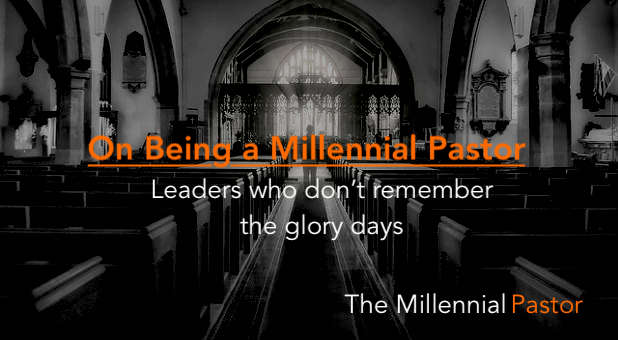
On Being a Millennial Pastor – Leaders who don’t remember the glory days

“You give us hope for the future.”

The first time I heard those words, I was 23 years old and in seminary. A group of us had travelled 7 hours, from the prairies to the mountains, to attend a study conference for pastors and other church professionals. We were a group of 20 and 30 somethings, all Masters of Divinity students already having bachelor’s degrees and work experience, but compared to the average age of pastors in the mainline, we may as well have been teenagers. So we probably seemed like a group of disruptive students crashing a conference for older folks.

But instead of being grumpy with us or giving us glares (as church folk can sometimes be guilty of doing with young noise makers), we were heartily welcomed by our future colleagues. Our relative energy and enthusiasm seemed to bring them some life and excitement.

And that is when it started happening. Sometimes one or more elder colleagues would sidle up to us and say things like, “You all give me hope for the church’s future” or “You make me feel better about the future.”

“Millennials” weren’t a thing back then, but our age cohort was perhaps the first to be obviously missing from the church. We weren’t the first generation to stop attending, that was the Boomers, our parents, who led the mass exodus. But rather, we were the first to be noticeably absent. The first generation to have mostly never been there at all. And so when a bunch of Gen Xers and Millennials showed up at seminary together around the same time, it was out of the ordinary. We were a cohort of young leaders who had been the kids in our home churches who were leading youth groups, playing in worship bands, serving on church councils, attending campus ministry while at school, working as bible camp counsellors and even camp directors. Our parents had bucked the trend of the Boomer exodus, and brought us to church where we had been encouraged to lead. We had to lead because we were all there was of our age cohort.

The “You give us hope” comment became a pretty regular occurrence in seminary and after… but I always had the sinking suspicion that the church wasn’t quite ready to hand over the reigns to the next generation.

Whether it was the resistance of boomers to converting the seminary newspaper from a paper publication to an online blog format, or later on to a hesitation let young pastors serve in positions of leadership in the church, a constant comment I heard from seminary classmates in their first few years of ministry was,

“We were trained and prepared to serve in this church, but no one got this church ready for us.”

After ordination, when I began serving in my first call, I couldn’t help but notice something that seemed to be below the surface of wherever I went in the church. Not just my congregation, but the ones of neighbouring colleagues, and larger church ministries, and coming from church leadership. It took me a while to put my finger on it.

And then as I had yet another conversation with colleagues or parishioners or other church folk lamenting the absence of young people, the decline of attendance and giving, and the general sad state of the present church… it dawned on me.

These people are grieving. 

As soon as I could see it, it was like puling back the veil and seeing the weight being carried by nearly everyone around me. Everyone of a certain age that is.

The glory days were gone. The days when pews were full, Sunday Schools bursting at the seams, programs well attended, giving was enough to pay the bills and increasing, when every family had 4.2 kids and a housewife who would devote volunteer time to the church, or keep the house in check while her husband did. Those days were over.

But it wasn’t just that those days were over, it was the intense desire to bring them back. Churches, pastors, leaders who could remember those days seemed to be universally bound and determined to somehow bring that glory back. Get the young people back, get the families back, fill the pews, resurrect the Sunday Schools, meet and exceed the budgets.

My problem, as a young pastor was, I wasn’t grieving the glory days with most people around me. I wasn’t grieving them because I don’t remember them.

Even though now I have almost a decade of experience under my belt, I am still a young pastor by mainline standards.

And it has always been tension the church that most people around me are grieving, and the one that I have always known and loved. The church that God called me to seminary and to be a pastor to serve.

The church has always been filled with grey hair in my memory. Sunday School has always been pretty sparsely attended, youth groups have never been more than a handful of kids, budgets have always been hard to meet, and there are rarely times when it is hard to find an entire pew to yourself in worship.

This is only version of the church I know… and it is the one I am called to serve.

I also suspect it is the church God is calling us to be. 

While it is has been difficult for the congregations I serve to have a leader who isn’t longing for the glory days as they are, it has also been good for me and them. It has been hard and taken time, but eventually we have started looking forward rather than looking back. We have begun to listen to where God is calling us now and where God is calling us to go.

God’s mission hasn’t changed, just the vehicle isn’t as fancy as it once was. The Gospel is is still preached, sacraments still administered, the Body of Christ is still present… even in churches whose glory days are over.

And I think that this is the cross roads that many churches and denominations find themselves at these days. Will the memory of the glory days keep us looking backwards? Will we admit that our desire to bring the young people back, might actually be us saying that we want to be young again?

The synod (read: diocese/jurisdiction/area) in which I serve is about to elect a new Bishop. For the past few months we have been asked to discern what kind of Bishop the synod needs, and to do that discernment in congregations and other synod ministries. This discernment process here has got me thinking about leadership, and about what kind of leaders the church will need going forward. What will a declining Christianity need in order to begin moving faithfully into the future?

And the answer I keep coming back to is that the church in North America will need leaders who can let go of the glory days. Maybe even leaders who don’t remember the glory days. Leaders who can see the church as it is now, rather than what it used to be.

As my generation, Gen X and Millennial pastors and clergy, steps into more and more leadership positions in the church, letting go of the glory days becomes inevitable. We simply don’t remember them.

Because we are the ones who showed up to seminary full of energy, called to serve a church in decline.

The church for us has always been full of grey haired faithful and committed people.
The church has always been small close-knit Sunday Schools and youth groups.
The church has always been struggling to meet budgets by searching for creative solutions.
And the church has always had room in the pews for more people to come.

It will not be easy to get over the grief that is lingering below the surface, and it will be easy to see the solutions to what the church is currently lacking by going back to a time when we remember abundance.

But the church cannot go backwards. And God doesn’t call us into the past, God calls us into the future.

So perhaps it is time for the church to let leaders who cannot remember the glory days, but who only know the present, guide the way into the future.

Perhaps “You give us hope for the future” needs to become:

“You give us hope now.”

Into the Lenten Wilderness

John 11:1-45

Now a certain man was ill, Lazarus of Bethany, the village of Mary and her sister Martha. Mary was the one who anointed the Lord with perfume and wiped his feet with her hair; her brother Lazarus was ill. So the sisters sent a message to Jesus, “Lord, he whom you love is ill.” But when Jesus heard it, he said, “This illness does not lead to death; rather it is for God’s glory, so that the Son of God may be glorified through it.”(Read the whole passage)

Last week we witnessed a Transfiguration moment, the Blind man having his sight restored. It was like the revelation on the mountaintop, eyes were opened to see the world, and see God, in a new way.

But by Wednesday, the euphoria of transfiguration was over. And we descended to the ashes, to the signs of decay and death around us, the evidence that sin and suffering still hold much sway in our world.

And now we begin Lent.

Lent always begins with wilderness. Usually we hear the story of Jesus’ temptation. After Jesus’ baptism, the spirit takes Jesus into the wilderness in order to be tempted. This begins Jesus’ ministry in Matthew, Mark and Luke. But as we explore John this year, through the narrative lectionary, we hear a story that normally comes at the end of Lent, a story that foreshadows Holy Week, a story of death and resurrection.

But with all of Lent still laying before us, there is still a long way until we are ready for Holy Week. We are just entering the wilderness.

So we hear this familiar story of Lazarus with different ears.

The wilderness experiences throughout this story are varied and different, yet they are all about the experience of being vulnerable and exposed. The wilderness is a place where safety and comfort is taken away, it is a place of wandering, a place of isolation.

The wilderness begins with news of Lazarus illness. He is in a wilderness that we all know, the wilderness of suffering. Suffering which leads to death. We have all seen this story before, whether it is a friend or family member. A life threatening illness strikes, yet there is hope for a cure. But the treatments don’t work, the prayers seem to be unheard and death is inevitable. A common wilderness experience.

Mary and Martha are helpless care givers for their brother, and his death brings them into a wilderness of grief. Martha’s a frantic and searching grief, Mary’s an overwhelming and debilitating grief.

Martha meets Jesus on road, she wants answers, she wants to point the finger, she is lashing out. Her grief is a wild and untamed wilderness experience, a roller coaster of emotion.

Mary also meets Jesus on the road, but her grief is different. She collapses at Jesus feet. She is crushed and falling, falling deeper and deeper into despair.

The disciples are also in a wilderness of sorts… they are lost and confused about Jesus’ actions. They have seen Jesus heal and care for strangers, yet here he is delaying to care for a beloved friend.

And finally Jesus, just like the stories of his temptation, is also in the wilderness. This time the temptation is again there, the temptation to rush in and save the day, to use his power to avoid all the pain and suffering of his friends and disciples.

As we enter in Lent, this year bouncing from vignette to vignette, hearing these examples of different wilderness journeys, we can recognize ourselves. We have been there too, we have all been tossed out into the wilderness in just the same ways.

We have been in the wilderness of grief and loss. We have been there in the midst of broken relationships, in the midst of addiction, in the midst of job loss or difficult times making ends meet. We have been through wildernesses of illness and disease.

And we all know that our world and society creates wildernesses of suffering and isolation because of race, gender, sexual orientation, religion, class, and whatever other arbitrary divisions and categories for people we create.

And it isn’t just individuals who wander in the wilderness.

This week an entire nation is once again wandering in a wilderness of gun violence, after 17 people were killed in a Florida high school.

And of course, many churches find themselves in wildernesses of decline, wondering about the future, wondering how to keep on with fewer resources and few people to carry the load.

With all these wilderness experiences around us, it may seems strange to practice one as the church… to create one that begins Ash Wednesday and ends on Good Friday.

Yet, we rehearse this Lenten wilderness journey year after year because avoiding the realities of life will not help… we can only pretend everything is okay for so long.

Rather, as the body of Christ, we practice going through the wildness year after year so that we learn how to navigate them when we encounter them in life. We practice so that we know how to make it through. We practice so that we can see the other side…

But even then, there is a deeper message that the Lenten wilderness gives us…

In the wilderness, God finds and gathers us.

As Jesus waits to go to his friends Mary, Martha and Lazarus, he does so knowing that his purpose is not to heal people and make them feel better. Jesus has come to announcing the Kingdom of God coming near… and that rushing to make any suffering just go away does not really deal with the true issues of our world.

And so when Jesus finally goes to Bethany, he brings his confused disciples with him. He brings them so that they see that aren’t just wandering around with a gifted healer. Jesus has called them to follow a deeper purpose… to take up their crosses and find new life.

On the way, Jesus stops to collect Martha. He promises her even in her frantic grief that he is the resurrection and the life.

And then he collects Mary, and with her, he simply weeps, he comes along side her in her despair to let her know that she is not alone.

And finally, he comes to Lazarus. Lazarus who has entered into the last wilderness waiting for us all… the wilderness of death.

And here standing in front of the tomb, is not the end of wilderness, not the escape. But rather the farthest out, most vulnerable, most isolating moment of any wilderness journey.

Jesus has gathered Mary, Martha, Lazarus and his disciples as the moment when all hope is lost, when nothing makes sense, when safety, security and healing cannot be imagine.

Surely, the disciples couldn’t have been more confused than when Jesus commands the stone to be rolled away.

Surely, Mary couldn’t have been born the thought of seeing the body of her dead brother once again.

Surely, Martha couldn’t be expected to believe that Jesus was the resurrection and the life in this moment.

Surely, Lazarus couldn’t have been anything but dead, since it had been four days.

Surely, Jesus couldn’t have waited this long to heal Lazarus.

“Lazarus, come out!” Jesus commands.

Who but Jesus could know that the wilderness leads to this place?

It is not the escape or exit from a wilderness journey. Rather, this moment, this Lenten moment at the tomb is the revelation that all the things we think give us safety and security, the things that may protect us and prevent us harm are all but illusory.

We practice Lent year after year because the wilderness is life. It is where we always are.

And it is where Jesus gathers us up. Lost and alone and vulnerable to a world of sin and suffering, Jesus comes and gathers us up.

Jesus comes and gathers up and brings us to the cross and to the grave, to the very places where sin, suffering and death seem to have won and Jesus declares their power over. Jesus declares that the Kingdom of God has come near to us, here and now.

Because in the face of confusion, suffering, grief and death, in the face of human sin, brokenness, failures and faults, in the face of more mass shootings and the inexorable power of decline…. what else is there but to be gathered around Word, Water, Bread and Wine.

When there is nothing else for us,

Jesus gathers us around Wilderness words like, “I am the resurrection and the life.”

Jesus gathers us around water that washes our dead bodies, heals us of our suffering, and unbinds from our sin.

Jesus gathers us around a table of bread and wine, a table that sits next to an empty tomb and has room for all.

Jesus gathers in the wilderness because the wilderness is where we are, and so the wilderness is where God will give live to the world.

The wilderness is where God gathers us around new life.