Tag Archives: Church

Looking for Jesus in the wrong places

John 12:20-33

Now among those who went up to worship at the festival were some Greeks. They came to Philip, who was from Bethsaida in Galilee, and said to him, “Sir, we wish to see Jesus.” Philip went and told Andrew; then Andrew and Philip went and told Jesus. Jesus answered them, …And I, when I am lifted up from the earth, will draw all people to myself.” He said this to indicate the kind of death he was to die. (Read the whole passage)

This is our final step along the way in our wilderness journey. We have heard the story of Lazarus, watched as Peter objected to Jesus watching the disciples feet, and then we spent two weeks with Jesus on trial. Today, we hear again a story from Holy Week, but we are not so deep into the story this time. We preview what is coming next Sunday on Palm Sunday. Jesus and his disciples are in Jerusalem. They are there for the passover festival. They are there on Sunday, the first day of the week, first day of Holy Week. This piece of John’s gospel takes place just after Jesus rides into Jerusalem on a donkey. It should really be told next Sunday, sometime in the afternoon. But we hear it today, on the last Sunday of Lent, for a reason.

It begins with Greeks. Greek who are from elsewhere. Jews who speak greek because they live in greek lands, far from Jerusalem. And they have come for passover, they have come to have their sins forgiven, they have come to see the great spectacle of Jerusalem at festival time. But the way these greeks approach Philip suggest they are looking for something more, something that is more than entertainment or show.

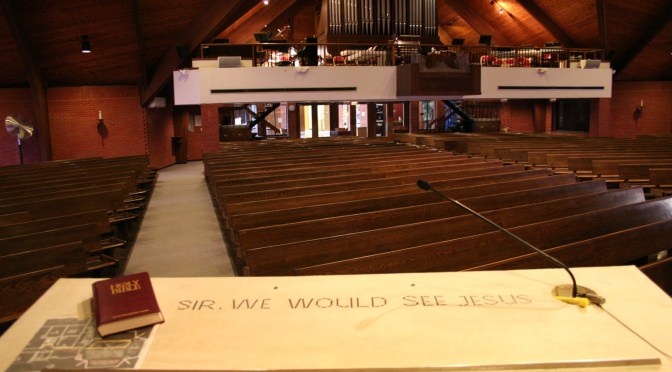
“Sir, we wish to see Jesus”.

Sir they say to a lowly fisherman. Sir they say a pilgrims wealthy enough to travel far just for a festival.

We wish they say. We hope. We long. We Yearn. We desire. We need. They express their want to see Jesus as wishing. Wishing which implies a need for change, a hope for something different.

Sir, we wish to see Jesus. They want to see and know Jesus. The man who’s name means God Saves. The man who has been healing people, exorcizing unclean spirits, who has been teaching and preaching. The man who raised someone from the dead in Lazarus.

The greeks have come looking for something, someone. And maybe they don’t know what or why or who. But Jesus might fit the bill, fit their need for something deeper, something mysterious, something bigger than themselves.

The polite request by the Greeks to see Jesus is a feeling we know well. We too long for something more. For things to be different. We hope that our lives could be other than the way they are.

As human beings, we have this longing deep within us. We want to know that there is something bigger than us out there and we want to know where we fit in the cosmic order. Churches try all the time to bring this sense of “more” to worshippers.

Some churches search for that sense of euphoria, that spiritual high. Praise songs and hand raising, long sincere prayers and wonderful fellowship.

Others try to bring people closer to God by serving others. Soup kitchens and food banks, giving money to far way countries and for starving orphans.

And still other churches try to show the mystery and grandness of God. With big stone cathedrals, powerful organ music and reverent liturgy.

And indeed all are ways in which God is experienced. We see God in these places.

But that desire to see God also expresses itself in other ways. We look for the divine in buying and consuming things. We look to make ourselves secure and safe from the the things that would harm us or that make us fearful. We seek out power and control over our world and others.

We look for God in all the wrong places. We look to be like God. We look to be God in God’s place. And we do it because of original sin, of that desire within us to ourselves first.

When the Greeks and Philip and Andrew finally get to Jesus, he doesn’t answer their question in a way that any of them expect. He doesn’t offer himself to the greeks, he doesn’t say, “See I am here!”.

As we pass through this final week of Lent, we have been prepared for what is to come. Jesus has gone into the wilderness, Jesus brought Lazarus back from the dead, he has reminded Peter that there is no share in him unless Jesus washes us clean, Jesus has stood firm in the truth while Peter denied him, and Jesus has confronted the powers of the world in Pilate and in death. Now, after 4 weeks of preparation, four weeks of wilderness, four weeks of having our failing and faults revealed, we are finally ready to ask that question that the greeks ask, “Sir, we wish to see Jesus”.

And Jesus points us to a time and place. “And I, when I am lifted up from the earth, will draw all people to myself.” It takes a while, but Jesus does answer our longing, our hope, our desire for something different, something bigger than ourselves. But it is not at all in the way we expect. We are longing and hoping for a glimpse of the divine, to see past the veil. We want to see the world as it should be, as we would like it to be. We want the spiritual high, the feeling of gratification after helping someone, the reverence of divine mystery. And instead Jesus gives us a cross. A cross where we will see God.

Imagine if someone came here looking for a church home, looking for some truth bigger than themselves, looking for a place to belong, a place to be fed, a place to meet God, a place to see Jesus. And instead of doing all the things we normally do when a visitor comes seeming interested in us, like giving them a newsletter or a mailbox or pointing them to the pew we know isn’t unofficially saved by a regular… Imagine if we instead simply pointed to the cross.

Imagine if someone said to us,

“We wish to see Jesus.”

And we just turned and pointed at the cross on the wall.

It is absurd.

The cross is an absurd place for God to be found.

Yet the cross is the place where God is revealed.

Yet the cross is the place where Jesus reveals God to the world.

Yet the cross is the place where God is visible to us in plain sight.

And the cross, the place of suffering, humiliation and death is the very place where God gathers all people to Godself.

The cross is the place where we see Jesus.

In just less than two weeks, on Good Friday, the glory of God will be revealed on a cross and no matter what we are looking for, no matter the places the we search, churches, shopping malls, schools, places of work, places of power, places of escape. And on the cross God is making room for all of us beneath it arms. God is gathering us all up to show us that in the least likely of places, God is revealed.

And we will see Jesus. We will see Jesus in all his glory. We will see God changing the world. We will see God changing us.

On Being a Millennial Pastor – Leaders who don’t remember the glory days

“You give us hope for the future.”

The first time I heard those words, I was 23 years old and in seminary. A group of us had travelled 7 hours, from the prairies to the mountains, to attend a study conference for pastors and other church professionals. We were a group of 20 and 30 somethings, all Masters of Divinity students already having bachelor’s degrees and work experience, but compared to the average age of pastors in the mainline, we may as well have been teenagers. So we probably seemed like a group of disruptive students crashing a conference for older folks.

But instead of being grumpy with us or giving us glares (as church folk can sometimes be guilty of doing with young noise makers), we were heartily welcomed by our future colleagues. Our relative energy and enthusiasm seemed to bring them some life and excitement.

And that is when it started happening. Sometimes one or more elder colleagues would sidle up to us and say things like, “You all give me hope for the church’s future” or “You make me feel better about the future.”

“Millennials” weren’t a thing back then, but our age cohort was perhaps the first to be obviously missing from the church. We weren’t the first generation to stop attending, that was the Boomers, our parents, who led the mass exodus. But rather, we were the first to be noticeably absent. The first generation to have mostly never been there at all. And so when a bunch of Gen Xers and Millennials showed up at seminary together around the same time, it was out of the ordinary. We were a cohort of young leaders who had been the kids in our home churches who were leading youth groups, playing in worship bands, serving on church councils, attending campus ministry while at school, working as bible camp counsellors and even camp directors. Our parents had bucked the trend of the Boomer exodus, and brought us to church where we had been encouraged to lead. We had to lead because we were all there was of our age cohort.

The “You give us hope” comment became a pretty regular occurrence in seminary and after… but I always had the sinking suspicion that the church wasn’t quite ready to hand over the reigns to the next generation.

Whether it was the resistance of boomers to converting the seminary newspaper from a paper publication to an online blog format, or later on to a hesitation let young pastors serve in positions of leadership in the church, a constant comment I heard from seminary classmates in their first few years of ministry was,

“We were trained and prepared to serve in this church, but no one got this church ready for us.”

After ordination, when I began serving in my first call, I couldn’t help but notice something that seemed to be below the surface of wherever I went in the church. Not just my congregation, but the ones of neighbouring colleagues, and larger church ministries, and coming from church leadership. It took me a while to put my finger on it.

And then as I had yet another conversation with colleagues or parishioners or other church folk lamenting the absence of young people, the decline of attendance and giving, and the general sad state of the present church… it dawned on me.

These people are grieving. 

As soon as I could see it, it was like puling back the veil and seeing the weight being carried by nearly everyone around me. Everyone of a certain age that is.

The glory days were gone. The days when pews were full, Sunday Schools bursting at the seams, programs well attended, giving was enough to pay the bills and increasing, when every family had 4.2 kids and a housewife who would devote volunteer time to the church, or keep the house in check while her husband did. Those days were over.

But it wasn’t just that those days were over, it was the intense desire to bring them back. Churches, pastors, leaders who could remember those days seemed to be universally bound and determined to somehow bring that glory back. Get the young people back, get the families back, fill the pews, resurrect the Sunday Schools, meet and exceed the budgets.

My problem, as a young pastor was, I wasn’t grieving the glory days with most people around me. I wasn’t grieving them because I don’t remember them.

Even though now I have almost a decade of experience under my belt, I am still a young pastor by mainline standards.

And it has always been tension the church that most people around me are grieving, and the one that I have always known and loved. The church that God called me to seminary and to be a pastor to serve.

The church has always been filled with grey hair in my memory. Sunday School has always been pretty sparsely attended, youth groups have never been more than a handful of kids, budgets have always been hard to meet, and there are rarely times when it is hard to find an entire pew to yourself in worship.

This is only version of the church I know… and it is the one I am called to serve.

I also suspect it is the church God is calling us to be. 

While it is has been difficult for the congregations I serve to have a leader who isn’t longing for the glory days as they are, it has also been good for me and them. It has been hard and taken time, but eventually we have started looking forward rather than looking back. We have begun to listen to where God is calling us now and where God is calling us to go.

God’s mission hasn’t changed, just the vehicle isn’t as fancy as it once was. The Gospel is is still preached, sacraments still administered, the Body of Christ is still present… even in churches whose glory days are over.

And I think that this is the cross roads that many churches and denominations find themselves at these days. Will the memory of the glory days keep us looking backwards? Will we admit that our desire to bring the young people back, might actually be us saying that we want to be young again?

The synod (read: diocese/jurisdiction/area) in which I serve is about to elect a new Bishop. For the past few months we have been asked to discern what kind of Bishop the synod needs, and to do that discernment in congregations and other synod ministries. This discernment process here has got me thinking about leadership, and about what kind of leaders the church will need going forward. What will a declining Christianity need in order to begin moving faithfully into the future?

And the answer I keep coming back to is that the church in North America will need leaders who can let go of the glory days. Maybe even leaders who don’t remember the glory days. Leaders who can see the church as it is now, rather than what it used to be.

As my generation, Gen X and Millennial pastors and clergy, steps into more and more leadership positions in the church, letting go of the glory days becomes inevitable. We simply don’t remember them.

Because we are the ones who showed up to seminary full of energy, called to serve a church in decline.

The church for us has always been full of grey haired faithful and committed people.
The church has always been small close-knit Sunday Schools and youth groups.
The church has always been struggling to meet budgets by searching for creative solutions.
And the church has always had room in the pews for more people to come.

It will not be easy to get over the grief that is lingering below the surface, and it will be easy to see the solutions to what the church is currently lacking by going back to a time when we remember abundance.

But the church cannot go backwards. And God doesn’t call us into the past, God calls us into the future.

So perhaps it is time for the church to let leaders who cannot remember the glory days, but who only know the present, guide the way into the future.

Perhaps “You give us hope for the future” needs to become:

“You give us hope now.”

Into the Lenten Wilderness

John 11:1-45

Now a certain man was ill, Lazarus of Bethany, the village of Mary and her sister Martha. Mary was the one who anointed the Lord with perfume and wiped his feet with her hair; her brother Lazarus was ill. So the sisters sent a message to Jesus, “Lord, he whom you love is ill.” But when Jesus heard it, he said, “This illness does not lead to death; rather it is for God’s glory, so that the Son of God may be glorified through it.”(Read the whole passage)

Last week we witnessed a Transfiguration moment, the Blind man having his sight restored. It was like the revelation on the mountaintop, eyes were opened to see the world, and see God, in a new way.

But by Wednesday, the euphoria of transfiguration was over. And we descended to the ashes, to the signs of decay and death around us, the evidence that sin and suffering still hold much sway in our world.

And now we begin Lent.

Lent always begins with wilderness. Usually we hear the story of Jesus’ temptation. After Jesus’ baptism, the spirit takes Jesus into the wilderness in order to be tempted. This begins Jesus’ ministry in Matthew, Mark and Luke. But as we explore John this year, through the narrative lectionary, we hear a story that normally comes at the end of Lent, a story that foreshadows Holy Week, a story of death and resurrection.

But with all of Lent still laying before us, there is still a long way until we are ready for Holy Week. We are just entering the wilderness.

So we hear this familiar story of Lazarus with different ears.

The wilderness experiences throughout this story are varied and different, yet they are all about the experience of being vulnerable and exposed. The wilderness is a place where safety and comfort is taken away, it is a place of wandering, a place of isolation.

The wilderness begins with news of Lazarus illness. He is in a wilderness that we all know, the wilderness of suffering. Suffering which leads to death. We have all seen this story before, whether it is a friend or family member. A life threatening illness strikes, yet there is hope for a cure. But the treatments don’t work, the prayers seem to be unheard and death is inevitable. A common wilderness experience.

Mary and Martha are helpless care givers for their brother, and his death brings them into a wilderness of grief. Martha’s a frantic and searching grief, Mary’s an overwhelming and debilitating grief.

Martha meets Jesus on road, she wants answers, she wants to point the finger, she is lashing out. Her grief is a wild and untamed wilderness experience, a roller coaster of emotion.

Mary also meets Jesus on the road, but her grief is different. She collapses at Jesus feet. She is crushed and falling, falling deeper and deeper into despair.

The disciples are also in a wilderness of sorts… they are lost and confused about Jesus’ actions. They have seen Jesus heal and care for strangers, yet here he is delaying to care for a beloved friend.

And finally Jesus, just like the stories of his temptation, is also in the wilderness. This time the temptation is again there, the temptation to rush in and save the day, to use his power to avoid all the pain and suffering of his friends and disciples.

As we enter in Lent, this year bouncing from vignette to vignette, hearing these examples of different wilderness journeys, we can recognize ourselves. We have been there too, we have all been tossed out into the wilderness in just the same ways.

We have been in the wilderness of grief and loss. We have been there in the midst of broken relationships, in the midst of addiction, in the midst of job loss or difficult times making ends meet. We have been through wildernesses of illness and disease.

And we all know that our world and society creates wildernesses of suffering and isolation because of race, gender, sexual orientation, religion, class, and whatever other arbitrary divisions and categories for people we create.

And it isn’t just individuals who wander in the wilderness.

This week an entire nation is once again wandering in a wilderness of gun violence, after 17 people were killed in a Florida high school.

And of course, many churches find themselves in wildernesses of decline, wondering about the future, wondering how to keep on with fewer resources and few people to carry the load.

With all these wilderness experiences around us, it may seems strange to practice one as the church… to create one that begins Ash Wednesday and ends on Good Friday.

Yet, we rehearse this Lenten wilderness journey year after year because avoiding the realities of life will not help… we can only pretend everything is okay for so long.

Rather, as the body of Christ, we practice going through the wildness year after year so that we learn how to navigate them when we encounter them in life. We practice so that we know how to make it through. We practice so that we can see the other side…

But even then, there is a deeper message that the Lenten wilderness gives us…

In the wilderness, God finds and gathers us.

As Jesus waits to go to his friends Mary, Martha and Lazarus, he does so knowing that his purpose is not to heal people and make them feel better. Jesus has come to announcing the Kingdom of God coming near… and that rushing to make any suffering just go away does not really deal with the true issues of our world.

And so when Jesus finally goes to Bethany, he brings his confused disciples with him. He brings them so that they see that aren’t just wandering around with a gifted healer. Jesus has called them to follow a deeper purpose… to take up their crosses and find new life.

On the way, Jesus stops to collect Martha. He promises her even in her frantic grief that he is the resurrection and the life.

And then he collects Mary, and with her, he simply weeps, he comes along side her in her despair to let her know that she is not alone.

And finally, he comes to Lazarus. Lazarus who has entered into the last wilderness waiting for us all… the wilderness of death.

And here standing in front of the tomb, is not the end of wilderness, not the escape. But rather the farthest out, most vulnerable, most isolating moment of any wilderness journey.

Jesus has gathered Mary, Martha, Lazarus and his disciples as the moment when all hope is lost, when nothing makes sense, when safety, security and healing cannot be imagine.

Surely, the disciples couldn’t have been more confused than when Jesus commands the stone to be rolled away.

Surely, Mary couldn’t have been born the thought of seeing the body of her dead brother once again.

Surely, Martha couldn’t be expected to believe that Jesus was the resurrection and the life in this moment.

Surely, Lazarus couldn’t have been anything but dead, since it had been four days.

Surely, Jesus couldn’t have waited this long to heal Lazarus.

“Lazarus, come out!” Jesus commands.

Who but Jesus could know that the wilderness leads to this place?

It is not the escape or exit from a wilderness journey. Rather, this moment, this Lenten moment at the tomb is the revelation that all the things we think give us safety and security, the things that may protect us and prevent us harm are all but illusory.

We practice Lent year after year because the wilderness is life. It is where we always are.

And it is where Jesus gathers us up. Lost and alone and vulnerable to a world of sin and suffering, Jesus comes and gathers us up.

Jesus comes and gathers up and brings us to the cross and to the grave, to the very places where sin, suffering and death seem to have won and Jesus declares their power over. Jesus declares that the Kingdom of God has come near to us, here and now.

Because in the face of confusion, suffering, grief and death, in the face of human sin, brokenness, failures and faults, in the face of more mass shootings and the inexorable power of decline…. what else is there but to be gathered around Word, Water, Bread and Wine.

When there is nothing else for us,

Jesus gathers us around Wilderness words like, “I am the resurrection and the life.”

Jesus gathers us around water that washes our dead bodies, heals us of our suffering, and unbinds from our sin.

Jesus gathers us around a table of bread and wine, a table that sits next to an empty tomb and has room for all.

Jesus gathers in the wilderness because the wilderness is where we are, and so the wilderness is where God will give live to the world.

The wilderness is where God gathers us around new life.

Could decline be a good thing for Christianity?

You might have figured this out already, but I write a fair bit about the decline of Christianity in North American. And by decline I mean the aging and shrinking membership of churches as people drift away from church membership and attendance.

I talk about it, preach about it, and I blog about it here.

I have been a pastor for nearly a decade, but I am still just young enough to be considered a millennial. Millennials, of course, being the generation much lamented as the ones who stopped going to church (here is a secret: it was our parents who started the exodus).

As churches and denominations experience the effects of decline, both in terms of fewer members and smaller budgets, there has been a lot of hand-wringing and lamenting and finger-pointing and worrying. There has been conflict about who is to blame, experts are brought in to teach churches how to “bring people back.”

Often the habit of those still committed to upholding congregations and denominations is to try to diagnose the reasons that people have stopped coming and churches are shrinking. The Lord’s Prayer no longer being said in public schools, Sunday shopping, sports on Sundays, etc… As if just changing one of those things send people back into church in droves. We long for the magic bullet fix that will turn the church back into what we remember it being… something that was never as great in actuality as it was in memory.

Decline is very scary for churches today. It is the thing that makes us wonder where all the young people went, that makes us tired and want to pass on responsibilities to someone else, it can quite frankly make us feel depressed every time we walk into big mostly empty sanctuaries with just a few bodies dotting the pews for worship.

Yet, I wonder if we have ever considered whether or not decline is actually a bad thing for us.

Could the decline of Christianity in North America even be a good thing?

We often imagine, describe and speak about decline in unhelpful ways. We buy into the notion that more is always better. We think of churches like companies who if they aren’t growing, taking in more people and more revenue, are dying.

But churches aren’t companies trying to survive in a downturned market. Churches are more like living creatures. And when living creatures only take in more and more and more it is not healthy. In fact, we know that never-ending growth for a living creature will lead to death.

Instead, living creatures need moderation and balance. When we have too much of something we need to cut back in order to be healthy.

The decline that we have been experiencing lately just might be God putting us on a diet. God is calling us to cut back, in order to be healthy, in order that we might live.

Just step back for moment and consider all that the things that need to be true about the church if decline is truly bad and limitless growth is good.

It means that the Gospel is nothing more than a numbers game, a tool to increase attendance and revenue.

It means that the Kingdom of God is retreating from the world as we shrink, and that God can only do as much as we are able to provide the money and people to do.

It means that real ministry is about attraction, sales, and consumerism because the goal is to get more people through the doors, rather than sending more disciples out.

It means that if we could reverse the decline we lament, the church would become a virus growing until everything is consumed by it, all people and all resources.

If these things are not true, is it possible that decline might be a good thing? 

If decline is a call to give up the excess, the things that don’t help us live but weigh us down… what is it that we are being called to give up?

The churches in the area I serve in are dealing with this question in concrete ways by working towards 5 congregations being served by 1.5 pastors.

But to get there we had to sort out the difference between important things and essentials. There are a lot of important things that we had to let go of. We had to let go of the hurts and failures of the past, the much beloved traditions and expectations that feel so central to our identity as churches. We had to sacrifice comfort and security for the sake of ministry, and for the sake of our brothers and sisters in faith.

And in coming to what was essential, we had to ask what were the things that God called us to do that made us church… things that we had to do no matter how big or small, rich or poor we are. Surprise, surprise, it turned out the be the same stuff that Martin Luther and the reformers said was essential to being church. The same stuff that Jesus commanded us to do – Word and Sacrament ministry. And while we would not be able to do a lot of the important things that churches are used to doing (programs, events, committees, traditions, expectations), we discovered that we could make sure that everyone had the essentials.

As we have taken the first steps towards a paired down focus on the essentials, on Word and Sacrament ministry, it has been surprising how good it is for us. It is like eating healthy food and doing exercises for a church, focusing on the stuff that we need to keep doing in order to still be Church.

And we are still figuring out what to do with this new smaller, leaner Body (of Christ) it clear that a lot of churches and denominations in North America just might benefit from decline as much be hurt by it. 

No, we will not be the churches we once were. Not everyone will come back, not every fall supper, craft sale, dinner theatre production, scout troupe, curling bonspiel can be resurrection. Maybe not even every Sunday School or women’s group or men’s breakfast. We cannot go backwards, we cannot return to what we once were.

Because it was unsustainable. Memories of full churches with lots going on, and more people and finances than we knew what to do with could be described in others ways. Full and growing can also mean bloated and gaining weight. Filled to the brim can also mean burdened.

God just may be calling us to let go and cut back on the stuff that no longer works, stuff that we struggled to find volunteers for, that we tire ourselves trying to maintain, that we wish there were others to take over for us.

God just may be telling us to stop. 

To stop relying on social pressure or favourable shopping hours to bring people to church, but instead let the Holy Spirit call people to faith.

To stop seeing church membership as an act of citizenship, but instead a practice of faith.

To stop focusing our energy and time on maintaining budgets, facilities, membership roles, committees, programs and local traditions, but instead let the disciplines of Word and Sacrament ministry govern our communities. To let the rhythms and patterns of the liturgy and church year show us where to spend our time and energy.

To stop trying to do everything for all people, but instead refocus ourselves on the Gospel – the story of Christ’s saving death and resurrection.

The longer church declines and more we try to go backwards… the clearer it becomes that God is getting us ready for the future. But first God is shedding us of our old selves, cutting back on the things that once worked for us, but now weigh us down and keep us from moving forward.

Decline isn’t a bad thing. It is a diet, a diet so that the church can be healthy again. 

The Great Multitude and Declining Churches


Revelation 7:9-17

After this I, John, looked, and there was a great multitude that no one could count, from every nation, from all tribes and peoples and languages, standing before the throne and before the Lamb, robed in white, with palm branches in their hands… (Read the whole passage)


All Saints Sunday is an ancient yet often unfamiliar festival of the church for many of us. It has only been in the past few decades that some Lutheran churches have begun to observe the feast day on the first Sunday in November.

But we all know of a tradition related to All Saints Day, and that is Halloween or All Hallows Eve – Hallowed being another word for saints. In other words, the Eve of All Saints.

All Saints is the tradition of remembering in prayer all those in our community who have died during the past year since last All Saints. In the Roman Catholic version of the festival, the official list of approved saints is recited and prayed on Nov 1st, and then on Nov 2nd, All Souls Day is marked when those who are still in purgatory are prayed for.

As Lutherans, we mash the two together in a sense, praying for all those who have died on the Sunday of All Saints as we dropped the notion of purgatory 500 years ago with the Reformation.

And so, many churches today will be praying for loved ones by name, or lighting candles as a part of worship and as a way to observe All Saints. In that sense, All Saints Sunday can be a bitter sweet day – one where grief is remembered but also one of hope pointing us to the coming end of time when God will gather all the saints into the Kingdom.

As we hear Matthew’s beatitudes and how they speak to the idea of the saints, they certainly speak to the definition of blessedness. In that way they point us to the Reformation idea that we are sinners AND saints… saints not because we have been blessed by good fortune, health and conflict free lives… but because God has declared us holy and blessed, even in the midst of the struggles of life.

And while unpacking the ins and outs of what it means to be a saint and what it means to be blessed is not a bad idea on All Saints Sunday… it is not the beatitudes that truly show us the vision of All Saints. The idea that we are all joined together in faith to the saints who have gone before and who will come after us.

Rather, it is John’s vision in Revelation, and the great multitude coming before the throne of God, that gives us a true glimpse into what All Saints is all about.

The setting of this vision from John found in the book of Revelation was that is was written for an early church community experiencing persecution. Christians in the decades following the death and resurrection of Jesus found themselves clustered in small communities scattered across the Roman Empire. Island of faith in a sea of imperial paganism.

These small churches of sometimes only one or two dozen people lived in a world that didn’t give them too much mind. They were surrounded by a pluralistic society that prioritized the empire and its success beyond any particular religion. Early Christians communities stood out because they insisted, like their Jewish cousins, on worshipping the one true God. Most of the time Christians were largely ignored by this world, but when they were noticed by Roman society, they were oppressed and persecuted. As the first generations of the faithful began to pass by, these early church communities started to wonder about the imminent return of Jesus… Some, as we hear in Paul’s letters began to doubt the point of keeping the faith at all.

As John’s Revelation writings came to these early church communities they would have sounded radical, absurd even. To small communities used to be ignored or forgotten, or remembered only to be used as lion food in the gladiator games, John’s vision promising hope in a God who would correct all things, end oppression, destroy evil and bring the world to right would have sounded crazy.

Imagine being a church of a few dozen people, in some forgotten and ignored part of the world, trying your best to keep the faith. And as the world around you seems to pay little attention, you receive this letter of encouragement. A letter proclaiming a future where the Kingdom and reign of God is dramatically breaking into the world. Where God gathers up the little group of a few dozen into a great and uncountable multitude, robed in white, signifying the fact that they are not alone in following the risen Christ. And there in that crowd they march with joy to worship at the throne of God singing the very same songs that had been sung week after week in the worship of faithful:

“Salvation belongs to our God who is seated on the throne, and to the Lamb!…

Blessing and glory and wisdom

and thanksgiving and honor

and power and might

be to our God forever and ever! Amen.”

It sounds incredible, unbelievable.

It sounds nuts.

And it sounds familiar.

1900 years on from those small church communities hearing the Revelation of the John for the first time, we aren’t in that much of a different space than they were. Things have changed for us, we used to be the biggest show in town and the world used to care about who we were and what we did. But now we are not much more than small islands gathering to keep the faith in a world that has mostly forgotten we exist at all.

No group of Christians is immune to this reality today. Churches are declining across board, we are no longer the big deals that we once thought we were.

And we wonder how the great multitudes will ever come back, how the grand worship before the throne can ever be a thing again. Especially on a day like All Saints Sunday when we remember all those who have gone before us faith, it is hard to imagine who will come after us.

It is almost like the vision itself plays out the same conversation that we are regularly having. As John stands there with the elder watching the great multitude of the saints go by, he asks,

“Who are these, robed in white, and where have they come from?”

And along with John we have no idea. We cannot imagine or understand this world where God is bringing all creation to worship before the throne.

And so we too shrug our shoulders…. we don’t know. We only know small gatherings of hopeless peoples… or so we think.

“These are they who have come out of the great ordeal; they have washed their robes and made them white in the blood of the Lamb.”

This is the great uncountable multitude, from all tribes and all nations, worshipping God and the lamb.

And in case we missed the memo, this great uncountable multitude is us.

You and me and all those gathered here… we are part of that multitude.

When the name of the triune God and the communion of the Holy Spirit is invoked, God is gathering us into the great multitude of saints.

When sins are confessed and forgiveness received in the body of Christ, God is gathering us into the great multitude of saints.

When the word is proclaimed, and the good news is heard, God is gathering us into the great multitude of saints.

When the faith is confessed, prayers are offered up for the world, the church and those in need, God is gathering us into the great multitude of saints.

When body of Christ is placed in our open empty hands and when we take in the blood of Christ swirling with the cloud of witnesses, God is gathering us into the great multitude of saints.

You see, this scene from the vision of John is not just a vision of the end of world… it was a vision of those tiny churches without hope scattered across the Roman empire, it was reminder of who God was forming them to be.

And John’s vision is a reminder to us, of who God is making us. Each time we gather, even though we may feel small and forgotten…

God is making us into the great multitude of the saints, past, present and future.

God is reminding us that we are not alone in carrying the faith.

God is showing us that here in this moment, in this community, as we worship…

That the great multitude is gathering here, before the throne, singing the praises of Christ the lamb,

And here we will hunger no more, and thirst no more;

the sun will not strike us,

nor any scorching heat;

for the Lamb at the center of the throne will be Our shepherd,

and he will guide us to springs of the water of life,

and God will wipe away every tear from our eyes.”

Amen.