Tag Archives: Church

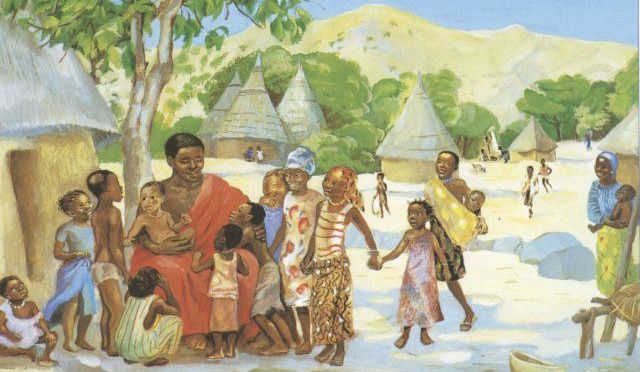
There is no greatest nor least

Mark 9:30-37

Jesus and his disciples passed through Galilee. He did not want anyone to know it; for he was teaching his disciples, saying to them, “The Son of Man is to be betrayed into human hands, and they will kill him, and three days after being killed, he will rise again.” But they did not understand what he was saying and were afraid to ask him.

Then they came to Capernaum; and when he was in the house he asked them, “What were you arguing about on the way?” But they were silent, for on the way they had argued with one another who was the greatest. He sat down, called the twelve, and said to them, “Whoever wants to be first must be last of all and servant of all.” Then he took a little child and put it among them; and taking it in his arms, he said to them, “Whoever welcomes one such child in my name welcomes me, and whoever welcomes me welcomes not me but the one who sent me.” (Read the whole passage)

We are well into this second part of the the long season of green… We have been winding our way through Mark’s gospel since May and the deeper we get, the more frustrating the disciples become. Today, they come off looking rather petty, like kids in the school yard at recess fighting over who is the king of the playground castle.

Of course we know that this isn’t just a play ground debate, we also recognize this debate about who is the greatest from the nightly news… especially as election season is upon us and one particular unavoidable politician who cannot help but tell us how tremendously great he is, unbelievably great.

But for people of faith, the scene between Jesus and the disciples today is about deeper things than self-aggrandizement and we know it. We know that this uncomfortable exchange between the disciples and Jesus has something to say about us too and about what it means for us to follow Jesus… or at least we are going to find that out.

The debate over who is the greatest is the memorable moment of the story today, but it is something that is repeated from last week which sets everything off. Jesus is talking about dying again. Last week Peter couldn’t abide it and took Jesus aside to rebuke him. This angered Jesus who the called Peter ‘Satan.’ This week, Jesus is talking about dying again but the disciples do not understand and are afraid to ask.

This point is important to keep in mind during the rest of the story. Because the disciples cannot understand what Jesus means when he says he will die and be raised three days later, they begin to focus on something trivial and manageable… they start arguing over who is the greatest. They are arguing over something they feel can control, something that seems to be quantifiable, a topic they think they can contribute to… all to distract from the fact that they didn’t understand what Jesus was talking about before and they were afraid to ask – remember what happened to Peter last week when he spoke up.

The question of who is the greatest among them is an idea they can manage… unlike the notion that Jesus has come into this world to be betrayed and die, only to rise again in 3 days. The little trivial matter is easier to talk about when the big issue, the big question makes them feel scared and powerless and insignificant.

And so they argue, they debate, they make passionate cases for who among them is the greatest… and probably they feel like they are achieving something as they travelled down the road to Capernaum. That is until Jesus hears them and sits them down for a talking to.

The disciples are doing something that we know well as human beings and especially as church folk. We know how to focus on the small trivial matters in order to avoid the big questions and bigger issues just like the disciples do.

Many of us have been to that church council meeting where the minute details of fixing a leaky sink or buying hot dog buns for the church barbecue or haggling over $10 item lines in a budget of 10s of thousands take up the bulk of time and energy….while questions of what it means to be disciples or how to follow Jesus in our community or how to encourage members growing in faith are met with silence and blank stares.

We naturally grab onto the small things, the things that feel manageable, the things that we can argue and debate and discuss… because the big questions of faith and mission and life… they sit like weights on our chests making our heats beat with anxiety when we think about them too much, let alone when we talk about them.

And so we end up sounding like the disciples, we end up arguing about who is the greatest because we are too afraid to ask about what it means for us that Jesus is betrayed, killed and raised three days later.

And we end up debating the little things like the annoyance of Sunday sports and shopping, grumbling about those who have drifted away and left us with the work, arguing over who is the blame for the decline of congregational resources and attendance… because we are too afraid to ask what it means for us that we are in this state, and what is God saying to us about being the church in this time of struggle.

So as we grumble along the way, on the road from where we were to where we are going… Jesus finally overhears us, stops us and sits us down – just as he did with the disciples.

To the disciples he says, whoever wants to be first must be last. Or in other words, all this stuff you are arguing about doesn’t mean a thing…it doesn’t mean a thing in the Kingdom of God.

And then as Jesus picks up a child and sets them in his lap, he says, “whoever welcomes one such child in my name welcomes me.”

But it isn’t some kind of moral lesson to the disciples… Jesus is in fact making a point about all that stuff he first said about dying and rising.

Because who is doing the welcoming? Who is holding the child in his lap? And who is it in baptism that declares to be children of God.

We aren’t the welcomers. We are the children.

God is the one welcoming us.

Jesus is reminding the disciples that they don’t need to be the greatest to understand what Jesus is up to in the world. Because in the Kingdom of God there is no first and last, no greatest and no least. We are all God’s children, and for us Jesus has come into the world. Jesus has come to die with us, to die with a dying creation. Yet, three days later Jesus shows us that death is not the end. And because Jesus rises from the tomb, we rise with the God of New Life on the third day.

The disciples don’t need to understand what it all means for Jesus to be betrayed, to die and to rise again… that isn’t their job. Rather Jesus tells them that he has come to bring them into the Kingdom, he comes to walk along side them, to let them see, hear and feel the Word of God among them… the Word made flesh.

And for all the things that we grab hold of to distract from the bigger issues of faith and life… they don’t matter in the Kingdom either. Because God will continue doing what God has always done for us. Whether it be when we thought we knew what God was up to with full churches and strong attendance and budgets we could meet or whether it is now when none of those things seem to be the case.

God continues to give us the Word of forgiveness and mercy week after week.

God continues to welcome us as God’s own as we are washed and renamed beloved.

God continues to gives us bread to eat and fill our hearts, so that we might become the bread that God uses to feed the world.

It has never been up to us to understand how the Kingdom works, or to have all the answers or to be saviours.

It is up to God.

And God is coming to us, coming to little ones such as these,

in the person of Jesus who dies and rises again,

coming to us again and again in Word and Sacrament,

signs of God welcome for us, signs that remind us that we are neither the greatest nor the least in the Kingdom, we are God’s beloved children.

A Sermon for the Ordination of a Bishop

On the Occasion of the Ordination of the Rev. Jason Zinko as Bishop
Manitoba Northwestern Ontario Synod
Evangelical Lutheran Church in Canada

John 13:2-17 

 He came to Simon Peter, who said to him, “Lord, are you going to wash my feet?” Jesus answered, “You do not know now what I am doing, but later you will understand.” Peter said to him, “You will never wash my feet.” Jesus answered, “Unless I wash you, you have no share with me.” Simon Peter said to him, “Lord, not my feet only but also my hands and my head!” 10 Jesus said to him, “One who has bathed does not need to wash, except for the feet, but is entirely clean. (Read the whole passage)

Sermon

It is a delight that the MNO synod has elected you and called you Jason, as our next Bishop.

I remember the first time I met Jason back in seminary. It was a gathering of students during the seminary’s open house. We were at the home of one of our classmates and here was some guy from Winnipeg cracking jokes from the lazy boy in the corner of the living room.

And trust me, “Now here is someone who is Bishop material” was not a thought that crossed my mind. But not for the reasons you might think. Firstly, no one thinks that when meeting seminary students. But as I got to know you, Jason, I remember your struggle with the call to ministry. Not with the fact that you clearly had gifts and abilities for ministry, but particularly how following the call to Word and Sacrament ministry might set you above in some way. That idea seemed to contradict your nature. And the Jason of those days is pretty much the same as today: approachable, thoughtful and down to earth. And also not super formal. 

Which is funny because here we are at your ordination as a Bishop… So, would you have gone through with it all back then if you knew you would be here today? Never the less, here you and we are. 

And I am honoured that you have asked me to preach on this day of your ordination to the office of Bishop. However, what do I know about being a bishop?

So I looked to Martin Luther for some insight. And you know what? Luther has a lot to say about Bishops… None of what he says is good. Mostly stuff about how Bishops just want to be lazy princes and lords and don’t do their jobs… 

Yet, like a lot of church folks and rostered ministers, I DO have lots of opinions about bishops and thus Luther for good company. Maybe that’s all that is needed for this occasion. //

This story from the Gospel John, despite being a recommended ordination reading, is a bit odd, ins’t it? It is odd because of “when” it brings us to in the story. Maundy Thursday, a day on which we would never schedule an ordination!

Regardless, it is this surprising and unexpected thing that Jesus does that seems relevant. He gets up from the supper table to wash the disciples feet. Normally, a task reserved for the house slave, Jesus reverses the order of things and takes the posture of a servant. 

Finally, after washing the disciples’ feet, Jesus exhorts his friends and followers to do what he has done for them, wash one another’s feet.

Here is a metaphor about the life of faith, or the experience of ministry. That our callings are not to higher and higher things, but to service and getting down into the dirty, muddy, not so nice places.  

And surely, as we gather to celebrate an ordination of a Bishop today, we celebrate that God has called you Jason, to this office of ministry in our synod. We also celebrate that this call is a renewal of our call to the work of the Kingdom and the ministry of the Gospel.

This exhortation by Jesus to the disciples gives roots to our celebration today by reminding us that the call to the office of Bishop is not a bigger and fuller call than that of the call to Word and Sacrament or Word and Service ministry. 
And those two callings are not bigger and fuller calls than our first calling. 
And that is the calling we all share, the calling given in baptism. 

Baptism is the calling that most fully expresses God’s call to us to serve one another in the kingdom… it is certainly no coincidence that washing feet looks more like baptism than laying on of hands. And the call to these particular set-apart-ministries within the church, to be Deacons, Pastors and Bishops are all about narrowing and confining —  restricting even — the call of the baptized to a particular and limited set of responsibilities within the body.

And as such, a synod only needs one Bishop, and congregation or ministry only needs one or a few rostered ministers, but there is always need of and room for more of the baptized in our midst. 

Now… having said all of this… and how lovely an image foot washing is… I am not really sure that it is the main point of this story.

While there is something to Jesus’ exhortation to service, it is the interaction between Peter and Jesus that is really interesting and that really has something to say about us and about the church and the world. 

As Jesus kneels down to wash feet in this Maundy Thursday moment the disciples are probably confused, but Peter is the one to say it out loud.

In a moment between the high of Palm Sunday and the crushing low of Good Friday, Jesus and Peter begin arguing over a bucket of water between them. 

“You will never wash my feet” Peter protests. 

He must know that something is about to happen, something big. And he wants to go back. Back to the last 3 years of following Jesus around the country side with crowds in tow. Back to the simpler, easier times, when ministry was straightforward and the results were obvious. 

Peter longs for the past. He understands the past, he can see how good he had it then (even as he was often speaking first, thinking second). He doesn’t want whatever big thing is coming, whatever change is on the way. 

“Unless I wash you, you have no share with me” Jesus says.
“Lord, not my feet only, but also my hands and my head.”

When Jesus won’t back down, Peter moves from avoiding what scares him to changing it. He tries to get Jesus to wash him as a religious leader would wash someone for ritual purity, not as a servant would wash dinner guests. If Peter cannot put his head in the sand and pretend that the scary things around him aren’t happening, he will recreate the past. He will re-make Jesus back into the Rabbi and teacher that Peter is comfortable with. Peter is going to hold on to the way things were at just about any cost. 

Sounds familiar doesn’t it?

Like Peter we too are very uncomfortable with Jesus taking this position, being in this posture. Like Peter we are very uncomfortable with the Body of Christ looking like it is down on the bottom, and we would much rather the Body of Christ of those glory days when the crowds just came, and the miracles were easy and the teachings enthralled the masses. 

Like Peter we would rather that the Body of Christ never have to wash feet. If only Sunday Schools and Youth groups were full again, if only people came back to do the work we are tired of doing. If only there was no Sunday shopping or hockey practices or dance lessons. If only our pews were full and offering plates fuller… there wouldn’t be need of foot washing.

Like Peter, we would rather change what the Body of Christ is doing so it looks and feels better. If only we tried the next program or bible study or trendy church growth tactic. If only we put up some screens and updated the music, if only we invested in some professional church organists and choir directors. If only we preached more biblically and worked more for justice, if only we changed the right part of ourselves, we could go back to the way things were… and the Body of Christ wouldn’t be kneeling before the world.

Peter on Maundy Thursday shows us who we really are. //

Here we are as the church as embodied in this gathering to celebrate the ordination of a new bishop, as the MNO Synod and ecumenical partners, as the Evangelical Lutheran Church in Canada. Big change is upon us, much of what we once knew is already no longer the same, the glory days are behind us… and what is coming… it’s scary. 

But let’s make no mistake, Jason isn’t our new saviour. 
Jason isn’t Jesus. 
Jesus is Jesus. 

Instead, along with Jason, we are standing before Jesus, before the Body of Christ brought low, in this posture that makes us uncomfortable. And we too have a sense that this is not the way things should be.

And Jesus’ response to Peter in the moment?

“This is happening. I am going to wash your feet and just your feet, you don’t get to be in control”

Because it isn’t just about foot washing is it?

Because this moment is the grand reversal of the incarnation, of God coming down to our level, in human flesh, in order to show us love. This is the creator kneeling before creation in order to say, “I love you.” 

This is creation betraying God because we will not open our eyes to what is happening. This is the best that humanity has to offer, religious and political leaders, rejecting the divine, and putting God on a cross because we will not accept what is about to happen. 

Because this moment is nothing less than cross and empty tomb. God taking and holding creation in God’s hands — 

dirty, muddy, tired, sore, sinful, suffering, creation — 
and God washing away a little dirt here, 
scrubbing out the soreness there, 
bringing life and wholeness in a way that we never thought possible and in a way that we firmly tried to prevent. 

So, no pressure Jason, and no pressure to the rest of you. 

But this is our foot washing moment. 

Jesus is telling you Jason, Jesus is telling all of us… 

“This is happening. I am going to wash your feet and just your feet, you don’t get to be in control.”

Because Jason, when you make those vows to the office of Bishop, and we make promises in return, and when that cope is placed on your shoulders and that staff is placed in your hand… it won’t be because this ministry is something that you get to form and shape into your vision, or something that we get to shape and form into ours. 

Rather, it is going to be Jesus taking hold of your feet in order to show you how much God loves you. 

And then Jesus will do nothing less than bring God’s Word of Life into the world through your ministry, 
and God will wash, feed and nourish the people entrusted to you through your ministry, 
and the Spirit with breathe new directions and visions and dreams for us into your leadership. 

Because this moment is nothing less than the spirit of God breathing new life into the church. Nothing less than God declaring that in this Body of Christ, 
this segment of the Church brought low and kneeling on the ground, 
that this is precisely where Jesus is about to transform us and all of creation. 
That cross and empty tomb are being lived out right in our midst. 
And Jesus is making us alive while moving us into the future, no matter how much we yearn for the past.

And as God takes hold of us, of this Body of faith brought low and dying… 
God is washing away a little fear and trepidation here, 
scrubbing out a little resistance to change there, 
and breathing new life into us…. 
new life in the ministry of a new bishop 
and in the renewed ministry of this synod and its members.//

So while Luther didn’t say much positive about bishops, he did point us to the heart of this ministry. He says:

“We will now return to the Gospel, 
which not merely in one way gives us counsel and aid against sin; 
for God is superabundantly rich [and liberal] in grace [and goodness]. 
First, through the spoken Word by which the forgiveness of sins is preached in the whole world; 
which is the peculiar office of the Gospel. 
Secondly, through Baptism. 
Thirdly, through the holy Sacrament of the Altar…”

So with Luther’s reminder of the centrality of the gospel, and Christ’s words to Peter, we are reminded again that our call to the ministry of the gospel does not lift us higher or push us lower and is not even OUR call. 

The call is God’s, 
the Call is Christ’s, 
and it comes from a servant brought low, 
washing and raising us to New Life. 

Amen. 

Only Messiah would be born in a grave

John 6:35, 41-51

Jesus said to the people…”I am the bread of life. Your ancestors ate the manna in the wilderness, and they died. This is the bread that comes down from heaven, so that one may eat of it and not die. I am the living bread that came down from heaven. Whoever eats of this bread will live forever; and the bread that I will give for the life of the world is my flesh.” (Read the whole passage)

We are talking about bread again… and in fact, we have been talking about bread for several weeks now, and we still have one more week to go in this detour into John’s Gospel. We have been slowly, piece by piece going through this conversation between the crowds and Jesus. The crowd of 5000 that was first fed with 5 loaves and 2 fish, and now the crowds that do not and will not understand who Jesus is and what Jesus is offering to them. 

But John is drawing our attention to a debate about bread, John is telling us what this bread actually means. In the Gospel of John, the dynamic between Word and Sign, word and bread is always lying underneath the surface. Jesus proclaims his Gospel in words, Jesus IS the Word of God, yet those who hear that Gospel, the crowds, the disciples, the pharisees and scribes, they all want signs, they all want bread. The words are supposed to be enough, but the demand for bread and signs never ends, and so Jesus shows who he is, as the Word made flesh, by doing miracles, healing the sick and the lame, casting out demons and finally by dying on a cross and being raised on the third day. And so in the Gospel of John, Word and Sign – Jesus and bread – are inextricably bound up together, they cannot be separated. There is the Word, the Good News of God’s Love, and then there is the Sign, the bread of Christ’s body to be shared. Word and Sign – Jesus and bread.

Today in the Gospel of John, we see that the good news and bread are one. Jesus is the Word made flesh to hear, Jesus is the bread made flesh to share. For John, we are given grace and we are given bread, and God gives them to us in the same package. The Good News comes in bread and body to be shared. Jesus gives himself to us in the flesh and in the bread of life. 

But today, this conversation about bread takes a turn. Up until now, the conversation has been about the divine, about the unwillingness of the crowds to see Jesus as God. Last week the crowds wanted to be able to perform the works of God. But today, Jesus goes a little deeper, goes right to the heart of reasons why the crowds, and why we, try to be God in God’s place. Its the reason that our sinful self wants to be in control. Jesus reminds the crowds, “Even your ancestors ate manna in the desert, they ate the bread from heaven provided by Yahweh Elohim, the God of Abrham and Isaac, the God who delivered you from Pharaoh and slavery in Egypt.  They ate that heavenly bread, and yet, even they died. 

Jesus is getting to the heart of what all the quibbling about bread is about. Jesus is reminding us of that fact that none of us likes to be reminded of. It doesn’t matter if your ancestors were the ones whom Yahweh fed with manna in the desert and it doesn’t matter if your ancestors were the ones whom God fed with bread grown in the fertile land Manitoba, WE ARE ALL GOING TO DIE. The crowds wanted to do the works of God, but the work of God is New Life, something that we must rely on God to do for us.

And so for us, death is real and death in unavoidable. The Old Adam, the sinful self, would rather quibble about bread any time. Being reminded of the reality of death, to be reminded of its constant presence, is never easy. Instead, its unsettling and for the Old Adam in us, it is the ultimate reminder that we are indeed not God. 

While we may live in perhaps the most peaceful country in the world, and while as a society, we try to pretend very hard that death is not real, or at least does not affect us, it does not take much to be reminded of how close it truly is. Read the newspaper or watch the news, and the stories of death abound. Drive by any number of the cemeteries that dot the highways here, and it does not take long to be reminded that dying is OUR reality. Death is our reality so much so, that we are born dying. We are born as beings unto death, our lives are aimed, right from the beginning towards our end. 

But just because death is our reality does not mean that death is God’s reality. Just because death is our end, does not mean that its God’s end.

American Pastor and Scholar, Paul Tillich, once told a story about a World War II. There was a Jewish man who managed to escape being sent to concentration camp in Poland.  After leaving his home and all that he held dear, the man was finally forced to live and hide in a Jewish cemetery with many others wartime refugees. In fact, he lived in an empty grave, all the refugees did. And there, they hid from the Nazis. 

One day, in the grave next to the one where he had taken up residence, a young woman was giving birth to a baby, giving birth the unlikeliest of places. In her delivery, she was assisted by an Old Man dressed in a dark shroud, presumably the grave digger. When the newborn child uttered its first cries in the world, the Old Man lifted the baby to heaven and said, “Great God, hast thou sent us Messiah? For who but Messiah could be born in a grave?”

(Pause)

 In the moment when death is certain, when the reminder that we all will die is so certain and life seems to be over, God in Christ is doing a work so amazing that the Old Adam in us does not want to believe its possible. God is making new life happen, God is making eternal life happen. In place where death’s power seems to be certain and absolute, God is granting us eternal life through Messiah, through Christ. 

Starting with 5 loaves and 2 fish, and onwards with quibbling about bread, quibbling about who Jesus is, God is there offering us eternal life. It is not John’s original idea to make bread and eternal life go together, but rather, this is the work of God. It is the work of God to offer us life in the Word of Christ, and life again in Body of Christ. It is, of course, no accident that the blessing after communion goes, 

“Now may the body and blood of our Lord Jesus Christ strengthen you and keep you in his grace until life eternal”. 

Today, Jesus reminds us that we will all die, no matter who we are, no matter who our ancestors were. But for Jesus, death is not the end, and there with us in the grave, we are given eternal life in body and blood. Jesus gives us God the Father, and along with the Father, we are given God’s love and mercy and grace. Death is real, death is unavoidable. We are not immune to its effects, we are not immune to the reality and constant presence of death. And still for God, even in the grave there can be new life. New Life that sometimes can come in something so totally unimaginable to us, new life that comes to us OUT of the grave. But the greatest promise of New Life, is that it always comes in God’s gift of eternal life. 

We are three weeks into the Gospel of John and its discussion on bread, three weeks into this story about the 5 loaves and 2 fish. And yet, in Christ in the Word and in this Sign of bread, we are reminded first that we will all die. But more importantly, we are also promised that we shall all live. We are promised that God is working in the world to bring us new life, new life in unexpected and surprising ways. New life out of the grave. Because only God would sent us good news in bread. Only God would be born in a grave.

Remember that you were aliens and strangers with no hope too

Mark 6:30-34, 53-56

The apostles gathered around Jesus, and told him all that they had done and taught. He said to them, “Come away to a deserted place all by yourselves and rest a while.” For many were coming and going, and they had no leisure even to eat. ….When they got out of the boat, people at once recognized him, and rushed about that whole region and began to bring the sick on mats to wherever they heard he was. And wherever he went, into villages or cities or farms, they laid the sick in the marketplaces, and begged him that they might touch even the fringe of his cloak; and all who touched it were healed. (read the whole passage)

We are coming to an end point of sorts. After this week, we will detour from Mark’s Gospel to hear 5 Sundays from John on the Bread of Life. And this scene from Mark today, is the culmination of something building in the background of these stories of Jesus’ preaching, teaching, healing, exorcising demons and arguing with the pharisees. 

Today, the crowds move from the background of the stories and take centre stage. The crowds were there as Jesus’ family tried to take him away and Jesus compared the Pharisees to Satan, they were there when Jesus taught in confusing parables which he only explained to his disciples in private. They were left behind as Jesus and the disciples rode that boat out into the storm. They were silent witnesses as Jesus healed Jairus’ daughter and the bleeding woman. And they watched as Jesus could do no deeds of power in his home town. 

After sitting always in the background and even after being avoided by Jesus and his disciples, the crowds, the poor, unwashed masses following Jesus around Galilee looking for hope and healing finally have their moment today. 

As Jesus and the disciples feel the pressure of the crowds, Jesus suggests that they all find some place quiet to go. So again, they try to escape the crowds by boat. But this time the crowds will not be fooled. They run around the shore ahead of Jesus and disciples. 

And while it isn’t totally explained just who these crowds are, the stories that they have been a part of and the background suggest that these are likely the common people of Israel. The poor, the disadvantaged, those on the outside, those who have little power in their world, those who excluded from political and economic upper echelons of society. Some might be beggars, those who bear disease or infirmity, but also everyday average people who try to work and care for their families, to eek out a living in Roman occupied Israel, which was a harsh and difficult place to live. These are the faceless, nameless masses of the world. The kind of people you pass on the streets, or in the mall or at the grocery store without much thought. People whose lives are mostly normal, if not unremarkable. People who don’t really get names or details of their own, they are just crowds. 

And the crowds have been ignored and forgotten for long enough, there is no pushing them aside anymore. They have come to Jesus and Jesus cannot keep putting them off anymore.

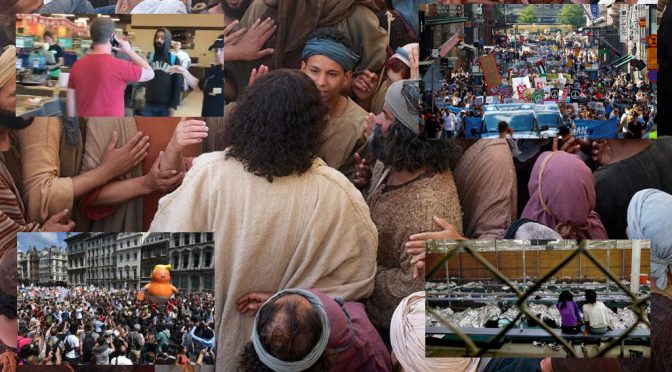
Maybe you feel the same way, but I can get what Jesus is feeling like today. The crowds of our world seem to asserting themselves in much the same way. Flip on the news and there are crowds gathering around every corner. Crowds on the streets of London and Helsinki to greet a certain world leader. Huddled masses appearing at the borders between Mexico and US, and the US and Canada. Crowds seen in fenced-in detention centres separating families, crowds at grocery stores looking on as some lunatic in a red t-shirt tries to call the cops because someone dared to have dark skin and a beard in his presence. 

The crowds seem to coming up front and centre in the news these days, in our social media feeds, and even on our doors steps. 

And it is easy to see those crowds as outsiders. As the lost and forgotten, the alien and strangers of our world. It can be overwhelming to imagine what we could possibly do for them Should be out in the streets with protest signs too? Should we be at the border with food and clothes to help welcome the lost and forgotten before their are thrown in detention centres? Should we step in front of a raving and angry person making a scene in a public place?

These don’t feel like our problems, they are the problems of other people, the problems people on the outside, foreigners and aliens and strangers. 

As the crowds press in on us and give us hardly a moment to rest or eat these days… Paul has some words for us. Some words first given to the Ephesians, but just as applicable today. 

“…remember that you were at that time without Christ, being aliens from the commonwealth of Israel, and strangers to the covenants of promise, having no hope and without God in the world.”

Remember that you were once outsiders too. Outsiders to God’s love with no hope in this world. 

_________

As Jesus and the disciples land their boats back ashore, their attempt to escape the crowds seems to have been for naught. They crowds are pressing back in again, searching for some kind of hope and healing.

But this time something shifts in Jesus. Jesus has compassion for these desperate crowds. He sees them for who they are and what they need. They are lost and forgotten. They are aliens and foreigners. They are outsiders. 

And so Jesus finds them. 

Jesus remembers them. 

Jesus welcomes them.

Jesus knows them. 

Jesus brings them inside….inside into God’s mercy. 

And all of sudden, in a subtle but important shift, Jesus isn’t trying to escape anymore. He simply lets the crowds be. He lets them be around him, near him, and come to him. They are a part of who and where Jesus is. They are part of the family. 

As we sit in our comfortable churches, it is easy to feel like insiders, and even difficult to identify with those crowds on the streets of London and Helsinki, or the crowds in detention centres are borders, or the crowds witnessing racism in grocery stores. 

And as people of faith on the inside, we can even wonder where is God among these crowds today? Is God at work in the crowds in the streets of London and Helsinki? Is God handing out food and blankets at the borders? Is God stepping in between that lunatic at the grocery store and the poor victim of his rage? 

Maybe… God might be in those places…

Paul reminds us: 

“…remember that you were at that time without Christ, being aliens from the commonwealth of Israel, and strangers to the covenants of promise, having no hope and without God in the world.”

But Paul also says: 

“But now in Christ Jesus you who once were far off have been brought near by the blood of Christ. For he is our peace; in his flesh he has made both groups into one and has broken down the dividing wall, that is, the hostility between us”

Here is the thing, Paul isn’t reminding of what it feels like to be outsider… most of us were brought into this family of faith as insiders as babies and we don’t remember being outsiders. 

Rather, Paul is reminding of the gift of a place in God’s family that has been given to us. The free gift, the undeserved gift, the unearned gift of being a member of God’s family that Christ has given to us. 

Because here as we gather from far off, Jesus brings us near. Jesus gives us peace in reconciliation and forgiveness. Jesus makes us one in the Word of Good News that we hear, and Jesus breaks down the wall, the hostility between us. 

And Jesus is first here among this crowd and in these streets between us, gathering us at this table. And Jesus brings us bread and healing at the table, at the border between heaven and earth. And Jesus steps in-between us and sin and death to proclaim that those things are not okay and will have no place here anymore.

Paul reminds us that we were all once outsiders and and aliens and strangers. But Jesus has brought us in to the love and mercy of God, and Jesus continually brings us in, continually makes us – and the whole world – part of God’s family.

And so today, the crowds press in, on Jesus and on us. Yet are reminded that we are not the insiders removed from it all that we thought we were… Rather, we are the crowds too, and we now have a place near to Jesus, in the household of God. 

This is not the end of the story

Mark 6:14-29

…Immediately the king sent a soldier of the guard with orders to bring John’s head. He went and beheaded him in the prison, brought his head on a platter, and gave it to the girl. Then the girl gave it to her mother. When his disciples heard about it, they came and took his body, and laid it in a tomb.
(Read the whole passage)

They came and took his body and laid it in a tomb. 

Familiar isn’t it?

We have heard that story before. We heard it just in April… Jesus died on the cross, and one of his disciples Joseph of Aramathea came and took his body and laid it in a tomb.

Except today, it is not Jesus but John the Baptizer. It is not crucifixion but beheading. It is not Pilate but Herod. And John will be not raised from the dead in three days. 

This story comes in the middle of Mark’s gospel. A brief departure from the things we have been hearing about, from the parables, healings, exorcisms and miracles. We stop for a moment to hear a dark and disturbing, story. Political intrigue – a King who lives lavishly, takes what he wants, and yet is perplexed by the preaching of a wilderness prophet and hermit. Pride and incest – A queen who will not stand to be shamed for leaving her husband for his brother, the King, and especially not by this lowly Hebrew religious hermit and religious nut. Murder — A young girl who is used by her parents as a pawn in a political game. A prophet is murdered so that a drunken tyrant can save face. 

No happy ending. No drama to come. Simply power, greed, lust, and pride getting what they all want. Mark doesn’t leave out any of the dirty details. This is not a feel good story. This is too much like real life, too much like the world around us. This is not enough like a Hollywood feel good ending and too much like a bad night for news.

John the Baptist, the wild Advent preacher of the Messiah’s coming to make paths straight has an ignominious end of to life… a public execution simply to satisfy the political and prideful wrangling of the ruling elite. And then his disciples come and take away his body… and thats it. 

Sometimes the story just doesn’t end well. Sometimes life doesn’t figure itself out. Sometimes there is no happy Hollywood ending. 

This strange story, today, sets itself apart from the rest of the Mark’s gospel. It feels like it doesn’t’ fit. It is selfish motivations and actions, pure and simple. And yet, it can feel so familiar. It is the story of the world at its’ worst. It is our story at our worst. We don’t need to have the drunken parties, the incestuous relationships, the desire to show power and control, or pointless death to know what it feels like. This story of Herod, Herodias, Salome and John is just as much about us. It is the story of the dirty details of life. The story of broken families and marriages, the story of job loss and bankruptcy, the story of political games and corruption, the story of money and greed, the story of poverty and powerlessness, the story of disease and illness, the story of grief and death.  

And it is missing something… or rather it is missing someone. Someone who is hinted at at best and completely absent at worst. 

This is the only part of the Gospel of Mark where Jesus isn’t front and centre… in fact, Jesus isn’t in the story at all. It makes us wonder why Mark would include this terrible event, why tell us the details? Why lay out the whole thing for us?

This story is there because it is not the end. 

Not the end of Jesus’ story. 

Not the end of our story.  

If these dirty details was all there was to story, we wouldn’t need to hear about victory of evil and sin because we live it all too often. We hear about it on the news too much. We know that this happens in the world. 

But Mark has chosen to tell us this story. To boldly include all the dirty details of power, control, pride, lust, greed and evil. Mark has chosen to include this in the story of Jesus. To include the dirty details in the Good News of Jesus Christ. 

They came and took his body and laid it in a tomb is not the end of the story of God. And it is not the end of our story. It is not the end of our stories of suffering and sin, of evil and death. God includes all our dirty details. Includes them in the story of Jesus born in flesh. Included in the story of God’s great love for us. And they are not only included, but as our stories become God’s, God’s story becomes ours. God makes the ending that we know, the empty tomb, the resurrection on the third day, the news of the risen Christ, God makes this the new ending of our stories. God makes us the new end, the new point, the new purpose of God’s love.

The Good News of Christ is that in the midst of all the evil, all the sin, all the death that exists in our world, in our lives, in relationships, in our stories, God is joining our story, our world, our lives. God joins us by coming in flesh and dwelling among us. God joins us to the Body of Christ. The dirty details, they are not what make the story any more. Rather the new plot twist, the surprising new reality is New Life. New Life in Christ, New life in the ongoing story of God. 

Sometimes life just seems full of the dirty details. Sometimes Jesus is nowhere to be seen. Sometimes all there is pointless evil, rampant sin, and needless death. 

And sometimes when our stories feel too terrible to be anything like God’s, God reminds us that we haven’t reached the end yet. There are still chapters to be written, still details to be added. God reminds us that in Christ, that because of Christ, there is only one ending possible to our story. 

God reminds us today, that our ending is life and our ending belongs to God. 

Amen.