Tag Archives: Church

The future we cannot imagine

GOSPEL: John 5:1-9

6When Jesus saw him lying there and knew that he had been there a long time, he said to him, “Do you want to be made well?” 7The sick man answered him, “Sir, I have no one to put me into the pool when the water is stirred up;… (Read the whole passage)

Six Sundays into Easter we are coming to the end of the great party of the resurrection. Sure, things have been winding down for a few weeks already, but now is the time when the hosts are letting everyone know that the kitchen is only open a few more minutes, its last call before hitting the road. We are close to being ejected from this celebratory season into the next thing. But the coming end of Easter isn’t just about moving to the next thing. Easter wraps up the first half of the church year where we tell the story of Jesus’ life, from birth to death to resurrection. On Pentecost Sunday we mark the beginning of the Church, the Body of Christ, of Jesus’ presence in the world in a new way and we follow that with about 25 Sundays of green where we hear the teachings of Jesus.

And so it is curious, that coming to the end of the portion of the church year where we tell the story of Jesus’ life we skip back to a moment earlier on. A scene from early on in Jesus’ ministry not long after his baptism and early miracles. In the light of Easter, this moment takes on different connotations than it might have before.

Jesus is making his way through Jerusalem and comes near the Sheep Gate and the pool of Bethzatha. It was believed that this particular pool was periodically visited by an angel who would stir up the waters, after it would heal those who bathed in it – the sick, blind and lame.

Laying there is a sick man who had been there for 38 years. Jesus sees this man and asks him a question, “Do you want to be made well?”

The man tells Jesus that there is no one to bring him to the waters when they are stirred up, and he cannot make it in time on his own.

At this point, the conversation should be feeling a little off. It is like when someone responds to a question that isn’t actually an answer to the question. We have all had these kinds conversations. “What time is it?” “Oh, well we haven’t had lunch yet.” Or “How do you get to the grocery store from here.?” “That’s a long ways, you will need to drive.”

Jesus asks a fairly straight forward question and the man answers a completely different one. And in fact, there are a lot of different answers that the man could have given that would have been closer to answering Jesus’ question. He could have said ‘yes’ or ‘no,’ he could have told the story of how he lost the use of his legs or became sick, he could have asked for mercy and help. But the man doesn’t respond in any of those ways…

Instead the man begins, “Sir, I have no one…”

The man begins with relationships or his lack there of. He has no one, no one in his community has been willing to help him for 38 years. But the man also claims no agency, he believes that his problem is that he has no one, and no one will make way for him.

And maybe after 38 years that makes sense in the man’s mind. He neither sees nor imagines any kind of alternate future. This is his life, the sheep gate with all the others in his community like him, just a few steps from healing, yet completely unattainable.

The man has also completely avoided Jesus’ initial question. “Do you want to be made well?” And that is significant.

It’s significant because it is the same kind of thing we do as well. The conversation that Jesus and the man have could have just as easily been one in our homes or work places, churches or neighbourhoods. It feels unimaginable that no one would have helped this many in nearly 40 years. Yet, how many of us live with pain and discomfort, frustrations or grudges for years upon years? How often when faced with the prospect of doing something about the problems we bear, we look around and say, “There is no one here to do the work needed to do.” As a community and society, how often do we simply accept or even encourage the suffering of an unfortunate few? “If only they could help themselves, if they did’t make the choices they did, what could I do about a problem so big and so hard?”

Our problem is that we find it so hard to imagine any kind of different future than our present. The man has become his story. He has no one to take him to the pool and when he tries to make it on his own, someone steps in his way.

And so too we become our stories…

I am too old to start over,

too set in my ways to learn,

too far gone to be be saved.

We are dying because there is no one to step up and do the work,

we are declining because sports and shopping on Sunday morning,

people just don’t care enough to give of their time and resources like folks did in the past.

Climate change is too big a problem.

Sexism, racism, and inequality are other people’s problems.

I didn’t do those awful things, why should I have to pay for the sins of my ancestors.

We too cannot imagine a future different than our present. It isn’t that we don’t want to be made well or not… its that we don’t know what being well even looks like. We believe that we are what we are.

Yet, Jesus shows up and asks anyways. “Do you want to be made well?”

And you see, before the man even answers, Jesus has invalidated the man’s story of himself. “Sir, I have no one…”

Except the One who has seen him and reached out to him and asked him if he want to be made well.

And even when the man cannot see it, even when he still does not realize that Jesus has broken through his isolation and solitude, and that Jesus has seen him not for his problems but for his humanity…. even when the man cannot see all that… Jesus stays present.

“Stand up, take your mat and walk.”

It isn’t that Jesus has fixed the man’s legs, or taken away his sickness. It’s that even when the man cannot recognize Jesus’ breaking through with a new future and a new story… Jesus hears the man.

It is as if Jesus is saying, “So you think your problem is that you cannot make it to the pool and no one will help you there?… Okay, how about now?” And the man has help, the man can get to the pool.

Jesus meets this man, see him for who he is, and hears who the man believes himself to be…. and Jesus breaks through it all. Jesus makes the man well with a future that only God could have imagined.

And for all the ways in which we cannot imagine any other future, in which we believe that our present is our future… God has a new future and new story in mind for us.

Each time we gather as the assembly, God greets us with a new story about us.

Forgiveness for sinners,

Healing for suffering,

Reconciliation for the conflicted,

Intimacy for the isolated,

Welcome for the marginalized,

Community for outsider,

Hope for the despairing,

Peace for the tormented,

Life for the dying,

Resurrection for the dead.

God greets us and this world with a Word that changes our present, and opens us up to a future we cannot conceive of or imagine.

And even when we cannot see what Jesus is doing, Jesus sees who we truly are in the waters of baptism, the new identity that we are washed and cleansed with in the waters.

And even when we cannot imagine what being well looks for us, when we cannot answer Jesus’ question for us, Jesus greets us at the table, welcomes us into God’s future, into healing relationship and community found in the Body of Christ.

It is as if Jesus hears all the stories about ourselves that we bring here, that we bring to this assembly, and Jesus says to us, “Okay, so you think that that is your story, that this is your future? Okay, how about now?” And we are forgiven and healed and reconciled and brought to new life.

Jesus meets us over and over again, from Christmas, to Lent, to Good Friday, to Easter and beyond. And Jesus keeps on asking,

“Do you want to be made well?”

And thankfully, our answer to this question doesn’t matter… because Jesus has already seen us, already sought us out and already has set us into God’s future.

And Jesus’ answer to us is, “Stand up, take your mats and walk.”
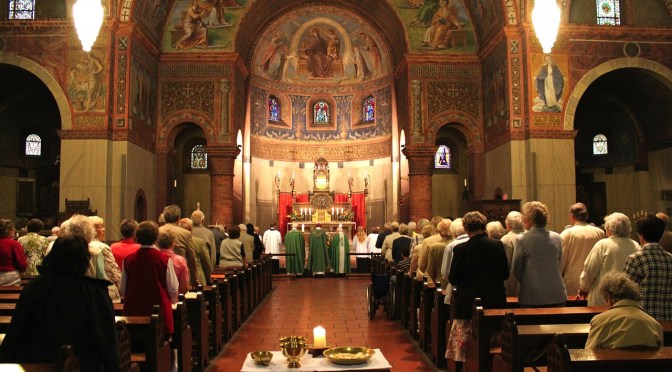
The Complications of Belonging to a Church

GOSPEL: John 13:31-35

31When he had gone out, Jesus said, “Now the Son of Man has been glorified, and God has been glorified in him. 32If God has been glorified in him, God will also glorify him in himself and will glorify him at once. 33Little children, I am with you only a little longer. You will look for me; and as I said to the Jews so now I say to you, ‘Where I am going, you cannot come.’ 34I give you a new commandment, that you love one another. Just as I have loved you, you also should love one another. 35By this everyone will know that you are my disciples, if you have love for one another.” (Read the Acts text)

We are now into the latter half of the season of Easter. The Alleluias from Easter Sunday, or as it is formally called The feast of the Resurrection of our Lord, are not ringing as loudly as they were a month ago. Yes, it is still Easter but with 4 weeks of resurrection stories behind us we are coming into the questions that the early church community faced. Questions about what it means to be a community, what does it mean to belong, who exactly are we and where do we go from here? Sound familiar?

Even as we consider this new Easter world, John jumps us back to Maundy Thursday… to hours before betrayal, arrested, trial, and execution. Jesus is eating the Last Supper with his disciples, and he gives them a New Commandment – to love one another. On the night before Good Friday, these are the last instructions of a teacher to his followers. Yet, here a month into Easter, they speak of a different reality to a fledgling Easter community being birthed before our eyes.

In some ways we should have read story of Peter from the book of Acts after the gospel reading, because Peter’s dilemma is precisely how to live into the New Commandment that his teacher and master had given him.

In the days, months and years after the resurrection, the community of Jesus’ followers that continued on to become the church, had to begin dealing with a lot of questions. Questions about who belonged and what it took to become a member of the community. As Peter became the leader of the Christian community in Jerusalem, the question of who could be a part of the community quickly arose. Particularly, as small Christian communities began to sprout up beyond Jerusalem and into the Greek world, the early church had to contend with what new converts needed to do in order to join.

When Peter meets the community in Jerusalem, they are a Jewish group… all are circumcised. And they have been keeping to the tradition of Judaism not necessarily seeing following Jesus as a departure from the faith of their ancestors. Yet, Peter has been meeting with uncircumcised followers – gentiles. But not just meeting with them, eating with them. Of course, observant Judeans kept Kosher, so eating with gentiles would certainly mean breaking Hebrew purity laws. The circumcised believers question Peter’s actions… so Peter tells them a story. Peter was given a vision, a voice from heaven telling him to eat non-kosher meat. Yet when he dismissed the dream, it kept coming back.

Even then, Peter is not swayed… so the spirit sends him to the home of a gentile, Cornelius. And there Peter’s mind is changed.

Now some twenty centuries later, we don’t generally feel the same way about circumcision and eating non-kosher meat that the early christian community in Jerusalem did… yet there is still something extremely familiar about this debate.

Of course, we know on a technical level that the first step of becoming a Christian is to be baptized. In fact, the Greek word Cristos means anointed one, Messiah is the equivalent in Hebrew. And after being washed in the waters of baptism, we are a marked with cross in oil… we are anointed, we are named as Christians.

And yet, knowing what it means to become a Christian through baptism and anointing compared to belonging to a particular community… well those could very well mean different things.

In the first congregation that I served, an open country church on the corner of a quarter section of farmland, what it meant to belong had a complicated meaning. Belonging happened in a variety of ways: If your family had been farming the land for a few generations, you belonged whether you wanted to or not, whether you were in church every Sunday or once a year. And yet, if you were new to the community, meaning being the first generation to the land, you were always new. Some who had been faithfully attending for decades, were still considered “new members.”

In my second congregation, a very large congregation in a small city, belonging was very much tied to involvement and connections. You could quickly belong within months by joining one of the many groups active in the congregation, like knitters, musical groups, prayer groups, people interested in global mission and so on. Yet, you could remain a new person for years if you kept to yourself and just showed up for worship.

And at my last congregation, belonging was tied to one’s place in the community surrounding the church. Where you worked in town, what street you lived on and who your neighbours were, and how connected you were in town determined your status of belonging.

Of course, here at Sherwood Park, we have unspoken rules about what it means to belong too… they are apart of every church from Peter’s day to ours.

Circumcision and eating non-kosher meats, or having generations to stand on the shoulders of, or sharing a common interest like quilting or music or missionary work, or meeting by chance at the grocery store and again at the PTA meeting and again while shovelling snow… all of these things and so many more make up the complicated definition of belonging to a community, belonging to a church, of a church belonging to a denomination, of a denomination belonging to a religion and so on.

Yet, all of these complications of belonging are about more than checking off boxes and fulfilling requirements. They are ways that we deal with the same fear living within each of us. The circumcised ask Peter about his fraternizing with the uncircumcised because they are worried if they themselves are worthy, if they are acceptable, if they actually belong. All of our ways to defining who is in and out, who checks the right boxes and who doesn’t… they all have to do with our own fear of being good enough, of being worthy and acceptable.

Last week, we heard from Revelation giving good news to Christian communities living on margins of society and how the great multitude worshipping before the throne was God’s way of breaking down walls that divide and separate.

Today, is about God breaking down the same walls within our communities, within ourselves.

Even after being given the same vision three times Peter is not convinced… that is until he comes to the home of Cornelius.

It is when Peter must look Cornelius in the eye, in the flesh, and decide whether the good news of God’s forgiveness and love is also for this Gentile… The Holy Spirit breaks the walls Peter’s heart. The Spirit makes Peter realize something new…

All the complications of belonging… that is our baggage, that is our stuff.

But for God, there are no complications… there is simply belonging.

In Christ, we all belong. We all belong to Christ.

We all belong because of the one who crossed the chasm, who bridged the divide of Creator and creation, who joined what was separated in sin and death together in forgiveness and resurrection. In Christ, the one who is both our flesh and the divine, we are joined to the Trinue God of all.

And this same Christ, likes to keep reminding us of that. Not in the complications, but by meeting us in the flesh. Christ meets in human voices and bodies that read and proclaim God’s word, in prayer and song, in peace shared and praises given.

Christ reminds us that we all belong in the water that washes us and the oil that anoints us, and we are washed and forgiven by God, we are anointed and clothed by God, and we given the same family name – Christian.

And Christ reminds us that we are all one in the same body. As Jesus gathers at the table, as we share in Body and Blood of Christ, God makes us what we eat and drink – Christ’s body given for the sake of the world.

And all those complications, all those other things, all those reasons we find to say someone whether belongs or doesn’t… those things are pushed aside.

And instead Christ proclaims us that belonging isn’t up to us, not based on our worth or the worthiness of the generations that came before, not based on our ability to participate or contribute, not determined by our integration into the fabric of community, the number of connections to others we carry….

But belonging is determined by the One to whom we belong.

Today, Christ declares to Peter, to the early church, and to us… that we no matter who we are, we belong to God.

Peter, Do you love me? Yes Lord, I am your friend.

John 21:1-19

Jesus showed himself again to the disciples by the Sea of Tiberias; and he showed himself in this way…

He said to him the third time, “Simon son of John, do you love me?” Peter felt hurt because he said to him the third time, “Do you love me?” And he said to him, “Lord, you know everything; you know that I love you.” Jesus said to him, “Feed my sheep…” (Read the whole passage)

It is still the Great Day of the Resurrection. Two weeks into the season of Easter, and we meet the disciples again in the hours and day following Jesus’ resurrection. Last week, Jesus came to them in a locked room, breathing life and peace back into his lost disciples. And now we get to the denouement, the part of the story that comes after the drama and tension, the part that wraps it all up in a nice happy ending. Or at least that is how it is supposed to go.

For the first time in the Gospels the disciples know the end of the story, they finally have caught up to us, they now know what we have known since Christmas morning – that there would be crucifixion and resurrection. The disciples now know that the story of the Jesus ends with life despite death, empty tombs despite crosses. The disciples know this miracle, this Good News, but they are back fishing. Back to their old lives, back to what they knew before this Jesus guy ever came into the picture – Peter leading the way.

And still Jesus finds them, and tells them how to catch fish and they do. As if they needed more proof of who the Messiah is, Jesus gives them yet another sign. And then calls them over for breakfast.

In the early morning hours. The first pinks and purples of the sun are showing in the sky. There is a fire glowing on the beach, the smell of fish and toast. The sound of waves lapping up onto the sand. Its maybe the first peaceful moment in days. There are no words spoken, simply the smell of the fresh seawater, and the dancing shadows of firelight. And as Jesus and Peter lay on the beach, having eaten breakfast, still under the dark of night, Peter cannot help but be reminded of another fire in the dark that he visited.

Lost in thought and memory, Peter stares into the flames. Jesus is the first to break the silence.

“Simon son of John, do love me more than these?”

Its a question that snaps Peter back to the present, a question that cuts right through to the heart. We know this question, and we have asked this question.

Maybe it’s the question of a child to parent. “Do you love me mommy?” “Do you love me daddy?” Maybe it’s the question spoken into a cell phone well into the night, “Do you love me enough to come home from work?” Maybe it’s a question asked after a fight between a married couple on the edge, “Do you still love me?”

We know this question and we have asked this question, because it’s rooted in our insecurities. It’s rooted in the insecurities we see in others. Do I really love them? How can they love someone like me?

Without hesitation, Peter answers back “Yes Lord, you know that I am your best friend!”. Peter does not respond with the same love that Jesus asked the question with, instead Peter uses a lesser and different love.

Jesus simply says, “Feed my lambs”.

Peter keeps staring at the fire, he can’t bring himself to look at Jesus. He doesn’t know where this question is coming from, but in the glow of the fire he can imagine the look on Jesus’ face. A sad, disappointed look. A look that cannot forgive Peter. A look of betrayal and abandonment.

A second time Jesus breaks the silence, “Simon Son of John do you love me enough to lay down your life for me?”

The question cuts deeper this time. Peter knows why Jesus is asking. This is not the first time Peter has been huddled around a fire in the darkness. This is not the 2nd time that Peter has been asked this question, but the 5th. And the first three answers he gave to the sound of a rooster crowing, “I do not know this man.”

Jesus asks do you love me enough to give your life – agape in Greek, and Peter couldn’t even acknowledge that he knew him the first three times, and now he can only respond in friendship – Philias in Greek, not the deep love of self sacrifice, not agape.

“Do you love me?” It’s a question we don’t want to hear, and that is painful to ask. The answer can be frightening. It demands self examination and exploration of feelings we may not want to deal with, emotions we don’t want to experience. It also reminds us of our betrayals and the times we abandoned those around us. When we have failed to live up to promises, when we have failed to be anything more than self-centered.

And again, without hesitation Peter answers, “Yes Lord, you know that you are my best friend!”.

Jesus simply says, “Tend my Sheep”.

The wound is now as fresh in Peter’s heart as it was when the rooster crowed the first time. When that 3rd denial came out of Peter’s mouth, he knew what he had done, and now he is reliving it… reliving it in front of his teacher and best friend, in front of Messiah, the one that Peter could not bring himself to believe in when Jesus said, “I will be raised up on the 3rd day”.

Again, Jesus breaks the silence. Peter knows what is coming and it hurts to bone. “Simon Son of John, do you even consider me a friend?”.

It’s the last nail, the final blow. A last strike that we know and that we have felt. The final words of a friendship, the death of a relationship, the last words between two people who will not speak again. Without looking, Peter can see the face that asks this question. A face stoically set on concluding affairs. A face that is seared in our minds each time we have hurt a loved one beyond repair, beyond forgiveness.

This time Peter takes a breath, and staring into the flames, struggling to say something, struggling to find words for his teacher, “Jesus you know all things, you know how I feel about you, you know you are my best friend!”

Peter can’t help it anymore, he needs to see Jesus’ face, even if it’s set on ending their friendship. He knows he has abandoned his friend, he knows that he can’t forgive himself for it, but he still needs to look his friend in the eye one more time.

But when Peter looks up from the fire, its not the face of rejection, or disappointment, or stoic resolve. Its a face of compassion, a face of forgiveness, a face of tender care for a grieving friend.

“Feed my sheep”.

Jesus’ words are gentle and kind.

Despite the betrayal around that fire on Maundy Thursday, Jesus still loves his friend. Despite Peter’s lack of faith and return to his life before Christ, Jesus is there offering his friend the bread of life. Despite the hard questions and Peter’s luke warm answers, Jesus is giving Simon Son of John forgiveness… grace for an undeserving sinner.

The risen Christ has met his disciples on the Sea shore to remind them once again of who he is. Jesus welcomes Peter back into the community of God… welcomes him back home with words of Peace spoken in a locked room. And Jesus is there to forgive Peter what he cannot forgive himself — a betrayal around a fire in the cover of darkness. For as they eat and talk, the sun is rising and banishing the dark world of betrayal. And Jesus is there bringing fish and bread, just as he did for the 5000, to remind his disciples and friends, to remind his best friend Peter, where the bread of life comes from. Jesus is feeding his lambs, tending his sheep and feeding his sheep.

And the Risen Christ meets us too on the sea shore. Meets us to break into our questions, our insecurities, our suffering and pain, our self-centeredness and our inability to forgive ourselves. We know the questions that are asked today, we have heard them, we have asked them. But what we learn anew is that Jesus knows us.

That Jesus knows where we are and calls to us again and again.

Jesus knows us sinners.

Jesus knows our betrayals and abandonment, our losses and grief.

Jesus knows how we inflict these things on each other and still he says, “Follow me”.

Follow me, when we do not deserve to follow him out of the tomb.

Follow me, when we cannot forgive ourselves as Jesus forgave from the cross.

Follow me, when we return to life before Christ — having lost our faith.

It is still the Great Day of the Resurrection today, and even though it feels like this is the end of the story… it is in fact just the beginning.

The beginning of Jesus’ call to follow him into eternal life, into the love of God, into grace that forgives all sins. Jesus knows where we are and knows that this our beginning… and Jesus keeps meeting us wherever we are with the fish, bread and wine of New Life to give us strength for the journey.

Yes, it is still Easter

John 20:19-31

Then the disciples rejoiced when they saw the Lord. Jesus said to them again, “Peace be with you. As the Father has sent me, so I send you.” When he had said this, he breathed on them and said to them, “Receive the Holy Spirit. If you forgive the sins of any, they are forgiven them; if you retain the sins of any, they are retained.”

It is still the first day of the week, it is still the day of the resurrection but it can feel like the excitement has already worn off. The drama of an empty tomb, the joy of the story: Christ is Risen! It all seems like a lifetime away.

Although it feels like we might be moving on, the season of Easter is seven weeks or 50 days long. The early church considered the 50 days to be one great day of the resurrection. And in fact each Sunday is understood to be the day of the resurrection, a mini-Easter so to speak. And despite all this, it is often our habit as modern Christians to move on and get back to normal.

This is something we do a lot in our post-modern world… we engage in the big moments for a time, and then we get back to business as usual, we go back to the routines we have always followed because they provide us comfort and certainty.

Our 21st century response to moments of significance is not that unlike the response of first century people. On that first Easter, it didn’t take long for the disciples to begin hiding away in a locked room. They hear that Jesus is alive and still they lock themselves away in fear. They have been told the good news by Mary Magdalene… but as far as they are concerned Jesus is dead.

And what else is there to do? Whether the story is true or not, Jesus isn’t there to keep things going. Dangers are as real as ever, life is now changed, but also must go on. And so quickly all the disciples fall into fear and hiding. The resurrection hasn’t changed anything for them, there is no New Life for this terrified group. Instead, they are packed away in a tomb of their own making, they are closed off to the world.

Like the disciples, we often go about our lives as if Jesus is still dead. We may not hide ourselves away in real locked rooms, but we are surrounded and entombed by apathy, by a world that simply doesn’t care about how the resurrection might change things. In times gone by non-Christians may have tried to make the claim that Jesus wasn’t real, or that he did not rise from the dead. But today, a non-believer might say “Jesus was raised from the dead? So what? Who cares? How does that make a difference in my life?” Jesus is worse than dead, he is ignored and made meaningless… at least that is what it can feel like to those of us who have gathered ourselves together on this second Sunday of Easter.

With the news full of floods and even more acts of terrorism and hockey playoffs and political maneuvers, this second Sunday can feel forgotten. Jesus’s resurrection is left behind by a world getting on with more exciting things. The world lives as though he is still dead and does not matter. And we too begin to move on, we just keep going with life, everything becoming the same after Easter as it was before.

As the disciples hide away and try to figure out what they should do now, something or someone appears in their midst. The words come first. Words that feel like wind.

“Peace be with you”.

Jesus doesn’t just make an appearance at the empty tomb. Jesus shows up right in the middle of his disciples. Right between them. Close enough for them to feel his breath.

“Peace be with you. As the father has sent me, so I send you.”

He breathes on them the spirit.

Until this moment Jesus seemed dead to the disciples. And until this moment, the disciples were acting as though they too were dead in a tomb, hidden away from the world. And yet Jesus walks right into their tomb and finds them. Jesus shows them that he is alive. But this is more than Jesus being alive, this is Jesus breathing life back into them. This is more than Jesus the man who has died and risen. This is God who has conquered death for all.

Jesus speaks like God in creation. Just as God spoke, “Let there be…” in the beginning. Now, Jesus speaks his followers into life. “Peace be with you. God’s Shalom be with you. The wholeness and completeness of God be with you”.

Just as God breathed Life into the Adam, Jesus breathes life into his death-like disciples. Jesus gives them the spirit, the sign that God lives in them and they in God.

Jesus breathes hope into them when the world seems too dangerous. And Jesus keeps coming, even when the disciples are still in the locked room. Jesus will not leave them. Jesus won’t let them keep falling into fear and hiding, into a life where there are dead men walking.

Jesus comes even though our world doesn’t want to believe that Jesus matters anymore. Jesus speaks words like “Peace be with you” even when we cannot see how they change us. Jesus breathes the spirit into us, even when we cannot feel it. Jesus comes when we cannot see why and cannot understand what this all means. And Jesus keeps coming.

Jesus comes gathering us each day, each week, each Easter, and Jesus comes in between. The faith that Jesus gives is not solid belief or concrete certainty that we can hold on to. The faith that Jesus gives is hope for a future that we cannot see. It is trust in things we cannot understand. Jesus brings us into the relationship of faith, a relationship that goes on, that exists in the in between times, between each day, between Sundays and between Easters. Jesus brings us into a relationship of faith that exists between us, between neighbours, friends and family. Jesus brings us into a relationship of faith that joins us together into One Body — the Body of Christ.

And so, even when we often continue to live our lives like Jesus is still dead. Even when we have heard the Good News, and are still hiding and afraid. Jesus comes into our midst. And Jesus keeps coming. Today, tomorrow, next week and in between.

Hosanna – Save Now

Luke 19:28-40

As he was now approaching the path down from the Mount of Olives, the whole multitude of the disciples began to praise God joyfully with a loud voice for all the deeds of power that they had seen, saying,

“Blessed is the king
who comes in the name of the Lord! 

Peace in heaven,
and glory in the highest heaven!”

We have been in the Wilderness with Jesus since Ash Wednesday. We have been preparing as followers of Christ for what is to come this week. We experienced temptation in the wilderness. We watched at Jesus lamented over the center of human chaos, and we have brought our big questions and doubts to Jesus. We heard how the prodigal Father seeks out his two lost sons. And we have been uncomfortable with Mary’s extravagant act of love to prepare Jesus with perfume and the smell of death

And today, our lenten journey, our lenten wilderness and wanderings have brought us to the gates of Jerusalem shouting Hosanna. We have been calling upon God for deliverance from our oppressors. That word Hosanna, that word which sounds a lot of Halelujah, like praise the Lord does not mean the same thing.

Hosanna means save now.

Save us now God.

Save us from enemies.

Save us from our sufferings.

Save us from all that threatens us.

We know what it is like to need to be saved, to yearn for deliverance.

We pray Hosanna for those who are sick, for those who are broken.

We whisper Hosanna for those at death’s door.

And each week, we sing Hosanna, Blessed is he who comes in the Name of the Lord. Hosanna in the highest.

We sing Save us Now, and call upon God to come down a meet us.

To meet us in Bread and Wine, to become Body and Blood.

To become our Body and Blood.

To be the Body of Christ that we share in the Lord’s supper.

To become the Body of Christ that we are as the Church.

We sing Hosanna, save us now, because this week more than ever we need to be saved.

Because this week we will meet Jesus in the Lord’s Supper on Maundy Thursday.

And we will be the ones who give Jesus over to be arrested for 30 pieces of silver.

We will be the ones who take up the sword to return violence with violence.

We will be the ones who deny Jesus just before the rooster crows.

And we will be ones who stand helpless at the cross.

We sing Hosanna week after week.

We sing Hosanna today, because we need God to save us from ourselves.

To save us from sin, to save us from death.

We need God to be Hosanna for us. We need to be saved.

And this week God will.

God will enter the city to our rejoicing.

God will share the last meal of criminal sentenced to death with us.

God will hang on the cross for us.

We sing Hosanna today, and each Sunday. Because we need to be saved.

But also because, when we let those words cross our lips:

Hosanna in the Highest, blessed is he who comes in the name of Lord. Hosanna in the Highest.

We are reminded.

God has come.

God has saved.

God has come for us.

God has saved us.

Amen.