Tag Archives: baptism

Will Lent Never End?

Each year, as the Lenten season arrives, I try to think of a theme or image that expresses the feelings we bring into the season. Wilderness, valleys, journeys, and deserts are often images that I imagine for the season. 

This year it might be that Lent feels like we are being pushed off a cliff, or all alone in a world of threatening danger. Which is saying something, given what the world has been through in the past few years. 

The threats that we are navigating globally and locally are both nothing new for this world of ours and also more intense than the dangers that most of us have had to deal with in our lifetimes before 2020. 

We arrive at this Lenten season already tender and aching, still traumatized from the pandemic, from ongoing wars in Ukraine and then Gaza, and then have had to contend with the consequences of an incomprehensible trade war with our closest neighbour and ally that may very directly impact our lives as Canadians. There are many personal and familial wildernesses that many of us have been wandering as well. This wilderness is going to form into something new and different than what we are now. 

Many of these wilderness journeys are ones we have been in on for years as communities of faith, as Manitobans, Canadians and people living in the world in 2025. Having been walking in the wilderness for as long as we have, our destination remains unclear. What is around the next corner is unclear. Our wilderness vision is foggy and opaque. 

We have begun looking at the Catechism in these past months and there is a very Lenten reason for it. In the early Church, the Lenten season was the one during which new converts to Christianity were taught the faith in preparation for their baptism which would happen at the Easter Vigil. Often, baptized Christians would join in this catechetical experience in Lent. Bishops and priests took this time to teach the mysteries of faith to these new converts preparing to be baptized. What are these mysteries of faith? The Creed, the Lord’s Prayer and the Ten Commandments. These, along with the Sacraments of Baptism and the Lord’s Supper, are the main topics in the Catechism. 

So in this Lenten wilderness where we find ourselves this year, there is a reminder passed on to us from the saints who have gone before us. When we cannot see what comes next, and when our vision and pathway forward is hard to see, we cling to the promises and truths found in these mysteries of faith. God is calling us to remember our Baptismal identity. In the Commandments, we hear the Law that declares that we are sinners on our way to death. In the Creed, we hear the Gospel promise that God in Christ was sent to save sinners through the Holy Spirit. In the Lord’s Prayer, we are given a faith to live out in community with our siblings in Christ. 

These Baptismal mysteries ground us in things that truly matter, with truths big enough to confront the threats and dangers around us. Suddenly, the wilderness feels less daunting and overwhelming.  Knowing where we might end up at the end of our journey feels less anxiety-producing when we are reminded of God’s claim on us, that the One who has already brought us out of the waters from death to life will not abandon us in the wilderness either.

So as we begin this very Lenty Lent, let us remember that we are God’s, and that God has already promised us life on the other side. 

The Beginning of Faith – Pastor Thoughts

If you hear enough Lutheran sermons, you *should* have some sense that Baptism is a cornerstone part of our understanding of faith. (I will have to talk with my pastor colleagues if they haven’t made clear that Baptism is pretty important). Martin Luther pushed for a renewal of the Christian understanding of Baptism as centrally important to how we understand our identity as people who belong to God and as members of the Body of Christ. 

This week we hear the story of the Baptism of Jesus, which is important to come back to each year. As we are implored regularly in the liturgy, remembering our Baptism is an important part of our worship. The irony is that most of us don’t remember our own Baptism. So what does remembering our Baptism look like? Well, it is something we do as we hear about and witness the Baptisms of others. 

In the story of Jesus going down into the waters of the Jordan to be baptized by John, God proclaims that Jesus is God’s Beloved Son. This proclamation is not just for that moment but the proclamation that God makes to all who are baptized. It was the proclamation made over Sutton who was baptized last Sunday at our church. And it is the proclamation made to each person we bring to the waters and who is washed in the name of the Father, Son and Holy Spirit. 

But Baptism is still more than just a welcome for new babies and an entrance into the Church of Christ. The story of Jesus’ Baptism does not come to us in a vacuum. It comes to us in this season after Epiphany as we move toward Lent and Holy Week. The one who is baptized by John in the Jordan, whom God is well pleased with, will become the one who is crucified on Good Friday and who  rises again on Easter Sunday. 

St. Paul reminds us in Romans 6, therefore we were buried with him by baptism into death, so that, just as Christ was raised from the dead by the glory of the Father, so we also might walk in newness of life.”

In Baptism, God claims us as God’s own children. God names us beloved AND most importantly, God identifies us with the death and resurrection of Christ. God ties us to the in-breaking of God into the world with mercy and reconciliation. 

This essential part of Baptism is the beginning point of faith, that we die to sin and death in the baptismal waters with Christ and we are raised to new life by the resurrection of Christ. So when we gather together to witness a Baptism in our community, we are reminded that, just as this new Christian is now identified with Christ’s death and resurrection, so too are we, by virtue of the same Baptism with which we were baptized. 

As we hear this story of Christ’s Baptism this week, remember that it is the story of our Baptism, too.  

The extravagance of a baptism – Pastor Thoughts

Baptisms are one of my favourite things to do as a pastor. I have been privileged to preside at many over the years.

For most families coming for baptism, I have made the point of meeting with the family ahead of time to talk about the meaning, reasons, symbols and images of the rite. Baptisms present shameless opportunities to invite myself into the home of all kinds of folks for an hour, often people who might only be connected to church through grandparents, and talk about Jesus, faith and what it means to be a Christian.

(As an aside, if anyone thinks that pastors have a magical power to convince people to come to church, we don’t. Of all these pre-baptismal meetings I have done, the families who were actively engaged before remained so. And the families who weren’t active or who were even unchurched, also remained so. But I have seen many church members invite family, friends and neighbours to church who then became active members themselves.)

Pre-baptismal meetings have been great conversations about faith, about how we see God active in our lives and how families hope to see God active in the lives of their children. We also unpack the subtle but rich symbols of baptism: Water, Word, Oil and Candle. (Ask about an adult study if you want to know more!)

Equally as exciting is the baptismal rite in worship itself. Baptisms, though seemingly brief, are packed with liturgical action. There is the litany of questions and promises, the “flood prayer” declaring God’s actions and promises made in water, the “washing” of the candidate, the laying on of hands, the anointing with oil and the candle lit from the light of the Paschal candle. That being said, the way that Lutherans tend to do baptism is often understated and to the point. We often get uncomfortable being too much on display and so we keep things somewhat restrained. 

There is one baptism, however, that I will never forget. For all the baptisms that I had seen growing up in my home congregation or the ones that I had assisted with on internship, it was a baptism that took place during my final year of seminary that sticks out in my mind the most. 

It was a baptism for the newborn child of a classmate and my best friend, presided over by our seminary liturgy professor in my final year. During one of our chapel services, we all gathered around the font. There, the deep and notoriously large bowl at the seminary was filled with water. 

As the parents answered the questions, our professor held the child who was wrapped up in a warm blanket. As she prayed the “flood prayers”, her hands played in the water, splashing to remind us that water moves and has life. She then took green boughs, dipped them in the water and sprinkled the entire congregation, reminding us we were also baptized children of God. 

Then the baby was unwrapped from the blanket, wearing nothing, and just like so many parents have done in kitchen sinks, our professor put the baby right into the water, sitting the child down as if she were having a bath. The baby was washed from head to toe in the warm water as the baptismal formula was proclaimed: I baptize you in the name of the Father, and of the Son and of the Holy Spirit. 

Then back into the warm towel the baby went. Laying her hands on the baby’s head, the pastor prayed the prayer of confirmation. Then she took some sweet smelling baby oil and carefully anointed the baby on the head, behind the ears, the chest and back, on each arm and hand, leg and foot. Our professor carefully made the sign of the Cross first on the child’s head, then over the baby’s mouth, on the heart, and then on each hand and each foot, each and every part of the baby, marking the child as belonging to Christ.

Finally, the baby was dressed in a baptismal gown: The white robes of the great multitude that gathers before the throne of God in the book of Revelation, the symbol of the baptized who belong to the Body of Christ. Robes that we could all wear when we gather for worship, but that at least the pastors wears to remind us that we are baptized.

Some part of me felt as if I had finally seen a baptism for the first time. Not that our normally restrained versions weren’t baptisms, but that they often only hinted at rich images and symbols of the rite. 

There was something to the slow and careful ritual of preparing the whole body of the baby, of being unwrapped, fully washed, anointed (chrismated, as it is called in the Orthodox Church) with oil and dressed in the baptismal garment that made it clear that this little baby was now forever changed in the presence of the community. Something had happened to this baby – they now belonged to the church, to the Body of Christ in a way that they hadn’t before. It wasn’t that a box had been checked, or a certificate provided; it was that a journey and a transformation had taken place.

Of course all the ritual action doesn’t make the baptism more valid; all we need (as the small catechism reminds us) is Water and the Word. 

But I do know that we can forget just what has happened to us in Baptism, just how we have been changed and transformed. As we hear the story of Jesus’ baptism this Sunday, we will be reminded of what God is doing with us and with the water. And we are reminded that this action of God is life changing. 

Maybe some day we will build up to taking our time with liturgical action like my seminary professor did; but today we know that the work of God is the same in us, washing us from head to toe, anointing us fully and completely in Christ, naming and claiming each and every part of us for the sake of the Kingdom of God. 

Voices Piercing the Chaos – A Sermon for the Baptism of our Lord

GOSPEL: Luke 3:15-17, 21-22
As the people were filled with expectation, and all were questioning in their hearts concerning John, whether he might be the Messiah, 16John answered all of them by saying, “I baptize you with water; but one who is more powerful than I is coming; I am not worthy to untie the thong of his sandals. He will baptize you with the Holy Spirit and fire. 17His winnowing fork is in his hand, to clear his threshing floor and to gather the wheat into his granary; but the chaff he will burn with unquenchable fire.”
21Now when all the people were baptized, and when Jesus also had been baptized and was praying, the heaven was opened, 22and the Holy Spirit descended upon him in bodily form like a dove. And a voice came from heaven, “You are my Son, the Beloved; with you I am well pleased.”

Imagine with me for moment. That we are far away from the cold winter, and in a warmer place with more comfortable weather. We step down into knee deep water, a gentle stream rolling by. The water swirls around our feet. It is cool, and refreshing. The movement is gentle and easy. It feels good to be in the water. 

We have been floating down the river for a while now. Each year, we hop into the boat together and start the trip all over again in Advent. We float towards Christmas and through Epiphany. It is a journey that is familiar yet also new each time we take it. It is a Journey that begins with end times, that stops to hear John’s sermons and questions. Then it makes its way, with Mary and Joseph to the stable manger. We hear Simeon and Anna’s song of promise upon seeing the Messiah they waited a life time for. Then we see the magi follow the star to the child. 

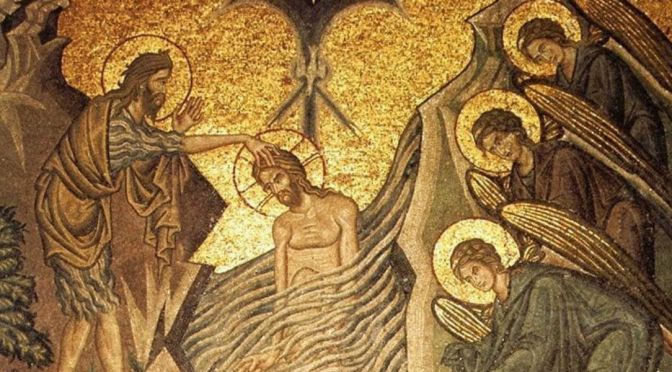
Today we pick up speed and fast forward 30 years, we float down the river Jordan where Jesus is baptized by John. Jesus’ baptism is an unusual story, an uncomfortable scene for Christians. Why does Jesus need to be baptized? For forgiveness of sins? Repentance? What does it say about John as he baptizes instead of being baptized? In many ways the story of Jesus’ baptism invites more questions as we hear it again. 

In Advent, we heard John’s preaching on the river bank. His stiff condemnation of the crowds and his warnings of the Messiah. This time, Jesus shows up at the end of the sermon. The spirit of God descends upon him and along with John, the crowds witness an incredible thing. 

But John and the crowds do not see what is going on. They are full of expectation. They are wondering if John is the one they are waiting for. They looking for a fixes to their problems, for hope and salvation. They are hoping for a powerful Messiah. A warrior who will end injustice and who will remove foreign powers from control in Israel, but Jesus is not those things. It is the beginning of the problems that John, the disciples, the crowds, the Pharisees, scribes and temple authorities will have with Jesus. Some will want an ally, some will want a powerful warlord, some will want Jesus to go away. But Jesus simply refuses to fit their categories. Jesus is going to show us God in ways that don’t see… that we can’t see… that we refuse to see. 

Remember the feeling of standing in the water, feeling the cool fresh flow around our legs? Well the further we float, the more the current picks up. The gentleness is replaced by force and weight. The water doesn’t smoothly pass by. It pushes and grabs, it pulls and drags. The cool gentle stream that cooled our feet now pulls us in and drag us along. The power of the river is more than we could have ever imagined. 

Like the crowds who gathered along the banks of the Jordan, we gather to wait also. We are waiting for the world to get better. But it doesn’t. We are full of expectation, searching for hope and promise, looking for fixes to problems and an end to struggles. 

As we hoped for a more normal Christmas, the pandemic kept rolling on. Plans were dashed and changed in a hurry. And then many became sick, maybe even friends and family sent those texts or made those phone calls, ‘I tested positive.” And worry and anxiety ensued,  It has all felt like a great setback. 

Our world hasn’t changed all that much since John and Jesus met in the river. Sure, we drive cars, live in heated houses and can talk to anyone on the other side of the planet instantly. But, we are no different than those crowds standing on the rive bank, full of expectation, wanting our world to be different, wanting our problems to disappear. 

The weight of all of this threatens to drown us in the inability to care any more. We hear the reports, read the news articles and it is too much to take, too much to grieve for. Not only is it hard to see what is going on as Jesus is baptized by John, it is hard to see where God is at all. 

Today, it might feel like the cool refreshing water of the river has pulled us in and dragged us under. The current is churning and spins us about. We bounce in all directions, sputtering for air, aimed over the cliff, over the waterfall. 

This is not what the river journey begun in Advent is supposed to be like. 

This is not what God is supposed to allow to happen in the world.

We are not supposed to drown in the waters of grief and apathy.

(Pause)

And a voice pierces the chaos.

“You are my beloved. With you I am well pleased”. 

Words of promise, words of hope. 

As John dunks Jesus down into and then brings him up out of the water, as breath and air flood back into empty lungs, God speaks. God speaks in a way that hasn’t been heard since the beginning of creation. God speaks and the world is transformed. 

We tumble over the waterfall, we plunge into the deep pool at the bottom. We are squeezed and crushed under the weight, we can’t tell which direction is up. Death under the waters seems imminent. 

And then all of a sudden, while we are tossed about in the churn, not knowing which direction is up or down, we pop up and out of the water. Air rushes back into our lungs. This is where God’s action begins. In drowning, in death. This is as strange a place as we can imagine God to be working. And yet, God speaks as Jesus comes out of the water “You are my beloved children and with you I am well pleased”. What a weird and wonderful God who can push us below the surface in order to make us His own. In order to give us new names as child of God, as Christian, as beloved. 

This is why John doesn’t know what is going on when Jesus asks to be baptized. This is why we cannot see God working in the world. It is too radical, too unbelievable. 

And yet, this is promise that was made to us in the waters of Baptism, and it is the promise that is renewed each day and remembered each time we witness another child being drowned AND raised in these waters of life. It is a promise made that in the place we lease expect it, in death God is showing us something new, something life filled, something surprising. Something that can come only from a God like ours. 

A God who comes into the world as baby born to a unwed teenage mother, 

a God who lives a poor carpenter in 1st century Israel, 

a God who died on a Roman cross as a common criminal, 

a God who was raised from the dead and who in turn calls us to be drowned and then raised, 

New life can only come from a God who does not act like we believe God should.

The radical God of water and Baptism comes to us in ways that are so unimaginable and so crazy, that we can hardly make them out. The journey that God is promises is not easy or gentle. The results of God’s work in the world is rarely what we imagine or hope for. Yet, as this unexpected God meets us in our world, and on our terms, we cannot help but be drawn in to this unexpected God whose story has become our story. Whose story we tell over and over again. 

As we float down the river of Advent and Christmas, as we pass by Jesus and John in the river, we see again and anew the marvel of God’s love for us. We see a God who not only pushes us below the water to die, but who pulls us out again so that we may rise into new life. And today, we hear a God who speaks through chaos

“You are my beloved Children. With you I am well pleased.”

Amen. 

Not a safe or harmless baptism

GOSPEL: Matthew 3:13-17

13Then Jesus came from Galilee to John at the Jordan, to be baptized by him. 14John would have prevented him, saying, “I need to be baptized by you, and do you come to me?” 15But Jesus answered him, “Let it be so now; for it is proper for us in this way to fulfill all righteousness.” Then he consented. 16And when Jesus had been baptized, just as he came up from the water, suddenly the heavens were opened to him and he saw the Spirit of God descending like a dove and alighting on him. 17And a voice from heaven said, “This is my Son, the Beloved, with whom I am well pleased.”

It wasn’t that long ago that it felt like we were painstakingly waiting for Messiah. Counting down each week of Advent, lighting one more candle until we reached Christmas, the Feast of the Nativity of Our Lord. And then for 12 days we lingered at the manger. We heard the familiar stories from Luke [In those days a decree went out from Emperor Augustus…] and from John [In the beginning was the word].

Yet, hear we are today, and it is like 30 years has gone by in the blink of an eye. That little baby we were watching and waiting for is now a grown man. (There is probably a parenting metaphor there). A grown man travelling the countryside, coming to the River Jordan to be baptized in front of expectant crowds.

And with that vanishing 30 years, we flip another page on the seasons of the church year. The waiting and watching of Advent led us to Christmas. Christmas then made way for Epiphany and the season after. A portion of the church year that always begins with the Baptism of Jesus.

Yet, the story of Messiah makes a bigger shift than just the change of seasons. Our focus shifts from waiting for Messiah’s coming to now watching how Jesus of Nazareth is revealed as God’s chosen one, sent to save. Advent and Christmas tell us the story of incarnation, of God’s coming in flesh. Epiphany to Transfiguration tell us of Christ being revealed as the divine Son of God.

So after having just been gathering around the manger, only a few days ago, we find ourselves back on the banks of the Jordan river with John the Baptist (as we were in Advent). But John is not preaching today, rather putting on a show out in the wilderness. A show that riles up the religious establishment just the same.

It is here that Jesus enters the scene. He asks John to Baptize him, yet John doesn’t like that idea. He would rather be baptized himself by Jesus. But Jesus insists.

So John dunks Jesus into the waters of the river Jordan, and when Jesus comes up and out of the waters, the heavens open up and the spirit descends on Jesus. The voice of God thunders over the crowds, so that the whole world could hear. “This is my Son, the Beloved. With him I am well pleased.”

(Pause)

When I was in high school and university, I played the cello in the orchestra in musical production called Love According to John, an annual Easter tradition in Edmonton. Over its 30-year-history, the musical had grown big enough to take over the main concert hall in town with four sold-out performances every Holy Week.

The opening scene shows John the Baptist preaching on the banks of the River Jordan as Jesus joins a line-up of people waiting to be baptized. When it comes to Jesus’ turn, lightning and thunder erupt from the stage. The stage lights flash and thunder booms from the sound system. A prop dove on strings then lowers down into the scene. A voice echoes from heaven, “This is my son, the Beloved…”

Now, Love According to John is mostly based on the Gospel of John, but the writers also filled in the gaps with the other Gospels, and with a lot of creative liberty. For example, John’s Gospel doesn’t actually include Jesus’ baptism. Regardless… for some reason, the musical’s writers decided to embellish the moment and give some lines to extras. Lines that are not in the bible.

The crowd of extras reacts to the voice from heaven by saying, “It was thunder!” “No, it was a voice like thunder!”

Sitting down in the orchestra pit, it always struck me that quibbling about the voice from heaven missed the point – the guy who had just been identified as the Son of God, and on whom the spirit of God descended was standing right there!

And yet, like in the gospels, the moment comes and goes. No one seems to be truly affected by the thundering voice and everyone more or less keeps treating Jesus the same as before.

Despite my objection to the embellished lines… I think there might actually be an unintentional yet truthful commentary about human beings in that scene, even though it was certainly not what the writers planned.

There is something about hearing the voice of God and then arguing over what was actually heard, that is so human. You would think that in the cacophony of voices in our world that claim to be the truth, that God’s voice would cut right through them all. But the problem isn’t the multitude of voices…. it is us, the hearers. We cannot help but spin the message, to hear what we want to hear, to miss the point.

The hermit preacher out in the wilderness is a spectacle to behold, but mostly harmless. The Christmas carols and pageants that give us warm and nostalgic feelings are easily put back in the box for when we are ready to haul them out again. We like a good show, but we also like being in control of the story.

Yet, a voice from heaven… that’s not safe and harmless. The voice of God, telling us, showing us the Messiah right in front of our eyes… well, that is downright terrifying. It’s no wonder that 2000 years later, even people putting on a musical about this moment want to get hung up on what the sound from the heavens actually was. That is a way to hold onto control, to be the ones defining the message and writing the story.

Yet, this is not what the Baptism of Jesus is about.

John the Baptist knows it, the crowds know it and we know it.

Because when we slow down for a moment, we can feel in our bones that God has just changed the game. The cute cuddly Messiah of the manger is not the mostly harmless incarnate God we hoped for.

As God the Father opens the heavens, as the spirit of God descends upon Jesus, and as Christ the Son of God comes up and out of the water… God pulls back the curtain on creation, and reveals the One who has been there since the beginning of all things.

Just as the spirit hovered over the waters of creation while God set the world into motion by speaking the words, “Let there be light…,” The spirit that hovers over the waters of the Jordan, and the voice that speaks into that world sets into motion a new creation, a new creation born in the One who first comes up and out of the waters.

There is a new creation coming into being in Christ Jesus, and that is a scary and terrifying thing for us. Because it reminds us that we are not in control of this world like we thought we were, we are not authors of our story. The voice from heaven that announces this new creation isn’t a harmless prophet preaching out in the wilderness, nor a voice that can be hauled out once a year for a special holiday and then packed away again.

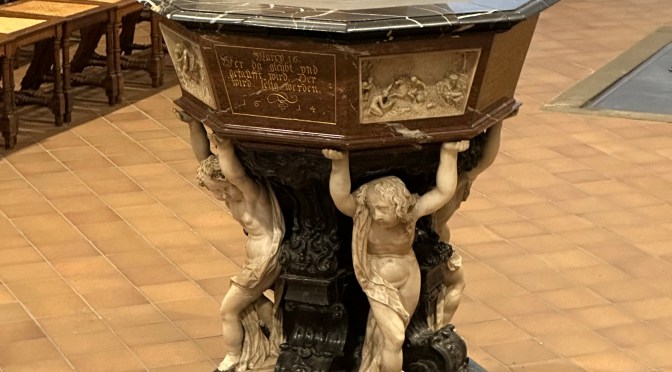
This voice that proclaims Jesus as the Father’s beloved son and ushers into our a world a new creation is the same voice heard in the waters of this font, and same voice that speaks in this bread and wine.

Just as the voice named Jesus the Son of God, the Messiah, the one who was sent to save all creation… this voice names and claims us too. Names and claims us in our baptism, and each day afterwards. The voice re-creates us anew in the waters, names us as daughters and sons – beloved children of God.

And that is scary. Terrifying.

We are not control of our new names. We are not the ones who choose how God feels about us. We do not get to choose what kind of new creations we will be. We are not the authors of our story.

And yet, this new creation revealed in the waters of Baptism, this Son of God in whose image we are created, this Messiah we have been waiting for… this is the One who writes for us a new story. Who changes our fate of sin and death, to God’s new story of mercy, grace and new life.

It might be in our nature to do everything we can do to ignore that voice from heaven, to argue about whether it might be thunder or a voice like thunder… missing what God is really up to. Yet God puts Messiah, the Son of God, right front of us. Right in front of us in the Holy Words, Holy Baths and Holy Meals that we share here, week after week.

And in those things, God re-writes our story. God makes us new creations. God proclaims that in this baptized One who first died and rose again, we too are named and claimed by God. And God’s voice thunders over us bringing us from death to life. God names us Children of God – Beloved and Pleasing to the One who makes all things new.