Tag Archives: Advent

Finding refuge, and God, in the wilderness – Pastor Thoughts

Wilderness. 

John the Baptizer comes to us in this second week of Advent, or rather the Advent story takes us out in the wilderness to see and hear John preach. It feels like we are leaving the familiar places of home to go out into the unknown in order to hear a message from John. 

It is pretty clear to see that our safe and familiar places have become less safe and comfortable over the course of the past few years. Our homes, our places of work, our community gathering places have been breached… breached by dangers and risks we never imagined, and change we did not anticipate. An air of unfamiliarity has overtaken them. 

This is something that I have noticed this Advent. The breezy comfort that we once exuded in our day-to-day lives just five years ago, has been replaced with a mild discomfort that seems to be everywhere. 

It is no wonder the crowds left their homes and communities to hear John preach, their world had few places for safety and comfort either. 

Usually, when we think of wilderness, we imagine dangerous, secluded, sprawling and untamed lands. Maybe the wilderness feels unsafe. 

Yet, the wilderness can be a place to get away. To go out from the chaos that looms over us at home, to leave behind the troubles that close in on our lives. 

In my five summers of working bible camps, two were spent at a Southern Alberta camp called Wilderness Ranch. Deep in the sprawl of the Porcupine Hills and at the base of the Livingstone Mountain Range, there was a certain clarity to be had. Away from phones, electricity and plumbing; away from the hustle of modern life, there was the opportunity to think without distraction. To sit on a horse following a well-worn trail and let the mind ponder and in that pondering to hear again the call of God. To sense the Spirit’s promptings anew.

In the Old Testament, God often sent the people out into the wilderness, to learn and grow, to be changed. To encounter the divine. God often meets us in the wilderness, where with all the baggage of life left behind we can listen and hear God again.

We are in a wilderness moment again as a church. Not a wilderness moment where we have been cast out into unsafe places. But rather a time where God invites us to leave our baggage behind, to leave our preoccupations and worries behind, to discover the unburdened freedom and space to listen for the divine once again. 

John the Baptizer is out in the wilderness this week, and so are we. John is God’s sign of hope in a suffering world and it just so happens that hope is what we are looking for. 

What do Advent and Christmas in November have to do with each other? – Pastor Thoughts

A couple of weeks ago, our family made the choice (mistake?) of going to the mall on a Saturday. It was the afternoon of Remembrance Day and I have never seen the mall so busy. There were people in all the stores and busy streams of folks moving along the corridors. Then in something I had never seen before, there were all kinds of people just loitering, standing against the balcony railings, sitting on every bench and chair. 

There was even a line-up for the Lego store. I asked the employee waving people in if there was a special sale and he said, “Nope, just fire regulations.”

Now why was the mall so busy on November 11th? I am sure you know the answer already. It was the first unofficial day of Christmas shopping. In addition to the throngs of people, the mall was covered in the usual Christmas decor and blaring Christmas music. People were hauling bags and bags of things that were destined to be wrapped and put under a tree. 

Now two weeks later as we plan to begin Advent (and we are a week early!), secular Christmas has been in full swing for almost a month. I used to be upset by all the Christmas stuff going up nearly two months before Christmas actually begins (the season of Christmas starts on December 25th and is 12 days long). I would also be annoyed by all the Christmas stuff coming down on December 26th, on only the 2nd Day of Christmas.

In the last few years, I have been coming to see more and more that this season of lights and winter whimsy centred on Santa Claus; and the Feast of the Nativity and the Christmas season that follows are really two different things. The lights and displays that go up this time of year are a way for us to adapt to the winter season and darkness which can be hard to cope with. It is a way to push back against a world that would otherwise feel like it is closing in on us. 

In fact, secular Christmas is a lot more like Advent than the actual Feast of the Nativity. Even though it is full of Nativity and Christmas images (songs, displays etc…) Secular Christmas is about preparing and getting ready, it encompasses our struggles and desire for a different world, and it often reveals the contradictions and conflicts that exist in our families, relationships and society as we contend with the contrast between extravagant gift buying with increasing poverty and need.

Now, unlike Advent, it does not do these things intentionally, but rather quite accidentally.

So as we begin Advent this week, getting ready for the coming of Messiah, searching for the light in our darkness, for hope in our suffering world, we know that we are walking alongside a world that is also searching for hope – but maybe going about it in a strange way. 

And that in our waiting for Messiah, God is revealing again the promise given to our world that our darkness and struggle will not define us. And that no matter how we try to fill that void with store-bought gifts, light displays, Hallmark movies and Santa photo shoots, Messiah is coming to meet us with gifts of the love, mercy and life of God.

Advent 4 Sermon – The Messiness of Advent

Luke 1:39-45(46-55)
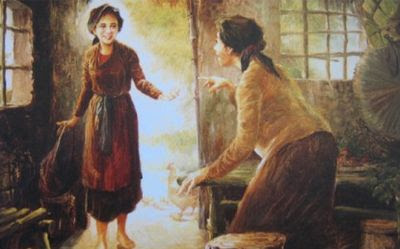
In those days Mary set out and went with haste to a Judean town in the hill country, where she entered the house of Zechariah and greeted Elizabeth. When Elizabeth heard Mary’s greeting, the child leaped in her womb. And Elizabeth was filled with the Holy Spirit and exclaimed with a loud cry, “Blessed are you among women, and blessed is the fruit of your womb. And why has this happened to me, that the mother of my Lord comes to me? For as soon as I heard the sound of your greeting, the child in my womb leaped for joy. And blessed is she who believed that there would be a fulfillment of what was spoken to her by the Lord.”

We have come to the end of Advent. Advent has been rough this year. We have endured talk of the end times and John the Baptist’s fiery preaching from the river banks.

Finally today, on this last Sunday of Advent things start to sound a little more Christmasy. Elizabeth, a woman thought to be too old to conceive and barren, is pregnant with John. Mary, a virgin still only engaged to be married, is pregnant with the Messiah. 

Today’s story sounds beautiful and picturesque. It is easy for us to imagine two delightfully pregnant women greeting one another lovingly; a scene that makes us smile.

But we forget to consider the struggles these two women are facing. Elizabeth is older than a pregnant woman should be. She and Zechariah will be raising a child in their old age, more like grandparents who have unexpectedly found themselves raising children again. While Mary is a young unmarried teen girl, and her fiancé is not the father of her child. Joseph could call off the marriage off at best… maybe forcing Mary to a life of begging on streets, with a child to care for. At worst, both she and her unborn child could be stoned for adultery. For both women in their day, child birth was dangerous and all too often women would not survive the birth experience without some luck. There is probably more relief than joy while the women greet one another, as Mary has gone with haste to see her cousin, to avoid the judgement of her hometown family and friends.

The story of Mary and Elizabeth is not one of those Christmas movies. Rather it is story full of fear and danger, one that stands in contrast to the Christmas image we generally try to present. Mary and Elizabeth challenge the notion that we usually hold about Christmas: shopping, baking, decorating and hosting. Mary and Elizabeth introduce things we don’t want to talk about this time of year. Fear, danger, shame and uncertainty. 

(Pause)

Marlena’s mind was wandering, thinking about Christmas things. Father Angelo’s voice snapped her back to attention, “These two reveal to us the ways in which the spirit is pregnant with possibilities among us.” Marlena was sitting in the pews at St. David’s, listening to the sermon on the last Sunday before Christmas. 

With her was her husband Jim and to two kids, Lizzie and David. The world had been slowly finding a new equilibrium. Even with masks in church, showing their vaccine passports, sitting one household to a pew… simply being at church with other people was such an improvement over the year before. 

As she began scanning the congregation scattered throughout the amphitheatre style seating, she caught the eyes of a good friend Miriam. Miriam and her family had become quite close to Marlena’s family this past year. Miriam was holding a bouncing one year old girl in her lap while keeping a precocious 4 year old busy in the pew below her. 

Marlena smiled, though she knew that smiling happened mostly with the eyes while wearing a mask. Miriam seemed to be smiling back, but she couldn’t help but look tired. Marlena was too. They all were. 

(Pause)

The real story of Mary discovering that she is pregnant unravels and upsets our vision of the Christmas story. We don’t want Christmas to be like real life, it supposed to something different, or least that is what we hope to create. The perfect and ideal vision of the perfect family preparing for a new baby. This was supposed to be the Christmas that we have been desperately hoping for after our zoom Christmas last year. Yet, once again our plans are disrupted and real life will not come close to matching our expectations, our hopes and dreams. We easily imagine calm and peaceful expectant mothers, Mary and Elizabeth, as if they this is the way the planned to have children all along. 

Just as we imagine our own family gatherings, Christmas parties, and holidays traditions that we used know. But that is our version of Christmas. NOT necessarily God’s. 

God is telling a different story at this time of year. God is telling a real story, about real people. About people who have big problems, and no easy way out. It is about poverty, about unmarried parents, about unwanted babies, about couples too old to raise a child, about judgment and the threat of death. It is about tiresome pandemics, exhausted poeple, a longing for our trials tribulations to be over. And it is about how God’s people respond to fear and danger. 

(Pause)

After church Marlena and Miriam met in the in parking lot. The kids were playing on the windrows that surrounded the cars. Jim and Miriams’ husband Jesse were chatting about work. Marlena looked to her friend. 

“Have you heard from your family yet?:” Marlena asked. 

“They aren’t going to make it.”

“What about Jesse’s family?

“They can’t either.” Said Miriam. 

The two friends looked at each other. 

“Well, then it is settled.” Marlena declared. “You all will come us to the lakehouse.”

“I feel like we are imposing on your family Christmas, we have done that enough already.” Responded Miriam. 

“Nonsense. You are family. Christmas without you would hardly be Christmas.”

(Pause)

Sometimes the real world can get in the way of Christmas. While we try to create perfect memories with seemingly perfect families, God is discarding the rules about pregnancy before marriage in order to send us a messiah. As we stress and worry and prepare for the perfect Christmas, God is sending divine messengers to an old woman and unwed teen mom living in poverty.

God does not wait for the everything to be perfect or to fall into place in order to begin the work of the incarnation. God does not come only when it is safe and there is nothing to fear. God’s activity of taking on our flesh and becoming like us starts now. God comes to us, whether we want God to or not. 

Mary’s and Elizabeth’s real life shoves aside our idyllic nativity scenes, visions of perfect Christmases. Mary and Elizabeth show us a real story about real people. A story about shame, and danger and betrayal. But also a story about mercy, and compassion and grace.

(pause)

Miriam looked at her friend Marlena. 

“Why do you keep taking care of us?” Miriam asked. “Aren’t you tired of us yet? Aren’t we more work than we are worth?”

Marlena laughed. “Ridiculous. We aren’t the ones stuck with you, you are the ones stuck with us. Ever since that roadside motel, when I got to hold newborn Christopher in my arms, when I see the way my kids and Jim come alive with you all. Your family is special to us. I see hope and joy and promise when we are together.”

Miriam sighed. “The spirit pregnant with possibilities, just like Father Angelo said, I guess.” 

The two friends smiled and laughed, and this time they could see each others’ faces. 

(pause)

For when Mary gets past the shame of pregnancy before marriage, when she get spast the fear of death for adultery, she with her husband to be Joseph, with her elderly cousins Elizabeth and Zechariah, they all become guardians of God’s promise, bearers of the Good News made flesh. 

And it is the same for us, when our fears and worries get out in the way, when we can’t see what God is up to. God comes anyways.  And God bears grace and mercy for the world in us. God makes us the messengers of the Good News of God’s love and compassion for all. God sends Messiah to frightened world.  

And because of what God is doing, with Mary, we can sing:

“My soul magnifies the Lord,

and my spirit rejoices in God my Savior,

for he has looked with favor on the lowliness of his servant.”

Sermon for Advent 3 – Messiah’s Winnowing Spoon

Luke 3:7-18
As the people were filled with expectation, and all were questioning in their hearts concerning John, whether he might be the Messiah, John answered all of them by saying, “I baptize you with water; but one who is more powerful than I is coming; I am not worthy to untie the thong of his sandals. He will baptize you with the Holy Spirit and fire. His winnowing fork is in his hand, to clear his threshing floor and to gather the wheat into his granary; but the chaff he will burn with unquenchable fire.”

So, with many other exhortations, he proclaimed the good news to the people.

Stir up the wills of your faithful people, Lord God.

Advent is normally my favourite season of the church year. I don’t think that is uncommon for pastors. 

Christmas is of course the Super Bowl (or Grey Cup) of the church year. Christmas is like the most popular chain restaurant in town, everyone goes there and it is a big party. But Advent is more like that hole-in-the-wall family run restaurant with the most delicious food you can find, that most people seem to pass by without much notice.

The rich flavour of Advent is found in the images that we hear – the way of Lord, valleys filled up, mountains made low, crooked paths made straight that we heard about last week. This week it is the spicy brood of vipers, the fiery winnowing fork burning the chaff. Next week it will be angels and virgins, and promises and hints of Messiah. Advent’s beauty is in the blending of hints and promises of Messiah together with real life. With the messiness of people looking for something better. 

Real people like the crowds in the desert going to John the Baptist, looking and hoping for something different than what they know. Real people like the hypocritical religious and political leaders that we know as well as 1st century Israel did. Real people like a girl dealing with an unplanned pregnancy and the reality of impossible life choices. 

Advent speaks to the real circumstances that people – everyday, average people – deal with all the time.

And Advent weaves the coming of Messiah through it all. Christmas tells us of the extraordinary. Advent brings God close to the ordinary.

Normally, we prefer to focus on the light of the coming Messiah shines brightly through the cracks of our Advent images. We love to see Messiah bursting into our world.

Given all that we have experienced in these long couple of years, this Advent feel more Advent-y than usual. All the messy and broken stories of God’s people that we hear in Advent follow along side our story these days more than feels comfortable.

Stories and images of burning chaff speak less to farm hands separating wheat on the threshing room floor and more to the struggles of our communities trying to get a handle on public health measures, about believing science over misinformation, about putting the well being of all ahead of our own personal perceptions of inconvenience. 

Stories about King Herod’s willingness to kill infant boys to protect his own power and the violent world of occupied Israel of Jesus’ day reminds us all too much violence that has become a constant refrain in our world. Murder trials, hate crimes, and school shootings encouraged by delinquent parents.  

Stories about the innkeepers who turned away the holy family remind us too much of people fleeing floods and atmospheric rivers, essential supplies stuck in shipping containers in ports and warehouses, warnings that something must be done now to protect our planet’s future. 

Stories like the possible stoning that Mary could have endured had Joseph chosen to dismiss her sound too much like violence against women simply because they are women reminds us of the anniversary of Ecole Polytechnic and the violence against women still taking place today. 

Advent stories are coming at us in the news and daily life as often as they are coming from the bible.

Advent is our reality. Waiting for Messiah is what we are doing this year.

As John the Baptist declares, “You brood of vipers! Who warned you to flee from the wrath to come?” We are living out Advent in real time.

We are the ones standing on the riverbanks hoping that this wild hermit preacher named John can give us some hope. And all he seems to be talking about is wrath. Axes waiting to cut down trees. Warnings to start living better lives. Threats of burning with the chaff unless we get it together. 

At least that is what John seems to be talking about.

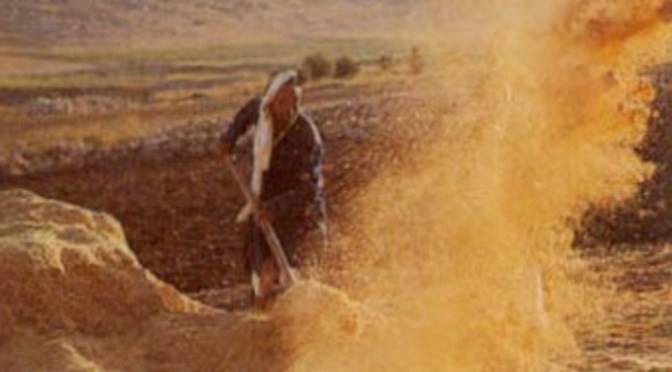
John describes the Messiah standing on a threshing room floor, the place where grain is brought in once it is harvested from the land. And the Messiah has his mighty winnowing fork in hand. A winnowing fork is used to separate a wheat stock from the grain itself. As the fork lifts the grain from the pile, the heavy grain falls to the floor, and the lighter useless chaff is blown into the fire to be burned away.

John’s message today sounds harsh but fitting for our world.

As Advent-y as things seem this year, as full of strife and struggle our world seems to be… maybe throwing us all into the chaff isn’t what John is getting at.

Because a pitchfork is not what Messiah is holding, for a fork would be a useless tool to clear a threshing room floor. And nor is the word fork used in the original greek of this text. No, the tool that the messiah is holding is more of a winnowing spoon… or more precisely a shovel. The winnowing shovel is not a tool of separating but a tool for gathering. 

Maybe just maybe, Messiah is gathering us up. Gathering us all up. Gathering up our broken and suffering and dying world so that we can finally begin to see the light. 

Maybe that is how God is reminding us that the Good News isn’t just reserved for Christmas.

As bad as the world seems to be, Messiah is already a work around us. Messiah has his winnowing shovel and is gathering. Messiah’s is bringing light to our Advent world.

Messiah is gathering us up as children and seniors roll up their sleeves to be vaccinated, adding more layers of protection to this pandemic weary world. As healthcare workers, education staff, businesses and community leaders, neighbours and families keep the inconvenient but essential public health measures day after day, week after week. 

Messiah is pulling us together in the many hands working tirelessly to rebuild and repair water logged homes, washed out roads and bridges, caring for now homeless flooding victims.  

Messiah is scooping us up off the floor as we recommit again to the work of social justice and caring for community, welcoming the stranger, providing for those in need. Just as our SLAW youth did in dropping a tremendous haul of Christmas supplies to the Urban this week. 

And Messiah is building us up as National church committed to the work of ending domestic violence against women with the Thursday in Black campaign. 

And Messiah is scooping us up off the threshing room floor here at Sherwood Park as we find new ways to gather for worship, to meet as small groups, to safely make music together, to reconnect with families and households, to find new ways of being the same body of christ that we have long been. 

Messiah is gathering us up, all the mess and all the struggle of our real life Advent so that we can see that God is really coming to us in incarnation, God in flesh among us.

So sure, John the Baptist may sound a little harsh today. Advent might feel extra Advent-y this year. But the promised Messiah is gathering us up today, scooping us off the threshing room floor with his winnowing spoon, making us ready for the in-breaking of light and hope among us. 

Stir up your power Lord Christ and come.

Thoughts for Advent 3 – Perspective Shift

When my grandfather’s family immigrated from Norway, my understanding is that they landed first in Minnesota, where a lot of Scandinavian immigrants settled. But before long, many of these immigrants were longing for home, particularly for the Fjords of Norway. So a group of them decided to pick up and move to a place that reminded them of home the most. From Minnesota they moved to the coast of BC, to a place called Bella Coola. A tiny community nestled in the Fjords of BC. A community on the water but also among the mountains. A place where  sometime in late fall the sun would fall behind the mountains, not to be seen again until the end of winter. 

I always thought this was a strange decision and I wondered why my ancestors made it. 

Then I moved to the Red River Valley myself. Most Manitobans probably don’t think about this much, but there are virtually no hills here, no variation to the topography. If you know where to look you can find a hill, but they are not common. And no, driving over the Disraeli bridge does not count as a hill. 

The uncommon hills here are nothing compared to the hills and valleys found around Edmonton where I grew up, or the rolling prairie to the east, or mountains to the west. 

There are times when I long for a hill or two. And certainly there is strong sense of belonging whenever I am in the mountains – I think it is my Nordic blood. 

A few years ago, on one of our trips to see family out west, we were coming into the mountains just outside of Calgary when our daughter Maeve started complaining that she couldn’t see. We thought she meant she couldn’t see because of a pillow or blanket blocking her window, but we quickly sorted out that it was in fact the mountains themselves that were blocking her view of the sky (I think we are raising a real Manitoban…). 

Maeve is not the first prairie person to get panicky driving a mountain highway. I also know a few folks from BC who find the open skies of the prairies unnerving. 

As we navigate our way through the mountains, valleys, and flat places of Advent, I think there is something to the way God is working in and through our different perspectives. 

Flattened mountains and filled in valleys and straight paths don’t particularly excite me, but they might be a relief for some. 

The short days and long nights of winter might be something to be endured for some, but a sun that falls behind the mountains might feel like home for others. 

Advent is all about shifting our perspective. The stories we tell demand that we re-think the way we see the world. 

The End becomes the Beginning. 

John the Baptist’s bombastic preaching to wilderness crowds points us to a baby born in quiet and out-of-the-way manger. 

A young teenager, getting pregnant out of wedlock becomes the one in whom God is birthed into the world. 

The Messiah joins in with the life of creation in order to overcome death on the cross, and show us to new life. 

And finally, when we are tired, achy, slowing down, feeling as though we might be dying… when our lives, when the church, when the world feels as though things are falling apart… it might actually be something else. 

We just might be pregnant with new possibilities, soon to be entering into our world, changing our perspective on just what God is doing with us.