Sermon for Advent 3 – Messiah’s Winnowing Spoon

Luke 3:7-18
As the people were filled with expectation, and all were questioning in their hearts concerning John, whether he might be the Messiah, John answered all of them by saying, “I baptize you with water; but one who is more powerful than I is coming; I am not worthy to untie the thong of his sandals. He will baptize you with the Holy Spirit and fire. His winnowing fork is in his hand, to clear his threshing floor and to gather the wheat into his granary; but the chaff he will burn with unquenchable fire.”

So, with many other exhortations, he proclaimed the good news to the people.

Stir up the wills of your faithful people, Lord God.

Advent is normally my favourite season of the church year. I don’t think that is uncommon for pastors. 

Christmas is of course the Super Bowl (or Grey Cup) of the church year. Christmas is like the most popular chain restaurant in town, everyone goes there and it is a big party. But Advent is more like that hole-in-the-wall family run restaurant with the most delicious food you can find, that most people seem to pass by without much notice.

The rich flavour of Advent is found in the images that we hear – the way of Lord, valleys filled up, mountains made low, crooked paths made straight that we heard about last week. This week it is the spicy brood of vipers, the fiery winnowing fork burning the chaff. Next week it will be angels and virgins, and promises and hints of Messiah. Advent’s beauty is in the blending of hints and promises of Messiah together with real life. With the messiness of people looking for something better. 

Real people like the crowds in the desert going to John the Baptist, looking and hoping for something different than what they know. Real people like the hypocritical religious and political leaders that we know as well as 1st century Israel did. Real people like a girl dealing with an unplanned pregnancy and the reality of impossible life choices. 

Advent speaks to the real circumstances that people – everyday, average people – deal with all the time.

And Advent weaves the coming of Messiah through it all. Christmas tells us of the extraordinary. Advent brings God close to the ordinary.

Normally, we prefer to focus on the light of the coming Messiah shines brightly through the cracks of our Advent images. We love to see Messiah bursting into our world.

Given all that we have experienced in these long couple of years, this Advent feel more Advent-y than usual. All the messy and broken stories of God’s people that we hear in Advent follow along side our story these days more than feels comfortable.

Stories and images of burning chaff speak less to farm hands separating wheat on the threshing room floor and more to the struggles of our communities trying to get a handle on public health measures, about believing science over misinformation, about putting the well being of all ahead of our own personal perceptions of inconvenience. 

Stories about King Herod’s willingness to kill infant boys to protect his own power and the violent world of occupied Israel of Jesus’ day reminds us all too much violence that has become a constant refrain in our world. Murder trials, hate crimes, and school shootings encouraged by delinquent parents.  

Stories about the innkeepers who turned away the holy family remind us too much of people fleeing floods and atmospheric rivers, essential supplies stuck in shipping containers in ports and warehouses, warnings that something must be done now to protect our planet’s future. 

Stories like the possible stoning that Mary could have endured had Joseph chosen to dismiss her sound too much like violence against women simply because they are women reminds us of the anniversary of Ecole Polytechnic and the violence against women still taking place today. 

Advent stories are coming at us in the news and daily life as often as they are coming from the bible.

Advent is our reality. Waiting for Messiah is what we are doing this year.

As John the Baptist declares, “You brood of vipers! Who warned you to flee from the wrath to come?” We are living out Advent in real time.

We are the ones standing on the riverbanks hoping that this wild hermit preacher named John can give us some hope. And all he seems to be talking about is wrath. Axes waiting to cut down trees. Warnings to start living better lives. Threats of burning with the chaff unless we get it together. 

At least that is what John seems to be talking about.

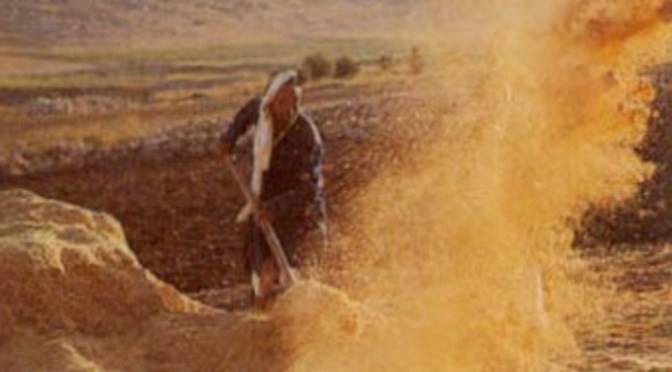
John describes the Messiah standing on a threshing room floor, the place where grain is brought in once it is harvested from the land. And the Messiah has his mighty winnowing fork in hand. A winnowing fork is used to separate a wheat stock from the grain itself. As the fork lifts the grain from the pile, the heavy grain falls to the floor, and the lighter useless chaff is blown into the fire to be burned away.

John’s message today sounds harsh but fitting for our world.

As Advent-y as things seem this year, as full of strife and struggle our world seems to be… maybe throwing us all into the chaff isn’t what John is getting at.

Because a pitchfork is not what Messiah is holding, for a fork would be a useless tool to clear a threshing room floor. And nor is the word fork used in the original greek of this text. No, the tool that the messiah is holding is more of a winnowing spoon… or more precisely a shovel. The winnowing shovel is not a tool of separating but a tool for gathering. 

Maybe just maybe, Messiah is gathering us up. Gathering us all up. Gathering up our broken and suffering and dying world so that we can finally begin to see the light. 

Maybe that is how God is reminding us that the Good News isn’t just reserved for Christmas.

As bad as the world seems to be, Messiah is already a work around us. Messiah has his winnowing shovel and is gathering. Messiah’s is bringing light to our Advent world.

Messiah is gathering us up as children and seniors roll up their sleeves to be vaccinated, adding more layers of protection to this pandemic weary world. As healthcare workers, education staff, businesses and community leaders, neighbours and families keep the inconvenient but essential public health measures day after day, week after week. 

Messiah is pulling us together in the many hands working tirelessly to rebuild and repair water logged homes, washed out roads and bridges, caring for now homeless flooding victims.  

Messiah is scooping us up off the floor as we recommit again to the work of social justice and caring for community, welcoming the stranger, providing for those in need. Just as our SLAW youth did in dropping a tremendous haul of Christmas supplies to the Urban this week. 

And Messiah is building us up as National church committed to the work of ending domestic violence against women with the Thursday in Black campaign. 

And Messiah is scooping us up off the threshing room floor here at Sherwood Park as we find new ways to gather for worship, to meet as small groups, to safely make music together, to reconnect with families and households, to find new ways of being the same body of christ that we have long been. 

Messiah is gathering us up, all the mess and all the struggle of our real life Advent so that we can see that God is really coming to us in incarnation, God in flesh among us.

So sure, John the Baptist may sound a little harsh today. Advent might feel extra Advent-y this year. But the promised Messiah is gathering us up today, scooping us off the threshing room floor with his winnowing spoon, making us ready for the in-breaking of light and hope among us. 

Stir up your power Lord Christ and come.

Thoughts for Advent 3 – Perspective Shift

When my grandfather’s family immigrated from Norway, my understanding is that they landed first in Minnesota, where a lot of Scandinavian immigrants settled. But before long, many of these immigrants were longing for home, particularly for the Fjords of Norway. So a group of them decided to pick up and move to a place that reminded them of home the most. From Minnesota they moved to the coast of BC, to a place called Bella Coola. A tiny community nestled in the Fjords of BC. A community on the water but also among the mountains. A place where  sometime in late fall the sun would fall behind the mountains, not to be seen again until the end of winter. 

I always thought this was a strange decision and I wondered why my ancestors made it. 

Then I moved to the Red River Valley myself. Most Manitobans probably don’t think about this much, but there are virtually no hills here, no variation to the topography. If you know where to look you can find a hill, but they are not common. And no, driving over the Disraeli bridge does not count as a hill. 

The uncommon hills here are nothing compared to the hills and valleys found around Edmonton where I grew up, or the rolling prairie to the east, or mountains to the west. 

There are times when I long for a hill or two. And certainly there is strong sense of belonging whenever I am in the mountains – I think it is my Nordic blood. 

A few years ago, on one of our trips to see family out west, we were coming into the mountains just outside of Calgary when our daughter Maeve started complaining that she couldn’t see. We thought she meant she couldn’t see because of a pillow or blanket blocking her window, but we quickly sorted out that it was in fact the mountains themselves that were blocking her view of the sky (I think we are raising a real Manitoban…). 

Maeve is not the first prairie person to get panicky driving a mountain highway. I also know a few folks from BC who find the open skies of the prairies unnerving. 

As we navigate our way through the mountains, valleys, and flat places of Advent, I think there is something to the way God is working in and through our different perspectives. 

Flattened mountains and filled in valleys and straight paths don’t particularly excite me, but they might be a relief for some. 

The short days and long nights of winter might be something to be endured for some, but a sun that falls behind the mountains might feel like home for others. 

Advent is all about shifting our perspective. The stories we tell demand that we re-think the way we see the world. 

The End becomes the Beginning. 

John the Baptist’s bombastic preaching to wilderness crowds points us to a baby born in quiet and out-of-the-way manger. 

A young teenager, getting pregnant out of wedlock becomes the one in whom God is birthed into the world. 

The Messiah joins in with the life of creation in order to overcome death on the cross, and show us to new life. 

And finally, when we are tired, achy, slowing down, feeling as though we might be dying… when our lives, when the church, when the world feels as though things are falling apart… it might actually be something else. 

We just might be pregnant with new possibilities, soon to be entering into our world, changing our perspective on just what God is doing with us. 

Preparing for Messiah is not fun…

GOSPEL: Luke 3:1-6
….the word of God came to John son of Zechariah in the wilderness. 3He went into all the region around the Jordan, proclaiming a baptism of repentance for the forgiveness of sins, 4as it is written in the book of the words of the prophet Isaiah, 
“The voice of one crying out in the wilderness:
‘Prepare the way of the Lord,
make his paths straight.

Some of the moments that stick out the most from my childhood were the boredom and impatience of getting ready for a special day or event. Whether it was putting on fancy and uncomfortable church clothes, packing for family vacation, cleaning the house when company was on the way over… these were all moments when the world became painfully slow and uninteresting, with lots of wondering why we we had to do this thing in the first place. 

Now as an adult and parent myself… I see the stress and pain from the other side. Frantic clean-ups as those anticipated guests arrived a little too early. Getting kids dressed, packed and out the door taking all the willpower in my body. And packing for holidays begins with mental checklists long before a suitcase is pulled out from the back of the closet. 

Getting ready. Waiting to be ready. Living in that liminal time, that in-between time of anticipation is hard, no matter how we experience it. 

Today is the second week of Advent, the Sunday that always introduces us to John the Baptist and his message preached in the wilderness. His message of preparation and getting ready for what is coming next. 

It is probably not too difficult to recall our own moments of board waiting or frantic making ready for that anticipated and special moment. 

But for the people of Israel, the people listening to John’s message, their anticipating was more than boredom or frantic last minute chores. 

John’s audience was a desperate one. They were a people waiting for something different, people looking for hope. They were living under oppression by a powerful foreign empire in the Romans. They were people taxed to the gills by every level of government, often by corrupt tax collectors also skimming off the top for themselves. They were constricted by a religious system that demanded a kind of expensive and burdensome faithfulness that few could afford, and therefore salvation and mercy were just out of reach. 

And there was no escaping any of it. No United Nations refugee programs or social media resistance movements. There were no relatives waiting to welcome them in prosperous nations on the other side of oceans, no kind church groups wanting to sponsor new lives elsewhere.  There was virtually no hope for a better life found anywhere, not even in risky options like fleeing their homeland for a the chance of a better life in a new land. 

The people coming to hear John were desperate for some kind of hope, something at all. And so they flocked out into the wilderness to hear the wild prophet, to hear about this coming Messiah that John was preaching about, to have something to hold onto in the midst of their struggle and hardship filled world. 

John’s words weren’t exactly good news in and of themselves. There wasn’t mention of God’s love, there wasn’t a kingdom coming near, there wasn’t the welcome of the Heavenly Father. But John was talking about something important. 

Our world is desperate to hold on too these days. In the Advents of the before time, letting in those thoughts that reminded us that there is still suffering in the world somewhere, was an interruption to our Holiday Season making ready. But these past two years we have been experiencing a desperation much more similar to the people of 1st century Israel. 

Even this week, as the world seemed to be inching towards equilibrium and finding its way to something new, this seemingly never ending crisis hit us again with Omicron. Travel bans and increased restrictions immediately followed. Booster shots for privileged nations that can afford them and fewer vaccines for peoples that cannot. And of course volatile stock market reactions ensued. Not to mention the devastating floods that have book ended our country, forcing people to flee their homes and livelihoods, stranding several and even causing the loss of life. Restoring roads, rebuilding bridges and homes, re-creating supply chains are reminders that this world has changed under our feet. 

We arrive at this second Sunday of Advent desperate for good news, wanting something to hold onto, seeking out hope. 

With John it is easy to get focused on the preparing, the slow waiting for the new thing to arrive or the frantic activity of making ready for a world struck by change. The realization that there is no escape, no leaving these crises behind, no waiting for the news cycle to move on or burying our heads in the sand to pretend it isn’t happening. 

The people of first century Israel were constantly reminded of the things that made their lives a struggle: the Roman coins in their pockets, the tax collectors on every street corner, and the religious laws that governed nearly every aspect of life.  

And we are constantly reminded of the things that are making our lives a struggle: the masks in our pockets, and the news alerts on our phones, and the careful consideration needed to navigate every sojourn outside of our homes,. 

John declares that the paths will be made straight, the valleys filled in, the mountains levelled, rough ways made smooth which sound like fixes to problems… yet these things are not quite the good news because John implores us to do the work. Prepare the way of the Lord, he says.

John isn’t describing the good news, but rather pointing to it. 

Or pointing to the one who will bring the good news. 

Like a frantic parent stressed about cleaning the house for company and getting angry at toys still left on the floor… John is focused on the moment of preparation. Something that we can be guilty of too… holding on to the preparations that are before hope and salvation. 

But still John points, John makes ready, John precedes the one that we truly need. 

It isn’t John’s words that are central, but who John is and what John is doing. The people of Israel don’t hear the hope of Messiah, but see it when they come out to John. They are reminded of the song that John’s father, Zechariah, a priest of the temple, sang after John’s birth. They see another miracle child promised by God, they see one called by the most high to herald the Messiah, the see a prophet who presence in and of itself is a sign of Messiah’s imminent arrival… like a servant announcing the arrival of royal, seeing John means that Messiah is right around the corner. 

John’s presence means Messiah is close. 

Our desperation wants to know what the fixes to our problems will look like, but John points to the one who will do the fixing. 

And the promised Messiah… well, it is not John but Zechariah who tells us what Messiah is going to. As Zechariah looked at his newborn son John, he sang the song we sung this morning, he sang of God’s promised Messiah: 

Messiah will save God’s people. 

Messiah will save us from our enemies. 

Messiah will show mercy. 

Messiah will free us and make us God’s children. 

And it is this Messiah that John will be a herald of. 

John the Baptist’s message for us is not about how our problems will be fixed, John isn’t the one who knows God’s plans for God’s people. But John points us to the one who does. John helps us to make ourselves ready, but it is Messiah who brings good news to our desperate world. 

And John’s strange and curious desert preaching announces for us the imminence of Messiah here too. As we seek something or someone to give us hope, Messiah comes to us again. 

Again in the gathering of God’s people, 

in siblings in faith sitting next to one another in the pew, 

commenting next to one another in the comment section. 

Messiah comes in the waters of new life that we are washed with, 

in the confessions of hearts, 

in the words of forgiveness and mercy that we hear, 

in absolution and blessing that we receive.

Messiah comes in the bread and the wine, 

in the body and blood of Christ that we share. 

The body of Christ we receive transforms us into the Body of Christ to which we belong. 

Messiah comes in the Word of promise, 

the Advent word that tells the story of God’s coming into our world, 

in the prophetic word spoken by a wildness preacher long ago. 

For people desperately waiting for the good news to arrive, today, we receive a sign that Messiah is around the corner. John the Baptist telling to us to “Prepare!” means that Messiah is nearly here. 

And on this 2nd Sunday of Advent,  as we seek salvation in our struggling and suffering world, seeing and hearing John the Baptist again is the sign we need,

to know that our salvation is on the way. 

The Days are Surely Coming, say the Lord – a Sermon for Advent 1

Luke 21:25-36
Jesus said, “There will be signs in the sun, the moon, and the stars, and on the earth distress among nations confused by the roaring of the sea and the waves. People will faint from fear and foreboding of what is coming upon the world, for the powers of the heavens will be shaken. Then they will see ‘the Son of Man coming in a cloud’ with power and great glory. Now when these things begin to take place, stand up and raise your heads, because your redemption is drawing near.”

The days are surely coming, says the Lord. 

The first words of the season of Advent begin with Jeremiah, speaking words from the mouth of God to the people of Israel facing destruction by Babylon. An oracle that begins us immediately with the promise of God to a people who feels as though they are surrounded by oppression, suffering and darkness. 

We have flipped the calendar today, and are about to begin a new season of the church year. Advent might be the only time the church is ahead of the rest of the world… and even then, we don’t really do this time of year the way most do. We begin by talking about the end, we begin by pausing and stopping and waiting for what comes next. In Advent, as in the Church, beginnings and endings often go hand-in-hand. 

Advent is a peculiar season. The church decorates with blue or purples, we generally hold off on singing Christmas Carols (although it is sometimes hard to resist), we patiently and almost quietly count down the days until Advent ends on Dec 24th… all while wondering about what all these stories of John the Baptist and a pregnant virgin actually mean for us. 

But on the first Sunday of Advent, we don’t quite get into those stories just yet. We begin instead with the end. On this first Sunday of the church year we begin with visions and promises of the end, the great reconciling of all creation that God promises to God’s people. 

For the people of Jeremiahs’ day, their world was surrounded by war and destruction, the Babylonians were threatening to conquer much of the Middle East. And Jeremiah prophesied the coming destruction, the people of Israel awaiting what was to come next for them as warring nations around them sought control of the region. 

And for the people of Thessaloniki, St. Paul writes to them hoping they are well in the midst of trials and tribulations because the Romans around this small fledgling Christian community are blaming them for upsetting the social order. 

Two communities who are wondering what comes next for them, what will happen to them in the midst of tension, chaos and uncertainty in the world.

And then we hear from Jesus as he preaches to his disciples about the end. Visions and signs of the coming Son of Man. Words from Jesus spoken to his disciples in the middle of Jerusalem during a time of great tension and uncertainty – during the days between Palm Sunday and Good Friday. 

The tension and the uncertainty sounds oh so familiar to us doesn’t it?

Whether it is this ongoing and lingering pandemic, and it is restrictions and surprises, its struggles and effects of isolating us from each other. Or fears about the economy and inflation, the cost of groceries, gas and rent or housing. 

Whether it is the regular reminders that our society has yet to reconcile with our colonial and racist history, that we still struggle to care for the least among us, the poor, those struggling with addition and homelessness, those living on the margins. 

Whether it is this present reality that church is dealing with decline, with a future that we are not sure of, and now has to figure out where we stand in the midst of and following a global pandemic that sent us all home for longer than we every imagined we wouldn’t be gathering in-person together. 

We know what it means to live under a cloud of uncertainty and to wonder what comes next for us… even if we would rather not think about it. Even as we foolishly and misguidedly try to get back to normal with Black Friday shopping lists, baking and decorating and all the other things that come with the holiday season… here we are as the church, starting a new church year and forcing ourselves to pause and sit with this hard question of what comes next for us. 

And here is the thing about Advent, here is the thing about Jesus and all his talk of signs and visions of the end… there is no answer for what comes for us. That is not the answer we get to today, nor really any day in Advent. 

Instead, Advent arrives with an answer to a different question. And it answers it with the very first words of the season. 

The days are surely coming, says the Lord. 

Advent’s answer for us is not to tell us what comes next, but who. 

Messiah. 

Messiah is coming. 

The righteous branch of Jesse to save all of Judah. 

The one sent by our God and Father, the Lord Jesus

The Son of Man coming in a could. 

The Messiah. 

And no, the promise of the Messiah’s coming did not stop the Babylonians coming to destroy the Jerusalem and exiling its most important citizens. 

And no, the promise of Messiah’s coming did not stop the persecution of Christians in the Roman Empire. 

And no, the promise of Messiah did not prevent the ugly ending of Holy Week with a public execution on a cross…

But God’s promise of the Messiah was that none of these thing would not be end. Not the end of people of Israel and nor the people of Thessaloniki. 

And the cross… well the cross was no ending at all, but rather the beginning. The beginning of God’s new reality for creation, the beginning of God’s new promise of Resurrection and New Life come to fruition for us all. 

And then after the cross, that Son of Man coming in the clouds also walked out of the tomb. But that story is not for Advent to tell. 

Instead, Advent points us again to the promise of Messiah coming also for us. This Messiah whose coming means that all the things of our world which bring tension and uncertainty, conflict and suffering, sin and death… they will not be the end of us. Rather the Messiah’s coming means that we are not alone, not forgotten, not abandoned to the present nor to the future. Messiah’s promised coming means that our world is already transformed now, because a world with the Messiah on the way is a world designed for salvation, rather than a world destined for destruction. And that changes everything. 

And as the Messiah is coming, the Messiah also walks along side us. No matter the outcomes of all those things that cause us tension and uncertainty, no matter the outcomes of things that feel too big to control and too much to bare. No matter the uncertainty of pandemic and inflation, no matter the struggles of families, neighbours and community… Advent points us to the Messiah who shows us that God’s new world is right around the corner, coming into view, breaking through into our world right before our eyes. 

Breaking through to us in the things that have always been before us, that have always been the signs of God’s love and mercy for us here in this place. 

And so even as the world continues to be a place full of tension and uncertainty, Messiah is coming to us bringing God’s new world. 

Coming to us in word, water, bread and wine. 

Coming to us in the gathering of this community, a sign of the Body of Christ. 

Coming to us with the promises of God, made and fulfilled. 

Messiah is coming and Messiah is here. This is the story of Advent, the story that begins today, even the in the midst of all of uncertainty and endings about what comes next. 

The days are surely coming, says the Lord. 

Ep 201 – We‘re Back! Season 2 Starts Now!

https://www.podbean.com/media/share/pb-iadqi-113f3e4

We’re Back for Season 2!

It’s been a while since you last heard from us! Things have changed a lot since the end of season 1 and ministry has taken new shapes as this pandemic continues to evolve. Join us as we catch up on pandemic ministry in our first episode of Season 2!

Check out The Millennial Pastor blog.

This podcast is sponsored by the Manitoba Northwestern Ontario Synodof the Evangelical Lutheran Church in Canada (ELCIC).

Music by Audionautix.com

Theme Song – “Jesus Loves Me” by Lutheran Outdoor Ministries in Alberta and the North (LOMAN)

An iPhone Pastor for a Typewriter Church