Category Archives: Theology & Culture

UPDATED: Photo Caption Contest – Meet Jesus Here

So, now for something completely different on The Millennial Pastor.

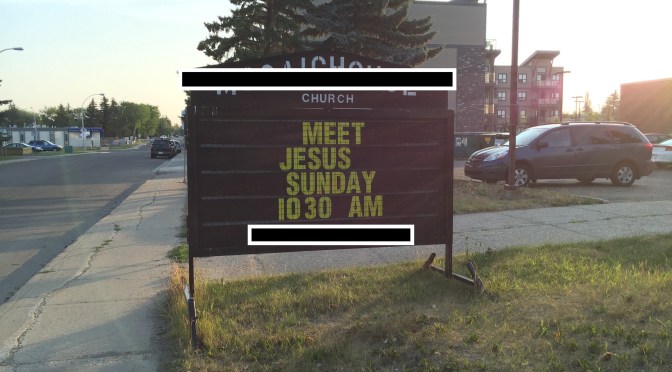
As I was out for a walk with my family this morning, we walked past this sign: IMG_3590

While on the one hand I agree with the concept of meeting Jesus in worship, putting this on the kind of sign usually used to advertise a sale at the corner store, I had to stop and snap a photo.

Then my wife, Courtenay, started immediately thinking of captions. While aren’t trying to be mean or make fun, I think this could be a wealth of humour.

And so I am now putting this photo out to you, the readers of this blog. Download the photo, add a caption and email it back to me at: Millennialpastor@gmail.com and I will add the best ones to this post!

Or add a caption idea in the comments, I will add some of the best ones to the photo myself and post them here.

Let’s have some fun with this!

Here are a couple that Courtenay and I came up with:

Jesus Attends Jesus Book Signing

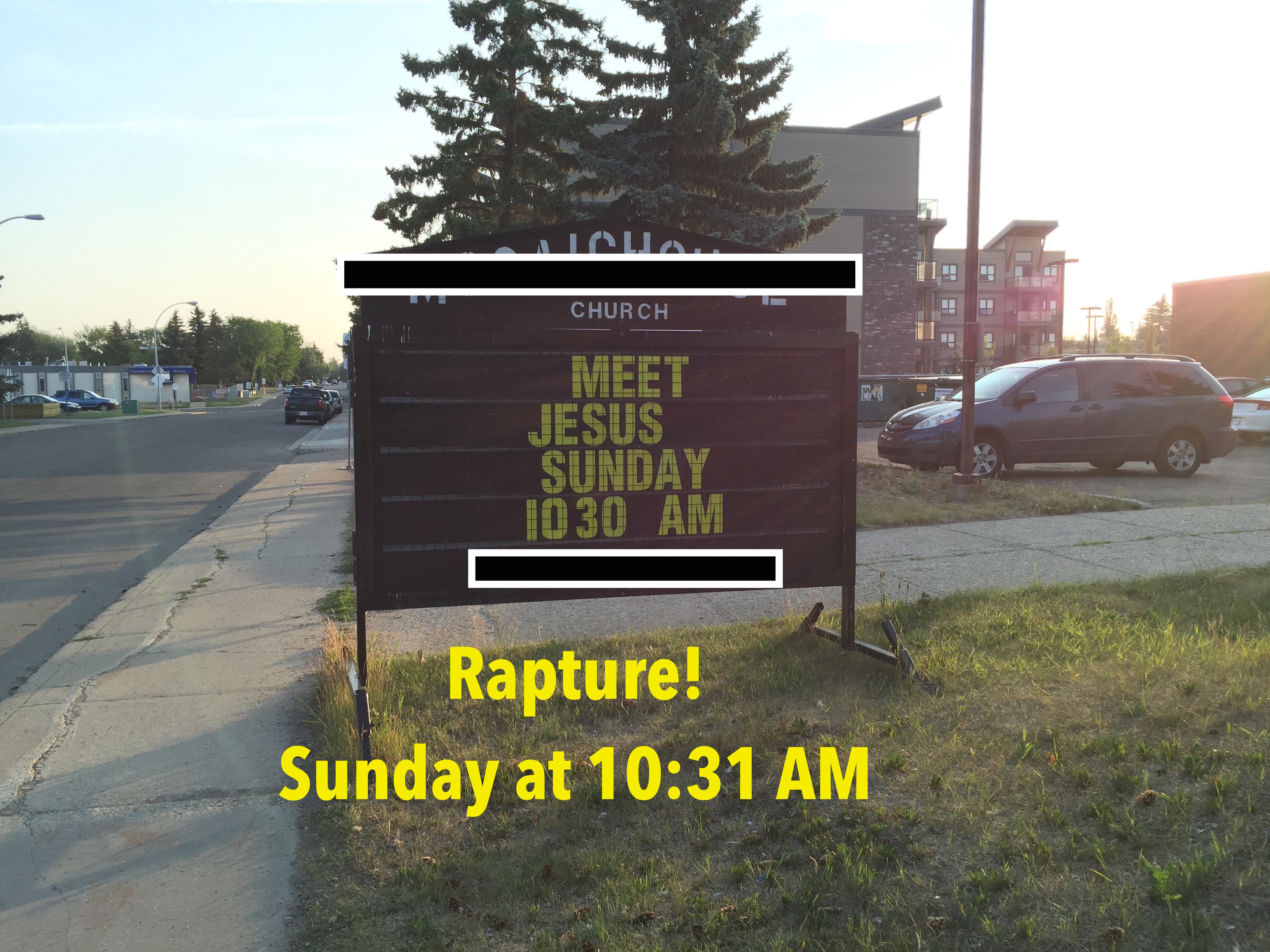
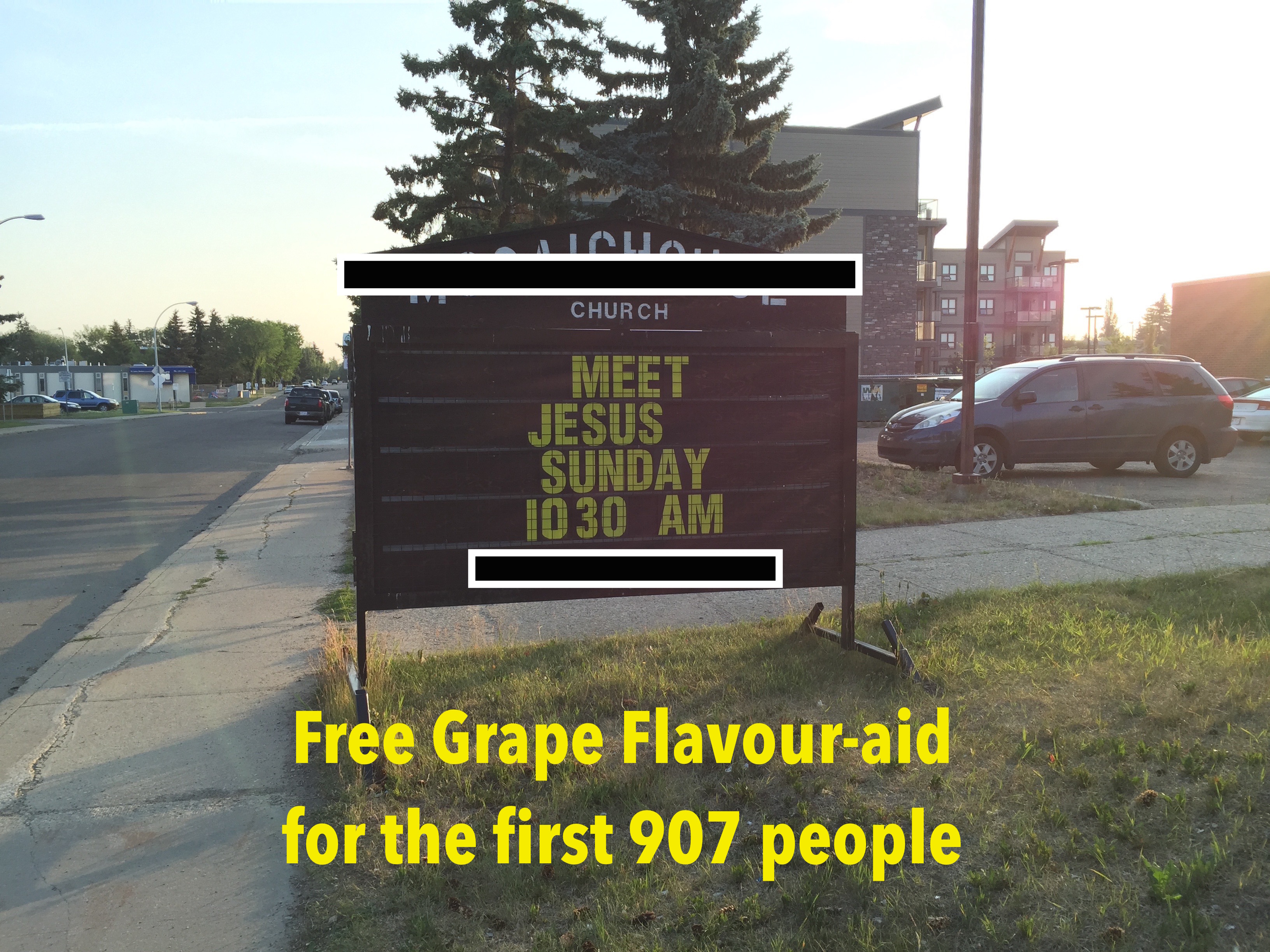
And here are some of funniest captions:

Sign my bible Rapure 10-31 Loaf Eating Contest Grape Flavour Aid

Why Churches Need to Stop Being Good Hosts

Mark 6:1-13

He said to them, “Wherever you enter a house, stay there until you leave the place. If any place will not welcome you and they refuse to hear you, as you leave, shake off the dust that is on your feet as a testimony against them.” So they went out and proclaimed that all should repent. (Read the whole passage)

This story is one of the most uncomfortable for Christians to hear, even among some of the very difficult parts of Jesus’ story that we tell. More uncomfortable than death, than conflict, than sin. We don’t like this story because it doesn’t reflect how we experience the good news and church for the most part.

The first half of the reading sets the stage for our discomfort. Jesus goes to his hometown and is ridiculed and his message isn’t even heard by those he is trying to reach.

And with that rejection in mind comes the really scary part. Jesus sends out the disciples to meet people, to be welcomed by them and to reach them with the good news. To be evangelists.

And if we are honest about our feelings with this story, the images of well dressed mormon missionaries and Jehevoh’s Witnesses knocking on our doors come to mind. People who make us uncomfortable when they come to us… and now we are supposed to imagine becoming just like them. Jesus wants us to go our door knocking so that we can enforce our religious views on others who probably aren’t interested in religious conversation? Doesn’t Jesus remember the part right before where his own friends and family reject him as a preacher? Shouldn’t they be the most supportive?

For a lot of Christians, the prospect of going out in the community, into the world conjures up feelings of hesitation, disdain, discomfort, uncertainty.

And it is not surprising that we feel that way given our recent history. 

For the last 50 years or more, Christianity hasn’t needed to do local evangelism. Evangelists and missionaries were people we sent to far away lands. To the tribes of Africa, to the heathens of the middle east, to mysterious peoples of Asia. And even still when we did to large scale evangelism at home, it was in the form of residential schools with the intention of taking the savage out of the Indian.

For a long time, the evangelism that most christians and most local churches have done is to welcome people who are already Christians into our established communities. People who have recently moved into town, people who have immigrated from other Christian countries, people from other churches, usually of the same denomination.

And yet in the past few years, the world changed. Most people stopped being Christian. Many people began drifting away from church. And today, most young adults have almost no experience of church at all because their parents stopped going when they were young adults.

And yet we as local churches and church leaders kept operating like all we needed to do was to be ready to welcome existing Christians into our communities. We are well structured to receive Lutherans looking for a Lutheran church with a Lutheran Sunday School, Lutheran Choir, Lutheran confirmation program, Lutheran church council, Lutheran bible study and other Lutheran programs. When all the Lutherans looking for an established church come to town, we will be ready. 

Yet, we all know that isn’t going to happen.

So it is n wonder that the idea of being sent out to spread the gospel is uncomfortable for us. We have been trained and structured to be ready and waiting here for people to come to us.

And again, it is no wonder that this story of Jesus sending out the disciples is scary for us. Because when we really think about ir, Jesus sends the disciples out to be guests – not hosts – to those that they are reaching. Yet, the only way most churches try to reach those in need of the gospel is by being host.

As the disciples are sent out by Jesus, they are sent to be beloved guests. They are sent to meet people in their territory. To meet people in their comfort zones, on their turf. They are sent to be guests receiving and accepting the hospitality of others. That is what the whole dust on the feet thing is about. A good host in that culture would wash the feet of guests. And so dust still on the feet would be a sign that the disciples  had not been received with proper hospitality.

Being a beloved guest is not easy. To enter into the space of another. To go with humility. To give up control and to meet the other on their terms. It is a relational act. Unlike churches where hospitality is often the set up to ask visitors to join the congregation, to sing in the choir, to teach Sunday School, to serve on a committee… as a beloved guest, hospitality is something received.

The disciples receive hospitality and in exchange offer good news. They offer the good news of relationship, the good news of God’s great love for us, the good news of Jesus Christ – God come to us in flesh.

As difficult as this story is for us, as uncomfortable as we are with the idea of being sent out… we are asked to consider a few things. 

What would hospitality without an agenda look like for us in the church? What would our hospitality look like if rather than hoping for another warm body with a pulse to join our ranks, that se looked upon guests as people sent to us with a message of God’s love?

A what would it look like for us to be beloved guests sent to receive the hospitality of others? Sent to offer the good news as thanks and gratitude for the welcome and generosity we receive?

Jesus is calling us to radically new and different ways of being people of faith. It is one that we haven’t been prepared for, kind of like the disciples who are sent without much to take on their journey. Jesus is calling us to a new way of being disciples but also to an old way.

Jesus is calling us to reach out to the people around us, the people outside of our comfort zone, outside of the community that gathers under this roof, to reach out in relationship with the good news.

And yes, being a guest, a beloved guest, is scary. It will mean we are not in control, it will mean we don’t get to operate on our terms, instead will have to abide by the terms of those whom we are tying to reach. And we will not feel ready or prepared for this task.

But just as the disciples discover as they preach transformation of mind and soul to those that they meet, we too will discover that Jesus is enough. That the good news is sufficient. That God’s love and forgiveness for sinners like us is enough. That God’s new life for people dead and re-born in baptism like us is enough. That God’s welcome and hospitality this table with bread and wine given us for us enough. These things are enough to allow us to be beloved guests sent to reach the world. They are enough to allow us to receive the beloved guests sent to us with messages of God’s love.

Jesus is calling us into a new yet familiar world. One that resembles the world of the disciples more than it resembles our recent past. And the reception we receive might be rejection. And we might have to shake off the dust of our feet… and yes this is not something we are used to and it puts us outside of our comfort zone.

But even scarier will be when we are received with hospitality and welcome. Even scarier will be when hospitality is extended. Like the visitor who comes to us searching for something more, searching for the presence of God among us, we too will find the presence of God among those who receive us. Just as we are washed and fed by God here, we will be able to faithfully name that the washing and feeding we receive at the hands of others is God’s presence out in the world.

Evangelism, going to the world, forming relationship with those who don’t know yet of God’s love for the world is daunting and scary… maybe one of the scariest things we will consider as Christians. But it is also where Jesus is sending us. And the good news is, as we go out, Jesus will be all we need.

Amen.

On Being an iPhone Pastor for a Typewriter Church

The ‘Millennials and Church’ thing has been written about to death in recent years. Theories about what millennials want in church range from the newest, flashiest most technologically advanced thing to the oldest, most artisanal traditions. If you are sick of reading about how to get millennials back to church,  join the club. In fact, I wouldn’t blame you for not reading yet another blog post about the topic… but bear with me, I promise not to talk at all about what millennials want or how to get us back to church.

That being said, figuring out millennials is big business for Christianity these days… and finding the magic bullet to get us all back to church would make someone rich.  Lots of church consultants and ministry experts are making the speaking rounds telling the church all about millennials and the big “change” the world is experiencing.

And yet, as a millennial myself, I am rarely asked why I didn’t follow the rest of my exiting generation… and when I am asked why I am still around, it is usually after I have pointed out that I am rarely asked.

Being a millennial and an ordained Lutheran pastor has provided me some insight into the Church’s quest to regain millennials. Almost always the starting point for this conversation is, “how do we get the young people back?

Yet, it is almost never asked, “Why are young people leaving?”

Church people are convinced they know the answer to why people are leaving. The surface level answers have to do with sports on Sundays, shopping on Sundays, lack of commitment, not having prayers in the schools, boring traditional worship, not enough youth ministry, too many rules, too much organ, etc…

The experts have more sophisticated reasons like people being busy and carefully choosing how to spend their discretionary time.

Yet, none of these things seem to really name the reason that my contemporaries are not going to church. None of these reasons seem sufficient to explain my anecdotal experience.

Admittedly, I have never had parishioners my own age in the last 6 years of ministry. Yet there is one area where I have consistently done ministry with millennials.

Baptisms.

I have met with dozens of millennials who are bringing their babies to be baptized, but who don’t otherwise go to church. Since, I require that I meet with them for friendly conversations about baptism, I have the opportunity to ask about the role of faith in their lives.

And there are two things I have taken away from these experiences:

  •  Even though I fit the big teddybear-like white-guy-with-a-beard mould of the stereotypical pastor, I don’t fit the age mould. And I don’t talk about faith like they expect me to. And I tell them way more about baptism than their parents, grandparents or my predecessors have. Almost always, the millennials I meet with find it refreshing that I didn’t just expect them to magically know everything about church and that I encourage questions and skepticism.
  • While the first takeaway is troubling, the bigger takeaway when I meet with other millennials (even ones that are almost completely unchurched) is that I don’t have to make the cultural commute that I am constantly making with most of the people I serve.

What is a cultural commute you ask?

Well, it is the whole “iPhone pastor for a Typewriter church” thing.

It is the idea that in order to engage or interact with a certain community or group of people – or generation of people –  you need to speak in their cultural language.

An easy example is actual languages. Even though I am an English speaker, I took grade school in French. It was draining to operate in a second language all the time.

It is the same for immigrants and foreigners, even when they already speak English. You don’t just speak the same language, you learn  a whole system of symbols, images, colloquialisms, inside jokes, history, and baggage that go along with a group of people. And when you don’t get that culture, you feel constantly like you are on the outside.

I remember when I first got my iPhone and would pull it out to make appointments or send messages in front of parishioners. They would often look at me like I just beamed down from the starship Enterprise; these were people who remember riding to school in a horse and buggy.

But more than that, when I sit in most meetings or conversations with church people, the discussion ends up being full of cultural references that pass me by. TV shows, music, movies and historical references from the 50s, 60s, and 70s, of which I don’t understand the meaning, are regular parts of conversation. While at the same time, I have to park my cultural baggage. I can’t make Friends or Breaking Bad or Jay-Z or Mumford and Sons or Hipster or Twitter references because most people won’t get them.

But it isn’t just pop-culture symbols. It goes deeper than that.

It is the whole way church and faith were approached 50 years ago versus how things are approached today.

The most draining cultural commute that I experience as a millennial pastor is the difference between congregations who still expect that every good Canadian (or American) citizen would be a church goer versus my expectation that only people who are interested and for whom faith is very important would be a church goer.

It is a cultural commute that takes shape most clearly for me in this way:

When I go and talk to unchurched millennials about baptism, I often get asked about why faith and church is important to me. This is often is the most exciting part of the conversation.

Yet, when I ask churched boomer and older members about why faith and church is important to them, I get uncomfortable looks and uncertain answers.

Now don’t get me wrong.

I love the people I have served and do serve. And I don’t begrudge them this in anyway. If anything, this is a failure of church leadership to not help people think through why church is important to them.

I also think that it is an important part of ordained pastoral ministry to be constantly making cultural commutes to those whom you serve in order that they might hear the gospel (wasn’t the whole incarnation a cultural commute?).

But this cultural commute… this expectation that as a millennial I will always cross the bridge in the cultural gap and engage – work, speak and serve – in a world that is culturally different is not just because I am a pastor. Church people so often expect that anyone outside the dominant culture or generation – millennials, foreigners, seekers, new converts – will be the ones to make the commute. And often this expectation is unconscious.

It is okay for a millennial pastor to be the one crossing the bridge, making the cultural commute in order to be a part of a church community. But it doesn’t work for millennial church members.

And I think this is a big reason millennials aren’t in church. It just isn’t a world that most of us can even access.

I am about to go to the Evangelical Lutheran Church in Canada’s (ELCIC) National Convention next week. The 4 day event is filled with important agenda items. We will talk about how to do ministry in remote parts of country where pastors are unavailable, we will talk about right relationships with Canada’s indigenous peoples, we will talk about working for justice in the correctional system, we will pass resolutions on climate change and immigration issues. And we might event talk about “how to get the young people back.”

These are important issues, things we should talk about, things we should speak out about.

But we aren’t talking about why people are leaving church.

And we certainly aren’t talking about how to translate ourselves into a church for 2015 and beyond. Instead, we are talking about restructuring, and right-sizing… the corporate language of the 80s and 90s.

I suspect that this is where a lot of conversations in local churches, in districts and national offices are going. Churches are trying to catch up to the 80s… while my millennial contemporaries are leaving churches because the cultural commute to even access church is just too far a journey.

Being commuting pastors is something that many of my millennial colleagues and I just accept. I know that helping congregations and church bodies into the 21st century (hopefully before it ends) is just going to be my lot… no, not just our lot, but our calling…

Yet I wonder as I prepare for this national gathering of my church body and as Christians across North America struggle with young people walking away… I wonder when we are going to start looking to the millennials still here to help us become a church for all generations faithfully looking forward into the 21st century.

Until then, I will keep being an iPhone Pastor for a Typewriter church.


What cultural commutes are you making at church? How can we help the church into the 21st century? Share in the comments, or on the Facebook Page: The Millennial Pastor or on Twitter: @ParkerErik

PS Thanks to Nadia Bolz Weber for introducing me to the concept of  ‘cultural commute’.

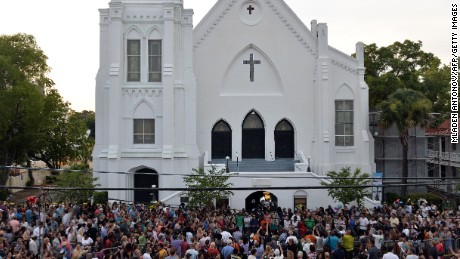
The Heresy of the Charleston Shooter: Racism and Lutherans

The Charleston shooting is still heavy on our hearts and issues around race boiling over and over on social media. Here in Canada, we have been dealing with issues related to our (predominantly white and Christian) government’s relationship with indigenous peoples. Just this week, the premier of Manitoba apologized for the “60s Scoop” where thousands of aboriginal children were taken from their homes and given up for adoption to white families, often in other countries.

As a white Canadian, I am pulled to consider the role I play in passive racist systems. I have to acknowledge the privileges I enjoy because of my skin colour and the benefit of the doubt I receive because I don’t look “other.”

As a Christian, I am also moved to consider the role our faith plays in the suffering of marginalized peoples, and the ways in which the church has been tacitly and explicitly connected to racism.

However, the Charleston shooting hits particularly close to home as the suspected shooter (who I refuse to name) is a member of the Evangelical Lutheran Church in America (ELCA). I serve in the ELCA’s sister church of the Evangelical Lutheran Church in Canada (ELCIC). It not just that the shooter was a Lutheran. Our church bodies are so interconnected that I could have been the shooter’s pastor. There are number of Americans serving ELCIC churches that I count as friends. There are Canadian friends of mine serving in the ELCA. He could have been my parishioner.

And still again, Presiding Bishop of the ELCA, Rev. Elizabeth Eaton, wrote in her pastoral letter following the shooting, “Mother Emanuel AME’s pastor, the Rev. Clementa Pinckney, was a graduate of the Lutheran Theological Southern Seminary, as was the Rev. Daniel Simmons, associate pastor at Mother Emanuel.”

This incident is first and foremost a tragedy for the victims and their families, for the African American community, for South Carolina, for the US as a whole. But further down the list, it is also a Christian and, specifically, a Lutheran tragedy. 

And as Lutherans it is particularly troubling that the shooter sought to identify himself with the racist regimes in apartheid South Africa and Rhodesia. The shooter’s twisted view of race, clearly born in a larger system of racist thought, is something that Lutherans have indeed strongly and clearly condemned for decades.

Almost certainly the shooter did not know, probably nor cared to know, that the Lutheran World Federation in fact condemned apartheid in 1977. “A statement on “Southern Africa: Confessional Integritydeclared that the racial separation of the church in compliance with apartheid in Southern Africa constitutes a “status confessionis” (a basis in faith for churches to reject apartheid publicly and unequivocally).” And while Lutherans have a complicated history when it comes to racism with Hitler using some of Martin Luther’s writings to justify his actions, Lutherans during the past few decades have sought to clearly condemn racism, as they did in 1977.

To put this in perspective, the last time Lutherans added something to their confessions (collected statements of faith) was in the 1500s. The Lutheran World Federation thought it was so important to condemn the racist regimes of apartheid, that it made the issue a matter of faith, and those who practiced apartheid would be excommunicated.

The accused shooter’s views on apartheid and race, therefore, make him a Lutheran heretic. His views and actions have put him outside of fellowship with Lutheran church.

Lutherans are a people and community born out of excommunication, and it is very odd to turn those tables around. However, I think it bears understanding just how contrary to the core of our faith as Christians, and especially as Lutherans, that the events of Charleston are.

In the wake of this tragedy, I would expect bishops and pastors closer to the situation to make pastoral statements, expressing care and concern, sorrow and sadness, while also calling for healing and pointing to our source of hope – The One who was also murdered by oppressors and those in privilege.

However, I think that it needs to be said publicly, by pastors and other faith leaders, that the actions of the shooter last Wednesday night in Charleston were just as contrary to Christian faith as denying the Trinity or the divinity of Christ or any other heretical view.

The exclusion of someone based on the colour of their skin, gender, age, sexual orientation or otherwise is contrary to the gospel. 

Here is an anecdote to explain why:

When I was doing my pastoral internship in Calgary, Alberta, it was the in the 12 months just prior to 2008 financial crisis. Oil prices were booming. Housing was soaring. Rental units were impossible to find. The economy was firing on all cylinders.

But poverty was also soaring. The population of Calgary was growing very fast and 25% of the population was comprised of visible minorities. Poverty was growing, but in a new form. The ‘working poor’ became a new term.

Housing and the cost of living had become so expensive, that people with full time jobs couldn’t find housing and were living on the street. As a winter city,  Calgary churches and other organization were scrambling to find people shelter. Our congregation participated in a program called “Inn from the Cold”, where we provided cots and food for people to have a warm place over night. Many of the clients using the program were families where both parents were employed, but who couldn’t find affordable housing.

As a pastoral intern one of my regular duties was to help serve communion. It was during that year, having the chance to regularly serve communion – the body and blood of Christ, to that congregation, at that time, opened my eyes to the reality of God’s hope for the church.

Week after week, at the communion rail, people of all different kinds knelt with hands open to receive. There were rich oil executives, teachers, doctors, blue collar oil patch workers, single parents, unemployed people and even homeless people. There were young and old, men and women, and people of all different ethnicities.

It became clear to me, just as it was in 1977 to the Lutheran World Federation, that the Body of Christ cannot be limited by human categories. Regardless of gender, class, occupation or race, we are all equal before God. We are all kneeling beggars with our hands open to receive at the railing.

And this equality at the communion rail is a fundamental characteristic of the God’s grace for us. There is nothing about us, about human beings, that earned our place at the railing. And in fact, to suggest that something like skin colour would be a disqualifying characteristic, denies the very nature of God’s grace and mercy – a divine love – given wholly and freely by God with no condition.

That is why the Charleston shooter is a heretic. That is why he is to be excommunicated. His views on race contravene the very nature of God’s unconditional love for all humanity. 

Along side heavy hearts, conversations about race relations and renewed focus on gun violence, it also needs to be said that this tragedy committed in a church by a church member against other people of faith is tragic, deplorable and ultimately, heretical.


Share in the comments, or on the Facebook Page: The Millennial Pastor or on Twitter: @ParkerErik

Everybody Panic! – Why We are All Wrong About Church Decline

Unless you live under a rock or only get your news from the Farmer’s Almanac, you have probably heard about the recent Pew Research report detailing the decline of Christianity in the US, and the rise of the ‘nones’ – those who claim no religious affiliation.

Predictably, people are up in arms. Bloggers are writing doom and gloom pieces. People are trying to explain the decline. Some are saying that the decline is the result of lax theology and drifting away from traditional / conservative beliefs and values. Others are saying that liberal mainliners are providing what the ‘nones’ are really looking for, especially what young disaffected millennials are looking for.

Perhaps the only new, but unsurprising, find of this recent Pew report is that Evangelicals are declining too. This contradicts the often lauded trope of the last few years that decline is a mainline thing.

Well I have to admit, that this all feels like a tired rehash of what we already know. But in particular, as a Canadian, I see the panic happening among US Christians as something we felt about 20 years ago. We are a lot farther along the social secularization path than our dramatic neighbours to the south.

And as I have blogged about before, as a Millennial Christian in Canada, the only church I have known is one in decline. I have only ‘heard’ the stories of everyone in town being in church on Sundays… I haven’t lived it. Being a church-going person was the exception among my peers growing up, not the norm. We used to sing the national anthem on Monday mornings in school but we never prayed the Lord’s Prayer. In fact, the idea of one of my grade school teachers leading the Lord’s Prayer sounds absurd.

Yet, the analysis, panic, fear, and explanations of the past few days is not what we are all getting wrong about this decline thing.

I think there are few things that we miss when we panic about a society and culture that is no longer evangelizing for us. And these things should be the first things we name when talking about church decline in North America.

1. The Golden Era of Church attendance in the 1950s was the abnormality.  

So often our discourse on decline assumes that wide-spread socially motivated church attendance is normative. So many church people are used to a world where the question was which church to attend on Sunday mornings, not whether or not one should attend at all. During the Reformation, many protestant groups were born out of the fact that most people were nominally Christian, and did not attend church or “show their faith” in how they lived. North American society in the 1800s and early 1900s was not one that ubiquitously attended church. I think the big bulge in church attendance, church planting and growth of the 1950s was due to a global experience of PTSD following World War One, the Great Depression and World War Two. The church was convenient place to land for a world looking to make sense of decades of suffering. 60 years on from then, I think decline is a correction, rather than a failure.

2. What we are seeing is the death of Christendom… not the Church. 

Conversations about church decline are almost always accompanied by the lament of the loss of cultural Christianity. There is talk of prayer in schools and town council meetings, the 10 commandments on display at courthouses, sports, music and dance happening during Sunday morning worship, the church as community centre and neighbourhood gathering place. And yet, if we took a minute to really consider what that means, we are actually demanding a church that is dependant on empire, that is served by kingdoms and governments. We want a church that needs to have all other activities banned during its worship. We long for a church that needs its prayers taught in schools and that seeks power by influencing political leaders.

Is it really such a bad thing to see the decline of that church?

3. We like to think that we are the ones who can finally do the church in.

As if the church lives and dies by us. Christ’s church has been around for 2000 years. It began by spending 300 years on the margins of a religiously plural world. It was subsumed into being the bureaucracy of the Roman Empire. It has been nearly blown by up schism. Almost over-run by the empires of other faiths. It has crusaded and begun terrible holy wars. It has been cracked and splintered by reformation. It has been challenged to its core by renaissance and scientific revolution. The church has survived all of that, against all odds.

But now our social angst and apathy, and our institutional intractability is going to finally put the church out of its misery? Because we cannot be the church of empire or let social structures do our evangelism for us, the church will just fade away?

Sometimes I think that we tie our attendance to God’s faithfulness. We believe that God approved of the church more when it was full 50 years ago. And now God is frowning at us because we couldn’t freeze time, because the world changed around us and we weren’t sure how to deal with it.

This Pew Research report is nothing new. It is full of things we already know. But maybe decline, the more it gets thrown in our face, is telling us something important about the church – about God’s work in the world.

A declining church does not equal a declining God.

Nor does a full and rich church equal an increasing God.

Maybe God’s work in the world has nothing to do with numbers.

Maybe God’s mission through the church cannot be measured quantitatively.

Maybe what God is doing can only be experienced qualitatively. The Good News is not about winning souls by filling pews. The Good News is that Christ’s death and resurrection is our death and resurrection too – and this fact transforms who we are.

So maybe, just maybe, this declining stuff… this dying stuff that the church is doing… is just what always comes right before empty tombs and being known in breaking bread.

What we get wrong about decline is that we rarely consider that it just might how God is doing God’s work, in and through us – God’s church.


How did you respond to the Pew Research report? Can the church survive decline? Is the best thing to happen to Christianity in a while? Share in the comments, or on the Facebook Page: The Millennial Pastor or on Twitter: @ParkerErik