Category Archives: Theology & Culture

I am choosing religion for my children – they don’t get a say yet

Whether or not to raise your children with religion is a pretty controversial topic. Just google “choosing religion for your children” and you will find a host of articles explaining why choosing religion for children is a bad idea.

In spite of the prevailing opinion out there, I am going to make a bold claim:

The idea that you can defer choosing a religion for your children until they are old enough to choose for themselves is wrong.

As parents we are choosing for our children either way, whether we choose religion or not, we are making the choice for them. We are not putting off that choice, we are choosing something or we are choosing nothing for them. It is like saying I am not going to choose literacy for my children, they can decide to be readers on their own when they are older, if they want to. You aren’t delaying the choice, you are depriving them of a real opportunity to read.

And while, I get that every family and every child is unique, and that applying a universal rule is impossible… I am convinced that choosing religion for your children can be and is a very good thing.

Strangers in a Foreign Land

I do a lot of baptisms for families with babies or young children. And most of the baptisms I do are for families who have only the most nominal or tenuous connection to the church. Grandma has said that the new baby in the family needs to be baptized to protect him or her from hell.

And what usually results is that some sheepish and tentative new mother or father phones or emails the church, wondering about baptism for their new beloved child.

“I was baptized and confirmed at this church,” they say. “We are thinking of coming back.”

(I don’t know about you, but the idea of introducing a significant lifestyle change, like regular church attendance, shortly after having a baby is crazy-talk in my books).

So I set up a meeting to talk about what baptism means and we plan to have the baptism on a Sunday morning. I try to go into good depth about the meanings and symbols of baptism; and about what the church believes that it means and what we believe that God is doing in baptism. But no amount of casual, yet informative, conversation can prepare a family for standing in front of a congregation of regular church attenders with this weird guy in a dress praying prayers, asking questions and pouring water on the baby’s head.

I almost always feel bad for families that come for baptism, and the obvious awkward self-conciousness that they are experiencing while standing in front of a group of mostly strangers.

It takes years to live into and feel comfortable with the liturgy and ritual of the church. So for those for whom church is not really a part of their daily lives, parachuting in for a baptism can be a strange and alien experience. I imagine it to be something like if I were to be parachuted in as a contestant in a Miss Universe pageant. I only know the vaguest things about the pageant world from the movie Miss Congeniality… it is an understatement to say it would be super awkward!

I don’t question the motivations of those who come for baptism and I will baptize anyone who asks, but I do wonder why people subject themselves to a ritual and experience they have no connection to and little desire to pursue in any meaningful way.

Choosing Religion vs. Choosing Faith

My parents chose religion for me. Sunday morning worship was a weekly event, in addition to playing music, youth group, confirmation, bible studies, fellowship events throughout the week. Church was a big part of the life of our family, and it was clear that as children we didn’t have a choice about participating.

Sure there were some annoying parts, like missing all the medal games of weekend sports tournaments because they would be scheduled during Sunday morning worship. Or knowing that Saturday night was essentially like a school night because I had somewhere to be in the morning.

But looking back, there was nothing else in my world that gave me the experiences that church did. There was no other intergenerational community full of adults (not related to me) who knew my name, asked about my life, and just cared about me. There was no other place where the deep questions of meaning – life and death – could be talked about without hushed, anxious voices. There was no other place where I was exposed to the rituals, symbols, metaphors, music and history that comprise so much of our western world.

As I grew up going to church, what became clear to me is the more religion I was exposed to, the less my parents were making the choice for me. Faith was my choice and my experience at church allowed me to be informed about what I was getting into.

  • A caveat: I am aware that not every church or faith community is a safe and healthy place. In fact many are centred around fear, judgement and shame. Many do not encourage questions and conversation, nor are places that allow members to search for deeper meaning. Sometimes churches can be places of abuse. These churches are not religious experiences that I would advocate for, and I am sorry for those for whom this is their experience of religion.

Liturgy and ritual in our DNA

Recently, our 3-month-old daughter was baptized. Standing on the other side of the font, so to speak, as a parent rather than the pastor, I was struck by the experience. I have presided at more baptisms than I can remember, but only been a parent for two.

fullsizeoutput_434eWhile the Bishop (presiding at the baptism), godparents, my wife and I stood around the font, our two-year-old son stepped up and placed his water cup and container of goldfish on the font. He must have thought it was a natural spot to stash his stuff. And then he proceeded to do laps around the font as the Bishop led us through the liturgy for baptism. None of us were worried or anxious, all 5 of the adults standing there were seminary trained (who else do pastors ask to be godparents but friends from seminary!). We even laughed when our son started dipping his hands in the font in order to bring some water to his own head (re-baptizing himself?).
I was struck at how comfortable my son was in the moment. He wasn’t in a strange place. The font and altar rail and nearby pews were not foreign pieces of furniture. Being in worship with us and in front of the congregation was not unusual.

My son was at home.

I wasn’t just struck by his comfort, I was moved by it. I could see that even at the age of 2, he was beginning to be shaped and formed by the experience of worship, by the experience of religion and community. Liturgy and ritual is being imprinted on his DNA, his daily life is connected to the practice of re-telling the story of Jesus.

When it comes time for him to chose faith for himself, I know that he will know intimately what he is choosing. He will know what practicing religion feels like, he will know what it means to be a loved member of a community. He will have a sense of what it might feel like and be like to practice other religions.

My wife and I are choosing religion for our children, because we are choosing to give them an experience that will allow them to choose faith later on in life. We are choosing religion, because there are few, if any, other places in our lives where we can be a part of diverse, intergenerational communities that help us make sense of and bring meaning to our lives. And choosing “not to choose religion” for our children, would actually be almost certainly be choosing “nothing” for them.


Are you choosing religion for your kids? If so, why? If not, why not?Share in the comments, or on the Facebook Page: The Millennial Pastor or on Twitter: @ParkerErik

The parable of the Pharisee and Tax Collector – It’s a Trap

Luke 18:9-14

The Pharisee, standing by himself, was praying thus, `God, I thank you that I am not like other people: thieves, rogues, adulterers, or even like this tax collector. I fast twice a week; I give a tenth of all my income.’ But the tax collector, standing far off, would not even look up to heaven, but was beating his breast and saying, `God, be merciful to me, a sinner!’

“God, I thank you that I am not like other people: proud, haughty, self-righteous, or even like that on-fire-for-Jesus Christian. I bow my head when I pray silently, and I cover the amount on my envelope with my thumb when I slip it into the offering plate”.

Have you ever prayed that prayer? Or had those thoughts?

“God, how could you love someone like me. I am not like those other people who have it all together, who give more than I do, who volunteer more than I do, who are better people than I am. Have mercy on me, because that’s all I have”

What about this prayer and these thoughts?

It is easy to hear this parable and think that it is a lesson about the value of humility. There is the Pharisee, incorrectly dividing the world into categories. Thankfully we are not like him. And there is the tax collector. He knows what this is about, he is a good Lutheran. All sin. The only hope he has is for God’s mercy.

To modern listeners, the details of this parable go by so quickly. We don’t know what it was like to stand in the temple of Jerusalem. The term Pharisee is derogatory today. It can seem easy to identify the villain here because we have not heard the standard prayers of the Hebrew faith.

But understanding the context, as always, is very important. The temple of Jerusalem would have been grand sight to behold. It was big and it had rules. The people believed that it was where God lived – in the inner sanctum, the holy of holies. The temple was the place where you had to earn every inch of God’s favour. Whether you were a Pharisee or tax collector, you knew where you stood in the eyes of God when you were inside the temple.

The Pharisee knows that he is righteous. He prays a Benediction that every Jewish man was to pray each day. Thank you God that I am not a Gentile, a sinner, or a woman. The Pharisee modifies the prayer, but the point is still the same. He is genuinely thankful for who he is. The pharisees see those around him and looks down on them.

The tax collector, on the other hand, knows that he cannot expect anything from God. His job requires him to break the rules of Judaism. To charge interest, to handle money with graven images on it, even to steal or assault. He is not righteous and his only hope is God’s mercy. The tax collector is so wrapped up in himself, that he doesn’t see the world around him.

The Pharisee and the Tax Collector are both quick to divide people into categories and be judge on God’s behalf. The Pharisees judges himself righteous, the tax collector judges himself unrighteous. And we are often guilty of the same.

Whether we are thanking God for not being thieves, rogues, adulterers or tax collectors, or whether we are thanking God because we are not arrogant, self-righteous, or prideful, the issue is the same. We divide humanity into categories, justified or unjustified, saved or unsaved, loved or unloved.

Human beings are constantly looking for the ways that we can identify who is in and who is out. We might not be standing on the street corner, boldly thanking God in prayer for our certain salvation. But have we looked down on others, the homeless, those in financial trouble, those who struggle with addiction, those who come from broken families, even those who are sick, and we thank God that we are not them. “Therefore by the grace of God, go I”. Or how often have we been the ones thinking that we are worthless compared to those around us. That we unworthy, while everyone else seems so perfect. Whether we are intentional about it, or whether we do not know that we are doing it, we too place ourselves in the same categories that the Pharisees and the Tax Collector do.

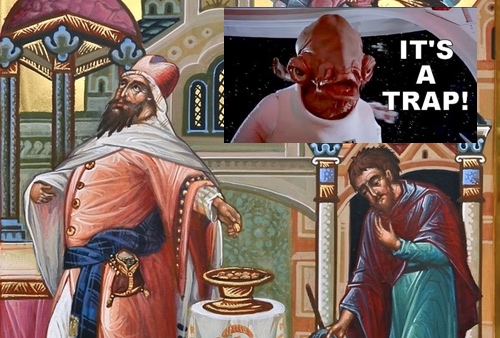
Now, here is the thing about that kind of thinking. It is a trap.

And so it the parable today.

The parable that Jesus tells today is a trap that makes us identify ourselves with either the Pharisee or the tax collector. But this parable is not about pride or humility, and it is just as much not about pharisees or tax collectors.

The parable is about the storyteller.

The parable is about Jesus.

While we are busy trying to make things about us, God is reminding us that it is God alone who justifies. God alone decides who is good enough for the Kingdom.

According to the law, the Pharisee came into the temple righteous, and left the temple righteous. But Jesus says something about the tax collector that should grab our attention,

“I… tell… you,  this man went down to his home justified”.

There is nothing that the tax collector did, rather it is Jesus who says that the man is justified. It is Jesus who decides.

In the world of the Jerusalem temple, there were those were in and those were out. But everything changes with Jesus.

Through birth, life, death and resurrection, Jesus comes to tear down the categories we try to build. Whenever we try to make categories, God will stand on the other side, because God wants all to be included, all to receive grace, all to be loved. God has only one category for all of us. We belong to God and God alone.

Now, to the confirmands who shared their faith statements. If there was one thing I hope you take away from the past two years, it this. That we are not good enough to save ourselves, and nor are we too bad to be loved by God. God is the one who decides who is in and who is out, and God says, you are in.

The parable that Jesus tells is not a parable on how to act, or who to be like or how to pray. This is a parable about God. A parable that shows us God’s motives and shows us the way that God chooses to act in the world. That shows us that God wants to be with and care for the least, the lost, the sinners and the alone. God wants to care for us… because  we are the least, the lost, the sinners and the alone.

Neither the Pharisee, nor the tax collector, nor us, want to see or admit, that being justified, that being saved is something that God does for us. Yet, that is what is told to us today.  The trap is laid that we try to divide humanity into saved and not saved. And it is God who alone who knows the way out. Through love and mercy God chooses humanity. God who chooses those who truly cannot be righteous on our own, God comes to us as Christ who lives and dies, with us, with imperfect and flawed human beings, God sends us the Holy Spirit to bring us into the resurrection and into new life.

Perhaps our prayer today should be:

“God, we thank you that we ARE like other people: Pharisees and tax collectors, sinners and saints.  We are justified by your righteousness; we are saved by your love.”

Amen. 

It was not Moses who gave us Thanksgiving

John 6:25-35

Then Jesus said to them, “Very truly, I tell you, it was not Moses who gave you the bread from heaven, but it is my Father who gives you the true bread from heaven. For the bread of God is that which comes down from heaven and gives life to the world.” (read the whole passage)

Earlier this week, a New York Times food columnist wrote about “Canadian Thanksgiving.” His article was about the surprising but little known holiday of Canadian Thanksgiving on the second Monday in October. He wrote about  the quieter nature of Canadian Thanksgiving that sadly and unimaginatively mirrors the American one in menu and traditions. He thought that there could be something uniquely Canadian that would make Canadian Thanksgiving our own.

The Canadian Thanksgiving for most of us sounds funny, because for us there is just Thanksgiving, and then American Thanksgiving, which seems to be an excuse to have a shopping holiday on Black Friday.

And so this weekend, as we gather with family and friends around mashed potatoes, turkey and football to celebrate “Canadian Thanksgiving,” it may be worth considering where this holiday came from.

While the legends are that the roots of Thanksgiving takes its roots from the pilgrims landing on Plymouth Rock and sharing a feast with the indigenous people that they met in the new world… the reality is that people have been giving thanks around the time of harvest for hundreds of years before the discovery of the new world.

And so for us in Canada, Thanksgiving has been a time to give thanks for all the things that we have been blessed with. To give thanks for the harvest after a long summer of plowing, planting, growing and harvesting.

But let’s be honest, most of us aren’t celebrating thanksgiving for those reasons. Its not like this is the one time of year when we have enough extra food to have a feast. We could probably afford a turkey dinner most days if we really wanted one.

Thanksgiving for us is much more about the time spent with loved ones. We might be able to have turkey whenever we want, but finding the time to be with family and friends… well, that is something we are often desperate for. In fact, unlike the pilgrims of Plymouth Rock, or the extended families working on prairie farms 100 years ago who lived, worked and spent most time together, family time and rest time is very scarce for us. And thanksgiving might one of 2 or 3 times a year when families get to spend quality time together.

We might even get desperate to make this weekend special, with stressing over food and decorations, fighting and bickering because we already sad to say goodbye to loved ones before they arrive, trying to bring back the memories and feelings of the past that we forget to let new memories be made in the now.

As much as Thanksgiving is a chance to be with family and have that moment to pause and relax and just be… it can just as much be that painful reminder of the deep void that we all carry within us. The emptiness that never seems to be filled. The pain of loss and suffering that is never quite healed. The longing for something more than ourselves that we try to fill with things and stuff. That need for meaning in our lives that we push aside with mindless tv or endless internet surfing. That search for happiness that too often ends in substance abuse and addiction, that the next hit never fulfills.

Thanksgiving, like any holiday or time that we try to fill with nostalgia and sentimentalism, can all too often be a reminder of the great void at centre of beings, that we just don’t know how to fill.

Wow… This is a depressing thanksgiving sermon.

Maybe the bible can help? or that Jesus fellow we like talking about in church?

Well, today, when the crowds are following Jesus around the lake, they are clearly looking for something. While they pretend to be surprised to have come upon Jesus, he knows that they are out searching for something to fill their voids. They are doing the same thing that we are often trying to do on Thanksgiving weekend and Jesus calls them on it. These crowds have just experienced the miracles of the feeding of the 5000.  Jesus turned 5 barley loaves and two small fish into enough to feed thousands. And the crowds having experienced this miracles from heaven want more.

More food that is.

The crowds that are following Jesus are probably serial messiah followers. You see, in Jesus’ day, messiahs were a dime a dozen. There were leaders of small religious groups around every corner. Charismatic people who convinced people that they had the solutions to all their problems. The Messiahs promised that they would show people the path to righteousness, or that they would raise an army to oust the Roman occupiers, of that they would make their followers rich… or that they would make the nation great again. And the crowds would follow each would be messiah like the flavour of the week. The messiah they were following last week would different than the one followed now, and the one they would be following next.

And Jesus knows this. “You just want more bread” he scolds the crowds with.

“So show us a sign, that you are real deal” they respond.

The crowds don’t realize they are just following a cycle of disappointment, going from one messiah to the next. They are desperate people, looking for hope anywhere. And each time, they want this messiah to be the one who will fill their voids, who will give them something to hold on to.

But Jesus doesn’t give them a sign. All the other messiahs had signs and miracles too.

Instead, Jesus reminds them of the truths that they have been taught for generations. The manna, the bread from heaven that their ancestors were given did not come from Moses. Or in other words, Jesus reminds the desperate crowds that falling just another messiah in the hopes that this will be the one is not who they are.

Jesus reminds them that is is not Messiahs with big promises, it is not Thanksgiving dinners, it is not seeking after the next hit, is not trying to fill our empty voids with junk that satisfies.

Jesus reminds the crowds that is was God who provided the manna, the bread from heaven.

And then the crowds see.

It wasn’t signs that they needed. It wasn’t more bread. It wasn’t more stuff. It wasn’t more distraction. It wasn’t more escape. It wasn’t more of what they once had.

Jesus reminds them WHO it is that gives true bread from heaven.

Jesus reminds us WHO it is that can fill that void centre of our being, WHO it is that will give us that bread of life. Only God can relieve the our hungry void. Only God can fill our thirsty emptiness.

This weekend, as we sit at Thanksgiving tables desperate for the thing that will fill our empty voids, to satisfy the longing that we carry for something or someone to finally give us what we need… it won’t be the turkey, or the memories, or the stuff in our lives, or the escapes we seek out that will fill us. It will be those moments when we reach out across the table with open and empty hands and say, “pass the potatoes.”

It will be when we look into the eyes of those that we love, and recognize that we are loved, that we will be filled.

Because, those moments of recognizing love in others begins here first. It begins with the open hands and open hearts that we bring to God’s table.

As we come with our voids held out and open, God says to us “the Body of Christ given for you. You are now a part of me and I am a part of you.”

As we come with the emptiness deep inside of us ready to be filled, God says to us, “the Blood of Christ, shed for you. I will fill you with my love, and you will not thirst”

Here, in this Body that is the church, in this family of Christ, we are reminded of what we have been taught for generations. That true bread from heaven, bread that leaves us full inside, that fills our voids and our longing… that God gives us this bread.

That here, at the Lord’s table of Thanksgiving,  God gives us the true Thanksgiving meal.

Jesus said to them, “I am the bread of life. Whoever comes to me will never be hungry, and whoever believes in me will never be thirsty.”

Are we the rich man in The Rich Man & Lazarus?

Luke 16:19-31

Jesus said, “There was a rich man who was dressed in purple and fine linen and who feasted sumptuously every day. And at his gate lay a poor man named Lazarus, covered with sores, who longed to satisfy his hunger with what fell from the rich man’s table; even the dogs would come and lick his sores. (Read the whole passage)

Is anyone here worried? Did any anyone else take a moment to think as we heard this parable? Am I like the rich man and I don’t know it? Will I end up in Hades because I have a house and a car and RRSPs? These are fair and honest questions. Last week there was confusion about the Master who praises his dishonest manager. But this week things are clear. The rich man is rewarded in this life and punished in the next. Lazarus, the poor man living in front of the rich man’s house was punished in this life and will be rewarded in this next.

Well, let’s think about this. How much makes you rich? Well, if your annual salary is $40,000 a year, you are in the top 5 percent of the worlds richest people. If you make $60,000 a year, you are in the top 1% of the world’s richest people. These can be staggering figures.

If this parable is really about the amount in your bank account, then most Canadians are in deep trouble.

And while this parable is familiar to us, we cannot reduce it to its surface meaning. When Jesus tells a story, there is always more to it than what’s at the surface.

The rich man is more than just a rich person. He is the epitome of wealth and excess. He wears the clothes of kings, the feasts each day like he is at the royal court. He is a caricature more than real person. And Lazarus, he is the poorest soul you have ever seen. Starving at the rich man’s gate and too weak to move. Diseased and unclean. He is so pitiful that even the street dogs take mercy on him.

Yet, something strange happens when Lazarus dies. For you see, normally an unclean sinner like Lazarus should not be taken to heaven, at least according to the religious understanding of his day. The poor and the unclean are unrighteous, and while they are to be cared for in this world, they excluded from the next. But when Lazarus dies, he is carried into heaven by angels, similar to Elijah or Moses, heroes of the Hebrew people. Heaven was reserved for only the most favoured of God.

And something even stranger happens when the rich man dies. Most people in Jesus’ day didn’t believe in an afterlife for the average person. The place you went to when you died was Sheol, the ground, the grave. But the rich man isn’t just buried. He goes to Hades. And Hades is not just generic Hell. No, the rich man winds up in Greek Hell. Gentile Hell. Being buried wasn’t bad enough in the parable, he had to go to the hell of another religion.

And here is where we get to see that this isn’t about what we need to do to get in heaven. Even in Hades, the rich man still doesn’t have clue about what is going on. He cries out to Abraham from gentile hell. And even from hell he maintains his superior attitude. As if poor Lazarus hasn’t suffered enough, the rich man say to Abraham, “Send that poor Lazarus fellow down with a drop of water.”  Here he is in hell, acting like a snooty hotel guest ordering room service. And when Abraham says no, the rich man tries again. He orders a message to his brothers, and still Abraham refuses.

The rich man is the epitome of selfishness. He does not care for the poor on his door step as religious law dictates, he dresses like a king and eats like a king. And even when he is in Gentile hell, he doesn’t give up on his sense of entitlement. The chasm that has been set between Abraham and the rich man is the chasm of self-righteousness.

The chasm of selfishness that we create for ourselves so often keeps us from seeing the world around us. The rich man might be an exaggeration and Lazarus might be an extreme example, but the reality of these feelings and emotions about others, about ourselves, remains the same. Often we get stuck inside ourselves. We cannot see beyond what we are owed, what we believe we deserve and what injustices have been done to us.

And we have a name for this as Lutherans — original sin. We are curved in on ourselves. We try to be like God. We try to save ourselves.

And in the end, we fall short and we fail.

We die.

Its the last few words of the parable that cue us into what Jesus is talking about today.

“Neither will they be convinced, even if someone rises from the dead”.

We have heard those words before. The rich man wants Lazarus the ghost to go to warn his brothers of their fate so that they can save themselves. But Jesus is not talking about Lazarus the ghost.

It is not Lazarus who comes to us from the position of the poor in order to save us. It is God in Flesh. It is Christ who comes into our world as the child of peasants, Christ who is a homeless and penniless carpenter, Christ who is put to death as a common criminal.

The rich man is trying to save himself while Lazarus is dead to the world. These two are not really people, but reminders of who we are. That we are in need of salvation. And it is God who is giving up all power and might, to become like us. Christ is born into the muddy, dirty places that we live in, the places of self indulgence, the chasms of superior attitudes, the gates of self-pity and death.  And it is in these places, where God comes near to us.

Whether we are rich or poor, entitled or humble, in the mansion or on the street.

God is turning death into life regardless.

God is licking our wounds of suffering and sin.

God is loving us, even when we do not deserve to be loved.

And God is doing this whether we see it or not


God is acting in the world no matter what we are doing. God is making the dead alive, even if we are too busy to notice.  And God isn’t swayed by our righteousness or unrighteousness. God acts out of love, God comes near enough to touch us because we belong to God.

The world is so much more grey, so much more complicated than the story of the rich man and Lazarus. We are all too rich too see others around us. And we are all too poor to do anything to save ourselves. And this parable isn’t about condemning the rich and nor is about the value of being poor.

This parable is about the cross.

The cross where new life begins in the most powerful symbol of death.

The cross where God empties Godself of all power and might to take on human flesh and dies like us.

The cross where God hides in plain sight, where God turns the world on its head and where God reminds us all that it is God alone who saves us.

Will our riches will keep us out of heaven? Yes they will, not even money can pay our way. Will being poor and dead to world make us worthy of salvation. No. Nothing that we do will save ourselves.

God alone saves.

The Lost Sheep & Lost Coin vs Caring Shepherd & Joyful Woman

Luke 15:1-10

So he told them this parable: “Which one of you, having a hundred sheep and losing one of them, does not leave the ninety-nine in the wilderness and go after the one that is lost until he finds it?…

“Or what woman having ten silver coins, if she loses one of them, does not light a lamp, sweep the house, and search carefully until she finds it?…

Finally, Jesus seems to be laying off the guilt trip this week. For the past couples weeks, Jesus has been giving us a hard time. Two weeks ago he was criticizing our sense of self-importance. Last week it was our holding on to possessions, and how they hold on to us.

Today, we hear two familiar parables. The Lost Sheep and the Lost Coin. They are connected to a third, the parable of the Prodigal Son, which we heard in Lent. And it is nice to hear something that sounds a little more Jesus-y. A little less Jesus the critic and little more of the feel good Jesus, the hopeful Jesus.

The experience of being lost and being found is something we can all identify with. We have all been lost or have lost something. We have been found or have found something or someone. Being found is a joyful feeling, finding that lost thing is a relief. And as that familiar song says, “I once was lost, but now am found. Was blind, but now I see.” We are deeply connected in faith to the idea of the lost being found. When Jesus talks about finding lost things, it is something that we feel down in our souls, in the very core of our being.

Jesus is talking to a varied group of listeners. Tax collectors and sinners, or more appropriately, debtors. The people who collected the money and the people who owed the money, along with the Pharisees and scribes, religious authorities. Upon hearing their grumbling about the company that he keeps, Jesus offers these first two of three parables.

A shepherd loses a sheep. One lost from the flock of 100. So he leaves the 99 in order to the find the one. Some might call it dedication, others might say irresponsible. But he finds the sheep and celebrates.

A woman loses one of her coins. A silver coin or day’s wage. She tears apart the house to find it and then throws a party. A lot of effort for just one coin, but she finds it and celebrates.

The point is made. The pharisees and the scribes might be grumbling about the presence of tax collectors and sinners, but lost things, lost people are kind of God’s thing. And yet, the grumbling of the Pharisees and scribes does point us to a problem that we often seem to share. No matter how hopeful and feel good Jesus gets, we find reasons to grumble.

The Pharisees and scribes show us our own complicated relationship with the idea and experience of being lost.

I can remember those moments that stick in my memory from childhood. Wandering the aisles of the grocery store or the clothing racks of the department store, when my mother disappeared from sight. I was never lost for more than a few seconds or minutes, but the fear that so quickly sets in can be paralysing. It is the same for being lost in an unfamiliar city, or hiking through the mountains and leaving the trail only being unable to make your way back.

But perhaps, it isn’t just being physically lost. It is losing that job, losing that relationship, losing that sense of freedom because of illness or disability. Or maybe it is just feeling lost in life, unable to gather your sense of self enough to feel grounded and secure.

Being lost is terrifying, unsettling, debilitating. And when we are lost, or when we feel like we have lost out, we are quick to blame those around us. The map maker, or GPS company or city planners. The company we used to work for, the government, the economy, our ex, the disease or accident. Or maybe just the whole world seems to be at fault.

Yet, there has been a strange attitude that our world has been exposed to lately. The attitude that brings us Trump or Brexit or Canadian Values Screening. When others are lost, we are quick to blame the lost for their problems. Those people don’t need to come here and take our jobs. That person should have had the will-power to resist addiction. If he just tried a little harder at work. If she just gave him another chance. If they had taken better care of themselves, maybe they wouldn’t have gotten sick.

When we are lost, it is someone else’s fault. When someone else is lost, it is their own fault.

Being lost is a complicated experience indeed.

Some of your may remember all the way back to Lent and the story of the Prodigal Son. You may remember that the titles of parables are not what Jesus’ named them. The titles are what we, the church over the centuries, have named Jesus’ stories.

And the parable that we call The Prodigal Son is called by another name by the Eastern Orthodox. They call it the parable of the Loving Father.

And how we name the parable shows us which part we think is most important.

The parable of The Prodigal Son is about a spoiled brat of a son who spends his inheritance on partying, only to have to return home, hand in hand. It almost sounds like a cautionary tale!

But the parable of The Loving Father, well that is about a father who welcomes his lost son home with open arms.

Hear the difference?

When these three parables are placed side by side by side, the Lost Sheep, Lost Coin and Prodigal Son, we see that that the lost things have little to do with each other. It is hard to see the common thread between a sheep, a coin and a son.

Yet, when we compare the Shepherd, the Woman and the Father… each goes and seeks out the lost. The Shepherd leaves the 99 to find the 1. The woman turns her house inside out to find the coin. And the Father runs to greet his son while his son is still far off.

Each goes and seeks the lost. And then when the lost has been found, each celebrates. The Shepherd rejoices with his friends. The Woman throws a party for a coin. The Father slays the fatted calf for his son that was lost and now is found.

We name the parables after the lost things because we think the lost things are the most important parts of the story.

But just maybe Jesus isn’t making a point about what is lost, but instead who does the finding.

Maybe the parables should be named the Caring Shepherd, the Joyful Woman, the Loving Father.

Maybe Jesus is trying to make a point about just who is finding us.

The Pharisees and scribes want to blame the lost for being lost. We have a complicated relationship with the idea of being lost. We would blame everyone and anyone else when we feel lost, but anyone else who is lost has only themselves to blame.

Yet in the midst of misread maps and failing GPS, in the midst of lost jobs, lost loves and lost health… in the midst of all the things and people that are lost in our world.

Jesus is talking about being found.

Jesus is talking about who is doing the finding.

Jesus is talking about how God goes to extraordinary lengths to find lost things and people.

Jesus is talking about all those people that we are quick to label as lost,

tax collectors and sinners,

those who owe debts and those who collect,

those whose maps have led them astray in life,

those who know the loss of brokenness and suffering,

those who have no other place where they belong,

Jesus is talking about how all those people are the ones who God finds.

Jesus is talking about how all those people are us.

And in fact, when Jesus tells these parables again here today, Jesus tell us that no matter how lost we may feel in life, no matter much we focus on the lost things and the lost people, that the point of this story is being found. Jesus tells these parables about God who finds.

Jesus says today, that here, where lost sinners gather together to repent… that here we are the most found we can be.

Because our finding God has found us, in the forgiving words of grace, in the finding waters of baptism, in celebrating feast of bread and wine.

Jesus is telling feel good, hopeful parables today. Parables that we may think are about lost things and lost people. But parables that are really about Caring Shepherds, Joyful Women and Finding Gods.