Category Archives: Theology & Culture

What President Trump could mean for Mainline Christianity

Since that fateful early morning announcement on 11/9 that Donald Trump had been elected president, I have felt like we have been living in the opening scenes of one of those movies. You know, the ones where oblivious and unassuming people are living in a world that is about to be completely changed for the worse, but no one believes it. You know, a disaster movie.

And in the days since the election, news continues flooding out with so many scandals relating to the Trump transition (he isn’t even in office yet) it is hard to know what to focus on, from Trump’s White Supremacist Chief Strategist, to an unhinged National Security Advisor, to global uncertainty, to Obama having to deal with a flood of concerned world leaders, to Trump’s ties to Russian interference in the election, to Trump’s insane list of conflicts of interests, to Trump’s inexcusable treatment of the press, to even suggestions of vote rigging (he did say it was rigged!). And let’s not forget his pre-election scandals like the misogynist Trump Tapes and Trump University law suits.

It is surreal to say the least.

With this hurricane of insanity around us, I keep coming back to the question of what this means for the church, specifically for mainline Christianity. For the portion of Evangelicals that elected trump, I actually think this was the final step in turning White Evangelicalism into a nationalist political movement. While many evangelicals may still be believers, Evangelicalism can no longer claim to follow the Triune God of the Bible.

American Evangelicalism is no longer Christian by any meaningful measure. 

But for mainline Churches, whose American members may or may not have voted for Trump, but whose leadership did not lineup behind him for a chance at power, Donald Trump may transform us in ways we would never have imagined.

If the Trump administration’s transition to power continues down this rocky and convention defying path, taking the next government deeper into racist behaviour and policy, isolationist attitudes, questionable ethics and attempted censorship complete with Orwellian double speak, we can only imagine what the world will look like after January 20th.

People are already afraid as the incidence of race related attacked and violence increases. Protests have been going on since the election and people are talking about how to survive the new regime. Many political and public leaders are advocating a wait and see approach, but many others simply don’t want to make the same mistake that the appeasement period before World War Two did and are already speaking out.

And so as Churches and communities of faith, where does this leave us?

To imagine how this new world might collide with the church consider this example I have been using for a while now:

Imagine going back to a church in 50s or 60s. If you told the average person in the pew that in 50 years many churches would be shells of their former selves with aging and declining membership, you would be laughed at. Churches were full of young families and programs. Families had 4.2 kids and church attendance was socially required.

But why were they full? Because people were better Christians back then?

Or was it that the world had just come through two world wars and the Great Depression? Was it that society had collectively stood at the brink and glimpsed our collective demise for 5 years straight before the first good news for the allies on D Day? 

Church was a place where hope was found, where grief, anxiety, struggle, pain and fear could be handed over to something bigger than ourselves. Churches proclaimed that there was something more powerful than huge armies marching over nation after nation, than governments who were sending millions of husbands and sons to war, than the threat of oppression and even extinction. 

Churches didn’t have to do anything special other than be communities that proclaimed the Good News as they had been for nearly 2000 years. They were naturally what so many people needed in that world.

Now imagine telling anyone who has regularly been in a pew for the past 15 years that it is possible that our currently declining and aging church may be full and bustling again in a few decades. They will laugh at you.

Well, maybe they would have laughed before November 8th.

But now all the things we thought were important in reversing decline like flashy worship, entertaining sermons, lattes for sale in the lobby, Nickelodeon night for the youth and all the other things we think will “attract” people mean nothing now. 

Churches, especially mainline ones, will need to focus again on the core things that we have always been: 

We will need to be communities of refuge because people will have fewer and fewer safe spaces.

We will need to be communities of resistance in a world that is demanding division, conflict and violence.

We will need to be communities of hope because we cannot just go back to sleep and pretend the government will have our backs while we spend our time mindlessly consuming stuff and entertainment.

We will need to be proclaimers of the gospel.

Of course, God has always called us to be all these things. But lately we have been delinquent in that call because we couldn’t see all that which we needed saving from. The world told us that our only problem was not having enough.

But now the threats and dangers, both external and internal will be obvious. We will now see what it is that we need saving from more clarity.

And we will see how God is using us to proclaim that salvation with more clarity.

And this new world will make what the church has always done subversive to the established order. Just by being the church we will declare that bigotry, hatred and self interest are not virtuous.

Just by doing what we have always done we will be seen as contrarians who believe that forgiveness of sins, life and salvation are given to us freely by God. Things that didn’t seem to mean much when the world’s biggest problem was not having enough stuff. But now are things that will mean everything to people suffering under a kleptocratic regime.

Just by being people of Word and Sacrament, we will birth a reality completely different than the one dictated by power.

A reality grounded in Christ and rooted in defiant hope. 

For a while now, many churches, church leaders and Christians have been wringing our hands over decline, wondering what it might take to get people back. And we foolishly thought it would be trendy programs and music selection.

Now, we are discovering what may actually drive a resurgence in mainline Christianity and what will be truly important for the church to be about.

Are we ready for the kind of world that will finally give us what we have been longing for?

The world has been forever changed in the past two weeks

Luke 23:33-43

The people stood by, watching Jesus on the cross; but the leaders scoffed at him, saying, “He saved others; let him save himself if he is the Messiah of God, his chosen one!” The soldiers also mocked him, coming up and offering him sour wine, and saying, “If you are the King of the Jews, save yourself!” There was also an inscription over him, “This is the King of the Jews.” (Read the whole passage)

So… the world is very different place than it was two weeks ago…

Today, is Chris the King Sunday, the day on which we name and celebrate the fact that Jesus is our King, the one in control over all things, who holds us and all creation in his hands.

Christ the King is also the last Sunday of the church or liturgical year, kind of like New Year’s Eve. In many ways, Christ the King Sunday stands between two worlds. The world of the past and the world of the future. The world of the past that we are leaving behind began last Advent we began a journey that took us from the announcement of the coming of Messiah, to the birth of Christ in a Manger, to the visit of the magi at Epiphany. We kept on moving into Ash Wednesday and the path of Lent, the path to the cross. We were surprised by an empty tomb on Easter morning, and yet again by the coming of the Holy Spirit in tongues of fire at Pentecost. After that we heard the teachings of Jesus again and anew.  Just a few weeks ago we remembered the reformation and how it shapes who we are, and we remembered loved ones who have died on All Saints Sunday. Along side all of that, we baptized new Christians, we confirmed young adults, we witnessed weddings, we celebrated anniversaries and we grieved at grave sides.

The world of the future begins in much the same way that last year began. We will begin the story of Advent, with waiting for Messiah to come.

And yet, Christ the King is not just a flip of the calendar page from one year to the next. Things don’t just continue on in the cycles and patterns of life that we are used to. Christ the King is no ordinary year end. Christ the King also carries with it a view of the end of all things, the big ending that our world is headed towards.

In many ways, the world has been preparing us to glimpse the grand scale of Christ the King. This year our world feels like it is teetering on the edge of chaos, we have seen terror attacks, we have seen mass migrations of people fleeing war and violence. We have seen whole nations grow in discontent, with fear and anxieties rising, with division and strife popping up right on our door steps. We have seen people reject the ruling class in favour of populist leaders and outcomes.

And all of a sudden the part of Christ the King Sunday that harkens to the end of time doesn’t seem so far off. What is coming next for us in our little part of the world and for all peoples of the earth feels uncertain and foggy at best, ominous and terrifying at worst. Our world feels like it is standing in a doorway… we are leaving a way of being that was comfortable and familiar, and we are about to enter a new space, a new more dangerous and unknown world. Christ the King is a doorway of sorts, a space between, neither fully in one space or the other.

And so perhaps oddly or fittingly, we don’t hear a gospel passage that is about the beginning or the end, but a story that is in the middle of Jesus’ story.

Today, we return to the cross.

We turn to a moment when Jesus is named as King, but in the least King-like of circumstances. It is an odd moment from Jesus’ story to choose to remember when we are celebrating Christ as our King. Yes, technically Jesus is talked about as a King, but only in the most mocking and sarcastic way.

(And as an aside: If there is any lesson to those who are our leaders and rulers, it that those who promise great change to devoted legions of followers looking for someone to turn their suffering around, it is that you can be hailed and worshipped as a King on Sunday only to be tried and crucified by the same crowds by Friday).

And so the moment of the cross is not really a Kingly moment, and neither is it the beginning or the end of the story.

But the cross IS a doorway moment.

The cross is moment between two worlds.

A moment where all creation stands between two worlds.

Everything that leads to the cross… from creation, to God’s covenant with the people of Israel, to the birth and ministry of Jesus was all shadowed by the reality of the Garden of Eden. That sin and death had taken hold of humanity and creation, and that no matter how much God had called us and creation to repent and return… we did not.

And so the threshold, the doorway of the cross was that Jesus along with all creation stood between the power of death and the power of the God of life.

And everything that was upside-down about the world was exposed to us. That humanity believed that power comes from the ability to control and to kill. That the one who was our king was who we were putting to death. That we suffered in a world that was more dark than light. The cross exposed all those things to us, while showing us what was to come. That true power is found in love and compassion, in the ability to make alive. That the one we were putting to death is the one who would save us all. That the world was about to be flooded with light that would overcome the darkness.

And this is the moment that we stand at today still.

Christ the King is the same threshold moment of the cross.

Our world feels like is spiralling out of control. Division and conflict seems to have won. Fear and judgement and hate seems to be growing. Terror, violence and war feels nearby and out of control. Our world feels so much different than it did just two weeks ago, just one year ago, just a decade ago.

And yet, precisely at the moment when we feel as though we are about to be swallowed up by all the darkness… Precisely at this doorway moment of Christ the King where we are about to step out of one world into the next…

This is precisely the moment when God will turn our world right side up.

God will turn us around to begin the story of life all over again.

And God will begin quietly in the stories of Advent. In the story of God coming into the world, like a match being lit in a dark room, God will remind us again and again and again that just when the world feels the most lost, the most hopeless, the most dark it can be… that light is being born in the most unexpected places.

Light that comes not from Kings or Presidents, not in bold and brash and loud and overwhelming ways.

But light birthed to teenage mothers and old carpenters, in stables and forgotten places.

Christ the King is a doorway to that world. To a world where the light is being born. Christ our King is the one who comes to us as the light of our dark world, who comes to us again and again each Advent… each time we think the darkness is about to win.

Today, God is pulling us through the threshold, through the doorway found on the cross. Christ the King Sunday is how we end one year and begin another. But Christ our King is the one in whom our God meets us on a cross, in a stable, in the dark of the world.

And today, God takes from cross to empty tomb, from stable to lavish feast around the throne, from darkness into light, from death into life.

See, the world is very different place than it was few weeks ago… because today is the doorway into God’s world.

Amen

The first President my kids will remember and the one they won’t 

My son is only about 6 months older than Donald Trump’s two year campaign for the Oval Office. My daughter a couple weeks older than Trump’s nomination at the Republican National Convention.

For the past few weeks I had been dreaming of how different the world of my children would be. Even as Canadian, the American President is an important symbol of power and authority. The first president I remember was Bill Clinton – a white man. My memory is like every other person who had a memory of a president – white men.

But for the past 8 years, a new generation now will remember a person of colour as their first president. And then my son and daughter had the promise of remembering a woman as president.

That promise is gone for now.

I can only hope that things change by 2020, that the outcome to this election is the blip in the trend and the last eight years did signify true change.

And with the ugliness of this past election cycle bombarding the entire world, I can only pray that Americans of all political stripes will repent of the division that brought them to where they are.

I pray that those politicians and other leaders who left significant portions of the population to fall further and further behind as only a few benefitted from unregulated markets and globalization will see that this greedy behaviour is pushing the world into deep crisis that we haven’t seen since the first half of the 20th century.

I pray that those who feel left behind cease using the poor and marginalized – immigrants, Muslims, uppity women and more – as the targets of their frustrations, fears and anxieties. That they will realize that this fear is creating a reality where violence and bigotry is acceptable public discourse.

There are a million reasons and ways the world is so different today than it was before the election. But I am determined to let my children know, whether a woman or another person of colour or LGBTQ person is elected to the presidency or even to be Prime Minister here in Canada or not, that power and authority is not just for white men. I am determined to help them see a world where gender, race, sexual orientation or religion are nothing but side notes in a person’s fitness for presidency.

If this election taught us anything, it is that there is a lot of work to do. And the problems we face are complex and difficult. But my children teach me everyday that the work is worth doing in order to create a world that I want for them. 

So let’s meet back here in 2020, and tell the story of a president I hope will be the one my children first remember.

The Beatitudes According to Trump

Luke 6:20-31

Jesus looked up at his disciples and said:

“Blessed are you who are poor,for yours is the kingdom of God. (Read the whole passage)

We find ourselves coming near the end of church year. All Saints Sunday is a herald of the closing year and the coming of Advent. In only two weeks, comes Christ the King Sunday, the final Sunday of this church cycle. And so in this regard, All Saints takes us to places of beginnings and ends, birth and old age, life and death.

In the past two weeks, we have already marked the occasion of All Saints as we laid to rest members of our community. And today, we will broaden the occasion. We will remember both with joy and grief, those saints who have gone before us, those loved ones who have died. But it is not just the saints whom we have buried in the ground, but also those whom we have drowned in the waters of baptism this past year that we remember and pray for as well.

Saints, so to speak, can be a fairly broad category. The Church of Rome, has compiled their list of saints under strictly maintained standards. Other protestant churches often avoid saint talk all together. Lutherans have a favourite phrase to identify ourselves: ‘ Sinner and Saint’.

All these different definitions of who and what saints are, muddy our understanding of what a saint is. But probably we could agree that a saint is someone holy, or in other words a blessed person. And blessings is what Jesus is talking about today.

For All Saints Sunday, we hear Jesus’ famous Sermon on the Plain. It is a sermon that is well known and often quoted. Blessings and Woes. And these are not the heavenly minded blessings of Matthew’s Sermon on the Mount which reads: Blessed are the poor in spirit.  Luke is concrete and direct. Blessed are you who are poor, for yours is the Kingdom of God. These are concrete blessings that have to do with rich and poor, hungry and filled, laughing and weeping, hate and respect. And more specifically, they have to do with you… and me, and us… they are not about some abstract group of people.

The thing is, that lately, the version of the blessings and woes that we have been hearing in our world are quiet different than Jesus’. As the US elections looms over the entire world, we all know the version of blessings and woes that one particular candidate seems to be preaching. But just for fun, maybe we could imagine them going something like this:

“The poor are a bunch of losers,
for they deserve to be poor. Get a job! Which I alone can give.

“The hungry, what a bunch of lazy bums,
just get some food, I mean c’mon.

“Sad people, the worst, the worst,
sad poeple haven’t done anything for the world, let me tell you.”

“But rich people, I love rich people,tremendous.
I love just ‘em. I am really rich, by the way.

“And people with lots to eat,We gotta protect people with lots to eat.
We gotta do something for them.

“And happy people, happy people are the best
I will be the greatest president for happy people. No one else will be a better president for happy people”

“Now listen, we are going to make things great again, trust me.”

The beatitudes according to today.

But before we feel too smug because we would never preach this version, this perspective on what it means to be blessed and cursed is one that we all have the capacity to believe. The old sinner within each of, the part of us that carries our fears and anxieties and desire for security and control, that part of us want to hold on to what we have, even if that means those around us go without. The part of us is controlled by fear and anxiety worries that sharing with others who don’t have as much might make us miss out.

And yet, the world’s version of the beatitudes are held up to us like a mirror,  and we start to see how destructive they truly are. We begin to see that a world that operates according to this version is not a world we want to live in.

And so when Jesus offers his version of blessings and curses, it challenges this accepted version of things that exists in our world. It challenges the idea that the rich and happy are blessed, while the poor and persecuted are cursed. So what are we to do Jesus’ version?

Unlike the world’s version of the beatitudes which tell us what should try for – try to be rich and avoid being poor.

Jesus’ beatitudes are not a prescription on how to be blessed. Rather they are descriptive. They are poetic words about life. They are a painting of joy and suffering. They are music that speaks to our hearts and minds. They are reminders of where God is through the blessings and woes of life.

When Jesus talked about blessing, he is naming God’s presence. Jesus is telling where God shows up in life.

We can hear what it means to be blessed in the words that are proclaimed at the end of every service:

The Lord bless you and keep you.
The Lord’s face shine upon you with grace and mercy.
The Lord look upon you with favour and give you peace.

We bless each other to say that God is with us. We pronounce blessings at baptisms, confirmations, weddings, funerals, on normal green Sundays, on Christmas Eve and Easter Morning, at the beginning and end of the day. We bless each other in times of joy and sadness, in times of celebration and grief. Because God goes with us at all these times.

Yet, God does not stop there. God does not simply promise to be with us. God shows us the way through the blessings and woes of life. God, through Jesus, comes down from heaven and into flesh to be blessed by us. To bring us close to the divine. As Jesus preaches blessings and woes, he points to the cross. He points to the cross, as he foreshadows the weeping and mourning and persecution to come. The cross is where Jesus earns our sainthood. Our sainthood is earned in Christ’s death and resurrection.

On the cross, Christ declares us saints. Because to be saints, is not really about being holy as far as God is concerned. It is not about being rich or full or happy. It is not about security and power and control. Because one of the truths about the world’s beatitudes is that the longer and louder they are preached, the more obvious it becomes that no amount of wealth, power and security will actually make us feel blessed enough. And in fact, it becomes clear that we all belong to the cursed group. We all need to be blessed, we all need something, someone bigger than ourselves to bring us real hope and real grace and mercy.

The truth of the Beatitudes is that they are are not about blessings as we usually think of them. To be blessed by God, is to be loved. And it is divine love that we discover on the cross. It is the Crucified God who blesses us and claims us as his own. The poor, the hungry, the weeping, the persecuted… they are blessed because God is with them. God is with us.

The beatitudes of Jesus that we read today are the true hope of All Saints Sunday. As we remember, and as we continue to grieve all those who have died, God blesses us and keeps us. As we struggle with being poor or being rich, with being blessed or being cursed, God shines his face upon us with grace and mercy. As we search for peace in a troubled world, God looks upon us with favour.  And God promises peace that will carry us and all the saints until the end.


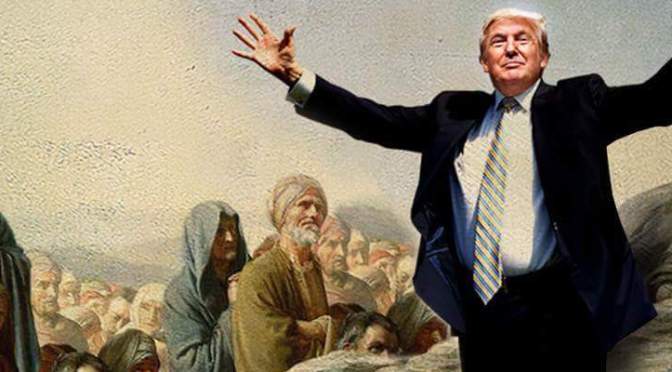
Header Image: https://onehundredbillionsuns.com/2016/08/05/the-beatitudes-by-donald-trump/

Reformation Four Nine-Nine

John 8:31–36

Then Jesus said to the Jews who had believed in him, “If you continue in my word, you are truly my disciples; 32and you will know the truth, and the truth will make you free.” 33They answered him, “We are descendants of Abraham and have never been slaves to anyone. What do you mean by saying, ‘You will be made free’?”

34Jesus answered them, “Very truly, I tell you, everyone who commits sin is a slave to sin. 35The slave does not have a permanent place in the household; the son has a place there forever. 36So if the Son makes you free, you will be free indeed.

Sermon

So confirmands, today you are lucky enough to share this day with the 499th anniversary of the reformation. Now don’t worry if you aren’t entirely sure what “The Reformation” is all about, your parents and families probably aren’t entirely sure either. But today, as you affirm your faith in front the congregation you are standing on the shoulders of a community of people that have gone before you for almost 500 years – The Lutheran community (and Anglican one for some). And Lutherans and Anglicans are just one part of a larger Christian family that has been around for 200 years.

Now the words and promises that you will hear today have already been spoken and made to you in your baptism. But you probably don’t remember your baptism, so we remind you of those promises again today, when you are at an age when you will remember. So you can hear and remember the promises that God has made just to you.

And those promises are the same ones that the reformation was all about.

Reform. Change. Reformation. Change for the better.

Our world talks about change and reform a lot. Political reform, economic reform, environmental reform, social reform – you name it, we are talking about changing it. When we listen to the message around us and to what we as individuals want, change and reform are common themes.

The call for reform and change is not just for change’s sake. The desire for reform comes from a deep need within ourselves. A need to make things better, to make things right. We desire a better life, better circumstances. And at the same time the scariest thing about reform and change, is the fear of loss.

As Lutherans we stand on change, we try to embrace ongoing reform. There are 87 million of us in the world, nearly 3 times the population of Canada. And today, the Lutherans around the world remember that big Reformation from where we began and started.

Four hundred and ninety-nine years ago on October 31st, 1517. A young monk, priest and university lecturer, published 95 theses about change, about religious reform. Martin Luther hoped that his ideas could be discussed by friends and colleagues in a civil manner. Instead, Luther’s writing expressed the growing dissent among the people and pushed into the light issues that had been simmering for decades, which hit Christianity in Europe like a hurricane.

For you see, Luther hit a chord. He connected to that deep desire for change. He identified the issues of oppression in the church and of abuse by the clergy. People were tired of being exploited by the church who made them fear death, hell and purgatory nor did they not want to be continually controlled by the nobility who made them fear soldiers and prisons. As Luther identified these issues, he diagnosed the illness that existed in medieval church.

Figuring out he problem is the easy part though. We are good at diagnosing our problems and knowing that we need and want something different. Luther looked around and saw the suffering of the people and he saw the need for reform.

When we look around at ourselves, we see problems too. We long for change. Here we see a shrinking church membership and at the same time an aging membership. We have heard about financial short comings. And many of us are tired as we give more of ourselves to the church, of our time our money, and of our energy.

And so while Identifying the problem is the easy part, actual Reformation is hard.

When the followers of the Jesus are faced with the prospect of freedom, they balk at the idea. They know their problems too. They struggle under the government of the Romans. And they struggle under the religious rule by the temple priests. But when change and freedom stares them in the face, they would rather stick to what they know. They would rather be oppressed by the Romans and the Jerusalem Temple.

When Luther began proposing reforms to the Church of his day, they were rejected. Even though the Vatican was in debt because of never ending wars and had been bankrupted by the enormous building project of St. Peter’s Basilica, they wanted to stay on the same path rather than actually change.

And the difficulties that christianity faces today in North America are so frightening to some, that congregations are deciding simply to slowly die. To make sure all the surviving members are cared for in the last years of their lives. It is easier and safer to stay the same, even when we can clearly see the problems around us.

And so here we stand. On this Reformation Sunday, on this Sunday of change, we know that we have a problem, we know that we need to reform too.

As Jesus talks to his followers today he reminds them of two simple realities. The truth will make you free. The Son will make you free.

It is the same truth that Luther discovered, the truth that prompted him to begin writing about change in the church.

And it is the same truth that will carry our congregation and our larger Christian family through our problems.

Jesus will set us free.

The reality of our need for change, our desire for reform, is that we cannot do it on our own and and we cannot get it right. As St. Paul writes in Romans, “For all have sinned and fall short of the glory of God”.  We know that things could be different, we know that life could be better, but we also know that no matter how hard we try, we cannot keep from hurting others or being hurt, or from causing others to suffer or suffering ourselves, from causing grief or being grieved, or from killing or dying.

And while most people would give up in the face of this news. Luther heard something different. Luther heard the promise that Jesus makes:

So if the Son makes you free, you will be free indeed

We are all sinners, and we all fall short. Yet, God’s promise is in Christ. As Jesus comes  into our world, as Jesus joins us in falling short and being unable to make things better, Jesus offers freedom.

The Reformation started with this idea, that we cannot really change things, but instead, God is doing the changing. Even though we sin, and fall short, even though we cannot change our world to be the place we know it could be, God is there loving and caring for us. Christ is there, living with, dying and rising again with us.

And God’s grand plan for changing the world, began in the smallest way. A baby born in a stable. A baby like no other. A baby that was divine and human. But God wasn’t done there. God’s next reform was to the idea God loved some and not others, and that God’s love was for those who could earn it. As Jesus preached and taught, he told people, he tells us, that God’s love is for all people. And finally God’s biggest change was in the shape of the cross. On Good Friday, Jesus endured death, yet the surprise of Easter morning was God’s undoing of death’s power over life, God had made a new promise that new life will go on.

It is on these changes and reforms, these promises by God that the Reformation began. And it is on the shoulders of the Reformation that we stand. As Lutherans, we have been given a gift. A gift that came at great cost, a gift that came out of division, conflict and strife. A gift that reminds us that the most important thing the church can do is tell people of God’s love.

And by God’s love, we are set free. We are set free from sin and death. We are set free from our own failures and fears.

Reformation Sunday is about remembering what happened 499 years ago, about remembering and commemorating where we came from. But it also about the reformation that is happening now. The Reformation and transformation that God has been up to this whole time – God has been changing the world, changing us by setting us free.

Amen.