Category Archives: Theology & Culture

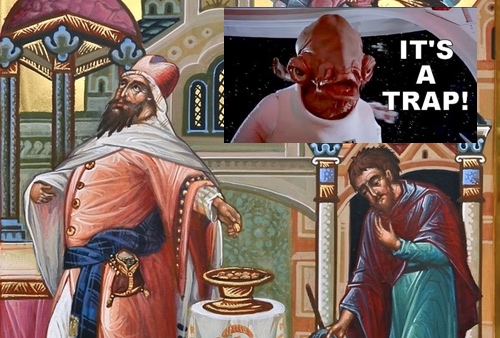
The parable of the Pharisee and Tax Collector – It’s a Trap

Luke 18:9-14

The Pharisee, standing by himself, was praying thus, `God, I thank you that I am not like other people: thieves, rogues, adulterers, or even like this tax collector. I fast twice a week; I give a tenth of all my income.’ But the tax collector, standing far off, would not even look up to heaven, but was beating his breast and saying, `God, be merciful to me, a sinner!’

“God, I thank you that I am not like other people: proud, haughty, self-righteous, or even like that on-fire-for-Jesus Christian. I bow my head when I pray silently, and I cover the amount on my envelope with my thumb when I slip it into the offering plate”.

Have you ever prayed that prayer? Or had those thoughts?

“God, how could you love someone like me. I am not like those other people who have it all together, who give more than I do, who volunteer more than I do, who are better people than I am. Have mercy on me, because that’s all I have”

What about this prayer and these thoughts?

It is easy to hear this parable and think that it is a lesson about the value of humility. There is the Pharisee, incorrectly dividing the world into categories. Thankfully we are not like him. And there is the tax collector. He knows what this is about, he is a good Lutheran. All sin. The only hope he has is for God’s mercy.

To modern listeners, the details of this parable go by so quickly. We don’t know what it was like to stand in the temple of Jerusalem. The term Pharisee is derogatory today. It can seem easy to identify the villain here because we have not heard the standard prayers of the Hebrew faith.

But understanding the context, as always, is very important. The temple of Jerusalem would have been grand sight to behold. It was big and it had rules. The people believed that it was where God lived – in the inner sanctum, the holy of holies. The temple was the place where you had to earn every inch of God’s favour. Whether you were a Pharisee or tax collector, you knew where you stood in the eyes of God when you were inside the temple.

The Pharisee knows that he is righteous. He prays a Benediction that every Jewish man was to pray each day. Thank you God that I am not a Gentile, a sinner, or a woman. The Pharisee modifies the prayer, but the point is still the same. He is genuinely thankful for who he is. The pharisees see those around him and looks down on them.

The tax collector, on the other hand, knows that he cannot expect anything from God. His job requires him to break the rules of Judaism. To charge interest, to handle money with graven images on it, even to steal or assault. He is not righteous and his only hope is God’s mercy. The tax collector is so wrapped up in himself, that he doesn’t see the world around him.

The Pharisee and the Tax Collector are both quick to divide people into categories and be judge on God’s behalf. The Pharisees judges himself righteous, the tax collector judges himself unrighteous. And we are often guilty of the same.

Whether we are thanking God for not being thieves, rogues, adulterers or tax collectors, or whether we are thanking God because we are not arrogant, self-righteous, or prideful, the issue is the same. We divide humanity into categories, justified or unjustified, saved or unsaved, loved or unloved.

Human beings are constantly looking for the ways that we can identify who is in and who is out. We might not be standing on the street corner, boldly thanking God in prayer for our certain salvation. But have we looked down on others, the homeless, those in financial trouble, those who struggle with addiction, those who come from broken families, even those who are sick, and we thank God that we are not them. “Therefore by the grace of God, go I”. Or how often have we been the ones thinking that we are worthless compared to those around us. That we unworthy, while everyone else seems so perfect. Whether we are intentional about it, or whether we do not know that we are doing it, we too place ourselves in the same categories that the Pharisees and the Tax Collector do.

Now, here is the thing about that kind of thinking. It is a trap.

And so it the parable today.

The parable that Jesus tells today is a trap that makes us identify ourselves with either the Pharisee or the tax collector. But this parable is not about pride or humility, and it is just as much not about pharisees or tax collectors.

The parable is about the storyteller.

The parable is about Jesus.

While we are busy trying to make things about us, God is reminding us that it is God alone who justifies. God alone decides who is good enough for the Kingdom.

According to the law, the Pharisee came into the temple righteous, and left the temple righteous. But Jesus says something about the tax collector that should grab our attention,

“I… tell… you,  this man went down to his home justified”.

There is nothing that the tax collector did, rather it is Jesus who says that the man is justified. It is Jesus who decides.

In the world of the Jerusalem temple, there were those were in and those were out. But everything changes with Jesus.

Through birth, life, death and resurrection, Jesus comes to tear down the categories we try to build. Whenever we try to make categories, God will stand on the other side, because God wants all to be included, all to receive grace, all to be loved. God has only one category for all of us. We belong to God and God alone.

Now, to the confirmands who shared their faith statements. If there was one thing I hope you take away from the past two years, it this. That we are not good enough to save ourselves, and nor are we too bad to be loved by God. God is the one who decides who is in and who is out, and God says, you are in.

The parable that Jesus tells is not a parable on how to act, or who to be like or how to pray. This is a parable about God. A parable that shows us God’s motives and shows us the way that God chooses to act in the world. That shows us that God wants to be with and care for the least, the lost, the sinners and the alone. God wants to care for us… because  we are the least, the lost, the sinners and the alone.

Neither the Pharisee, nor the tax collector, nor us, want to see or admit, that being justified, that being saved is something that God does for us. Yet, that is what is told to us today.  The trap is laid that we try to divide humanity into saved and not saved. And it is God who alone who knows the way out. Through love and mercy God chooses humanity. God who chooses those who truly cannot be righteous on our own, God comes to us as Christ who lives and dies, with us, with imperfect and flawed human beings, God sends us the Holy Spirit to bring us into the resurrection and into new life.

Perhaps our prayer today should be:

“God, we thank you that we ARE like other people: Pharisees and tax collectors, sinners and saints.  We are justified by your righteousness; we are saved by your love.”

Amen. 

It was not Moses who gave us Thanksgiving

John 6:25-35

Then Jesus said to them, “Very truly, I tell you, it was not Moses who gave you the bread from heaven, but it is my Father who gives you the true bread from heaven. For the bread of God is that which comes down from heaven and gives life to the world.” (read the whole passage)

Earlier this week, a New York Times food columnist wrote about “Canadian Thanksgiving.” His article was about the surprising but little known holiday of Canadian Thanksgiving on the second Monday in October. He wrote about  the quieter nature of Canadian Thanksgiving that sadly and unimaginatively mirrors the American one in menu and traditions. He thought that there could be something uniquely Canadian that would make Canadian Thanksgiving our own.

The Canadian Thanksgiving for most of us sounds funny, because for us there is just Thanksgiving, and then American Thanksgiving, which seems to be an excuse to have a shopping holiday on Black Friday.

And so this weekend, as we gather with family and friends around mashed potatoes, turkey and football to celebrate “Canadian Thanksgiving,” it may be worth considering where this holiday came from.

While the legends are that the roots of Thanksgiving takes its roots from the pilgrims landing on Plymouth Rock and sharing a feast with the indigenous people that they met in the new world… the reality is that people have been giving thanks around the time of harvest for hundreds of years before the discovery of the new world.

And so for us in Canada, Thanksgiving has been a time to give thanks for all the things that we have been blessed with. To give thanks for the harvest after a long summer of plowing, planting, growing and harvesting.

But let’s be honest, most of us aren’t celebrating thanksgiving for those reasons. Its not like this is the one time of year when we have enough extra food to have a feast. We could probably afford a turkey dinner most days if we really wanted one.

Thanksgiving for us is much more about the time spent with loved ones. We might be able to have turkey whenever we want, but finding the time to be with family and friends… well, that is something we are often desperate for. In fact, unlike the pilgrims of Plymouth Rock, or the extended families working on prairie farms 100 years ago who lived, worked and spent most time together, family time and rest time is very scarce for us. And thanksgiving might one of 2 or 3 times a year when families get to spend quality time together.

We might even get desperate to make this weekend special, with stressing over food and decorations, fighting and bickering because we already sad to say goodbye to loved ones before they arrive, trying to bring back the memories and feelings of the past that we forget to let new memories be made in the now.

As much as Thanksgiving is a chance to be with family and have that moment to pause and relax and just be… it can just as much be that painful reminder of the deep void that we all carry within us. The emptiness that never seems to be filled. The pain of loss and suffering that is never quite healed. The longing for something more than ourselves that we try to fill with things and stuff. That need for meaning in our lives that we push aside with mindless tv or endless internet surfing. That search for happiness that too often ends in substance abuse and addiction, that the next hit never fulfills.

Thanksgiving, like any holiday or time that we try to fill with nostalgia and sentimentalism, can all too often be a reminder of the great void at centre of beings, that we just don’t know how to fill.

Wow… This is a depressing thanksgiving sermon.

Maybe the bible can help? or that Jesus fellow we like talking about in church?

Well, today, when the crowds are following Jesus around the lake, they are clearly looking for something. While they pretend to be surprised to have come upon Jesus, he knows that they are out searching for something to fill their voids. They are doing the same thing that we are often trying to do on Thanksgiving weekend and Jesus calls them on it. These crowds have just experienced the miracles of the feeding of the 5000.  Jesus turned 5 barley loaves and two small fish into enough to feed thousands. And the crowds having experienced this miracles from heaven want more.

More food that is.

The crowds that are following Jesus are probably serial messiah followers. You see, in Jesus’ day, messiahs were a dime a dozen. There were leaders of small religious groups around every corner. Charismatic people who convinced people that they had the solutions to all their problems. The Messiahs promised that they would show people the path to righteousness, or that they would raise an army to oust the Roman occupiers, of that they would make their followers rich… or that they would make the nation great again. And the crowds would follow each would be messiah like the flavour of the week. The messiah they were following last week would different than the one followed now, and the one they would be following next.

And Jesus knows this. “You just want more bread” he scolds the crowds with.

“So show us a sign, that you are real deal” they respond.

The crowds don’t realize they are just following a cycle of disappointment, going from one messiah to the next. They are desperate people, looking for hope anywhere. And each time, they want this messiah to be the one who will fill their voids, who will give them something to hold on to.

But Jesus doesn’t give them a sign. All the other messiahs had signs and miracles too.

Instead, Jesus reminds them of the truths that they have been taught for generations. The manna, the bread from heaven that their ancestors were given did not come from Moses. Or in other words, Jesus reminds the desperate crowds that falling just another messiah in the hopes that this will be the one is not who they are.

Jesus reminds them that is is not Messiahs with big promises, it is not Thanksgiving dinners, it is not seeking after the next hit, is not trying to fill our empty voids with junk that satisfies.

Jesus reminds the crowds that is was God who provided the manna, the bread from heaven.

And then the crowds see.

It wasn’t signs that they needed. It wasn’t more bread. It wasn’t more stuff. It wasn’t more distraction. It wasn’t more escape. It wasn’t more of what they once had.

Jesus reminds them WHO it is that gives true bread from heaven.

Jesus reminds us WHO it is that can fill that void centre of our being, WHO it is that will give us that bread of life. Only God can relieve the our hungry void. Only God can fill our thirsty emptiness.

This weekend, as we sit at Thanksgiving tables desperate for the thing that will fill our empty voids, to satisfy the longing that we carry for something or someone to finally give us what we need… it won’t be the turkey, or the memories, or the stuff in our lives, or the escapes we seek out that will fill us. It will be those moments when we reach out across the table with open and empty hands and say, “pass the potatoes.”

It will be when we look into the eyes of those that we love, and recognize that we are loved, that we will be filled.

Because, those moments of recognizing love in others begins here first. It begins with the open hands and open hearts that we bring to God’s table.

As we come with our voids held out and open, God says to us “the Body of Christ given for you. You are now a part of me and I am a part of you.”

As we come with the emptiness deep inside of us ready to be filled, God says to us, “the Blood of Christ, shed for you. I will fill you with my love, and you will not thirst”

Here, in this Body that is the church, in this family of Christ, we are reminded of what we have been taught for generations. That true bread from heaven, bread that leaves us full inside, that fills our voids and our longing… that God gives us this bread.

That here, at the Lord’s table of Thanksgiving,  God gives us the true Thanksgiving meal.

Jesus said to them, “I am the bread of life. Whoever comes to me will never be hungry, and whoever believes in me will never be thirsty.”

Are we the rich man in The Rich Man & Lazarus?

Luke 16:19-31

Jesus said, “There was a rich man who was dressed in purple and fine linen and who feasted sumptuously every day. And at his gate lay a poor man named Lazarus, covered with sores, who longed to satisfy his hunger with what fell from the rich man’s table; even the dogs would come and lick his sores. (Read the whole passage)

Is anyone here worried? Did any anyone else take a moment to think as we heard this parable? Am I like the rich man and I don’t know it? Will I end up in Hades because I have a house and a car and RRSPs? These are fair and honest questions. Last week there was confusion about the Master who praises his dishonest manager. But this week things are clear. The rich man is rewarded in this life and punished in the next. Lazarus, the poor man living in front of the rich man’s house was punished in this life and will be rewarded in this next.

Well, let’s think about this. How much makes you rich? Well, if your annual salary is $40,000 a year, you are in the top 5 percent of the worlds richest people. If you make $60,000 a year, you are in the top 1% of the world’s richest people. These can be staggering figures.

If this parable is really about the amount in your bank account, then most Canadians are in deep trouble.

And while this parable is familiar to us, we cannot reduce it to its surface meaning. When Jesus tells a story, there is always more to it than what’s at the surface.

The rich man is more than just a rich person. He is the epitome of wealth and excess. He wears the clothes of kings, the feasts each day like he is at the royal court. He is a caricature more than real person. And Lazarus, he is the poorest soul you have ever seen. Starving at the rich man’s gate and too weak to move. Diseased and unclean. He is so pitiful that even the street dogs take mercy on him.

Yet, something strange happens when Lazarus dies. For you see, normally an unclean sinner like Lazarus should not be taken to heaven, at least according to the religious understanding of his day. The poor and the unclean are unrighteous, and while they are to be cared for in this world, they excluded from the next. But when Lazarus dies, he is carried into heaven by angels, similar to Elijah or Moses, heroes of the Hebrew people. Heaven was reserved for only the most favoured of God.

And something even stranger happens when the rich man dies. Most people in Jesus’ day didn’t believe in an afterlife for the average person. The place you went to when you died was Sheol, the ground, the grave. But the rich man isn’t just buried. He goes to Hades. And Hades is not just generic Hell. No, the rich man winds up in Greek Hell. Gentile Hell. Being buried wasn’t bad enough in the parable, he had to go to the hell of another religion.

And here is where we get to see that this isn’t about what we need to do to get in heaven. Even in Hades, the rich man still doesn’t have clue about what is going on. He cries out to Abraham from gentile hell. And even from hell he maintains his superior attitude. As if poor Lazarus hasn’t suffered enough, the rich man say to Abraham, “Send that poor Lazarus fellow down with a drop of water.”  Here he is in hell, acting like a snooty hotel guest ordering room service. And when Abraham says no, the rich man tries again. He orders a message to his brothers, and still Abraham refuses.

The rich man is the epitome of selfishness. He does not care for the poor on his door step as religious law dictates, he dresses like a king and eats like a king. And even when he is in Gentile hell, he doesn’t give up on his sense of entitlement. The chasm that has been set between Abraham and the rich man is the chasm of self-righteousness.

The chasm of selfishness that we create for ourselves so often keeps us from seeing the world around us. The rich man might be an exaggeration and Lazarus might be an extreme example, but the reality of these feelings and emotions about others, about ourselves, remains the same. Often we get stuck inside ourselves. We cannot see beyond what we are owed, what we believe we deserve and what injustices have been done to us.

And we have a name for this as Lutherans — original sin. We are curved in on ourselves. We try to be like God. We try to save ourselves.

And in the end, we fall short and we fail.

We die.

Its the last few words of the parable that cue us into what Jesus is talking about today.

“Neither will they be convinced, even if someone rises from the dead”.

We have heard those words before. The rich man wants Lazarus the ghost to go to warn his brothers of their fate so that they can save themselves. But Jesus is not talking about Lazarus the ghost.

It is not Lazarus who comes to us from the position of the poor in order to save us. It is God in Flesh. It is Christ who comes into our world as the child of peasants, Christ who is a homeless and penniless carpenter, Christ who is put to death as a common criminal.

The rich man is trying to save himself while Lazarus is dead to the world. These two are not really people, but reminders of who we are. That we are in need of salvation. And it is God who is giving up all power and might, to become like us. Christ is born into the muddy, dirty places that we live in, the places of self indulgence, the chasms of superior attitudes, the gates of self-pity and death.  And it is in these places, where God comes near to us.

Whether we are rich or poor, entitled or humble, in the mansion or on the street.

God is turning death into life regardless.

God is licking our wounds of suffering and sin.

God is loving us, even when we do not deserve to be loved.

And God is doing this whether we see it or not


God is acting in the world no matter what we are doing. God is making the dead alive, even if we are too busy to notice.  And God isn’t swayed by our righteousness or unrighteousness. God acts out of love, God comes near enough to touch us because we belong to God.

The world is so much more grey, so much more complicated than the story of the rich man and Lazarus. We are all too rich too see others around us. And we are all too poor to do anything to save ourselves. And this parable isn’t about condemning the rich and nor is about the value of being poor.

This parable is about the cross.

The cross where new life begins in the most powerful symbol of death.

The cross where God empties Godself of all power and might to take on human flesh and dies like us.

The cross where God hides in plain sight, where God turns the world on its head and where God reminds us all that it is God alone who saves us.

Will our riches will keep us out of heaven? Yes they will, not even money can pay our way. Will being poor and dead to world make us worthy of salvation. No. Nothing that we do will save ourselves.

God alone saves.

The Lost Sheep & Lost Coin vs Caring Shepherd & Joyful Woman

Luke 15:1-10

So he told them this parable: “Which one of you, having a hundred sheep and losing one of them, does not leave the ninety-nine in the wilderness and go after the one that is lost until he finds it?…

“Or what woman having ten silver coins, if she loses one of them, does not light a lamp, sweep the house, and search carefully until she finds it?…

Finally, Jesus seems to be laying off the guilt trip this week. For the past couples weeks, Jesus has been giving us a hard time. Two weeks ago he was criticizing our sense of self-importance. Last week it was our holding on to possessions, and how they hold on to us.

Today, we hear two familiar parables. The Lost Sheep and the Lost Coin. They are connected to a third, the parable of the Prodigal Son, which we heard in Lent. And it is nice to hear something that sounds a little more Jesus-y. A little less Jesus the critic and little more of the feel good Jesus, the hopeful Jesus.

The experience of being lost and being found is something we can all identify with. We have all been lost or have lost something. We have been found or have found something or someone. Being found is a joyful feeling, finding that lost thing is a relief. And as that familiar song says, “I once was lost, but now am found. Was blind, but now I see.” We are deeply connected in faith to the idea of the lost being found. When Jesus talks about finding lost things, it is something that we feel down in our souls, in the very core of our being.

Jesus is talking to a varied group of listeners. Tax collectors and sinners, or more appropriately, debtors. The people who collected the money and the people who owed the money, along with the Pharisees and scribes, religious authorities. Upon hearing their grumbling about the company that he keeps, Jesus offers these first two of three parables.

A shepherd loses a sheep. One lost from the flock of 100. So he leaves the 99 in order to the find the one. Some might call it dedication, others might say irresponsible. But he finds the sheep and celebrates.

A woman loses one of her coins. A silver coin or day’s wage. She tears apart the house to find it and then throws a party. A lot of effort for just one coin, but she finds it and celebrates.

The point is made. The pharisees and the scribes might be grumbling about the presence of tax collectors and sinners, but lost things, lost people are kind of God’s thing. And yet, the grumbling of the Pharisees and scribes does point us to a problem that we often seem to share. No matter how hopeful and feel good Jesus gets, we find reasons to grumble.

The Pharisees and scribes show us our own complicated relationship with the idea and experience of being lost.

I can remember those moments that stick in my memory from childhood. Wandering the aisles of the grocery store or the clothing racks of the department store, when my mother disappeared from sight. I was never lost for more than a few seconds or minutes, but the fear that so quickly sets in can be paralysing. It is the same for being lost in an unfamiliar city, or hiking through the mountains and leaving the trail only being unable to make your way back.

But perhaps, it isn’t just being physically lost. It is losing that job, losing that relationship, losing that sense of freedom because of illness or disability. Or maybe it is just feeling lost in life, unable to gather your sense of self enough to feel grounded and secure.

Being lost is terrifying, unsettling, debilitating. And when we are lost, or when we feel like we have lost out, we are quick to blame those around us. The map maker, or GPS company or city planners. The company we used to work for, the government, the economy, our ex, the disease or accident. Or maybe just the whole world seems to be at fault.

Yet, there has been a strange attitude that our world has been exposed to lately. The attitude that brings us Trump or Brexit or Canadian Values Screening. When others are lost, we are quick to blame the lost for their problems. Those people don’t need to come here and take our jobs. That person should have had the will-power to resist addiction. If he just tried a little harder at work. If she just gave him another chance. If they had taken better care of themselves, maybe they wouldn’t have gotten sick.

When we are lost, it is someone else’s fault. When someone else is lost, it is their own fault.

Being lost is a complicated experience indeed.

Some of your may remember all the way back to Lent and the story of the Prodigal Son. You may remember that the titles of parables are not what Jesus’ named them. The titles are what we, the church over the centuries, have named Jesus’ stories.

And the parable that we call The Prodigal Son is called by another name by the Eastern Orthodox. They call it the parable of the Loving Father.

And how we name the parable shows us which part we think is most important.

The parable of The Prodigal Son is about a spoiled brat of a son who spends his inheritance on partying, only to have to return home, hand in hand. It almost sounds like a cautionary tale!

But the parable of The Loving Father, well that is about a father who welcomes his lost son home with open arms.

Hear the difference?

When these three parables are placed side by side by side, the Lost Sheep, Lost Coin and Prodigal Son, we see that that the lost things have little to do with each other. It is hard to see the common thread between a sheep, a coin and a son.

Yet, when we compare the Shepherd, the Woman and the Father… each goes and seeks out the lost. The Shepherd leaves the 99 to find the 1. The woman turns her house inside out to find the coin. And the Father runs to greet his son while his son is still far off.

Each goes and seeks the lost. And then when the lost has been found, each celebrates. The Shepherd rejoices with his friends. The Woman throws a party for a coin. The Father slays the fatted calf for his son that was lost and now is found.

We name the parables after the lost things because we think the lost things are the most important parts of the story.

But just maybe Jesus isn’t making a point about what is lost, but instead who does the finding.

Maybe the parables should be named the Caring Shepherd, the Joyful Woman, the Loving Father.

Maybe Jesus is trying to make a point about just who is finding us.

The Pharisees and scribes want to blame the lost for being lost. We have a complicated relationship with the idea of being lost. We would blame everyone and anyone else when we feel lost, but anyone else who is lost has only themselves to blame.

Yet in the midst of misread maps and failing GPS, in the midst of lost jobs, lost loves and lost health… in the midst of all the things and people that are lost in our world.

Jesus is talking about being found.

Jesus is talking about who is doing the finding.

Jesus is talking about how God goes to extraordinary lengths to find lost things and people.

Jesus is talking about all those people that we are quick to label as lost,

tax collectors and sinners,

those who owe debts and those who collect,

those whose maps have led them astray in life,

those who know the loss of brokenness and suffering,

those who have no other place where they belong,

Jesus is talking about how all those people are the ones who God finds.

Jesus is talking about how all those people are us.

And in fact, when Jesus tells these parables again here today, Jesus tell us that no matter how lost we may feel in life, no matter much we focus on the lost things and the lost people, that the point of this story is being found. Jesus tells these parables about God who finds.

Jesus says today, that here, where lost sinners gather together to repent… that here we are the most found we can be.

Because our finding God has found us, in the forgiving words of grace, in the finding waters of baptism, in celebrating feast of bread and wine.

Jesus is telling feel good, hopeful parables today. Parables that we may think are about lost things and lost people. But parables that are really about Caring Shepherds, Joyful Women and Finding Gods.

The Church is no longer invited to the Party

Luke 14:1, 7-14

But when you are invited, go and sit down at the lowest place, so that when your host comes, he may say to you, `Friend, move up higher’; then you will be honored in the presence of all who sit at the table with you. For all who exalt themselves will be humbled, and those who humble themselves will be exalted.” (Read the Whole Passage)

Sermon

For most of the summer, we have been hearing the stories of Jesus ministry, dropping in on scenes from his travels, hearing parables and other teachings. Stories like Mary and Martha, the Lord’s Prayer and the Good Samaritan. Last week we heard about the women who was bent over or stopped for 18 years. All Jesus had to do was reach out to touch her and she stood up straight, she was liberated from her condition by Jesus’ compassion.

Today, Jesus in invited by some big whig pharisees to a dinner party. An invite that only important people get. And with all eyes on him, Jesus is sounding a lot like Martha Stewart. Jesus is giving dinner party advice. About where to sit and how to avoid giving offense or being embarrassed. Don’t sit too high so that you aren’t asked to move to a lesser seat. Imagine that drunken and sleazy wedding guest trying to cozy up to the one of the bridesmaids at the head table of a wedding banquet. Not cool, Jesus says. Instead sit below your station. Find a table at the back of the banquet hall, and the bride’s father will come and move you closer to the front, and everyone will see how important you are! You can almost see the headline across a house and home magazine: “Where should you sit at the party?” find out pg. 23.

The only problem with this kind of dinner party advice is that it sounds opportunistic or faux humble coming from Jesus. And isn’t Jesus supposed to promote authentic humility? Sitting low to move high is not humble. Shouldn’t Jesus tell us to sit low and stay low?

These days, proper dinner party etiquette is mostly a niche interest, a vanity for the kind of people who worry about centrepieces, dinnerware settings and chair covers. But 2000 years ago in Hebrew culture, social standing was extremely important and it came to play anytime people gathered together. Each guest would sit according to the station in the community and knowing where you sat at a dinner party was about knowing how to rank yourself in society. And everyone knew where they belonged, on top, on the bottom or in between. And where you stood was a sign how important you were, how much respect you commanded, how you stood in the eyes of the powerful, and even where you stood with God. In fact, your social standing had a lot to do with where you stood with God. The more important you were socially, the more you had earned God’s favour. But perhaps most crucially to today’s story is the effect of honour and shame in Jesus’ world. To be moved down to a lesser place would bring shame upon yourself, and shame would lessen your social standing, and therefore lessen your favour with God. But for a host to seat you below your standing would be shame for the host, so it would be essential for the host to make sure that each guest was given the proper respect and honour due their standing. To be moved into the place of honour, was like being ushered a little closer to the gates of heaven.

The world that Jesus lived in was a little more Downton Abbey than we are used to… We just aren’t as hyper attentive to who are most and least important people in the room.

Still, in many ways our world is full of the same kind of concern for where we stand, and the same ranking of who is in and who is out, who is on the top and who is on the bottom.

Last week, Pastor Stan spoke to us of how the image of this woman bent over, unable to see anyone’s face but only their feet, that this was an image for the church. We are feeling bent over and burdened like this woman. It is a surprising turn for us, for the church. We used to occupying a place a of power and privilege in the world, we used to be seated at the places of honour. We used to host the influential and the powerful in our buildings and communities. Yet, these days we feel like we have been left off the guest-list by the world, or if we are invited to the party, it is to be the court jester. And when it comes to our table, we feel like there are more than enough places, that the few guests who are here, can choose any seat because you can’t offend an empty chair. Our tables feel empty.

However, there is more to Jesus’ dinner party advice than just knowing where to sit. We should realize that we have been guilty of exactly the things he names. When we had the power, we were often guilty of sending people down the table. We made sure that people knew they weren’t good enough for the seats of honour, and we saved the best spots for ourselves. And when people stopped coming to fill the cheap seats, we blamed them for not knowing their place and fulfilling their duty.

And now… now, we have been sent down the table. The world has told the church that we were sitting too high for our station. People are choosing sports, shopping, recreation, or sleeping in, rather than being at church on Sunday mornings. It has been happening for decades. And now as the baby boomers enter retirement, they would rather golf or go the cabin or travel than be in church. Generation Xers don’t trust institutions like us, and would rather build their own communities and their own families. Millennials are tired of the church trying to attract them in with loud music and flashy services, they want a church that wants to honestly deal with their doubts instead of shushing their questions.

Jesus’ advice to us about dinner parties is a lot more than it seems indeed.

But it is Jesus’ next piece of advice that should really get our attention. Dont’ invite those who can repay the favour… instead invite those who cannot.

For as much as the church is guilty of sending people up and down the table, we have also  been generous, we have welcomed strangers like the refugee family that arrived this summer. We have fed the hungry, cared for the sick, and opened our doors to our community. We have been a curious mix of generous and concerned with status, we have helped those in need even as we let them know their place was down the table.

But with Jesus’ last piece of advice, he names the thing that we have forgotten. Jesus reminds us that the table is not ours. The food, the chairs, the drinks, the invitations. They were never ours to control.

The table is God’s. And God has invited us to it. God has not invited friends and brothers and relative and rich neighbours. God has invited the poor, the crippled, the lame, and the blind. God has invited us. We are the ones who cannot repay the invitation, we have no table, no place, no welcome good enough for God… and yet God’s table, Jesus’ table is always open to us.

And at God’s table each place is the place of honour. There is no moving up or moving down. There is no sitting higher with the risk of being sent down. There is no sitting lower to work our way up. All the places are the same, all are the best, all are open for us. With God, there is simply a place at God’s table. A place for us, each and every one of us.

Jesus’ dinner party advice is more than it seems. And even though the church has not always been the best guest or host, we have a God who is the ultimate host. God is the one who always has a place for us. God is the one who welcomes us to the place of honour. God is the one to whom the table belongs.

So when it seemed like we as a church sat at the place of honour in the glory days, or now when it feels like have been left off the guest list… neither has been the truth. For we have always had a spot at God’s able, a spot no better, and no worse than anyone else.

God’s table has always been open, set and ready for all. Ready for us.