Category Archives: Theology & Culture

Reformation 500 – The Next 500 years for Lutherans, Protestants and the Church

This year is the 500th anniversary of Martin Luther’s famous act of nailing his 95 theses to the church door in Wittenberg on October 31st.

This act is considered by many as the beginning of the Reformation.

For Lutherans, Martin Luther’s particular witness to the gospel of Christ forms the basis of our confession and understanding of the Christian faith.

So as Reformation 500 approaches this year, Lutherans all over the world are commemorating the anniversary (as opposed to celebrating) and we are trying to include brothers and sisters of other denominations, particularly Roman Catholic, where possible.

As I attended the National Convention of the denomination in which I serve, the Evangelical Lutheran Church in Canada, we have been asked to consider what the next 500 years will bring for Lutherans, and all Christians.

This question has been rumbling around in my mind for a long time and in a renewed way this 500th anniversary year.

This is not an easy question to answer. It is deeply related to the biggest struggles of European and North American churches, most notably it relates to our experience of decline. Before getting to what I think the next 500 years will hold for us, the issue of delcine needs to be addressed.

Humans have this habit of thinking that what just happened will continue happening indefinitely. We, in this North American context of Lutheranism and wider Christianity, have been experiencing churches that are dropping in membership and attendance, budgets that are getting bigger while giving is shrinking and the average age of those still in the pews and contributing is getting older. And because this is our most recent experience we assume that the future holds more of the same.

But this is actually a really poor prediction model.

Let me put it in different terms.

50 years ago, the same kind of convention that I attended for my denomination would have looked like this: The-American-Lutheran-Church-Constituting-Convention_2-18-13

Now imagine going to someone standing in that crowd and telling them that in a mere 50 years, that the 3 or 4 Lutheran bodies that each look like the above picture will be merged together and look like this when they gather:

19800617_10159029420640541_3990159967040986153_o
Photo Credit – https://www.facebook.com/CanadianLutherans/

Thousands reduced to less than 200.

Those people back in the 50s and 60s would have laughed and laughed and laughed… But this is where we are now. So what would make people today laugh and laugh and laugh… not a prediction of more of the same. But perhaps a predication that churches will be filled once again… filled with a new spirit and new vitality that we would have never dreamed or imagined. It won’t be the 50s again, but it will be something unexpected and new.

You see, we also have to think back 100 years to gain perspective. Much of North American Christianity looked similar to where we are now. There were some large and thriving groups, but lots of small communities barely able too keep up buildings, barely able to pay pastors, barely able to fund seminaries or missionaries or wider church structures. Many church groups were marginal to larger society and many churches didn’t make it and were lost to history.

But think about it, society was in a time of great transition. Conflict was the story of global politics (WW1), immigration was high (settling the western part of the continent), new technologies were changing the way people lived (electricity, telephones, automobiles, modern medicine etc…). And it remained messy for nearly the entire first half of the 20th century.

But this chaotic situation eventually led to many, many people seeking a truth greater than themselves, finding solace in the promises of a God who was in control when the world seemed ready to end, finding comfort in faith despite the rapid pace of new technology constantly changing the world.

We don’t have to think about our current world situation very long to see the similarities, to see that our political and economic world which once seemed to provide a stability for people to live their lives on, is turning into an instability that is only going to get worse before it gets better.

Most predications that I hear about the next 500 or 50 or 5 years tell us that decline will simply continue indefinitely and we are just going to have to accept that.

I don’t.

I don’t think that the antidote to decline is to simply be better sales people for church with flashiest and shiniest features to entice largest slice of a shrinking pie of interested people into church.

I think the church is about to be one of the few places of hope that many people will have to turn to in our increasingly chaotic world. I think that some political leader may just push that red button (and no it will not be like an apocalypse movie) or some aspect of climate change will be pushed over the edge, or some hacker will decide that it is time to empty everyone’s bank account… or most likely I think that through difficult struggle and resistance the average people of the world – who are sick of living under systems that privilege a small few – will decide this is not acceptable anymore.

And a paired down church will have to be ready. Ready to welcome the masses who have no where else to turn for hope. The masses who no longer rely on the invisible forces of the world (governments, international organizations, corporations and civil society) to care for them.

Over the coming years and decades, as most church leaders anticipate more decline, the world is going to surprise us. The world is going to surprise us by needing what the church has to offer.

Let me offer and example.

In 2015,  the National Church Council of the denomination that I serve in the Evangelical Lutheran Church in Canada wanted to challenge our church body to 4 different ways of commemorating Reformation 500. We were encouraged to raise $500,000 for the Lutheran World Federation (LWF), to provide 500 scholarships for students in Jordan and the Holy Land, to plant 500,000 trees and to sponsor 500 refugees.

As the story goes, the intial idea was the above with one fewer zero on each number. But a particular council member said, “let’s slap a zero on these challenges.”

Of course the council did not expect us to meet those goals, but swinging for the upper deck was better than just going for a base hit.

Two years later, we have raised 150,000 for the LWF (3 times the pre “slap a zero on it goal”), we have provided 160 scholarships (3 times the original goal), and we have planted 80,000 trees (almost two times the original goal.

But here is where it gets interesting.

Since 2015, and with several months to go before Oct 31, we have sponsored 540 refugees exceeding the “slap a zero on it” goal and more than 10 times the original goal!

How did we do that?

Well just a couple months after our 2015 national convention, the body of a young Syrian boy named Alan Kurdi washed up on a beach in Turkey. A boy who had been denied entrance to Canada. A boy whose tragic death mobilized the world. 
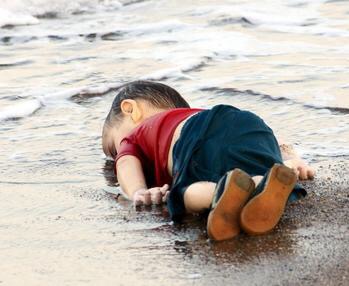
So did we meet our “slap a zero on it goal” because we are a church of expert refugee sponsors? Hardly.

But rather the world needed what we had to offer. Which was communities small enough to care for families who needed help, but large enough to mobilize enough money, furniture, and volunteers to settle newcomers in our commmnities.

All we needed to do was let our anxieties about decline die just long enough to see that God was bringing about tangible new life through us. God is using us for real resurrection.

It is in this intersecting place that a declining church meets a world in need of hope.

The decline of North American churches in the past few decades is not a never ending trend. But I do think God is using this time to help us shed our baggage. God is letting us struggle so that we can get all the wrong fixes and solutions to decline out of our system. So that we can try trendy music and flashy tech and hip pastors. So we can try to reincarnate the knitting groups and service clubs and curling bonspiels of the past. So that we can get all the complaining and shaming of our family, friends and neighbours over with. So that we can see that nothing we come up with will be the solution to our problems.

God is letting us experience decline long enough to finally die to our memories and nostalgia of the glory days and realize that the only thing the church ever had was the good news of Christ’s death and resurrection. All we ever were at our best are communities grounded in Christ’s new life given for us.

To be honest, I think in many ways the next 500 years for Lutherans and for North American Christianity will look a lot like the last 500. We will continue to be communities where the gospel is preached and where the sacraments are administered. Sometimes we will be strong in number and power. Other times we will be weak and marginalized. But in the end, neither of those realities matter.

That God is answering all the sin and death in the world with resurrection and new life proclaimed in churches just like us does.

Abraham failed the test… and so did God

Genesis 22:1-14

When they came to the place that God had shown him, Abraham built an altar there and laid the wood in order. He bound his son Isaac, and laid him on the altar, on top of the wood. Then Abraham reached out his hand and took the knife to kill his son. (Read the whole text)

Here we are back into the long season of green, the chance to explore the various stories the bible. The Gospel readings of this season tell about Jesus’s teachings and ministry. The Epistle readings take us through the various letters of the New Testament to explore what was happening in the early church. And the Old Testament readings give us the stories of God’s people.

Today, the story of Abraham and Isaac is simply too tempting to avoid exploring.

The story of Abraham and Isaac is one we know well. It is a story that is not only familiar when we hear it, it is one whose themes are used over and over in literature, movies  and TV. How often is the hero in a movie faced with an impossible choice involving the sacrifice of someone that they love?

The reason that Christians know this story of Abraham so well is that it is often used as an example of faithfulness. Abraham is an example of unwavering faith, so the idea goes. And on the surface it is an idea that makes sense.

In order that Abraham demonstrate his faith, God orders Abraham to put his faith before everything. Before the love he has for Sarah and their only son. Before  the love that Abraham has for Isaac, the son who will be person who carries Abraham’s legacy into the future. Without Isaac, Abraham and Sarah are simply people who will be forgotten to the sands of time.

And Abraham delivers. He shows us what it means to be faithful. Abraham’s faith is so powerful an example that even the authors of the New Testament point to it as a model to follow.

Abraham is willing to sacrifice his own son if God asks. Unwavering faith.

Or perhaps blind faith.

Or perhaps radical faith.

Radical fanaticism even.

Because we don’t usually call people willing to kill for their faith great examples… we have other words for those people don’t we?

And what about God? In this story, God asks his chosen disciples and follower to sacrifice his son, the very son that is the fulfillment of the covenant.

Have we read this story right? Christians have been using Abraham as an example of faith for hundreds of years, and the Hebrew people for thousands before that.

But blind faith or radical fanaticism is not normally the kind of faith that we are trying to help grow in people, in ourselves.

And a God who toys with us simply to “test” our faith doesn’t seem very loving or caring.

So what is going on in this story?

Well, to understand how Abraham and Isaac arrive at this moment, we need to go back to the beginning.

The oldest part of the bible is not found in the stories of creation or the garden of Eden or in Noah’s flood. Rather Abraham’s is the oldest. And ten chapters before Abraham and Isaac, the story begins. Back when Abraham was Abram, and Sarah was Sarai, God called these two to take up everything they had to go to the land that God would show them.

Abraham’s story begins with a 3 part covenant made with God. God promises Abraham land, descendants and a relationship. And this 3 fold promise becomes the focus of the rest of the book of Genesis, and to some degree the rest of the Old Testament.

So Abraham and Sarah pack up everything and go. And when God says, “Go” Abraham is really good at going. He is always willing to go when God calls.

But it is this other part of the promise… the descendants one that Abraham has trouble with. Going is easy… when God commands it, Abraham does it either out of faithfulness or perhaps fear. But the promise of descendants is tougher. Faith in this promise cannot be rooted in obedience out of fearfulness. Believing that God will provide this barren couple with children takes hope, it takes faith in the future, and faith in the third promise, that Abraham and Sarah are indeed God’s chosen.

And so Abraham goes, but as soon as he encounters the powerful Pharaoh of Egypt he gives Sarah away to be a part of Pharaoh’s harem, claiming Sarah is his sister, not his wife. So God has to intervene to save the day.

And then Sarah, fearing that she will not provide a son, tells Abraham to have a child with the servant Hagar, who gives birth to Ishmael… but he is not the son that God promised.

Next God tells Abraham directly that Sarah will bear a son, and all Abraham can do is fall to the ground in laughter.

And two weeks ago we heard the story of God showing up again to tell Abraham and Sarah that she will bear a son and this time Sarah laughs.

And after all this, Abraham gives Sarah to King Abimelech for his harem, again requiring God to intervene.

So finally, after 9 chapters of Abraham’s struggle to believe the promise of children, Sarah gives birth to Isaac.

And the long awaited, hard to believe promise has come to fruition.

Yet still Abraham still struggles to believe in the promise, in hope for a future. Even with Isaac in his arms now.

Some Rabbis suggest that the test that God gives Abraham is not one of obedience. That it isn’t a game of chicken that God is playing. In fact, God knows that Abraham will follow the commands, he has always been willing to go when called.

But does Abraham have faith in God’s future? Does he believe that God will make him the father of God’s chosen people?

So just one chapter after Isaac’s birth, God gives the command to sacrifice Isaac.

So Abraham goes and for three days – without a word of protest – walks to the mountain with Isaac. And when they arrive, Isaac asks where the lamb to be sacrificed is… and Abraham says something about God providing it, knowing full well that there isn’t a lamb. Abraham then leaves his servants and pack animals behind, and goes to the ritual place with Isaac. There he ties up his son, binds his son like lamb to be slaughtered and places him on the altar.

And without hesitation raises the knife.

In that moment, when you take into account everything that has happened in the ten chapters before this… Abraham has not passed the test.

He has failed.

And so has God.

For ten chapters, through rescuing Abraham from himself, from proving wrong Abraham’s laughter at what he and Sarah thought was impossible, God must have thought that Abraham would finally believe that promise, the promise of descendants, the promise of hope and a future.

And yet for 3 days Abraham marched to mountain without a word of protest. Abraham looked his son in the eye and lied about what or who would be sacrificed. Abraham tied up his son and placed him on an altar of sacrifice. God must have expected that Abraham would protest or bargain, just as he had for the people of Sodom. God must have thought that Abraham would demand that God live up to the covenant, that God certainly wouldn’t just arbitrarily take away Abraham’s future. God waited for the protest. But nothing.

And so Abraham fails the test… but so does God, for a good test is one a student can pass.

And yet there on mountain, standing above Isaac with his knife in hand… just maybe it is Abraham who teaches God something, maybe it is Abraham who tests God.

Perhaps after 10 chapters of trying to get Abraham to believe in the covenant, in the promise of hope and future that God makes with Abraham, God realizes that Abraham cannot have faith… only fear. Fear that drives him to go when God commands, but fear that prevents him from having hope.

So God intervenes.

God caries the hope for the future that Abraham cannot.

God upholds God’s part of the covenant… even if Abraham cannot have faith in the promise…

God will have hope in Abraham, even when all the signs say that God shouldn’t.

God sends a ram.

God sends a ram who is a sign that God will not give up on us.

God sends a lamb who will be not a sign of death on an altar, but life on a cross.

A lamb whose coming into our world will signify God’s unwavering faith in us.

A lamb who is God’s promise of hope and future in the flesh.

For you see, we are just like Abraham.

In fact we are Abraham.

We too find the promises of God laughable, we find the threats to our future too much to confront, we too have difficulty seeing our hope and our future… even when God plunks signs right in our arms.

And so God sends us the lamb who will save us.

The Christ who is found in the thicket of the church.

The Christ who is mercy and reprieve from the knives that we threaten our hope with.

The Christ who is life, when there is surely and only death in store for us.

The Christ who is God’s promise in flesh.

Abraham’s faithfulness is nothing to be marvelled at, he isn’t a model to aspire to…

Abraham is a model of the faith we already have.

As too is Abraham’s fear the same fear that we carry. Fear that is dispelled each and every time we gather around God’s word of promise and hope for us.

Abraham reminds us that God knows we cannot be faithful on our own… and so God is faithful for us. God knows that the promise of Christ is our hope and our future.

God is one the passes the test for us.

Two Sparrows for a Penny

Matthew 10:24-39
Jesus said to the twelve disciples…,

“Do not think that I have come to bring peace to the earth; I have not come to bring peace, but a sword.

“For I have come to set a man against his father,
and a daughter against her mother,
and a daughter-in-law against her mother-in-law;
and one’s foes will be members of one’s own household… (Read the whole passage) 
As we begin this long season of green in the church, we start with some bold words from Jesus as told to us by the Gospel of Matthew. You would think that we could start this season of Jesus’ parables, preaching, and ministry with something a little more tame. But that is not Matthew’s style.

The 4 gospels, and their four authors, Matthew, Mark, Luke and John tell the same story, but in very different ways. Just like 4 pastors might preach very different sermons on the same topic. If we were to imagine what kind of people the gospel writers were, John might remind us of an academic, a professor type passionately using lots of words to describe his topic of study. Luke would be the compassionate care-giver, always thinking of the less fortunate. Mark should remind us of a mystic, a wise spiritual advisor who never says more than he has to.

And then comes Matthew. Matthew is like the TV evangelist, the mega church preacher preaching to a stadium of people. Matthew is the type who has all the answers. Matthew can spitfire verse after verse of scripture without hardly taking a breath. Matthew knows what is right and what is wrong, what is good and what is bad.

And so, as we hear Matthew collect some of the sayings of Jesus, he gives them to us in spitfire fashion, one after another. 

Together, they almost sound like a warning. Warnings about being in the right allegiance, about following Jesus in the right way, about being a disciple and the dangers of what will happen if we choose the wrong side:
“If they have called the master of the house Beelzebul, how much more will they malign those of his household!”
“rather, fear him who can destroy both soul and body in hell.”
“whoever denies me before others, I also will deny before my Father in heaven.”
“I have not come to bring peace, but a sword.”
“For I have come to set a man against his father,”
“whoever does not take up the cross and follow me is not worthy of me”

Wow… harsh stuff.

The Gospel of Matthew has been the most popular gospel of Christian history. For nearly 1000 years, it was the only Gospel that christians used. And when we hear what Matthew offers us today, as harsh as Jesus sounds, Matthew’s popularity makes sense. Matthew offers us what we want to hear. Easy answers. Right and wrong answers. Matthew offers us a legalistic path to the truth. Do this, this and this, and you will be okay. Do that, that and that, and you will go to hell.

Matthew’s approach to Jesus’s words appeals to our fears. Matthew frightens us into feeling secure. Matthew warns us of the danger in the world, and then tells how we can avoid it. Just like a good salesmen or TV evangelist.

And we lap it up.

We love the binary, right/wrong, us/them answers. We love the categories of us and them. We like knowing what to be afraid of in the world, and how we can protect ourselves. We like it all because it is easy, it feels safe, we feel like we are in control.
And that need for control comes from a place deep within us. It is from Original Sin, the Old Adam, the Old Sinner that wants to be like God that drives to easy answers that Matthew and so many others try to give us. And it this original sin that what we are washed of in Baptism. 

In Baptism, God begins the hard work of stripping away our need for control, our desire to be like God. And it is hard for us too. It is hard to deal with questions. Answers are easy. It is hard work to live with the ambiguities, the grey in life. Binary, right/wrong is easy. But it is hard to be uncertain, to be vulnerable. It is easy to know who and what to be afraid of so we can stay safe.

We don’t want to deal with questions or uncertainty or ambiguity. We like it when someone gives us the answers we want to hear.

But that is not Jesus’s way.
Even while Matthew is trying to give us the harsh Jesus, the one who warns, one with easy answers and ways to protect oneself from all the dangers, Matthew cannot help but let Jesus break through with the Gospel. In the midst of swords, devils, fighting families, choosing sids, taking up our cross, denying Jesus… It almost passes us by.
Two sparrows for a penny. Jesus says, do not two sparrows cost a penny. Two things so invaluable and worthless that you can’t even sell one for a penny, you have to offer two. Even these do not live or die apart from God. God is interested in everything or everyone. God is not choosing sides, God is not about right/wrong binaries, God is not out there offering easy answers. Jesus is showing us a God who is found even with the worthless sparrows. Nothing is too small, too inconsequential for God. In a world that wants Jesus to tell us what we want to hear… this is not it.
And even St. Matthew, the author of the most famous and often used of the Gospels, cannot keep Jesus breaking through to us, breaking through our desire for easy  answers. Matthew cannot help but show us God. 
So often the answers we long to hear are not the ones that God gives to us. Even as Matthew strives to give us a Jesus who is out separating good from bad, right from wrong, and while we lap it up. No matter how much we want the easy, safe, secure, certain answers, Jesus is giving us something else.

Jesus is giving us questions, Jesus is giving us ambiguity, Jesus is telling us that God’s concern for the world is so much bigger than we can imagine. Two sparrows for a penny. Something that isn’t even worth the smallest coin imaginable… even this sparrow does not live or die apart from God. God is working in ways and in places that we would never think to look. It is not flashy or showy or easy. It isn’t a list of requirements or steps to follow. It is hard, yet life giving work.

And what God is up to begins in baptism, begins in the waters of new life. God uses baptismal waters to introduce new questions into our world, questions of mercy, forgiveness, and life. God shows us that God’s world is so much deeper and wider than we could ever imagine.

Matthew’s harsh words like sword, Beelzebub, denial, against, unworthy – they are designed to scare us, scare us into binary right-wrong thinking and easy answers. But today, Jesus is all about the sparrow. The thing that seems worthless, even this is important to God. God breaks through our desire for an easy to categorize world. God breaks through with questions and ambiguity, but God also breaks through in the baptismal waters with grace, mercy and new life.

Unrealized Hopes – The Road to Emmaus

While I am late in posting, thanks to a guest preacher Rev. Courtenay Reedman Parker, and her sermon from the 3rd Sunday in Easter. You can find her on twitter: @ReedmanParker

Gospel: Luke 24:13-35

13Now on that same day [when Jesus had appeared to Mary Magdalene,] two [disciples] were going to a village called Emmaus, about seven miles from Jerusalem, 14and talking with each other about all these things that had happened. 15While they were talking and discussing, Jesus himself came near and went with them, 16but their eyes were kept from recognizing him. …34They were saying, “The Lord has risen indeed, and he has appeared to Simon!” 35Then they told what had happened on the road, and how he had been made known to them in the breaking of the bread.

Three weeks into the season of Easter and we continue to hear the stories of that first day. We continue to be placed back with the disciples. In their grief. In their sadness. In their un-belief of what has transpired.

Three weeks into the season of Easter and we continue to hear the story of resurrection. New life. Changed life – because the way it was is not the way it is. And everyone knows it.

Except for those who don’t. For those who stand in fear at the empty tomb, for those who wait to see Jesus for themselves, for those who are on the road between the death of Good Friday and new life discovered on Easter Sunday.

Three weeks into the season of Easter and we continue to hear stories of the disciples encountering the risen Christ.

This first day, Easter day, is important. Three weeks in and we are still hearing about its impact. Today we encounter two disciples on the road to Emmaus when Jesus shows up along side them.

Only Cleopas and the other disciple don’t know that it’s Jesus – they don’t recognize him.

This detail is significant. But they aren’t special. Last week the disciples do not believe that Jesus is amongst them until they hear him speak words of peace and see and touch his wounds. The women, too, do not immediately recognize Jesus for who he is – instead thinking he is a gardener.

In their minds, Jesus has died. It’s done.

And this reality is heartbreaking.

This first day when the disciples are between Jesus’ death and knowing and believing that the resurrection has taken place reveals how difficult is for the human condition to move from the way it was to the way it is.

And it is when Cleopas is talking to Jesus – not knowing it is Jesus – that this becomes so clear. Jesus asks the two men what they are talking about, and Cleopas, surprised “Are you the only stranger in Jerusalem who does not know the things that have taken place?”

Somewhat ironically he’s asking him, have you been living behind a rock these last few days? …. Well, yes, yes I have.

“What things?” Jesus asks very simply.

So the disciples tell Jesus about who he was to them, and how he had been handed over to death. We hear about who they had hoped Jesus would be – that he had come to redeem Israel – but instead he was put to death.

The way they thought the future would unfold did not turn out as they had hoped.

The person they thought Jesus was, the one they expected him to be, did not turn out as they had hoped.

The stories they are now hearing about Jesus being raised from the dead is not how they expected life would unfold next. It’s not how they anticipated God would act.

The disciples find themselves on a long road between what they had hoped for and exclaiming “he is risen indeed”. It is an uncomfortable place to be.

Perhaps we know a little something about what happens when the things we hope for don’t unfold the way we anticipate.

  • When our relationships are complicated or breakdown or break up
  • When our health or our bodies fail us
  • When our work takes a sudden turn
  • When our ministry doesn’t grow or take root in the way we thought
  • When God doesn’t act, look, or respond the way we had hoped for

Perhaps we know something about the discomfort of the in-between-ness between what has been and what will be. Even if things “will be ok” eventually, death of any kind stings. Death is still death. Our emotions are the same. Our grief is still the same.

It is hard to see Jesus when we are expecting one thing and another happens.

The disciples arrive where they think they are going, only to have their eyes opened in the retelling of the sacred stories – Jesus’ story… God’s story – and in the breaking of the bread. It’s then that “their eyes were opened and they recognized him”.

Like the disciples, it is hard to see Jesus walking alongside us when our expectations – our hopes of who Jesus will be, of how God will act or intervene or call us into relationship – blinds us to the real Jesus, who was there the whole time.

It is hard to see Jesus when we are preoccupied with life’s struggles. Hard even when Jesus is walking with us, telling us what’s what.

The good news is that God in Jesus walks the road with us. In doing so, God helps us let go and reframe our issues, and once they have been reframed, the fact that Jesus was there the whole time becomes apparent.

And, like the disciples, Jesus will walk with us down the wrong road, even while calling us in a different direction.

Three weeks into the season of Easter and we too are experiencing an in-betweeness as a congregation. We know that life will not be as it was, but we aren’t yet sure of the way it is or will be.

What we do know is that God promises to be with us.

God in Jesus walks with us down all the roads of life.

God in Jesus walks with us in the in-between places.

God in Jesus walks with us when we are in the midst of dead ends.

God in Jesus leads us down new paths.

Three weeks into the season of Easter and we are still hearing stories of that first day, still with the unbelieving disciples, and when all we think we see is death, Jesus is still walking out of tombs in order to show us new life. AMEN.

When the Old Thing was Finished

John 18:1-19:42

The journey to this moment, began with those first stories of Advent. The angels that told Mary and Joseph that they would have a son. We don’t think much about Good Friday while singing Christmas carols.

But we began to clue in to where Jesus was headed when he went down the mountain of transfiguration into the valley of Lent.

From temptation in the wilderness, to secret meetings with the Pharisee Nicodemus as night, to Jacob’s well and the woman who had had 5 husbands, to the blind man who didn’t know who had healed him, to Mary and Martha’s grief on the road to Bethany… as Jesus uncovered our fears and anxieties in intimate encounters week after week… there were signs, signs that something bigger than just our issues and personal sufferings was being confronted. Jesus was passing by the particularities of our humanity. Jesus passed by because he was headed somewhere else.

Jesus was going to contend with something much bigger, something that was not about us individually… but something that is about us collectively.

And by the time we stood with the crowds waving palm branches, singing “Hosanna, blessed is he who comes in the name of the Lord”…singing “Save us now,  Son of David” there was no doubt that we would find ourselves here.

There was no doubt that the disciples would betray and deny him.
There was no doubt that the mobs would demand crucifixion
There was no doubt political and religious leaders would use the outrage for their own benefit.
There was no doubt that the empire would coldly and ruthlessly order execution.

There was no doubt that the place Jesus was going to was the cross.

We could see that today was where Jesus was going because Good Friday we have seen before.

We have seen the betrayals and denials of friends and family.
We watch the angry mobs crying out for vengeance on cable news.
We witness daily political and religious and business leaders use our outrage to turn a profit or gain a political win or entrench the power of religious institutions.
We see an empire that treats people coldly and ruthlessly even as we live and thrive because of that same empire.

We have no doubt that Jesus could end up on cross, because people like Jesus always do.

The ones who speak out.
The ones who risk themselves for others.
The ones who fight for goodness over self-benefit, justice over victory, compassion over power.
The ones who show warmth amidst coldness, who show love over ruthlessness.

We know today, we know Good Friday well, because in our world, there is also Good Monday, Good Tuesday, Good Wednesday and Thursday, Good Saturday, and Sunday.

Jesus’ journey to Good Friday is a common journey.

And it isn’t.

Because we remember the angels of Advent and Christmas, because we remember the voice of God thundering over the waters of Baptism and on the mountain of Transfiguration.

And then even though we have seen this story often enough, of betray and denial, of outraged mobs, and manipulative leaders, and cold uncaring Empires… beneath the cross we finally see the thing that Jesus has been pulling us towards all along.

The truth that Jesus tried to remind the tempter of.
The questions that Jesus explained to Nicodemus
The living water that Jesus gave to the woman at the well.
The sight that Jesus revealed to the blindman.
The buried  mercy that Jesus opened up for Martha, Mary and Lazarus.

Today Jesus reveals to us not another person doomed to die on a cross.

Today, Jesus reveals God, willing to die on a cross.

For us.

And thus begins the new thing that God is doing.

The new thing in oldest of stories.

In oh so common of human deaths for the sake our failing humanity, our sinfulness exposed in every way imaginable…. in the ultimate hubris, our belief if we just killed God we could be God.

God shows us life by dying.

Jesus shows us the beginning accomplished through the end.

Jesus shows us mercy given by a God who simply won’t be pushed away any longer.

Jesus shows us the love and grace that will be born, and live and pass by and come close and be just like us. How this love and grace ties humanity and all creation together on the cross.

Jesus shows us the completion of the journey where God does the thing that we have refused to do since Adam and Eve left the garden….

God joins the fallen to the divine, joins the sinful to the forgiven, joins the finite to the infinite, permanence of death to constant renewal of life.

Jesus shows us a God that dies just like us.

A God comes to us and finds us in every place we can possibly go, even in death.

So that we will live, and death will not be our end anymore.

No… we don’t think about Good Friday while we sing Christmas carols.

But God does.

The cross was where the incarnation, where God come in flesh, was going from the beginning.

The cross is the place where God was going to redeem creation all along.
The cross is the place and Good Friday is the day when the old thing – the power of sin and death –

When the old thing was finished.

And Jesus made all things new.