Category Archives: Theology & Culture

The Lord Christ is coming – The Messiah has always been here

Mark 13:24-37

Jesus said, “In those days, after that suffering,
the sun will be darkened,
and the moon will not give its light,
and the stars will be falling from heaven,
and the powers in the heavens will be shaken. (Read the whole passage)


It would probably be a safe bet that no one attended a rocking new year’s eve party last night.

Advent, and the beginning of a new church year is pretty understated as far as New Years goes. Never the less, we are taking the first step of a new church year today. And as always, we begin with Advent.

Advent is the season of waiting and watching. We drape the sanctuary with blue, a colour representing hopeful anticipation. We light candles to symbolize the light of Christ coming into the world. We hear stories of the waiting of Israel for Messiah, and then Jesus’ own words about the end of the world.

And we do all of these somewhat odd things while the rest of world is frantic with Christmas fever, the lights and decorations having been out long enough to be gathering dust, and the music has gone stale on the radio and over mall speakers.

As is often the case, we find that the church tends to do the opposite of the world.

And so today, we slow down to light our lamps and watch for the signs of the coming Messiah.

As we hear Jesus begin our advent season, the thing he is talking about is the end. He gives us a prophecy, a glimpse of the end of the world. Signs found in darkened celestial bodies, and the coming of the Son of Man in glory.

And Jesus is speaking to an audience that has been waiting for Messiah for generations. The people of Israel had been waiting for a long time for God to send the one who would free them from oppression, release them from their suffering and re-establish a divine rule by one of God’s appointed kings, and not foreign occupiers like the Romans.

The Israelites had been waiting since the time that Isaiah prophesied Messiah’s coming, hundreds of years before Jesus’ day. And during that time life had not been easy. Israel had constantly been surrounded by enemy nations, there had been constant destruction and ruin. But despite this, the promise they clung to was that God was sending a promised Messiah, a saviour who would come to free them.

By Jesus’ day the Israelites were growing restless… but they could also see the signs. King Herod had killed all the children in the holy town of Bethlehem around the time of Jesus’s birth, and John the Baptist decades later had begun preaching in the desert. And now here was the one, the wandering preacher and healer, telling them of the coming Messiah.

The people could feel that it was close, that Messiah was in the air. The signs were there, and here was the one whom many thought to be Messiah, Jesus of Nazareth, and he was telling them of God’s plans to restore creation and set the world to right.

Finally, Messiah was close at hand.

2000 years down the road, we might not be living with that same kind of imminent sense of Messiah’s coming. While we hear the stories and read of Messiah’s impending coming, we do so year after year, decade after decade, lifetime after lifetime. And the stories written with such urgency take on a different meaning and we hear them in different ways.

And these days, as so many of us wonder about churches and the future of the faith in our part of the world, we feel less like the crowds listening expectantly to Jesus the Messiah in flesh announce God’s plans to restore creation, more like those who had been waiting generations before. We feel more like those who heard Isaiah’s words:

We all fade like a leaf,
and our iniquities, like the wind, take us away.
There is no one who calls on your name,
or attempts to take hold of you;
for you have hidden your face from us,
and have delivered us into the hand of our iniquity.

Isaiah has us pegged.

The grand visions of Jesus in Mark are not the clear and blinding signs for us that they were for the people of Jesus’ day. For us, they are hazy and hard to make out. The cosmic re-ordering that God is about to undertake feels more abstract and far off, than immediate and close at hand.

We faded leaves know the struggle. We know what it is to be tired and to wait, to feel thinned out and week. It is hard to keep the faith these days. Hard to keep showing up to hand out bulletins and sing God’s praises. Hard to volunteer to vacuum the church and receive forgiveness. Hard to look at budget statements and council reports AND pray without ceasing.

Jesus’ exhortation to ‘Keep Awake’ is hard enough to do during the sermon, let alone to keep vigil day after day, week after week, year after year.

But the Church has known this. Christians have known that waiting for the Messiah is both a long and a short game. Even as Mark was setting down his gospel only 30 years after Jesus rose from the dead, the early church was wondering when Jesus would return. Those first witnesses to the resurrection were getting old and beginning to die off.

And ever since, the church has lived with the sense of the now and not yet. The sense that God’s Kingdom is here NOW among us. And that God’s grand future plans to restore all creation have NOT YET come to fruition.

So we live with this dual reality. The reality that Jesus proclaims, the coming Son of Man and the reality of Isiah, that we are fading leaves waiting to be blown away in the wind.

Each Advent we begin by acknowledging this reality with the words of the collect or prayer of the day. While most begin by praising God, in Advent we begin with a petition, a request. And we direct it not to God the Father, but straight to the long awaited Messiah.

Stir up your power, Lord Christ, and come.

Stir up your power, Lord Christ, and come.

We pray knowing that we need, ever so desperately the stirring up of Messiah’s power.

And we pray knowing that the Messiah, the one sent to save us is finally now, after our long waiting is stirring up power like a pot boiling over.

Stir up your power, Lord Christ, and come.

And as the Israelites waited and waited for the coming of Messiah, even as they faded like leaves blowing in the wind.

And as the crowds heard Messiah himself preach the coming of God in power, even as they could feel Messiah in the air.

And as we grow tired waiting for something to happen among us, even as it is hard to keep up the faith.

And as the church of today sits at a moment of tremendous change, even as we don’t want to see it.

The Lord Christ is coming.
The Messiah has always been here.

The Lord Christ is coming, even when we find it hard to believe, even though it feels painfully slow. The Lord Christ is coming to bring an end to suffering, to make our upside down world right, reconcile all creation to God, to restore us all to what God intended us to be. It just has NOT YET come fully.

And the Messiah has always been here, already among us, here NOW, giving us mercy, forgiving our sins, showing us resurrection and new life.

The Messiah has always been here, present in the word of God, made manifest in the words that sound from our lips and in our midsts.

The Lord Christ is always coming to us from the waters of baptism, pulling us into a not yet future, where our sin and selfishness are no more, where we die and rise to new life.

The Messiah Lord Christ is here and yet coming to us in the bread and wine, body and blood, where God meets us, where God binds and joins us to Christ, the now risen and still coming one.

Even as we wait, even as we grow tired. Even as the story is told over and over again from the people of Israel to now…. God is bringing us from the end to the beginning.

From Advent and its promises of the great cosmic plan of God, to the beginning, to the beginning of God’s new creation born within us that first Easter.

Sure, there probably no new year’s eve parties last night.

But that is because God’s great and never ending party, starts here today.

The Parable of the Talents is not a lesson in Stewardship

Matthew 25:14-30

…Then the one who had received the one talent also came forward, saying, ‘Master, I knew that you were a harsh man, reaping where you did not sow, and gathering where you did not scatter seed; so I was afraid, and I went and hid your talent in the ground. Here you have what is yours.’ But his master replied, ‘You wicked and lazy slave!…As for this worthless slave, throw him into the outer darkness, where there will be weeping and gnashing of teeth.’” (read the whole passage)

We are coming to the end of the church year. And for nearly six months, we have been hearing stories from Matthew’s gospel. For the the past few weeks, it has been parables from Holy Week. During those short few days between riding into Jerusalem on a donkey, being hailed as King and then being arrested and put on trial, Jesus took the opportunity to preach and teach. The parable of the talents is the last parable that Jesus tells before being arrested and put on trial.

The parable of the talents is a familiar parable. As a rich man prepares to go on a long trip, he gives three trusted slaves large sums of money to attend to. 5 talents to one, 2 to the next and 1 to the last. And when the man returns the first two have doubled their share. But the third, being fearful of his harsh master has buried his talent. When the slave returns just the one talent, his master is not pleased, expecting more.

To our profit and productivity obsessed world, the master seems well justified in his anger at this slave. He could have at least earned basic interest if the slave had just put the money in the bank.

And that has often been the message preached by modern Christians, especially when we expand the definition of talents beyond money to the other more common usage of talents. The talents that many preachers talk about with this parable are gifts of time, money and abilities. We all have been told that God gives us these gifts and we should give back to the church.

But is this parable really about an encouragement to use our gifts, and abilities and time for Jesus? Or is that a direction that preachers take because it is too hard to pass up an opportunity to preach about stewardship?

On the surface is sure sounds like the master (or God) is telling the slaves (or us) to make good use to the talents we have been given in this life… and yet when we dig past the surface there just might be something else going on here.

If we slow down and listen, the master does not seem to be very God-like. The third slave names it for us. The master is harsh, reaping where he did not sow, gathering where he did not scatter seed. And then the master confirms the third slave’s assessment. He is outraged and throws the slave into the outer darkness. Simply because the slave returned what had initially belonged to the master.

So is this harsh and greedy Master really a comparison for God? Does the God of stable mangers, the God of nail pierced hands and feet, the God of empty tombs and being known in breaking bread really operate this way? Does God really say “look at all I have given to you… now you owe it back twice over… or at least give me the going interest rate.”

If this harsh and greedy and rage filled master is not an example of God, is this parable really about encouragement to us our “talents” to the fullest?

In strictly economic terms, a biblical talent is no metaphor for gifts and abilities. It is a measure of money. One talent represented about 20 years wages, or the working lifetime of a day labourer. So the master hands out 8 life times worth of money to 3 slaves to manage, and when his 8 talents are turned into only 15 he flies into a rage. Or to put it into modern terms, 20 years of the average annual income in Canada is $1,000,000. So this master is enraged when his 8 million only grows to 15 million instead of 16.

Wow, what a disappointment.

This master sounds not so much like God, but more like that cranky Dragon from the TV show Dragon’s Den who was all about the money. Or that other reality tv star turned blowhard politician whose catchline is “You’re fired!”

But perhaps more troubling is how easily Christians have tried to make this harsh and greedy master virtuous. How deeply have we been enmeshed in the cult of money, power and success that we would compare economic success with faithfulness and salvation.

And rather than some kind of lesson on putting our gifts and talents to their best use, it is this troubling reality that Jesus is more likely pointing to as he tells the parable to the crowds and religious authorities.

If the business of faith and salvation were up to us, up to sinful human beings, we would make it an issue of wealth and power. In fact, in Jesus day it was. Only the rich and powerful could afford to be righteous and pure according to the laws and traditions of ancient Israel. And for 2000 years of Christianity, it has frequently been portrayed in this way – faith tied to the amount of wealth and power that one holds. Salvation has often been something that could be bought.

Jesus is naming this reality. Jesus is naming this reality in just hours before the crowds will turn on him. Before he will be arrested and tried and executed.

Jesus is revealing to those who will crucify him for being God in flesh that the reason is their own desire to be in control of salvation, to dictate the terms of our faith based on money and power. Jesus is the ultimate threat to that desire. If Jesus is indeed the Messiah, God’s Son, than humanity cannot be God. And if we are not God, then no amount of power, or wealth, or self-righteous greed and anger can save us.

And as Jesus prepares teaches the crowds with these parables he does so as he is about to go to the cross.

Paul’s letter to the Thessalonians fills in the rest of the story. Paul tells us how it is that God is truly enacting salvation. Paul writes, “For God has destined us not for wrath but for obtaining salvation through our Lord Jesus Christ, who died for us, so that whether we are awake or asleep we may live with him”

It is not the wrath of the greedy master than will save or condemn us.

It is not whether we can double the talents we have been given, or whether we bury them in the ground.

It is not an economic transaction that is required for Salvation.

To the Thessalonians, who were feeling like that third slave, fearful and hiding their talents in the ground, Paul declares that it is the Lord Jesus Christ who died for us who obtains our salvation.

And whether we feel like the first slave who doubles his talents, the third who buried his or even the master greedy and filled with rage… is not us and what we do but the Lord Jesus Christ who obtains salvation.

It is Lord Jesus Christ who gives up all god-like power and who comes into human time and space, who breaks into our productivity and profit focused world.

It is our Lord Jesus Christ who reveals to us our sinful nature and our attempts to make wrath and rage and greed into virtues.

And it is only our Lord Jesus Christ who truly saves us from sin and death. Only Jesus who obtains salvation for us. Only Jesus who brings forgiveness, mercy, reconciliation and grace into our world.

And just as Jesus prepares the crowds and temple authorities for salvation given by God in the cross, Jesus prepares us too.

Jesus prepares us with forgiveness instead of wrath.

Jesus prepares us with the word of life rather than the word that casts out into the outer darkness.

Jesus prepares us with the water of baptism that wash us of our greed and desire for power.

Jesus prepares us with the bread and wine of salvation, food that fills us like no amount of profit or return ever could.

As Jesus tells the parable of the talents today, we discover again that it is not about the thing that we thought it was about. And as much as we try to make salvation and faith fit our terms, as much as we try to make greed and productivity a virtue… Jesus is pointing us back to God who comes without power, but instead with love.

Jesus is showing us in the parable, on the cross and here in Word and Bread and Wine that God’s Salvation is given freely. God gives is freely to us and for all.  

The Great Multitude and Declining Churches


Revelation 7:9-17

After this I, John, looked, and there was a great multitude that no one could count, from every nation, from all tribes and peoples and languages, standing before the throne and before the Lamb, robed in white, with palm branches in their hands… (Read the whole passage)


All Saints Sunday is an ancient yet often unfamiliar festival of the church for many of us. It has only been in the past few decades that some Lutheran churches have begun to observe the feast day on the first Sunday in November.

But we all know of a tradition related to All Saints Day, and that is Halloween or All Hallows Eve – Hallowed being another word for saints. In other words, the Eve of All Saints.

All Saints is the tradition of remembering in prayer all those in our community who have died during the past year since last All Saints. In the Roman Catholic version of the festival, the official list of approved saints is recited and prayed on Nov 1st, and then on Nov 2nd, All Souls Day is marked when those who are still in purgatory are prayed for.

As Lutherans, we mash the two together in a sense, praying for all those who have died on the Sunday of All Saints as we dropped the notion of purgatory 500 years ago with the Reformation.

And so, many churches today will be praying for loved ones by name, or lighting candles as a part of worship and as a way to observe All Saints. In that sense, All Saints Sunday can be a bitter sweet day – one where grief is remembered but also one of hope pointing us to the coming end of time when God will gather all the saints into the Kingdom.

As we hear Matthew’s beatitudes and how they speak to the idea of the saints, they certainly speak to the definition of blessedness. In that way they point us to the Reformation idea that we are sinners AND saints… saints not because we have been blessed by good fortune, health and conflict free lives… but because God has declared us holy and blessed, even in the midst of the struggles of life.

And while unpacking the ins and outs of what it means to be a saint and what it means to be blessed is not a bad idea on All Saints Sunday… it is not the beatitudes that truly show us the vision of All Saints. The idea that we are all joined together in faith to the saints who have gone before and who will come after us.

Rather, it is John’s vision in Revelation, and the great multitude coming before the throne of God, that gives us a true glimpse into what All Saints is all about.

The setting of this vision from John found in the book of Revelation was that is was written for an early church community experiencing persecution. Christians in the decades following the death and resurrection of Jesus found themselves clustered in small communities scattered across the Roman Empire. Island of faith in a sea of imperial paganism.

These small churches of sometimes only one or two dozen people lived in a world that didn’t give them too much mind. They were surrounded by a pluralistic society that prioritized the empire and its success beyond any particular religion. Early Christians communities stood out because they insisted, like their Jewish cousins, on worshipping the one true God. Most of the time Christians were largely ignored by this world, but when they were noticed by Roman society, they were oppressed and persecuted. As the first generations of the faithful began to pass by, these early church communities started to wonder about the imminent return of Jesus… Some, as we hear in Paul’s letters began to doubt the point of keeping the faith at all.

As John’s Revelation writings came to these early church communities they would have sounded radical, absurd even. To small communities used to be ignored or forgotten, or remembered only to be used as lion food in the gladiator games, John’s vision promising hope in a God who would correct all things, end oppression, destroy evil and bring the world to right would have sounded crazy.

Imagine being a church of a few dozen people, in some forgotten and ignored part of the world, trying your best to keep the faith. And as the world around you seems to pay little attention, you receive this letter of encouragement. A letter proclaiming a future where the Kingdom and reign of God is dramatically breaking into the world. Where God gathers up the little group of a few dozen into a great and uncountable multitude, robed in white, signifying the fact that they are not alone in following the risen Christ. And there in that crowd they march with joy to worship at the throne of God singing the very same songs that had been sung week after week in the worship of faithful:

“Salvation belongs to our God who is seated on the throne, and to the Lamb!…

Blessing and glory and wisdom

and thanksgiving and honor

and power and might

be to our God forever and ever! Amen.”

It sounds incredible, unbelievable.

It sounds nuts.

And it sounds familiar.

1900 years on from those small church communities hearing the Revelation of the John for the first time, we aren’t in that much of a different space than they were. Things have changed for us, we used to be the biggest show in town and the world used to care about who we were and what we did. But now we are not much more than small islands gathering to keep the faith in a world that has mostly forgotten we exist at all.

No group of Christians is immune to this reality today. Churches are declining across board, we are no longer the big deals that we once thought we were.

And we wonder how the great multitudes will ever come back, how the grand worship before the throne can ever be a thing again. Especially on a day like All Saints Sunday when we remember all those who have gone before us faith, it is hard to imagine who will come after us.

It is almost like the vision itself plays out the same conversation that we are regularly having. As John stands there with the elder watching the great multitude of the saints go by, he asks,

“Who are these, robed in white, and where have they come from?”

And along with John we have no idea. We cannot imagine or understand this world where God is bringing all creation to worship before the throne.

And so we too shrug our shoulders…. we don’t know. We only know small gatherings of hopeless peoples… or so we think.

“These are they who have come out of the great ordeal; they have washed their robes and made them white in the blood of the Lamb.”

This is the great uncountable multitude, from all tribes and all nations, worshipping God and the lamb.

And in case we missed the memo, this great uncountable multitude is us.

You and me and all those gathered here… we are part of that multitude.

When the name of the triune God and the communion of the Holy Spirit is invoked, God is gathering us into the great multitude of saints.

When sins are confessed and forgiveness received in the body of Christ, God is gathering us into the great multitude of saints.

When the word is proclaimed, and the good news is heard, God is gathering us into the great multitude of saints.

When the faith is confessed, prayers are offered up for the world, the church and those in need, God is gathering us into the great multitude of saints.

When body of Christ is placed in our open empty hands and when we take in the blood of Christ swirling with the cloud of witnesses, God is gathering us into the great multitude of saints.

You see, this scene from the vision of John is not just a vision of the end of world… it was a vision of those tiny churches without hope scattered across the Roman empire, it was reminder of who God was forming them to be.

And John’s vision is a reminder to us, of who God is making us. Each time we gather, even though we may feel small and forgotten…

God is making us into the great multitude of the saints, past, present and future.

God is reminding us that we are not alone in carrying the faith.

God is showing us that here in this moment, in this community, as we worship…

That the great multitude is gathering here, before the throne, singing the praises of Christ the lamb,

And here we will hunger no more, and thirst no more;

the sun will not strike us,

nor any scorching heat;

for the Lamb at the center of the throne will be Our shepherd,

and he will guide us to springs of the water of life,

and God will wipe away every tear from our eyes.”

Amen.

Reformation 500 – Telling the Right Story

John 8:31–36

Reformation 500

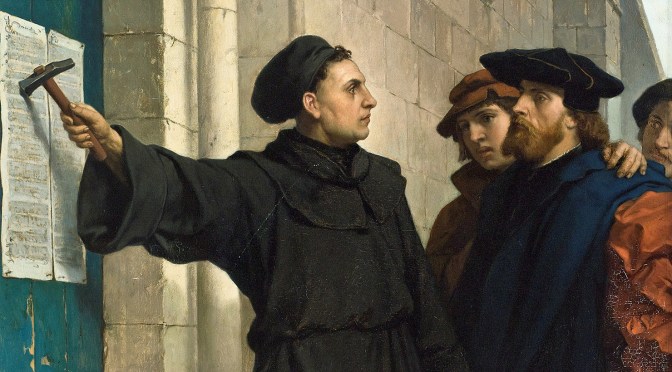
October 31st, 2017 will be the 500th anniversary of the day that a young Roman Catholic monk and university professor nailed a list of 95 theses to the door of the church in Wittenberg. His list of 95 pointed and succinct grievances became the flashpoint for the beginning of a period of upheaval and change in western Christianity which would later be named “the Reformation” by historians.

And so each year on the Sunday on or before October 31st, we, along with Lutherans around the world, take the opportunity to commemorate this occasion.

This 500th anniversary year, in particular, has been a busy one for Lutherans everywhere. It began in Lund, Sweden (the birthplace of the Lutheran World Federation) last year as the President of the LWF, the General Secretary of the LWF and the Pope led a shared worship service as a sign of reconciliation between Lutherans and Catholics. This past summer, the ELCIC hosted its National Reformation Commemoration during our National Church Convention in Winnipeg at St. Gianna’s Roman Catholic Church with ecumenical leaders from a variety of denominations from across Canada.

Along the way churches and communities all over have been marking this 500th anniversary year with special bible studies, community events, concerts, and even in this part of the world a Manitoba Reformation Social.

And so even though today may feel like a fairly typical Sunday morning, we gather for worship with our Lutheran sisters and brothers in Christ from around the world to mark this significant occasion.

As we commemorate, and remember, and celebrate, and mark, and observe this Reformation moment 500 years on, things in 1517 were not nearly as festive. (There were definitely no socials).

Martin Luther’s intention in nailing his list of 95 theses articulating what he believed to be errors and failures of the Pope and institution of the Roman Church was perhaps to inspire some lively debate among his colleagues at the university. But the relatively new invention of the printing press changed all of that, and Martin’s writings were copied and spread throughout all of Europe. Today, we might say Luther went viral.

Luther’s main concern had to do with the Church’s practice of selling indulgences. Essentially papers issued by the pope (and sold by the church) giving people time off of purgatory. And not just for yourself, but also for your dead loved ones! Basically the church’s version of monopoly’s get out of jail free card. The selling of indulgences was Rome’s way of fundraising for the construction of St. Peter’s basilica.

What resulted was a showdown between Martin Luther and the arrayed political and religious powers of his day. Luther’s insistence that salvation was entirely a gift from God in faith threatened the church’s main source of income. Popes had been using the Vatican treasury to play politics, assemble armies for war and fund large building projects and art commissions. Indulgences kept the Vatican afloat, and needless to say, church leaders were not impressed with this nobody monk from the sticks and his growing popularity.

Now, nothing that Luther advocated for was new to Christianity. He certainly did not discover grace, that originated with that Jesus guy 1500 years earlier. Nor was Luther the first since Jesus to re-articulate the centrality of grace as a free gift from God, as we just heard that from St. Paul in Romans. And there was St. Augustine and others  were also very clear about salvation being a free gift from God.

The thing that Luther identified in his day was how the church was turned in on itself and obsessed with its own history and power. For hundreds of years, the church had been very cozy to political power, crowning emperors and declaring empires to be holy. By Luther’s day, power and influence were the centrally important things for most Popes and other leaders. Rome’s identity was deeply wrapped up in being an institution of influence and power, and not in being the body carrying out God’s mission to the world.

And so when Luther showed up declaring that perhaps God and God’s mission to save a sinful world was more important than big cathedrals and military forces, it did not go over well with those in power.

The ensuing conflicts between Rome and Luther resulted in a split in the Roman church and the birth of numerous protestant denominations over the past 500 years.

500 years on from Luther’s moment at the church door in Wittenberg, things have a changed a fair bit. Those of us who bear his name as Lutherans no longer carry the same clarity of the gospel that Luther did, and we often fall into the same temptation that the 16th Roman church did of loving our past, the power and influence that we used to have, a little too much.

As we commemorate 500 years of our history, it is easy to forget that one of Luther’s key points was that our history is not the point. God’s story is.

God’s story of love, and mercy;

God’s story of reconciliation, and grace.

God’s story of redemption for a fallen humanity.

This story is not one that is told in past tense only, but in the present and in the future.

Martin Luther’s insistence on grace through faith had to do with a simple but radical idea that salvation is not something that we could achieve. We cannot save ourselves, we cannot save others, we cannot save the church, we cannot save the world.

Salvation is God’s alone to do. God is the actor, the one who gives the gift, the subject of the sentence, the one whose deeds of power achieve the goal.

A simple but radical idea.

Simple because it sounds like it should be obvious.

Radical because it challenges our notion that we are in control, that our power and influence matters, that our story and history is somehow significant when it comes to salvation.

And if any Reformation commemoration is going to tell the story of the Reformation faithfully, it is not going to just be about Martin Luther, or just about the Lutheran church. But it will remind us again of God’s story. Of God’s story where sinners are forgiven freely, and the dead are raised to new life.

This central focus of Reformation on God and God’s action is also the hardest part of Reformation. It is easy to get lost in our own story, to make our past the thing that defines us, to believe that the way things were are how they are supposed to be in the future. It is hard to set aside our own past and continually orient ourselves back to God’s story and God’s future…

In fact, as Martin Luther would remind us, it is impossible not to make things about us, it is impossible not to put ourselves into God’s place, whether we are the church of 1517 or 2017.

But what is impossible for us, is not impossible for God.

God who continues to form us into God’s image.

God who continues to make things about forgiveness and mercy; grace and reconciliation.

God who continues to shed us of our own stories and pasts.

God who continues to transform us with the story of resurrection and new life.

God who continues to reform us 500 years on from a church door in Wittenberg.

*This sermon was co-written with Rev. Courtenay Reedman Parker*

Reformation 500 – The Next 500 years

This year is the 500th anniversary of Martin Luther’s famous act of nailing his 95 theses to the church door in Wittenberg on October 31st.

This act is considered by many as the beginning of the Reformation.

For Lutherans, Martin Luther’s particular witness to the gospel of Christ forms the basis of our confession and understanding of the Christian faith.

So as Reformation 500 approaches this year, Lutherans all over the world are commemorating the anniversary (as opposed to celebrating) and we are trying to include brothers and sisters of other denominations, particularly Roman Catholic, where possible.

As Lutherans look back on the past 500 years, we are also looking forward to what the next 500 years will bring for Lutherans, and all Christians.

This question has been rumbling around in my mind for a long time and in a renewed way this 500th anniversary year.

This is not an easy question to answer. It is deeply related to the biggest struggles of European and North American churches, most notably it relates to our experience of decline. Before getting to what I think the next 500 years will hold for us, the issue of delcine needs to be addressed.

Humans have this habit of thinking that what just happened will continue happening indefinitely. We, in this North American context of Lutheranism and wider Christianity, have been experiencing churches that are dropping in membership and attendance, budgets that are getting bigger while giving is shrinking and the average age of those still in the pews and contributing is getting older. And because this is our most recent experience we assume that the future holds more of the same.

But this is actually a really poor prediction model.

Let me put it in different terms.

50 years ago, when Lutherans gathered they often would have looked like this: The-American-Lutheran-Church-Constituting-Convention_2-18-13

Now imagine going to someone standing in that crowd and telling them that in a mere 50 years they might look like this:

p6245412.jpg

Thousands reduced to dozens or less.

Those people back in the 50s and 60s would have laughed and laughed and laughed… But this is where we are now. So what would make people today laugh and laugh and laugh… not a prediction of more of the same. But perhaps a predication that churches will be filled once again… filled with a new spirit and new vitality that we would have never dreamed or imagined. It won’t be the 50s again, but it will be something unexpected and new.

You see, we also have to think back 100 years to gain perspective. Much of North American Christianity looked similar to where we are now. There were some large and thriving groups, but lots of small communities barely able too keep up buildings, barely able to pay pastors, barely able to fund seminaries or missionaries or wider church structures. Many church groups were marginal to the larger society and many churches didn’t make it and were lost to history.

But just as now, that society was in a time of great transition. Conflict was the story of global politics (WW1), immigration was high (settling the western part of the continent), new technologies were changing the way people lived (electricity, telephones, automobiles, modern medicine etc…). And it remained messy for nearly the entire first half of the 20th century.

But this chaotic situation eventually led to many, many people seeking a truth greater than themselves, finding solace in the promises of a God who was in control when the world seemed ready to end, finding comfort in faith despite the rapid pace of new technology constantly changing the world.

We don’t have to think about our current world situation very long to see the similarities, to see that our political and economic world which once seemed to provide a stability for people to live their lives on, is turning into an instability that is only going to get worse before it gets better.

Most predications that I hear about the next 500 or 50 or 5 years tell us that decline will simply continue indefinitely and we are just going to have to accept that.

I don’t.

I don’t think that the antidote to decline is to simply be better sales people for church with flashiest and shiniest features to entice largest slice of a shrinking pie of interested people into church.

I think the church is about to be one of the few places of hope that many people will have to turn to in our increasingly chaotic world. I think that some political leader may just push that red button (and no it will not be like an apocalypse movie) or some aspect of climate change will be pushed over the edge, or some hacker will decide that it is time to empty everyone’s bank account… or most likely I think that through difficult struggle and resistance the average people of the world – who are sick of living under systems that privilege a small few – will decide this is not acceptable anymore.

And a paired down church will have to be ready. Ready to welcome the masses who have no where else to turn for hope. The masses who no longer rely on the invisible forces of the world (governments, international organizations, corporations and civil society) to care for them.

Over the coming years and decades, as most church leaders anticipate more decline, the world is going to surprise us. The world is going to surprise us by needing what the church has to offer.

As governments and corporations and other institutions continue to struggle to contend with the big issues that face our world like war and conflict, refugee crisis, economic inequality, climate change, growing nationalistic movements, etc… People will begin to look for places where they kind find real hope. The things that we all believe we could relay on to look after us, like the political leaders we elect and the social institutions that we have created, will not be able to deal with our problems. And so people will begin looking for something bigger than us, someone bigger than us, to deal with our problems. In a dark and a hopeless world (like that of Jesus, like that of Martin Luther), God and the promises of hope and new life that God has given us will begin to pull people to faith.

All that we need to do is let our anxieties about decline die just long enough to see that God was bringing about tangible new life through us. God is using us for real resurrection.

It is in this intersecting place that a declining church meets a world in need of hope.

The decline of North American churches in the past few decades is not a never ending trend. But I do think God is using this time to help us shed our baggage. God is letting us struggle so that we can get all the wrong fixes and solutions to decline out of our system. So that we can try trendy music and flashy tech and hip pastors. So we can try to reincarnate the knitting groups and service clubs and curling bonspiels of the past. So that we can get all the complaining and shaming of our family, friends and neighbours over with. So that we can see that nothing we come up with will be the solution to our problems.

God is letting us experience decline long enough to finally die to our memories and nostalgia of the glory days and realize that the only thing the church ever had was the good news of Christ’s death and resurrection. All we ever were at our best are communities grounded in Christ’s new life given for us.

To be honest, I think in many ways the next 500 years for Lutherans and for North American Christianity will look a lot like the last 500. We will continue to be communities where the gospel is preached and where the sacraments are administered. Sometimes we will be strong in number and power. Other times we will be weak and marginalized. But in the end, neither of those realities matter.

What does matter is that God is answering all the sin and death in the world with resurrection and new life proclaimed in churches just like us.

*The original version of this post can be found here*