Category Archives: Theology & Culture

Washing away social convention at Jacob’s well

John 4:1-42  

6Jacob’s well was there, and Jesus, tired out by his journey, was sitting by the well. It was about noon. 7A Samaritan woman came to draw water, and Jesus said to her, “Give me a drink.”  (Read the whole passage)

You may remember this story from the season of Lent last year. Nicodemus too, the story we heard last week was also from the season of Lent. And the story of blind man next, also from Lent last year. Yet, as we continue our journey through the Narrative Lectionary this year, we are hearing this stories with different ears. Ears that are listening for revelation rather than preparing for crucifixion. We hear this stories with an eye to how Christ is revealed among us, as God’s son.

So last week as Nicodemus came by night, Jesus told him to be be born again or anew. Today, Jesus offers a Samaritan woman Living Water. Water that will keep her from ever being thirsty again.

The contrast between Jesus’ encounter with Nicodemus and the Samaritan woman are striking. It was Nicodemus who sought Jesus in the darkness of night, with questions to ask. But today, it is high noon in the desert and Jesus is the one coming to the woman with questions of his own. The scandal of this scene is lost to us. We only see a thirsty man asking a woman for a drink. But when Jesus approaches this solitary woman to ask for water, he is breaking rules and overstepping his place in the the culture of the day.

For a man to speak to a woman in public was unthinkable. Women belonged to their husbands like property, and for another man to even give the appearance of tampering with that property invited scorn and suspicion. Jesus’ request of this poor woman could have endangered her life should she be accused of adultery. But it is not only the issue of gender that makes this scene scandalous.

For a Jew to interact with a Samaritan was unthinkable. Samaritans were also people of Israel, but they chose to worship differently… not at the temple. This theological difference, meant that for Jews, Samaritans were unclean. For Jesus to be close to a Samaritan, to drink from her bucket, would have meant he would become unclean. But this is not all, there is still more scandal to come.

Unlike the obvious cultural boundaries of gender and religion, Jesus creates a personal scandal. The woman has come to the well at noon. The hottest and least ideal time of day to fetch water. All the other women would have come to the well early in the morning and then again late at night. But this woman, for whatever reason, has chosen to come in the middle of the day, probably in order to be a alone. And it is scandalous for the woman, that Jesus interrupts her quest for solitude.

And so when Jesus meets the woman at the well and asks for a drink, it is all the things, these social conventions, that prevent the woman from hearing what Jesus has to say. Just like Nicodemus last week, this woman isn’t hearing what Jesus is getting at because of all the other noise, all the social conventions, the categories she is put in and identities she had been given by the world around her.

As human beings we are good at finding reasons to build walls, to categorize and judge one another. The arbitrary and abstract social conventions of  religion, gender, or race keep us form hearing one another, they keep us divided, they give us reason to be cut off from the rest of the world.

We put up walls because we think they are going to protect us, walls that we hope will keep us safe, and we build them to keep the bad folks out. But our walls only end up hurting us. They isolate us, the turn us away from our neighbour and from our communities. The walls and boundaries can become oppressive structures, that keep always in the dark, always alone and always wary of others.

From Lutheran and Catholics, to Christians and Muslims and Jews, to conservatives and liberals, men and women, indigenous and non-indigenous, there are all sorts arbitrary reasons why we hold back from each other.

Whether it is the town we grew up in, or the job we work at, or the church we attend, or the hockey team we cheer for… we are just as adept as the Samaritan woman at giving reasons as to why we should’t give a glass of water to people like Jesus, who show up at our wells thirsty for a drink.

As poeple of faith, we know just how powerful those social conventions and inherited identities can be. We live with the the fruits of them every day. We long for our congregations and communities to be full and vibrant as they once were, but we are wary of those who aren’t like us, those who don’t fit in before the arrive, those who don’t know how things work around here. We live with this tension, of wanting our communities of grow again, while clinging to the arbitrary identities and societal rules that give us reasons to stay divided.

When Nicodemus, despite his curiosity, couldn’t get past his identity and the rules that came with it, he asked Jesus how a person who re-enter their mother’s womb and be born again? Jesus’ response is the sermons that contains John 3:16.

Yet when the Samaritan woman does the same, she asks for a literal drink of the spiritual living water than Jesus offers… and perhaps knowing that the sermon lecture didn’t turn out so well last week Jesus does something different.

He doesn’t berate the woman as he does Nicodemus, nor does he preach or pontificate. Instead he cuts through all the noise and conventions that would say talking to this woman is wrong because she is a Samaritan, a woman and alone in the heat of the day.

He cuts through it all and shows the woman that he knows her.

Jesus knows her story, her life, her pain and suffering, her isolation and alienation.

Jesus knows her. She isn’t just a woman, and a samaritan, and someone isolated from her community. She isn’t just abstract social conventions, but a real person.

And Jesus knows her.

Then something changes in the woman.

The abstract and arbitrary social conventions and identities don’t matter anymore. All the reasons that seemed to stand in the way of even talking to Jesus don’t matter anymore.

Jesus becomes more than a man at the well, a jew and an interrupting stranger.

Jesus becomes a real, tangible person standing at the well, water bucket in hand, meeting this woman face to face in the heat of the sun.

And unlike Nicodemus who left Jesus still uncertain and confused about who Jesus is, this woman recognizes just who has offered her living water.

The One who is found in the Living Water of the Life, the Messiah come to save, the Christ who breaks through all the other things that try to define us – the Christ who knows us.

It is here too, at the water that we gather round in this place that Jesus becomes a real tangible person, offering us living water.

And like the Samaritan woman at the well, Jesus breaks through all the identities that we bear, arbitrary names that we carry that would make us think we shouldn’t even talk to one another or to God.

In the waters of baptism we are washed of that other noise in our lives. All the identities that separate us, all the social conventions that dictate who we are allowed to interact with, all the things that seem so real and concrete and immovable.

Standing at the font, when flesh and water meet, when the screams of an unimpressed baby or the tears of a moved adult are mixed together with the promises that the Word of God speaks in our midst, all that other stuff is washed away.

And the only identity that matters is the one that Jesus gives us.

Child of God.

And as children of God, we are reminded of our identity every time someone is washed in the waters, we are given the Living Water of Christ.

The Living Water of Christ that connects us rather than divides, the living water that satisfies our thirst, the living water that brings us to new life.

The Living Water that Christ offers us is the water that changes who we are at the core of our being, the sign that we belong to God.

The Living Water that swirls around the font is where God binds us together into one Body with no social conventions between us, with no identities that keep us from knowing each other.

The Living Water of Christ tells us who we are.

And so like woman who is given this Living Water, this woman who Jesus knows, we are given the same. Jesus gives us that waters of life and in our dying and rising to Christ in those waters we – each of us and all of us – are made Children of God.

Differentiated Jesus in Toxic System

*This is guest sermon from Rev. Courtenay Reedman Parker who is preaching on the RCL while I am preaching from the Narrative Lectionary

Mark 1:21-28

21[Jesus and his disciples] went to Capernaum; and when the sabbath came, he entered the synagogue and taught.22They were astounded at his teaching, for he taught them as one having authority, and not as the scribes. 23Just then there was in their synagogue a man with an unclean spirit, (Read the whole passage)


We are well into the season after Epiphany, seeing and hearing the stories of Jesus being revealed. And we are learning, like those first disciples and people encountering him, that Jesus is unlike anyone we have encountered before.

Today, we encounter Jesus’ first healing, his first miracle. And not just any healing, but an exorcism. Talk about a way to reveal yourself. There’s a lot of baggage caught up in the word exorcism. Maybe rightly so. Casting out a demon isn’t nothing. But it’s also not like a seen from a horror movie either. Being demon-possessed, being unclean isn’t the same as being disabled or different, it’s being toxic, or unhealthy to a system… a community. Likely, this man looked the same as anyone else in the synagogue that day. But something gave him away, that identified him as one who was possessed, unhealthy, toxic.

The gospel of Mark is carefully constructed. As we have learned through the seasons Advent, Christmas and these first few weeks after Epiphany, Mark is not one to embellish. He provides the necessary information to impart the good news of Jesus. So the way that Jesus finds out about this man is not insignificant. This is a small detail, but an important one. One that could easily be missed if not looking closely at what is happening and how the story it being told.

[Those gathered] were astounded at his teaching, for he taught them as one having authority, and not as the scribes. Just then [as this was taking place] there was in their synagogue a man with an unclean spirit, and he cried out, “What have you to do with us, Jesus of Nazareth? Have you come to destroy us? I know who you are, the Holy One of God.” 

Jesus is teaching in the synagogue. But in a new way, a different way than what they are used to – it’s not like that of the scribes. The people hearing his teaching are astounded – they are interested and intrigued by what he has to say. He has their attention. And seeing all this take place causes this man to feel uncomfortable… anxious… threatened. Jesus comes along, and this man recognizes him immediately.

What this man says to Jesus is important too because it tells us a lot about the man:

“What have you to do with us, Jesus of Nazareth?” – who do you think you are?

His behaviour is classic toxic behaviour – when there is a threat, or a perceived threat to the toxic person their anxiety increases.

“Have you come to destroy us?”

But he’s not finished:

“I know who you are, the Holy One of God.”

This man is the only one who sees who Jesus is, and even after he clearly identifies who Jesus is, the people are still confused. But what is just as interesting is that no one else in the community seems to recognize that this man is possessed by a demon. Because no one who was considered “unclean” would be allowed into the synagogue in the first place. It’s more likely, then, that the community has adapted to his behaviour.

The boundaries, the norms of a system, a community set in place what is considered acceptable and unacceptable behaviour in that particular system. These are frequently not healthy but what become considered normal.

That’s the thing about unhealthy people and unhealthy systems. We often don’t recognize how unhealthy and toxic they are until someone new, someone different comes along and points it out to us, someone who shows us a different way. We adapt to the dis-ease and unhealthy behaviour until it becomes normal, like allowing a demon-possessed man to go unnoticed in a community.

So when a new person enters the system, the community, and presents new, healthy, different behaviours, systems, boundaries and expectations the whole system is threatened. Because the established norms are questioned, and the possibility of change is introduced. And most people, given the choice, would prefer to stay in an unhealthy system that is known and comfortable, than risk discomfort in a new and healthy but uncomfortable one.

Today, Jesus’ power and authority is revealed by crossing boundaries – Jesus calls out toxic and unhealthy behaviour in the midst of the community – and in doing so reveals that Jesus… God… is willing to go to places no one else wants to go. God in Jesus is willing to dismantle unhealthy systems that keep people from knowing

Of all the things Jesus said in the synagogue that day, Mark chooses to record only what Jesus says in response to this man: “Be silent, and come out of him!”

Jesus’ statement is one of differentiation, it sets him apart from the man and the unhealthy and toxic system he represents and wants to maintain.

Jesus heals a man, a man whose unhealthy behaviour has become toxic in the midst of his community. And in doing so, Jesus frees not only the man, but the community as well. They are amazed – not just that he commands unclean spirits, but that they OBEY him. The demons, the unclean and unhealthy behaviours and systems that had a hold on the entire community had no power over Jesus.

This is the power Jesus holds – the power to identify that which is unhealthy and toxic and exorcize it from the people and communities it has taken hold of.

This is the power of the Gospel. The power to free us from the toxic systems of sin and death.

To free us for a life that draws us into new relationships… new realities where the burden of maintaining unhealthy and toxic systems are lifted, the burden of sin and death lifted. Our unclean, unhealthy, toxic selves gone. Attachments to unhealthy and toxic systems, gone.

And in their place, new and eternal life. This is the promise we receive in baptism: new life in Jesus.

When we enter into a baptismal service, we begin with a profession of faith – when we renounce, we give up our unhealthy, toxic ways:

Do you renounce the devil and all the forces that defy God?

Response:

I renounce them.

Do you renounce the powers of this world that rebel against God?

Response:

I renounce them.

Do you renounce the ways of sin that draw you from God?

Response:

I renounce them.

Washed in the waters of baptism, marked with the sign of the cross by God the Father, the Son, the Holy Spirit. This is how Jesus is revealed. This is who Jesus is revealed to be: the one who frees us for new and eternal life with God. God casts out our old selves, our old ways. God frees us so that we no longer belong to our unhealthy behaviour or systems. God frees us so that we no longer belong to the people or places that hold us back. We no longer belong to our shame, our anxiety, our disappointments, our unclean spirits that demonize us and our communities.

In their place we are named and claimed: You belong to Christ, in whom you have been baptized. Alleluia.

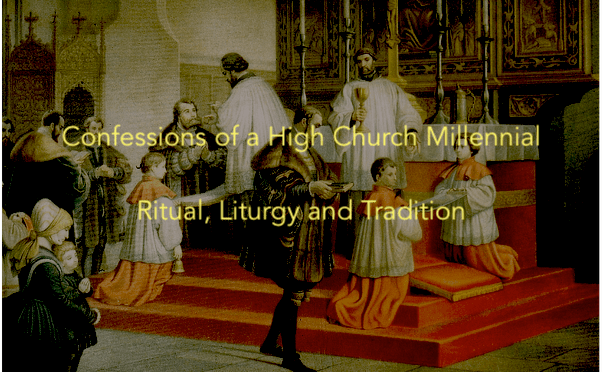
Confessions of a High Church Millennial – 10 Ways I am grounded by Ritual, Liturgy and Tradition

I haven’t confessed this to you in a while, but I am still a High Church Millennial. Just because I often wear jeans on office days, have tattoos and an apple music subscription on my iPhone… doesn’t mean I don’t love old things. And not looms, vinyl played by a gramophone and artisanal vegetables as the caricature of a millennial hipster goes.  I love ancients things like ritual, liturgy and the traditions of Christianity.

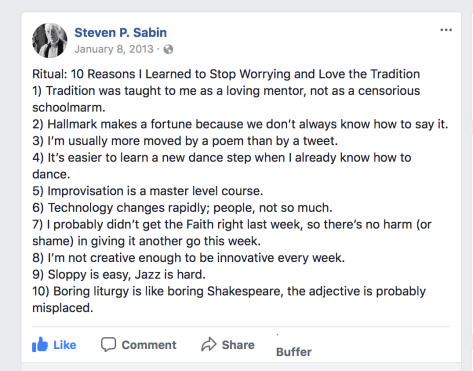
So recently, as I went about my normal perusal of social media, I came across the post of a pastor friend. The Rev. Steven Sabin serves in San Francisco, and he thoughtfully wrote the post pictured below:

Screen Shot 2018-01-16 at 11.27.18

I love the way Pastor Sabin describes his experience of a high church faith. I can see my own experience in his post. And as many churches search for ways to get “the young people back” with the newest and flashiest toys, gadgets, fads and entertainment…. let me tell the story of why this millennial would rather have the old things and the deeper meaning.

*Note: I skipped a few of Pastor Sabin’s points.

1 Tradition was taught to me as a loving mentor, not as a censorious schoolmarm.

I grew up in a world where tradition was shunned and Lutheran liturgy was like eating vegetables… you did it but no one liked it. Our worship was often treated as if it was a list chores to do every Sunday morning. And then our church hired some musicians to help plan our liturgy and music. And for the most part, the congregation continued to feel the same way about liturgy. But as a teenager, I noticed that suddenly worship became a more cohesive experience. The list of chores transformed into the script and stage directions of a beautiful play. There was movement, there was purpose to our worship, the music connected to the prayers, the prayers connected to scripture, the biblical texts connected to the eucharist and so on and so on.

When I went to seminary, I was finally taught the finer and detailed points of the ritual I had been enraptured by. Liturgy for me now is not a burdensome set of rules to follow and chores to do, but a ground to stand on in worship, guiding the assembly into deeper meaning and a deeper experience of the divine… proclaiming the gospel and inviting us into the body of Christ in a way that no other worship form can do.

2 Hallmark makes a fortune because we don’t always know how to say it.

One of the things I cling to as a preacher and presider is that when the words of my sermon fail, then the words of the liturgy say what needs to be said. And knowing that Christians around the world and through the centuries have used these same words gives them a sense holiness and authority that spontaneous and unprepared words lack.

3 I’m usually more moved by a poem than by a tweet.

There are such things as twitter poets, yet even they recognize the limitations of the medium.

A tweet is an ephemeral abstract thing. Most tweets rarely have a long life, they come at us quickly and in high volume. Great for breaking news, but lacking the deliberately slow and considered words of a good poem. Poetry is intentional and reflective. Poetry is an economy of words not because there are only 140 (or 280) characters, but because every word matters. The same goes for the liturgy.

4 It’s easier to learn a new dance step when I already know how to dance.

I recently moved from leading worship in 1 congregation to 5. While each congregation has its own particularities, it is the commonality of the liturgy that makes it possible smoothly step in to preach and preside each week. The order, the movement, the rhythm is all familiar, even if a few steps are different.

6 Technology changes rapidly; people, not so much.

There are a lot of things that are rapidly changing in my millennial world. Social media flies by rapidly each day. The way people communicate with me has changed dramatically over the years. 65 year olds used to phone my landline but now text me when planning a funeral for the parents, 30 something colleagues let me know about job opportunities in facebook groups, even my 96 year old grandmother talks to my kids on FaceTime now and then.

But worship, the familiar words, patterns, seasons, texts and emphasis is one of the grounding forces of my life. I more easily associate significant memories with the liturgical season they occurred in rather than with date and month. Each week, I find my grounding and footing again in the familiar and stabilizing experience of the liturgy in the assembly.

7 I probably didn’t get the Faith right last week, so there’s no harm (or shame) in giving it another go this week.

I am coming on 9 years of ordained ministry. I probably surpassed 500 times presiding in worship recently, and I still feel like I am just starting to scratch the surface or the depth of the faith. Maybe 40 more years and I will feel like I got it right… but I doubt it.

10 Boring liturgy is like boring Shakespeare, the adjective is probably misplaced.

Being bored is usually a sign of not understanding what is going on. I grant that the church and pastors have not always been very good a teaching the liturgy and tradition of the church. But the best way to learn is to experience. We live in a world that says we are all experts before we begin… or should be. The liturgy is rich and deep and complex and beautiful. And it can be confusing if it is unfamiliar. But what form of unfamiliar worship wouldn’t be confusing? The best way to learn is through repetition. Try worshipping in a liturgical church every week for a year, and then how liturgy feels. If you find yourself bored, perhaps it is because there is learning that needs to happen. Talk to your pastor, they might be able to help.

Now, make no mistake Liturgy, ritual and tradition are not the newest (or oldest) gimmicks to get millennials back to church. Rather they are just servants of the gospel, the vehicles through which we regularly encounter God as people of faith. And it is meeting and following Jesus that is the most important thing – the most important thing that we do, and that worship helps us to do, as people of faith.

So as I said, I am still a High Church millennial. And it is these ancient things of liturgy, ritual and tradition – and how they so clearly proclaim Christ crucified and risen – that are the reasons I am still in the church.


*Thanks again to The Rev. Steven Sabin for allowing me to annotate his great post.

The Lord Christ is coming – The Messiah has always been here

Mark 13:24-37

Jesus said, “In those days, after that suffering,
the sun will be darkened,
and the moon will not give its light,
and the stars will be falling from heaven,
and the powers in the heavens will be shaken. (Read the whole passage)


It would probably be a safe bet that no one attended a rocking new year’s eve party last night.

Advent, and the beginning of a new church year is pretty understated as far as New Years goes. Never the less, we are taking the first step of a new church year today. And as always, we begin with Advent.

Advent is the season of waiting and watching. We drape the sanctuary with blue, a colour representing hopeful anticipation. We light candles to symbolize the light of Christ coming into the world. We hear stories of the waiting of Israel for Messiah, and then Jesus’ own words about the end of the world.

And we do all of these somewhat odd things while the rest of world is frantic with Christmas fever, the lights and decorations having been out long enough to be gathering dust, and the music has gone stale on the radio and over mall speakers.

As is often the case, we find that the church tends to do the opposite of the world.

And so today, we slow down to light our lamps and watch for the signs of the coming Messiah.

As we hear Jesus begin our advent season, the thing he is talking about is the end. He gives us a prophecy, a glimpse of the end of the world. Signs found in darkened celestial bodies, and the coming of the Son of Man in glory.

And Jesus is speaking to an audience that has been waiting for Messiah for generations. The people of Israel had been waiting for a long time for God to send the one who would free them from oppression, release them from their suffering and re-establish a divine rule by one of God’s appointed kings, and not foreign occupiers like the Romans.

The Israelites had been waiting since the time that Isaiah prophesied Messiah’s coming, hundreds of years before Jesus’ day. And during that time life had not been easy. Israel had constantly been surrounded by enemy nations, there had been constant destruction and ruin. But despite this, the promise they clung to was that God was sending a promised Messiah, a saviour who would come to free them.

By Jesus’ day the Israelites were growing restless… but they could also see the signs. King Herod had killed all the children in the holy town of Bethlehem around the time of Jesus’s birth, and John the Baptist decades later had begun preaching in the desert. And now here was the one, the wandering preacher and healer, telling them of the coming Messiah.

The people could feel that it was close, that Messiah was in the air. The signs were there, and here was the one whom many thought to be Messiah, Jesus of Nazareth, and he was telling them of God’s plans to restore creation and set the world to right.

Finally, Messiah was close at hand.

2000 years down the road, we might not be living with that same kind of imminent sense of Messiah’s coming. While we hear the stories and read of Messiah’s impending coming, we do so year after year, decade after decade, lifetime after lifetime. And the stories written with such urgency take on a different meaning and we hear them in different ways.

And these days, as so many of us wonder about churches and the future of the faith in our part of the world, we feel less like the crowds listening expectantly to Jesus the Messiah in flesh announce God’s plans to restore creation, more like those who had been waiting generations before. We feel more like those who heard Isaiah’s words:

We all fade like a leaf,
and our iniquities, like the wind, take us away.
There is no one who calls on your name,
or attempts to take hold of you;
for you have hidden your face from us,
and have delivered us into the hand of our iniquity.

Isaiah has us pegged.

The grand visions of Jesus in Mark are not the clear and blinding signs for us that they were for the people of Jesus’ day. For us, they are hazy and hard to make out. The cosmic re-ordering that God is about to undertake feels more abstract and far off, than immediate and close at hand.

We faded leaves know the struggle. We know what it is to be tired and to wait, to feel thinned out and week. It is hard to keep the faith these days. Hard to keep showing up to hand out bulletins and sing God’s praises. Hard to volunteer to vacuum the church and receive forgiveness. Hard to look at budget statements and council reports AND pray without ceasing.

Jesus’ exhortation to ‘Keep Awake’ is hard enough to do during the sermon, let alone to keep vigil day after day, week after week, year after year.

But the Church has known this. Christians have known that waiting for the Messiah is both a long and a short game. Even as Mark was setting down his gospel only 30 years after Jesus rose from the dead, the early church was wondering when Jesus would return. Those first witnesses to the resurrection were getting old and beginning to die off.

And ever since, the church has lived with the sense of the now and not yet. The sense that God’s Kingdom is here NOW among us. And that God’s grand future plans to restore all creation have NOT YET come to fruition.

So we live with this dual reality. The reality that Jesus proclaims, the coming Son of Man and the reality of Isiah, that we are fading leaves waiting to be blown away in the wind.

Each Advent we begin by acknowledging this reality with the words of the collect or prayer of the day. While most begin by praising God, in Advent we begin with a petition, a request. And we direct it not to God the Father, but straight to the long awaited Messiah.

Stir up your power, Lord Christ, and come.

Stir up your power, Lord Christ, and come.

We pray knowing that we need, ever so desperately the stirring up of Messiah’s power.

And we pray knowing that the Messiah, the one sent to save us is finally now, after our long waiting is stirring up power like a pot boiling over.

Stir up your power, Lord Christ, and come.

And as the Israelites waited and waited for the coming of Messiah, even as they faded like leaves blowing in the wind.

And as the crowds heard Messiah himself preach the coming of God in power, even as they could feel Messiah in the air.

And as we grow tired waiting for something to happen among us, even as it is hard to keep up the faith.

And as the church of today sits at a moment of tremendous change, even as we don’t want to see it.

The Lord Christ is coming.
The Messiah has always been here.

The Lord Christ is coming, even when we find it hard to believe, even though it feels painfully slow. The Lord Christ is coming to bring an end to suffering, to make our upside down world right, reconcile all creation to God, to restore us all to what God intended us to be. It just has NOT YET come fully.

And the Messiah has always been here, already among us, here NOW, giving us mercy, forgiving our sins, showing us resurrection and new life.

The Messiah has always been here, present in the word of God, made manifest in the words that sound from our lips and in our midsts.

The Lord Christ is always coming to us from the waters of baptism, pulling us into a not yet future, where our sin and selfishness are no more, where we die and rise to new life.

The Messiah Lord Christ is here and yet coming to us in the bread and wine, body and blood, where God meets us, where God binds and joins us to Christ, the now risen and still coming one.

Even as we wait, even as we grow tired. Even as the story is told over and over again from the people of Israel to now…. God is bringing us from the end to the beginning.

From Advent and its promises of the great cosmic plan of God, to the beginning, to the beginning of God’s new creation born within us that first Easter.

Sure, there probably no new year’s eve parties last night.

But that is because God’s great and never ending party, starts here today.

The Parable of the Talents is not a lesson in Stewardship

Matthew 25:14-30

…Then the one who had received the one talent also came forward, saying, ‘Master, I knew that you were a harsh man, reaping where you did not sow, and gathering where you did not scatter seed; so I was afraid, and I went and hid your talent in the ground. Here you have what is yours.’ But his master replied, ‘You wicked and lazy slave!…As for this worthless slave, throw him into the outer darkness, where there will be weeping and gnashing of teeth.’” (read the whole passage)

We are coming to the end of the church year. And for nearly six months, we have been hearing stories from Matthew’s gospel. For the the past few weeks, it has been parables from Holy Week. During those short few days between riding into Jerusalem on a donkey, being hailed as King and then being arrested and put on trial, Jesus took the opportunity to preach and teach. The parable of the talents is the last parable that Jesus tells before being arrested and put on trial.

The parable of the talents is a familiar parable. As a rich man prepares to go on a long trip, he gives three trusted slaves large sums of money to attend to. 5 talents to one, 2 to the next and 1 to the last. And when the man returns the first two have doubled their share. But the third, being fearful of his harsh master has buried his talent. When the slave returns just the one talent, his master is not pleased, expecting more.

To our profit and productivity obsessed world, the master seems well justified in his anger at this slave. He could have at least earned basic interest if the slave had just put the money in the bank.

And that has often been the message preached by modern Christians, especially when we expand the definition of talents beyond money to the other more common usage of talents. The talents that many preachers talk about with this parable are gifts of time, money and abilities. We all have been told that God gives us these gifts and we should give back to the church.

But is this parable really about an encouragement to use our gifts, and abilities and time for Jesus? Or is that a direction that preachers take because it is too hard to pass up an opportunity to preach about stewardship?

On the surface is sure sounds like the master (or God) is telling the slaves (or us) to make good use to the talents we have been given in this life… and yet when we dig past the surface there just might be something else going on here.

If we slow down and listen, the master does not seem to be very God-like. The third slave names it for us. The master is harsh, reaping where he did not sow, gathering where he did not scatter seed. And then the master confirms the third slave’s assessment. He is outraged and throws the slave into the outer darkness. Simply because the slave returned what had initially belonged to the master.

So is this harsh and greedy Master really a comparison for God? Does the God of stable mangers, the God of nail pierced hands and feet, the God of empty tombs and being known in breaking bread really operate this way? Does God really say “look at all I have given to you… now you owe it back twice over… or at least give me the going interest rate.”

If this harsh and greedy and rage filled master is not an example of God, is this parable really about encouragement to us our “talents” to the fullest?

In strictly economic terms, a biblical talent is no metaphor for gifts and abilities. It is a measure of money. One talent represented about 20 years wages, or the working lifetime of a day labourer. So the master hands out 8 life times worth of money to 3 slaves to manage, and when his 8 talents are turned into only 15 he flies into a rage. Or to put it into modern terms, 20 years of the average annual income in Canada is $1,000,000. So this master is enraged when his 8 million only grows to 15 million instead of 16.

Wow, what a disappointment.

This master sounds not so much like God, but more like that cranky Dragon from the TV show Dragon’s Den who was all about the money. Or that other reality tv star turned blowhard politician whose catchline is “You’re fired!”

But perhaps more troubling is how easily Christians have tried to make this harsh and greedy master virtuous. How deeply have we been enmeshed in the cult of money, power and success that we would compare economic success with faithfulness and salvation.

And rather than some kind of lesson on putting our gifts and talents to their best use, it is this troubling reality that Jesus is more likely pointing to as he tells the parable to the crowds and religious authorities.

If the business of faith and salvation were up to us, up to sinful human beings, we would make it an issue of wealth and power. In fact, in Jesus day it was. Only the rich and powerful could afford to be righteous and pure according to the laws and traditions of ancient Israel. And for 2000 years of Christianity, it has frequently been portrayed in this way – faith tied to the amount of wealth and power that one holds. Salvation has often been something that could be bought.

Jesus is naming this reality. Jesus is naming this reality in just hours before the crowds will turn on him. Before he will be arrested and tried and executed.

Jesus is revealing to those who will crucify him for being God in flesh that the reason is their own desire to be in control of salvation, to dictate the terms of our faith based on money and power. Jesus is the ultimate threat to that desire. If Jesus is indeed the Messiah, God’s Son, than humanity cannot be God. And if we are not God, then no amount of power, or wealth, or self-righteous greed and anger can save us.

And as Jesus prepares teaches the crowds with these parables he does so as he is about to go to the cross.

Paul’s letter to the Thessalonians fills in the rest of the story. Paul tells us how it is that God is truly enacting salvation. Paul writes, “For God has destined us not for wrath but for obtaining salvation through our Lord Jesus Christ, who died for us, so that whether we are awake or asleep we may live with him”

It is not the wrath of the greedy master than will save or condemn us.

It is not whether we can double the talents we have been given, or whether we bury them in the ground.

It is not an economic transaction that is required for Salvation.

To the Thessalonians, who were feeling like that third slave, fearful and hiding their talents in the ground, Paul declares that it is the Lord Jesus Christ who died for us who obtains our salvation.

And whether we feel like the first slave who doubles his talents, the third who buried his or even the master greedy and filled with rage… is not us and what we do but the Lord Jesus Christ who obtains salvation.

It is Lord Jesus Christ who gives up all god-like power and who comes into human time and space, who breaks into our productivity and profit focused world.

It is our Lord Jesus Christ who reveals to us our sinful nature and our attempts to make wrath and rage and greed into virtues.

And it is only our Lord Jesus Christ who truly saves us from sin and death. Only Jesus who obtains salvation for us. Only Jesus who brings forgiveness, mercy, reconciliation and grace into our world.

And just as Jesus prepares the crowds and temple authorities for salvation given by God in the cross, Jesus prepares us too.

Jesus prepares us with forgiveness instead of wrath.

Jesus prepares us with the word of life rather than the word that casts out into the outer darkness.

Jesus prepares us with the water of baptism that wash us of our greed and desire for power.

Jesus prepares us with the bread and wine of salvation, food that fills us like no amount of profit or return ever could.

As Jesus tells the parable of the talents today, we discover again that it is not about the thing that we thought it was about. And as much as we try to make salvation and faith fit our terms, as much as we try to make greed and productivity a virtue… Jesus is pointing us back to God who comes without power, but instead with love.

Jesus is showing us in the parable, on the cross and here in Word and Bread and Wine that God’s Salvation is given freely. God gives is freely to us and for all.