Category Archives: Theology & Culture

Remember that you were aliens and strangers with no hope too

Mark 6:30-34, 53-56

The apostles gathered around Jesus, and told him all that they had done and taught. He said to them, “Come away to a deserted place all by yourselves and rest a while.” For many were coming and going, and they had no leisure even to eat. ….When they got out of the boat, people at once recognized him, and rushed about that whole region and began to bring the sick on mats to wherever they heard he was. And wherever he went, into villages or cities or farms, they laid the sick in the marketplaces, and begged him that they might touch even the fringe of his cloak; and all who touched it were healed. (read the whole passage)

We are coming to an end point of sorts. After this week, we will detour from Mark’s Gospel to hear 5 Sundays from John on the Bread of Life. And this scene from Mark today, is the culmination of something building in the background of these stories of Jesus’ preaching, teaching, healing, exorcising demons and arguing with the pharisees. 

Today, the crowds move from the background of the stories and take centre stage. The crowds were there as Jesus’ family tried to take him away and Jesus compared the Pharisees to Satan, they were there when Jesus taught in confusing parables which he only explained to his disciples in private. They were left behind as Jesus and the disciples rode that boat out into the storm. They were silent witnesses as Jesus healed Jairus’ daughter and the bleeding woman. And they watched as Jesus could do no deeds of power in his home town. 

After sitting always in the background and even after being avoided by Jesus and his disciples, the crowds, the poor, unwashed masses following Jesus around Galilee looking for hope and healing finally have their moment today. 

As Jesus and the disciples feel the pressure of the crowds, Jesus suggests that they all find some place quiet to go. So again, they try to escape the crowds by boat. But this time the crowds will not be fooled. They run around the shore ahead of Jesus and disciples. 

And while it isn’t totally explained just who these crowds are, the stories that they have been a part of and the background suggest that these are likely the common people of Israel. The poor, the disadvantaged, those on the outside, those who have little power in their world, those who excluded from political and economic upper echelons of society. Some might be beggars, those who bear disease or infirmity, but also everyday average people who try to work and care for their families, to eek out a living in Roman occupied Israel, which was a harsh and difficult place to live. These are the faceless, nameless masses of the world. The kind of people you pass on the streets, or in the mall or at the grocery store without much thought. People whose lives are mostly normal, if not unremarkable. People who don’t really get names or details of their own, they are just crowds. 

And the crowds have been ignored and forgotten for long enough, there is no pushing them aside anymore. They have come to Jesus and Jesus cannot keep putting them off anymore.

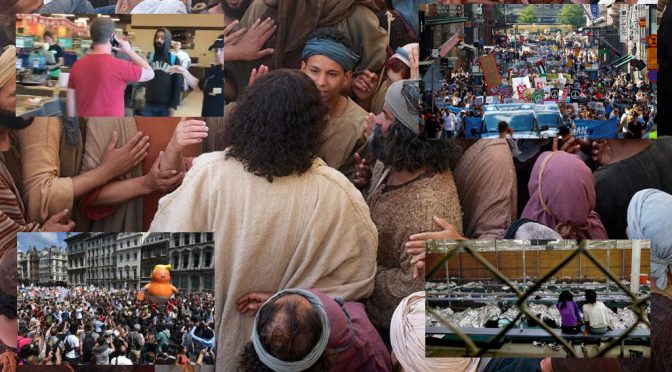
Maybe you feel the same way, but I can get what Jesus is feeling like today. The crowds of our world seem to asserting themselves in much the same way. Flip on the news and there are crowds gathering around every corner. Crowds on the streets of London and Helsinki to greet a certain world leader. Huddled masses appearing at the borders between Mexico and US, and the US and Canada. Crowds seen in fenced-in detention centres separating families, crowds at grocery stores looking on as some lunatic in a red t-shirt tries to call the cops because someone dared to have dark skin and a beard in his presence. 

The crowds seem to coming up front and centre in the news these days, in our social media feeds, and even on our doors steps. 

And it is easy to see those crowds as outsiders. As the lost and forgotten, the alien and strangers of our world. It can be overwhelming to imagine what we could possibly do for them Should be out in the streets with protest signs too? Should we be at the border with food and clothes to help welcome the lost and forgotten before their are thrown in detention centres? Should we step in front of a raving and angry person making a scene in a public place?

These don’t feel like our problems, they are the problems of other people, the problems people on the outside, foreigners and aliens and strangers. 

As the crowds press in on us and give us hardly a moment to rest or eat these days… Paul has some words for us. Some words first given to the Ephesians, but just as applicable today. 

“…remember that you were at that time without Christ, being aliens from the commonwealth of Israel, and strangers to the covenants of promise, having no hope and without God in the world.”

Remember that you were once outsiders too. Outsiders to God’s love with no hope in this world. 

_________

As Jesus and the disciples land their boats back ashore, their attempt to escape the crowds seems to have been for naught. They crowds are pressing back in again, searching for some kind of hope and healing.

But this time something shifts in Jesus. Jesus has compassion for these desperate crowds. He sees them for who they are and what they need. They are lost and forgotten. They are aliens and foreigners. They are outsiders. 

And so Jesus finds them. 

Jesus remembers them. 

Jesus welcomes them.

Jesus knows them. 

Jesus brings them inside….inside into God’s mercy. 

And all of sudden, in a subtle but important shift, Jesus isn’t trying to escape anymore. He simply lets the crowds be. He lets them be around him, near him, and come to him. They are a part of who and where Jesus is. They are part of the family. 

As we sit in our comfortable churches, it is easy to feel like insiders, and even difficult to identify with those crowds on the streets of London and Helsinki, or the crowds in detention centres are borders, or the crowds witnessing racism in grocery stores. 

And as people of faith on the inside, we can even wonder where is God among these crowds today? Is God at work in the crowds in the streets of London and Helsinki? Is God handing out food and blankets at the borders? Is God stepping in between that lunatic at the grocery store and the poor victim of his rage? 

Maybe… God might be in those places…

Paul reminds us: 

“…remember that you were at that time without Christ, being aliens from the commonwealth of Israel, and strangers to the covenants of promise, having no hope and without God in the world.”

But Paul also says: 

“But now in Christ Jesus you who once were far off have been brought near by the blood of Christ. For he is our peace; in his flesh he has made both groups into one and has broken down the dividing wall, that is, the hostility between us”

Here is the thing, Paul isn’t reminding of what it feels like to be outsider… most of us were brought into this family of faith as insiders as babies and we don’t remember being outsiders. 

Rather, Paul is reminding of the gift of a place in God’s family that has been given to us. The free gift, the undeserved gift, the unearned gift of being a member of God’s family that Christ has given to us. 

Because here as we gather from far off, Jesus brings us near. Jesus gives us peace in reconciliation and forgiveness. Jesus makes us one in the Word of Good News that we hear, and Jesus breaks down the wall, the hostility between us. 

And Jesus is first here among this crowd and in these streets between us, gathering us at this table. And Jesus brings us bread and healing at the table, at the border between heaven and earth. And Jesus steps in-between us and sin and death to proclaim that those things are not okay and will have no place here anymore.

Paul reminds us that we were all once outsiders and and aliens and strangers. But Jesus has brought us in to the love and mercy of God, and Jesus continually brings us in, continually makes us – and the whole world – part of God’s family.

And so today, the crowds press in, on Jesus and on us. Yet are reminded that we are not the insiders removed from it all that we thought we were… Rather, we are the crowds too, and we now have a place near to Jesus, in the household of God. 

This is not the end of the story

Mark 6:14-29

…Immediately the king sent a soldier of the guard with orders to bring John’s head. He went and beheaded him in the prison, brought his head on a platter, and gave it to the girl. Then the girl gave it to her mother. When his disciples heard about it, they came and took his body, and laid it in a tomb.
(Read the whole passage)

They came and took his body and laid it in a tomb. 

Familiar isn’t it?

We have heard that story before. We heard it just in April… Jesus died on the cross, and one of his disciples Joseph of Aramathea came and took his body and laid it in a tomb.

Except today, it is not Jesus but John the Baptizer. It is not crucifixion but beheading. It is not Pilate but Herod. And John will be not raised from the dead in three days. 

This story comes in the middle of Mark’s gospel. A brief departure from the things we have been hearing about, from the parables, healings, exorcisms and miracles. We stop for a moment to hear a dark and disturbing, story. Political intrigue – a King who lives lavishly, takes what he wants, and yet is perplexed by the preaching of a wilderness prophet and hermit. Pride and incest – A queen who will not stand to be shamed for leaving her husband for his brother, the King, and especially not by this lowly Hebrew religious hermit and religious nut. Murder — A young girl who is used by her parents as a pawn in a political game. A prophet is murdered so that a drunken tyrant can save face. 

No happy ending. No drama to come. Simply power, greed, lust, and pride getting what they all want. Mark doesn’t leave out any of the dirty details. This is not a feel good story. This is too much like real life, too much like the world around us. This is not enough like a Hollywood feel good ending and too much like a bad night for news.

John the Baptist, the wild Advent preacher of the Messiah’s coming to make paths straight has an ignominious end of to life… a public execution simply to satisfy the political and prideful wrangling of the ruling elite. And then his disciples come and take away his body… and thats it. 

Sometimes the story just doesn’t end well. Sometimes life doesn’t figure itself out. Sometimes there is no happy Hollywood ending. 

This strange story, today, sets itself apart from the rest of the Mark’s gospel. It feels like it doesn’t’ fit. It is selfish motivations and actions, pure and simple. And yet, it can feel so familiar. It is the story of the world at its’ worst. It is our story at our worst. We don’t need to have the drunken parties, the incestuous relationships, the desire to show power and control, or pointless death to know what it feels like. This story of Herod, Herodias, Salome and John is just as much about us. It is the story of the dirty details of life. The story of broken families and marriages, the story of job loss and bankruptcy, the story of political games and corruption, the story of money and greed, the story of poverty and powerlessness, the story of disease and illness, the story of grief and death.  

And it is missing something… or rather it is missing someone. Someone who is hinted at at best and completely absent at worst. 

This is the only part of the Gospel of Mark where Jesus isn’t front and centre… in fact, Jesus isn’t in the story at all. It makes us wonder why Mark would include this terrible event, why tell us the details? Why lay out the whole thing for us?

This story is there because it is not the end. 

Not the end of Jesus’ story. 

Not the end of our story.  

If these dirty details was all there was to story, we wouldn’t need to hear about victory of evil and sin because we live it all too often. We hear about it on the news too much. We know that this happens in the world. 

But Mark has chosen to tell us this story. To boldly include all the dirty details of power, control, pride, lust, greed and evil. Mark has chosen to include this in the story of Jesus. To include the dirty details in the Good News of Jesus Christ. 

They came and took his body and laid it in a tomb is not the end of the story of God. And it is not the end of our story. It is not the end of our stories of suffering and sin, of evil and death. God includes all our dirty details. Includes them in the story of Jesus born in flesh. Included in the story of God’s great love for us. And they are not only included, but as our stories become God’s, God’s story becomes ours. God makes the ending that we know, the empty tomb, the resurrection on the third day, the news of the risen Christ, God makes this the new ending of our stories. God makes us the new end, the new point, the new purpose of God’s love.

The Good News of Christ is that in the midst of all the evil, all the sin, all the death that exists in our world, in our lives, in relationships, in our stories, God is joining our story, our world, our lives. God joins us by coming in flesh and dwelling among us. God joins us to the Body of Christ. The dirty details, they are not what make the story any more. Rather the new plot twist, the surprising new reality is New Life. New Life in Christ, New life in the ongoing story of God. 

Sometimes life just seems full of the dirty details. Sometimes Jesus is nowhere to be seen. Sometimes all there is pointless evil, rampant sin, and needless death. 

And sometimes when our stories feel too terrible to be anything like God’s, God reminds us that we haven’t reached the end yet. There are still chapters to be written, still details to be added. God reminds us that in Christ, that because of Christ, there is only one ending possible to our story. 

God reminds us today, that our ending is life and our ending belongs to God. 

Amen. 

Jesus could do no deeds of power…

Mark 6:1-13

 And he could do no deed of power there, except that he laid his hands on a few sick people and cured them. And he was amazed at their unbelief. (Read the whole passage)


The Gospel of Mark has not been easy on us the past few weeks. In fact, as we explored the parables and teachings and experiences of Jesus, we discover that Mark is not easy on us at all. As Jesus preached about Satan’s House being undivided, we were reminded that our houses, that our communities cannot avoid being divided. We heard of God the radical gardener who plants the weed like mustard shrub in the garden, knowing that it will take over everything and grow out of control, and that this what the kingdom of God is like. We watched as Jesus calmed the storm, but in the process terrified the disciples and us, causing them to question who really is this Jesus. Last week, we saw Jesus break boundaries and rules, in order to bring God’s love near to us. We saw the way in which Jesus creates a new community among us and how uncomfortable this makes as we are stripped of the ways in which we like to be in control. Mark has held up a mirror, and it has shown us a reflection that we don’t always like to see. 

Today is no different. 

As we hear about Jesus preaching in his hometown following by the sending out of his disciples, it would be easy to focus on the instructions that Jesus gives. To preach to those who will listen, and to move on from those who won’t. If only ministry was that simple, work those who like you – ignore those who don’t. 

Focusing on those instructions of Jesus to his disciples is the easy way of bypassing the part of today’s reading that really makes us uncomfortable, that really makes us squirm. 

And he could do no deed of power there. 

What?!?!

Jesus returns to his hometown of Nazareth on his preaching tour. Jesus goes back to the place where he is well known, and his reception is a little frosty. Those of us who have left home and then come back, know the feeling. No matter how long we have been away, no matter how much we see and experience, no matter how much success we achieve, once we come home, we become what we were before. Mary’s son. The child of that family. The sibling of this person. The relative of those folks. The carpenter, the class clown, the paperboy, the nerd, the high school star athlete.  

Jesus comes home and no one can see more than the little boy, that young man who lived in their community and had a very certain place among them. A place that didn’t include being a prophet or teaching the word of God. For the people of Nazareth, Jesus was not going to come home and preach to them. They could not let go of the image of the boy who grew up in their community and was just another common man, they could not consider that Jesus just might be preaching something worth hearing. 

And because of Nazareth’s refusal to hear, we become uncomfortable with the results. As much they could not see a prophet preaching in their midst, we get squeamish with the idea of a God who can do no deeds of power. 

(Pause)

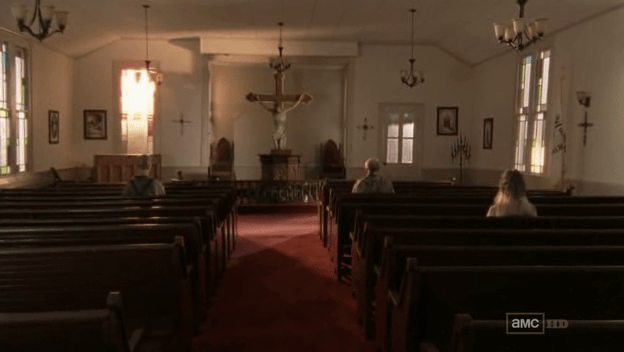
The TV series, the Walking Dead, portrays a post-apocalyptic world. A world where a plague has wiped out most of humanity and turned people into re-animated corpses bent on consuming the living. The world is full of zombies. The show focuses on a small group of people struggling to survive in this nightmarish world. 

The main character, Sheriff’s Deputy Rick Grimes, leads a group of friends and family through this world trying to simply survive each day. The stress of finding food, weapons ,fuel and safety takes its toll. As disaster after disaster strikes the group, Rick finally finds himself standing in a vacant church, standing before a large crucifix, and feeling at the end of his rope. Despite himself, he offers up this prayer:

“I am not a religious man, I have had faith in other things, my job, my friends, my family mostly. But the thing is, we need… I could use a little something to help us keep going. Some kind of acknowledgment, some kind of indication I am doing the right thing. Just a little sign. Any sign i’ll do.” 

(Pause) 

In our world with such a complicated relationship with power, we get the struggle that Jesus encounters. He hasn’t come to conquer or destroy. He has come to preach the good news… and if people don’t want to hear it, what power does he have over them to compel them?

Power comes in so many different shapes and forms in our world, and along with everything else these days… power is changing too. We once thought we were masters of nature, yet now with climate change we struggle to contend with disaster. We once thought progress and democratic freedom would march us towards greater prosperity and stability, yet now the structures the hold the world seems to be fraying at the edges, teetering on the brink. We once thought the church was the great central guiding institution of our communities, yet now we are a shell of former glory. Politicians, officials, experts and the famous used to command the public respect and deference, yet now anyone with a phone can be famous, can start a revolution, can influence the world. 

So when Jesus shows up and people don’t want to listen, we get what that looks and feels like. 

And Jesus could do no deeds of power there. 

To imagine a God that doesn’t have the power to do miracles makes us wonder if God is God at all. Is Jesus really who we think he is, if he all of a sudden couldn’t show his power. Yes, the sinful self within all of us attempts to be God in God’s place. But in our moments of desperation, in the moments when we need something bigger than ourselves, we want to at least know that there is someone who is exerting control over this chaotic world. A

No wonder we would rather just leave that verse, that idea alone. 

(Pause)

Before leaving the empty church and the crucifix, and returning to the troubles of the world of the Walking Dead, Rick Grimes, concludes his desperate prayer:

“I just need an indication to know whether I am doing the right thing. You have no idea how hard that is know…”

And then he pauses and looks up at the image of Christ… blood dripping from the crown of thorns… hanging from the cross. And Rick takes a breath. 

“Well, maybe you do…”

(Pause)

And Jesus could do no deeds of power there. 

This powerless moment of Christ is meant to catch us, it not meant to simply be glossed over. While we have watched Jesus calm the storm, heal the bleeding woman, and raise a little girl to life with a word, we are being prepared for where Jesus is going. 

Jesus has not come into our world to heal our wounds, still our fears or prevent us from dying too soon. Jesus mission is something completely different. Jesus is headed for a different place of powerlessness. 

Jesus is rejected in Nazareth, but it will not be the last place. As Jesus rides into Jerusalem as a powerful king, he will be carried out as crucified criminal. But it is not just that Jesus will be rejected. As Christ goes to the cross, it will become the place where God’s power seems to completely disappear. 

At least where Godly power on our terms will seem to be gone. In fact, the cross will become the place of humanity’s most godlike act. The place where we will not just crucify and kill a common carpenter, but the cross is the place where humanity will put God to death. 

With our most God like power, we will kill God. 

And so God shows us a different kind of power. It is not a power that is about mighty deeds, or miracles. It is not a power that compels us to believe. Jesus does not come down from the cross as King and force us to kneel at his feet. 

God shows us power in weakness. God shows us love. Love that even when put to death will not stop loving. God will not permit even that mightiest power of death to prevent God from loving us. God’s love cannot be ended or destroyed. 

And it is because the miracles will not solve our problems. The deeds of power will not save us. God’s love is the only way we can be healed or reconciled or brought to new life. God’s love is the only way to truly saved from ourselves. 

And he could do no deeds of power there. 

Yet God’s mission, Christ’s purpose remained the same. Deeds of power or no deeds power, Jesus came into the world to show us God’s love, not God’s power. And yes, that makes uncomfortable, and makes us squirm. Despite our desire for power, God is willing to go do the cross to show us that love and life, that forgiveness and mercy are the true actions of God like power. God is willing to die… so that we may be loved. 

Do you not care Jesus?

Mark 4:35-41

 A great windstorm arose, and the waves beat into the boat, so that the boat was already being swamped. But he was in the stern, asleep on the cushion; and they woke him up and said to him, “Teacher, do you not care that we are perishing?” He woke up and rebuked the wind, and said to the sea, “Peace! Be still!” (Read the whole passage)

For the past few weeks, Mark has been taking us on an intense ride through the beginning parts of his gospel. The pharisees began by plotting to kill Jesus for healing a man with a withered hand on the sabbath, Jesus’ family believed he has crazy and wanted to take him away, and last week Jesus told parables about the Kingdom of God being like the mustard bush, the worst weed in the garden. 

Yet still, with our own news is full of extremes… world cup upsets, legalization of another kind of weed, and of course children being ripped from families at the US border… it isn’t like these intense scenes from Mark are that different from what is going on around us.

Today, of course, is no different. The disciples find themselves on an ill fated boat ride with Jesus. As they cross the sea of Galilee, a violent storm comes upon them. As fisherman, they shouldn’t have been surprised as violent storms have the habit of coming on suddenly on Galilee. But even as experienced fisherman, they wake Jesus because they are afraid of drowning. 

“Teacher, do you not care that we are perishing?”

It is a rather loaded question. It is not a direct request for help. It is not the usual cry to God that we might expect. It is not a “Help me God or Save me Jesus”. 

It is almost as if the disciples are saying, 

“Wake up Jesus! Wake up so that you can drown with us!”, 

And Jesus does wake. Jesus wakes up and rebukes the wind. He literally muzzles it. He tells the waves to stop and be still. And then Jesus chastises the disciples. 

“Why are you afraid? Have you still no trust” or more accurately, “Why are you cowardly? Do you still not trust?”

And then something interesting happens. The wind and the waves were calm. But the disciples become fearful. More than fearful. They fear a great fear. They are Terrified upon terrified. Frightened upon frightened. 

And instead of looking to Jesus, they look to one another. 

“Who is this in the boat with us? Who is this guy that even the wind and the waves obey him?”

We know these fears of the disciples well. We have been through the storms of life too. 

Our storms might not be found in boats, but they rock us just the same. They are the accusations that so many throw about, “Do you not care about children being ripped rom their parents?” They are the fears of trade tariffs and economic hardships. They are broken relationships and hurting families, illness and disease. Our wind and waves are change and upheaval. In our congregations, our cries to Jesus and asking if he cares are about the future, about declining numbers, about uncertainty and conflict. And sometimes it can feel as if these storms hit us, one after another. 

But all of these fear and worries sit on above a greater fear buried deep within us.  fear that comes from a more primal place. Fear rooted in sin, in self centeredness. Fear rooted in our wanting to be God in God’s place. Fear that shows itself when we are faced with the reality that God is in control and we are not. Fear that makes us wonder, who is this Jesus. Who is this Jesus that is in the boat with us, in our homes with us, in the church with us?

Whether we admit it or not, we like to think that Jesus is only around when we bother to pray or read the bible, but probably goes home when we are busy. We like to think God is an ever available problem solver, always waiting but never intruding. And as congregations, we act as if were we ever to close up shop, God would close up shop too. 

And so on days like today, when the storm is calmed and we cannot help but see God in the world and in our midst, we are left with the disciples asking, “Who is this Jesus?”

Who is this Jesus?

The storm is the least of the disciples’ problems. In fact, the disciples ask the question that is at the core of their being. “Do you not care that we are perishing?”

Do you not care? 

We long to know that we are cared about, that someone, something out there believes that we matter. 

And does this Jesus actually care?

Does Jesus care about us, about me?

Deep within us is the fear that no one cares, that God does not care about us. That we don’t mean anything, that we are of no value. When the dispels ask Jesus, “Do you not care that we we are perishing?” It wasn’t about the storm, it was the fear that Jesus might not actually care about them after all.

Do you not care Jesus?

And yet, it is precisely because God cares has come to be ride with us in our boats. Because God cares about sin and death that God has been born in flesh. 

God has come to live life among us, and God come to die with us. 

It is isn’t the storm of wind and waves that Jesus has come to still. 

It is the storm of death. 

Jesus has come to muzzle death. 

Jesus has come to die on the cross in order to silence death.

As the disciples wonder at who is this Jesus that is in the boat with them, their wonder is not truly about this one among them who even the wind and wave obey. It is a wonder about whether this God in flesh actually cares about them, about creation, about all of us. 

And for us who know the end of the story, the wonder is no different. The wonder and fear of the one who can muzzle and silence death from cross still doesn’t make us certain that we are cared about.

But that is our stuff.  

Because Jesus still comes into our boats. Just as Jesus road in the boat with disciples, Jesus rides with us into our storms, our places of fear and uncertainty. The places where we fear that no one cares about us, we fear that we will die and becoming nothing.

Just like the disciples whose fear was only multiplied by not knowing who this Jesus is, we too fail to see Jesus in the storms and in the calm. And yet, Jesus gets into our boats anyways. Jesus comes into our world, lives among us and goes to the cross anyways. Because there in the boat and in the storms, there on the waters of creation where the distance between creation and creator is shortened… Jesus claims us. Jesus names us as God’s own. In the waters of baptism, Jesus reminds us that whether we live or we die, we belong to God. 

God is in control whether we like it or not. God is saving us from sin and death whether we see it or not. God is loving us, whether we like it or not. 

“Do you not care that we are perishing? “

“Do you not care God?”

And there in our boats, in our storms, in the midst of our accusations and fears, Jesus reminds of just how much God cares for us. That no matter the wind and the waves, we belong to God. That no matter how many jobs might be lost because of one man’s pride, or how many families might be separated because of cruelty and fear, or no matter what dangers that might cause us to believe we are dying we encounter, 

Jesus is with us, in our boats, in our cages, in our fears and in our anxiety… reminding us that we are not alone, and wether we live or wether we die, we belong to God. 

And even when we still have no faith, 

God has faith in us and for us,

because God cares for us, 

and for all. 

Video: On Being an iPhone Pastor for a Typewriter Church

I shared the manuscript of this presentation a few weeks ago, but here is a video of the TED Talk style presentation I gave: