Category Archives: Theology & Culture

The Kingdom of God in the Birth-pangs

Mark 13:1-8

As Jesus came out of the temple, one of his disciples said to him, “Look, Teacher, what large stones and what large buildings!” Then Jesus asked him, “Do you see these great buildings? Not one stone will be left here upon another; all will be thrown down.”

When he was sitting on the Mount of Olives opposite the temple, Peter, James, John, and Andrew asked him privately, “Tell us, when will this be, and what will be the sign that all these things are about to be accomplished?” Then Jesus began to say to them, “Beware that no one leads you astray. Many will come in my name and say, ‘I am he!’ and they will lead many astray. When you hear of wars and rumors of wars, do not be alarmed; this must take place, but the end is still to come. For nation will rise against nation, and kingdom against kingdom; there will be earthquakes in various places; there will be famines. This is but the beginning of the birth-pangs.”

It is coming close to the end of the church year. Next week it will be Christ the King Sunday, the final Sunday of the church year. And then we will flip the calendar over to Advent, and begin again. Today, we hear from Mark for the final time this year. Mark who has been aggressively pushing the disciples and calling us to let go of all the things that hold us back, our selfish desires, our want of comfort and security, our habit of putting ourselves ahead of others. And Mark has been showing us a Jesus who wants us to see the Kingdom of God, to see the transforming world around us and to witness the work of God in the world.

Of course, it has not been easy and nor have we been all that successful. And Mark seems to get this. From beginning to end, Mark’s gospel recognizes that the disciples never figure it out and neither do we. And yet Jesus sticks with them and sticks with us despite that.

Today, we pick up from last week, from the story of the widow’s mite. After watching the widow give everything she had to the temple, in an act of resignation, Jesus and his disciples leave together. On their way out, the disciples begin remarking on this grandness of the Jerusalem temple. And indeed the temple was a sight to behold. For the people of Israel in that day, the temple was the centre of their world. It was the dwelling place of God, the place from where their history and identity flowed, as well as power and privilege.

Yet, Jesus will have none of it. He grumpily declares that all of it will be thrown down. Which is akin to saying that all of Israel will be thrown down, the power and history and religion of the Israelites will be crushed. Of course, it was only about 40 years later that the Romans did indeed raze the temple to the ground. But for the disciples and the rest of Israel at that moment, it probably seems unimaginable.

Finally, on the Mount of Olives looking down on the temple, after the disciples look around to see that no one is listening and eagerly ask Jesus just when the temple will be destroyed. Presumably the are imagining something even greater coming in its place. If their teacher and master really is the Messiah, he will certainly usher in a new age of prosperity for the people, which includes a new temple. The disciples can only imagine more of what the temple attempts to portray — they can only imagine a greater symbol, a more influential centre of society and culture, an even grander source of meaning and a more potent history for the people of Israel.

The disciples, despite all that they have been through with Jesus are still marvelled at the prospect of power that the temple represents.

As we prepare to turn our calendars over the Advent and begin telling the story of Jesus again new, we do so knowing that we carry the same struggle as those disciples. We don’t really want imagine all the birthpangs or really any part of the pregnancy. We want the Christmas moment, the angels and shepherds, animals and drummer boys. Whether it is in our personal lives or at work, we dream so often of the time when everything comes around for us. Whether it is in our communities or around the world, dreams of peace and harmony abound (as long everyone buys into our vision of peace). Or whether it is the church, the longing we carry for different circumstances, for the easy abundance of our fond memories.

And just how do we know that we feel just as the disciples did? Just listen to regular church goers on Christmas Eve… when the church is often full, full of friends and family we so often hear or say ourselves, “Wouldn’t it be nice if it could always be like this?”

We like the idea of the birth moment, the time when all the work comes together, when all the waiting is over, when the uncomfortable, achy, growing pregnant body is finally done with being pregnant and the new miracle is birthed (of course we know that pregnant bodies don’t just go back to normal but are forever changed by childbirth).

We love the magic of Christmas, the powerful symbol it represents in our minds and hearts – much like the Jerusalem temple for that disciples.

But we do not like what it takes to get there, we do not like the hard work and messiness that is required for something to be refashioned, to be reclaimed, to be renewed, to be reborn.

Or as Jesus calls it, the wars and conflict and earthquakes and famines.

The birthpangs.

The disciples want to know when things will be accomplished, but Jesus is concerned with what it takes to make the journey.

For you see, at this point in the story, Jesus has ridden into Jerusalem hailed by the crowds as conquering king… and will in hours, be arrested, tried, and executed. All by the great powers of the temple of Jerusalem and by the great powers of Rome.

Jesus knows that despite our desire to skip the messy stuff and go straight to magical moment, the Christmas moment, that we tend to spend a lot of our lives in the mess. We spend much of our lives waiting, wishing for things to be different, wading through imperfect and flawed places of the world, through the chaos of just making it from one day to another.

But Jesus also knows that it is in the birthpangs, in the human mess that God is at work. That even as Jesus is about to enter into the darkest valley of human sinfulness, that God is doing that hard work of refashioning, reclaiming, renewing, rebirthing.

Refashioning sin on a cross.

Reclaiming death as New Life.

Renewing the bond between creator and created.

Rebirthing all of us into Kingdom as beloved and forgiven children of God.

These are the birthpangs.

This is work that God is doing in the messy places, that bottom, common, ungrand, powerless, unremarkable places. In and through people like those nobody disciples out in the far and forgotten corners of the world. And also in and through people like us, in the far and forgotten corners of Manitoba and the Interlake.

While we are waiting for Christmas. Hoping that the end of the struggle comes soon, that everyone is resolved and wrapped neatly in bow. And that the Christmas magic will become our new everyday…

God comes to us in the real places, comes to real human life. Real life that happens in the messiness of families and communities and places of work. Real Life that happens in the never ending, monotonous day to day. Real life happens in all those other Sundays when it seems like there are too few voices for the singing and too few hands to greet and share the peace with.

These are our birthpangs, the places where the Kingdom of God is breaking into our world to refashion, reclaim, renew and rebirth us.

It is not about temples being crushed or conquering Messiahs or making church feel like Christmas every Sunday… Jesus is telling us today that he has come for the real thing… the real and messy parts of life. Because that is where we are and we know it.

Jesus comes in the birthpangs because we are constantly being stretched and pushed by life for what comes next. And in the midst of all that, of real life, Jesus comes to us.

Jesus comes to give us a glimpse of the Kingdom being born right here, right now.

The Widow’s Mite: Resigned to Death

Mark 12:38-44

He sat down opposite the treasury, and watched the crowd putting money into the treasury. Many rich people put in large sums. A poor widow came and put in two small copper coins, which are worth a penny. Then he called his disciples and said to them, “Truly I tell you, this poor widow has put in more than all those who are contributing to the treasury. For all of them have contributed out of their abundance; but she out of her poverty has put in everything she had, all she had to live on.”

We are coming near to the end. The end of the church year in just a few weeks, the end of the year of Mark. Mark who has been squeezing hard to make us squirm, trying to get us, along with the disciples, to let go of our baggage so that we can just maybe glimpse the Kingdom of God that Jesus is bringing near to us. The last two weeks we got a bit of a reprieve from Mark, as we observed Reformation Sunday and All Saints. Yet, even today, as our nation take times to remember the 100th anniversary of Armistice Day, Mark still presses to look forward to the coming Kingdom of God.

In fact, Mark has been making us ready for months. It began last June, and throughout the summer and fall, Mark has been challenging the ways we understand the world by telling us the stories of the disciples’ failures. Peter is called Satan, James and John conspire to sit at the right and left of Jesus, the whole group argues over who is the greatest.

And now in this moment in the days and hours before Jesus is betrayed, put on trial and crucified, he is in the temple teaching. And then Jesus watches as a widow comes and puts her final two coins into the treasury. This is no moment of great faithfulness, rather a moment of tragedy Jesus tells his disciples. While widows are not obligated to give to the temple, but rather receive alms from the temple, this woman puts her last two coins, two nearly worthless pennies into the treasury. Not an act of sacrifice, but of resignation. She is preparing herself for the end, for someone who cannot afford food or shelter is certainly destined soon to die.

It is a story connected deeply to the story of the Widow of Zerephath and Elijah. A story that could have very well been picked out of our nightly news.

Elijah has just been told by God to flee his homeland, and God provides for a starving Elijah with dry creek bed and a raven who brings him food. Finally God sends Elijah to a foreign land, to a widow who will feed him.

Now imagine the widow, already a woman struggling to make ends meet and to feed her family. And here comes a foreigner, a refugee from a war torn country asking for help. Certainly we have heard that story in the news, we have even lived here in Selkirk with the refugees families that we have been a part of sponsoring.

Yet, the widow of Zerephath, a woman who is not a Hebrew, who worships a different God and is of a different people than Elijah, responds curiously to his request. She says that she only has enough grain and oil for one more meal for herself and her son. One last meal before they will go hungry and die. Elijah has barely survived escaping his homeland, only to survive with the minimum provision. And God sends him to a woman in the same predicament.

People who are not just facing scarcity, who have not just experienced decline and loss, who are not longing for what they once had… but people are resigned to the end, who can see death on horizon. There is no perspective change or reimagining of ways to use the resources they have, no pulling themselves up by their own bootstraps, no visioning program or stewardship drive that will help. No amount of resumes sent to prospective employers or unpaid internships will turn this around.

For the widow and her son, and for Elijah this is the end. The greatest fear of scarcity has become reality – scarcity has led to death.

And is not that precisely the fear we carry with us, the mindset that pervades our world. Things are tight, resources are scarce, there is not enough to go around. It is the loudest message being told in our world these days. It is the message of advertising, of politicians, struggling institutions, and even often churches. And underneath this warning that there is not enough is the fear that running out will mean death. That caravans will cross borders and take what is ours. That people with different skin, who worship God differently, who speak a differently language will steal our way of life. That technology is taking our jobs, employers are taking our time, sports and Sunday Shopping and a host of other activities are stealing our numbers in the pews. That we are taking the life the planet to drive more cars and make more plastic things. Everything is being taken from us… that is the message of the world. And if we are not careful everything will be taken from us until there is nothing left to give… until we are dead.

Then Elijah responds to the widow. “Do not be afraid.”

Elijah speaks with words usually reserved for divine messengers. Words from Angels, and Arch-Angels, Cherubim and Seraphim.

“Do not be afraid. Go and do as you have said.”

And she does it.

This woman who has nothing, decides to give a refugee her last morsel of food, surely not because of her faith, but because all is lost for anyways, so why not feed someone who has a chance to go on living.

And all of a sudden there is enough. Enough for her, for her son and for this strange Hebrew man who will become the greatest prophet of Israel.

And the widow in the temple does the same, puts her last two morsels in to the treasury in order to maybe feed someone who has a chance to go on living.

And all of sudden there is a cross followed by an empty tomb – and life goes on. Death is no longer the end, but the one who raised Lazarus, lives as well.

“Do not be afraid. Because even where there is never enough in this world, even when all roads lead to death… in Jesus Christ is there more, there is enough, there is life.”

Of course this is what God has been promising to us all along. That when all roads lead to death there is more.

When the world tells us to fear others, people with the wrong language and religion and skin colour who might come and take our way of life, Jesus says to us come and hear my promise of forgiveness, come and be reconciled, come and receive mercy.

When jobs and economies and trade deals makes us wonder how we are going to pay our bills, fill our pension plans, and care for our families Jesus says, come and be washed, come and be named, come and be welcomed into my body.

When the threats of violence and war, catastrophe and danger consume our minds and hearts, and makes us wonder about the future of this planet for our children and grandchildren, Jesus says come and eat, bread and wine, body and blood that never runs out, food that will fill your empty hearts and longing souls.

When we look to the past and long for what once was, when we feel shame as though we have failed those who have gone before us, when there seems to be no future but death for churches and communities of faith Jesus says, you are my body and my body has an abundance that you can never imagine. An abundance of life that overcomes sin and death.

These two widows and Elijah and Mark are all preparing us for this reality about to be glimpsed. The reality that scarcity and death cannot imagine… the reality of God’s Kingdom coming into the world. The reality that in the very moment when we have nothing left but to simply die, God will show up and say,

“Do not be afraid”

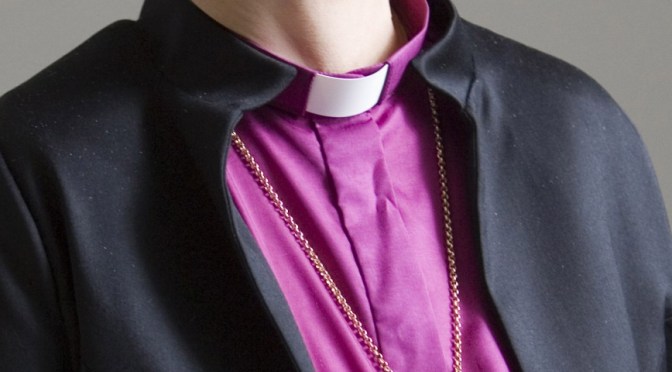
A Sermon for the Ordination of a Bishop

On the Occasion of the Ordination of the Rev. Jason Zinko as Bishop
Manitoba Northwestern Ontario Synod
Evangelical Lutheran Church in Canada

John 13:2-17 

 He came to Simon Peter, who said to him, “Lord, are you going to wash my feet?” Jesus answered, “You do not know now what I am doing, but later you will understand.” Peter said to him, “You will never wash my feet.” Jesus answered, “Unless I wash you, you have no share with me.” Simon Peter said to him, “Lord, not my feet only but also my hands and my head!” 10 Jesus said to him, “One who has bathed does not need to wash, except for the feet, but is entirely clean. (Read the whole passage)

Sermon

It is a delight that the MNO synod has elected you and called you Jason, as our next Bishop.

I remember the first time I met Jason back in seminary. It was a gathering of students during the seminary’s open house. We were at the home of one of our classmates and here was some guy from Winnipeg cracking jokes from the lazy boy in the corner of the living room.

And trust me, “Now here is someone who is Bishop material” was not a thought that crossed my mind. But not for the reasons you might think. Firstly, no one thinks that when meeting seminary students. But as I got to know you, Jason, I remember your struggle with the call to ministry. Not with the fact that you clearly had gifts and abilities for ministry, but particularly how following the call to Word and Sacrament ministry might set you above in some way. That idea seemed to contradict your nature. And the Jason of those days is pretty much the same as today: approachable, thoughtful and down to earth. And also not super formal. 

Which is funny because here we are at your ordination as a Bishop… So, would you have gone through with it all back then if you knew you would be here today? Never the less, here you and we are. 

And I am honoured that you have asked me to preach on this day of your ordination to the office of Bishop. However, what do I know about being a bishop?

So I looked to Martin Luther for some insight. And you know what? Luther has a lot to say about Bishops… None of what he says is good. Mostly stuff about how Bishops just want to be lazy princes and lords and don’t do their jobs… 

Yet, like a lot of church folks and rostered ministers, I DO have lots of opinions about bishops and thus Luther for good company. Maybe that’s all that is needed for this occasion. //

This story from the Gospel John, despite being a recommended ordination reading, is a bit odd, ins’t it? It is odd because of “when” it brings us to in the story. Maundy Thursday, a day on which we would never schedule an ordination!

Regardless, it is this surprising and unexpected thing that Jesus does that seems relevant. He gets up from the supper table to wash the disciples feet. Normally, a task reserved for the house slave, Jesus reverses the order of things and takes the posture of a servant. 

Finally, after washing the disciples’ feet, Jesus exhorts his friends and followers to do what he has done for them, wash one another’s feet.

Here is a metaphor about the life of faith, or the experience of ministry. That our callings are not to higher and higher things, but to service and getting down into the dirty, muddy, not so nice places.  

And surely, as we gather to celebrate an ordination of a Bishop today, we celebrate that God has called you Jason, to this office of ministry in our synod. We also celebrate that this call is a renewal of our call to the work of the Kingdom and the ministry of the Gospel.

This exhortation by Jesus to the disciples gives roots to our celebration today by reminding us that the call to the office of Bishop is not a bigger and fuller call than that of the call to Word and Sacrament or Word and Service ministry. 
And those two callings are not bigger and fuller calls than our first calling. 
And that is the calling we all share, the calling given in baptism. 

Baptism is the calling that most fully expresses God’s call to us to serve one another in the kingdom… it is certainly no coincidence that washing feet looks more like baptism than laying on of hands. And the call to these particular set-apart-ministries within the church, to be Deacons, Pastors and Bishops are all about narrowing and confining —  restricting even — the call of the baptized to a particular and limited set of responsibilities within the body.

And as such, a synod only needs one Bishop, and congregation or ministry only needs one or a few rostered ministers, but there is always need of and room for more of the baptized in our midst. 

Now… having said all of this… and how lovely an image foot washing is… I am not really sure that it is the main point of this story.

While there is something to Jesus’ exhortation to service, it is the interaction between Peter and Jesus that is really interesting and that really has something to say about us and about the church and the world. 

As Jesus kneels down to wash feet in this Maundy Thursday moment the disciples are probably confused, but Peter is the one to say it out loud.

In a moment between the high of Palm Sunday and the crushing low of Good Friday, Jesus and Peter begin arguing over a bucket of water between them. 

“You will never wash my feet” Peter protests. 

He must know that something is about to happen, something big. And he wants to go back. Back to the last 3 years of following Jesus around the country side with crowds in tow. Back to the simpler, easier times, when ministry was straightforward and the results were obvious. 

Peter longs for the past. He understands the past, he can see how good he had it then (even as he was often speaking first, thinking second). He doesn’t want whatever big thing is coming, whatever change is on the way. 

“Unless I wash you, you have no share with me” Jesus says.
“Lord, not my feet only, but also my hands and my head.”

When Jesus won’t back down, Peter moves from avoiding what scares him to changing it. He tries to get Jesus to wash him as a religious leader would wash someone for ritual purity, not as a servant would wash dinner guests. If Peter cannot put his head in the sand and pretend that the scary things around him aren’t happening, he will recreate the past. He will re-make Jesus back into the Rabbi and teacher that Peter is comfortable with. Peter is going to hold on to the way things were at just about any cost. 

Sounds familiar doesn’t it?

Like Peter we too are very uncomfortable with Jesus taking this position, being in this posture. Like Peter we are very uncomfortable with the Body of Christ looking like it is down on the bottom, and we would much rather the Body of Christ of those glory days when the crowds just came, and the miracles were easy and the teachings enthralled the masses. 

Like Peter we would rather that the Body of Christ never have to wash feet. If only Sunday Schools and Youth groups were full again, if only people came back to do the work we are tired of doing. If only there was no Sunday shopping or hockey practices or dance lessons. If only our pews were full and offering plates fuller… there wouldn’t be need of foot washing.

Like Peter, we would rather change what the Body of Christ is doing so it looks and feels better. If only we tried the next program or bible study or trendy church growth tactic. If only we put up some screens and updated the music, if only we invested in some professional church organists and choir directors. If only we preached more biblically and worked more for justice, if only we changed the right part of ourselves, we could go back to the way things were… and the Body of Christ wouldn’t be kneeling before the world.

Peter on Maundy Thursday shows us who we really are. //

Here we are as the church as embodied in this gathering to celebrate the ordination of a new bishop, as the MNO Synod and ecumenical partners, as the Evangelical Lutheran Church in Canada. Big change is upon us, much of what we once knew is already no longer the same, the glory days are behind us… and what is coming… it’s scary. 

But let’s make no mistake, Jason isn’t our new saviour. 
Jason isn’t Jesus. 
Jesus is Jesus. 

Instead, along with Jason, we are standing before Jesus, before the Body of Christ brought low, in this posture that makes us uncomfortable. And we too have a sense that this is not the way things should be.

And Jesus’ response to Peter in the moment?

“This is happening. I am going to wash your feet and just your feet, you don’t get to be in control”

Because it isn’t just about foot washing is it?

Because this moment is the grand reversal of the incarnation, of God coming down to our level, in human flesh, in order to show us love. This is the creator kneeling before creation in order to say, “I love you.” 

This is creation betraying God because we will not open our eyes to what is happening. This is the best that humanity has to offer, religious and political leaders, rejecting the divine, and putting God on a cross because we will not accept what is about to happen. 

Because this moment is nothing less than cross and empty tomb. God taking and holding creation in God’s hands — 

dirty, muddy, tired, sore, sinful, suffering, creation — 
and God washing away a little dirt here, 
scrubbing out the soreness there, 
bringing life and wholeness in a way that we never thought possible and in a way that we firmly tried to prevent. 

So, no pressure Jason, and no pressure to the rest of you. 

But this is our foot washing moment. 

Jesus is telling you Jason, Jesus is telling all of us… 

“This is happening. I am going to wash your feet and just your feet, you don’t get to be in control.”

Because Jason, when you make those vows to the office of Bishop, and we make promises in return, and when that cope is placed on your shoulders and that staff is placed in your hand… it won’t be because this ministry is something that you get to form and shape into your vision, or something that we get to shape and form into ours. 

Rather, it is going to be Jesus taking hold of your feet in order to show you how much God loves you. 

And then Jesus will do nothing less than bring God’s Word of Life into the world through your ministry, 
and God will wash, feed and nourish the people entrusted to you through your ministry, 
and the Spirit with breathe new directions and visions and dreams for us into your leadership. 

Because this moment is nothing less than the spirit of God breathing new life into the church. Nothing less than God declaring that in this Body of Christ, 
this segment of the Church brought low and kneeling on the ground, 
that this is precisely where Jesus is about to transform us and all of creation. 
That cross and empty tomb are being lived out right in our midst. 
And Jesus is making us alive while moving us into the future, no matter how much we yearn for the past.

And as God takes hold of us, of this Body of faith brought low and dying… 
God is washing away a little fear and trepidation here, 
scrubbing out a little resistance to change there, 
and breathing new life into us…. 
new life in the ministry of a new bishop 
and in the renewed ministry of this synod and its members.//

So while Luther didn’t say much positive about bishops, he did point us to the heart of this ministry. He says:

“We will now return to the Gospel, 
which not merely in one way gives us counsel and aid against sin; 
for God is superabundantly rich [and liberal] in grace [and goodness]. 
First, through the spoken Word by which the forgiveness of sins is preached in the whole world; 
which is the peculiar office of the Gospel. 
Secondly, through Baptism. 
Thirdly, through the holy Sacrament of the Altar…”

So with Luther’s reminder of the centrality of the gospel, and Christ’s words to Peter, we are reminded again that our call to the ministry of the gospel does not lift us higher or push us lower and is not even OUR call. 

The call is God’s, 
the Call is Christ’s, 
and it comes from a servant brought low, 
washing and raising us to New Life. 

Amen. 

The Bread of Life: The hardest loaf to swallow

John 6:51-58

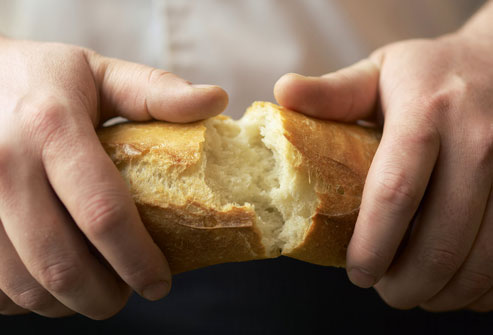
… So Jesus said to them, “Very truly, I tell you, unless you eat the flesh of the Son of Man and drink his blood, you have no life in you. Those who eat my flesh and drink my blood have eternal life, and I will raise them up on the last day; for my flesh is true food and my blood is true drink. Those who eat my flesh and drink my blood abide in me, and I in them. Just as the living Father sent me, and I live because of the Father, so whoever eats me will live because of me…. (Read the whole passage)

Today we receive our fourth loaf of bread. We have been abiding in the 6th chapter of John’s gospel for 4 weeks now, and still there is one more week to go. The ongoing discussion that we have been eavesdropping in on, between Jesus and the crowds, began with the feeding of the 5 thousand, with 5 loaves and two fish. But soon after the food had been eaten and the baskets of leftovers collected, the crowds and Jesus get into a debate. A debate about what the bread means. A debate about who Jesus is. A debate about who God is. A debate about life in the community of faith. 

And now, instead of just celebrating the simple and beautiful miracles of 5 loaves and 2 fish becoming enough for all and then moving on, we have delved deep into the heart of the issue between Jesus and crowds. We are dealing with the big issue for the people listening: Abandon all they know to be truth, and accept the promise of life and grace, a promise made by wandering carpenter turned preacher. Abandon their families, friends, culture and all sense of security that exists in a troubled world and life, for a promise that has no guarantee. 

For the crowds listening to Jesus, the idea of eating flesh and blood would have made them squirm, as it does us. Yet, for the Jewish crowds, the challenge to their religious practice and tradition would have been equally hard to accept. The eating of flesh and blood was something done in pagan temples. The pagans believe that by ingesting the sacrifices made to their gods, they could acquire their god’s powers. 

In the temple in Jerusalem, some of meat that was sacrificed was permitted to be eaten and it was not because it had any special power, but because it was good food. And the blood used in temple rituals was understood to have purifying effect, not magical powers. 

But what Jesus was talking about was on a whole other level. Eating my flesh. Drinking my blood. This is a direct challenge to the way the Jerusalem Temple and religion operated. Jesus is suggesting that there are other ways to obtain God’s forgiveness than temple sacrifices. There are new ways of acting and being under the law. That there is a new understanding of how God feels about sinners and the unclean. 

Eat this bread, eat his flesh, and you will live forever Jesus says. But at what risk? Giving up the system, the traditions, the practices, the worship that everyone knew and understood. Give up knowing how the world works, even if it is hard and exclusive world. Even if often the poor and common people cannot obtain forgiveness or be made clean or find God’s love because it is simply too far from reach. 

_______________

American Lutheran Pastor and Professor Joseph Sittler wrote about his experience with a parishioner who held fast to her understanding of prayer. Sittler’s congregant often boasted about her prayers for parking spots. 

“Whenever I am going to work or to the mall or to church or to the theatre, I pray for parking spot. And without fail there is always one waiting for me when I get there.”

This understanding of prayer bothered Sittler, and often he would try to show her different ways to view prayer and how God answers it.

“Have you ever not found a spot? What about others praying for parking?” he once asked. Yet these questions did not sway the woman’s view. 

Another time Sittler asked, 

“What if there was a mother with a sick child driving to the hospital? And what if you were on your way to a routine doctor’s appointment? What if you took her spot? Which prayer did God answer?”

“Well mine of course” responded the woman fiercely. “Because I prayed harder and had more faith”. 

_______________

As modern Christians, we understand Jesus’ words today in a eucharistic context. We know, we can feel it in our bones that Jesus is pointing us to the Lord’s Supper. To that holy meal that we share each week that feeds our faith, that binds us together as a community and that gives us strength for service in the world. 

But we also know what it is to squirm with the crowds who are debating with Jesus. We may feel icky at the idea of eating flesh and drinking blood, but we can place this idea within a larger understanding of what Jesus is getting at. 

Yet, like the crowds, we too have our own views and understandings. We have traditions and our system for religion. Like the crowds, we know how good faithful people worship and pray, how we keep the laws and rules and act morally. We know who among us has the sincerest faith and the most studied understandings. And when we begin to differ, we also know the arguments that prop up our point of view best are the ones that condemn others. 

And so while we share in Jesus body and blood, we don’t escape the challenge that Jesus presents today. We don’t escape the challenge that Jesus gives to our traditions and systems, to our abilities to keep the rules and judge those who don’t. And most importantly, we cannot escape the fact that Jesus is telling us today, that it is God and God alone who obtains, who gives, and who allows us to be forgiven. It is God alone who gives us life. It is not by our own merits, or faithfulness, or acceptance of Jesus that saves us or makes us pure. It isn’t by being a good Christian that we save ourselves. It is always in the moment we think we can wrap our hands around this faith stuff and the moment we think we know what God wants and likes, that we lose it all. It is in the moment when we think we have got the right understanding, that Jesus steps in and reminds us that it is always different than we think.  

_______________

Over the course of years, Joseph Sittler tried again and again to convince his parishioner that parking spots were not likely to be one of God’s chief concerns. And again and again, he was rebuffed. “You need to pray harder and more sincerely” was the response he got over and over again. 

Until finally, one day in Advent, and the topic of praying for parking came up again, Sittler knew how he would respond to this certain and self-assured parishioner. After hearing once again, that when this woman prayed for parking spots God always provided, Sittler said, 

“What do you suppose a very pregnant Mary was praying for as she bounced along on the back of that donkey while riding to Bethlehem.”

“I don’t understand what you mean, Pastor”, the woman replied. 

“Luke 2 verse 7” Sittler offered. “And she gave birth to her firstborn and wrapped him in bands of cloth, and laid him in a manger, because there was no place for them in the inn.”

_______________

Just when we think we have the world figured out, just when we think we have God figured out. Just when we think we can point to God and say, if you worship, or pray, or act, or serve in this way, you will be in God’s good books, Jesus lands in front of us again. Jesus lands in a manger when there are no room at the inn. Jesus lands on a mountain top with hungry people needing bread, but needing God’s love even more. Jesus lands on a cross, and transforms death into life. And here, Jesus lands as body and blood in our midst, at our table, in our mouths and into our bodies. Jesus lands in, with and under us, reminding us that just when we think we have God figured out… Jesus is the one who is giving us life, and we are forgiven, not because of our efforts or faith or ability to know, but solely because of God’s love for us. 

This fourth loaf of bread might be the hardest to swallow. The first loaf was a miracle, a miracle reminding us that with Jesus there is enough for all, enough for us. But today, as we hear again of the Bread of Life, as we hear about who the bread of life is and what it means for us to eat this bread… we are stripped of our comforts, of our traditions and systems that help us to be self assured and certain of our understandings. Today, Jesus feeds us bread from the living Father, and we will live. It might not be comfortable and it might make us squirm, but in this Jesus, this God who turns what we know upside down, in Christ there is life. 

Remember that you were aliens and strangers with no hope too

Mark 6:30-34, 53-56

The apostles gathered around Jesus, and told him all that they had done and taught. He said to them, “Come away to a deserted place all by yourselves and rest a while.” For many were coming and going, and they had no leisure even to eat. ….When they got out of the boat, people at once recognized him, and rushed about that whole region and began to bring the sick on mats to wherever they heard he was. And wherever he went, into villages or cities or farms, they laid the sick in the marketplaces, and begged him that they might touch even the fringe of his cloak; and all who touched it were healed. (read the whole passage)

We are coming to an end point of sorts. After this week, we will detour from Mark’s Gospel to hear 5 Sundays from John on the Bread of Life. And this scene from Mark today, is the culmination of something building in the background of these stories of Jesus’ preaching, teaching, healing, exorcising demons and arguing with the pharisees. 

Today, the crowds move from the background of the stories and take centre stage. The crowds were there as Jesus’ family tried to take him away and Jesus compared the Pharisees to Satan, they were there when Jesus taught in confusing parables which he only explained to his disciples in private. They were left behind as Jesus and the disciples rode that boat out into the storm. They were silent witnesses as Jesus healed Jairus’ daughter and the bleeding woman. And they watched as Jesus could do no deeds of power in his home town. 

After sitting always in the background and even after being avoided by Jesus and his disciples, the crowds, the poor, unwashed masses following Jesus around Galilee looking for hope and healing finally have their moment today. 

As Jesus and the disciples feel the pressure of the crowds, Jesus suggests that they all find some place quiet to go. So again, they try to escape the crowds by boat. But this time the crowds will not be fooled. They run around the shore ahead of Jesus and disciples. 

And while it isn’t totally explained just who these crowds are, the stories that they have been a part of and the background suggest that these are likely the common people of Israel. The poor, the disadvantaged, those on the outside, those who have little power in their world, those who excluded from political and economic upper echelons of society. Some might be beggars, those who bear disease or infirmity, but also everyday average people who try to work and care for their families, to eek out a living in Roman occupied Israel, which was a harsh and difficult place to live. These are the faceless, nameless masses of the world. The kind of people you pass on the streets, or in the mall or at the grocery store without much thought. People whose lives are mostly normal, if not unremarkable. People who don’t really get names or details of their own, they are just crowds. 

And the crowds have been ignored and forgotten for long enough, there is no pushing them aside anymore. They have come to Jesus and Jesus cannot keep putting them off anymore.

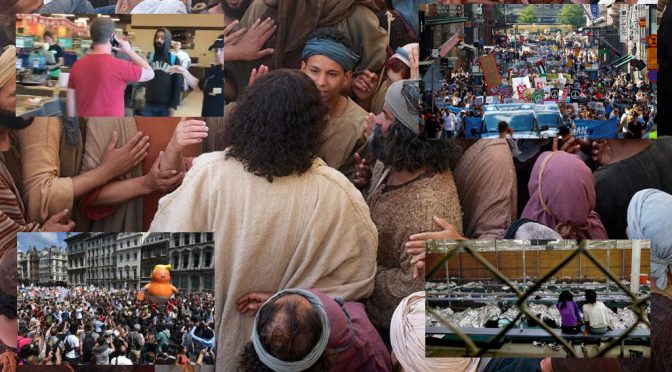
Maybe you feel the same way, but I can get what Jesus is feeling like today. The crowds of our world seem to asserting themselves in much the same way. Flip on the news and there are crowds gathering around every corner. Crowds on the streets of London and Helsinki to greet a certain world leader. Huddled masses appearing at the borders between Mexico and US, and the US and Canada. Crowds seen in fenced-in detention centres separating families, crowds at grocery stores looking on as some lunatic in a red t-shirt tries to call the cops because someone dared to have dark skin and a beard in his presence. 

The crowds seem to coming up front and centre in the news these days, in our social media feeds, and even on our doors steps. 

And it is easy to see those crowds as outsiders. As the lost and forgotten, the alien and strangers of our world. It can be overwhelming to imagine what we could possibly do for them Should be out in the streets with protest signs too? Should we be at the border with food and clothes to help welcome the lost and forgotten before their are thrown in detention centres? Should we step in front of a raving and angry person making a scene in a public place?

These don’t feel like our problems, they are the problems of other people, the problems people on the outside, foreigners and aliens and strangers. 

As the crowds press in on us and give us hardly a moment to rest or eat these days… Paul has some words for us. Some words first given to the Ephesians, but just as applicable today. 

“…remember that you were at that time without Christ, being aliens from the commonwealth of Israel, and strangers to the covenants of promise, having no hope and without God in the world.”

Remember that you were once outsiders too. Outsiders to God’s love with no hope in this world. 

_________

As Jesus and the disciples land their boats back ashore, their attempt to escape the crowds seems to have been for naught. They crowds are pressing back in again, searching for some kind of hope and healing.

But this time something shifts in Jesus. Jesus has compassion for these desperate crowds. He sees them for who they are and what they need. They are lost and forgotten. They are aliens and foreigners. They are outsiders. 

And so Jesus finds them. 

Jesus remembers them. 

Jesus welcomes them.

Jesus knows them. 

Jesus brings them inside….inside into God’s mercy. 

And all of sudden, in a subtle but important shift, Jesus isn’t trying to escape anymore. He simply lets the crowds be. He lets them be around him, near him, and come to him. They are a part of who and where Jesus is. They are part of the family. 

As we sit in our comfortable churches, it is easy to feel like insiders, and even difficult to identify with those crowds on the streets of London and Helsinki, or the crowds in detention centres are borders, or the crowds witnessing racism in grocery stores. 

And as people of faith on the inside, we can even wonder where is God among these crowds today? Is God at work in the crowds in the streets of London and Helsinki? Is God handing out food and blankets at the borders? Is God stepping in between that lunatic at the grocery store and the poor victim of his rage? 

Maybe… God might be in those places…

Paul reminds us: 

“…remember that you were at that time without Christ, being aliens from the commonwealth of Israel, and strangers to the covenants of promise, having no hope and without God in the world.”

But Paul also says: 

“But now in Christ Jesus you who once were far off have been brought near by the blood of Christ. For he is our peace; in his flesh he has made both groups into one and has broken down the dividing wall, that is, the hostility between us”

Here is the thing, Paul isn’t reminding of what it feels like to be outsider… most of us were brought into this family of faith as insiders as babies and we don’t remember being outsiders. 

Rather, Paul is reminding of the gift of a place in God’s family that has been given to us. The free gift, the undeserved gift, the unearned gift of being a member of God’s family that Christ has given to us. 

Because here as we gather from far off, Jesus brings us near. Jesus gives us peace in reconciliation and forgiveness. Jesus makes us one in the Word of Good News that we hear, and Jesus breaks down the wall, the hostility between us. 

And Jesus is first here among this crowd and in these streets between us, gathering us at this table. And Jesus brings us bread and healing at the table, at the border between heaven and earth. And Jesus steps in-between us and sin and death to proclaim that those things are not okay and will have no place here anymore.

Paul reminds us that we were all once outsiders and and aliens and strangers. But Jesus has brought us in to the love and mercy of God, and Jesus continually brings us in, continually makes us – and the whole world – part of God’s family.

And so today, the crowds press in, on Jesus and on us. Yet are reminded that we are not the insiders removed from it all that we thought we were… Rather, we are the crowds too, and we now have a place near to Jesus, in the household of God.