Category Archives: Theology & Culture

Questioning our identity in Advent – Pastor Thoughts

Every so often, I find myself in a situation where someone is trying to figure out who I am and what I do. Maybe at a funeral, or a community event, sometimes when meeting other clergy from other denominations. One particular conversation stands out for me when I was serving at Messiah in Camrose, Alberta as the Senior Pastor of a large congregation. Upon meeting another minister in the community our conversation went as follows:

“Nice to meet you, Erik. So what do you at Messiah?”

“I am the pastor.”

“Oh? Is this your first call, just newly ordained?”

“Nope, this is my second call.”

“Oh, okay! So do you have a specific portfolio, like youth pastor?”

“Nope, I am the Senior Pastor”

“Oh wow really, the SENIOR Pastor! Really? Like in-charge-of-the-whole-congregation SENIOR Pastor?”

“Yup, that’s me. The SENIOR Pastor”

Now, fortunately, these types of conversations don’t happen all that often to me (ask my wife how often she is asked whether she is the daughter or granddaughter of a patient at the hospital, even while she is in a clerical collar). I don’t know if it is that I look young, or unsuitable to be a pastor to some folks. But it can be an odd feeling to encounter someone who cannot fathom that you are filling the role that you do. 

I imagine that people in all kinds of occupations encounter similar kinds of situations, yet I do know that if I were 20 years older, my beard grey and my tattoos covered up, I would fit the expected image of what a pastor looks like. 

The jobs we do, the professions we practice, and the vocations we bear are often such an integral part of our identity that it is more than just amusing or an annoyance for the folks around us to see us differently than we understand ourselves. It is questioning who we are at the core of our being, which can bring all kinds of discomfort and uncertainty. 

In this 3rd week in Advent, John the Baptizer is questioned in this way. The other religious leaders around him want to know how he fits into their world.  

As he is questioned about who he is, presumably so that the priests and Levites might control him or condemn him, John defers to the identity – the calling – given to him by God. 

John makes it look easy; but finding that grounding to root our sense of self is difficult. Those of us who aren’t called to be desert prophets live in worlds of community where our identities are constantly being refined against the perceptions of the people we interact with each day. Who we are can often depend on how the people around us treat us – on whom our family, friends, colleagues, and neighbours tell us we are. 

As we come to this middle portion of Advent, we shift from questions of cosmic meaning to finding refuge in the wilderness to wondering just who we are in this world. It is not an easy journey, but it is a path that is leading us to incarnation.  This path is leading us to Messiah, the one who is coming into our world in order to be close enough to look us in the eye and remind us again of who we are – God’s beloved. 

Finding refuge, and God, in the wilderness – Pastor Thoughts

Wilderness. 

John the Baptizer comes to us in this second week of Advent, or rather the Advent story takes us out in the wilderness to see and hear John preach. It feels like we are leaving the familiar places of home to go out into the unknown in order to hear a message from John. 

It is pretty clear to see that our safe and familiar places have become less safe and comfortable over the course of the past few years. Our homes, our places of work, our community gathering places have been breached… breached by dangers and risks we never imagined, and change we did not anticipate. An air of unfamiliarity has overtaken them. 

This is something that I have noticed this Advent. The breezy comfort that we once exuded in our day-to-day lives just five years ago, has been replaced with a mild discomfort that seems to be everywhere. 

It is no wonder the crowds left their homes and communities to hear John preach, their world had few places for safety and comfort either. 

Usually, when we think of wilderness, we imagine dangerous, secluded, sprawling and untamed lands. Maybe the wilderness feels unsafe. 

Yet, the wilderness can be a place to get away. To go out from the chaos that looms over us at home, to leave behind the troubles that close in on our lives. 

In my five summers of working bible camps, two were spent at a Southern Alberta camp called Wilderness Ranch. Deep in the sprawl of the Porcupine Hills and at the base of the Livingstone Mountain Range, there was a certain clarity to be had. Away from phones, electricity and plumbing; away from the hustle of modern life, there was the opportunity to think without distraction. To sit on a horse following a well-worn trail and let the mind ponder and in that pondering to hear again the call of God. To sense the Spirit’s promptings anew.

In the Old Testament, God often sent the people out into the wilderness, to learn and grow, to be changed. To encounter the divine. God often meets us in the wilderness, where with all the baggage of life left behind we can listen and hear God again.

We are in a wilderness moment again as a church. Not a wilderness moment where we have been cast out into unsafe places. But rather a time where God invites us to leave our baggage behind, to leave our preoccupations and worries behind, to discover the unburdened freedom and space to listen for the divine once again. 

John the Baptizer is out in the wilderness this week, and so are we. John is God’s sign of hope in a suffering world and it just so happens that hope is what we are looking for. 

What do Advent and Christmas in November have to do with each other? – Pastor Thoughts

A couple of weeks ago, our family made the choice (mistake?) of going to the mall on a Saturday. It was the afternoon of Remembrance Day and I have never seen the mall so busy. There were people in all the stores and busy streams of folks moving along the corridors. Then in something I had never seen before, there were all kinds of people just loitering, standing against the balcony railings, sitting on every bench and chair. 

There was even a line-up for the Lego store. I asked the employee waving people in if there was a special sale and he said, “Nope, just fire regulations.”

Now why was the mall so busy on November 11th? I am sure you know the answer already. It was the first unofficial day of Christmas shopping. In addition to the throngs of people, the mall was covered in the usual Christmas decor and blaring Christmas music. People were hauling bags and bags of things that were destined to be wrapped and put under a tree. 

Now two weeks later as we plan to begin Advent (and we are a week early!), secular Christmas has been in full swing for almost a month. I used to be upset by all the Christmas stuff going up nearly two months before Christmas actually begins (the season of Christmas starts on December 25th and is 12 days long). I would also be annoyed by all the Christmas stuff coming down on December 26th, on only the 2nd Day of Christmas.

In the last few years, I have been coming to see more and more that this season of lights and winter whimsy centred on Santa Claus; and the Feast of the Nativity and the Christmas season that follows are really two different things. The lights and displays that go up this time of year are a way for us to adapt to the winter season and darkness which can be hard to cope with. It is a way to push back against a world that would otherwise feel like it is closing in on us. 

In fact, secular Christmas is a lot more like Advent than the actual Feast of the Nativity. Even though it is full of Nativity and Christmas images (songs, displays etc…) Secular Christmas is about preparing and getting ready, it encompasses our struggles and desire for a different world, and it often reveals the contradictions and conflicts that exist in our families, relationships and society as we contend with the contrast between extravagant gift buying with increasing poverty and need.

Now, unlike Advent, it does not do these things intentionally, but rather quite accidentally.

So as we begin Advent this week, getting ready for the coming of Messiah, searching for the light in our darkness, for hope in our suffering world, we know that we are walking alongside a world that is also searching for hope – but maybe going about it in a strange way. 

And that in our waiting for Messiah, God is revealing again the promise given to our world that our darkness and struggle will not define us. And that no matter how we try to fill that void with store-bought gifts, light displays, Hallmark movies and Santa photo shoots, Messiah is coming to meet us with gifts of the love, mercy and life of God.

Making decisions above my pay grade – Pastor Thought

In 15 years of serving as a pastor, I have remained a mostly “by the book” person. That is to say, when it comes to worship and liturgy, I tend to stick to the orders, texts and traditions of the church. It is not that I am unwilling to try new or different ideas,  nor is it the case that I feel compelled to follow the rubrics (stage notes in our hymnals) as if they were written in stone. However, I find the structure and careful attention of our established liturgies to be the most compelling means of proclaiming the Gospel in the worshipping assembly. Or to put it another way, you would need to convince and show me how our liturgical worship practices are not the best for saying the important stuff about God for me to change a lot of stuff. 

So this Sunday, as we observe Christ the King Sunday at Sherwood Park, there is a small part of me that is uneasy. The reason for that is that we are technically a week early! … Gasp!

This year, the 4th Sunday in Advent falls on the morning of December 24th. As you all well know, there are evening services that are pretty important to a lot of folks that day as well. 

So rather than packing Christmas full of services from morning to night, we are leaving the Sunday morning of December 24thopen and moving all of Advent forward one week, as well as moving Christ the King Sunday. 

And yes, it was my idea. Even if changing the liturgical calendar feels beyond my pay grade.

In some sense, Christ the King Sunday is a strong reminder that so much of our life of faith is not up to us – beyond our pay grade, so to speak. It can be easy to reduce faithfulness to things like following the rules, being a good person or earning our salvation. 

But as we hear the readings for Christ the King Sunday, which paint a picture of God’s intention to restore and reconcile ALL creation into something new, we can begin to see that, as individuals, we are just small pieces in the great unfolding of God’s divine work.

As creation hurdles towards God’s future, we as the Church bear witness to something that extends far beyond our personal and individual faithfulness. We are witnesses to the work of God taking place all around us, to God’s transformation of all things into the reconciled and recreated beings that we were meant to be. 

So while we move Christ the King Sunday forward by a week, we do so knowing that while we can shift the calendar around here or there, it is God who is moving all creation into a new future that we have yet to see fully. 

All Saints according to Coco – Pastor Thoughts

All Saints Sunday is one of my favourite times of the year, and not because it is the same Sunday as the time change when we ‘fall back’ to daylight savings time. 

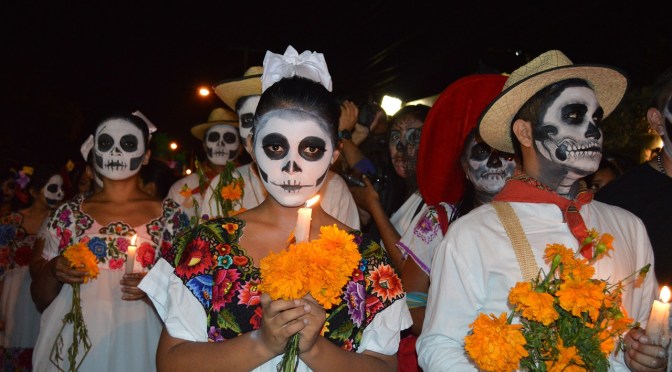
Our family has had an All Saints Sunday tradition of watching the movie “Coco” in the afternoon. Coco is a Disney/Pixar animated film that tells the story of a young boy, Miguel, in Mexico who is transported to the Land of the Dead on Dia de los Muertos (the Mexican holiday, Day of the Dead). The Land of the Dead is a colourful fantasy world of skeletons that more or less continue living as they did in fleshly life. As he tries to return home, Miguel encounters his family members and other adventures. 

Spoiler warning: the next paragraph describes the final scene of the movie.  

The final scene of the movie is back in the land of the living, at a Dia de los Muertos feast – an All Saints feast, surrounded by family both living and dead, enfleshed and skeletons. They are visiting and singing, eating and dancing, all as a great gathering of beloved family. The skeletons, with a golden glow, are imperceptible to the living, but there with them all the same. 

There is something in that scene that sparks an image of All Saints Day. The gathering of the great multitudes around the throne of God, singing and dancing, feasting and visiting. But it is not just an image for All Saints Day, but every time we gather at the Lord’s table, every time we gather to sing, pray and praise with beloved family⎯mothers and fathers who have gone before us in faith, siblings who gather at our side at the table, children and descendants yet to follow in our footsteps. 

This image of the whole host of heaven, the cloud of witnesses that holds us in our faith is one that we must encounter and remember on our way to Advent. It is the place to which the whole story of the Church Year has been leading us⎯ from Christmas and Easter to all the parables and stories of the Green Sundays. The vision of the Kingdom of God is as much our anticipated future as Christians as it is our present reality gathered around the table. 

As much as the great multitude is the end of the story, it is also what leads us back to the beginning, because All Saints and our forebearers in faith are also the ones who have handed on to us the story of Advent and the coming of Messiah. Our waiting for God’s promises was first begun by those who have gone before us. 

There is one more image from Coco that resonates with me. There is a cosmic scale to All Saints Sunday⎯the promises given to the whole company of heaven. But in that final scene in Coco, the vision of All Saints is also intimate and personal. It is a gathering in the backyard of the family shoemaking business; it is a family dinner with people who are truly known and loved. It is a vision All Saints where this little Mexican family of Miguel’s represents all families. It is God’s promise given not just to all generally and broadly, but also personally and directly. 

God’s promise that, in the Kingdom, there is a place where we truly belong.