Category Archives: Theology & Culture

Lenten Place – Massah and Meribah

Lenten Devotions

Massah and Meribah

READING: Exodus 17:1-7

Our Lenten Journey brings us today to Massah and Meribah, a stop in the wilderness. There the Israelites have wandered and found themselves wanting, hungry and thirsty. 

This journey began in Eden. In the Garden of Eden, there was an abundance. Food and water enough for all – for Adam and Eve and all the creatures of God’s making to have enough. But Eden was not enough, Adam and Eve sought to be like God. In their reaching Eden came to an end. But God did not send them away without a promise that they would not be alone. 

Then in Ur, Abram and Sarai were called to get up and go. To a land that God would show them, to become parents to a nation, to be God’s people from then on. But the covenant of God’s trifold promises was not enough, and Abraham and Sarah’s descendants consistently fell from God. 

Now the Israelites, after escaping slavery in Egypt because of God’s promises and leading, because of the prophet Moses that God sent, are now wandering in the Wilderness. But they long to go back, back to Egypt and the known reality of slavery over the unknown of the wilderness. They long to go back to Ur, back to before they were called to get up and go. Back to Eden, where they were not dependent on God’s providence, where the milk and honey flowed. 

Looking and longing for where we once were is a very human emotion. Wanting to go back is the source of nostalgia, the source of grief, the source of our regret. The places and people, the things and experiences that we have left behind are often better in memory. Wanting to go back and experience them again is a feeling we all know well. 

It isn’t just that familiarity brings us comfort, even when the familiar is not comfortable 

It isn’t just that the known brings us anxiety, even when what lays ahead might be better for us, might be full of promise. 

It is that we are people of story. We understand the world through our stories, we make sense of our lives through the narratives we tell, the history that defines us. Our stores are anchored to our past. It is the reason we tell the same stories again and again when they are our favourites. It is the reason we follow a known liturgy in worship, and in the hockey arena, and in the drive-thru line at Tim’s and in the Monday morning staff meetings at work and in our bedtime routines. 

Stories help us make sense of the world; stories make the past into the present and into the future.

Which is why God’s promises and call are so scary. They are not yet our stories. They things yet to be, possibilities and risks unknown. Slavery wasn’t good, but at least it isn’t dying of thirst in the desert the Israelites complain to Moses. A refrain we have repeated again and again throughout the ages. 

And while stories of the past are so powerful, so integral to how we understand the world and our communities, our families and ourselves… they cannot give us water when we are lost and thirsty in the desert. 

This is what God knows about us. That we are people who need a story to make sense of things, AND people who water. New living water from the rock. The rock of Meribah and Massah. 

That is why God’s stories are different. God’s stories help us to make sense of our world. God’s stories bring familiarity when we need it. 

But God’s story is not the story of the past. 

God’s story is the story of the future – promise and hope. 

God’s story is the story of now – love, mercy and grace that meets us here and now. Water from the rock and a new story to tell. 

The stories we tell of God are stories that help us see that God’s people have been where we are before and remind us that God is with us now. God is in our world, our lives, our communities and families now. And God is bringing us through the unknown and uncertain.

The Israelites needed to be reminded of the present and future promise that God gave them in Egypt – rescue from slavery. 

The promise God gave them at Ur – a land, descendants and a relationship. 

The promise God gave them in Eden – that they would not go into the world alone. 

The promise that God gives us here now – that in the Christ to come, there is forgiveness, salvation and new life. 

Tonight’s stop at Masseh and Meribah quenches the thirst of Israelites; it quenches our thirst. But it also gives God’s new story of promise and hope to tell… that God is with us, showing us the way through to the other side of wilderness, to new life in Christ. 

Lenten Place – Ur

Lenten Devotions – Week 2

Ur

Genesis 12:1-4a

Our journey through the Lenten wilderness has brought us to important places along our way. We began our mid-week stops with the Garden of Eden last week, where Adam and Eve ate from the tree of the knowledge of Good and Evil to become like God. But there they were sent on their way with God’s promise that they would not leave Eden alone, but that with them God would go into our much less than Edenic world. 

Today, we begin in the oldest part of the Bible. It is here in Genesis twelve, in the land of Ur, that we find Abram and Sarai. Ur was in southern Mesopotamia, the fertile flood plains of civilization around modern Iraq today, just to the West and North of Israel. 

Abram’s lineage is traced back to Shem. Shem, one of Noah’s three sons, Noah who, with his family in the Ark became the second Adam. The second ‘first’ human of creation, as God started over, blotting out all the wickedness of the earth with the flood. 

The call of Abram and Sarai is an unexpected one. The Lord meets this couple, who already had a life and kindred in the city of Haran, in the land of Ur. Abram and Sarai are called by God to give it all up and go. To get up and go to an unknown place, to a land that they did not know but that would only become known in the future. 

This call from The Lord is by no means an easy call to follow. Yet, this call sets the stage for the people of Israel and their relationship with the Lord God. There is a signal in this call to give up Sarai and Abram’s country, and father’s house, and kindred that the life of faith and obedience might regularly demand us to leave behind comfort and certainty. 

But Abram and Sarai faithfully go. Not knowing where the Lord God will send them. 

Eventually, Abram and Sarai will become the parents of Israel. Their sons, Isaac and Ishmael, and grandsons, Jacob and Esau, and their 12 great-grandsons, including Joseph and his dream coat, will eventually establish the nation of the Israelites. The people who are rooted and formed in the call of The Lord to get up and go. 

But God’s call is not just one that makes demands of Abram and Sarai, that makes demands of us. 

With God’s call comes a covenant. A trifold promise. The Lord promises to Abraham first land. Not just any land, but land that God will provide – promised land. Land that it takes Moses to lead God’s people to. A place to call home, a place where God’s people belong. 

The second promise is that God will make of Abram and Sarai a great nation, that God will bless them with many descendants. With offspring more numerous than the stars in the sky. People who will claim that they have Abram and Sarai, or Abraham and Sarah as their ancestors. 

Finally, the third promise that God makes is that Abram and Sarai will be blessed. Blessed means that they will carry with them the presence of God, that they will not go alone, but that God goes with them. Just like Adam and Eve who left Eden and God went with them, Abram and Sarai leave Ur with God along for the journey. 

However, these three promises are not just any promises. They are not promises that are just for Abram and Sarai; these promises are given or all of God’s people. These three promises become the Abrahamic Covenant – the promise that is the foundation of God’s relationship with the Hebrew people throughout the Old Testament. It is a birthright that Isaac was given over Ishmael, the promise that Jacob stole from Esau, the promise that Joseph rescued from certain doom when he brought his family from famine and into the land of Egypt. The promise that Moses than carried with the Israelites into the exodus and eventually almost to the promised land. 

They are the promises that Jesus would have learned as a young boy studying the Torah, listening at the feet of his parents at Shabbat, from the Rabbis in the synagogue, from the priests in the temple. The promise that the Pharisees threw in his face when he promised a new covenant. 

It is the promise that becomes the through-line from Genesis to the end of the Old Testament, and again from the Gospels to Revelation. The promise that still defines the people of Israel to this day. 

It is the promise that Jesus adds onto with the New Covenant of the cross, the new covenant that we receive in Bread and Wine, the New Covenant that defines us, the Body of Christ. That we too are given a place in God’s Kingdom, that we too are part of God’s family, that God is our God and we are God’s people. 

From humble beginnings in Ur, two faithful people were called to get up and go, to follow God’s call out into the world. With them went a promise, a covenant, that has carried from there to us, reminding us that in this world we are not alone but always going with God. 

A Service of Leave-Taking

This was a post shared with my congregation the day before our Leave-Taking service on June 22.
A service of Leave-Taking is a hard thing to define. The name tries to make it obvious – someone or something is taking leave. But who is leaving, and what is staying behind? It is not entirely clear.

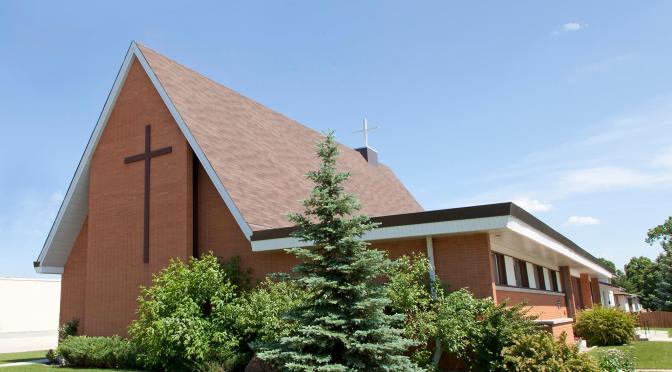
The thing that we are doing is taking leave of our building at 7 Tudor Crescent. We – the congregation and community of Sherwood Park Lutheran Church – are leaving the building that has served our community for over 60 years. 

Having moved from our first family home less than 3 years ago, there are some similarities. Once the decision to move is made, there is a flurry of activity. Sorting, packing, recycling and trashing. It is work that is daunting; it feels like climbing a mountain with no sight of the peak. It is exciting; there is the anticipation of the next thing. 

Yet, there also comes a point when all the memories and experiences that live in the walls and floorboards of a place come flooding into memory. Things that have been packed away since move-in are rediscovered. There is the realization that you cannot bring the wall that tracked the height of growing children with you. There are countless moments of celebration and joy, of hardship and sorrow that were experienced in a place that will be, in part, left behind. 

I think all of that is true about our leaving 7 Tudor Crescent. As I said last week, the walls and floors bear the pathways of community. We are leaving the bricks and mortar that housed a community of faith for generations, that bore witness to the entirety of lives lived together from birth to death and all things in between. 

The places we call home become more than their constituent parts; they bear a history. They are memory keepers for the lives of those that pass through, standing vigil for the flurry of life’s whirlwind of activity that abides in them. 

Now, the thing about service of leave taking tomorrow is that it isn’t just about leaving this building full of memories behind. There is also the acknowledgment that the community we are in this moment will transition to something else. Now, of course, that is true at all times. If we could take year-by-year snapshots of a congregation, we would see that we are always changing and never the same community for long. 

But we also know that this is a big change. That the community as we are comprised on the 22nd will not be the community that constitutes in an identifiable fashion on June 29. The reliability of being a consistent worshipping body is going to change much more starkly than the gradual year-by-year change we have usually experienced. 

We are going to be something new and right away. This is not an easy thing to endure, and I think we have been anticipating this abrupt change for a while, building up the energy to meet this moment. 

If there is something to cling to this week, it is that in all the history of a community, they are giving thanks for tomorrow, we go forward into the future with the Lord of Life, who has seen us through all along the way. 

In our Word of Faith shared among us, in the Gospel Promise given to us in the waters of the font, in the Gospel food shared at the altar rail, God in Christ has been with us. God has been shaping and forming us, calling us into New Life. 

And that same God who has been with us all along the way, from before even the first shovel went into the soil at 7 Tudor, making us into new creations as we lived our lives together in faith… this same God goes with us and will continue to call us into a Gospel future. Even though we are taking leave of this place, knowing that our community will not be the same, God is not taking leave of us, nor we of God. Instead, wherever we go, God will continue to bring us into the life of the Trinity, continue to make God’s promises heard in the Word, continue to wash us in the waters of life, and continue to feed us into the Body of Christ. 

So we prepare to take our leave soon, and it will be hard to leave behind the building at 7 Tudor, but we do not go alone. Instead, we go following the call of the Holy Spirit, the God who is always promising to make us new again.

The Strangeness of Congregational Transitions

This is a post that was initially shared with my congregation on June 14, in the days ahead of our Leave Taking Service:

There is strangeness to this moment for us as the congregation of Sherwood Park Lutheran Church in Winnipeg. 

We have been counting down the months, weeks and days until we say goodbye to our building. During these past few months and weeks, plans have been put into place to take with us what we need to bring with us and to leave behind what we need to leave behind. 

Just a few days ago, I was working on our final service. 

One of the final prayers before the blessing is called the ‘Declaration of Leave-Taking.’ In it, the Bishop says, “I declare this building to be vacated for the purposes of Sherwood Park Lutheran Church.” There is a certain finality to the statement. It is the conclusion of a service in which all the last things will take place: the final hymns, final prayers, final sermon, final communion and final blessing in this place. Now, of course, a new community of faith will begin many of those things anew this summer at 7 Tudor Crescent, but not as Sherwood Park. 

We don’t often talk about purposes so directly; in fact, it might be difficult at first to name our purposes if we were put on the spot. Yet, our purposes as a community, in the end, are the reasons we have been doing what we are doing as a community for 64 years in this building of ours. 

Last year, during one of my evening conversations while on the Reformation Tour in Germany with Dr. Gordon Jensen, we were talking about the purpose of the Gospel. “The Gospel is for the sake of community,” he said. The gospel⎯the good news of Christ’s death and resurrection that gives us new life⎯is given to us in order that we might be reconciled with God and be reconciled with one another. The Gospel is primarily given for us, not for me or for you, but for us. The Gospel is given for community because we need it together and in our relationships with one another, much more than individually or on our own. 

So the purpose of our community, as Sherwood Park Lutheran Church at 7 Tudor Crescent, has been to be a concrete place where the Gospel is found. Found in the Word preached, in Baptisms that welcomed new Christians into our community, in the Lord’s Supper that fed us so that we could be bread for the world. In those things a community was formed and shaped, a community that lived and worshipped together, that loved and cared for each other, that shared in all the moments of life together, from birth, childhood, adolescence, young adulthood, in family life, work life, retirement, elder years and death together. A community was shaped and formed through the Gospel that lived out the joys and sorrows of life together. 

Now, those Gospel things that created community will happen for the last time in our building for this community. How we do them as a community going forward will be different afterwards. Where we gather, who we gather with, the community that is created will all be different and new.

That is what makes this moment strange, we know that this is a kind of ending for us, in the way we lived our Gospel callings together, and yet our calling to be a Gospel community remains. In fact, we are being called anew to the next thing, the next Gospel community that remains to be known… but is promised to us all the same. 

Easter is not an answer but a promise

We are coming to the final days of Easter: nearly seven weeks of celebrating the Resurrection. We began with the disciples experiencing the death and resurrection of Christ—this apocalyptic moment, this instance of God breaking into our history⎯the moment that changed our trajectory. We lingered with the disciples as they met the Risen Christ in the upper room, on the road to Damascus, on the beach eating fish. Then we turned with the disciples to make sense of it all. What has this moment changed in us? What has it changed in the world?

On this final Sunday of Easter, if this were the kind of narrative we like to read or watch in novels or on TV, we would come to some kind of resolution. An answer would be provided, and the journey of transformation would have a beginning, a middle and an end. 

Except in reality, on this 7th Sunday in Easter, we don’t get that. Rather, we eavesdrop in on a prayer. A prayer from Jesus to God the Father. A prayer that entrusts us into God’s care. A prayer asking that we would be remembered and blessed by the Father. A prayer that we listen in on, and yet one that is precisely for our ears to hear. 

There is no tidy ending to this process of transformation. The Cross and Resurrection event break into the world, but they don’t break out. The Cross and the Resurrection enter into our world and remain, changing all things from the Easter moment onward. But they do not give us answers. We don’t get to neatly figure out what Jesus has done to us, how Jesus has changed us. 

Rather, we get to live with unanswered questions. What do we do with this death and resurrection business? How are we going to live lives of faith? That is still being determined; that is still playing out. 

These are questions of the early Church and questions for Sherwood Park Lutheran Church. Where we go from here? is not an easily answered question. Our journey is not the plot of a TV series. It is still going to take some time to find the fulfillment of our calling to serve the world with the Gospel.  Living a life of faith isn’t a set of steps to follow, but it is a way of life spent following the Holy Spirit’s call and serving our neighbours. It is hearing the Gospel of God’s mercy and forgiveness for sinners.

Answers are not what we need on the last Sunday of Easter. What we need is a reminder that God will not forget or abandon us in this life of faith, a testament that Jesus still has disciples and followers top of mind, even in an Easter world. That is the Easter message that God gives us, just when we need it most.