Category Archives: Sermon

Clinging to the Ghosts of the Past

Luke 24:36b-48

Then he opened their minds to understand the scriptures, and he said to them, “Thus it is written, that the Messiah is to suffer and to rise from the dead on the third day, and that repentance and forgiveness of sins is to be proclaimed in his name to all nations, beginning from Jerusalem. You are witnesses of these things. (Read the whole passage)

Today it is the still the day of the Resurrection. Even though this is the third Sunday in the season of Easter, in keeping with the tradition of the church we treat this whole 50 day season as one great day of celebration. And so we go back once again to the day the resurrection, and we hear a similar story to last week’s story of Thomas… yet, this time it is Luke who tells it to us. 

It is situation that can be pretty hard to identify with. We may know the Easter story and believe that we encounter the risen Christ here in this place each time we gather for worship, but how many of us have witnessed the death of a close friend and teacher, only to have that person show up in our house a few days later? Don’t answer that…

Jesus’ moment with the disciples today comes as the third such moment where the disciples struggled to understand their encounter with the risen Christ. First it is Peter who runs to check the empty tomb, after the women from their group report back that the tomb is empty. And Jesus walks with other disciples on the road to Emmaus, who cannot see who they are walking with until he breaks bread with them. 

And now, with all the disciples in one place, Jesus shows up again. 

But of course, the group thinks he a ghost. 

And so Jesus goes through elaborate ancient tests to demonstrate that he isn’t a ghost. He shows them his hands and feet, invites the disciples to touch him, to see that he walks on the ground and doesn’t float in the air like a ghost. And he eats a meal with them, because ghosts don’t eat, people do.

Yet, the disciples still don’t understand what is going on. 

They are stuck, they are stuck back on Good Friday, back in Holy Week, back in the wildness of Galilee, back on all those dusty roads, small town synagogues, back among the crowds of people clamouring for a piece of Jesus. 

It us more than seeing Jesus as a ghost, they are clinging to the past. They still have not moved on from what once was, from the way things were, from the pre-crucifixion Jesus that they knew and loved. 

They are holding onto the ghost of what was before because they are afraid to move on. Peter was more than willing to run out into the world when he thought Jesus was dead, but once he found an empty tomb, he and the others are hiding in fear. 

They hide because it is easier to hold on to the ghosts of the past then to begin new life with new purpose. And so when Jesus shows up, they would almost rather that Jesus were a ghost than risen from the dead. 

The disciples are not much different than we are. 

Like the disciples, we too cling to the ghosts of our past. 

As our country continues to feel the pain and loss, the grief for the lives lost outside of Tisdale Saskatchewan a week ago Friday, we might have some insight into what it means to be in a mental and emotional state that can’t quite get past what has taken place. Because we know what it is to be driving on rural highways. Because we know what it is to send our kids, our loved ones, out into the world that we know is unsafe, where accidents happen everyday.

And so we we grieve and pray, we wear jerseys and put hockey sticks on porches. We cling to one another searching for hope and peace, much like those disciples after the tragedy that they had encountered. 

Yet,  ghost our pasts come in many forms not always rooted in grief and loss. They may have to  do with church, and with our memories of the past and wanting things to be like they were. To bring the young people back or perhaps really to ourselves the young people that we remember sitting in the pews. 

But the ghosts of our past can also be personal. We might cling to relationships that ended long ago, to times in our lives that we wish never ended, to jobs we once held, to youth we once enjoyed, to eras that we once understood. 

The ghosts come in many shapes and sizes, and the desire to cling to them is not anything but a normal human response to grief, loss and even change.

Yet, we know that refusing to accept change will not work. Staying stuck in the past, clinging to things as they once were, holding onto the ghosts of what once was, in the end, is impossible. 

Because the more stuck and unwilling to move on we become, the more like the ghosts we cling to we become… Like the disciples who found the tomb of Jesus empty, their response was to hide away from the world in a tomb of their own making. A tomb where they could stay at Good Friday, cling to the Jesus they once knew refusing to imagine to new life, the new Jesus that they sense is coming. 

And again, Jesus comes into their midst offering peace. 

Peace to the troubled hearts of the disciples. Peace to those who are stuck in the tense conflict of holding onto a past that is slipping away. 

Peace to our troubled hearts, peace to our grieving world, peace to those unable to let go. 

But Jesus doesn’t end with Peace. 

Once Jesus shows the disciples that clinging to ghosts is not possible, he takes things a step further. 

And all of a sudden the Easter moment, the resurrection moment extends beyond the empty tomb of Jesus and reaches into his hide away of the disciples. 

Jesus begins to transform these stuck and hopeless disciples clinging to a ghost of the past. 

“Everything you know, everything you believe in” Jesus says, “From Moses, to the prophets, to the psalms” or in other words the whole Hebrew bible, “has been fulfilled.”

And Jesus opens their minds, Jesus begins to transform these disciples giving them a new understanding and a new experience of their world. 

Everything that they thought they knew about God, about religion, about meaning and purpose in the world has been changed. The Messiah’s death on a cross and resurrection from an empty tomb changes everything. Everything moment in the story of God’s people that has come before has been leading to this moment… to this Easter moment. 

To this moment of the disciples’ Easter, to this moment of our Easter. 

“You are witnesses of these things.”

A witness is more than someone who saw something or experienced something. 

A witness is someone with a story. 

A witness is someone with a story to tell. 

Jesus transforms the disciples, transforms the world, transforms us. Jesus brings us into God’s story. Into God’s story of new life, new life given for the sake of the world, new life found in empty tombs where there should only be death. 

By making us witnesses of the Messiah, by making us witnesses to this story of God bringing new life into the world… we are given new life, we are given new meaning and purpose. 

Everything we thought we knew, everything we thought we understood has been changed by Messiah, by the death and resurrection of Jesus. 

And every week, every Sunday, every Easter morning, Jesus reminds us of this again. Jesus reminds us that that ghosts we cling to will not root us in past, and we no longer will be stuck. 

Jesus has made us witnesses. People tied inextricably to the story of God. People whose purpose is to tell that story to world. 

And Jesus continues to make us witnesses in the word of God that is proclaimed here, in the holy waters that we are washed and claimed in, and in the bread and wine, body and blood of Christ that we share together. Jesus makes us resurrection people, free from the ghosts and the past and given a story to tell. 

Today, Jesus says to us,

I have made you witnesses to resurrection and new life. 

Thomas, Fake News and Resurrection

John 20:19-31

A week later his disciples were again in the house, and Thomas was with them. Although the doors were shut, Jesus came and stood among them and said, “Peace be with you.” Then he said to Thomas, “Put your finger here and see my hands. Reach out your hand and put it in my side. Do not doubt but believe.” Thomas answered him, “My Lord and my God!” (Read the whole passage)

It has been a week since we released the alleluias from their captivity, since we gathered around the story of the empty tomb and pronounced that Christ is Risen, Christ is Risen Indeed! Easter has come after a long time spent in the wilderness of Lent, after a Holy week where we did holy things like wave palm branches, share in the eucharist and lament at the foot of the cross.

And even though we are now a week into the Easter seaason, we a reminded today of that first Easter day…. the whole 50 days of Easter have been long held up as one great day of celebration of the resurrection.

So we go back to day one, we hear a story from that first Easter day. And it is a familiar one.

Thomas… We always get Thomas on the second Sunday in Easter.

There must be something about this story that we hear it every year.

It begins on the day of the resurrection, the disciples have heard the news of the empty tomb so they are naturally hiding away in fear. To give them the benefit of the doubt, they did watch their teacher and master be executed by the state and now three days later to hear that he has risen from the dead. This probably seems like too much to handle.

So while they are hiding away, Jesus shows up in their midst. He offers them peace… peace after of the chaos of the previous week. He then blesses them and sends them out, reminding them of the mission that he had been preparing them for.

But Thomas wasn’t there.

Perhaps he wasn’t afraid like the others, or maybe he drew the short straw and was sent to the grocery store for some milk.

Regardless, when Thomas returns he hears the news, the story from the others. Jesus has appeared to them. The rumours are true, Jesus has risen from the dead.

But Thomas will not believe.

So often we portray Thomas as some kind of skeptic… almost scientist like. Thomas the crime scene investigator who needs some evidence, some DNA to put under a microscope, some unassailable proof that Jesus is indeed alive. But those are 20th century concerns… not 1st century ones. And in some ways our 21st century world has moved much closer to the Thomas’s 1st century one.

Thomas lived in a world much like ours. Political leaders or dictators ruled cruelly and with fuzzy relationships to the truth. People were desperate for hope, for salvation, for quick fixes. Jesus wasn’t the only healer and miracle worker around. They were a dime a dozen, messiahs on every street corner collecting followers with promises of salvation, promises of revolution, promises of a better life. And most were fake news.

Thomas had heard the crazy stories before, his world was full of them. He knew what fake news sounded like, stories or conspiracies or promises too good to be true.

And after the week that he had just lived through, one where his beloved teacher and friend Jesus had been crucified because of fake news, because of false claims brought against him by the religious authorities and mobs, because of the heartless Romans who knew very well that the charges were false yet executed him anyways… because of all the events of the previous week…. this news that Jesus was alive was probably too much to deal with.

Thomas wasn’t a scientist or crime scene investigator. He was a hurting human being. Someone who was too wounded and grief filled to get his hopes up again for story that was too good to be true.

Because what if he did believe that Jesus was risen from the dead and it turned out to be another false hope…

We have been living in Thomas’s world for a while now. Despite all our technological advancements and progress, we find ourselves in a society where truth and facts are largely irrelevant. Fake news is everywhere. Just the other day I saw a news story about a group of people in the United States who believe that mass shootings are conspiracies. Fuelled by internet conspiracies, this group travels around the country to confront the families of victims of mass shootings… to tell them that their loved ones were not killed and probably never existed in the first place.

Horrific

Of course, not all fake news is so extreme.

A recent survey of Canadians and their perception of climate change revealed that one third don’t believe that human beings have contributed to climate change, and only about half believe that addressing climate change should be a government priority.

And who among us hasn’t received a spam email from a Nigerian prince offering to give pass on a fortune to us.

Christianity isn’t immune from those who peddle fake news or false hope either. Turn on the tv and find any number of prosperity gospel preachers offering miracles, health and wealth all for a modest contribution to their ministry.

We know what Thomas’s world was like, we know that we cannot trust every story we hear out there. We know what it is like for those in power to twist the truth for their advantage, we know what it is like for those who lead our world to lie to us.

It is easy to see that Thomas might be distrustful of a story that seems too good to be true.

And we also know what it is like to have a lot invested in Jesus, to have all our hope and all our faith in the Christ.

Especially having just come through Holy Week ourselves, having been gathering together week after week proclaiming the importance of this story of Jesus’ resurrection… we too know the heartbreak that would come if it turned out to be just fake news.

That heartbreak is exactly what Thomas is guarding himself against. He knows that he just wouldn’t be able to handle getting his hopes up, only to have them crushed all over again.

So when Jesus shows up again, he does so to give Thomas exactly what he needs. Just as he came and stood among the disciples, he comes and stands before Thomas.

And both times, Jesus does something that is so opposite of how our world would choose to spread the news of someone back from the dead.

Jesus begins with peace.

So often Fake News declares, “Look at me!” “Be surprised!” “Be enraged!”

Yet Jesus speaks, “Peace.”

Peace, so that the disciples can see their Risen Lord.
Peace, so that Jesus can break through Thomas’s guarded heart.
Peace, to calm our troubled hearts that need to know Jesus.

And then Jesus offers Thomas his hands and his side.

It is easy to think that it is holes that are important for Thomas to see. The holes in Jesus hands and the holes in Jesus’ side.

But it is the hands that have shared bread with Thomas for years that reach out.
It is the body that has walked and sat and slept next to Thomas that is offered.
It is the flesh of the one whom Thomas loves and follows who breaks through to Thomas’s guarded heart.

Thomas wasn’t looking for evidence of crucifixion and death, Thomas needed to see that Jesus was alive.

And that is what Jesus gives him.

And is what Jesus gives us.

Because Jesus does the same for us. Jesus continually breaks into our fake news world offering peace and life.

Peace to our troubled hearts.
Peace so that we can be calmed down in order to hear God’s promise given to us.
Peace so that we see.

Jesus breaks through to us, through all the stories and people of our world that we are suspicious of, that we know are too good to be true, that we cannot unguard our hearts for.

And Jesus reaches out to us in the hands that share peace with us,
the hands that place the bread and wine into our outstretched hands,
the hands that welcome us here.

And Jesus offers his side,
his body given to us in the bodies of our brothers and sisters
who sing and praise and pray next to us,
the bodies who come to table and receive next to us,
the body of Christ that we eat and share,
the body of Christ that we become.

Jesus has been breaking into our world over and over again, from the empty tomb, to the upper room, to the waters of font, to the table of the Lord.
Jesus breaks through to us in order that our guarded hearts might know Peace.
Jesus break through in order that we see the Christ, God in flesh.

God in wounded flesh, Risen from the dead.

Do not be afraid… Christ has been Raised!

Mark 16:1-8

When the sabbath was over, Mary Magdalene, and Mary the mother of James, and Salome bought spices, so that they might go and anoint Jesus. And very early on the first day of the week, when the sun had risen, they went to the tomb. They had been saying to one another, “Who will roll away the stone for us from the entrance to the tomb?” When they looked up, they saw that the stone, which was very large, had already been rolled back. As they entered the tomb, they saw a young man, dressed in a white robe, sitting on the right side; and they were alarmed. But he said to them, “Do not be afraid; you are looking for Jesus of Nazareth, who was crucified. He has been raised; he is not here. Look, there is the place they laid him. But go, tell his disciples and Peter that he is going ahead of you to Galilee; there you will see him, just as he told you.” So they went out and fled from the tomb, for terror and amazement had seized them; and they said nothing to anyone, for they were afraid.


“And they said nothing to anyone, for they were afraid.”

This is not the ending of the story that we usually tell. In fact, nothing about the stories from the Gospel of Mark is usual. The Gospel of Mark has never done things the way we expect. Of all the Gospels, Mark is the shortest and perhaps the strangest, expecting things of us, expecting that we will put the pieces together and be moved to a deeper discipleship.

Mark’s Easter story is perhaps the strangest of all.  In the 3 other gospels, we normally here about Jesus appearing to the women and disciples at the empty tomb. Jesus speaks with Mary in the Gospel of John. He bring greetings to all the women in the Gospel of Matthew. In Luke, Jesus meets two of his disciples on the road of Emmaus.

But in Mark there is none of that. And it makes us uncomfortable. And not just us today, but Christians for centuries have been so uncomfortable with Mark’s ending, that they added to it. Hundreds of years later, shorter and longer endings to the Gospel of Mark were added just to try and wrap things up.

So what is it about the Gospel of Mark and his ending that doesn’t sit well with us?

“And they said nothing to anyone, for they were afraid.”

Failure.

Easter isn’t suppose to be a story of failure. The women hear the good news, they are given clear instructions to tell people about Jesus being risen, and they tell no one.

In fact, this is the story all the way through the Gospel of Mark. The disciples, the ones who are supposed to know and understand who Jesus is what he is about never do. And the people who do know are unreliable. It is unclean spirits and demons who recognize Jesus as God’s son. It is the blind man who never actually sees Jesus who knows he has been healed by the Messiah. All the way through the gospel of Mark, not a single reliable soul figures it out.

But here is the thing, Mark knows that we know that it didn’t end with the women being afraid. We all know the story of the resurrection. We are reading it in Mark’s gospel. We proclaim that Christ is risen from the dead every Sunday we gather for worship, Christians all over the world have been doing so for 2000 years!

So Mark expects that we can figure out that the women didn’t run from the tomb afraid… but Mark is also including us in the story, in the command to go and tell the world of the resurrection. Because if the women are too afraid to speak, that only leaves us, the reader. We are called to be ones who are not afraid to speak.

It is a big calling.

Because it was only on Good Friday that we stood below the cross and we proclaimed that this instrument of torture and violence, of humiliation and death is God’s transformed tool of life.

Because now today at the empty tomb with the women who are too afraid to say anything that we are just as afraid as they were. Afraid to announce this news to world. Afraid of that no one will believe our incredible, unbelievable story.

But this Easter morning and Easter story reminds us something else more than our fear and failure.

We are reminded that it is always in our fears and failures that Christ meets us. It is when we are too weak, too afraid, too focused on ourselves, when we are too much intent on our sin, on our selfishness, that Christ comes and meets us.

There is no Easter without sin and death, there is no resurrection without humanity’s greatest failure, without our trying to be God in God’s place.

And in the midst of our failures, big and small, the Risen Christ meets us. The Risen Christ reveals himself to us and brings us into the new reality of a world where sin and death are no longer the end. Yet still, our fear overcomes us and this new world that God is creating is too much for us. And like the women at the tomb we are too afraid to speak, too afraid to act, too afraid even look at how things are different.

“Do not be afraid, you are are looking for Jesus for Nazareth, who was crucified. Has has been raised.”

Do not be afraid.

Across the old and new testament, these words always precede good news.

Do not be afraid.

And even still the good news can be terrifying.

We stand before an empty tomb today, on this day of the Resurrection. And even when everything is supposed to be perfect, and when death is finally defeated, and Christ is raised from the dead. We are reminded that we still fail. We are reminded that we are still imperfect, sinful and selfish people who are frozen in the face of God’s amazing work in our world.

And we are also reminded again, that it is in our frozen failure that we are met by the Risen Christ.

The Risen Christ who has overcome the cross.

The Risen Christ who has conquered death.

The Risen Christ who has entered in our lives, our joys and our sorrows and has made our life his own.

The Risen Christ who has shown us a new reality, where death is no longer the end, where we are no longer defined by our failures, and where our sin no longer has control of us.

We are met today by the The Risen Christ and we are shown that God’s love for us is alive and there is no place we can go to escape it, and there is no way that would could fail and make God stop loving us.

Even when are afraid to speak a word to anyone, the Risen Christ meets us with the words “Do not be afraid!”

Hearing the Holy Week story anew… again.

GOSPEL: Mark 14:1–15:47 (Read the whole passion text here)


Today, we enter into Holy Week.

We step out of the wilderness into the chaos.

Don’t mistake the palms for some kind of party or excuse to celebrate. This is the tension filled moment of at the beginning of a thriller. Every detail, every action, every face in the story should be sign that things are not as they seem. This coronation moment on the road in the Holy City will not last, the crowds will not see the one riding a donkey as a king who will save for much longer.

Humanity puts Christ on the throne today…. a human throne of power.

But the throne at the end of the week, the throne of suffering and death is where Christ will end up is the opposite moment of today.

Today, we begin the story. The story we have told so many times, the story that has been imprinted on our foreheads in baptism, the story that our bodies take in when we eat of the bread and drink of the cup… this story is one that we cannot help but tell. A story told each Sunday in the words of scripture, in our worship, in our gathering as a community.

And yet, this week, this passion week, this holy week, the story is told anew. The story of Christ’s passion and crucifixion is told as though we have not heard it before. It is told in old and ancient ways to new ears.

It is new because we still need salvation from sin and death, it is new because God continues to come into our world saving us from sin and death.

No, we do not relive the story, and Christ is not nailed to cross again and again… yet we continually die to sin. We die each day, deaths in a million small ways, the deaths of failures and brokenness, deaths because of the things we have done to ourselves and others, and the things others do to us.

The story is new because we keep experiencing death in this world.

But the story is also new because of what God is doing with us.

God keeps showing us the empty tomb. God keeps pulling up and out of the waters, breathing new air, a new spirit, a new life into our lungs.

The story is new because even with all the death in the world around us, God is meeting and confronting all those millions of ways we die. And God promising us resurrection, God is pulling us up out of the tomb.

The story is new, because God is making us new.

God is making us new creations in the risen one, in the Christ whose exit from the grave becomes our way out too.

So let us begin this week anew, this passion week, the holy week. Let us hear the story that we know so well as if it is new.

Because it is new.

Because God is making us new… again.

Looking for Jesus in the wrong places

John 12:20-33

Now among those who went up to worship at the festival were some Greeks. They came to Philip, who was from Bethsaida in Galilee, and said to him, “Sir, we wish to see Jesus.” Philip went and told Andrew; then Andrew and Philip went and told Jesus. Jesus answered them, …And I, when I am lifted up from the earth, will draw all people to myself.” He said this to indicate the kind of death he was to die. (Read the whole passage)

This is our final step along the way in our wilderness journey. We have heard the story of Lazarus, watched as Peter objected to Jesus watching the disciples feet, and then we spent two weeks with Jesus on trial. Today, we hear again a story from Holy Week, but we are not so deep into the story this time. We preview what is coming next Sunday on Palm Sunday. Jesus and his disciples are in Jerusalem. They are there for the passover festival. They are there on Sunday, the first day of the week, first day of Holy Week. This piece of John’s gospel takes place just after Jesus rides into Jerusalem on a donkey. It should really be told next Sunday, sometime in the afternoon. But we hear it today, on the last Sunday of Lent, for a reason.

It begins with Greeks. Greek who are from elsewhere. Jews who speak greek because they live in greek lands, far from Jerusalem. And they have come for passover, they have come to have their sins forgiven, they have come to see the great spectacle of Jerusalem at festival time. But the way these greeks approach Philip suggest they are looking for something more, something that is more than entertainment or show.

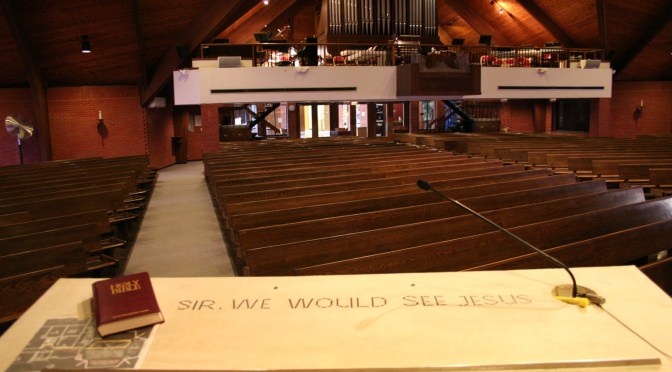
“Sir, we wish to see Jesus”.

Sir they say to a lowly fisherman. Sir they say a pilgrims wealthy enough to travel far just for a festival.

We wish they say. We hope. We long. We Yearn. We desire. We need. They express their want to see Jesus as wishing. Wishing which implies a need for change, a hope for something different.

Sir, we wish to see Jesus. They want to see and know Jesus. The man who’s name means God Saves. The man who has been healing people, exorcizing unclean spirits, who has been teaching and preaching. The man who raised someone from the dead in Lazarus.

The greeks have come looking for something, someone. And maybe they don’t know what or why or who. But Jesus might fit the bill, fit their need for something deeper, something mysterious, something bigger than themselves.

The polite request by the Greeks to see Jesus is a feeling we know well. We too long for something more. For things to be different. We hope that our lives could be other than the way they are.

As human beings, we have this longing deep within us. We want to know that there is something bigger than us out there and we want to know where we fit in the cosmic order. Churches try all the time to bring this sense of “more” to worshippers.

Some churches search for that sense of euphoria, that spiritual high. Praise songs and hand raising, long sincere prayers and wonderful fellowship.

Others try to bring people closer to God by serving others. Soup kitchens and food banks, giving money to far way countries and for starving orphans.

And still other churches try to show the mystery and grandness of God. With big stone cathedrals, powerful organ music and reverent liturgy.

And indeed all are ways in which God is experienced. We see God in these places.

But that desire to see God also expresses itself in other ways. We look for the divine in buying and consuming things. We look to make ourselves secure and safe from the the things that would harm us or that make us fearful. We seek out power and control over our world and others.

We look for God in all the wrong places. We look to be like God. We look to be God in God’s place. And we do it because of original sin, of that desire within us to ourselves first.

When the Greeks and Philip and Andrew finally get to Jesus, he doesn’t answer their question in a way that any of them expect. He doesn’t offer himself to the greeks, he doesn’t say, “See I am here!”.

As we pass through this final week of Lent, we have been prepared for what is to come. Jesus has gone into the wilderness, Jesus brought Lazarus back from the dead, he has reminded Peter that there is no share in him unless Jesus washes us clean, Jesus has stood firm in the truth while Peter denied him, and Jesus has confronted the powers of the world in Pilate and in death. Now, after 4 weeks of preparation, four weeks of wilderness, four weeks of having our failing and faults revealed, we are finally ready to ask that question that the greeks ask, “Sir, we wish to see Jesus”.

And Jesus points us to a time and place. “And I, when I am lifted up from the earth, will draw all people to myself.” It takes a while, but Jesus does answer our longing, our hope, our desire for something different, something bigger than ourselves. But it is not at all in the way we expect. We are longing and hoping for a glimpse of the divine, to see past the veil. We want to see the world as it should be, as we would like it to be. We want the spiritual high, the feeling of gratification after helping someone, the reverence of divine mystery. And instead Jesus gives us a cross. A cross where we will see God.

Imagine if someone came here looking for a church home, looking for some truth bigger than themselves, looking for a place to belong, a place to be fed, a place to meet God, a place to see Jesus. And instead of doing all the things we normally do when a visitor comes seeming interested in us, like giving them a newsletter or a mailbox or pointing them to the pew we know isn’t unofficially saved by a regular… Imagine if we instead simply pointed to the cross.

Imagine if someone said to us,

“We wish to see Jesus.”

And we just turned and pointed at the cross on the wall.

It is absurd.

The cross is an absurd place for God to be found.

Yet the cross is the place where God is revealed.

Yet the cross is the place where Jesus reveals God to the world.

Yet the cross is the place where God is visible to us in plain sight.

And the cross, the place of suffering, humiliation and death is the very place where God gathers all people to Godself.

The cross is the place where we see Jesus.

In just less than two weeks, on Good Friday, the glory of God will be revealed on a cross and no matter what we are looking for, no matter the places the we search, churches, shopping malls, schools, places of work, places of power, places of escape. And on the cross God is making room for all of us beneath it arms. God is gathering us all up to show us that in the least likely of places, God is revealed.

And we will see Jesus. We will see Jesus in all his glory. We will see God changing the world. We will see God changing us.