Category Archives: News on the home front

Dying Well – Grieving My Father

This week has been a difficult week for my family. At the end of last week, my father was contending with what appeared to be a summer flu. Over the weekend, his symptoms worsened, to the point where he needed to be admitted to the hospital. While in the ambulance, he experienced a cardiac arrest.

For the past week, he was being treated for an infection for which the medical staff have struggled to determine the source. Because of complications along the way and a limited response to treatment, the decision was made to move him to palliative care. His heart was strong, but much of the rest of his body was failing. 

His family prayed and sang with him, and told him that we loved him.

Courtenay and I prayed the commendation of the dying with him, and we entrusted him into God’s care. On Saturday night, around supper time, my Dad breathed his last.

Requiescat in pace, Dad.
In the midst of a lot of texts, phone calls and FaceTime with family, I have been thinking (again) about my recent trip to Germany. 

A subtle theme in the story of Martin Luther’s life, and for all of society in the Late Middle Ages, was death. One of the most popular books in the 1400s and 1500s was a book called Ars Moriendi, written by unknown authors. The title translates into English as the “Art of Dying.” That was a time when the plague or Black Death was ravaging European populations. Death became seen more clearly as a regular part of life. Often parents did not give children a name until they were about five years of age, just to be sure that they would survive. Many believed that the opportunity to “die well” was a blessing. This meant to have one’s affairs in order, to be allowed to reconcile with anyone with whom one had a grievance, to say goodbye to beloved family and, most importantly, to face death knowing the promises of God’s salvation given in Christ. 

It is important to keep in mind that the Church at that time was selling indulgences as protection against sin and Hell, often using the fear of these things to keep people forking over their money. So dying well was one way to counteract the persistent fear of what might come after death. 

Of course, any pastor is familiar with being around a family’s journey of death and dying. But it still has hit me differently when the dying is happening to my family’s loved one. One of the struggles is in how the dying process can make one feel so lonely. Yet, I realize it is a journey that we all end up taking alone, even with others around us. 

In 1519, Martin Luther wrote a sermon entitled “Preparing To Die.” In it he emphasized the importance of trusting in God’s promises, that the forgiveness of sins found in the Sacraments of Baptism and the Lord’s Supper are signs that God has conquered sin, death and the Devil, so that we ought not fear. 

In the sermon, you can hear Luther’s foundational premise that God’s plan for salvation was for all people. Luther began addressing something that people knew well – death – an important topic of the day, and then he pointed to the Good News found in God’s promises. 

Ten years later, the plague came to Wittenberg. Luther refused to leave his congregation. Also during that time, Elizabeth Luther was born to Katie and Martin. She was a sickly child who died at six months of age. It is believed that during this time of plague and personal tragedy, Luther wrote the famous hymn A Mighty Fortress is Our God

Though we often sing it as a rallying cry and anthem of the Reformation, its words take on a different feel as a hymn of hope and comfort, especially the fourth verse, when one considers these as the words of a grieving father:

God’s Word forever shall abide,
     no thanks to foes, who fear it;
    for God himself fights by our side
    with weapons of the Spirit.

    Were they to take our house,
    goods, honor, child, or spouse,
     though life be wrenched away,
     they cannot win the day.

The kingdom’s ours forever!

Text: Martin Luther, 1483-1546; tr. Lutheran Book of Worship
Text © 1978 Lutheran Book of Worship, admin. Augsburg Fortress

P.S. Photo(s) from my trip to Germany: Luther was born and died in Eisleben. The first photo is of the baptismal font of the church where he was baptized. In recent decades the font was built into the floor as a large pool right in the chancel of the church. A tangible and visible image of dying and rising in baptism, by going into the ground and coming up out again. A sign of the resurrection promised in Christ when we will brought out of our graves into new life.

The second photo is a copy of Luther’s death mask. Medieval death masks were taken because it was believed they could “determine the state of one’s soul at the time of death.” A calm expression implied that one was welcomed by God.

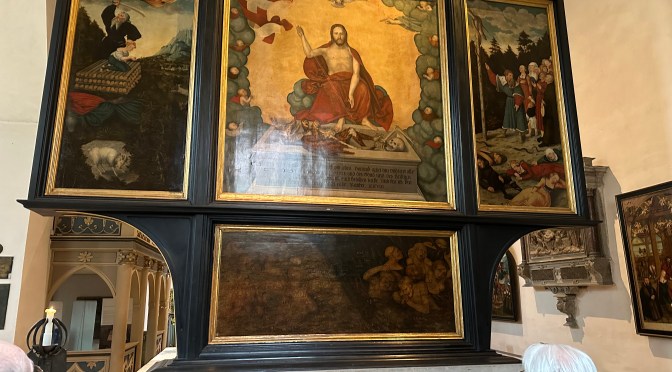
Header Photo: The back panel of the altar piece at the Stadtkirche in Wittenberg. A depiction of Christ defeating the powers of sin and death.

A Contextual and Practical Theologian – Pastor Thoughts

For 9 days in September, I was at the Lutheran Theological Seminary in Saskatoon, with 8 other Doctor of Ministry students beginning a journey together. The cohort of students was comprised of people from BC, Saskatchewan, Manitoba, Ontario and even Tanzania. There are Lutherans, Anglicans, United Church and Evangelical folks. 

As I have been already talking and writing about the program, I still had a lot to learn and understand myself. For instance, what is a Doctor of Ministry in Contextual and Practical Theology all about?

Well, now I can say that I have a much better sense of what this program of study will actually entail. And that is to become a Practical Theologian. Practical Theology is a relatively new field of study – only 150 years old! Compared to Systematic Theology or Biblical Studies, which can trace their roots back to the early days of Christianity, Practical Theology is just coming onto the scene as a formal discipline.

And yet, it really isn’t new. Theologians, clergy and even ordinary people of faith have been taking insights from Scripture and the Tradition of the Church and bringing them into conversation with the lived practices of everyday faith. Reflection on how what we believe and confess to be true and how that impacts the things we do in faithful community – and vice versa – has always been something that is happening among congregations and faith communities. 

As Lutherans, we have a strong example of a practical and contextual theologian in Martin Luther. So much of what he wrote and did was about bringing his understanding of scripture and the theology of the church into conversations about how the church of his day practiced the sale of indulgences (tickets to heaven), how the mass or Holy Communion was celebrated and observed, who could read the bible, how faith was passed on and so much more. 

Modern Practical Theology goes a little further using the tools and methods of the social sciences to do research that provides qualitative data. Surveys, focus groups, interviews, asset mapping, appreciative inquiry, and more generate data about the practices of real-life communities. It is a way to bring theological reflection into the real and ordinary things that we do in our faith community. 

What does this mean for the research I will be doing? Well, Practical Theologians do their research not to or on, but with the community. So I will be doing aspects of my research together with my congregation and folks in our area, with the goal that reflection and new understandings will bring about real transformation. 

There is a part of me that is nervous about this. What might happen if we intentionally seek transformation through learning and reflecting together? I don’t know… and that is the point.

Because I am also very excited… for what we might discover and how that might change us along the way. 

Starting New Things This Fall – Pastor Thoughts

My children keep asking me how much longer Spring Break will be. They haven’t really distinguished yet between Spring Break and Summer Break.

They are true COVID children in that their experience of their first few years of school has been marked by several extended breaks or pauses of in classroom learning. So Summer Break has yet to take concrete shape in their minds. And different than my childhood longing that summer breaks would last forever, they are looking forward to seeing their friends and teachers again. They have lived through the experience of not knowing when they might suddenly without warning not be returning to school for a week or month or even longer. 

So we have been preparing them for how long summer break is and when school will start again, going over the schedule of family trips, days camps, visits from friends and family, and so on. 

As the kids look forward to going back to school already, I find myself in the same boat. I announced a few weeks ago that I am going back to school this fall too, to begin a Doctor of Ministry (DMin) degree program at the seminary in Saskatoon. Since graduating in 2009, I will admit that I have enjoyed being free from the unique pressures of going to school, as I went straight from grade school to university to seminary. In fact, I still have the occasional bad dream where I haven’t prepared for an exam or written a paper that is due. 

But the seminary that I am going back to is quite different than the one I graduated from in 2009. My four years of seminary, like my four years of undergraduate study, were fairly traditional. In person, on-campus learning in a semestered format. 

Now, the seminary has shifted to an intensive and often online format. Courses are taken one at a time in the span of two to three weeks, one after another, rather than three to five courses at a time over a three-month semester. Courses are also offered either in person or over Zoom, which the seminary started long before the pandemic. This was done to accommodate students who couldn’t uproot families or cease working, but who could be in Saskatoon for a week or two and could study at home. 

In addition to the changed intensive, online option format, the Doctor of Ministry Degree program will also be a new kind of study experience for me. The DMin program is similar to a PhD program in that it is a terminal degree meant to help students delve deeply into un-researched topic areas. But it is different than a PhD, which is a purely academic degree intended to focus on theoretical research; the DMin has a professional component. It might be a compared to a specialization in Medicine or in Law. A DMin is intended to be done while a student is working, and research is meant to be conducted in the context that the student is serving in. So it is not just that you *can* work full time while doing a DMin program, you *must* be working full time in ministry.

Because the DMin is done in short intensive spurts along side the regular rhythms and duties of ministry, this summer I have already begun readings and coursework. I used to get truly annoyed by the mature students in university or seminary who were always reading and working ahead, and here I am doing the same! And at this stage of my life, I now get why those olderstudents were like that. It is the same reason why sleeping in these days means getting up at 7 am, rather than 6:00. 

Thankfully, there is still more than a month until school starts and almost two months until I head off to Saskatoon for my first week of DMin work. Yet, this year, like my kids, I am looking forward to school starting in the fall and the new journey that it will bring⎯but not too far forward! 

Recency Bias, Laughing at God, and Birthing New Possibilities

Genesis 18:1-15 [21:1-7]
And Sarah was listening at the tent entrance behind him. 11Now Abraham and Sarah were old, advanced in age; it had ceased to be with Sarah after the manner of women. 12So Sarah laughed to herself, saying, “After I have grown old, and my husband is old, shall I have pleasure?” (Read the whole passage)

This is the first Sunday of green. Which means that the green banners and paraments are out, and I have put on my green stole. A number of other clergy online remarked about the change. Keeping track of time in the church isn’t always measured by the same calendars. And in this case, many folks noted that the last time we gathered for in person worship it was in Lent, and the colour was purple. Since then we have worn Red, White, Red and white again, and now finally green. And for many this new season of green will be another few months of online only worship. 

In that realization there is lament. Lament at what has been lost, lament at what is now, lament at what might not be recovered when and if things “go back to normal.” 

And so we enter into the next season of the church, the long season of green or ordinary time. A time for hearing the stories of the bible and hearing our own stories in them. Because while we have been experiencing something that no one alive has really known, we are certainly not the first people of faith to face trial and tribulation… in fact there are more stories about that than just normal boring everything-is-fine stories in the bible. 

This season begins with the story of Abraham and Sarah. Abraham and Sarah, then Abram and Sarai, who were called by God to pack up everything they had and follow God’s call into the wilderness. 6 chapters later the pair are well into their journey when they are met by three strangers asking for hospitality. So Abraham and Sarah welcome these passing strangers into their tent. Abraham and Sarah care for their visitors — mysterious messengers from God, with a message to deliver. 

Once the strangers have received the good grace and care of this wandering couple, one stranger promises to Sarah that she will bear a son in due season. 

At this Sarah laughs. 

Sarahs laughs because it is an absurd promise. She is old, she is past her child bearing years. She cannot have a child at this point in her life, that ship as sailed. 

Yet, when Sarah laughs, the stranger hears it and he wonders why. She denies it but stranger says, “Oh yes, you did laugh.”

It is mean to be heard as  comical interaction with between an elderly couple in the desert and unknown strangers. 

Sarah and Abraham, remind us of ourselves. As they follow God’s call to faith, God’s call to go out into the world, they give of themselves trusting that God will care for them as they go. At the same time, they struggle to trust that God’s promises of them are true, that there is something more for them than just waiting for the end of their lives. So as this stranger and unknown messenger promises something unimaginable happening, Sarah cannot help but laugh.

Their past, their experiences of life thus far are telling them that new life in this way, in Sarah’s body in impossible. They believe that the things that have just recently happened to them will continue to happen forever. 

There is a name for this phenomenon , it is called recency bias. 

We as human being tend to think that whatever has just happened to us will continue to happening forever. Sarah knows she cannot bear children because her body is no longer fertile. 

Recency bias affects us too. 

It is the reason why change is so difficult, our brains convince us that our recent experiences will be our truth forever. It is why people so often buy high and sell low on the stock market despite the adage. It is why when our favourite sports team wins a few games at the beginning of the season we start planning the championship parade. Or why when we have a bad meal at our favourite restaurant we might choose to stop eating there altogether.  

It is why we had such trouble believing the coronavirus was much worse than a flu, when the flu is what we already know as respiratory virus. It is also why with a few days and weeks of low case numbers,  we think we are quickly on our way back to normal and the end of this pandemic. 

We simply cannot stop ourselves from believing that whatever our most recent experience of something is will become the new truth forever.

And it is one reason why we  struggle so much with change and we struggle to anticipate what is coming next for us.

And it is also why declining churches cannot seem to turn things around despite trying “everything,” because they believe that their recent decline is their only future.

We simply assume that whatever has just been happening to us will keep happening forever. 

But now, like Sarah, we are being confronted with a different promise for our future… we are being told that what will come next for us cannot be determined by what just happened, but instead it is mostly unknown to us and rather known only to God. 

Only 6 chapters into the story of their call,  Sarah and Abraham have already forgotten the covenant. The covenant with God, where God made promises to Abraham. The promise of blessing, a relationship with God. The promise of land, a promised land for God’s people. And the promise of descendants. 

Descendants more numerous than the stars in the sky. 

A promise that was going to have to start somewhere. Start in someone’s body, someone’s womb. 

Even when Sarah and Abraham cannot imagine a different future, God has already set it into motion. Even when it seems as though all possibility for life has been taken away and all there is left is faithfulness to death… 

God has different plans. 

God brings the promise of a nation into the world from Sarah’s frail and old body. God brings new life into existence when all there seemed to be was waiting for death. God brings Isaac into the world to be the next generation to receive the promised covenant. 

And all of sudden, everything is different. Sarah and Abraham’s recent past no longer determines their future (it never really did…), instead everything is unknown, unpredictable and impossible to anticipate… but also life-filled and hopeful and on the way to something new. 

Yet, it took taking Abraham and Sarah away from everything they knew, to unknown places and unknown path… 

And in that place of the unknown, in that place where the even the past was left behind, God begins the first steps of the new thing. The first steps towards the birth of a nation, to a chosen people constantly turning and returning to God, and to the eventually sending of the Messiah, to the one sent to save God’s people and all creation. 

And so here we are in our own wilderness. Here were are with our own laughter at the idea that God might have something new and unexpected in mind us for… 

And even as world longs for our recent past, for those pre-covid halcyon days when the world was great…. (it wasn’t that great).

And even as our recent past as the church makes us believe that slow decline is our only future because nothing we have tried has got the young people to come back…

We are discovering that in this moment, when so much has been put on hold, taken way and changed, that our future is unknown to us. That the people we will become on the other side is known only to God. 

And in this opportunity when we are in unknown places and on unknown paths, God just may be planning to birth something new and totally unexpected in us, in the church. 

And yes, this is laughably absurd. 

But look at what happened to Sarah and Abraham. 

That in the just a few faithful servants waiting to die, God began a chosen people, a promised and chosen people to whom the Messiah – the savour of all – would come. 

If Sarah’s laughter and this pandemic have taught us anything, it is not to trust our recency bias, not to trust our limited vision of our future… but to expect that in this moment of unknowns God just might be making us ready for the next thing. God just might be beginning in us something so new and unexpected that we too might laugh. 

So today, on this first Sunday of green, as our way forward is as uncertain and unknown as it may ever have been, and when all there seems to be is lament about what is lost…

God is inspiring us to laugh… to laugh at the absurdity of it all… And God is also beginning in us, something new and unexpected that will change us and change the world. 

Holy Disruptions – A Sermon for an Installation

Gospel: Luke 4:14-21

Then Jesus, filled with the power of the Spirit, returned to Galilee, and a report about him spread through all the surrounding country. He began to teach in their synagogues and was praised by everyone. (Read the whole passage)

 *This sermon was written by The Rev. Courtenay Reedman Parker on the occasion of The Rev. Erik Parker’s Installation to a serve a new congregation.*

Grace and peace to you from our Lord and Saviour Jesus Christ.

Today is a day of celebration for Sherwood Park Lutheran Church, for Pastor Erik, and for the wider church as we mark the beginning of a new ministry. Today, as Pastor Erik is installed, the warranty comes off. He’s yours. You’re his. And this ministry that you have been called to officially begins. And so we gather with excitement for this new beginning, as Pastor Erik joins the ministry of Sherwood Park which is richly and deeply rooted. And with this new beginning is the anticipation for how God will work through you, and use your gifts together to proclaim the good news of Jesus Christ in this time and place.

As Sherwood Park started the new calendar year with a new pastor, and Pastor Erik with a new call, the church begins the year with the festival of Epiphany, when the magi visit Jesus, bringing gifts, but also signalling the start of something new. In Jesus, God reveals not only who God is, but how God will be in relationship to all humankind. It’s kind of a big deal. So these weeks that make up the season after the Epiphany continue to share stories of the ways in which Jesus… God is revealed to us. Stories of the magi following the star to find the newborn king, of Jesus being named and claimed God’s Beloved Child through baptism on the banks of the Jordan River, of Jesus turning water into wine at the wedding at Cana, and today returning to his hometown to publicly name and claim his identity through the words of the prophet Isaiah. 

These ancient stories offer us, just like their original hearers, a vision of hopeful anticipation for who Jesus, God, is, and what the world will look like under God’s rule. So too, as a new ministry begins there is also hopeful anticipation for this new thing… this new person you have called to be your pastor, and for Pastor Erik, hopeful anticipation for this new community of Sherwood Park he has been called to serve, and the ways God will be revealed in and through you, the ways God will shape and form you for ministry together. For our family, Pastor Erik, myself, Oscar, and Maeve, there is excited anticipation for this new beginning, for new relationships, to deepen connections with some of you who we already know, and to join you all in living out God’s mission for the world.

Today we hear the first part of Luke’s account of the beginning of Jesus’ ministry in Galilee. Word about him is spreading. He’s trending… he’s gone viral… people are talking about what he’s doing and saying, and they are praising him – they’re liking what they see and hear – What a great text for an installation… Then Jesus returns home to Nazareth, and as he has done so many times before, goes to worship in the synagogue. But this time is different. This time, he stands up to read, he proclaims the words of Isaiah, and after says to the congregation, “Today this scripture has been fulfilled in your hearing.”

Jesus is revealing himself to this congregation, to his people. He is telling them who is is and what he’s come to do: 

 “The Spirit of the Lord is upon me,

  because he has anointed me

   to bring good news to the poor.

He has sent me to proclaim release to the captives

  and recovery of sight to the blind,

   to let the oppressed go free,

to proclaim the year of the Lord’s favor.”

This is good news, especially if you are poor, if you are captive, blind, or oppressed. But… it’s not as good for the non-poor. Because what Jesus is announcing is the disruption of everything the people have known. A reversal of roles. The poor are released from their debt, the blind are given sight, the oppressed are now free. Which then also means the wealthy will likely need to share some of that wealth, and those with sight will see things in a new way – in ways that those of us with sight have overlooked, or not even noticed. Freedom for all means a redistribution of our roles… our power… our status. Well, when you put it that way Jesus, it doesn’t sound all that great for those of us who will have to change… to share… to examine the way we do things, and the ways in which we live together in this new reality.

This text, which begins with the people praising Jesus, concludes with the hometown crowd “filled with rage… drive Jesus out of town to the edge of a cliff” –  maybe a good thing this part of the story wasn’t included today… not the best ending… 

This isn’t to suggest Pastor Erik is Jesus  – believe me, he is many things, but he’s not Jesus. And not even Jesus could keep people pleased for long. 

But isn’t that just it? Aren’t we all for the new things God… Jesus… is up to when we are the beneficiaries? When the new thing, the change, the disruption is initiated by us?  When we are the change agents, when God’s plans also coincide with our plans things work well. It’s easy. But if we have learned anything as people of faith, it’s that rarely do God’s plans align perfectly with ours. 

Because God, Jesus, is disruptive! 

The Holy Spirit stirs us from our comfortable places and reveals God through new ideas, places, and people that on our own we likely would never have discovered. But being stirred up, is disruptive. And disruption often causes discomfort. 

Jesus’ declaration in the synagogue of who he is isn’t as flashy as the magi traveling from far off lands, or a booming voice coming down from heaven, or the miracle of turning water into wine. But make no mistake, Jesus’ announcement to the congregation at Nazareth that the Spirit of the Lord is upon him, that he is the anointed is the greatest disruption yet. New life for all. Salvation for all. Freedom and forgiveness for all. This new thing that Jesus is called to do isn’t dependent on us, but what Jesus is doing in and through us.

God has called Pastor Erik to this congregation. And God has called you to Pastor Erik. Because Pastor Erik has gifts to share with you, and you have gifts to share with him. Together, you will use your gifts and skills to build up the ministry of this congregation and the wider church. To hear God’s Word. To preach and teach the good news. To administer and receive the sacraments. To serve together in the day to day ministry of the congregation. 

And maybe (hopefully) it hasn’t happened yet that disruption and discomfort has stirred in this place. But it will. Jesus… God is doing a new thing in and through you and so disruption and discomfort is unavoidable.

The good news, is you’re not alone in your discomfort. When Paul writes to the community in Corinth, he uses the metaphor of the body to describe the interconnectedness of the church, and those of us who are a part of it. Paul writes, “If one member suffers, all suffer together with it”. That’s right, we’re in this together, even when it’s uncomfortable. But what this suggests more deeply, is that we’re in this together. Our joys. Our sorrows. Our strengths. Our weaknesses. They are all ours together. It is not a situation of one member, or one part of the body or congregation being better, stronger, more faithful, or knowledgeable than another. All of our struggles and all of our successes are together. Paul continues, “if one member is honoured, all rejoice together with it.”

We need one another. We cannot do this ministry God calls us to do on our own. The Body of Christ is at its strongest when it is working together. When individuals’ gifts are recognized and lifted up, used to the glory of God for the whole church – which extends beyond Sherwood Park, even beyond the MNO Synod or ELCIC, that extends to all the baptized, all over the world. 

Through our baptism, we are connected to one another in and through Jesus Christ. Which also means Jesus, God, is right with us, at the very heart of all that we do, in the good times, the bad times, the disruptive and the in-between times. God is disrupting us in order that a new thing can begin. God names and claims Jesus as the one who will bring new life. Forgiveness. Salvation. Freedom from sin and death for all. 

And so we as family, friends, as congregation, and as the wider church gather today to mark the beginning os this new thing. That this ministry is connected to something bigger than Pastor Erik, bigger than any one ministry of Sherwood Park or the congregation itself, but to the much larger Body of Christ to which we are all called to and connected to, and sent out into the world to name and proclaim God’s love to the world. AMEN.