All posts by The Rev. Erik Parker

iPhone Pastor for a Typewriter Church. Blogger, Podcaster | High Church Lutheran | Husband & Dad | Oilers fan in exile | He/Him

The Forefront of the Kingdom of God

I certainly don’t keep it a secret that I am a big Edmonton Oilers fan. I try to watch most games; it is my escape from the burdens and trials of the world. However, this week, one of my favourite players, Connor McDavid, finally got the chance to wear a Team Canada sweater. It is an interesting moment to watch the NHL Four Nations Face-Off. Hockey has a way of bringing Canadians together and making them feel some national pride. 

Interestingly, another force has brought Canadians together into a feeling of national unity at the same time. President Donald Trump’s desire to unite a nation was probably not to unite Canada against him, but here we are. 

Aside from hockey, we are in a moment in time where we are being forced to consider what kind of world we want to live in. Or perhaps, consider the kind of world that self-interested billionaires who have taken control of the US want us to live in – even as Canadians. 

These past few weeks, we have considered Martin Luther’s doctrine of Two Kingdoms, reminding us of the role of the church and civil authorities. We have looked at which Lord we are accountable to and who we are accountable for. Most recently, we pondered what it means to be called as the priesthood of the baptized. 

This week, we ponder how Jesus begins preaching the Sermon on the Mount – the beatitudes that begin, “Blessed are the poor, for theirs is the Kingdom of God.”

These blessings, which can come across as upside-down blessings, are not a prescription for holy living. Jesus is not suggesting a new kind of pathway to righteousness through poverty, hunger, thirst and grief. 

The Sermon on the Mount is something altogether different. It is a vision for the Kingdom of God. A vision for the world as imagined by the one who created all things. It is a vision that challenges our normal modes of operation, our assumptions about might making right, about wealth and power being blessings. It is a vision for the Kingdom that considers the least, lost and forsaken. A vision of God’s Kingdom where all are cared for, that those on the margin and bottom are a part of God’s blessing. 

Perhaps most importantly, though, it is a reminder of where that vision for the world comes into being. God’s vision doesn’t happen in the halls of power; it isn’t broadcast on TV, nor is it articulated by the rulers of this world – neither the ones we agree with nor the ones we detest. 

God’s vision of a blessed world happens in the small and local places, in communities like ours where the poor, hungry, and weeping can be known up close. God’s Kingdom isn’t defined by its borders and walls, but by its being nearer to the reality of human life, by its nearness to our life in community. The forefront of the Kingdom is right where we live day to day, whether we gather for worship week after week, in the eyes and our loved ones and neighbours, in the nearness of the people whose lived reality meets our lived reality regularly. 

These are days when it is easy to feel national pride because of hockey or real threats to our collective way of life. But the Kingdom to which God invites us to belong, meets us here and now, calling us blessed, and showing us the closeness of God’s love for us and this community around us. 

The Doctrine of Vocation: What does it mean to be called?

The world has been a pretty heavy place the past few weeks. The news feels like a Tsunami of rage-inducing items being shot at us from a fire hose. Usually, as Canadians, we feel at least one step removed from the chaos of our southern neighbours, but the tariffs’ rollercoaster this week carried with it very real implications for our lives in the northern part of the continent. 

So naturally, this week we get a story about being called. Jesus teaches some fishermen how to fish (Notice: a rabbi tells career fishermen how to fish!), and it goes so well that it almost sinks their boats. Then Jesus calls Simon (who will become Peter) to follow him. 

Sometimes, these gospel stories just pass us by because we have heard them before. We don’t always slow down enough to consider just how scandalous these stories are. Jesus’ call to these fisher disciples came right after a moment when their livelihoods were in peril because of no fish, and then when the abundance of fish threatened to sink them. 

This is the same call that Jesus is making to us while we navigate our moment of chaos, too. 

Yet, when we hear this notion of “being called”, it can be difficult to know what such a call would look like. So often, when we talk about being called in the church, we imagine it to be reserved for a special few, such as clergy or pastors.  This description of being called comes to us honestly; it was more or less the operating definition for the first 1500 years of Christianity. 

However, in the Reformation, re-prioritizing of baptismal identity came with what would be called the Priesthood of All Believers. Martin Luther saw in our baptisms a call to gospel ministry for every Christian, not just for monks, nuns, deacons, priests and bishops. God called everyone who was baptized to serve the Gospel, to be proclaimers of the Word, witnesses to God’s love and mercy given to sinners⎯the promise of the Gospel. 

Five hundred years from that time, we have more or less gone back to the idea that only the clergy are called, but with a more problematic variation. When we talk about the Priesthood of All Believers, the present-day church means that lay people are doing the stuff that clergy typically have done: lay-led worship, lay preaching, lay pastoral care, lay teaching and faith formation, etc. To be clear, oftentimes all these things, which most often were the tasks of clergy, can be done by lay people. But that is not what the Priesthood of All Believers means. Within the concept of the Priesthood of All Believers, we find the Doctrine of Vocation. Or, in simpler terms: the teaching of what it means to be called. 

The Doctrine of Vocation means that each baptized Christian is called to the ministry of the Gospel where they are. The school teacher, the lawyer, the tractor salesperson, the accountant, the stay-at-home parent, and on and on⎯ each baptized person is called to the ministry of the Gospel within their work in the world, in their community, in their family. Luther put it this way in his important treatise, The Freedom of a Christian (which I referenced last week): 

“As our Heavenly Father in Christ freely came to our aid, we also ought freely to help our neighbour through our body and its works, and each one may be Christs to one another and Christ may be the same in all, that is, that we may be truly Christians….”

Our baptismal calling is that each one of us bears to the world around us, Christ and Christ’s Gospel of forgiveness, life and salvation. Now, does that mean door-knocking and handing out tracts on salvation? Not at all. Luther also believed that one of the fundamental questions we ought to ask is, “What does my neighbour need to hear the Gospel?” Is my neighbour hungry? Need shelter? Need education? Need protection from harm? Need meaningful labour? Need love, compassion, and friendship? Need trustworthy people of faith genuinely interested in their wellbeing rather than just winning souls for Jesus?

Part of being Christ to our neighbour is also giving our neighbours what they need to hear the gospel. That might mean genuine love and care that witnesses to Christ through deeds rather than just words. It also might mean a simple invitation to church or the willingness to talk openly about faith, especially the things we don’t know and have questions about, too. 

I am not sure that Simon Peter had all this in mind when he left his boat and followed Jesus. I am also not sure that most parents who bring their children to the font to be baptized truly realize that calling that they are allowing God to place on their cute babies. I am not sure we, as people of faith, committed to a life of worship and fellowship together in the congregations to which we belong, often remember this calling with which God has called us. 

But this is the call of Christ, just the same. The call is not to be a perfect follower (certainly, Simon Peter was far from that), but to understand that we bear Christ to the world, to the people around us, as members of the Priesthood of the Baptized

And just maybe, in our moment of chaos (as in Peter’s), this call, this vocation, is exactly what is needed.

Photo: The Altar in front of which Martin Luther was likely ordained at the Cathedral in Erfurt.

Accountable To & Responsible For: Kings, Rulers, Presidents and Martin Luther

If you look back at my sermons from 2015 to 2020, more of them subtly point to a certain American President than I care to admit. It has been less than two weeks since January 20th, and in that time, the psychological and emotional turmoil that was Donald Trump’s first term in office has come back in full force. Following his election last November, it seemed like much of the world went into denial, pretending that those awful days of his first term were just a nightmare that we thought was over. 

Then January 20th arrived, and the psychological turmoil and chaos landed on us like a ton of bricks. 

This time around, I am committed to not starting my mornings wondering what the President has done or said that is more outrageous than the day before. I am still following the news but in measured amounts. I am not reading every article of breathless analysis designed to keep my cortisol spiked. I am falling for the trap that I need to read every article to stay apprised of things. I am trying to stay on top of what is happening rather than what might happen. 

Some perspective is important too, even if it is a little unsettling. 

The reality is, for a lot more of human history than not, kings, rulers, emperors, presidents and heads of state have been more Trump-like than not. Perhaps not in his particularities but in his appeal to popular moods and sentiments. It is easier to see why his followers follow him with this perspective. It is the same reason why many societies long endured under cruel and exploitative rulers. The leaders offer the promise of not having to be accountable and responsible ourselves. Leaders like Trump talk about fixes and solutions to all our problems while rarely delivering any. Conversely, they rarely put boundaries on their own words, feelings, behaviours and actions. They offer an intoxicating cult to follow. When a seemingly strong and populist leader promises to fix our problems and then lets loose with their behaviour, it feels oddly liberating. We feel free to express our base desires AND free from being responsible for them. The leader is taking on our responsibility for the problems of our lives and world. 

This kind of ruler is one that was common in 16th century (yes, I am turning again to Luther). In one of Martin Luther’s most important Reformation writings, The Freedom of Christian, he addresses what it means to live a Christian life in this kind of world. In the treatise, Luther asserts two basic theses:

The Christian individual is a completely free lord of all, subject to none.

    The Christian individual is a completely dutiful servant of all, subject to all.

Luther scholar Paul R. Hinlicky argues that this is a frame of who we are accountable to and responsible for. 

We are free “lords of all” because we confess that there is but one Lord Jesus Christ, the only Lord to whom we are accountable. There is no other human Lord that we fear or to whom we owe our allegiance. Thus we are free in the world from subjugating ourselves to human powers and principalities. 

Yet, this one Lord Jesus Christ, to whom we are accountable, first frees us in love and mercy. Then, the one Lord calls us in that same love to care for our neighbour. That accountability to God means we are responsible for our neighbour. This freedom is not easy, but it is hard work. Looking for how our neighbour needs care requires getting past our own needs and concerns. It is the work of seeing and attending to the other. The freedom to love our neighbour means exactly what Jesus reminds us is the greatest commandment: To love the Lord our God with all our heart, soul, mind and strength and to love our neighbour as ourselves. 

It is easy to see that this is the opposite of putting our trust in flawed human rulers and then absolving ourselves from living into our base desires. 

For me, in these past months of turmoil and chaos, returning to Luther’s theses of Christian Freedom has been a way to keep my sanity. I remind myself often, “Who am I accountable to? God. Not to any human power,” and “Who am I responsible for? For loving and caring for my neighbour.” I am not responsible for God (to my neighbour), or propping up any other systems and structures of human power and control. 

I am accountable TO the One Lord Jesus Christ and responsible FOR loving my neighbour. 

I hope that being reminded of this fundamental truth of faith can help you through the days, months, and years to come too. 

Photo: A community chest in Wittenberg, in which funds for those in need were kept. Accessible by two keys, one held by the mayor and the other by the pastor of the town church.

Two Kingdoms: A Bishop and President

This week, many of you might have seen or heard Bishop Mariann Edgar Budde’s sermon from Washington National Cathedral, which was a part of the inauguration events for President Donald Trump. 

In the sermon, Bishop Budde (the Episcopal Bishop of Washington) preaches about unity, using the themes of humility and mercy. Near the end, she addressed President Trump directly, imploring him to have mercy on “scared kids.” The sermon is readily available on YouTube here: https://www.youtube.com/watch?v=xwwaEuDeqM8&t=1s

It was a compelling moment for partisans on all sides, both positive and negative. Predictably, the President and his supporters did not like this and condemned Bishop Budde. Unfortunately, they have mostly succeeded in turning a sermon with Biblical foundations and moral clarity into a partisan issue, more about scoring points for or against Donald Trump. 

However, the sermon wasn’t a partisan act. As Lutherans, we know this because of Martin Luther’s Two Kingdoms Doctrine. Bishop Budde did precisely what we as Lutherans believe is the correct role of the church in relation to politics and the civil realm.

In Luther’s Two Kingdoms Doctrine, Luther (using St. Augustine as a foundation) describes two Kingdoms: The Kingdom or realm of the Church and the Kingdom or realm of Civil Authorities (Kings, Emperors, Democracies etc…).

The role of civil authorities is to protect society from outside threats, from non-Chrisians or those who would do evil, and, most importantly, to care for the vulnerable and needy in society. 

The role of the Church is to proclaim the gospel and to promote faith formation. In other words, to help shape and create people of faith. 

When the church steps outside of its realm, when it tries to claim more power than it should (such as how the Roman Catholic church of the 16th century was deeply involved in politics and wars), civil authorities step in to prevent the church from trying to be more than human, from trying to be God in God’s place. 

When civil authorities fail in their role and people are treated as less than human, it is the church’s responsibility to hold the civil authorities to account and to advocate that all are treated with dignity and humanity.

This, of course, is the role that the prophets and Jesus took on in scripture by holding kings, rulers and political authorities to account when they were not caring for the vulnerable and needy. It is the prophetic function of the church.

This function is rooted in our Baptismal calling and the calls given to deacons, pastors and bishops. As we are the church in the world, we do not belong to the world. Rather, we know that we belong to God. It is God who gives authority to both the civil realm and the church realm… and it is to God that we are all accountable to love and care for our neighbour. 

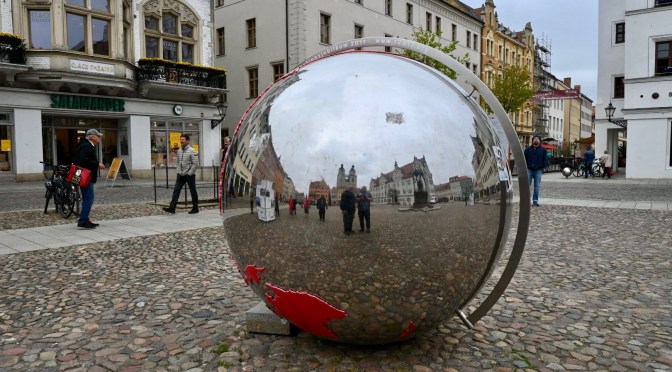
Photo: The town square and city hall in Wittenberg from where you can see the spires of St. Mary’s Church. Two Kingdoms side by side.

Returning to the Small Catechism

In my first call to ministry, I served a small farming congregation outside Edmonton. It was some of the most fertile farmland in Alberta, fed by the North Saskatchewan River. Since the mid-1800s, German immigrants had settled there having moved from the western parts of Russia. Serving that community was almost like stepping back in time, many members remembered when electric lights came to their farms. They recalled riding to church in horse, buggy, or horse and sleigh. 

The pastors of that community often served in a multiplicity of roles. They were also the local teacher, sometimes doctors, legal experts, and even postmasters! Confirmation was usually all day Saturday and included German language education, along with filling in the gaps that the local one-room grade school missed.

When I began serving, it was expected that I would attend the monthly Evangelical Lutheran Women’s (ELW) Bible Study. As we studied various things, I quickly discovered that many of the women could still recall much of the Small Catechism by heart, which they memorized in Confirmation classes. At the time, it felt like a curious artifact of history. 

Over the years in the ministry, I have continued to encounter Lutherans who could still recall the Small Catechism by heart (my mother is one of them!). I have come to see this less curious artifact of history and more blessing born in some brief teenage suffering in Confirmation class. 

The more and more I study Luther, and his theology, the more I am becoming convinced that despite those Lutherans of a certain vintage who can remember their catechism by heart, we, as clergy and church leaders, have mostly done a poor job of catechizing the people we serve. 

Last fall, as I prepared to teach the Lord’s Prayer to our confirmation class, I couldn’t help but wonder at how Luther’s explanation of the Lord’s Prayer is still so relevant today. 

‘People should know this!” was the constant refrain in my head.  As I have done Adult Study in the past and in the various other venues I have been privileged to teach, I have witnessed a hunger to know more and to go deeper. Even among confirmands — who might be the age where being interested in all this faith stuff is the most difficult — there has been an interest in learning the faith.

Before Christmas, I decided that teaching the catechism was something that I would do more. Starting on Sundays after worship, I will be inviting anyone who wants to join me, to grab a coffee following worship and have a brief discussion on one part of the Small Catechism. One of the commandments, one of the seven petitions of the Lord’s Prayer, or one line of one of the articles of the creed. The conversations won’t be long, maybe ten or twenty minutes, depending on what depths we can mine together. I hope to do this most Sundays. 

For several weeks, I was very proud of myself for coming up with this “Coffee and Catechism” idea. Until last week, through study and research, I discovered that my idea was not original at all. During the Reformation, the reformers would regularly preach on the catechism during the week, expecting that the children of Wittenberg would attend – along with the parents that brought them! Catechetical teaching was an important means of teaching the faith to people. Even then, it was not an original Reformation idea either. In the first three hundred years of the Church, when most converts were adults, as converts prepared for baptism through the season of Lent, the local Bishop would come and unveil the mysteries of God by teaching the 10 Commandments, the Creed and the Lord’s Prayer. 

So I might not be so original or brilliant, but I hope I am in good company. Most importantly, however, learning the faith is not something we do once in a couple of years when we are 13 years old, but something we continually come back to and learn again.