The Happy Exchange

Doubtless, you will have heard me talk about Martin Luther’s concept of the Happy or Joyful Exchange at one time or another in the past few months. 

The Happy Exchange is the metaphor that Luther uses to describe how our sins are forgiven. In the exchange, we give to Jesus our sins. But what does that mean? Do we heap them on him like some kind of scapegoat who is then sent away? Do we mark him with them like bruises and wounds like the famous camp skit ‘The Ragman’?

Not exactly. In giving our sins to Christ, it is that he takes responsibility for what was our responsibility. Jesus takes our sins from us by claiming them as his own. In return, Jesus gives us his righteousness, blessing and life. 

You might call it an exchange of goods for bads. 

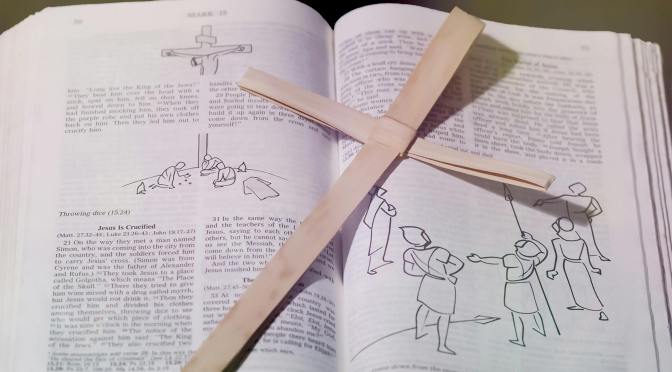
For the past few years, we have been using a Good Friday tradition of tying black strips of cloth to our rough-hewn cross on Good Friday. I will admit, the first year we did it, it felt a bit hokey. However, as we have come back to this tradition, it has taken on a more profound and deeper meaning. This year, while I watched as worshippers tied their black strips of cloth to the cross, I couldn’t help but think of the Happy Exchange. 

Here, we were putting our sins, suffering and death onto the cross⎯onto Christ. It didn’t matter if they were big or small, known or unknown. The moment that truly caught me, though, was the letting go. I noted that more than a few folks held onto their strips for a moment, and even more lingered after tying their cloth strip to the cross. It was an emotional act to make tangible our connection to Christ on the cross. 

Here is the thing about the Happy Exchange: it is not an easy trade. Giving up our sins is not easy. Our sins are not just rule infractions on a report card. Our sins make up a significant part of who we are; our failures, our hurts, and our sufferings, all contribute to shaping us as people. It is not easy to just hand big parts of ourselves over to God. 

There is a reason we confess our sins each week in worship. We need to practice the act of handing over our sins to Christ. Because once we do manage to let go, our sins are gone from us forever⎯we can no longer hold onto them!

On Easter Sunday morning, the image that we began on Good Friday was completed. The strips of black cloth were gone from the cross. In their place, were beautiful and colourful flowers⎯signifying the righteousness, the blessing and the life of Christ. 

It struck me this year more than it has before that, together in worship, we rehearsed and lived out the Happy or Joyful Exchange this Holy Week. A beautiful image of how our sins are forgiven and our lives are transformed by the Good News of Christ’s death and resurrection. 

Alleluia! Christ is Risen!

The In-Between of Easter Still to Come

Palm Sunday, Maundy Thursday, and Good Friday are behind us, yet Easter morning is still to come. This in-between moment is one where two realities exist at the same time. Christ has died and Christ has risen, but neither is fully here. 

While uncomfortable, this is the place where we live as the Church, as people of faith. We are always in-between realities. We are always becoming and on our way to something new. 

As we approach the Easter morning scene, the Resurrection moment, we are like the women who are the first on their way to the tomb. Everything they know, everything they have witnessed, every possibility they can imagine tells them that what they are about to find is going to be one sure thing⎯death. 

They had no concept of what was possible with God, of what they were actually on their way to see and witness. Their minds and hearts could not fathom it. 

Easter is like that. Our crucified and risen God is like that. Everything we see and understand around us says that one thing is true, when a totally different thing is about to happen. 

Resurrection and New Life are always surprising and unexpected. God has a way of surprising us with empty tombs and new realities that change everything. Easter has a way of showing up when there is no way we could have predicted it. 

That’s why we proclaim and emphasize the mystery part of the mystery of faith⎯Christ has died, Christ is risen, Christ will come again.

The Collision of Holy Week

The first Palm Sunday I can remember I was six or seven. A Sunday school teacher shoved a palm branch into my hands and told me to be happy; we were going to welcome Jesus. The Sunday school and adult choir paraded into the sanctuary singing a happy song as the congregation watched. I remember not being sure what was going on. But I knew that happy people were laying down their coats and palm branches to make a welcome mat for Jesus, who was parading into town. 

Palm Sunday is an odd event seen through this lens. Why is there a party for Jesus at the end of Lent and before Maundy Thursday and Good Friday? And it is not just my home congregation that bought into the party idea. The celebratory emphasis of Palm Sunday is a theme that can be seen in artwork, music and many passion plays throughout history. 

But Palm Sunday wasn’t a party or celebration, not really. Jesus’ ride into Jerusalem was something else. 

This year, many congregations in the United States are including protest signs in their Palm Sunday processions, as a way to protest their current government. Seeing Palm Sunday as a protest is probably closer to what the moment represented, but not quite. 

Processions are important social symbols in our world as they were 2000 years ago. We might not think about it much, but processions occur in a lot of places. A celebratory parade is an obvious one. But processions occur also at weddings, funerals, graduations, political and state ceremonies, military ceremonies, and in religious practice. Though it is understated, our worship begins with a procession and ends with a recession every week. From a practical standpoint, it is a matter of getting the people who have a role to play in worship into and out of the space. But, symbolically, processions draw attention and focus. They help to communicate that something important is about to happen.

This is what the procession of the triumphal entry was about. In the gospels, prior to the triumphal entry, much of Jesus’ ministry resulted in conflict with the religious authorities, the political authorities and the demonic authorities⎯the Kingdoms of Religion, Politics and Satan. The purpose of Jesus’ ride into Jerusalem was to draw attention and focus to the in-breaking of the Kingdom of God.

Palm Sunday is the event where the Holy Messiah, God-In-Flesh, arrives to meet human centres of power.  The Temple at the heart of Jerusalem was the symbol of power for the Kingdoms of Religion, Power, and Satan⎯the Kingdoms opposed to the Kingdom of God. The crowds shouting “Hosanna! believed that Jesus was coming as a conquering king⎯more like that scene from the movie Gladiator where Caesar rides into Rome as a war hero or like the Allied troops marching into a liberated Holland in World War II. The conflicts in both cases were not resolved, but only beginning. 

At the end of the triumphal entry, Jesus presents himself at the temple, preaching and teaching that God’s Kingdom had arrived, calling humanity to repent and to return to God. In that moment, the response to Jesus’ arrival was silence. 

On Palm Sunday, the kingdoms at odds had yet to collide. That collision comes later in the week, during the Great Three Days from Maundy Thursday to Easter morning. 

Why do we have to be this way – the Tension of Lent

Our Lenten journey hasn’t been easy this year. The themes we have explored have ranged from the clash of kingdoms to human unwillingness to receive in the incarnate Christ, to our anxieties over the judgement of our sinfulness, to the loving father whose sons were lost in worlds of their senses of entitlement. 

This fifth Sunday presents us with the story of Mary, the sister to Martha and Lazarus. As Jesus eats a meal with friends, she anoints his feet with expensive perfume, an act of extravagant love in preparation for Jesus’ burial which is being foreshadowed in the moment. 

Yet, Judas objects to such a waste of perfume, pointing out that the money could have been used to feed the poor. 

We have all been present for these kinds of moments. Something beautiful, tender and loving is ruined because someone cannot handle the depth of emotion, or so it seems. 

It makes me wonder how two people can see the same event and moment in time with such diametrically opposed perspectives about what is going on. One person sees a beautiful act of love and another person sees a wasteful overindulgence. 

This question is relevant to our moment in history. As Canada faces an election, and our longtime national neighbour to the south, the United States, pursues aggressive trade tactics, it boggles the mind how we can be so divided on how we perceive the leaders running for election and those enacting ruinous financial policies on the whole world. 

One side looks at a particular leader and sees a vile, destructive, untrustworthy person, while the other side sees a champion and protector. How can we look at the same things and see them so dramatically differently?

How can one person see a hero in someone when another person looking at the same individual sees only a villain?

As human beings, we have to live with one another while, at the same time, we represent an impossibly diverse spectrum of opinions and tastes. 

Judas is right⎯using the money for the perfume could feed many people. Mary is also right⎯the act of love is for Jesus who is on his way to Jerusalem and Good Friday. But cannot Judas also see the loving beauty in this sacrifice of perfume? But cannot Mary see that she is being extravagant and indulgent?

These final weeks in Lent leave us in much the same situation as the previous weeks. The Kingdom of God and the Kingdom of Satan remain in conflict. God’s people continue to be unwilling. The unproducing fig tree’s fate remains unknown if only delayed a year. The prodigal son and his older brother haven’t yet been transformed by their father’s love. 

Judas sees only money being poured onto the floor and down the drain; Mary sees only the end coming for her much-beloved friend.

Maybe that state of tension and uncertainty is the point. Maybe that is where human life is lived, in the tension between creatures that cannot see through each other’s eyes. 

Yet, somehow in that unresolved tension between us, Jesus comes and stakes his cross into the ground, into our hard hearts… and there God’s love is revealed. There, while we cannot see each other, it is revealed that God sees and understands us.