Crying out to be seen – surrounded by community

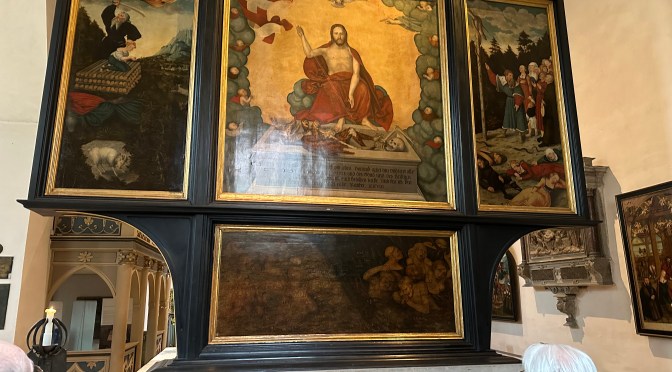
One of the paintings that I saw in Wittenberg has been returning to my mind as of late. It is a rather unremarkable painting on the back side of the altarpieces at St. Mary’s church in Wittenberg. St. Mary’s is the congregation that Luther served as pastor. 

The panel I am thinking of is the one unrestored panel on the bottom. The most notable thing about it is not really the artwork, but the fact that 16th-century confirmands used to clandestinely try and etch their names into it. One prominent name stands out: H. Luther. Hans Luther was Martin Luther’s son. 

Over these past couple of weeks, I have thought about that painting a few times as my family has journeyed through my own father’s death in July. 

I am sure it was not easy being Martin Luther’s child, as Luther was one of the most significant people in Europe by the time Hans came into the world. Martin Luther had a lot going on in his life. By all accounts, he was a good and devoted parent, but I am sure there were times when Hans felt it hard to gain his attention with all that Martin was attending to. I am also sure that Hans did not anticipate that his deep etching would stand out for centuries and become perhaps the most memorable aspect of the panel! 

Martin himself had sought his father’s attention, but not in the way he expected. His father had planned for Martin to attend law school. But Martin had theology in mind for his studies. 

In moments of grief and change, transition and endings, whether it is the death of a parent, marriage, divorce, job change or retirement, we are forced to evaluate our lives (or at least it is a good idea if we want to manage grief and other emotions). We are forced to contemplate what was and what now will be. Though I have often said the same about churches and congregations facing change, it served as a reminder this year, when I was faced with the death of my grandmother and now my father, that the emotions and grieving process don’t always give you the bandwidth for a lot of good self-reflection. We have also been engaging in this work of facing grief and change as people of faith, and we know that communities and congregations around us are also working through their experiences of grief and change. Nothing is straightforward, through all of this, nor is it easy.

When I think of little Hans Luther etching his name on the altar painting, I also think of all the art and symbols that surround his cry for recognition. Images of baptism, communion, preaching – Word and Sacrament, the tangible promises that God gives to communities of faith. These are the things that help us navigate difficult times and changes in significant relationships. 

Even among timeless pieces of art such as those that adorn St. Mary’s Church in Wittenberg, there is room for the pastor’s son to leave his mark and to be remembered by history. Perhaps reminding us that even in these imperfect and complicated parts of life, God makes room and holds us in God’s promises.

Dying Well – Grieving My Father

This week has been a difficult week for my family. At the end of last week, my father was contending with what appeared to be a summer flu. Over the weekend, his symptoms worsened, to the point where he needed to be admitted to the hospital. While in the ambulance, he experienced a cardiac arrest.

For the past week, he was being treated for an infection for which the medical staff have struggled to determine the source. Because of complications along the way and a limited response to treatment, the decision was made to move him to palliative care. His heart was strong, but much of the rest of his body was failing. 

His family prayed and sang with him, and told him that we loved him.

Courtenay and I prayed the commendation of the dying with him, and we entrusted him into God’s care. On Saturday night, around supper time, my Dad breathed his last.

Requiescat in pace, Dad.

In the midst of a lot of texts, phone calls and FaceTime with family, I have been thinking (again) about my recent trip to Germany. 

A subtle theme in the story of Martin Luther’s life, and for all of society in the Late Middle Ages, was death. One of the most popular books in the 1400s and 1500s was a book called Ars Moriendi, written by unknown authors. The title translates into English as the “Art of Dying.” That was a time when the plague or Black Death was ravaging European populations. Death became seen more clearly as a regular part of life. Often parents did not give children a name until they were about five years of age, just to be sure that they would survive. Many believed that the opportunity to “die well” was a blessing. This meant to have one’s affairs in order, to be allowed to reconcile with anyone with whom one had a grievance, to say goodbye to beloved family and, most importantly, to face death knowing the promises of God’s salvation given in Christ. 

It is important to keep in mind that the Church at that time was selling indulgences as protection against sin and Hell, often using the fear of these things to keep people forking over their money. So dying well was one way to counteract the persistent fear of what might come after death. 

Of course, any pastor is familiar with being around a family’s journey of death and dying. But it still has hit me differently when the dying is happening to my family’s loved one. One of the struggles is in how the dying process can make one feel so lonely. Yet, I realize it is a journey that we all end up taking alone, even with others around us. 

In 1519, Martin Luther wrote a sermon entitled “Preparing To Die.” In it he emphasized the importance of trusting in God’s promises, that the forgiveness of sins found in the Sacraments of Baptism and the Lord’s Supper are signs that God has conquered sin, death and the Devil, so that we ought not fear. 

In the sermon, you can hear Luther’s foundational premise that God’s plan for salvation was for all people. Luther began addressing something that people knew well – death – an important topic of the day, and then he pointed to the Good News found in God’s promises. 

Ten years later, the plague came to Wittenberg. Luther refused to leave his congregation. Also during that time, Elizabeth Luther was born to Katie and Martin. She was a sickly child who died at six months of age. It is believed that during this time of plague and personal tragedy, Luther wrote the famous hymn A Mighty Fortress is Our God

Though we often sing it as a rallying cry and anthem of the Reformation, its words take on a different feel as a hymn of hope and comfort, especially the fourth verse, when one considers these as the words of a grieving father:

God’s Word forever shall abide,
     no thanks to foes, who fear it;
    for God himself fights by our side
    with weapons of the Spirit.

    Were they to take our house,
    goods, honor, child, or spouse,
     though life be wrenched away,
     they cannot win the day.

The kingdom’s ours forever!

Text: Martin Luther, 1483-1546; tr. Lutheran Book of Worship
Text © 1978 Lutheran Book of Worship, admin. Augsburg Fortress

P.S. Photo(s) from my trip to Germany: Luther was born and died in Eisleben. The first photo is of the baptismal font of the church where he was baptized. In recent decades the font was built into the floor as a large pool right in the chancel of the church. A tangible and visible image of dying and rising in baptism, by going into the ground and coming up out again. A sign of the resurrection promised in Christ when we will brought out of our graves into new life.

The second photo is a copy of Luther’s death mask. Medieval death masks were taken because it was believed they could “determine the state of one’s soul at the time of death.” A calm expression implied that one was welcomed by God.

Header Photo: The back panel of the altar piece at the Stadtkirche in Wittenberg. A depiction of Christ defeating the powers of sin and death.

15 years – Pastor Thoughts

This week we observed those two beginning of summer milestones: Canada Day and American Independence Day. While both days have muted observations in Canada (the 4th of July for obvious reasons and July 1st for colonial ones), these two statutory holidays are signs of the beginning of summer.

The 4th of July is of particular significance to me for personal reasons – I was ordained to the ministry of Word and Sacrament on a hot and muggy day in Edmonton, Alberta in 2009. I was 26 years old, having just completed my Master of Divinity from Lutheran Theological Seminary in Saskatoon, and my Bachelor of Arts in History and Theology prior to that. It had been eight years of post-secondary schooling and I was ready to join the working world full-time. 

It was hard to believe that I was about to go from years as a long-time student to being given charge of the care of a congregation all by myself. As a student, my biggest responsibilities were getting assigned readings done, writing papers on time, and trying not to spend all of my student loans before the end of the term. In those first years of ministry, I certainly wasn’t the only person who was taken aback by someone so “young” serving as a pastor. I didn’t fit the usual stereotype of a grey-haired near retirement-age man that many expect pastors to be.

Now, I am fifteen years into this life of ordained ministry. While I know the joke is often that congregations think the ideal pastor is 30 years old with twenty-nine years of experience, at 41 years old and 15 years of experience, I have seen my fair share of things. I have served open country, small town, and urban/suburban congregations, big and small churches, across two different Synods in the ELCIC. Still, along with Pastor Courtenay, we are the youngest actively serving pastors in the MNO Synod. 

When I think back to that time before being ordained, I had begun my theological education at a Roman Catholic faculty at the University of Alberta. Studying theology in a non-Lutheran environment forced me to consistently research the Lutheran perspective – my perspective. Shifting to the seminary environment meant that my wondering evolved into what it means to be a Lutheran Pastor. 

That question has remained with me since. Many of you know that the heart of my Doctor of Ministry research is asking the same question. 

A few weeks ago, I wrote about how travelling to the places where Martin Luther lived and served brought a new perspective. Understanding what Luther did and wrote takes on a fresh new meaning when you go and walk the streets of Wittenberg, imagining Luther walking the same streets, dropping in on friends for a talk, gathering guests around his dining room table, preaching in the Town Church of St. Mary’s. 

Similarly, 15 years on the frontlines of ministry offers a perspective that you cannot get elsewhere. So much of what I learned prior to ordination has new meaning now when I imagine the communities, people and relationships that I have encountered serving. For some, this might feel like seminary doesn’t provide the right kind of learning for parish ministry, that it isn’t practical enough.  I think I see things differently. Just because things make better sense with some experience under your belt doesn’t mean you throw out the theoretical knowledge that you learn beforehand, rather it provides a deeper and richer understanding. 

At this 15-year mark, my hope is to keep learning from all that I experience AND from further studies. Just as understanding Luther by being where he lived AND reading what he wrote goes hand in hand, so does experience and study, 

We will see where this takes me and us, in 5,10 and 15 years from now.

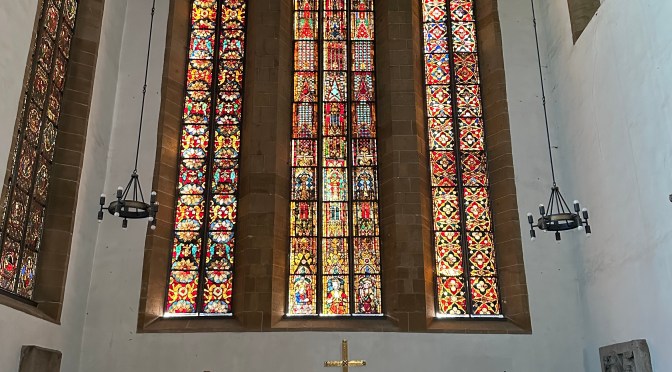
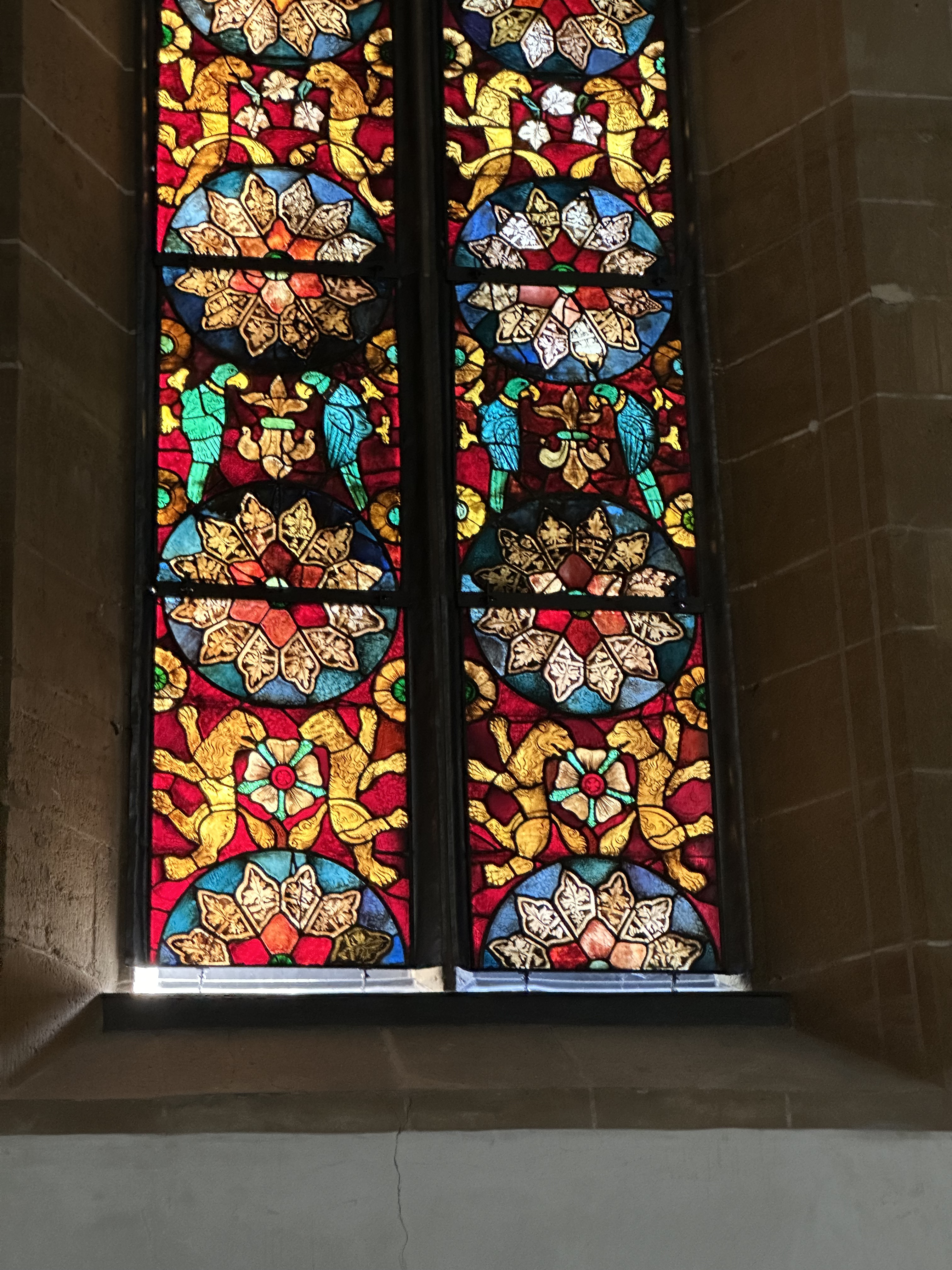
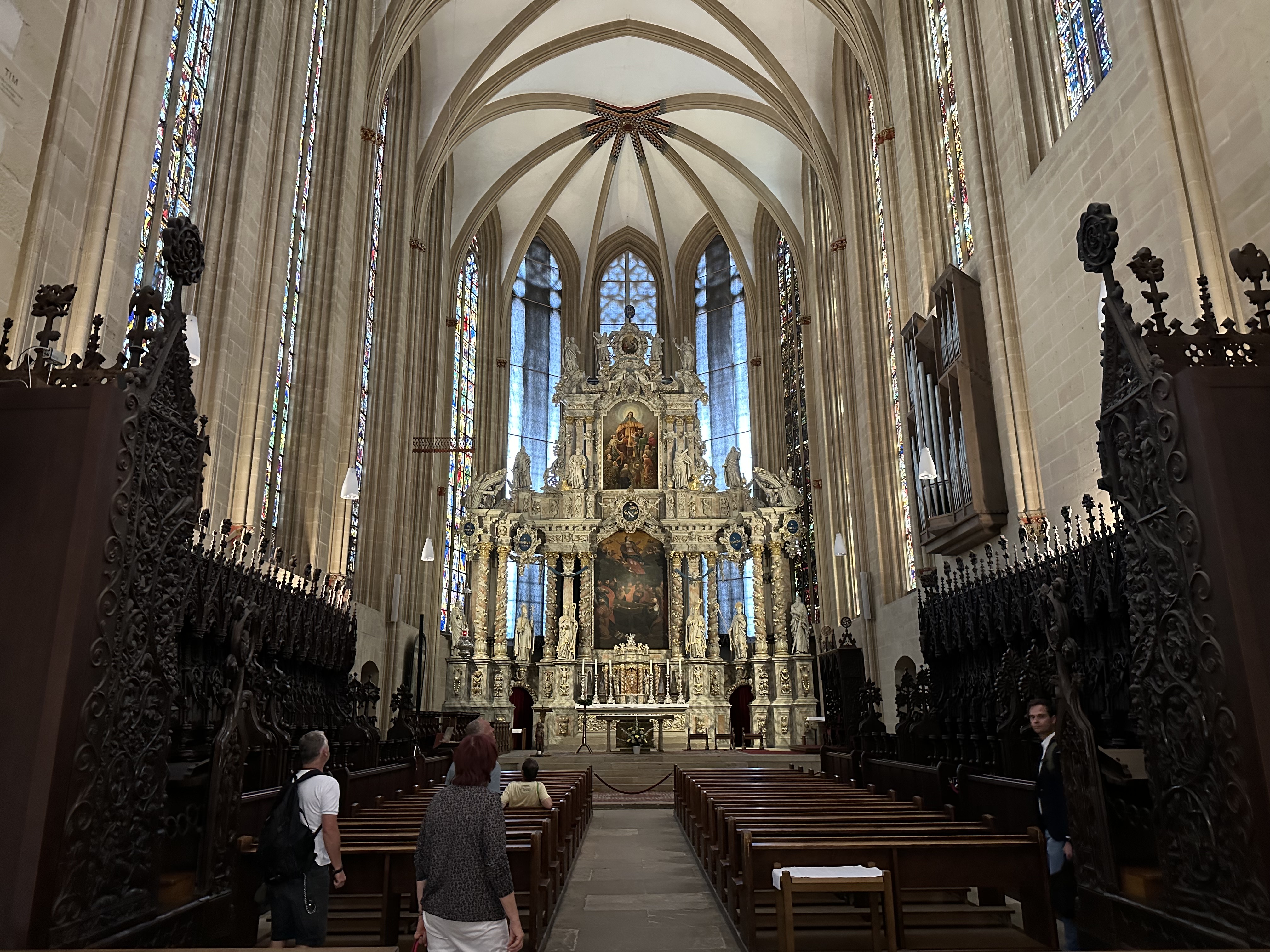
PS Photo(s) from my trip to Germany: [Above] The monastery chapel at Erfurt where Luther would have worshipped as a Monk. [Below] The stained glass was his inspiration for the Luther rose. The Cathedral in Erfurt where Luther would have been ordained a priest. My own ordination in 2009 and posing in a Luther cutout in Wittenberg.