Don’t let the Christmas notalgia make us forget Advent – Pastor Thoughts

We are through Advent and awaiting the big night to celebrate the birth of the Messiah. We have waited and watched, we have prepared. But we have also heard again the promises of God given in Advent stories. Advent stories that give context to the Messiah who is about to come, stories that help us to understand just what it means for Messiah to come into our world. 

Then something odd happens after the fourth Sunday in Advent and Christmas Eve, between our hearing of the promises and news given to Mary about just who she will bear in her body for the sake of the world. 

Some kind of switch flips in our brains, and all the Advent preparation and context is pushed aside in favour of the deep-set memories and nostalgia for Christmas. 

Maybe it is hearing more voices than on a usual Sunday stand together and sing, “O Come, All Ye Faithful.”

Maybe it is when the lights are dimmed, and the introduction to “Silent Night” begins, as a flame is passed from person to person bringing a warm glow to faces gathered in darkness.

Maybe it is when the reader moves to the ambo and begins to read, “The people who walked in darkness have seen a great light.”

There are all kinds of moments in the Christmas Eve service that catch our attention and bring us back to cherished Christmas memories. 

Memories that have the power to push our readiness for Messiah out of the way, and make Chrismas all about those powerful feelings that orient us to the past. Because for many of us, Christmas holds an outsized place in our hearts and minds.

It makes for an odd transition from Advent to Christmas, an odd experience of thoroughly preparing our hearts to hear a story with care and attention. Then, only when it comes time to hear that story, can we shift our focus to re-creating Christmas moments and memories from the past. 

Of course, I don’t think God is one bit surprised by this. In fact, I think this is all part of the Christmas story. We aren’t the first people to get wrapped up in our own things at Christmas and we almost miss the point. 

God is born into the world among a community that has little space or time for  Messiah. A world where the only available parents were two Israelites living in poverty. A world with no room for a baby to be born. And a world where social inferiors like Shepherds were the only ones to hear the Angelical announcement of Messiah’s birth. 

But God has chosen to join humanity in our mess, and that includes a messiness that has little room for Messiah. God chooses to come near anyway. God chooses to fulfill the Advent promises even as humanity is too busy with other things. 

I won’t tell anyone to try to hold back the Christmas memories in order to listen to the incarnation story more carefully and deeply… it is just too hard not to be transported back to Christmases of old when “Silent Night” starts playing on the organ. 

Instead, know that Messiah indeed has come. Messiah has come to fulfill the promises of God, right here amongst us. 
Dying with Mary at the end of Advent? – Pastor Thoughts

The end of Advent is coming into view

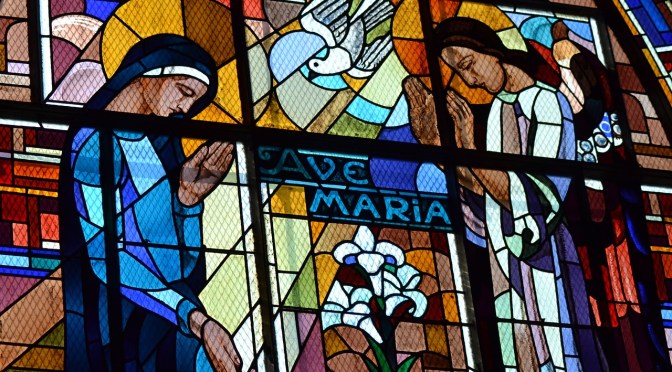
The fourth week of Advent turns the story of waiting and watching for Messiah to Mary, to a familiar story that we more closely associate with the Christmas – The Annunciation.  The Angel Gabriel appears to Mary telling her that she will bear a child. 

It is a part of the Nativity story that we tend to gloss over pretty quickly. Yet, it speaks deeply to our experience as people of faith and our current circumstances. The biblical narrative moves pretty quickly from the news delivered by the angel to Mary going off to live out her pregnancy with her cousin Elizabeth (mother of John the Baptizer). Joseph and Mary pick up the story right before the birth. 

Of course, anyone who has had to be pregnant knows that it is by no means quick and easy experience. 

Years ago, as the “decline” of Christianity in North America was just starting to be noticed by church leadership, I read an article by a clergyperson trying to describe and diagnose the church’s condition. She wrote that as a church we have begun to tire and slow down, that as a body we are transforming into something we don’t recognize and it feels like we are no longer in control of what is happening to us, we are headed towards something that we know will change us forever. Some would diagnose this as the symptoms of dying. However, the author of the article noted that these are also the symptoms of pregnancy. 

I cannot help but think about the birth of my son. As I walked with my wife through her pregnancy, every step made it clear that this was a thing happening to her. There is not a lot of control over one’s body and even less help to offer as a partner beyond foot massages and late-night snack runs. But when the due date came and went, we went to the hospital for a routine ultrasound before being induced. We were planning for lunch and the movies afterward. But the doctor told us that because there wasn’t enough fluid around the baby, it was time to be admitted to the hospital. Two days earlier than we expected… at the wrong hospital… with none of the bags or supplies that we packed for the birth. What followed were 48 long hours of not knowing when and how this child would arrive. 

The pop songs and nativity scenes do not do justice to the experience of waiting for a child that is coming on its own terms. You cannot help but carry feelings of powerlessness, anxiety, worry, confusion and frustration. You know, all the feelings that go along with Christmas, right?

The story of Mary’s pregnancy, the final story of Advent isn’t the Hallmark Holiday movie that we usually imagine the Christmas story to be. Still, it is a story that speaks to our real lives more than we like to admit. 

Those feelings of powerlessness, anxiety, worry, confusion and frustration are not just reserved for the last hours of pregnancy. They are the same feelings we have been carrying for years as a church, feelings exacerbated by the pandemic and an unstable world. Yet even as we think we just might be dying, this Advent story calls us to ask the question: Is the church dying or is the church pregnant and awaiting the arrival of new life among us that will change everything?

I am pretty convinced it is the latter, and that God is about to do something new with the church. It is just that we still have to endure the hardest parts of change and transformation first – things that we have little control over and that happen to us.

But once that new thing finally makes itself known to us – it will then be clear that God is transforming us and the world with light and life. 

Questioning our identity in Advent – Pastor Thoughts

Every so often, I find myself in a situation where someone is trying to figure out who I am and what I do. Maybe at a funeral, or a community event, sometimes when meeting other clergy from other denominations. One particular conversation stands out for me when I was serving at Messiah in Camrose, Alberta as the Senior Pastor of a large congregation. Upon meeting another minister in the community our conversation went as follows:

“Nice to meet you, Erik. So what do you at Messiah?”

“I am the pastor.”

“Oh? Is this your first call, just newly ordained?”

“Nope, this is my second call.”

“Oh, okay! So do you have a specific portfolio, like youth pastor?”

“Nope, I am the Senior Pastor”

“Oh wow really, the SENIOR Pastor! Really? Like in-charge-of-the-whole-congregation SENIOR Pastor?”

“Yup, that’s me. The SENIOR Pastor”

Now, fortunately, these types of conversations don’t happen all that often to me (ask my wife how often she is asked whether she is the daughter or granddaughter of a patient at the hospital, even while she is in a clerical collar). I don’t know if it is that I look young, or unsuitable to be a pastor to some folks. But it can be an odd feeling to encounter someone who cannot fathom that you are filling the role that you do. 

I imagine that people in all kinds of occupations encounter similar kinds of situations, yet I do know that if I were 20 years older, my beard grey and my tattoos covered up, I would fit the expected image of what a pastor looks like. 

The jobs we do, the professions we practice, and the vocations we bear are often such an integral part of our identity that it is more than just amusing or an annoyance for the folks around us to see us differently than we understand ourselves. It is questioning who we are at the core of our being, which can bring all kinds of discomfort and uncertainty. 

In this 3rd week in Advent, John the Baptizer is questioned in this way. The other religious leaders around him want to know how he fits into their world.  

As he is questioned about who he is, presumably so that the priests and Levites might control him or condemn him, John defers to the identity – the calling – given to him by God. 

John makes it look easy; but finding that grounding to root our sense of self is difficult. Those of us who aren’t called to be desert prophets live in worlds of community where our identities are constantly being refined against the perceptions of the people we interact with each day. Who we are can often depend on how the people around us treat us – on whom our family, friends, colleagues, and neighbours tell us we are. 

As we come to this middle portion of Advent, we shift from questions of cosmic meaning to finding refuge in the wilderness to wondering just who we are in this world. It is not an easy journey, but it is a path that is leading us to incarnation.  This path is leading us to Messiah, the one who is coming into our world in order to be close enough to look us in the eye and remind us again of who we are – God’s beloved. 

Finding refuge, and God, in the wilderness – Pastor Thoughts

Wilderness. 

John the Baptizer comes to us in this second week of Advent, or rather the Advent story takes us out in the wilderness to see and hear John preach. It feels like we are leaving the familiar places of home to go out into the unknown in order to hear a message from John. 

It is pretty clear to see that our safe and familiar places have become less safe and comfortable over the course of the past few years. Our homes, our places of work, our community gathering places have been breached… breached by dangers and risks we never imagined, and change we did not anticipate. An air of unfamiliarity has overtaken them. 

This is something that I have noticed this Advent. The breezy comfort that we once exuded in our day-to-day lives just five years ago, has been replaced with a mild discomfort that seems to be everywhere. 

It is no wonder the crowds left their homes and communities to hear John preach, their world had few places for safety and comfort either. 

Usually, when we think of wilderness, we imagine dangerous, secluded, sprawling and untamed lands. Maybe the wilderness feels unsafe. 

Yet, the wilderness can be a place to get away. To go out from the chaos that looms over us at home, to leave behind the troubles that close in on our lives. 

In my five summers of working bible camps, two were spent at a Southern Alberta camp called Wilderness Ranch. Deep in the sprawl of the Porcupine Hills and at the base of the Livingstone Mountain Range, there was a certain clarity to be had. Away from phones, electricity and plumbing; away from the hustle of modern life, there was the opportunity to think without distraction. To sit on a horse following a well-worn trail and let the mind ponder and in that pondering to hear again the call of God. To sense the Spirit’s promptings anew.

In the Old Testament, God often sent the people out into the wilderness, to learn and grow, to be changed. To encounter the divine. God often meets us in the wilderness, where with all the baggage of life left behind we can listen and hear God again.

We are in a wilderness moment again as a church. Not a wilderness moment where we have been cast out into unsafe places. But rather a time where God invites us to leave our baggage behind, to leave our preoccupations and worries behind, to discover the unburdened freedom and space to listen for the divine once again. 

John the Baptizer is out in the wilderness this week, and so are we. John is God’s sign of hope in a suffering world and it just so happens that hope is what we are looking for.