Tag Archives: Sermon

Jesus in the Wilderness and Temptations that aren’t Temptations.

GOSPEL: Luke 4:1-13
Jesus, full of the Holy Spirit, returned from the Jordan and was led by the Spirit in the wilderness, 2where for forty days he was tempted by the devil. He ate nothing at all during those days, and when they were over, he was famished. 3The devil said to him, “If you are the Son of God, command this stone to become a loaf of bread.” 4Jesus answered him, “It is written, ‘One does not live by bread alone.’ ”…

Here we are, on the doorstep of the mysterious season of Lent. Mysterious because unlike Christmas and Easter, Lent is mostly a non-event outside the walls of the church. Beginning with Ash Wednesday – a Wednesday hardly noticed by the world – we enter into this strange springtime season when we know that we are supposed to be more solemn, more serious than usual. 

When I first started as a pastor, the congregation I served only vaguely knew about Lent. The colours changed at the front of the church according to some kind of calendar, but for what reason wasn’t known. 

And at times in my time in ministry, people have pushed back against observing Lent. 

“Can’t we just have one song with an Alleluia Pastor?” 

“Do we have to give something up?”

“Can’t be a little less serious and more happy?”

Of course we *can* do those things, it isn’t about what we can and cannot do. Rather the question is what ought we to do as ones who belong to the Body of Christ, as a world -wide community of practitioners of this common faith in Jesus and how we walk together through the different seasons of our life and witness. 

And so, as we step into this season of Lent, we so do following paths trodden by the faithful over centuries. Paths towards a deeper understanding of faith, towards a growing awareness of God’s mercy to be poured out for us in Christ. 

Each year on the first Sunday in Lent we journey into the wilderness with Jesus. We hear how Jesus is tempted by the Devil. This is the place where our Lenten journeys begins. In the wilderness, on the road to Jerusalem and Good Friday. We are being made ready for a transformed life in Christ. But this is only the beginning. 

We stand by while Jesus and the devil interact. We watch as Jesus is offered things that the devil hopes will divert Jesus from his mission. 

As we watch Jesus, the model resistor, this familiar story is often upheld as a formula for Christian living. Jesus’ responses are said to be sure-proof ways to avoid temptation, as if two people slapping each other with bible verses prevented anything. 

Of course there is no manual and this is not a video guide demonstrating the right techniques of temptation avoidance. 

In fact, as we hear this familiar story today there is a strange tension about these temptations. They are things that have caused all the prophets who have come before to fall: 

Moses  committed murder, 

Elijah  stuck his neck out and then last all hope, 

And Abaraham, Isaac, and Jacob, 

And King David and Solomon… 

even God’s chosen prophets, especially God’s chosen prophets and kings fell for one reason or another. 

And yet, Jesus is different. It isn’t that Jesus has some kind of super human will power, it is that these temptations for Jesus, the son of God, the prophet of the most high God, are not really temptations at all. 

The Devil has forgotten or doesn’t really understand just who he is speaking with. 

Jesus has been declared God’s chosen, God’s son. The Devil thinks he is dealing with another prophet, he does not understand that this Prophet is not only one who speaks with God’s voice, but is the very Word of God made flesh.

The devil is trying to sell power that the devil does not have to give and Jesus knows it. The devil is really doing something that we do on a regular basis. The devil is trying to act as God, trying to be God in God’s place. To control and handle God. To make his will, God’s will. 

The devil asks God to bend to creaturely concerns, to the whims and desires of the finite and created. The devil’s temptations are not offers of power, but demands that God act according to the devil’s desires.

And if we are honest… the temptations that the devil offers aren’t really temptations to us either, because we all too often seek them our shamelessly.

If we could command the angels, we would! It would be a virtue, we would feel like superheroes. We would wish this pandemic way, we would send them into the hospitals and grocery stores, to provide childcare and senior-care we would find a million places to put them to work. 

If we had the power over kingdoms… we know well the pursuit of power in this world. Power on any scale from families, neighbourhoods, workplaces all the way up to cities and nations requires controlling others, taking away their power. We are watching the worst of it unfold before our very eyes Ukraine. The Power over Kingdoms and armies sought by one unstable dictator means violence, destruction, war and death. It means sending our young to sit behind tanks and guns to destroy cousins and neighbours. 

If we could turn stones into bread… it is the most seductive temptation of them all. The temptation to survive at all costs, to seek our own satisfaction, to put ourself first above all others. A temptation that looked like convoys rolling down Portage Avenue in protest of masks and vaccine passports, while at the Jets game the Hoosli choir sang for freedom in front of Winnipeg and the whole world.

These temptations that are presented to Jesus are things our world simply strives for, often at all costs, often proclaiming the virtuousness of power, control, of being satiated and comfortable, of putting ourselves first. 

At their core, these temptations are about getting Jesus to set aside his mission. To set it aside in favour of just being, just striving, just existing. But at the cost of giving up something of himself, to be less than the full Son of God, less than the full Messiah sent to save. 

The same thing that these temptations do to us…by asking us to set aside our callings and purposes, in order to just be, to just exist, to just take up space without moving forward.

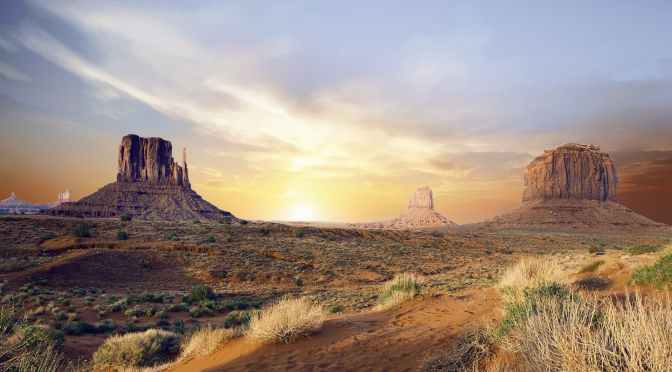
And yet, there in the hot, dry, sandy landscape of the wilderness, there tired, hungry, thirsty, chapped lip, windblown, and dusty Jesus sticks to the mission. 

As the Devil says to the same God who spoke all of creation into being from nothing…  If you are God, turn this rock into bread and Jesus says, “One does not live by bread alone”. God in Christ reminds the devil that the Word is standing there in the flesh.  

And then on top of world, the devil offers Jesus power over all nations if he would only bow down to chaos and confusion personified. The devil offers earthly power to the same God who has just been born in a manger as powerless baby, who has come to live in the created world, to play in the mud and sleep over at the neighbour’s house, to stub his toes and hug his parents, to go to weddings and learn the torah in the temple as a teenager. 

Then the Devil says worship me, and Jesus says “Worship the Lord your God and serve only him.” God in Christ reminds the devil that being God is not about power, but rather about giving up power in order to love and to love deeply. That being worshiped is not about being on top, but how God comes down to us.  

And then from the top of the world to the temple of Jerusalem. The devil asks Jesus to prove who is. The devil asks Yahweh Elohim, the God of Abraham and Sarah, of Isaac and Jacob, and Joseph. The God of Moses and Elijah. The devil asks this God to prove who he is on top of his own house, on top of the place that God’s chosen people come to worship the one true God.

The Devil says throw yourself from this temple, and Jesus says, “Do not put the Lord your God to the test”. God in Christ reminds the devil that there is no need to prove who he is… that this whole mission, that incarnation, ministry, crucifixion and resurrection are about God showing us who we are  – God’s beloved children. 

Jesus sticks to the mission. Because Jesus has come to fulfill God’s love and mercy given for us, to bring us back from being less than and to reclaim in us our calling and purpose. Jesus has come to pull us back from the brink of temptation and set us again on the way. The way to God. 

And so we begin each Lent in this same way. This mysterious, mostly unobserved season meets us in the messy world. In the world where we are seeking the satisfaction of bread, reaching for all power, looking to worship and follow the wrong things… and this year especially in all the worst ways. 

And Jesus reminds us that he has come into our world for a purpose. For a purpose revealed last week on the mountain of transfiguration, but soon to be revealed again on the mountain of Golgotha. Jesus has come not to prove who God is to us, but remind us again and again and again who God says we are. 

So as we set out on our Lenten journey today, God in Christ sets out with us knowing that we will forget who Jesus really is, but God never forgets who we are. 

God’s Interruption of Our Expectations – A Sermon on Transfiguration

GOSPEL: Luke 9:28-36 [37-43a]
Now about eight days after these sayings Jesus took with him Peter and John and James, and went up on the mountain to pray. 29And while he was praying, the appearance of his face changed, and his clothes became dazzling white. 30Suddenly they saw two men, Moses and Elijah, talking to him. 31They appeared in glory and were speaking of his departure, which he was about to accomplish at Jerusalem. 32Now Peter and his companions were weighed down with sleep; but since they had stayed awake, they saw his glory and the two men who stood with him. 33Just as they were leaving him, Peter said to Jesus, “Master, it is good for us to be here; let us make three dwellings, one for you, one for Moses, and one for Elijah”—not knowing what he said. 34While he was saying this, a cloud came and overshadowed them; and they were terrified as they entered the cloud. 35Then from the cloud came a voice that said, “This is my Son, my Chosen; listen to him!” 36When the voice had spoken, Jesus was found alone. And they kept silent and in those days told no one any of the things they had seen. 

Today, we come to the end of an unusually long season after Epiphany… Nearly two months ago, a lifetime ago, we gathered with the wisemen around the Christ-child to worship this new king sent to save the people. And in the weeks that followed, the divine Christ was revealed to us in different ways, each time pushing us, making us ready for today. For this journey up the mountain of Transfiguration… because on the mountaintop everything changes and the world as know it will come to an end. On this mountain, Jesus charts a course that puts him on a collision course with our efforts to be like God, to be in control of our own fate. 

Transfiguration Sunday is a hinge Sunday, a Sunday that swings us from one part of the story into the next. From the dark of Christmas night, into the bright noonday desert sun of Lent. Transfiguration is that moment where the bright lights are too much to take in and our eyes need some time to adjust.

These past two months have shown us a world that we were not prepared to see, a world that we did not expect. It has felt as between Sundays, between the stories that showed us again and again the Christ revealed in ways – in his baptism, at the wedding of Cana, filling fishing hets on the lake, preaching in Nazareth, and preaching blessings on the plain…. In between of all that a Pandemic thought to be winding down has raged, our family friends and neighbours occupied streets in Ottawa, important border crossings and the roadways outside of provincial legislatures all in name of freedom, with some white supremacy accelerationismon the side. And then as if that wasn’t enough… a peace between western nations that has last, if not uneasily, for 70 years, was broken as Russian military forces invaded Ukraine. 

In in twist of sick irony, the bright lights of bombs and gun fire has revealed to us a whole new world. 

Back on the mountain of transfiguration, things begin innocuously enough down in the valley, where Jesus decides to bring a select few with him to climb a mountain. Peter, James and John… oh, and the rest of us… are chosen to follow Jesus up the mountain. If you have ever had the chance to climb a mountain, you will know that it is not as glamorous as it sounds. It is mostly staring at the ground and the feet of the person in front of you as you tiredly trudge uphill. Once in a while there is a stop or pause to admire a view, but then more trudging. 

So after Jesus, Peter, James and John have trudged up their mountain, the disciples are understandably tired, sleepy even. And in their tired and sleepy state all of a sudden, Moses and Elijah appear. The two greatest prophets of Israel. And they are standing next to Jesus… but not normal Jesus. Jesus in dazzling white, looking suitably prophet-esque himself. 

Now before unpacking what happens next, it is important to know about all the clues we missed up until this point. The religious practice of Israel of the day was centred around the Jerusalem temple and laws of Leviticus. Making sacrifices in the temple and keeping the laws to maintain one’s purity and righteousness was how you stayed in God’s good books. The burden of righteousness of salvation rested on the shoulders of people. And the Jerusalem temple and its priests were the chief judges and gatekeepers of righteousness, making sure that only those who could keep the law and make sacrifices were given righteous status. 

But before the levitical laws and Jerusalem temple, there were the prophets of Israel. Messengers appointed by and speaking on behalf of God who brought God’s righteousness and mercy and compassion to God’s people. These prophets were the patriarchs of Israel, Abraham, Isaac and Jacob. But chiefly Moses and Elijah. And these prophets represented God away from the temple, and apart from the following the law. They often came preaching from the wilderness, they met God on holy mountains, they brought the very voice of God to God’s people. 

So as Jesus and his disciples trudge up this mountain, the clues are there. Jesus is not aligning himself with the centre of religious authority, with the temple and its laws. But rather with the prophets of old, those appointed directly by God to represent God to the people. 

And there on the mountain of transfiguration, Jesus receives his prophetic appointment, just as Moses and Elijah did. Confirmation that God was sending Jesus, the Messiah, to bring God’s righteousness, God’s love and mercy to God’s people. 

And yet even in this moment Peter cannot escape the burden of keeping the law, the sense that he must do that work of saving himself. 

“It is good for us to be here, let us make three dwellings.”

Peter wants to preserve this holy moment and make it a holy place, a place where the faithful can go to earn their righteousness. Peter just cannot imagine a faithfulness that doesn’t include his responsibility to earn his salvation. Peter cannot imagine a faithfulness outside of what he knows and experienced outside of his expectations.

We see you Peter. And we know you. 

We totally get this feeling. 

As for the past 20 years our world slowly shifted and twisted away from our expectations, as the church slowly but surely stopped being a given in Canadian society, in the lives our neighbours, friends, and family… maybe even in our own week to week routines… We understood that feeling that Peter has… we know in our bones what the world is supposed to look like, we know what being faithful Christians takes. And it almost hurts things aren’t just woking they are supposed to anymore. 

Following the rules, paying taxes, working hard is not the guarantee of a safe, secure, peaceful life it once was. Showing up to church with an offering envelope – when Sunday morning didn’t conflict other more exciting options – isn’t the promise that church will just be there when we need it that it once was. 

And certainly these past 2 years have crumbled our expectations that life will just keep going as it always has, the pace of change accelerated while we have held on desperately to the hope that we can go back to what things were. 

Finally this week, the 70 years of relative security and comfort for the Western World has come crashing down. Where we go from here no one knows, but building a dwelling place on top of a mountain is possible any more. There is no going back. 

So yeah, we totally get Peter’s feeling of being burdened. We would almost certainly want to do the same thing if we were standing on that mountain, we would try to capture the moment, hoping to continue life as we once knew it. 

Yet, before Peter gets too far into his plans to hold on.

God interrupts. 

Just as God spoke in Jesus’ Baptism, just as God spoke over the waters of creation, God speaks again. 

“This is My Son, My Chosen, listen to him!”

And what is that Jesus has said?

Well, he has NOT told his disciples and the crowds that earning their righteousness comes through keeping the law and making sacrifice at the temple. 

In fact, the last time that Jesus said anything before going up this mountain was to predict his death. That he will suffer, be rejected and be killed. And on the third day be raised again. 

Jesus has just told his confused disciples that he is coming to meet God’s people, to meet them in the midst of their suffering and rejection. And to die just as they die. Jesus has just told his disciples that he has come to bridge the distance between God and creation, and has come to carry their burdens. 

Jesus has come to carry their burden of righteousness earning to the cross.

Jesus has come to carry our burden of faithfulness to the grave. 

Jesus has come to carry the burdens of God’s people so that we don’t have carry our burdens alone.

This Messiah born in the manger, baptized in the Jordan, who turned water into wine in Cana, who filled the fishing nets on the lake, who preached on the plain… this Jesus, transfigured Prophet of the most high God does not stay on the mountain for an important reason. 

God’s prophets are not sent to go up mountains.

They are sent to go down.  

To bring God down to God’s people. 

Jesus the Messiah is coming down the mountain with Peter, James and John… and the rest of us… so that we can know that it is not our burden to earn our righteousness nor our right to stay on the mountain-top. So that we can face our changing world, even though we would rather stick with a world that meets our expectations. 

Still, God has always been coming down to meet us and to carry our burdens, to walk with us in suffering, to show us the way through uncharted waters.

God comes down to meet us every time we gather as community, no matter how many of us there are. 

God comes down to us whether we are in church every week, or have forgotten that church entirely. 

God comes to down to us in a world that we hardly recognize, to remind that us in the midst of the chaos God reminds the same and holds us to a faith that roots us in the image of God, that gives us an identity in the Body of Christ. 

God comes to meet us in this place and in many more places of worship whether they are full or nearly empty, whether the budget is easy to meet or underwater, whether we follow the success comes easy or we have no idea where to begin. 

God comes to meet us because we are God’s people, weighed down with burdens that only God can carry. 

And so God comes to carry them and to carry us. 

In God’s Word spoken here, in the waters of God’s cleansing grace, in the bread and wine of mercy, Christ’ body and blood – in all these things, God comes down the mountain to us. 

And so on this Transfiguration Sunday, as we also go down the mountain with Jesus, we are reminded  God is always on the way down to us. 

Following Jesus into the Deep

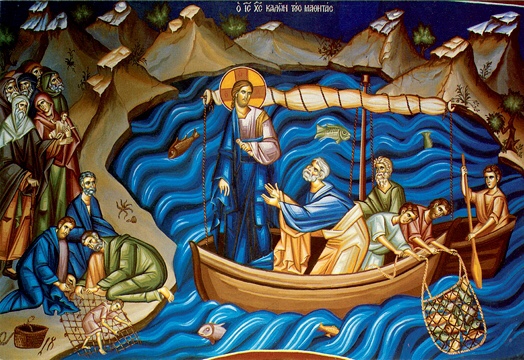
Luke 5:1-11
… For he and all who were with him were amazed at the catch of fish that they had taken; and so also were James and John, sons of Zebedee, who were partners with Simon. Then Jesus said to Simon, “Do not be afraid; from now on you will be catching people.” When they had brought their boats to shore, they left everything and followed him.

Last weekend, we decided to take drive across town to check in on the lot, or ditch patch as we  call it, where our new house is going to be built this year. On our way, we drove through downtown and encountered a large collection of tractor trailer, pick up trucks and SUVs with Canadian flags adorning them and lots of “freedom convoy” labels. It was a some unexpected drama that has captured our national attention. Last week, as Jesus confronted us as we were tired and edgy, he reminded us that no matter the messes that human communities find themselves in, that God continues to come and meet God’s people. This journey through this season after Epiphany has taken us from the the banks of the river Jordan, to the wedding at Cana, to the synagogue in Nazareth for the past two weeks. But now we end up in the boat with Jesus and his disciples. 

Today, the drama of this scene in Jesus’ story can be lost on us prairie dwellers. Last week Jesus was almost thrown off a cliff, while today he seems to go for a gentle boat ride. We are used to snow plows and SUVs, to eating beef, pork and chicken. And so when we hear that Jesus gets Simon to take his boat out and fish, and then Jesus provides overflowing nets, it seems like a nice story, a quaint story about Jesus making life a little easier for Simon and his companions. But dig a little deeper, and we begin to see that this is not just about Jesus providing fish. Today, Jesus is just as offensive as he was a week ago, and today, Jesus isn’t the only one in danger of losing his life.

As Jesus begins to get more famous, people begin to follow him around. The crowds press in on him to hear what he is saying. And this time they press him right to the edge of the Lake, so when Jesus can walk no further, he hops in a boat, into Simon who will later be named Peter, and continues to teach. Simon has caught nothing and is going home for the day. Yet when Jesus hops in his boat, he obligingly takes him out a few feet. Simon would have seen that Jesus was an important teacher with all these people coming to hear what Jesus had to say. 

Yet, when the sermon ends, Jesus doesn’t ask to go back to shore, instead he tells Simon to go out into the middle of lake. The preacher in the boat tells Simon the experienced fisherman to do exactly what fisherman don’t do. They do not go out on the lake in the middle of the day. They fish at night, near the shore by lantern light. This is how they have fished for generations. Simon is not impressed with this teacher fellow sitting in his boat. In fact he begins to refuse, 

“Look teacher, we have been fishing all night, our nets need repair, maybe you should stick to speeches and let us do the fishing” Simon has just met Jesus, but it doesn’t take him long to use that impulsive mouth that he will become known for. But then, Simon changes his mind part way through his refusal and says, “Well I guess it won’t hurt, so if you say so Jesus”. 

We aren’t too different than Simon, we often wonder if God actually knows what is going on. Like Simon, we find it easy to stick to the routines and to stick to what we know. Even when sticking to the routines leaves us with empty nets. Yet, God is calling us away from the safety of the shore, out to the deep water, out the unknown.

The unknown is scary and terrifying. And these days we only have a certain level of tolerance for anything different, anything that demands something of us. The issue at the core of the freedom convoy and any protest against COVID-19 restrictions or mandates has often begun with the resistance to this calling into the unknown, the unfamiliar. Masks are uncomfortable. Staying home is boring and lonely and hard. Getting vaccinated might cause uncertainty. 

But our resistance to the deep water, to following Jesus away from the shore, to allowing ourselves some discomfort comes at a cost. Sometimes it might be missed opportunities, as a church it could mean missing out on reaching new people in new ways, and as we are discovering during this pandemic… refusing to do that unexpected, unknown thing is resulting in more people getting sick, more ending up in the hospital and more people dying… all for the stated reasons of freedom, but for the real reason of being unwilling to be uncomfortable for a while or give up something of ourselves for the sake of our neighbour. 

God’s call to the deep waters can feel so risky that we would rather starve doing what we know. 

But with Jesus in his boat, Simon decided to listen to the teacher in the boat. And imagine his surprise as he lets down his nets into the deep water and then begins to haul them back in. The weight of the net pulling back more than Simon ever expected, maybe more than he had ever experienced. And Simon tries to the get the net — and all the fish — in the boat, there is so much that he must call to his friends, James and John before the nets break, and still there is so much fish that they both begin to sink. If there was excitement at catching a lot of fish, it would have disappeared when the boats began to sink, in the middle of lake. The wandering preacher might have guessed where the fish were, but it wasn’t going to do Simon any good, if he drowned first. And yet, they catch an abundance of fish that they had never seen before. 

But fish isn’t Jesus purpose. Jesus has so much more in mind for Simon… And though Simon doesn’t feel worthy, Jesus speaks the words that angels have spoken to those being called by God into something new, time and time again, “Do not be afraid.”

Along with Simon, Jesus is calling us out to the deep water today. And today, that call seems as crazy to us as it did to Simon, who knew better than to go far from the shore. And yet, God is doing something totally unexpected. Something that does not make sense to us. God calls us to die. God calls us to die in the waters of Baptism… but the call does not stop in death. God also calls us out of our ruts, out of our routines, out of the water, out of death and into life.

To a people stuck in the ruts, in the routine of what is safe and known, Christ’s call to risk everything in the deep water seems like too much to ask. But there in the deep water, Christ is giving us life. Life in the form of fish for fisherman with nothing, and today, life for communities contending with far too much sickness and death, life for people who are feeling caged up and alone.  

Out in those deep waters God calls to us from those first promises made to us at the font “By the baptism of his own death and resurrection, [God’s] beloved Son has set us free from the bondage to sin and death, and has opened the way to the joy and freedom of everlasting life”. Out of death, God brings life. Out of drowning in the deep waters of baptism, God forces the breath of life back into our lungs and joins us into a community of newly alive people.

Certainly our instinct is to resist this call, to push back against the dangers that we think we see and feel in the unknown, in the loss that we believe will come with giving something of ourselves. 

But like with Simon, Jesus says, “Do not be afraid.”

Because we do not follow this call alone. We do not go out into the deep waters alone. We are not in this boat called the church all alone. Jesus is with us in the boat and Jesus has much bigger purposes for us. Jesus is preparing us things that entirely new. 

We don’t know what is far from shore, what is out in the deep water, but Jesus does. Jesus knows where we need to go, and what path we need to follow. Jesus knows what must be done for the sake of a hungry and dying world. 

So no, this story today is not a quaint story about a little boat ride and catching fish. It is about the fear and uncertainty that come with following Jesus, with stepping out of what is comfortable and known, of being willing to risk, to be uncomfortable, to give of ourselves. 

But it also the story that always comes after, “Do not be afraid.” 

It is the surprising story of God’s surprising abundance given for us, nets full of fish, salvation found in the waters of our baptism, new opportunities out in the deep water. 

It is about following God’s call into unknown AND of God’s promise that wherever we God, Jesus is in this upside down boat with us. 

Slowing Down for the Spirit

Luke 4:14-21
Jesus, filled with the power of the Spirit, returned to Galilee, and a report about him spread through all the surrounding country. He began to teach in their synagogues and was praised by everyone.
When he came to Nazareth, where he had been brought up, he went to the synagogue on the sabbath day, as was his custom. He stood up to read, and the scroll of the prophet Isaiah was given to him. He unrolled the scroll and found the place where it was written:

“The Spirit of the Lord is upon me,
because he has anointed me
to bring good news to the poor.
He has sent me to proclaim release to the captives
and recovery of sight to the blind,
to let the oppressed go free,
to proclaim the year of the Lord’s favor.”

And he rolled up the scroll, gave it back to the attendant, and sat down. The eyes of all in the synagogue were fixed on him. Then he began to say to them, “Today this scripture has been fulfilled in your hearing.”

A star that guides the Magi from the East to the Christ child. 

A voice like Thunder that declares “You are my beloved Son”

Water turned into abundant flowing wine to gladden a wedding celebration. 

We have been witnesses to big, bold and exciting events the past few weeks. We have seen God pulling back the veil between heaven and earth to show us that Jesus, that God is flesh, is near. The grandness of these stories makes us certain of God’s presence in the world. 

And as we have witnessed the divine spectacle this season after Epiphany, we have become accustomed to these kinds of signs. We see God interjecting the divine into the lives of everyday people, and we anticipate that God will do the same with us. 

But today, there doesn’t seem to be any flashy sign or action to accompany Jesus. Today is different. Luke tells us a story in a more pedestrian style, a seemingly casual and low-key vignette of Jesus’ ministry. 

Today, Jesus does only what is expected of any Jewish man in the synagogue. No miracles or signs of power. Jesus simply reads from the scroll of the prophets and then provides explanation. It should feel almost normal, it should remind us of the same worship that is our custom as well.  

We return to Luke’s Gospel, after a detour in John’s Gospel last week for the wedding at Cana and the pace of the action slows. The story is one of subtle details. 

Jesus has been preaching and teaching in Galilee. Reports of him have spreading, he is coming to be regarded as a well known teacher, a traveling Rabbi. And with news spreading, Jesus arrives in his hometown of Nazareth. 

Jesus goes to the synagogue on the sabbath, as was his custom. Jesus is not only a regular worship attender, it is clear that in the synagogues is where he is getting his message out, where he is making his ministry known.

Yet still, it was possible for any Jewish man to be asked to read from the Tanahk, the Hebrew Bible. However, as a wondering preacher, the people likely expected this hometown son to now preach for the folks who knew him as a kid. Jesus stands to read and is given the scroll of the prophets. Jesus makes is way through the scroll and chooses a familiar passage, from what we now call Isaiah 61. 

Luke brings us right down to the moment by moment details. Compared to the drama of voices from heaven and surprising good tasting abundant wine, Luke adds tension in the slowness of motion. Once Jesus has concluded the reading, he rolls up the scroll… He hands the scroll to the attendant… Jesus sits down and prepares himself to teach… The whole synagogue is waiting for what Jesus is going to say… All eyes are trained on Jesus…. 

(Pause)

In these past weeks, our story has slowed down as well to moment by moment details. Our world had finally begun to expand from summer on last year, we began to imagine a bigger and brighter future. But then the pandemic found a way to squeeze us again. We have been scaled back and pared down, and yet we wait with bated breath for when this latest wave may end and there will be signs of life renewed. 

It is hard for even one day to go by and for us not to see how our world needs signs of hope. The poor need good news, the captives need releasing, the blind need sight, the oppressed need freedom. We cannot help but be bombarded by a world in desperate need wherever we look, whether it is here in Winnipeg or far away on the other side of the planet. 

As Jesus reads from Isaiah, the people that he was reading to longed for good news, for release, for healing and freedom. It is a longing that has lasted throughout all of human history. 

And as we long for change, we begin to load God with expectations. We hear Jesus speak of good news for the poor but we long for riches. We see the captives that need releasing but we long to be released from any and all obligations we might carry for our neighbour. We heard of sight for the blind but we want every ache and pain, every experience of discomfort to taken away from us. We imagine the oppressed being freed, but we desire being given control, being the ones who have the power to make decisions and be in charge. 

It is so very easy for our longing for justice to turn into an expectation for results. We want our prayers to be heard and answered, and we are disappointed with God when they are not. Our sinful, selfish nature makes us turn hope for justice and peace into a sense of entitlement. Entitlement to God’s acts of power, entitlement to control of God’s blessing.  

We hear Jesus declare this new and hopeful reality, and we cannot help but imagine what we are going to get out of it. We cannot help but put ourselves first and imagine the world according to our own vision and our own image. 

(Pause)

But today, it is in the details that Jesus is pointing us to something much bigger than our expectations and desires. Luke slows down the pace so that we can hear the details, so that we hear the words of God anew, stirring deep within creation, stirring deep within the Church, stirring deep within us. 

The very first words that Luke puts in our ears: Jesus, filled with the power of the spirit. 

Though this feels like a slowed down smaller story than the Magi following the star, the voice thundering over the baptismal waters, the blessing of the wedding with good wine… We are meant to connect this moment in the local synagogue with the building movement of the spirit that has brought us here through this season. 

And the Luke draws us back to the spirit again:

“The Spirit of the Lord has named me the Christ. 

The Christ who evangelizes and brings the gospel to the poor.

The apostle who releases the captives and heals the blind and sets the oppressed free. 

The preacher who declares the year of the Lord’s grace and mercy.”

In these simple words of scripture Jesus describes a new reality. Not a new reality based on our wants and desires. A new reality grounded in the incarnation, in the God who speaks these words out loud and in our hearing. A reality grounded in the God who brings these words to life in our midst. Who makes the words real right before our eyes. 

As the people of the Nazareth Synagogue sit waiting expectantly for Jesus to interpret the meaning the Prophets words for them, Jesus has only a brief and simple sermon. 

“Today this scripture has been fulfilled in your hearing”. 

Today, these words from the prophet have come to realization. Today, the anointed one, the saviour, the Christ has become present in flesh. Today, the God of the poor, of captives, the blind, the oppressed is here. The work of God in the world is now. 

The same spirit that led the Magi, that spoke like thunder, that provided the abundance of wine… this same spirit in Nazareth, at the synagogue, announcing to all that Jesus is the Messiah. The anointed one. The saviour of Israel. Even in this small and slowed down and familiar moment, Jesus is subtly but surely making God’s presence known. God is not far away, but here. God is with us even in our smallness, with us even in our isolation, with us in our illness and struggling, with us even when we feel abandoned and alone. 

Jesus not only announces the work of God in the world, but lays a foundation for us. For the Church. The Body of Christ proclaiming the gospel and caring for the poor. The Apostles of Christ releasing the captives and giving them a home. The Church giving sight to the blind, freeing the oppressed. People of faith preaching God’s love for the world.

Today, Jesus simply and straight forwardly announces the mission of Christ. Of the Christ who is among us in Word, Water, Bread and Wine. The Christ who IS us, we who ARE the Christ in the world, washing and feeding and loving a world in need of hope. 

We arrived today having just heard and witnessed the bigness of God:

A star that guides the Magi from the East to the Christ child. 

A voice like Thunder that declares “You are my beloved Son”

Water turned into abundant flowing wine to gladden a wedding celebration.

And we add to that list today: 

A simple sermon, preached in a small synagogue to people of faith waiting for good news. 

These are all signs of God’s presence in a world in need. 

Yet today, fulfilled and realized in our hearing, 

with all eyes fixed upon Jesus, 

despite our desire to put ourselves first and get what we selfishly desire, 

The anointed one who is working for justice and peace among us, 

The Christ speaks God’s word and declares that God is at work here, 

working in us, 

right now. 

Amen. 

Sermon on the Wedding of Cana – Running Out on the 3rd Day

John 2:1-11
On the third day there was a wedding in Cana of Galilee, and the mother of Jesus was there. Jesus and his disciples had also been invited to the wedding. When the wine gave out, the mother of Jesus said to him, “They have no wine.” And Jesus said to her, “Woman, what concern is that to you and to me? My hour has not yet come.” His mother said to the servants, “Do whatever he tells you.” Now standing there were six stone water jars for the Jewish rites of purification, each holding twenty or thirty gallons. Jesus said to them, “Fill the jars with water.” And they filled them up to the brim. He said to them, “Now draw some out, and take it to the chief steward.” So they took it. When the steward tasted the water that had become wine, and did not know where it came from (though the servants who had drawn the water knew), the steward called the bridegroom and said to him, “Everyone serves the good wine first, and then the inferior wine after the guests have become drunk. But you have kept the good wine until now.” Jesus did this, the first of his signs, in Cana of Galilee, and revealed his glory; and his disciples believed in him.

On the 3rd day of the wedding in Cana, they ran out of wine. It might seem strange to be talking about a party running out of wine today. Last week, we heard the story of Jesus’ baptism where God spoke to the crowds and to us. It was a big deal. And then between Sundays, our world continued on through our collision course with the Omicron variant. Some have called it a new pandemic. 

Parties and gatherings and running out of wine, seems trivial in the face of governments seemingly giving up on managing the pandemic and the feeling of being left to fend for ourselves. Forget thinking about parties and gathering as friends and family, daily life has become serious business, stress filled and difficult business. So talking about a miracle where Jesus turns some water into wine at a wedding sounds almost trivial. 

Yet, despite being a place known mostly for its poor party planning, Cana is also a place a place where life is serious, stress filled and difficult too. Cana knows the dangers of the world. They too worry if there will be enough on the table, worry about bills and taxes, work and family. Cana was a small town in the middle of nowhere. They lived under and paid taxes to the Romans, to Herod, to the Temple, to the Synagogue, to the local authorities and to soldiers. 

And here they were, trying to have a nice celebration for the community. To set a couple off right for the start of their marriage. A small celebration in an otherwise dark, serious, and difficult world. 

But on the 3rd day of the wedding they run out of wine. 

Mary and Jesus and the disciples are in Cana for a wedding. They are probably at the wedding of a distant relative, but for Cana this would have been a whole community affair. Like weddings today, the weddings of ancient Israel were big celebrations. It was expected that a fortune would be spent on the party. Wine and food was to flow for a week – literally 7 days. The Bridegroom was meant to be broke by the end of the party. The hospitality, celebration and the extravagance were meant to be sign of blessing. If it was a good party, it would be a blessed marriage. 

Except it is only day 3 in Cana, and they have no wine. 

Mary points this out to Jesus in only the way a mother could. And Jesus responds in only the way a son could, “Woman, what concern is that to you and me? My hour has not yet come”. Jesus has different idea of timing than his mother. But, she doesn’t care. She tells the servants, “Do whatever he tells you”. 

Jesus seems to only to see a party that has been poorly planned. A party that has run out. But Mary sees something different. Mary knows that the wine has run out on day 3, not even half way through. If were only a matter of poor planning, the wine might run out on day 6, but not day 3. The family is probably too poor to throw a proper wedding. 

Maybe they didn’t know about Manitoba wedding socials in Cana. Maybe they didn’t come together as people have done here, knowing that if everyone contributes a little to everyone else, when the time comes to host your own, the burden won’t be so great. But the people of Cana almost certainly did know this, and probably had all already chipped in to the party. 

And Mary sees that this community is too poor, they don’t even have enough reserves to have one party for these newlyweds. 

Mary and Jesus embody the moments of scarcity that we face every day. We know what it is like to need for more, to fear running out, to know that the time isn’t right, to hope for something different and to long for change. We have been living small lives, the fullness and busyness of what we used to know having been curtailed dramatically. We know what it is like to have celebration plans come crashing down (just think back to Christmas Eve!).  We have experienced a kind of scarcity of living and relationship these past two years that seemed inconceivable before. 

And we know that we too are closer to running out than we like to admit. Running out of patience, and resolve, and resilience. 

Running out of hope. 

Running out is something we all fret about, and yet it is connected to a much deeper fear. At the core of our being is a fearful sense that there is not enough. That if we run out, we will suffer, we will lose, we will be alone, we will die. We fear not having enough so much that it can make us crazy. It is the fear of running out that makes fight with each other, that makes us stubborn and unable to see the needs of those people around us, that makes us hold on with all our might, even when holding on is what is killing us. 

So when Mary pushes Jesus to act and even though he resists… it is because she must see that it isn’t really about the wine or the party ending 4 days early. It is about a community without much else to hold on to, a people without hope. If there is not enough wine, then there is not enough to eat or drink. There isn’t enough to live on. The world will have overcome them. There is no future, no hope, only death. 

Mary sees this deep connection between running out of wine, and how Cana itself is not that far away from death. She sees a community that needs some hope, that needs a future. And she knowns the only person who can truly provide. 

And so Mary presses the issue, not with Jesus, but with us. 

“Do whatever he tells you.”

Easy instructions for the servants… but words that should take our breath away. 

As we face challenges and struggles of this most difficult moment of a long pandemic, of making ends meet and just keeping it together day to day…
As we wonder if there is any hope for us, if there is a future here…
If all we have to look forward to is death…
“Do whatever Jesus tells you.” is a word that demands faith from us. Faith that we really don’t know how to give. 

But God does. 

Even when it doesn’t seem like Jesus’ hour… Jesus steps into the void.

And it isn’t just an abundance of wine that Jesus provides. Instead, God breaks into the world. God comes to a small community that is forgotten by everyone else. And God blesses the wedding, blesses the whole community. 

It is not about the wine. It is about the blessing. About God’s presence in that moment. Mary seemed to know that with God present at that wedding in Cana, running out of wine was something that Jesus needed to do something about. 

And all of a sudden on the 3rd day of the wedding, when hope was lost, when there was no future… God breaks into the world and provided wine. God meets that community and gives them hope. God creates a new future. 

And if we haven’t recognized it yet, let us be clear. Our 3rd day moment of scarcity is upon us too. 

And here… today…  God is breaking into our world here and now.
God is here among us, here with us wherever we are are.
And God is offering hope.
God is offering us a future.

Even as things feel dire, God offering us life found in the gospel word. The word that finds us today wherever we are. God is meeting us friends and community that have practiced being there for each other, even over a distance, even in the midst of struggle. God is reminding us that we have been here before, and God has weathered the storm with us. God has already shown us the other side, that we do not go forward alone but together with God. 

Sp yes, the wine ran out on the 3rd of wedding at Cana.
Today, our wine, our hope, our self-propelled future is running out. 

But make no mistake. As we gather on the 3rd day, on this Sunday, the Lord’s day,  we  are meant to be reminded of that other 3rd day miracle. 

When life itself seemed to run out, when the life of God in Christ ran out on the cross, the 3rd revealed something new and something unexpected. When all hope was lost, God emerged from the empty tomb. And like the servants drawing the water turned into wine, New abundant life was revealed to us in the most surprising of ways. When we didn’t seem to have a future, God provided new life in the resurrection. 

Here on this 3rd day, here in our world, here in our community, it might feel like we are running out of wine. It might feel like there is no hope and no future. But God is revealing to us the Christ who brings delicious and abundant wine, who fill the jars of our hope, who makes sure that there is future – because Jesus has saved good wine until now, he has saved it for us.