Tag Archives: Sermon

Alan Kurdi, the Syrophoenician Woman and Breaking Jesus’ Prejudice

Mark 7:24-37

Now the woman was a Gentile, of Syrophoenician origin. She begged him to cast the demon out of her daughter. He said to her, “Let the children be fed first, for it is not fair to take the children’s food and throw it to the dogs.” But she answered him, “Sir, even the dogs under the table eat the children’s crumbs.”  (Read the whole passage)

Sermon*

Most of us had a moment this week when we first saw the image of little Alan Kurdi lying face down on a beach in Turkey. The scene seemed unreal: childlike innocence contrasted with devastating tragedy. It seemed to jar the world out of our summer sleepiness and into a deeper awareness of the reality of the humanitarian and refugee crisis happening out of Syria.

It’s not that there haven’t been news reports, articles written, and videos posted showing the thousands of migrants clashing against police, migrants struggling to cross borders or telling us of migrants dying trying to make their way to a better life.

It’s also not that we haven’t responded to the crisis, which has been going on for 5 years: CLWR asked our national church for 10,000 sweaters and we responded with 70,000. We’ve given with financial support, we have hosted fundraisers, and we have even had ongoing conversations in our congregation about how we can support refugees.

And yet, the reality of this crisis has always seemed far away. Something distant and removed from us. That is until this week when one photo scooped us up from our living room couches, plucked us away from computer screens, and transported us around the world.

Unlike the news reports, the articles and videos of migrants, one photo of a Turkish beach made us feel like we were standing just a few feet away from little Alan Kurdi and demanded that we come near and truly see this humanitarian crisis.

Perhaps it is serendipity or perhaps the Holy Spirit is up to something, because Jesus has his own close encounter with a foreign woman this week. A parent doing anything she can to provide a better life for her child.

And it is this desperate parent who seeks Jesus out, hoping that he will help her and her demon possessed daughter.

As seems to be usual in Mark’s gospel, Jesus is tired and cranky. He is seeking refuge from the demanding crowds, and so when this woman comes into the house where he is staying, Jesus is well… very un-Christ-like with her.

She begs for his help, and Jesus puts her off. In fact Jesus tells her off. Jesus compares her to a dog. And not the beloved family pets many of us have at home, but a pest and nuisance. The word he uses is more akin to that pejorative name for a female dog.

Mark the gospel writer, doesn’t usually provide details unless they are important, so the fact that he mentions that this woman is Syrophoenician should not escape our notice. Syrophoenicians were mixed race gentiles living in the border lands of Tyre and Sidon, just beyond Galilee. Syrophoenicians were half Phoenician and half Syrian (the coincidence here should not be lost on us).

The Israelites of Jesus’ day saw these particular gentiles living just beyond their borders as lesser peoples. People unworthy of Jewish attention or compassion.

As the Syrian-Phoenician  woman comes to Jesus, she humbles herself at his feet, and she begs for his compassion on her daughter’s behalf. And she crosses the boundaries of proper social behaviour, by being a woman who speaks to a man in public, by being a gentile who approaches a Jew, by being a beggar hounding a respected teacher and authority. And Jesus responds to this woman’s bold yet desperate plea by expressing a common Jewish prejudice of his day in the way he deals with this desperate mother. He is willing to put her off, because her needs, her tragedy, her desperation are not worth his immediate action. Jesus makes it clear that she, and others like her, will only get help once the people the world has deemed more worthy have their needs met.

Jesus sounds a lot like our political leaders have sounded this week… and that should not sit well with us. In fact, it should make us squirm in our seats. This is not the Jesus who eats with tax collectors and sinners, the Jesus who is forgiving prostitutes, the Jesus who is welcoming the unworthy.

Jesus today sounds too much like world leaders who can’t be bothered with people who are just too different from them. Jesus sounds like those who blame others for the problems facing the poor and marginalized, passing the buck. Jesus sounds a little bit too much like us.

It is uncomfortable to watch Jesus succumb to the same prejudice that we fall victim to. It is disturbing to see him place walls and barriers in front of suffering people just like we do. It is strange to think that Jesus would deny anyone compassion just because they are different from him, just as we are often guilty of doing.

Our prejudice often affords us the excuse to remain passive in the face of human suffering. This week it was a photo of Alan Kurdi that reminded us of this fact. Last year, it was the story of Tina Fontaine. The year before, it was the case of Brian Sinclair… and the list goes on from there. Maybe it goes all the way back to the Syrian-Phoenician woman.

“Even the dogs under the table eat the children’s crumbs”

Just when we expect the Syrian-Phoenician woman to reject Jesus’ prejudice and bigoted words, she does the opposite. She holds them up as a mirror to Jesus’ prejudice and accepts the dog epithet. She is still begging for compassion, she is still asking Jesus for help. But instead of asking for help person to person, she is willing to lower herself… she is already on her hands and knees at Jesus’ feet… to the place of a dog. She is asking for the least that Jesus could do.

And in that moment, Jesus is faced with either turning her away and abandoning not only her humanity, but his own, or dropping his prejudice in order to show compassion.

Ephphatha. Be opened. 

It is not just the deaf man who is opened up today, but he instead re-iterates the opening up that Jesus experiences just before. When Jesus unplugs the ears and loosens the tongue of the deaf man, he makes a connection to a person who had no voice, who was on the margins and excluded from normal community. The deaf man can now speak because Jesus is listening.

It is a connection that Jesus first learns through the Syrian-Phoenician woman who presses him to show compassion. Jesus learns something about giving up his own prejudice, Jesus learns what it is like to have his own walls and barriers broken down. By holding Jesus’ prejudice up before him, by making her need for compassion heard, Jesus breaks open God’s compassion into the world. Compassion and mercy given to more than just the children of Israel, compassion now for Jew and gentile alike, compassion for all creation.

What starts as a tired and cranky Jesus refusing to help a person whom he thought was too other, too different, too unworthy becomes the means for God’s transforming compassion and mercy to enter the world. As Jesus is opened, God’s compassion meets a Syrian-Phoenician woman and a deaf man. As God is opened, the world is opened.

And it is the same thing that happened to the world and to us, this week. A single photo of a young Alan Kurdi, holds up a mirror to our prejudice, to the walls and barriers we build between ourselves and people who are different from us. When faced with tragedy like this, we are left with the option of going on with life as usual, where people like Alan don’t matter, or having our prejudice broken down and our compassion broken open by the realities of the Syrian migrant crisis through the heartbreaking photograph of a three-year old boy lying dead on a beach.

Still, even as the world now calls for compassion, even as we have been sending sweaters, praying, giving what we can, and discerning how to do more, even if our country opens our doors to as many refugees as we can take… we know that it is not enough. We know that our compassion has not and will not save the world. The power of the human spirit cannot do it alone, if at all.

Today, we are reminded, even as the Syrian-Phoenician woman pushes Jesus for compassion, that God is doing the work of breaking us open. God is speaking to us Ephphatha – Be open. 

There is no human cry for compassion, no human grief that will save Alan. There are just some walls of prejudice, some walls of indifference that we cannot break down.

And so like the Syrian-Phoenician woman, like the deaf man, and now like Alan Kurdi, we turn to God.

God alone who can meet our prejudice and open us up. 

God alone who can meet the walls and barriers we place in front of the suffering of our brothers and sisters.

God alone who can meet death,

God who knows what it is like for a son to slip from his arms and die on a cross. God who knows what it is like to die in the borderlands of a foreign and oppressing empire.

God alone who on the third day walked out of the tomb, breaking open death once and for all.

Today, we turn to God who speaks to us in the midst of prejudice and tragedy –

Ephphatha – Be Open. 

Amen

*This sermon was co-written between my wife, Courtenay @ReedmanParker and I. We haven’t done this before, but as we talked about our own reaction to the photo of Alan Kurdi this week, we decided to come together and write one sermon. It is something we will definitely do again. 

This story is not about hand washing

Mark 7:1-8, 14-15, 21-23

So the Pharisees and the scribes asked him, “Why do your disciples not live according to the tradition of the elders, but eat with defiled hands?” He said to them, “Isaiah prophesied rightly about you hypocrites, as it is written,

‘This people honours me with their lips,
but their hearts are far from me;
in vain do they worship me,
teaching human precepts as doctrines.’

You abandon the commandment of God and hold to human tradition.”

(Read the whole sermon here)

Sermon

This story is not about washing hands.

After a 5 week detour into the Gospel of John to hear the story of the feeding of the 5000 and then 4 more weeks of conversation about the bread of life, we are rudely dumped back into Mark’s gospel.

John has been giving us gentle rolling theological poetry of Jesus, hoping to unravel and expand our understanding of God.

Yet, as we are dumped back into Mark this morning, it is kind of like being woken up by a harsh alarm clock in the middle of a great dream.

Mark is not about expanding and unravelling the story of Jesus. Mark only gives us the minimum of details. He wants us to wonder. If we aren’t wondering what on earth is going on after hearing a passage of Mark’s gospel, we aren’t listening.

So be forewarned, this story is not about washing hands.

(Pause)

A few months ago, when the Bishop moved her office to St. David’s and made it the cathedral, she also made Father Angelo an archdeacon and put some of her duties on his plate, in addition to this role at St. David’s.

During he first week in his new role, Father Angelo received a phone call from a frustrated priest, serving in small rural congregation outside the city.

The priest was upset because her congregation hadn’t been attending the programs she had started in the parish.

(Pause)

Today, Jesus and his disciples are just minding their own business while they eat lunch. Some of the Pharisees and scribes from Jerusalem had come down to see what Jesus is up to, probably hearing of the crowds he had been drawing.

And when these Pharisees and scribes see that the disciples are eating with unwashed hands, they begin to make a stink about it with Jesus. And Jesus is not impressed.

He berates the accusers of the disciples: “Listen to me, all of you, and understand: there is nothing outside a person that by going in can defile, but the things that come out are what defile.”

Then Jesus goes on to name an extensive list of sinful behaviours and concludes with this gem: “All these evil things come from within, and they defile a person.”

We left the philosopher poet of John behind last week, and this week we get Mark’s angry lawyer-like Jesus, who is sticking it to the Pharisees and scribes about what it is the really defiles.

But lest we forget, this story is not about washing hands.

(Pause)

While on the phone with this frustrated priest, Father Angelo thought back to his first parish. He recalled being at a congregational meeting where sign up sheets were being passed around for two very different things. The first was from him to see if people were interested in having a weekly bible study. The other was was sent around by one of the property committee members. It was for mowing the cemetery lawn during the summer months.

When his bible study sheet came back to him, three names had been added to the list. But when the lawn mowing sheet passed him by, it was full. And it had only been through half the room.

He recalled how discouraged it had made him at the time.

(Pause)

This story between Jesus and Pharisees is not about hand washing.

The judgemental question -slash- accusation that the Pharisees make about hand washing is what sets Jesus off on his tirade about the things that truly defile human beings. And while his response is to swiftly condemn the things that truly defile, hand washing is only the pretext for the Pharisees, the reason they give for their judgement is not the real reason.

If they really cared about hand washing, they would have stopped the disciples before they started eating. Or at the very least their question to Jesus would have been, “Why are they eating with dirty hands, that can make them sick?”

Instead, the Pharisees and scribes are asking about something that is not really about hand washing.

“Why do your disciples not live according to the tradition of the elders?”, they ask.

Jesus is upset because first of all the Jews believed that the law had been given to them by God through Moses. The Pharisees are placing their faith in the elders and ancestors.

But not just that. The Pharisees have a confused understanding of faithfulness. They are trying to be faithful by appearing like they follow the rules, by being faithful to their ancestors and they way they practiced their faith. The Pharisees have intermingled their faithfulness and their understanding of being good, righteous and faithful Jews with being faithful children, with being good, righteous and faithful descendants.

They live in a world that values staying the same. They learned their way of life from their parents, who learned from their parents, who learned from their parents. And they learned that it is important to refrain from change. The way of life they know is what worked for generations before them, what right do they have to change it?

And while washing hands among the other rules of ritual cleanliness were first instituted as a way of keeping the people of Israel safe and healthy – the rules were meant to be of service to humans beings – the Pharisees had become servants to the rules.

Faithfulness was no longer about living in right and healthy relationships which each other, with creation and God.

Faithfulness, righteousness, knowing that you were in right standing with God was now about keeping the rules, the rules that made your parents, and grandparents and great grand parents righteous too.

(Pause)

After hearing the frustrations of a priest and her non-participatory congregation, Father Angelo did his best to encourage her.

After he hung up his phone, he thought back to his first parish full of eager lawn mowers. Since the parsonage was just down the road from the cemetery, Father Angelo made a point of heading over to the chat with whomever it was who was mowing. And over the course of the summer, he discovered that the people of his parish didn’t actually love hauling their lawn mowers in pick up trucks and trailers in order to mow the grass. But he did hear family stories and hear about family relationships. He heard the history of the community. He learned which tombstones were for the relatives of those mowing.

And he discovered as misplaced an attempt as it was, mowing the lawn was how his people tried to be faithful. And knowing that, he was able to begin helping his people to be faithful in new, more God-centred ways.

(Pause)

Even while Jesus lectures the Pharisees about what truly defiles them, he is challenging how they understand righteousness, how they understand the way that they are saved, how they understand the ways they are faithful.

The Pharisees think it is following the rules handed down generation after generation is what makes them faithful, is what makes them worthy of being forgiven and loved by God.

It goes without saying that this is something that people of faith, that church communities, that we struggle with too. Ask any couple bringing their child for a baptism why they want their baby baptized? Not one will say it is because through Water and the Word we are made children of God receiving God’s tangible sign of forgiveness, life and salvation. No, they will mostly say they are coming because it is what happens in their family, it is just the right thing to do.

It is very easy for us to lose sight of big picture. We can get stuck in ruts and fear change out of a sense of loyalty to our ancestors, forgetting why they did the things they did in the first place.

And so when Jesus challenges this idea that following the rules of the ancestors is not what earns us forgiveness, life and salvation – that being good rule followers is not why God loves us, we have to wonder… what does make God love us?

God’s love for us is not earn or achieved. God gives us love freely.  Washing our hands or having our babies baptized doesn’t earn it. Mowing cemetery lawns or keeping the faith of our ancestors unchanged doesn’t make us righteous.

In fact God’s love for us has nothing to do with those things. It has to do with who God is and who we are. It has to with God loving us because we belong to God. It is the love of the creator for the created, the love of a parent for a child.

Jesus’ challenges our understanding of faithfulness so that we don’t have to live put to the faithfulness of our ancestors. We don’t have be good Christians because our grandparents were. We are loved by God first and that is what makes us good.

Today’s story is not about washing hands.

Today’s Jesus is telling us that what we do, or don’t do doesn’t earn God’s love. That our faith in the traditions of the ancestors won’t save, nor make us righteous.

Only God can do that.

And clean or unclean, defiled or undefiled, faithful of ancestors or failing them, God chooses to love us no mater what.

Amen

Looking for the Bread King

John 6:24-35

Then they said to him, “What must we do to perform the works of God?”… Jesus said to them, “I am the bread of life. Whoever comes to me will never be hungry, and whoever believes in me will never be thirsty.” (Read the whole thing)

Sermon

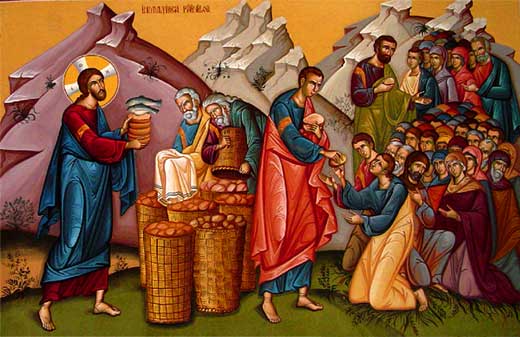
Five Loaves and Two fish. They just ate the five loaves and two fish that Jesus turned into such abundance, into so much for the crowd of 5000 that there was still 12 baskets left over. Yet, the crowds that have been following Jesus still want more bread. They want something more for their stomachs, something more for their hunger.

It has only been a week since we heard again the story of the miracle of the five loaves and two fish, and for the crowds wanting more bread today, it has only been moments since this miracle. Following the grand feast on the mountain, Jesus escaped to be by himself. The disciples, tried to cross back over the lake, only to be met by Jesus walking the water. And the whole way, the crowd has been stalking Jesus and the disciples. The crowds are looking for more.

Jesus tries to show the crowd a different way, he tries to show them true bread from heaven, but the crowd wants more bread. Bread that can be eaten, bread that fills their bellies. Last week the crowds were given bread and fish to eat, they were given a sign of God’s work and power right in front of their eyes. Yet today, they want more, they want more miracles, more manna like from Moses, more power to be shown and they want it for themselves. Jesus tries to turn their attention to what he is doing and what he is offering right in front of their eyes but they can only imagine God’s work on their terms. They might not exactly be certain what they want from Jesus, their Bread King, but they know they want something big, flashy, exciting and low risk.

Like the crowds who followed Jesus, we also can get caught up in a particular vision of what God’s work looks like in the world. “What must we do to perform the works of God?” the crowds ask Jesus. We like to ask our own versions of that question. What is God’s plan for my life? How can we attract people to our church? When will my prayers be answered? What can we do to make our church grow? Why is God letting this happen to me?

There are 3 things that the crowds are said to be looking for in this passage:

At first, John says they are looking for a Jesus… for a king. Someone to protect and care for them, someone to provide and entertain them.

And then Jesus accuses the crowds of looking to full their bellies. They are seeking instant gratification, to have some kind of emptiness they carry filled in the short term.

And then the crowds themselves say they are looking to do the works of God. They are looking for God on their terms, they are looking for easy access to God, some sign, some work that shows them they have found the right person to follow. They are looking for assurance.

We know what it is like to look for kings, for instant gratification, for God on our terms. We are about to enter into a election season, and we will be bombarded by political leaders saying all the things they think we want to hear. They will present themselves as benevolent leaders, seeking only what is best for us… or what is the best way to get our vote.

We know what it is like to seek instant gratification. Fast food, the latest gadgets, short line ups, speedy customer service. We want things and we want them now.

And we know what it is like to want God on our terms. As people of faith we genuinely want to be faithful… but only up to the point where it is isn’t too inconvenient, or risky or uncertain. God can ask to be disciples, as long we can do it in a couple hours a week.

As we are standing with those crowds… seeking God on our terms, seeking to have our bellies filled…

We are confronted with Jesus’ words about life. Jesus offers and then gives to us something different than that what we want. We want the Kings who say what we want to hear, the satisfaction of full bellies, we want God who is powerful yet tame.

And we want all of these things with the crowds,  while we haven’t the slightest clue that, Jesus, that God in flesh, that God’s greatest work made visible in the world is standing right there before the crowds, before us.

God is right there, before us, offering himself, and would rather find a God that fits our vision, than see God’s work right before our eyes.

And yet, despite our search God in our image, Christ stands there in our midst, offering himself to us. Offering us grace, love, mercy and compassion.

Its normal and human to want what the crowds want. It is in our nature to want a God that fits our expectations.

The crowds want a king, but we get a saviour nailed to a cross.

The crowds want bread to fill their bellies, but God gives us the Bread of life to fill our souls.

The crowds want God on their terms, but God comes to us and meets us on God terms. God meets in flesh, God meets us in Jesus.

The crowds don’t really know what they are looking for. And we so often, don’t know what to look for when it comes to finding God in our world.

But today, Jesus comes to us and helps us discover that God is right here, standing among us, pointing to the true works of the divine, to the works of God in our midst. God is not found in Kings or politicians, in fast food bread that fills us only for a moment. God is not a God of our invention. God is a God of love and mercy, a God of words of hope and promise. A God of water that quenches our thirst. A God of bread and wine that truly fill that emptiness inside of us.

Jesus says, “I am the bread of life. Whoever comes to me will never be hungry, and whoever believes in me will never be thirsty.” We want bread, and God satisfies our hunger and thirst with body and blood, bread and wine. We want to do the works of God, and God gives us Jesus the Christ, God with us in the flesh. And despite our efforts to look for God in all the wrong places, God gives us – for free and without condition – the bread of life.

Amen. 

5 Loaves on the Water

John 6:1-21

When they had rowed about three or four miles, they saw Jesus walking on the sea and coming near the boat, and they were terrified. But he said to them, “It is I; do not be afraid.” Then they wanted to take him into the boat, and immediately the boat reached the land toward which they were going. (Read the whole passage)

Sermon

Usually, when preachers come across two stories jammed together into one Gospel reading, it is a disappointment. A disappointment, because you can really only focus on one story in a sermon. And so you have to choose. Today, that choice would be between the Feeding of the 5000 or Jesus walking on the water. A story about abundance in the midst of scarcity. Or a story of a miracle meant to show us who Jesus really is.

6 years ago, this story was the text for the fourth sermon I had preached after becoming a pastor. I chose to focus on the feeding of the 5000, and to tell a story of encouragement… that despite a seeming decline in what we seem to be in as churches, that there is abundance in the midst of scarcity. That God is able to with incredible things with just a little, with 5 loaves and two fish.

And this is most certainly true… and yet, the message of scarcity and abundance feels different today. Six years later, the challenges that churches like ours are facing across the country are much the same. They have been the same for a decade or two even. Yet, the longer we struggle with doing incredible things with 5 loaves and two fish, with doing more with less as churches… maybe we are missing the point.

Maybe that second part of today’s story is more significant than it seems.


The story of Jesus walking on the water speaks to us today at little more directly than the feeding of the 5000. Churches probably feel a little more adrift on the rolling and windy waves and less so like we are on the mountain top dealing with the nice problem of having too many people and not enough food.

These stories of ‘Feeding the 5000’ and ‘Jesus Walking on the Water’ are powerful images on their own, but there is something about them, when taken together, that speaks to our current circumstances.

Sure the disciples were afraid of the wind and the waves as they crossed the sea, but as we will hear more during the next 4 weeks, they were also just as confused by what had happened on the mountain with the 5 loaves and two fish.

And think about it. It isn’t just the crowds on the mountain, it isn’t just Jesus appearing on the water… it is the experience of going from mountaintop high to stormy waters threatening to drag us under. If there is any part of the story that we totally get, it’s that one. It is the experience of not knowing why all those people were drawn to the mountain top, and then being tossed into the storm before sorting out what 5 loaves and 2 fish really mean.

We have been talking about decline and change for years now… and still the need for us to face these issues has never seemed more urgent than today. And it will be even more urgent tomorrow.

Yet, most of us, maybe none of us, have really had the chance to understand where we have been. We haven’t had the chance to really reflect on why the crowds came to the mountain top. The story of Lutheran churches in the past 100 years has been one of small faithful, mostly rural communities planting small churches around 100 years ago, and then experiencing incredible growth about 50 years ago and today experiencing decline.

And that is why we understand the disciples’ predicament. We know what it is like to be on the mountain with the hungry but happy crowds. And we know what it is like to be on the stormy waters unsure of where we are going or what God is doing. But we really know what it is like to come tumbling down the hill only to land in a boat set adrift on stormy waters. This is the story of Lutherans in Canada.


As the wind blows the disciples across the sea, they were still struggling to understand what happened up on the mountain…  and then Jesus strolls by, walking on the water.

He strolls by and declares, “I AM. Do not be afraid.”

And if the disciples haven’t figured it out yet. And if we haven’t figured it out yet.

Jesus makes it plain.

Whatever miracle was happening on the mountain, it is here in the midst of the wind and the waves that the  real action is happening.

It is here on the water that the spirit of God hovers over creation. And to underscore that point, Jesus uses that name that God gives God-self when he is speaking to Moses in the burning bush. “I AM”.

The water is where the Great I Am, where the creator is bringing about something new. The water is where God created all things and brought life into being. The water is where God delivered Noah and his family, where God brought the Israelites out of Egypt and into freedom. The water is where Jesus was baptized by John.

And as we will be reminded as Deakyn is baptized today, the water is where God first meets us.

So being on the water with the wind of the spirit blowing our boat somewhere new is exactly where God wants us to be. The mountain top is just a pit stop for us, it is not the destination. Yes, the 5 loaves and two fish can feed 5000, but most of the time they are only needed to feed five. The point is that God is feeding us, it is not about how many God can feed. The food is just meant to keep us going on the journey. On our journey where God is leading us from water to water, from bath to bath.

Jesus comes to meet us on the water, because the water is where the action happens. The water is where God is creating something new. And as scary as the water is, as terrifying as the wind can be, as much as we want to go back as figure out the bread, fish and 5000 of the mountain top, God is dragging us down into the water, and God’s spirit is blowing towards something unknown, but something new.

And, it is here on the water, here in baptism, here in the very foundations of creation that God finds us. And it is here in the stormy waters of creation that God is steering us to something new, steering the whole church, the whole body of Christ, into new incredible new life.

Amen. 

Sheep Without a Shepherd

Mark 6:30-34, 53-56

As he went ashore, he saw a great crowd; and he had compassion for them, because they were like sheep without a shepherd; and he began to teach them many things.(Read the whole passage here)

The crowds are unavoidable today. Throughout the gospel of Mark, Jesus has been growing in popularity with the common people, the crowds. Jesus has debated and argued with the pharisees about the undivided house, he has surprised and terrified the disciples by calming the storm, he has broken down barriers by healing both rich and powerful Jairus’s daughter and the poor outcast woman who had been bleeding for 12 years. But today, it is the crowds who finally get what they want — and they want Jesus.

The crowds are too much. They are chaotic and unrelenting. They are grabbing at Jesus and his disciples. They want more and more and more. There is almost too much to do, too many sick people to heal, too many exorcisms to perform, too many needs and too little time.

The crowds are clamouring for healing… they are demanding something from an exhausted Jesus and his disciples. The disciples have just returned from the mission that Jesus sent them on two weeks ago. They are excited with stories of exorcisms and healing, but they are also tired. And they have gotten into the boat with Jesus to find a quiet place. Yet, the crowds still follow them along the shore.

The crowds have one thing in mind. Miracles.

They are looking for a miracle from Jesus, as if he was a heavenly vending machine.

The vending machine God in the sky is an image for God that still persists today. In TV and movies, people turn to God when they need something. They offer up desperate prayers like quarters being dropped in a slot. Prayers prefaced by some admittance like, “If you are out there God, I don’t pray much, but I really need something now, so if you can just…” (fill in the blank).

This is certainly a prevailing image of God in today’s world. And while as people of faith, we would like to think we are beyond such simplistic and self-centred approaches to God… we can get narrowly focused on God too.

We can get bogged down by our need for healing, for an end to our suffering, for a fix for our brokenness. Our prayers can become self-centred and our relationship with God can become focused on relief and release from our problems. We look to God as individuals and as communities as the great band-aid dispenser in the sky.

As the crowds are desperate for Jesus today, Mark tells us that Jesus has compassion for them.

Compassion.

A word that evokes images of kindness and tender heartedness.

Compassion.

A word that is more then gentleness and caring, but that truly means to suffer with.

Jesus has compassion for them. But not for their woes and hurts and pains. It isn’t their blindness, or lameness, or sickness that moved Jesus.

Jesus has compassion for them, because they are like sheep without a shepherd.

And his response is to teach them many things.

To teach them that same message he has been preaching since first few verses of Mark’s Gospel. The oldest words that we know of that are attributed to Jesus:

The Kingdom of God is near to you. Be transformed in heart and mind and believe.

Jesus does not respond in the way the crowds were hoping. And Jesus doesn’t respond to our cries for healing in the way we hope either.

Instead, Jesus sees our individual sufferings and needs as part of a larger problem. Jesus sees how we are all weighed down by sin and death. How the blindness of one is the same as the lameness of the other. And there simply isn’t enough to heal each one. And healing in itself isn’t enough. Even the ones healed by Jesus are dead now.

Jesus’s compassion for us does not exclude a concern for our pain and suffering… but it is rooted in the fact that we are lost. We are shepherd-less. We need so much more than to be healed.

As Jesus sees the crowds pressing in on him, as tired as he is, he has compassion on them. They are like sheep without a shepherd.

They are focused on coming to God with our specific expectations. Their specific demands. Their need to be healed. Their need to be helped. Their desire to be fixed.

They can’t see Jesus beyond their problems.

And some days we can’t see Jesus beyond our problems. We aren’t just like the crowds. We are the crowds pressing in. We need a shepherd… and Jesus has compassion for us.

And that means Jesus has come to give us what we need and not what we want.

And what we need is a Shepherd who will gather us together. What we need us someone to teach us, to tell us of the Good News of God coming into our world. What we need is the intimacy and love of community. We don’t need our suffering to be taken away… because we know that it can never fully taken away. What we need is to know that we are not alone, that our suffering is shared.

And that is what Jesus’s compassion is all about. It is not a magical cure for our problems, it is a not a televangelist bopping us on the head proclaiming that we are healed.

God’s compassion is the word that cuts through our loneliness to join us to community.

God’s compassion is the water of baptism that washes, cleans and clothes us with Christ. The water that gives us new life, new life found in the community of sheep who also bear the scars and healed over wounds of life.

God’s compassion is the bread and wine of life, the meal that nourishes us for the Kingdom. The food that can only be shared in community, that is served at the Shepherd’s table for hungry sheep.

God’s compassion for the crowds and for us, even as we press in on a tired Jesus, is about reminding us that the Good News is that we are loved. That we are forgiven, reconciled, and made whole in the One Body of Christ.

As we press in on a tired Jesus today, God’s compassion means that we are no longer sheep without a Shepherd.

Amen.