Tag Archives: Pastor Thoughts

Returning to the Small Catechism

In my first call to ministry, I served a small farming congregation outside Edmonton. It was some of the most fertile farmland in Alberta, fed by the North Saskatchewan River. Since the mid-1800s, German immigrants had settled there having moved from the western parts of Russia. Serving that community was almost like stepping back in time, many members remembered when electric lights came to their farms. They recalled riding to church in horse, buggy, or horse and sleigh. 

The pastors of that community often served in a multiplicity of roles. They were also the local teacher, sometimes doctors, legal experts, and even postmasters! Confirmation was usually all day Saturday and included German language education, along with filling in the gaps that the local one-room grade school missed.

When I began serving, it was expected that I would attend the monthly Evangelical Lutheran Women’s (ELW) Bible Study. As we studied various things, I quickly discovered that many of the women could still recall much of the Small Catechism by heart, which they memorized in Confirmation classes. At the time, it felt like a curious artifact of history. 

Over the years in the ministry, I have continued to encounter Lutherans who could still recall the Small Catechism by heart (my mother is one of them!). I have come to see this less curious artifact of history and more blessing born in some brief teenage suffering in Confirmation class. 

The more and more I study Luther, and his theology, the more I am becoming convinced that despite those Lutherans of a certain vintage who can remember their catechism by heart, we, as clergy and church leaders, have mostly done a poor job of catechizing the people we serve. 

Last fall, as I prepared to teach the Lord’s Prayer to our confirmation class, I couldn’t help but wonder at how Luther’s explanation of the Lord’s Prayer is still so relevant today. 

‘People should know this!” was the constant refrain in my head.  As I have done Adult Study in the past and in the various other venues I have been privileged to teach, I have witnessed a hunger to know more and to go deeper. Even among confirmands — who might be the age where being interested in all this faith stuff is the most difficult — there has been an interest in learning the faith.

Before Christmas, I decided that teaching the catechism was something that I would do more. Starting on Sundays after worship, I will be inviting anyone who wants to join me, to grab a coffee following worship and have a brief discussion on one part of the Small Catechism. One of the commandments, one of the seven petitions of the Lord’s Prayer, or one line of one of the articles of the creed. The conversations won’t be long, maybe ten or twenty minutes, depending on what depths we can mine together. I hope to do this most Sundays. 

For several weeks, I was very proud of myself for coming up with this “Coffee and Catechism” idea. Until last week, through study and research, I discovered that my idea was not original at all. During the Reformation, the reformers would regularly preach on the catechism during the week, expecting that the children of Wittenberg would attend – along with the parents that brought them! Catechetical teaching was an important means of teaching the faith to people. Even then, it was not an original Reformation idea either. In the first three hundred years of the Church, when most converts were adults, as converts prepared for baptism through the season of Lent, the local Bishop would come and unveil the mysteries of God by teaching the 10 Commandments, the Creed and the Lord’s Prayer. 

So I might not be so original or brilliant, but I hope I am in good company. Most importantly, however, learning the faith is not something we do once in a couple of years when we are 13 years old, but something we continually come back to and learn again. 

The Beginning of Faith – Pastor Thoughts

If you hear enough Lutheran sermons, you *should* have some sense that Baptism is a cornerstone part of our understanding of faith. (I will have to talk with my pastor colleagues if they haven’t made clear that Baptism is pretty important). Martin Luther pushed for a renewal of the Christian understanding of Baptism as centrally important to how we understand our identity as people who belong to God and as members of the Body of Christ. 

This week we hear the story of the Baptism of Jesus, which is important to come back to each year. As we are implored regularly in the liturgy, remembering our Baptism is an important part of our worship. The irony is that most of us don’t remember our own Baptism. So what does remembering our Baptism look like? Well, it is something we do as we hear about and witness the Baptisms of others. 

In the story of Jesus going down into the waters of the Jordan to be baptized by John, God proclaims that Jesus is God’s Beloved Son. This proclamation is not just for that moment but the proclamation that God makes to all who are baptized. It was the proclamation made over Sutton who was baptized last Sunday at our church. And it is the proclamation made to each person we bring to the waters and who is washed in the name of the Father, Son and Holy Spirit. 

But Baptism is still more than just a welcome for new babies and an entrance into the Church of Christ. The story of Jesus’ Baptism does not come to us in a vacuum. It comes to us in this season after Epiphany as we move toward Lent and Holy Week. The one who is baptized by John in the Jordan, whom God is well pleased with, will become the one who is crucified on Good Friday and who  rises again on Easter Sunday. 

St. Paul reminds us in Romans 6, therefore we were buried with him by baptism into death, so that, just as Christ was raised from the dead by the glory of the Father, so we also might walk in newness of life.”

In Baptism, God claims us as God’s own children. God names us beloved AND most importantly, God identifies us with the death and resurrection of Christ. God ties us to the in-breaking of God into the world with mercy and reconciliation. 

This essential part of Baptism is the beginning point of faith, that we die to sin and death in the baptismal waters with Christ and we are raised to new life by the resurrection of Christ. So when we gather together to witness a Baptism in our community, we are reminded that, just as this new Christian is now identified with Christ’s death and resurrection, so too are we, by virtue of the same Baptism with which we were baptized. 

As we hear this story of Christ’s Baptism this week, remember that it is the story of our Baptism, too.  

Advent, Annunciation and Apoclaypse

The arc of Advent can be frustrating to those who see Advent as a countdown or barrier to the season of Christmas—four weeks of doing things that are Christmas adjacent but decidedly not Christmas. At church, we don’t tend to sing Christmas music; we decorate with hints of what is come, and we tell Apocalyptic stories different from the familiar Christmas ones. Only on this Fourth Sunday of Advent, when we are introduced to Mary, do we finally meet a familiar character from the Christmas story. 

Advent in the Church can feel like a counter-example to Christmas. In public, we notice the Christmas muzzak blaring on radios and store speakers from November onward, the ubiquitous Christ decor, Christmas menus, Christmas concerts and parties. Advent in the Church is slower, quieter, more reverent and expectant. Christmas is all about joy and celebration. 

Yet, is a Christmas that starts November 1st all that different from Advent? Even with weeks and weeks of “Christmas stuff” going on, there is still a secular understanding that Christmas does not truly come until December 25. Even though we try to have two months of Christmas, it is more like two months of stressed consumerism, extra cooking, baking, cleaning, hosting, socializing and preparation. It is almost like all the worst parts of Advent—a mountain of preparation for something that we are trying to convince ourselves has arrived already.

That is why, even though we meet Mary and her cousin Elizabeth this week, they piercingly represent a different kind of Advent. This isn’t pregnant Mary bouncing down the road to Bethlehem on the back of a donkey; this is Mary at the beginning of her pregnancy. Pregnancy is one of the most Advent experiences of all, where preparing for a new child involves a complete transformation of the self—physically, psychologically and spiritually. I pregnancy there is nothing that can be done to hurry the process along, instead, we live by the adage that “things happen when they happen.” 

When we let our human desires and fears guide our approach to Christmas, we try to jump to the ending right away. Instead, we create two months of stress and extra chores for ourselves. Because we can feel like we are in control of that version of Christmas, at least we are the ones choosing what we do and when we do it. But the version of Christmas that needs Advent to come first forces us to admit that we are not in control, that we do not get to decide when the apocalyptic in-breaking of God in incarnate flesh happens. Rather, Advent is a process of letting go of our control, and the Spirit opening us up to the revealing of Emmanuel—God with us. 

As we come to the end of Advent, Mary models for us that experience of letting go. Certainly, her encounter with the Angel Gabriel and the news that she would bear Emmanuel was life-altering—in both good and terrible ways. Her recourse is to let go, for her to receive the gift of faith in the Spirit and to know that God’s intention for her and for us is mercy and goodness. This is something she would have heard about over and over again in her faith community and from her ancestors—just as her song declares. One almost wonders if she believes it herself yet; but that, too, is part of the process. Mary prays back to God the Word of Promise that a faithful God has first given to all of us, so that we continually hear the Gospel. 

In this way, Advent, Annunciation and Apocalypse are intertwined. In our waiting, God’s promises are revealed. God breaks into human history, breaks into our lives, and delivers news that changes our reality. God in flesh is coming, in the space of the love between unexpectedly pregnant cousins and the space of a child growing in a mother’s womb, preparing to enter our world. 

*** I am grateful to daughter/father podcasting team, of theologians Sarah Hinlicky-Wilson and Paul Hinlikcy for there articluation of Apocalypse (which of coruse, they would attribute ultimately to Paul!) Check out their podcast here: https://www.queenofthesciences.com ***

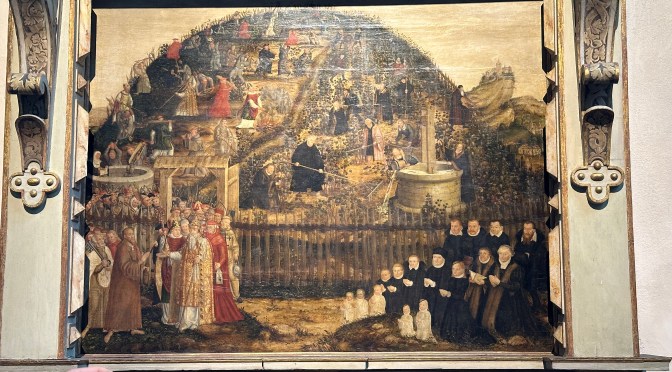
Photo: “The Vineyard of the Lord” from St. Mary’s Church in Wittenberg

The Apocalypse of John the Baptizer’s Community

You may have noticed that for a few weeks now, the titles of my weekly reflections have had mention of Apocalypse in them. You may be thinking that I am starting to sound like one of those Hellfire and Brimstone types. Maybe that is true. However, unlike in the movies, Apocalypse biblically carries a different definition than just the end of the world. Apocalypse comes from the Greek meaning ‘uncovering’ or ‘revealing.’ Apocalyptic literature speaks to the revealing of God’s plan or designs for the world or God’s intention to make right. This lands at the heart of created existence, where this ‘making right’ is contested or in a state of conflict. The Apocalypse or revealing is where God’s Kingdom coming to make the world righteous is in conflict with the powers of sin, death and the devil – forces that we experience in this world that are in opposition to God’s great love for us. 

Phew…

With that understanding of Apocalypse, we pick up with John the Baptist. Who is speaking to the crowds who have come out into the wilderness to hear him and be baptized for repentance and the forgiveness of sins. This follows with the long history of Israel seeking out prophets sent by God in times of crisis and seeking to repent of the ways in which God’s people have turned away from God. John is standing in a role they know and can identify from the Scriptures, and they are seeking to repent just as good people of faith should. 

Yet, they don’t quite get there. John isn’t just preaching repentance like the prophets of old. He is also preaching the coming of another, a Messiah. 

The crowd responds peculiarly. They ask John, “What then should we do?”

They ask this three times: “What should we do?”

In a time of crisis, when the world feels like everything is falling down around them, when the powers are threatening to crush them, when the future feels terribly uncertain, they want to know what they can do. Each of John’s answers is unsatisfying. 

Sounds familiar doesn’t it?

In a time of great uncovering and revealing the deep and uncomfortable truths at the heart of our existence, the apocalyptic conflict between God’s making right and the powers of sin, death and the devil that we can feel palpable in our world… the answers to our wonderings of, “what should we do?” have proven equally unsatisfying.

Maybe that is the point. It seems to be John’s point. Maybe what we need to do isn’t the chief issue. In this moment of Apocalypse, what we do just might be secondary to our salvation. The uncovering of what is really happening to us as God’s people is still in process, still being made known to us. But as we turn to the second half of Advent, I am sure it has something to do with the One we are waiting for, the One who is coming. 

The Messiah is on the way. 

Apocalypse is waiting

This week, we have stepped fully into Advent, the season that begins each liturgical year with waiting and watching for Messiah. Advent is the favourite season of most pastors and deacons, and I know more than a few lay folks who love Advent as well. There is something about those shades of blue that captures the essence of the night sky in this season of darkness. The Advent hymns of hope and longing speak deeply to the reality of our world. Advent doesn’t rush us to the good part of the story… rather, it takes its time unfolding. We are just starting this season now in the Church, whereas many in the world have been celebrating Christmas since November 1st. 

I think this love and connection to Advent is precisely because of the contrast it offers to the expectations of Christmas that begin ramping up in November with Christmas parties, concerts, baking, decorating, Hallmark movies and holiday muzak playing on radios everywhere. Our calendars fill up; we have to summon the energy to be social, to be good guests and hosts, and to be present physically, mentally, and emotionally at events with family, friends, acquaintances and strangers. It can be delightful, difficult, busy, tiring, fun or all of those things at once.

Conversely, Advent is about preparation and anticipation. Not in the frantic getting-the-house-ready-for-company kind of way, but in the quiet-stillness-of- your-own-thoughts-and-a-hot-cup-of-coffee-at-dawn kind of way. Advent calls us to slow down, to be present in our own minds and thoughts, in our bodies and hearts. Advent calls us to watch and listen for God, to prepare our hearts for Messiah, to attend to pregnant possibilities of divine activity in our world. 

In the four weeks of Advent, we journey from big to small. In the first week, we begin in the cosmic and apocalyptic realm, where Jesus calls us to pay attention. God is at work bringing the Kingdom of God to confront the kingdoms of sin, death and the devil. 

In the second week, we hear John the Baptist preach about the Kingdom of Israel, of empires and rulers, of politics and nations. 

In the third week, we keep shrinking down: John addresses the crowds before him on the River Jordan. 

Finally, in the fourth week, we witness an intimate conversation between Elizabeth and her cousin Mary, two women pregnant with miraculous babies. 

In Advent, divine activity is revealed in all the levels of our existence, from the cosmic, to the political, to the communal, down to the intimate. And yet, divine activity begins in this final and special place—in the wombs of our mothers. In this most intimate and closest of relationships we can have as human beings, God enters into creation in order to meet us in Christ. From this smallest and closest of beginnings, Christ proceeds to encounter the fullness of creation, joining God once again in divine fullness to every part of our existence. From incarnation and birth to crucifixion and death, Christ becomes one with us. And then, in the Resurrection, Christ’s apocalyptic renewal and reordering of our world in a new creation, we become one in Christ.