Tag Archives: Pastor Thoughts

A Service of Leave-Taking

This was a post shared with my congregation the day before our Leave-Taking service on June 22.
A service of Leave-Taking is a hard thing to define. The name tries to make it obvious – someone or something is taking leave. But who is leaving, and what is staying behind? It is not entirely clear.

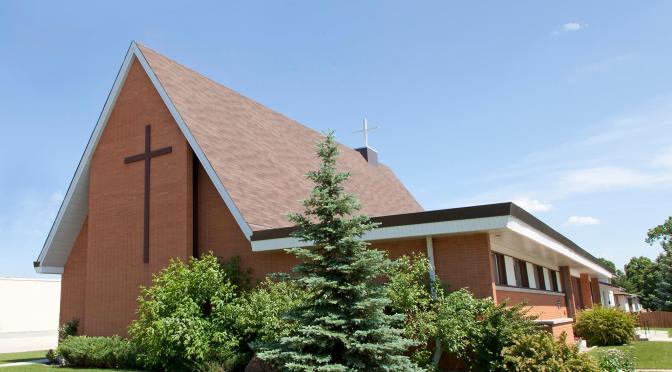
The thing that we are doing is taking leave of our building at 7 Tudor Crescent. We – the congregation and community of Sherwood Park Lutheran Church – are leaving the building that has served our community for over 60 years. 

Having moved from our first family home less than 3 years ago, there are some similarities. Once the decision to move is made, there is a flurry of activity. Sorting, packing, recycling and trashing. It is work that is daunting; it feels like climbing a mountain with no sight of the peak. It is exciting; there is the anticipation of the next thing. 

Yet, there also comes a point when all the memories and experiences that live in the walls and floorboards of a place come flooding into memory. Things that have been packed away since move-in are rediscovered. There is the realization that you cannot bring the wall that tracked the height of growing children with you. There are countless moments of celebration and joy, of hardship and sorrow that were experienced in a place that will be, in part, left behind. 

I think all of that is true about our leaving 7 Tudor Crescent. As I said last week, the walls and floors bear the pathways of community. We are leaving the bricks and mortar that housed a community of faith for generations, that bore witness to the entirety of lives lived together from birth to death and all things in between. 

The places we call home become more than their constituent parts; they bear a history. They are memory keepers for the lives of those that pass through, standing vigil for the flurry of life’s whirlwind of activity that abides in them. 

Now, the thing about service of leave taking tomorrow is that it isn’t just about leaving this building full of memories behind. There is also the acknowledgment that the community we are in this moment will transition to something else. Now, of course, that is true at all times. If we could take year-by-year snapshots of a congregation, we would see that we are always changing and never the same community for long. 

But we also know that this is a big change. That the community as we are comprised on the 22nd will not be the community that constitutes in an identifiable fashion on June 29. The reliability of being a consistent worshipping body is going to change much more starkly than the gradual year-by-year change we have usually experienced. 

We are going to be something new and right away. This is not an easy thing to endure, and I think we have been anticipating this abrupt change for a while, building up the energy to meet this moment. 

If there is something to cling to this week, it is that in all the history of a community, they are giving thanks for tomorrow, we go forward into the future with the Lord of Life, who has seen us through all along the way. 

In our Word of Faith shared among us, in the Gospel Promise given to us in the waters of the font, in the Gospel food shared at the altar rail, God in Christ has been with us. God has been shaping and forming us, calling us into New Life. 

And that same God who has been with us all along the way, from before even the first shovel went into the soil at 7 Tudor, making us into new creations as we lived our lives together in faith… this same God goes with us and will continue to call us into a Gospel future. Even though we are taking leave of this place, knowing that our community will not be the same, God is not taking leave of us, nor we of God. Instead, wherever we go, God will continue to bring us into the life of the Trinity, continue to make God’s promises heard in the Word, continue to wash us in the waters of life, and continue to feed us into the Body of Christ. 

So we prepare to take our leave soon, and it will be hard to leave behind the building at 7 Tudor, but we do not go alone. Instead, we go following the call of the Holy Spirit, the God who is always promising to make us new again.

Easter is not an answer but a promise

We are coming to the final days of Easter: nearly seven weeks of celebrating the Resurrection. We began with the disciples experiencing the death and resurrection of Christ—this apocalyptic moment, this instance of God breaking into our history⎯the moment that changed our trajectory. We lingered with the disciples as they met the Risen Christ in the upper room, on the road to Damascus, on the beach eating fish. Then we turned with the disciples to make sense of it all. What has this moment changed in us? What has it changed in the world?

On this final Sunday of Easter, if this were the kind of narrative we like to read or watch in novels or on TV, we would come to some kind of resolution. An answer would be provided, and the journey of transformation would have a beginning, a middle and an end. 

Except in reality, on this 7th Sunday in Easter, we don’t get that. Rather, we eavesdrop in on a prayer. A prayer from Jesus to God the Father. A prayer that entrusts us into God’s care. A prayer asking that we would be remembered and blessed by the Father. A prayer that we listen in on, and yet one that is precisely for our ears to hear. 

There is no tidy ending to this process of transformation. The Cross and Resurrection event break into the world, but they don’t break out. The Cross and the Resurrection enter into our world and remain, changing all things from the Easter moment onward. But they do not give us answers. We don’t get to neatly figure out what Jesus has done to us, how Jesus has changed us. 

Rather, we get to live with unanswered questions. What do we do with this death and resurrection business? How are we going to live lives of faith? That is still being determined; that is still playing out. 

These are questions of the early Church and questions for Sherwood Park Lutheran Church. Where we go from here? is not an easily answered question. Our journey is not the plot of a TV series. It is still going to take some time to find the fulfillment of our calling to serve the world with the Gospel.  Living a life of faith isn’t a set of steps to follow, but it is a way of life spent following the Holy Spirit’s call and serving our neighbours. It is hearing the Gospel of God’s mercy and forgiveness for sinners.

Answers are not what we need on the last Sunday of Easter. What we need is a reminder that God will not forget or abandon us in this life of faith, a testament that Jesus still has disciples and followers top of mind, even in an Easter world. That is the Easter message that God gives us, just when we need it most.

Letting go of ourselves – so that Easter can hold us

In the second half of the season of Easter, we have been hearing Gospel readings and readings from the book of Acts about the early church sorting out who they were and what this new community of Jesus’ followers was supposed to be about in the world. 

It can be a strange narrative to track. Benefiting from the perspective of two thousand years of church history, we come at the story backwards. As scenes and images of Pope Leo XIV have been flooding the news the past few weeks, could Peter have imagined a Church spread around the world, hundreds of denominations and billions of members? Or of bishops, cardinals and global Church leaders, prime ministers, queens and heads of state attending the first worship service of the church leader who is often claimed to be Peter’s successor? Surely the small band of Jesus’ followers could not have imagined that. 

As we enter into a phase of transition as the congregation of Sherwood Park Lutheran Church, I can feel my perspective changing. We have been on a journey of community transformation similar to the disciples these past few years. I don’t feel like I am looking at the story of this Easter community from the other side nearly as much. Sorting out what God has been calling us to and planning for us has been confusing, challenging, difficult and uncertain. Along the way, there have been missteps and false starts. Things that we hoped would work didn’t always turn out or come through. There have also been beautiful moments of clear-eyed faithfulness. I have felt the presence of the Holy Spirit in our muddled discernment numerous times. 

As we consider what it means to join with a new community or communities, it is difficult to let go of the hopes and dreams that we have carried. Yet, as we go to find new communities welcoming us, we discover that they indeed bear many of the important things that we value. [As an Oilers fan this week (hear me out now), I cannot help but feel there is some similarity. Jets and Leafs fans, there is room on the Oilers bandwagon! No, it isn’t quite the same, but there is something in common with being a hockey fan AND a Canadian. Sharing that core commonality is at the essence of being a fan.] 

But therein lies the challenge, and this is where I can see why it was so hard for the disciples to become that new Easter community. As we attend to the end of what we were at 7 Tudor Crescent as Sherwood Park, there are a lot of bits and pieces to manage. There are countless details to tend to, and each of those details bears a memory. Each of those details is a small piece of grief to bear. 

It is really hard to deal with all that grief and the prospect of beginning over in a new community, where the countless details are unfamiliar, where there just isn’t the same attachment and memories, where being a part of a community doesn’t come with a wealth of memories and experiences. It can feel discombobulating on Sunday morning to drive to a place that doesn’t feel like your car knows its way on its own, or which pew is yours, or the bulletin is unfamiliar, and you aren’t quite sure where the bathrooms are yet. 

I am sure that feeling is why Peter and several other disciples tried to go back to fishing. They were desperate for something familiar, even as everything they knew was being changed and transformed in the days and weeks after the Resurrection. 

But it isn’t about replacing one Sunday morning drive with a different one, or finding a new pew, or getting used to a new bulletin or finally locating the bathrooms. The process of transition and change requires us to strip all the old experiences and memories back, and hold off on grabbing onto the new ones. In the in-between moment, God calls us to step back and remember who we are and whose we are. God calls us to remember what the purpose of being a part of a community of faith⎯a local congregation⎯is in the first place. 

It is the same thing that the disciples had to figure out in order to have become that Easter community that was transformed into the Church. We are God’s people, we are a baptized and called community entrusted with proclaiming the Gospel. And that Word proclaiming, in the baptismal waters that forgives sin and raises us to new life, and in the bread and wine that turns us into the Body of Christ given to the world, in all those things the Kingdom of God meets us and meets the world. 

These are the things that all congregations hold in common with each other. The details that make each unique are dressings on these core truths. Our identity and the purpose to which God calls us is that we gather together with baptized siblings in Christ to hear the Word and receive the Sacraments. These core truths are the same from community to community, from place to place. 

As the disciples discovered after Easter, with all the chaos of moving from one reality to another, it is very hard to hold on to those core truths of identity and purpose… but we are not left to do it alone. That early church community was promised and given the Holy Spirit to guide their way, to be their connection in faith to the Christ who first called them, and brought them through from Good Friday to Easter. 

The inner call and outer call

The season of Easter was understood by the Early Church as one long day of celebration. Seven weeks of focusing on the good news of resurrection. 

The Gospel readings appointed for the season of Easter often tell the stories of resurrection appearances for the first three weeks. But in the second half of the season, the readings and focus of Easter turn toward what this new community of followers of Jesus will need to become. 

In this fifth week of Easter, we hear a Gospel lesson where Jesus encourages his disciples to love one another. In fact, Jesus commands it in a reading that should be familiar from Maundy Thursday. 

The commandment has one meaning given to the disciples about to witness the events of Good Friday.  It has another meaning given to the disciples and followers of Jesus, sorting out how to be this new community called the Body of Christ. 

To a post-resurrection community, the New Commandment from Jesus becomes an important lens to understanding our baptismal calling⎯our vocation as Christians. 

It is often the case that when we, as 21st-Century people of faith, talk about “call” or “vocation”, we conjure up modern imagery of following our passion or inner call. We imagine that inner drive or intrinsic passion to live out our dreams, to find that place where our personal passions can be pursued in the world. 

You might be surprised to discover that Martin Luther was highly suspicious of the notion of inner call. The idea of inner call was one that had been around since the Fourth Century and was very popular among monks. However, Luther felt that monasticism was trying to pull itself and the practice of faith away from the world. In Luther’s mind, the Gospel was for the sake of community, the Gospel reconciled us with God in order that we could love our neighbour. 

Thus, our baptismal call or vocation does not come from within us, but rather from our neighbour. Through our neighbours, the Holy Spirit calls us to service for the sake of our neighbours’ needs. The teacher is called to teach because the neighbour needs to learn. The farmer is called to grow food so the neighbour can eat. The carpenter is called to build so that the neighbour has shelter, etc. We are called to work to meet the needs of our neighbours, and this is the basis for our vocation or call. 

As the post-resurrection Easter community tries to determine what comes next, we hear the New Commandment from Jesus to love one another. Our calling, our vocation, comes from this commandment. Loving our neighbour, meeting our neighbours’ needs, becomes the place where our faith meets the world, where the Gospel’s community-building activity is lived out. The Holy Spirit calls us to take the Gospel into the world by loving our neighbour as Christ has first loved us. 

The Happy Exchange

Doubtless, you will have heard me talk about Martin Luther’s concept of the Happy or Joyful Exchange at one time or another in the past few months. 

The Happy Exchange is the metaphor that Luther uses to describe how our sins are forgiven. In the exchange, we give to Jesus our sins. But what does that mean? Do we heap them on him like some kind of scapegoat who is then sent away? Do we mark him with them like bruises and wounds like the famous camp skit ‘The Ragman’?

Not exactly. In giving our sins to Christ, it is that he takes responsibility for what was our responsibility. Jesus takes our sins from us by claiming them as his own. In return, Jesus gives us his righteousness, blessing and life. 

You might call it an exchange of goods for bads. 

For the past few years, we have been using a Good Friday tradition of tying black strips of cloth to our rough-hewn cross on Good Friday. I will admit, the first year we did it, it felt a bit hokey. However, as we have come back to this tradition, it has taken on a more profound and deeper meaning. This year, while I watched as worshippers tied their black strips of cloth to the cross, I couldn’t help but think of the Happy Exchange. 

Here, we were putting our sins, suffering and death onto the cross⎯onto Christ. It didn’t matter if they were big or small, known or unknown. The moment that truly caught me, though, was the letting go. I noted that more than a few folks held onto their strips for a moment, and even more lingered after tying their cloth strip to the cross. It was an emotional act to make tangible our connection to Christ on the cross. 

Here is the thing about the Happy Exchange: it is not an easy trade. Giving up our sins is not easy. Our sins are not just rule infractions on a report card. Our sins make up a significant part of who we are; our failures, our hurts, and our sufferings, all contribute to shaping us as people. It is not easy to just hand big parts of ourselves over to God. 

There is a reason we confess our sins each week in worship. We need to practice the act of handing over our sins to Christ. Because once we do manage to let go, our sins are gone from us forever⎯we can no longer hold onto them!

On Easter Sunday morning, the image that we began on Good Friday was completed. The strips of black cloth were gone from the cross. In their place, were beautiful and colourful flowers⎯signifying the righteousness, the blessing and the life of Christ. 

It struck me this year more than it has before that, together in worship, we rehearsed and lived out the Happy or Joyful Exchange this Holy Week. A beautiful image of how our sins are forgiven and our lives are transformed by the Good News of Christ’s death and resurrection. 

Alleluia! Christ is Risen!