Tag Archives: minsitry

Reformation Four Nine-Nine

John 8:31–36

Then Jesus said to the Jews who had believed in him, “If you continue in my word, you are truly my disciples; 32and you will know the truth, and the truth will make you free.” 33They answered him, “We are descendants of Abraham and have never been slaves to anyone. What do you mean by saying, ‘You will be made free’?”

34Jesus answered them, “Very truly, I tell you, everyone who commits sin is a slave to sin. 35The slave does not have a permanent place in the household; the son has a place there forever. 36So if the Son makes you free, you will be free indeed.

Sermon

So confirmands, today you are lucky enough to share this day with the 499th anniversary of the reformation. Now don’t worry if you aren’t entirely sure what “The Reformation” is all about, your parents and families probably aren’t entirely sure either. But today, as you affirm your faith in front the congregation you are standing on the shoulders of a community of people that have gone before you for almost 500 years – The Lutheran community (and Anglican one for some). And Lutherans and Anglicans are just one part of a larger Christian family that has been around for 200 years.

Now the words and promises that you will hear today have already been spoken and made to you in your baptism. But you probably don’t remember your baptism, so we remind you of those promises again today, when you are at an age when you will remember. So you can hear and remember the promises that God has made just to you.

And those promises are the same ones that the reformation was all about.

Reform. Change. Reformation. Change for the better.

Our world talks about change and reform a lot. Political reform, economic reform, environmental reform, social reform – you name it, we are talking about changing it. When we listen to the message around us and to what we as individuals want, change and reform are common themes.

The call for reform and change is not just for change’s sake. The desire for reform comes from a deep need within ourselves. A need to make things better, to make things right. We desire a better life, better circumstances. And at the same time the scariest thing about reform and change, is the fear of loss.

As Lutherans we stand on change, we try to embrace ongoing reform. There are 87 million of us in the world, nearly 3 times the population of Canada. And today, the Lutherans around the world remember that big Reformation from where we began and started.

Four hundred and ninety-nine years ago on October 31st, 1517. A young monk, priest and university lecturer, published 95 theses about change, about religious reform. Martin Luther hoped that his ideas could be discussed by friends and colleagues in a civil manner. Instead, Luther’s writing expressed the growing dissent among the people and pushed into the light issues that had been simmering for decades, which hit Christianity in Europe like a hurricane.

For you see, Luther hit a chord. He connected to that deep desire for change. He identified the issues of oppression in the church and of abuse by the clergy. People were tired of being exploited by the church who made them fear death, hell and purgatory nor did they not want to be continually controlled by the nobility who made them fear soldiers and prisons. As Luther identified these issues, he diagnosed the illness that existed in medieval church.

Figuring out he problem is the easy part though. We are good at diagnosing our problems and knowing that we need and want something different. Luther looked around and saw the suffering of the people and he saw the need for reform.

When we look around at ourselves, we see problems too. We long for change. Here we see a shrinking church membership and at the same time an aging membership. We have heard about financial short comings. And many of us are tired as we give more of ourselves to the church, of our time our money, and of our energy.

And so while Identifying the problem is the easy part, actual Reformation is hard.

When the followers of the Jesus are faced with the prospect of freedom, they balk at the idea. They know their problems too. They struggle under the government of the Romans. And they struggle under the religious rule by the temple priests. But when change and freedom stares them in the face, they would rather stick to what they know. They would rather be oppressed by the Romans and the Jerusalem Temple.

When Luther began proposing reforms to the Church of his day, they were rejected. Even though the Vatican was in debt because of never ending wars and had been bankrupted by the enormous building project of St. Peter’s Basilica, they wanted to stay on the same path rather than actually change.

And the difficulties that christianity faces today in North America are so frightening to some, that congregations are deciding simply to slowly die. To make sure all the surviving members are cared for in the last years of their lives. It is easier and safer to stay the same, even when we can clearly see the problems around us.

And so here we stand. On this Reformation Sunday, on this Sunday of change, we know that we have a problem, we know that we need to reform too.

As Jesus talks to his followers today he reminds them of two simple realities. The truth will make you free. The Son will make you free.

It is the same truth that Luther discovered, the truth that prompted him to begin writing about change in the church.

And it is the same truth that will carry our congregation and our larger Christian family through our problems.

Jesus will set us free.

The reality of our need for change, our desire for reform, is that we cannot do it on our own and and we cannot get it right. As St. Paul writes in Romans, “For all have sinned and fall short of the glory of God”.  We know that things could be different, we know that life could be better, but we also know that no matter how hard we try, we cannot keep from hurting others or being hurt, or from causing others to suffer or suffering ourselves, from causing grief or being grieved, or from killing or dying.

And while most people would give up in the face of this news. Luther heard something different. Luther heard the promise that Jesus makes:

So if the Son makes you free, you will be free indeed

We are all sinners, and we all fall short. Yet, God’s promise is in Christ. As Jesus comes  into our world, as Jesus joins us in falling short and being unable to make things better, Jesus offers freedom.

The Reformation started with this idea, that we cannot really change things, but instead, God is doing the changing. Even though we sin, and fall short, even though we cannot change our world to be the place we know it could be, God is there loving and caring for us. Christ is there, living with, dying and rising again with us.

And God’s grand plan for changing the world, began in the smallest way. A baby born in a stable. A baby like no other. A baby that was divine and human. But God wasn’t done there. God’s next reform was to the idea God loved some and not others, and that God’s love was for those who could earn it. As Jesus preached and taught, he told people, he tells us, that God’s love is for all people. And finally God’s biggest change was in the shape of the cross. On Good Friday, Jesus endured death, yet the surprise of Easter morning was God’s undoing of death’s power over life, God had made a new promise that new life will go on.

It is on these changes and reforms, these promises by God that the Reformation began. And it is on the shoulders of the Reformation that we stand. As Lutherans, we have been given a gift. A gift that came at great cost, a gift that came out of division, conflict and strife. A gift that reminds us that the most important thing the church can do is tell people of God’s love.

And by God’s love, we are set free. We are set free from sin and death. We are set free from our own failures and fears.

Reformation Sunday is about remembering what happened 499 years ago, about remembering and commemorating where we came from. But it also about the reformation that is happening now. The Reformation and transformation that God has been up to this whole time – God has been changing the world, changing us by setting us free.

Amen. 
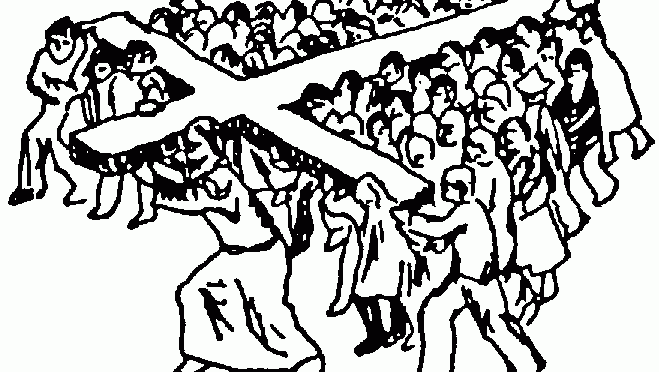
Church Membership vs. Carrying the Cross

Luke 14:25-33

“…So therefore, none of you can become my disciple if you do not give up all your possessions.” (Read the whole passage)

I remember when I was little and our family visited my grandparents. My grandparents living-room was always in perfect, pristine condition. Everything look new and unused, despite being dated with styles from decades before. Whenever we were in the living room, we had to be exceptionally careful not disrupt anything. No throw pillows could be moved, no dirt could be tracked, no signs of anyone actually being in the living room were allowed. Even as young child, I didn’t understand what the fuss was about – why was it called a living room, if there was no living allowed in it.

Now, as an adult, I understand only a slight bit more the desire to keep one’s possessions in good condition. And I also understand that nice things and children don’t really mix.

Yet, Jesus’s conditions on discipleship today, certainly poke at our materialism. We like our stuff, and Jesus knows it.

For a few weeks now, Jesus has been giving us the gears. Last week Jesus reminded us that we like to sit in the places of honour and send others down the table. Jesus continues the theme of pointing our faults, with his words on discipleship and possessions.

Today’s Gospel lesson has an unusual setting. Normally we pick up with Jesus in the gospels after he has traveled to a new place. But today, Jesus is still on the road. He is somewhere between destinations, with a crowd of people following him. You can almost picture it… Jesus and the disciples, on to their next village or town to preach in. And a large crowd following a short distance behind. From Jesus’s words to the crowds, we can guess that they were complaining. Kind of like the Israelites following Moses through the desert, the crowd is complaining about the journey. “Where are we going?” “When we will get there?” “What can we expect?” “What will we get out of it?” It sounds like the crowds are wondering whether following Jesus was a good idea, they are looking for something out of the deal. They want the benefits of being followers, but so far all they have found is a walk through the desert.

And so after hearing enough complaining, Jesus stops, turns and lays into the whiny followers behind him,

“Look, I didn’t say this would be easy. In fact, I told you that you would have to give up everything. Your homes, your families, your jobs, everything about your lives. If you are going to follow me, that means carrying MY cross.

You say you want to know what the plan is?!?! Yet, how many builders sit down and plan a whole project before beginning to build a tower? None.

You say you want assurances that we are going somewhere worth going to? Yet, how many Kings sit down with an enemy army across the field and say, “Well, looks like we won’t win. Let’s send out the white flag.” None.

If you want to be my followers, you are going to have to give up all the things tying you to your life before now.”

Jesus lays it out plainly for the crowds. They cannot hold on to their lives before and follow Jesus. Jesus knows that no builder can plan a whole project before its started. Think of all those contractors on HGTV who say things like, “Well, you don’t know how much the reno will cost before you open up the walls.” And yet the walls come down in search of show home living rooms and chef’s kitchens and dream master bedrooms. Jesus is calling out those who are grasping for the next new and shiny thing.

Think of all the wars being fought around the world for the sake of money and power. For the soldiers and civilians dying at the hands of kings and rulers who are trying to get or hold on to power. Jesus is calling out those who are clutching with all their might, and at any cost, on to power and control.

And now think of the church, and how we are like those crowds, looking for the things, the possessions that we can hold onto as well. Things like membership, with benefits like a reserved pew, or a key to the building, or eternal salvation.

But here is the thing about possessions. About the stuff we hold on to. The more we try to hold on, the more the stuff holds on to us. The more people want the next new and shiny thing, the more they become slaves to keeping up with the jones, to standing in line for that new iPhone coming out next week, or getting that new car, or having that kitchen renovated again. The more people try to hold on to power, to be in control, to call the shots,the more they must descend into darkness in order to keep power.

And here in the church, the more we see membership, faith and even God as something we have have, that we can own, that we can hold on to… the more it demands. The more weeks we have to keep making appearances to be in good standing. The more time we have to devote to keeping everything going, the traditions and duties and tasks. The more money we have to shovel into a hole that never seems to fill up. When membership and faith and God become possessions, they soon begin to own us, trapping us in a never ending cycle of keep it all afloat.

Jesus says, if you want to be a disciple, you need to give up your possession, give up all the things you are holding on to, because they will ultimately hold on to you and drag you under.

Jesus says, the thing you need to hold on to is the cross. Not your own cross, but his cross.

THE. CROSS.

And again, here is the thing about the cross.

We know that story. We know that Jesus carried the cross to Golgatha. We know that he hauled it up that mountain on Good Friday. But we also know that he stopped carrying the cross, because once he was on the mountain, the cross carried him. The cross held on to him. The cross trapped Jesus, just like all the things that we hold on to eventually do to us.

That is until Easter morning.

And all of sudden the cross that held Jesus on Good Friday, became the cross that holds all of us on Easter morning.

Jesus calls the crowds and calls us to carry the cross, because Jesus knows that we can’t carry the cross, because the cross carries us.

In world full of possessions that will hold on to us and drag us down – power, control, membership, status, new kitchens, pristine living rooms, things.

In our world full of all that, the cross is the only thing that lifts us up.

The cross is the place where the human need to hold on is met by God’s need to give up.

To give up wrath for love.

To give up judgement for mercy.

To give up sin for grace.

To give up death for life.

Jesus calls the crowds and us to give up our possessions, and not to literally empty our bank account and give away all our stuff. But to recognize that the things we hold on, keep us from seeing just what, or just who, is truly carrying us.

Our world will may never give up the quest for what is new and shiny. Our rulers may always be willing to sacrifice people for power.

Yet, God just may be calling the church to give up holding onto membership as something we own, to let faith be something that carries us. To see that the church is not a bottomless trap for energy, time and money.

But rather a community of the faithful.

A community of people who are being carried by Jesus, whose identities are being transformed by being together, who are called to work together to let the world know about this good news of giving up and letting go.

As Jesus calls out these crowds today, Jesus is reminding us of just who is doing carrying. Jesus is reminding us that the cross carries us. That Jesus’ love for the world, Jesus’ grace for sinners, Jesus triumph over death, all found on the cross, are what can truly carry us and lift us up.

Jesus tells the crowds and us today, that it is God, who was the first to give up everything. And that being a disciple, is not about what we carry, but about God who carries us.

Why nothing seems to get people back to church – The issue at the core of decline

“People just aren’t committed like they used to be”

This week, I came across this satirical article from the site BabylonBee “After 12 Years Of Quarterly Church Attendance, Parents Shocked By Daughter’s Lack Of Faith

The article humorously reveals an issue facing many churches today. I can’t tell you how many times (56,819 times) I have had the conversation where someone talks about the fact that young people aren’t as committed as they once were. People aren’t coming to church like they did in decades past, and those left behind have started to notice. Many congregations are feeling older, thinner, and tired out. The future feels bleak. The studies tell us that the church is declining.

And so churches try any number of things to attract people back to church. Youth group programs, revamped and modern music, renovated worship spaces, hip and cool pastors with tattoos and any number of other gimmicks.

But nothing seems to work. At least I haven’t heard of any churches successfully bringing back all the members who drifted away. And yet we keep at it, week after week, year after year worrying about people who were once here. Our grand plans for revitalization is to try and appeal to people who have already chosen to leave. Sure, it works once in a while, but this is probably not a strategy for success.

Yet, while churches fret and worry about those who were once there, we rarely take the time to understand what we are asking people to come back and commit to.

Commitment to church

A lot of sermons, bible studies, meetings, conferences, lectures, consultants, coaches and more have been spent analyzing and communicating the message that the social advantages of church that drove attendance in decades past no longer exist. It just isn’t the case anymore that good citizens born here are expected to become good church members. Schools, work, neighbours, businesses, governments don’t do –  society-at-large doesn’t do – our evangelism for us anymore.

Church isn’t an expected social commitment any longer.

Yet, almost always when we speak of getting people to start coming back to church, we say it just like that – ‘back to church.’ And the issue goes deeper to than that. So often when I ask church members what reason keeps them coming to church, there is almost always one things at to the top of the list: Church feels like family, church is a community.

Churches should be communities where we feel connected to each other in deep ways.  But family and community are still social commitments at the end of the day.

Social Commitment

Most churches are, at their core, institutions formed around a social or societal commitment. The core of churches have been based on the fact that people are expected to attend because of societal pressures. And when society taught us through family, friends, neighbours, schools, workplaces, TV, movies, newspapers, courthouses, and governments that being church attenders was important, churches organized around social commitment worked well.

These churches did good ministry, they reached people with the gospel and they were servant communities.

But now that society is no longer providing the pressure to be church attenders, attracting people to a social commitment doesn’t work.

In fact, it may be the very thing that is driving people away.

Our pitch for church has often become some version of “come to church because you should” or “come to church for your family” or “come to church for the community”

Yet, people are choosing sports or music or clubs or brunch with friends or sleeping in with family because they love those things. People are choosing things that they are passionate about, things that they love. Social pressure doesn’t hold much sway anymore, even if our society did push church on people.

When you love soccer, finding a team to play on is also finding a community with a shared passion. When you love brunch, finding a brunch club means joining a community that shares your love of brunch. When you love lazy Sunday mornings with family, you have a community that also loves sleeping in.

But what is our shared loved at church? Are we just communities to join without a shared passion?

Commitment to Jesus

If I had to guess, the vast majority of people who still might be looking for a church in 2016 are not looking for a social commitment to church.

As a millennial, I never lived in the era of social commitment or social pressure to go to church. While most of my peers growing up weren’t interested in church, nor exposed to it beyond Christmas and Easter, the ones who did express interest did not do it for the social commitment.

My church going peers were interested in following Jesus.

Now, imagine someone is looking for a church. They are looking for a church with a commitment to following Jesus at its core and they show up at a social commitment church. It would be like showing up for a soccer team that stopped playing soccer years ago, and who instead gathers for coffee and donuts with friends and family. But this gathering of people still call themselves a soccer team.

Now imagine members of that “soccer team” wringing their hands week after week over the fact that no one wants to join the team to clean up coffee and pick up the donuts. You can see why soccer players looking for a team wouldn’t join. You can see why many members of the team left a long time ago.

As churches try to understand why all the attempts to attract people back to church haven’t yield better results, I think it is because the core foundation that brings most church communities together is fundamentally at odds with what people who are looking for churches are seeking today.

If I had to guess, that if people are looking for church these days, they are doing it in the same way that someone would look for a soccer team. A soccer player looks for a team because they love soccer. A church seeker is looking for a church community because they love Jesus and want to follow him. They are not looking for a church because they love church.

And it goes deeper than that. If getting people to church is the chief concern, than we will always be looking to draw people in.

But if following Jesus, and letting people know about this gracious, merciful and compassionate God, is at our core, we will reach out. And reaching out to let people know about Jesus, may or may not include more bums in pews. Either way, building the church is not the goal, but at best is a symptom of reaching people with Jesus.

So how can churches address this? How can churches built on the social commitment to church have the conversation about the fact that the very thing that brings them together as a community is their biggest problem?

With a lot of soul-searching, a lot of questions, a lot of discerning and a lot of prayer. Changing our foundations and cores will not be easy. In fact, many churches will choose to die instead of changing to the core of following Jesus.

Despite the social commitment at the core of our churches, I think that many churches and church members do want to follow Jesus too. And it isn’t that a church has to choose between being a community or following Jesus. One doesn’t exclude the other.

But churches DO have to choose what is at their core. Churches need to choose the foundation that gathers their community.

Is it a social commitment to church?

Or are we followers of Jesus whose shared passion brings us together?


What is the core passion that brings your church together? How can churches change their core? Share in the comments, or on the Facebook Page: The Millennial Pastor or on Twitter: @ParkerErik

Why did Jesus have to die? – Why God didn’t kill Jesus on Good Friday

We are on the doorstep of Holy Week.

Clergy types will soon be setting out to write and preach sermons that somehow make sense of the passion story, from Triumphant Entry, to Last Supper, to Trial and Crucifixion and finally Resurrection.

Along the way, it will be important to say something about how the death of a wandering preacher, teacher and healer on a cross is the means of our salvation… and what exactly we are being saved from.

This is a tricky endeavour because the story of the passion doesn’t explain the reasons. Instead we are left to fill in the gaps, and Christians have been trying to make sense of Christ’s death since St. Paul was writing letters.

And so often on Good Friday, a strange and convoluted theory of the reasons for Christ’s death is presented… one that makes God seem merciless, if not plain incoherent.

Often, God is presented as the ultimate source of Christ’s condemnation, the one who kills Jesus on Good Friday.

And this is absurd.

It is my contention that Good Friday is the day of the most important facet of the Good News and it is not because God killed Jesus.

Satisfaction Atonement

One of the most common ways that Christians tend to explain the atonement is with Bishop Anselm’s satisfaction atonement theory. The cole’s notes version is that the punishment for human sin is our death. And the satisfaction, the making things right is Christ’s death (since he was without sin).

What is rarely stated is that Anselm used medieval legal practice to formulate his theory. In medieval law, a fine was the punishment for most crimes. Anselm saw then that death was the fine for sin. But that wasn’t the end of the matter. In order to compensate the victim, satisfaction was paid. An additional amount that would make things right.

Anselm figured that since death was the most human beings could pay, an additional payment to make satisfaction with God was needed. Christ’s death becomes the satisfaction for our sin.

Now, beyond the fact that his medieval legal system is flawed and very human like any other system, there are a number of problems with Anselm’s theory:

God requires blood in order to show mercy… which is not mercy.

God is bound by human laws… which means God isn’t free.

And finally God and Jesus split apart by the cross… which is trinitarian heresy.

Anselm’s atonement theory is certainly not the only one out there (Christus Victor/ Ransom theory, Moral influence theory, scapegoat theory etc…). But it shows a common problem that most explanations of what was going on on the cross seem to have – they undo the trinity.

The Cross and Trinity

For some reason preachers tend to get uncomfortable with God being too close to the cross of Good Friday. When I was a neophyte theology student, still two years from starting seminary I was asked to give a short reflection on Good Friday on one of the 7 last words of the cross. My words were “I thirst.” And I pontificated eloquently on how Jesus experienced the human condition fully on the cross. Sounds lovely. And I then expounded on how Jesus was fully separated from God, just like we were. Almost sounds legitimate… except for that whole trinity thing.

The doctrine of the trinity reminds us that the persons of the trinity are never separate because they are one God. They are distinct, but one. So the experiences of one are shared by all. The Father and the Son could not be separated, even on the cross.

And this the heart of the problem. We don’t like the idea of God suffering, the Father suffering. We would rather make God the killer than the sufferer.

But the Trinity necessitates that God the Father experienced the cross just as much the Son did. God was crucified and died on that cross.

So who killed God?

We did.

Humanity. Our religion. Our government. Our authorities. Our mobs.

Yes, I do think that God knew the cross was in store of Jesus even before that angel visited Mary to tell her she was pregnant.

But it was not because God was perversely and cruelly looking to punish someone for our sin. It is not because God needed blood to be merciful.

God knew the the cross was in store because God knew us. God knew that humanity couldn’t let God come close in the incarnation. God’s coming close threatened our godship. We cannot be god if God is God. We could not be god if Jesus is God.

And here is where the Good News of Good Friday meets us.

Even though God knew the consequence of incarnation – of coming close to creation, of coming in flesh – God followed through to the end. God was born, God lived, God died. God did all the human things. Good Friday was the completion. God declared that God is going to a part of all of created life. There is no part of human existence that would be apart from God.

So why did Jesus have to die? Because we said so.

And why do we get to live? Because God said so.

So this Holy Week, whether you are preaching or hearing the preaching, listen… listen for the good news of Good Friday.

Listen and know that it is not that God killed God’s son in order to show us mercy. The good news is never a demand for blood. That is sin.

The good news is that God chooses life. God chose to live. Chose to live all of created life, including death.

And because God lived it all, that whole resurrection thing that happens on Sunday becomes part of our story. Because God chose to live and die with us, we get to die and live with God.


What good news do you hear on Good Friday? Share in the comments, or on the Facebook Page: The Millennial Pastor or on Twitter: @ParkerErik

Anointing Jesus’ Feet – The Smell of Death

John 12:1-8

Six days before the Passover Jesus came to Bethany, the home of Lazarus, whom he had raised from the dead. There they gave a dinner for him. Martha served, and Lazarus was one of those at the table with him. Mary took a pound of costly perfume made of pure nard, anointed Jesus’ feet, and wiped them with her hair. (Read the whole passage)

Sermon

It must have been almost hard to breathe.

The smell of the perfume as it filled the room. It would have overwhelmed the noses of all present at the celebratory meal. We all know someone who wears too much perfume, whether its that strange aunt in the family, or lately it seems to be teenage boys wearing too much body spray cologne. Smells can overpower us like no other sense can. And certain scents can trigger memories like nothing else. They can remind us more powerfully than a picture of past events, places or persons. The smell of chlorine can take you right back to that first time swimming in an indoor pool. Or the smell of pine trees can take you back to beloved Christmas memories.

The smell today, the perfume that anoints Jesus’ feet cannot be taken lightly or be overlooked. A pound of perfume is not a delicate scent, and that seems to be Mary’s point. On this day, Jesus, his good friend Lazarus, and the disciples are being treated to a celebratory meal. Lazarus has been raised from the dead and this is the first time that Mary, Martha and Lazarus have seen Jesus since the miracle. Martha, as usual, is serving the dinner. She is giving thanks in her way. But Mary decides to give thanks in a different way. She wants to express her deep gratitude and her love for Jesus. Its the kind of emotional display that makes most of us uncomfortable, like two lovers passionately kissing in public. As Mary anoints Jesus feet, and then wipes them with her own hair, the rest of the guests at the party were probably feeling awkward. Washing feet was something that servants do. And using one’s hair as the cloth… well, that was just strange. Mary’s act is as extravagant and wild and passionate as it seems. Probably something that should have been saved for a private moment with Jesus.

In the midst of this beautiful moment, this act of love and gratitude that Mary is giving to Jesus, Judas pipes up. “Why wasn’t this perfume sold and the money given to the poor?”. The moment is ruined. Judas has re-interpreted this lovely scene to his own ends. Perhaps he was uncomfortable with the display of affection, or perhaps as John suggests, he has other intentions for the money. Whatever Judas’ reasons, he wants to disconnect from the intimate and personal moment. He tries to make it about the impersonal and distant and abstract idea of how money should be used. Judas tries to make the moment about practicality and he almost steals away Mary’s extravagant love, diminishing her by rebuking her feelings. Judas tries to dismiss Mary’s love and gratefulness with his distant and impersonal righteous indignation.

________________________________________________

We often attempt to distance ourselves from being too close or invested like Mary is today. Like Judas who seems to be using money or good intentions to create distance between himself and this powerful display of affection. Our fear of getting too close like Mary does, can prevent us from seeing and experiencing the love and beauty of the world.

And at the heart of our distancing, is our self-centred desire for control. We want to be control where we begin and end, to protect our feelings from risk and hurt. And we use whatever power we can. Money, judgement, shame. Mary’s act is not safe, its wild and untamed. Its extravagant and passionate. This is not the way we think the world should work. “Don’t waste the money” we declare because we are uncomfortable with risk. “Don’t be so emotional” we cry out because we know loving so deeply can lead us to getting hurt.

Our fear of being close, our need for control, can get in the way of seeing the beauty of faith. Our discomfort puts practicality or pragmatism before others, before people. Judas only sees dollars being poured on Jesus feet. We often get bogged down by the resources being expended on our family, on our neighbours, on the church, on ourselves. Judas doesn’t see that what Mary is doing for Jesus is worth more than any amount of money. Often we find it hard to see that the families, friends, neighbours and ministries that we give our time and passion to are worth more than any amount of money. It can be hard for us to see that risking being close can bring us the greatest reward, and staying distant will never bring real satisfaction or meaning.

____________________________________________

For five weeks we have been immersed in the season of Lent. Immersed in the sights, sounds, and smells. The feel and smell of Ashes marked our heads. We have kept from singing Alleluias, we have sung Lord have Mercy, Christ have Mercy, Lord have Mercy instead. And on this final Sunday before Palm Sunday, the smell of death enters into our sanctuary.

There is a pound of pure nard on Jesus feet. This perfume is one meant to keep the smell of death at bay. It is suppose to disguise the smell of a decaying body while it waits to be buried.

Yet, so often the thing meant to distance and disguise, to protect us from reality comes to symbolize the very thing it is trying to hide. The perfume becomes the smell of death.

Jesus does not miss the symbol. Mary has anointed his feet with the smell of Good Friday, the scent that is slowly building in our nostrils as we get closer to Holy Week.

Jesus does not see waste, Jesus doesn’t need to distance himself from Mary. Jesus sees love, lavish, wild and untamed love. Jesus sees the future. “Leave her alone” he says, ”She bought it so that she might keep it for the day of my burial”. Mary is not anointing a king, or prophet. Mary is anointing a friend, teacher and son, who will be soon prepared for burial on Friday evening, and Jesus is reminding his disciples and friends one more time of all of this. The ministry, the parables, the miracles, the teaching in synagogues, the traveling the countryside. None of it is about the bottom line, none of it has been about being practical with money, none of it was about God staying distant and safe from creation. This moment is a foretaste of God’s imminent future.

When the time comes for Jesus the corpse to be put in the ground, God will be accomplishing something new, something never seen. Something glimpsed as Lazarus stepped out of his tomb. God is accomplishing something new before the women even have the chance to anoint Jesus’s body on that Easter morning. God is about to turn the world upside, to bring new meaning to creation. Preparing for burial will no longer be preparing for death, but preparing for New Life.

Here in this perfume filled room, where passionate and impulsive Mary has shown her love and given thanks in her way, Jesus gives the whole world a new sign. God’s future is now about us. Jesus burial is about us. On Good Friday Jesus will be anointing the world with New Life. And God is doing it all by coming as close and near as God possibly can.

What a contrast to our attempt to remain distant and safe. We try to protect ourselves by staying far away, by being uncomfortable with love. God risks it all, even death, to come close, to take on and wear our flesh, so that we will know love.

Judas is uncomfortable with the perfume filled house, he wants to step back and distance himself. Make things about money, or poor people, or whatever else that is safe to feel. But Jesus stays present and near for Mary’s gesture of love, and then Jesus tells us that God is only coming closer. Coming in the familiar smells of Holy Week.

Like any powerful perfume, there is no distancing ourselves from God’s love after this. Today God’s Love comes near to us in perfume that anoints Jesus feet, it will come on palms branches next week, come in the bread and wine of Maundy Thursday. And it will comes so close on Good Friday, we will nail it to the cross to distance ourselves from it.

But after three days, God’s love will burst forth, uncontrolled, untamed, wild, passionate, extravagant. And it will be love that we can see, touch, taste and of course, love that we can smell.

Amen.