Tag Archives: ministry

Waiting for the Apocalyptic Kingdom

We have arrived at Christ the King Sunday. This is the end of the liturgical year, which means we have made our way through the stories of Jesus’ birth, journey to Jerusalem, death and resurrection as told by the season of Advent through Easter. We have also made it through Jesus’ teaching and ministry as told by the Gospel of Mark. 

Altogether, these two parts of the liturgical year serve to create a narrative that takes us through the story of Jesus each year. 

There is another piece to this journey, however. This liturgical move is more than one that moves us from one year to the next. The move we make in our calendars and in our Sunday worship shows us a glimpse of the much larger scale movement that is happening all around us. 

Christ the King Sunday, or perhaps more accurately, the Reign of Christ Sunday, lifts the Apocalyptic veil on our world. No, not an apocalypse like the movies imagine with zombies, nuclear war, environmental catastrophe, or exorcist priests fighting demons.

Rather, the Apocalypse as the Biblical Narrative imagines it, the one that we have had in the background in this year of reading Mark, and perhaps in the background of pandemics, wars in Ukraine and Gaza, the election of populist leaders that are tracking to fascism. Apocalypse hardly seems like the thing of movies and novels these days, it is out there in the world. 

The Apocalypse that the Bible imagines is one that is rooted in the conflict between the Kingdom of God and the Kingdom of Sin, Death and the Devil. On Christ the King Sunday we are equally concerned with the fact that the Kingdom of God has entered the battle plains of this world with the intention of striving against those forces that would defy the One who holds all creation and us within God as we are with Christ’s Kingship. 

This is the work of God’s Kingdom in the world, to push back against all those forces that cause suffering and death, the forces of systematic sin and evil that cause oppression and enslave us.

But God’s Kingdom’s work is not the one of military might or political and economic power.  Rather, it is accomplished on the cross, in the one who takes our sin and death to the grave while exchanging with us the gifts of forgiveness, righteousness and life. The Kingdom’s work is to meet the powers of this world with the reconciling mercy of God, with true Kingdom power that can transform this world for the better. 

On the Christ the King Sunday, we prepare for the Apocalypse of Biblical proportions to come – for it to flip us over into the Advent of God’s new world, where we will be new creations. 

All Saints and Communal Grief

All Saints Sunday is usually one of my favourite Sundays of the year. It comes near the end of the liturgical year, as we have been making our way through the teaching and parables part of the Gospels. There is often a feeling of being taken somewhere and getting to the destination after three to four months of dwelling in either Matthew, Mark or Luke’s Ordinary Time texts. All Saints Sunday arrives with a view of what is to come afterwards. It points us to Advent and it paints a picture of God’s promises coming true at the end of time–two versions of what is coming next for us. 

This year, however, All Saints is hitting me a little differently. I haven’t been looking forward to it or thinking about it in the same way. It might be that I have been thinking a lot more about the Reformation  and Martin Luther in my studies. (Those are certainly a big part of it). 

But there is another piece of All Saints Sunday that I have been both pushing out of my thoughts in some moments and desperately longing for in the next. One of the primary images of All Saints is of the great multitude of the faithful gathered before the throne of God. It is a Revelation image, one that we often allude to in our liturgical music, particularly the Hymn of Praise or the Gloria. We believe that when we sing these songs we are not just worshipping God here on earth. We are also joining in the continuous heavenly worship of the saints. We are literally singing with the great multitude of the faithful.

Much of the artwork and images of the great multitude depict it as a large and faceless gathering, where the size and cosmic nature of the scene is the point. And yet, the longer I have served in ministry and the older I get as a person, more and more that faceless crowd starts to add to it faces that I know. Faces that I have known and served and buried. This year, it  the multitude of Revelation, the great cloud of witnesses at All Saints, also includes my grandmother and my father. 

I have always imagined that All Saints Sunday had the capacity to raise feelings and experiences of grief… but this year I know that it does. I wrote in the summer that there is a profound loneliness that goes along with death–of being the one to walk the journey of dying or of going on it as far as you can when the dying person is someone close to you. Now, I don’t mean lonely in the sense of being sad, but more descriptive loneliness, like isolation. As the one who is dying, there is a journey taken that you know you will have to complete alone. As the loved one who is left behind, there comes a place where journeys diverge, almost like one experiences in airport security–a place where you can go no further. Only the one actually headed for the new destination can keep going through. 

Even though so many of us have taken that journey as far as we can with loved ones, each journey is unique. Each experience of loneliness and isolation is its own to contend with. Letting go is a place and process that we arrive at, each in our own way. I think that is why sudden and tragic deaths can be so painful. The journey and process of letting go happens in an instant with no time to prepare oneself; the letting go process becomes one of tearing away. 

Now, before I dwell on the grief experience too long, there is this thing that All Saints does. It reminds us of that dying journey and of the grief. That is the part I have been pushing out of my mind as I think about Luther (even if he had a way to address death with the hope of the Gospel). 

But there is this other thing that All Saints does. It gathers together all these lonely and isolating journeys of death and grief and stitches them together. It takes individual experiences and turns them into a communal one. We bring our individual grief to All Saints, where we sing, we pray, we light candles, and we commune as one body, one multitude of the saints. We rehearse the hymns that we will sing before the throne of God. And somehow this restores us to Community and begins to undo the isolating power of death. 

This restoration is the side of All Saints that I am longing for and needing this year, as I am sure many of us are. Through restoring our Community, God brings us back into the Body of Christ, the great multitude of the faithful. All those faces that we know there welcome us home, with open arms. 

Discipleship as Power?

We are in the final weeks of hearing from Mark’s Gospel. Way back in Advent through Easter, we heard all the dramatic stories of Jesus’ life and ministry. Since June, we have been wrestling with the middle chapters of the gospel book, working out with the disciples what Discipleship means. What it means to follow Jesus as he goes about bringing the Kingdom of God near. It sounds relatively simple if we don’t think about it much and stick to a Sunday-school-surface reading. 

Of course, Mark, Jesus and the Disciples don’t give us much of a chance to make that choice. This week, James and John ask Jesus to sit at his right and at his left. (It almost sounds like my children, who are often very keen to manage whom they sit next to at mealtime.) Yet, this is not just about children trying to get seated next to the teacher, or popular kid, or favourite grandparents at dinnertime. 

James and John are opening up a complicated and layered issue that Christians continue to deal with today. What does it mean to be associated with Jesus and what do we get out of it? We don’t have to look much further than the various elections going on around us to see the ways in which politicians use proximity or distance from Jesus, Christianity, the Church and Faith to gain votes and power. We also don’t have to think very far back to the ways that the Church has used Jesus as a means to wield power over other Christians, over our neighbours, and over Creation. 

On Sunday morning, we will discover that James and John don’t really understand what they are asking. They don’t yet see that Discipleship, as Power, is not what Jesus is offering. Discipleship as Service or Sacrifice might be more like it. Jesus also has some harsh words about the problems of trying to gain individual power on offer. 

Before we get to unpack what reversal and work of transformation Jesus is up to with us, we might have to sit and stew over these hard questions. What does it mean to belong to a religion that has had such a complicated relationship with power? How do we each fit within the relationship and experience of power?

By now you might be able to guess that some of these questions are part of what I am currently working on in my doctoral courses. As we try to understand just where we sit as people of faith in 2024, there is work to be done to understand how Christianity arrived here. 

However, I won’t dig too deep into issues of power, colonialism, white-euro-centric Christian supremacy and more right now. 

Instead, as we go back to Jesus and the disciples in the Gospel of Mark, we are reminded that even in the mess of power that they and we find ourselves in, Jesus has come to flip and overturn the established orders. Christ’s power is to serve, sacrifice and give. Christ gives Godself fully and completely to power-seeking people like James, John and the rest of us. And in that giving of Godself, somehow Jesus shows us the way to new life. 

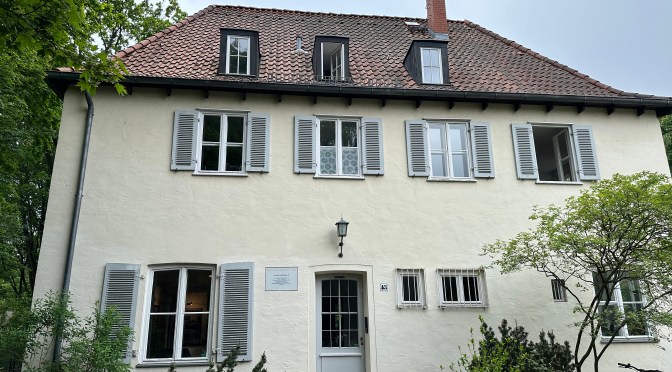
Photo: Dietrich Bonhoeffer’s House… and we know his ideas on the cost of discipleship.

Giving thanks over the years – Pastor Thoughts

I don’t think I could have ever imagined feeling this way, but I could have used a little more September this year. Between the program year ramping up, my foolishness in agreeing to a few too many things, the kid’s school year and activities starting and my coursework ramping up, it has felt like a busy few weeks. Thanksgiving should not be here this soon; I thought there was more time! 

When I was a kid, Thanksgiving felt like it was deep into the school year. Summer was already a distant memory, while Halloween was still three weeks away! Now, all that feels like it passes in the blink of an eye. 

Thanksgiving, like all holidays or holy days, comes at us differently at different times in our lives. When I was young, Thanksgiving weekend often felt like a great long break to eat lots of turkey and have an extra glorious day off from school before the snow arrived. For those with grandkids and large extended families, these important holiday events feel like touchstones yet provide fleeting opportunities to spend time with loved ones, chances to make memories, and opportunities to invest in what matters. For those of us in middle age, millennials are now middle-aged! – these holidays feel frantic managing kids, work schedules, social calendars, volunteer responsibilities and extended family obligations. Of course, there are those for whom Thanksgiving may be lonely or difficult and might be grief-filled with a notable spot at the table now empty. 

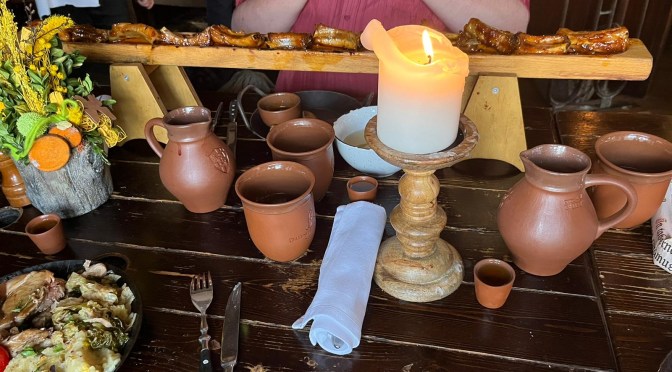
Ever since seminary, when in the course of learning theology, biblical studies, biblical Greek, and liturgy, we were taught that the word Eucharist means ‘thanksgiving,’ my brain always conflates the Great Thanksgiving that is a part of each worship service with communion and the holiday of Thanksgiving. I have started to see Thanksgiving weekend in Eucharistic terms – imagining this weekend around the second Monday in October as a time when Canadians practice Eucharist in our homes with family, friends and community. Thanksgiving tables aren’t necessarily the same as the Lord’s table that we gather around in worship. They are not public tables of welcome where we encounter the true presence of Christ as the Lord’s table is. But they are gatherings with a Eucharistic quality where often a motley collection of people gather together to share a meal and wind up somehow bound together into a new community in the process. The yearly gatherings are small reminders of the kind of community that we joined each Sunday around the Lord’s supper. 

So pay attention to who you eat with this weekend, know that you are joined to a new community of Eucharist and Thanksgiving. 

Canadian Lutherans and Colonialism – Pastor Thoughts

Monday, September 30th was the National Day for Truth and Reconciliation, where we remember those Indigenous children and families who were victims of and affected by Canada’s Indian Residential School system. This year, there were orange shirts around that weekend, as September 30th is also called “Orange Shirt Day.” 

As Lutherans, we are a church body whose origins are European; we carry with us a connection to the history of colonialism. Yet, as ELCIC Lutherans in Canada, we also carry with us a history distinct from that of other White-European churches, such as the Anglican, Roman Catholics and United Churches. While Lutherans have had a presence in parts of North America since the 16th Century, they were mostly in the US’s original thirteen colonies. Martin Luther came onto the scene decades after Columbus sailed the ocean blue, meaning there weren’t enough Lutherans to start spreading around until the 1600s. 

In the case of most churches and congregations that belong to the ELCIC, our oldest congregations are relatively young, started by our grandparents or great-grandparents in the last one hundred to one hundred fifty years. In the case of Canada’s residential school period, most Lutherans were considered immigrants and outsiders by the church bodies (Anglican, Roman Catholic, United) that were running the schools. 

So what is our connection to colonialism? We were not necessarily part of the institutions that were the core of the colonial project in Canada (the British and French empires), but we are part of the White European ethos by proxy. In the height of the colonial era (the late 1700s through 1800s), Europeans were colonizing all over the world, bringing their ways of life, culture and beliefs to nearly every corner of the globe. Europeans engaged in colonialism in Africa, the Middle East, Asia, North and South America during this time. This was the time when that saying, “the sun never sets on the British Empire” came into being.

At the core, colonialism was based on the idea that White European ways of life, culture and spirituality were the right and best ways for humans to live. This idea continues to propagate itself even as we now try to reconcile our colonial history. 

Colonialism is why Canada had “Indian Residential Schools” to ostensibly “remove the savage from the child.” It is why we forced our religious practices and culture on indigenous peoples and often declared that other ways of living, other cultures, and other ways of believing in God were inferior and wrong. 

As Lutherans in Canada, we have kind of sneaked into the back door of colonialism, going from being seen as immigrants considered outsiders for a lot of the last century and a half to trying to lump ourselves in with other White European descent church bodies at precisely at the wrong time. We didn’t have an institutional stake in colonialism, yet we are somewhat a part of the group that colonialism declared to be the right way – as long as we seemed, in Canada’s case, European, White and Christian enough. 

In this week’s gospel, the disciples are worried about others who are healing in Jesus’ name. They are worried that these “others” are not doing things the right way. Jesus reminds them that the work of the Kingdom of God happens in so many more ways than they can imagine. 

Unfortunately, that message didn’t get through to colonial empires. But, as we seek to dismantle and reconcile the structures and worldviews of colonialism that still exist in our world today, we can remember this message: God might be at work in places and ways we have not conceived of yet. We are called as people of faith to the important work of truth and reconciliation, even from our unusual position as Lutherans in Canada.