Tag Archives: ministry

Setting aside our mustard seed dreams for a mustard bush Kingdom

Matthew 13:31-33,44-52
Jesus put before the crowds another parable: “The kingdom of heaven is like a mustard seed that someone took and sowed in his field; it is the smallest of all the seeds, but when it has grown it is the greatest of shrubs and becomes a tree, so that the birds of the air come and make nests in its branches.” (read the whole passage)

To consider the immensity God’s kingdom usually defies our imaginations. For those sorts of people who ponder the mysteries of life, thinking about the Kingdom of God, about heaven, is as attractive as it is frustrating. There are so many possibilities, yet few particulars. Dreaming big comes pretty easy for most of us. We are taught to dream about the future at an early age. “What do you want to be when you grow up? A Hockey Player, an astronaut, a rock star, prime minister or maybe all of the above! But the motivation to dream big doesn’t end in childhood, but rather it is ramped up and stakes are higher as we grow older. Imagine life with that new car, with that new house, with no debt, with a wealthy retirement, with that new and better paying job.

We like our big stuff in this part of the world. And to dream big about the Kingdom of God, about Heaven is fair game. To imagine a lavish wedding banquet, or a cloudy paradise where friends and family greet you, or perhaps dozens of golf courses all empty and waiting to be played on nice sunny days.

There is no shame in dreaming big, and yet there is the inevitable downer of not having these dreams realized, of our hopes and dreams always and only being only hopes and dreams. All too often, our expectation, our anticipation is of something big and exciting happening in our lives. We spend a lot of time waiting for the next mountaintop experience by simply glossing over the rest. Weekdays are for getting us to weekends, school is for getting us jobs, jobs are for making money to spend on weekends and to save for retirement… retirement is about waiting to die? I hope not.

Jesus presents us with a scandal today, but we may have glossed it over waiting to get to the good part. For Jesus, the Kingdom of heaven is like a mustard seed, like a treasure small enough to bury in a field, like pearl only worth a lowly merchants wages, like a net that catches fish. For Jesus, the Kingdom of heaven seems to be nothing like we have imagined it. The Kingdom of heaven is more like these mundane and trivial objects, than the great golf course we imagined. We almost should ask, “What are you talking about Jesus?”

But Jesus is the one who has asked us first, “What are you talking about?” Jesus sees through our dreaming, and addresses us at our deepest insecurities, at our fears. Our fears that are hidden by our dreaming. Our fears about what we are capable or incapable of accomplishing in life, our fears about our futures, our fears about death. The Kingdom God is stripped from our dreaming and replaced with something that we don’t like, something that we want to avoid. Jesus names and points to the Kingdom of God, right here in the mundane boringness of everyday life.

Jesus’ examples of the Kingdom of God challenge everything we have been taught. It challenges each incidence where we were asked, “What do you want to be when you grow up?” “What school do you want to go to?” “Where do you want to retire to?” Jesus’ proposal about the Kingdom is not the way we are supposed to imagine things, it challenges our constant future orientation, our glossing over of the present, our displeasure with reality. For to imagine a Kingdom of God in the future is to deny that this world has much meaning and importance, this unsatisfying existence is not what our selfishness nature desires. And for Jesus to see the Kingdom of God in small, inconsequential things is to go against our desire for always something bigger and better.

And yet, when Jesus names the Kingdom right here and right now in the world, it changes and transforms this reality that we are constantly wanting more from. The world becomes something that we do not expect, something that we have never anticipated or dreamed of. It becomes God working among us.

To see this small thing, this small mustard seed is to see the Kingdom of God at work. What Jesus is getting at today, indeed, initially challenges our dreams of bigger and better. But once we those dreams are set aside, we see that what Jesus is describing is a dream much bigger than we can imagine. It is to see God’s Kingdom right here among us, right here among in the unsatisfying and undesirable conditions of life. Right here among us turning the tiny and trivial into life changing and life altering experiences.

God’s Kingdom comes to us in the present, it comes to us where we are. And it comes in forms that we do not expect, in ways that we cannot imagine. It comes to us in the flesh of Christ, in God as a lowly human being. It comes to us in small seeds, hidden treasures, and fishing nets. God’s promise of love and grace for us small and insignificant sinners will be made known the Baptism that we will see this morning. In the Holy Bath that we all share, in simple water that changes who we are and that makes us members of the Body of Christ, of God’s Kingdom.

Jesus says today, the Kingdom of Heaven is like a mustard seed, the smallest of all seeds bringing about the fullness of God.
There is life in the Wheat and Weeds

Matthew 13:24-30,36-43

The slaves said to him, ‘Then do you want us to go and gather them?’ But he replied, ‘No; for in gathering the weeds you would uproot the wheat along with them. Let both of them grow together until the harvest; and at harvest time I will tell the reapers, Collect the weeds first and bind them in bundles to be burned, but gather the wheat into my barn.’” (read the whole passage)

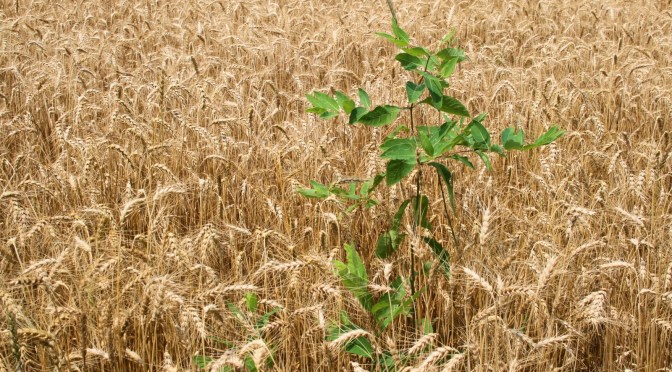
Most of us know the annoyance that weeds cause in gardens and lawns and even fields. Weeds steal energy, water and resources from the plants that we placed purposefully in our gardens. Weeding is probably one of the more joyless parts of maintaining our plants and gardens. Pulling those prickly, finicky nuisances that seem to do anything they can to stay in the ground is not fun.

And so when we hear Jesus tell the parable of the Wheat and Tares or wheat and the weeds, we can identify with the experience of the servant who wants to get the weeding done.

Yet, as anyone who regularly walks down neighbourhood streets knows keeping and maintaining gardens, in particular the weeds, is an individual approach as anything. On the street that we live on, the gardens, flower beds and lawns of our neighbours vary wildly. There are some lawns and flower beds kept impeccably. Hardly a blade of grass out of place, not a weed to be seen. And then there are others where the weeds and grass seem to be growing in harmony… and growing tall. The contrast is noticeable when there are next door neighbours with these two extremes of garden and lawn styles. A golf green lawn next to a patch of wild grass and weeds.

This tension sits at the heart of the parable of the wheat and weeds. The crops have been planted, the wheat is growing… but so are the weeds. And the servant and the master have very different approaches to deal with this tension. The slaves of the household wants to get down to weeding. They want to purify the fields, get ride of bad and unwanted weeds right away, resolve the tension that they are experiencing… but the master wants to wait. Let the wheat and weeds grow together, for in pulling up one you will destroy the other.

Now of course, when we slow to think about it, this parable is not about wheat and weeds. Jesus isn’t discussing gardening philosophies.

But nor is this parable about the explanation that Matthew puts in Jesus’ mouth either. This isn’t about the weeds being like the evil ones of the world who will be thrown into the fire, or about the good wheat being gathered into heavenly grain bins.

In fact, the explanation to the parable about what the wheat and weeds are seems to have missed the point.

The point just might be the tension.

We are not good at living with tension.

The master says to leave the weeds be, but we are most often more like the slaves who want to get down to weeding. We don’t do well with tension because we would rather get to resolution. Its why most TV shows tell a complete story each episode, and why cliffhangers frustrate us so much. It is why most music is careful to end with resolving notes, a song that ends without sounding finished feels wrong. It is why we want to get the weeding done, instead of letting the weeds grow with the garden… the tension bothers us.

But the tension extends far beyond gardens and into our lives and work, into our relationships and even into our faith. We don’t like it when things we perceive as good and bad, right and wrong, exist at the same time in the same place. We don’t like weedy things infecting our wheat.

As Matthew attempts to unpack this parable by telling us what it means, he puts it in terms of faith, or more specifically faith communities. As faith communities, we know that we need to welcome new people, to try new ways of doing things, to open ourselves up to new life and the places it could grow among us… yet, new people can feel weedy to us, new ideas and new ways of being can feel like they are taking our limited energy and resources… new life can feel like it is choking our life out.

How often do we turn down new ideas because they are too weedy… they seem like they will just take energy and life from us like weeds?

How often are we concerned only about whether we will get a fruitful return, a wheat crop as reward for our efforts? How often do we weed out potential new members to our community because we expect them to be wheat instead of weeds?

How often does new life in our midst need to be a bit weedy… need us to sacrifice some of our own resources, our soil, our water, our energy in order to let the new life take root among us?

We really do struggle with with letting the wheat and the weeds co-exist, especially as people of faith. We struggle with the tension, of living in the grey areas, and not being able to define our world in the terms of good and bad, right and wrong.

And yet the tension, the place in between good and bad, right and wrong, even life and death, is where so much of our faith rests. It is the grey ares where God seems to show up, in the places where wheat and weeds are growing together.

God comes to us a king of creation, yet born as a nobody peasant in the backwater town of Bethlehem.

God comes preaching good news, but to the lost, least and forgotten of the world.

God comes to save us, by dying on a cross.

And so we are sinners yet forgiven and righteous.

And so we find our lives by losing them.

And so we are made alive by dying in Christ.

And so God chooses to love us, even though we should be unloveable.

The master tells his servants to leave the weeds be, leave weeds because pulling them out will uproot the wheat.

The master tells the servants to live in the tension, because that is where life can grow. The weeds will steal from the wheat… but both will grow. The tension is the place where life grows.

It is the same message that God gives to us, that God proclaims in and through God’s church.

Come you who are sinners, to this community of people made righteous. Here your sins are forgiven.

Come you who are suffering, to this community of healing. Here you will be made whole.

Come you who are hungry, to this community of bread and wine. Here you will be fed.

Come you are dirty and unclean, to this community of the washed. Here you will be cleansed.

Come you are who are dead, to this community of life. Here you will be raised.

The tension is the place where life grows.

Here is the thing… just as wheat fields without wheat doesn’t exist in reality, there is no community of people without sinners, without suffering, without hunger, without being unclean, without death.

The Master knows that the weeds are always part of the growing, all part of the fruit producing. The Master knows that the weeds are a part of life.

And God knows that it is in the grey areas that life is found.

God knows sinner meets righteousness in the grey area of forgiveness.

God knows that suffering meetings healing the grey area of mercy.

God knows that death meets life in the grey area of resurrection.

And so the Master says to us, let the weeds be. Let the bad grow with the good because it is in the grey areas that life is found.

Abraham failed the test… and so did God

Genesis 22:1-14

When they came to the place that God had shown him, Abraham built an altar there and laid the wood in order. He bound his son Isaac, and laid him on the altar, on top of the wood. Then Abraham reached out his hand and took the knife to kill his son. (Read the whole text)

Here we are back into the long season of green, the chance to explore the various stories the bible. The Gospel readings of this season tell about Jesus’s teachings and ministry. The Epistle readings take us through the various letters of the New Testament to explore what was happening in the early church. And the Old Testament readings give us the stories of God’s people.

Today, the story of Abraham and Isaac is simply too tempting to avoid exploring.

The story of Abraham and Isaac is one we know well. It is a story that is not only familiar when we hear it, it is one whose themes are used over and over in literature, movies  and TV. How often is the hero in a movie faced with an impossible choice involving the sacrifice of someone that they love?

The reason that Christians know this story of Abraham so well is that it is often used as an example of faithfulness. Abraham is an example of unwavering faith, so the idea goes. And on the surface it is an idea that makes sense.

In order that Abraham demonstrate his faith, God orders Abraham to put his faith before everything. Before the love he has for Sarah and their only son. Before  the love that Abraham has for Isaac, the son who will be person who carries Abraham’s legacy into the future. Without Isaac, Abraham and Sarah are simply people who will be forgotten to the sands of time.

And Abraham delivers. He shows us what it means to be faithful. Abraham’s faith is so powerful an example that even the authors of the New Testament point to it as a model to follow.

Abraham is willing to sacrifice his own son if God asks. Unwavering faith.

Or perhaps blind faith.

Or perhaps radical faith.

Radical fanaticism even.

Because we don’t usually call people willing to kill for their faith great examples… we have other words for those people don’t we?

And what about God? In this story, God asks his chosen disciples and follower to sacrifice his son, the very son that is the fulfillment of the covenant.

Have we read this story right? Christians have been using Abraham as an example of faith for hundreds of years, and the Hebrew people for thousands before that.

But blind faith or radical fanaticism is not normally the kind of faith that we are trying to help grow in people, in ourselves.

And a God who toys with us simply to “test” our faith doesn’t seem very loving or caring.

So what is going on in this story?

Well, to understand how Abraham and Isaac arrive at this moment, we need to go back to the beginning.

The oldest part of the bible is not found in the stories of creation or the garden of Eden or in Noah’s flood. Rather Abraham’s is the oldest. And ten chapters before Abraham and Isaac, the story begins. Back when Abraham was Abram, and Sarah was Sarai, God called these two to take up everything they had to go to the land that God would show them.

Abraham’s story begins with a 3 part covenant made with God. God promises Abraham land, descendants and a relationship. And this 3 fold promise becomes the focus of the rest of the book of Genesis, and to some degree the rest of the Old Testament.

So Abraham and Sarah pack up everything and go. And when God says, “Go” Abraham is really good at going. He is always willing to go when God calls.

But it is this other part of the promise… the descendants one that Abraham has trouble with. Going is easy… when God commands it, Abraham does it either out of faithfulness or perhaps fear. But the promise of descendants is tougher. Faith in this promise cannot be rooted in obedience out of fearfulness. Believing that God will provide this barren couple with children takes hope, it takes faith in the future, and faith in the third promise, that Abraham and Sarah are indeed God’s chosen.

And so Abraham goes, but as soon as he encounters the powerful Pharaoh of Egypt he gives Sarah away to be a part of Pharaoh’s harem, claiming Sarah is his sister, not his wife. So God has to intervene to save the day.

And then Sarah, fearing that she will not provide a son, tells Abraham to have a child with the servant Hagar, who gives birth to Ishmael… but he is not the son that God promised.

Next God tells Abraham directly that Sarah will bear a son, and all Abraham can do is fall to the ground in laughter.

And two weeks ago we heard the story of God showing up again to tell Abraham and Sarah that she will bear a son and this time Sarah laughs.

And after all this, Abraham gives Sarah to King Abimelech for his harem, again requiring God to intervene.

So finally, after 9 chapters of Abraham’s struggle to believe the promise of children, Sarah gives birth to Isaac.

And the long awaited, hard to believe promise has come to fruition.

Yet still Abraham still struggles to believe in the promise, in hope for a future. Even with Isaac in his arms now.

Some Rabbis suggest that the test that God gives Abraham is not one of obedience. That it isn’t a game of chicken that God is playing. In fact, God knows that Abraham will follow the commands, he has always been willing to go when called.

But does Abraham have faith in God’s future? Does he believe that God will make him the father of God’s chosen people?

So just one chapter after Isaac’s birth, God gives the command to sacrifice Isaac.

So Abraham goes and for three days – without a word of protest – walks to the mountain with Isaac. And when they arrive, Isaac asks where the lamb to be sacrificed is… and Abraham says something about God providing it, knowing full well that there isn’t a lamb. Abraham then leaves his servants and pack animals behind, and goes to the ritual place with Isaac. There he ties up his son, binds his son like lamb to be slaughtered and places him on the altar.

And without hesitation raises the knife.

In that moment, when you take into account everything that has happened in the ten chapters before this… Abraham has not passed the test.

He has failed.

And so has God.

For ten chapters, through rescuing Abraham from himself, from proving wrong Abraham’s laughter at what he and Sarah thought was impossible, God must have thought that Abraham would finally believe that promise, the promise of descendants, the promise of hope and a future.

And yet for 3 days Abraham marched to mountain without a word of protest. Abraham looked his son in the eye and lied about what or who would be sacrificed. Abraham tied up his son and placed him on an altar of sacrifice. God must have expected that Abraham would protest or bargain, just as he had for the people of Sodom. God must have thought that Abraham would demand that God live up to the covenant, that God certainly wouldn’t just arbitrarily take away Abraham’s future. God waited for the protest. But nothing.

And so Abraham fails the test… but so does God, for a good test is one a student can pass.

And yet there on mountain, standing above Isaac with his knife in hand… just maybe it is Abraham who teaches God something, maybe it is Abraham who tests God.

Perhaps after 10 chapters of trying to get Abraham to believe in the covenant, in the promise of hope and future that God makes with Abraham, God realizes that Abraham cannot have faith… only fear. Fear that drives him to go when God commands, but fear that prevents him from having hope.

So God intervenes.

God caries the hope for the future that Abraham cannot.

God upholds God’s part of the covenant… even if Abraham cannot have faith in the promise…

God will have hope in Abraham, even when all the signs say that God shouldn’t.

God sends a ram.

God sends a ram who is a sign that God will not give up on us.

God sends a lamb who will be not a sign of death on an altar, but life on a cross.

A lamb whose coming into our world will signify God’s unwavering faith in us.

A lamb who is God’s promise of hope and future in the flesh.

For you see, we are just like Abraham.

In fact we are Abraham.

We too find the promises of God laughable, we find the threats to our future too much to confront, we too have difficulty seeing our hope and our future… even when God plunks signs right in our arms.

And so God sends us the lamb who will save us.

The Christ who is found in the thicket of the church.

The Christ who is mercy and reprieve from the knives that we threaten our hope with.

The Christ who is life, when there is surely and only death in store for us.

The Christ who is God’s promise in flesh.

Abraham’s faithfulness is nothing to be marvelled at, he isn’t a model to aspire to…

Abraham is a model of the faith we already have.

As too is Abraham’s fear the same fear that we carry. Fear that is dispelled each and every time we gather around God’s word of promise and hope for us.

Abraham reminds us that God knows we cannot be faithful on our own… and so God is faithful for us. God knows that the promise of Christ is our hope and our future.

God is one the passes the test for us.

Two Sparrows for a Penny

Matthew 10:24-39
Jesus said to the twelve disciples…,

“Do not think that I have come to bring peace to the earth; I have not come to bring peace, but a sword.

“For I have come to set a man against his father,
and a daughter against her mother,
and a daughter-in-law against her mother-in-law;
and one’s foes will be members of one’s own household… (Read the whole passage) 
As we begin this long season of green in the church, we start with some bold words from Jesus as told to us by the Gospel of Matthew. You would think that we could start this season of Jesus’ parables, preaching, and ministry with something a little more tame. But that is not Matthew’s style.

The 4 gospels, and their four authors, Matthew, Mark, Luke and John tell the same story, but in very different ways. Just like 4 pastors might preach very different sermons on the same topic. If we were to imagine what kind of people the gospel writers were, John might remind us of an academic, a professor type passionately using lots of words to describe his topic of study. Luke would be the compassionate care-giver, always thinking of the less fortunate. Mark should remind us of a mystic, a wise spiritual advisor who never says more than he has to.

And then comes Matthew. Matthew is like the TV evangelist, the mega church preacher preaching to a stadium of people. Matthew is the type who has all the answers. Matthew can spitfire verse after verse of scripture without hardly taking a breath. Matthew knows what is right and what is wrong, what is good and what is bad.

And so, as we hear Matthew collect some of the sayings of Jesus, he gives them to us in spitfire fashion, one after another. 

Together, they almost sound like a warning. Warnings about being in the right allegiance, about following Jesus in the right way, about being a disciple and the dangers of what will happen if we choose the wrong side:
“If they have called the master of the house Beelzebul, how much more will they malign those of his household!”
“rather, fear him who can destroy both soul and body in hell.”
“whoever denies me before others, I also will deny before my Father in heaven.”
“I have not come to bring peace, but a sword.”
“For I have come to set a man against his father,”
“whoever does not take up the cross and follow me is not worthy of me”

Wow… harsh stuff.

The Gospel of Matthew has been the most popular gospel of Christian history. For nearly 1000 years, it was the only Gospel that christians used. And when we hear what Matthew offers us today, as harsh as Jesus sounds, Matthew’s popularity makes sense. Matthew offers us what we want to hear. Easy answers. Right and wrong answers. Matthew offers us a legalistic path to the truth. Do this, this and this, and you will be okay. Do that, that and that, and you will go to hell.

Matthew’s approach to Jesus’s words appeals to our fears. Matthew frightens us into feeling secure. Matthew warns us of the danger in the world, and then tells how we can avoid it. Just like a good salesmen or TV evangelist.

And we lap it up.

We love the binary, right/wrong, us/them answers. We love the categories of us and them. We like knowing what to be afraid of in the world, and how we can protect ourselves. We like it all because it is easy, it feels safe, we feel like we are in control.
And that need for control comes from a place deep within us. It is from Original Sin, the Old Adam, the Old Sinner that wants to be like God that drives to easy answers that Matthew and so many others try to give us. And it this original sin that what we are washed of in Baptism. 

In Baptism, God begins the hard work of stripping away our need for control, our desire to be like God. And it is hard for us too. It is hard to deal with questions. Answers are easy. It is hard work to live with the ambiguities, the grey in life. Binary, right/wrong is easy. But it is hard to be uncertain, to be vulnerable. It is easy to know who and what to be afraid of so we can stay safe.

We don’t want to deal with questions or uncertainty or ambiguity. We like it when someone gives us the answers we want to hear.

But that is not Jesus’s way.
Even while Matthew is trying to give us the harsh Jesus, the one who warns, one with easy answers and ways to protect oneself from all the dangers, Matthew cannot help but let Jesus break through with the Gospel. In the midst of swords, devils, fighting families, choosing sids, taking up our cross, denying Jesus… It almost passes us by.
Two sparrows for a penny. Jesus says, do not two sparrows cost a penny. Two things so invaluable and worthless that you can’t even sell one for a penny, you have to offer two. Even these do not live or die apart from God. God is interested in everything or everyone. God is not choosing sides, God is not about right/wrong binaries, God is not out there offering easy answers. Jesus is showing us a God who is found even with the worthless sparrows. Nothing is too small, too inconsequential for God. In a world that wants Jesus to tell us what we want to hear… this is not it.
And even St. Matthew, the author of the most famous and often used of the Gospels, cannot keep Jesus breaking through to us, breaking through our desire for easy  answers. Matthew cannot help but show us God. 
So often the answers we long to hear are not the ones that God gives to us. Even as Matthew strives to give us a Jesus who is out separating good from bad, right from wrong, and while we lap it up. No matter how much we want the easy, safe, secure, certain answers, Jesus is giving us something else.

Jesus is giving us questions, Jesus is giving us ambiguity, Jesus is telling us that God’s concern for the world is so much bigger than we can imagine. Two sparrows for a penny. Something that isn’t even worth the smallest coin imaginable… even this sparrow does not live or die apart from God. God is working in ways and in places that we would never think to look. It is not flashy or showy or easy. It isn’t a list of requirements or steps to follow. It is hard, yet life giving work.

And what God is up to begins in baptism, begins in the waters of new life. God uses baptismal waters to introduce new questions into our world, questions of mercy, forgiveness, and life. God shows us that God’s world is so much deeper and wider than we could ever imagine.

Matthew’s harsh words like sword, Beelzebub, denial, against, unworthy – they are designed to scare us, scare us into binary right-wrong thinking and easy answers. But today, Jesus is all about the sparrow. The thing that seems worthless, even this is important to God. God breaks through our desire for an easy to categorize world. God breaks through with questions and ambiguity, but God also breaks through in the baptismal waters with grace, mercy and new life.

Doubting the Trinity 

Matthew 28:16-20

Go therefore and make disciples of all nations, baptizing them in the name of the Father and of the Son and of the Holy Spirit, and teaching them to obey everything that I have commanded you. And remember, I am with you always, to the end of the age. (Read the whole passage)

Holy Trinity Sunday is a unique festival in the church year. All the others ones tell specific stories, like we celebrated last week at Pentecost. The coming of the Holy Spirit in tongues of fire to the disciples, who then preached the Gospel was a story of drama and intrigue. Holy Trinity Sunday is quite a contrast. It is about a doctrine of the church. The trinity describes who God is, yet it is a complicated and often difficult to understand concept that we struggle to explain. We have all heard the children’s message examples. God is like water, solid, liquid, gas. God is like apple pie: crust, filling, ice cream. God is like someone who puts on different hats, sometimes a parent, sometimes a child, sometimes a friend. Each example that we try give ends up failing when stretched too far. The relationship between Father, Son and Holy Spirit is just too much, too broad, too complex to explain.

It is no wonder that some of the disciples doubted Jesus, even as they witnessed him ascending into heaven from the top of a mountain. They had stuck with him through the whole story. They has seen the improbably acts of his ministry of teaching and miracles. They had seen him fall into the execution plot of the temple authorities. And they had now heard the rumours and seen Jesus alive, even though he should be dead.

This is the final moment in the story of Jesus, and the final moment of the Gospel of Matthew. It hardly seems like the time for the disciples to still be doubting, yet the doubters are sticking out like a sore thumb there on the mountain top, not quite ready to get on the bandwagon. Their doubt is pulling them apart, pulling and tugging them away from the moment.

As the disciples stand on the mountain top and witness the risen Jesus with their own eyes, the doubt that some felt was probably not disbelief.  But perhaps they had a hard time making sense of what exactly all of this meant, all the events they had just lived through and all the the things that Jesus had told them. Their doubt is not skepticism, but rather a sense of being overwhelmed and pulled in different directions. Our doubt comes from the same place.

Doubt pulls us apart, it threatens to unravel us and undo our sense of understanding and meaning. Faith and doubt are nearly the same, as they are the way we put together all this stuff about God, about the Father, Son and Holy Spirit. Neither faith, nor doubt are about knowing with certainty or about complete skepticism. Rather, faith and doubt are lived experiences, part of day to day living with all this stuff about God and Church. Faith and doubt are a relationship and they are a part of being in relationship with God and each other. Faith is planted in grown through worship and prayer, in families and at church. It is a part of everyday life. And in the same way, doubt creeps into all parts of life. Self doubt, doubt when it comes to others, doubt when it comes to the community. Doubt comes in the moments when we are stretched to limit and when making sense of everything is too much to do on our own.

Did you notice the contrast that Matthew makes when it comes to doubt. He does not say some believe, and some doubted. Or some had faith and some doubted. Or some were certain and some doubted but Matthew reminds us where are our doubts are met. Simply believing harder or being more certain are not the solution to doubt. Matthew says that the disciples worshipped but some doubted. All the disciples worshipped, and in the mist of their worship some doubted.

And despite their doubt, Jesus gives them all the same task. To preach the Gospel and to Baptize in the name of the Father, Son and Holy Spirit. Jesus words are not just for those who feel like they have a strong faith or feel fairly certain of the message. The mission of the Gospel is for all members of the community. The doubtful and the faithful, the same group. And so is Jesus’ promise for all, not just for those feel like it is true in a given moment, but Jesus reminds and helps his followers to remember exactly what that promise is, “Remember, I am with you until the end of the age”.

Our doubt comes most alive in worship. And Jesus meets us in our doubts in worship. When we gather, there will always be some of us that doubt. We will all have times when we are feeling pulled apart and unsure…  when it will be hard to speak the words of worship. Words like, “Peace be with you” or “Lord to whom shall we go?” or “Christ has died, Christ is risen, Christ will come again”.

But it is in these words that the community of God, the community of Father, Son and Holy Spirit, the Trinity comes to us. The Trinity comes to us remembering us. Re-membering us together. Re-joining us, in faith, to the community of faith. Being re-membered, or made a member again, is part of the work of the Trinity. It is a part of the dance of the Trinity to give and receive, to move back and forth, to go forwards and backwards. The Trinity has room for our doubts, room for us to not understand and yet still be a part of the community.

There the disciples are, and there we are, in the mist of worship, some with doubts. And the promise that Jesus makes, the promise that God the Father, Son and Holy Spirit makes to us, is that we are remembered. We are not given certainty and Jesus does offer to help this crazy story of God in the world make sense. But the Trinity offers a place to be a part of the community. The Trinity is the promise that we are re-membered and re-joined.  God remembers and rejoins to the dance of the one in three, the back and forth, and the to and fro. God remembers and rejoins us in worship, with our faith and with our doubt.

Amen.