Tag Archives: ministry

Jesus doesn’t decide who sits at the seats of power

Mark 10:35-45

James and John, the sons of Zebedee, came forward to Jesus and said to him, “Teacher, we want you to do for us whatever we ask of you.” And he said to them, “What is it you want me to do for you?” And they said to him, “Grant us to sit, one at your right hand and one at your left, in your glory.” But Jesus said to them, “You do not know what you are asking….” (Read the whole passage)

We have been making our way through the heart of Mark’s gospel for a while now. These central chapters have not been easy on those who have encountered Jesus, or on us. And today it continues, James and John fail to get what Jesus is talking about for the third time. Just before James and John come to Jesus with their request, Jesus predicts his suffering and death for the third time. The first was before Peter’s rebuke, which caused Jesus to call Peter Satan. The second prediction was just before the disciples degenerated into arguing about who is the greatest. And the third prediction is just before James and John’s request today.

It seems that each time Jesus tries to tell the disciples about the true nature and character of God’s mission to the world in the incarnate Messiah, the disciples follow it up by saying something foolish because they have failed to understand what Jesus is talking about. And today is the most colossal failure of all. James and John not only do not see what Jesus’ mission is about, they imagine instead a triumphant warlord. They ask for seats next to Jesus’ throne as he becomes ruler. They imagine having seats next to Jesus at royal banquets. They want to be lieutenants commanding the right hand and left hand of Jesus’ army.

And worse yet, they ask for these positions of power with the intention to cut out the other disciples. They imagine that there is only so much glory to go around, a limited amount that they want to get their hands on. When the ten get angry, it is almost as if they are upset, not because of the audacity of this request, but because they didn’t think to ask first. The disciples look more like the cutthroat characters on Game of Thrones than the disciples of Jesus.

And as we watch this self serving behaviour from afar, there is a certain comfort for us in the persistent failures of these disciples. We can rest comfortable in the fact that there is always someone who understands what is going on with Jesus less than we do. We know that we would never be so presumptuous as to ask Jesus for such glory, to be at Jesus’ right and left hand. At least want to believe that about ourselves, despite the constant and blatant behaviour to that effect by politicians and other people of influence these days.

Of course our world governed by the same attitudes, by the desire to take the seats of power and privilege for ourselves and for our self identified tribes. We live in a world that sees that there is not enough to go around. Not enough power, not enough glory, not enough control. Not enough food, money or things we can own. Not enough jobs, toys, entertainment.

Those who sit atop of the pyramid of power, the most privileged people of our world have all but given up the charade of pretending that their lust for power isn’t the most important thing to them. Politicians who will do anything to get elected, billionaires who will spare no expense to influence governments and elections, celebrities whose fame is measured by social media followings, corporations who make more money than many of the world

We live in a world that tells us to greedily soak up whatever resources we can. Whatever comes along to comfort us, satiate us, make us feel better. And we try to get these things before anyone else can, before we run out.

And of course as people of faith, we too have a hoarding problem. And we try to hoard things that we really have no right to. We try to hoard God’s love. Out of one side of our mouths we say that God’s love is for anyone, for everyone. We say that it is free and abundant. And out of the other side we judge and condemn. We judge those who are different than us. We condemn those fail to be tolerant and accepting of what we find tolerable and acceptable. We cry out against those who don’t agree us, especially our brothers and sisters in Christ. We claim, regardless of the issue, that opinions, ideas and perspectives different than our own are a threat to us and to God’s love being proclaimed among us.

And we do this out of fear. Fear that we could be wrong. Fear that God might think differently than we do. Fear that if God accepts and loves people different than us, that we might be the ones who God doesn’t accept and doesn’t love.

When James and John ask for the two seats of honour, Jesus is unable to give them what they want. Jesus doesn’t say no, rather Jesus admits something surprising. The places on Jesus right and left have been reserved for others. And Jesus is not the one who has made these reservations.

Like James and John, we probably quickly run through list of potential candidates. Moses? Elijah? They stood next to Jesus on the mount of transfiguration. Caesar? The Generals of the Roman Army? They ruled the known world at that moment. Herod? Pilate? They control Israel. Donald Trump or Justin Trudeau? They are the most powerful people in our world and our country right now.

We cannot keep from imagining that the places next to Jesus are seats of power. But the spots at Jesus right hand and left hand are not divinely chosen places of honour. It is not God who has prepared these places. It is the mobs. The roman officials. The temple authorities. The spots next to Jesus are not chosen for the powerful, but by the powerful. They are not seats of honour, but places of condemnation.

James and John do not know what they are asking. The throne that has been prepared for Jesus is a cross. And it is has been prepared by us. By humanity at is most fearful. By humanity seeking to be God in God’s place. Humanity seeking to put God to death.

Yet, God has chosen to make our symbol of weakness and shame, a place of glory. God turns our condemnation and judgement into mercy and forgiveness. God meets us at our place of death and turns it into the throne of life.

James and John, the disciples, our hungry and insatiable world, we who presume to know where God’s love begins and ends, we fail to see that God chooses a new way for creation.

But God chooses to give life rather than take it.

But God chooses to be weak and lowly in order to come near and close to us.

But God chooses to give love away for free, for nothing, for those who do not earn it or deserve it.

But God chooses to grant us pardon and grace, where we only seek to hold keep what we have, away from others.

God’s glory is found on the cross, God’s glory is found in Christ who hangs dead at the hands of humanity. God’s glory is finds us at our worst moment, at our grandest attempts to be God, and God’s glory is opposite of what we expect. We expect power to the be the power of life, to choose who live and dies. But God’s glory is death turned into life, God choosing to give life freely to all of us.

And surprised we might be as much as James’ and John’s when Jesus says no, he cannot give us the seats of power because it is not up to him. But what God does is turns the order of our world upside down. God gives when all our world does is take. God forgives and makes right, even as we condemn and destroy.

And finally as we pursue power over and over again yet finding only destruction and death, God shows us true glory, the glory of the cross , the glory of New Life.
There is no greatest nor least

Mark 9:30-37

Jesus and his disciples passed through Galilee. He did not want anyone to know it; for he was teaching his disciples, saying to them, “The Son of Man is to be betrayed into human hands, and they will kill him, and three days after being killed, he will rise again.” But they did not understand what he was saying and were afraid to ask him.

Then they came to Capernaum; and when he was in the house he asked them, “What were you arguing about on the way?” But they were silent, for on the way they had argued with one another who was the greatest. He sat down, called the twelve, and said to them, “Whoever wants to be first must be last of all and servant of all.” Then he took a little child and put it among them; and taking it in his arms, he said to them, “Whoever welcomes one such child in my name welcomes me, and whoever welcomes me welcomes not me but the one who sent me.” (Read the whole passage)

We are well into this second part of the the long season of green… We have been winding our way through Mark’s gospel since May and the deeper we get, the more frustrating the disciples become. Today, they come off looking rather petty, like kids in the school yard at recess fighting over who is the king of the playground castle.

Of course we know that this isn’t just a play ground debate, we also recognize this debate about who is the greatest from the nightly news… especially as election season is upon us and one particular unavoidable politician who cannot help but tell us how tremendously great he is, unbelievably great.

But for people of faith, the scene between Jesus and the disciples today is about deeper things than self-aggrandizement and we know it. We know that this uncomfortable exchange between the disciples and Jesus has something to say about us too and about what it means for us to follow Jesus… or at least we are going to find that out.

The debate over who is the greatest is the memorable moment of the story today, but it is something that is repeated from last week which sets everything off. Jesus is talking about dying again. Last week Peter couldn’t abide it and took Jesus aside to rebuke him. This angered Jesus who the called Peter ‘Satan.’ This week, Jesus is talking about dying again but the disciples do not understand and are afraid to ask.

This point is important to keep in mind during the rest of the story. Because the disciples cannot understand what Jesus means when he says he will die and be raised three days later, they begin to focus on something trivial and manageable… they start arguing over who is the greatest. They are arguing over something they feel can control, something that seems to be quantifiable, a topic they think they can contribute to… all to distract from the fact that they didn’t understand what Jesus was talking about before and they were afraid to ask – remember what happened to Peter last week when he spoke up.

The question of who is the greatest among them is an idea they can manage… unlike the notion that Jesus has come into this world to be betrayed and die, only to rise again in 3 days. The little trivial matter is easier to talk about when the big issue, the big question makes them feel scared and powerless and insignificant.

And so they argue, they debate, they make passionate cases for who among them is the greatest… and probably they feel like they are achieving something as they travelled down the road to Capernaum. That is until Jesus hears them and sits them down for a talking to.

The disciples are doing something that we know well as human beings and especially as church folk. We know how to focus on the small trivial matters in order to avoid the big questions and bigger issues just like the disciples do.

Many of us have been to that church council meeting where the minute details of fixing a leaky sink or buying hot dog buns for the church barbecue or haggling over $10 item lines in a budget of 10s of thousands take up the bulk of time and energy….while questions of what it means to be disciples or how to follow Jesus in our community or how to encourage members growing in faith are met with silence and blank stares.

We naturally grab onto the small things, the things that feel manageable, the things that we can argue and debate and discuss… because the big questions of faith and mission and life… they sit like weights on our chests making our heats beat with anxiety when we think about them too much, let alone when we talk about them.

And so we end up sounding like the disciples, we end up arguing about who is the greatest because we are too afraid to ask about what it means for us that Jesus is betrayed, killed and raised three days later.

And we end up debating the little things like the annoyance of Sunday sports and shopping, grumbling about those who have drifted away and left us with the work, arguing over who is the blame for the decline of congregational resources and attendance… because we are too afraid to ask what it means for us that we are in this state, and what is God saying to us about being the church in this time of struggle.

So as we grumble along the way, on the road from where we were to where we are going… Jesus finally overhears us, stops us and sits us down – just as he did with the disciples.

To the disciples he says, whoever wants to be first must be last. Or in other words, all this stuff you are arguing about doesn’t mean a thing…it doesn’t mean a thing in the Kingdom of God.

And then as Jesus picks up a child and sets them in his lap, he says, “whoever welcomes one such child in my name welcomes me.”

But it isn’t some kind of moral lesson to the disciples… Jesus is in fact making a point about all that stuff he first said about dying and rising.

Because who is doing the welcoming? Who is holding the child in his lap? And who is it in baptism that declares to be children of God.

We aren’t the welcomers. We are the children.

God is the one welcoming us.

Jesus is reminding the disciples that they don’t need to be the greatest to understand what Jesus is up to in the world. Because in the Kingdom of God there is no first and last, no greatest and no least. We are all God’s children, and for us Jesus has come into the world. Jesus has come to die with us, to die with a dying creation. Yet, three days later Jesus shows us that death is not the end. And because Jesus rises from the tomb, we rise with the God of New Life on the third day.

The disciples don’t need to understand what it all means for Jesus to be betrayed, to die and to rise again… that isn’t their job. Rather Jesus tells them that he has come to bring them into the Kingdom, he comes to walk along side them, to let them see, hear and feel the Word of God among them… the Word made flesh.

And for all the things that we grab hold of to distract from the bigger issues of faith and life… they don’t matter in the Kingdom either. Because God will continue doing what God has always done for us. Whether it be when we thought we knew what God was up to with full churches and strong attendance and budgets we could meet or whether it is now when none of those things seem to be the case.

God continues to give us the Word of forgiveness and mercy week after week.

God continues to welcome us as God’s own as we are washed and renamed beloved.

God continues to gives us bread to eat and fill our hearts, so that we might become the bread that God uses to feed the world.

It has never been up to us to understand how the Kingdom works, or to have all the answers or to be saviours.

It is up to God.

And God is coming to us, coming to little ones such as these,

in the person of Jesus who dies and rises again,

coming to us again and again in Word and Sacrament,

signs of God welcome for us, signs that remind us that we are neither the greatest nor the least in the Kingdom, we are God’s beloved children.

This is not the end of the story

Mark 6:14-29

…Immediately the king sent a soldier of the guard with orders to bring John’s head. He went and beheaded him in the prison, brought his head on a platter, and gave it to the girl. Then the girl gave it to her mother. When his disciples heard about it, they came and took his body, and laid it in a tomb.
(Read the whole passage)

They came and took his body and laid it in a tomb. 

Familiar isn’t it?

We have heard that story before. We heard it just in April… Jesus died on the cross, and one of his disciples Joseph of Aramathea came and took his body and laid it in a tomb.

Except today, it is not Jesus but John the Baptizer. It is not crucifixion but beheading. It is not Pilate but Herod. And John will be not raised from the dead in three days. 

This story comes in the middle of Mark’s gospel. A brief departure from the things we have been hearing about, from the parables, healings, exorcisms and miracles. We stop for a moment to hear a dark and disturbing, story. Political intrigue – a King who lives lavishly, takes what he wants, and yet is perplexed by the preaching of a wilderness prophet and hermit. Pride and incest – A queen who will not stand to be shamed for leaving her husband for his brother, the King, and especially not by this lowly Hebrew religious hermit and religious nut. Murder — A young girl who is used by her parents as a pawn in a political game. A prophet is murdered so that a drunken tyrant can save face. 

No happy ending. No drama to come. Simply power, greed, lust, and pride getting what they all want. Mark doesn’t leave out any of the dirty details. This is not a feel good story. This is too much like real life, too much like the world around us. This is not enough like a Hollywood feel good ending and too much like a bad night for news.

John the Baptist, the wild Advent preacher of the Messiah’s coming to make paths straight has an ignominious end of to life… a public execution simply to satisfy the political and prideful wrangling of the ruling elite. And then his disciples come and take away his body… and thats it. 

Sometimes the story just doesn’t end well. Sometimes life doesn’t figure itself out. Sometimes there is no happy Hollywood ending. 

This strange story, today, sets itself apart from the rest of the Mark’s gospel. It feels like it doesn’t’ fit. It is selfish motivations and actions, pure and simple. And yet, it can feel so familiar. It is the story of the world at its’ worst. It is our story at our worst. We don’t need to have the drunken parties, the incestuous relationships, the desire to show power and control, or pointless death to know what it feels like. This story of Herod, Herodias, Salome and John is just as much about us. It is the story of the dirty details of life. The story of broken families and marriages, the story of job loss and bankruptcy, the story of political games and corruption, the story of money and greed, the story of poverty and powerlessness, the story of disease and illness, the story of grief and death.  

And it is missing something… or rather it is missing someone. Someone who is hinted at at best and completely absent at worst. 

This is the only part of the Gospel of Mark where Jesus isn’t front and centre… in fact, Jesus isn’t in the story at all. It makes us wonder why Mark would include this terrible event, why tell us the details? Why lay out the whole thing for us?

This story is there because it is not the end. 

Not the end of Jesus’ story. 

Not the end of our story.  

If these dirty details was all there was to story, we wouldn’t need to hear about victory of evil and sin because we live it all too often. We hear about it on the news too much. We know that this happens in the world. 

But Mark has chosen to tell us this story. To boldly include all the dirty details of power, control, pride, lust, greed and evil. Mark has chosen to include this in the story of Jesus. To include the dirty details in the Good News of Jesus Christ. 

They came and took his body and laid it in a tomb is not the end of the story of God. And it is not the end of our story. It is not the end of our stories of suffering and sin, of evil and death. God includes all our dirty details. Includes them in the story of Jesus born in flesh. Included in the story of God’s great love for us. And they are not only included, but as our stories become God’s, God’s story becomes ours. God makes the ending that we know, the empty tomb, the resurrection on the third day, the news of the risen Christ, God makes this the new ending of our stories. God makes us the new end, the new point, the new purpose of God’s love.

The Good News of Christ is that in the midst of all the evil, all the sin, all the death that exists in our world, in our lives, in relationships, in our stories, God is joining our story, our world, our lives. God joins us by coming in flesh and dwelling among us. God joins us to the Body of Christ. The dirty details, they are not what make the story any more. Rather the new plot twist, the surprising new reality is New Life. New Life in Christ, New life in the ongoing story of God. 

Sometimes life just seems full of the dirty details. Sometimes Jesus is nowhere to be seen. Sometimes all there is pointless evil, rampant sin, and needless death. 

And sometimes when our stories feel too terrible to be anything like God’s, God reminds us that we haven’t reached the end yet. There are still chapters to be written, still details to be added. God reminds us that in Christ, that because of Christ, there is only one ending possible to our story. 

God reminds us today, that our ending is life and our ending belongs to God. 

Amen. 

Clinging to the Ghosts of the Past

Luke 24:36b-48

Then he opened their minds to understand the scriptures, and he said to them, “Thus it is written, that the Messiah is to suffer and to rise from the dead on the third day, and that repentance and forgiveness of sins is to be proclaimed in his name to all nations, beginning from Jerusalem. You are witnesses of these things. (Read the whole passage)

Today it is the still the day of the Resurrection. Even though this is the third Sunday in the season of Easter, in keeping with the tradition of the church we treat this whole 50 day season as one great day of celebration. And so we go back once again to the day the resurrection, and we hear a similar story to last week’s story of Thomas… yet, this time it is Luke who tells it to us. 

It is situation that can be pretty hard to identify with. We may know the Easter story and believe that we encounter the risen Christ here in this place each time we gather for worship, but how many of us have witnessed the death of a close friend and teacher, only to have that person show up in our house a few days later? Don’t answer that…

Jesus’ moment with the disciples today comes as the third such moment where the disciples struggled to understand their encounter with the risen Christ. First it is Peter who runs to check the empty tomb, after the women from their group report back that the tomb is empty. And Jesus walks with other disciples on the road to Emmaus, who cannot see who they are walking with until he breaks bread with them. 

And now, with all the disciples in one place, Jesus shows up again. 

But of course, the group thinks he a ghost. 

And so Jesus goes through elaborate ancient tests to demonstrate that he isn’t a ghost. He shows them his hands and feet, invites the disciples to touch him, to see that he walks on the ground and doesn’t float in the air like a ghost. And he eats a meal with them, because ghosts don’t eat, people do.

Yet, the disciples still don’t understand what is going on. 

They are stuck, they are stuck back on Good Friday, back in Holy Week, back in the wildness of Galilee, back on all those dusty roads, small town synagogues, back among the crowds of people clamouring for a piece of Jesus. 

It us more than seeing Jesus as a ghost, they are clinging to the past. They still have not moved on from what once was, from the way things were, from the pre-crucifixion Jesus that they knew and loved. 

They are holding onto the ghost of what was before because they are afraid to move on. Peter was more than willing to run out into the world when he thought Jesus was dead, but once he found an empty tomb, he and the others are hiding in fear. 

They hide because it is easier to hold on to the ghosts of the past then to begin new life with new purpose. And so when Jesus shows up, they would almost rather that Jesus were a ghost than risen from the dead. 

The disciples are not much different than we are. 

Like the disciples, we too cling to the ghosts of our past. 

As our country continues to feel the pain and loss, the grief for the lives lost outside of Tisdale Saskatchewan a week ago Friday, we might have some insight into what it means to be in a mental and emotional state that can’t quite get past what has taken place. Because we know what it is to be driving on rural highways. Because we know what it is to send our kids, our loved ones, out into the world that we know is unsafe, where accidents happen everyday.

And so we we grieve and pray, we wear jerseys and put hockey sticks on porches. We cling to one another searching for hope and peace, much like those disciples after the tragedy that they had encountered. 

Yet,  ghost our pasts come in many forms not always rooted in grief and loss. They may have to  do with church, and with our memories of the past and wanting things to be like they were. To bring the young people back or perhaps really to ourselves the young people that we remember sitting in the pews. 

But the ghosts of our past can also be personal. We might cling to relationships that ended long ago, to times in our lives that we wish never ended, to jobs we once held, to youth we once enjoyed, to eras that we once understood. 

The ghosts come in many shapes and sizes, and the desire to cling to them is not anything but a normal human response to grief, loss and even change.

Yet, we know that refusing to accept change will not work. Staying stuck in the past, clinging to things as they once were, holding onto the ghosts of what once was, in the end, is impossible. 

Because the more stuck and unwilling to move on we become, the more like the ghosts we cling to we become… Like the disciples who found the tomb of Jesus empty, their response was to hide away from the world in a tomb of their own making. A tomb where they could stay at Good Friday, cling to the Jesus they once knew refusing to imagine to new life, the new Jesus that they sense is coming. 

And again, Jesus comes into their midst offering peace. 

Peace to the troubled hearts of the disciples. Peace to those who are stuck in the tense conflict of holding onto a past that is slipping away. 

Peace to our troubled hearts, peace to our grieving world, peace to those unable to let go. 

But Jesus doesn’t end with Peace. 

Once Jesus shows the disciples that clinging to ghosts is not possible, he takes things a step further. 

And all of a sudden the Easter moment, the resurrection moment extends beyond the empty tomb of Jesus and reaches into his hide away of the disciples. 

Jesus begins to transform these stuck and hopeless disciples clinging to a ghost of the past. 

“Everything you know, everything you believe in” Jesus says, “From Moses, to the prophets, to the psalms” or in other words the whole Hebrew bible, “has been fulfilled.”

And Jesus opens their minds, Jesus begins to transform these disciples giving them a new understanding and a new experience of their world. 

Everything that they thought they knew about God, about religion, about meaning and purpose in the world has been changed. The Messiah’s death on a cross and resurrection from an empty tomb changes everything. Everything moment in the story of God’s people that has come before has been leading to this moment… to this Easter moment. 

To this moment of the disciples’ Easter, to this moment of our Easter. 

“You are witnesses of these things.”

A witness is more than someone who saw something or experienced something. 

A witness is someone with a story. 

A witness is someone with a story to tell. 

Jesus transforms the disciples, transforms the world, transforms us. Jesus brings us into God’s story. Into God’s story of new life, new life given for the sake of the world, new life found in empty tombs where there should only be death. 

By making us witnesses of the Messiah, by making us witnesses to this story of God bringing new life into the world… we are given new life, we are given new meaning and purpose. 

Everything we thought we knew, everything we thought we understood has been changed by Messiah, by the death and resurrection of Jesus. 

And every week, every Sunday, every Easter morning, Jesus reminds us of this again. Jesus reminds us that that ghosts we cling to will not root us in past, and we no longer will be stuck. 

Jesus has made us witnesses. People tied inextricably to the story of God. People whose purpose is to tell that story to world. 

And Jesus continues to make us witnesses in the word of God that is proclaimed here, in the holy waters that we are washed and claimed in, and in the bread and wine, body and blood of Christ that we share together. Jesus makes us resurrection people, free from the ghosts and the past and given a story to tell. 

Today, Jesus says to us,

I have made you witnesses to resurrection and new life. 

Do not be afraid… Christ has been Raised!

Mark 16:1-8

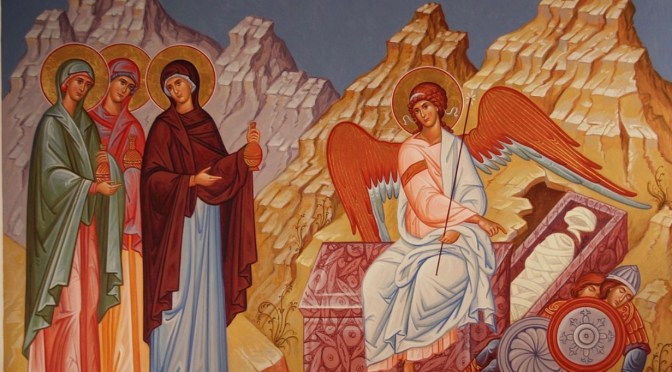
When the sabbath was over, Mary Magdalene, and Mary the mother of James, and Salome bought spices, so that they might go and anoint Jesus. And very early on the first day of the week, when the sun had risen, they went to the tomb. They had been saying to one another, “Who will roll away the stone for us from the entrance to the tomb?” When they looked up, they saw that the stone, which was very large, had already been rolled back. As they entered the tomb, they saw a young man, dressed in a white robe, sitting on the right side; and they were alarmed. But he said to them, “Do not be afraid; you are looking for Jesus of Nazareth, who was crucified. He has been raised; he is not here. Look, there is the place they laid him. But go, tell his disciples and Peter that he is going ahead of you to Galilee; there you will see him, just as he told you.” So they went out and fled from the tomb, for terror and amazement had seized them; and they said nothing to anyone, for they were afraid.


“And they said nothing to anyone, for they were afraid.”

This is not the ending of the story that we usually tell. In fact, nothing about the stories from the Gospel of Mark is usual. The Gospel of Mark has never done things the way we expect. Of all the Gospels, Mark is the shortest and perhaps the strangest, expecting things of us, expecting that we will put the pieces together and be moved to a deeper discipleship.

Mark’s Easter story is perhaps the strangest of all.  In the 3 other gospels, we normally here about Jesus appearing to the women and disciples at the empty tomb. Jesus speaks with Mary in the Gospel of John. He bring greetings to all the women in the Gospel of Matthew. In Luke, Jesus meets two of his disciples on the road of Emmaus.

But in Mark there is none of that. And it makes us uncomfortable. And not just us today, but Christians for centuries have been so uncomfortable with Mark’s ending, that they added to it. Hundreds of years later, shorter and longer endings to the Gospel of Mark were added just to try and wrap things up.

So what is it about the Gospel of Mark and his ending that doesn’t sit well with us?

“And they said nothing to anyone, for they were afraid.”

Failure.

Easter isn’t suppose to be a story of failure. The women hear the good news, they are given clear instructions to tell people about Jesus being risen, and they tell no one.

In fact, this is the story all the way through the Gospel of Mark. The disciples, the ones who are supposed to know and understand who Jesus is what he is about never do. And the people who do know are unreliable. It is unclean spirits and demons who recognize Jesus as God’s son. It is the blind man who never actually sees Jesus who knows he has been healed by the Messiah. All the way through the gospel of Mark, not a single reliable soul figures it out.

But here is the thing, Mark knows that we know that it didn’t end with the women being afraid. We all know the story of the resurrection. We are reading it in Mark’s gospel. We proclaim that Christ is risen from the dead every Sunday we gather for worship, Christians all over the world have been doing so for 2000 years!

So Mark expects that we can figure out that the women didn’t run from the tomb afraid… but Mark is also including us in the story, in the command to go and tell the world of the resurrection. Because if the women are too afraid to speak, that only leaves us, the reader. We are called to be ones who are not afraid to speak.

It is a big calling.

Because it was only on Good Friday that we stood below the cross and we proclaimed that this instrument of torture and violence, of humiliation and death is God’s transformed tool of life.

Because now today at the empty tomb with the women who are too afraid to say anything that we are just as afraid as they were. Afraid to announce this news to world. Afraid of that no one will believe our incredible, unbelievable story.

But this Easter morning and Easter story reminds us something else more than our fear and failure.

We are reminded that it is always in our fears and failures that Christ meets us. It is when we are too weak, too afraid, too focused on ourselves, when we are too much intent on our sin, on our selfishness, that Christ comes and meets us.

There is no Easter without sin and death, there is no resurrection without humanity’s greatest failure, without our trying to be God in God’s place.

And in the midst of our failures, big and small, the Risen Christ meets us. The Risen Christ reveals himself to us and brings us into the new reality of a world where sin and death are no longer the end. Yet still, our fear overcomes us and this new world that God is creating is too much for us. And like the women at the tomb we are too afraid to speak, too afraid to act, too afraid even look at how things are different.

“Do not be afraid, you are are looking for Jesus for Nazareth, who was crucified. Has has been raised.”

Do not be afraid.

Across the old and new testament, these words always precede good news.

Do not be afraid.

And even still the good news can be terrifying.

We stand before an empty tomb today, on this day of the Resurrection. And even when everything is supposed to be perfect, and when death is finally defeated, and Christ is raised from the dead. We are reminded that we still fail. We are reminded that we are still imperfect, sinful and selfish people who are frozen in the face of God’s amazing work in our world.

And we are also reminded again, that it is in our frozen failure that we are met by the Risen Christ.

The Risen Christ who has overcome the cross.

The Risen Christ who has conquered death.

The Risen Christ who has entered in our lives, our joys and our sorrows and has made our life his own.

The Risen Christ who has shown us a new reality, where death is no longer the end, where we are no longer defined by our failures, and where our sin no longer has control of us.

We are met today by the The Risen Christ and we are shown that God’s love for us is alive and there is no place we can go to escape it, and there is no way that would could fail and make God stop loving us.

Even when are afraid to speak a word to anyone, the Risen Christ meets us with the words “Do not be afraid!”