Tag Archives: ministry

The Doctrine of Vocation: What does it mean to be called?

The world has been a pretty heavy place the past few weeks. The news feels like a Tsunami of rage-inducing items being shot at us from a fire hose. Usually, as Canadians, we feel at least one step removed from the chaos of our southern neighbours, but the tariffs’ rollercoaster this week carried with it very real implications for our lives in the northern part of the continent. 

So naturally, this week we get a story about being called. Jesus teaches some fishermen how to fish (Notice: a rabbi tells career fishermen how to fish!), and it goes so well that it almost sinks their boats. Then Jesus calls Simon (who will become Peter) to follow him. 

Sometimes, these gospel stories just pass us by because we have heard them before. We don’t always slow down enough to consider just how scandalous these stories are. Jesus’ call to these fisher disciples came right after a moment when their livelihoods were in peril because of no fish, and then when the abundance of fish threatened to sink them. 

This is the same call that Jesus is making to us while we navigate our moment of chaos, too. 

Yet, when we hear this notion of “being called”, it can be difficult to know what such a call would look like. So often, when we talk about being called in the church, we imagine it to be reserved for a special few, such as clergy or pastors.  This description of being called comes to us honestly; it was more or less the operating definition for the first 1500 years of Christianity. 

However, in the Reformation, re-prioritizing of baptismal identity came with what would be called the Priesthood of All Believers. Martin Luther saw in our baptisms a call to gospel ministry for every Christian, not just for monks, nuns, deacons, priests and bishops. God called everyone who was baptized to serve the Gospel, to be proclaimers of the Word, witnesses to God’s love and mercy given to sinners⎯the promise of the Gospel. 

Five hundred years from that time, we have more or less gone back to the idea that only the clergy are called, but with a more problematic variation. When we talk about the Priesthood of All Believers, the present-day church means that lay people are doing the stuff that clergy typically have done: lay-led worship, lay preaching, lay pastoral care, lay teaching and faith formation, etc. To be clear, oftentimes all these things, which most often were the tasks of clergy, can be done by lay people. But that is not what the Priesthood of All Believers means. Within the concept of the Priesthood of All Believers, we find the Doctrine of Vocation. Or, in simpler terms: the teaching of what it means to be called. 

The Doctrine of Vocation means that each baptized Christian is called to the ministry of the Gospel where they are. The school teacher, the lawyer, the tractor salesperson, the accountant, the stay-at-home parent, and on and on⎯ each baptized person is called to the ministry of the Gospel within their work in the world, in their community, in their family. Luther put it this way in his important treatise, The Freedom of a Christian (which I referenced last week): 

“As our Heavenly Father in Christ freely came to our aid, we also ought freely to help our neighbour through our body and its works, and each one may be Christs to one another and Christ may be the same in all, that is, that we may be truly Christians….”

Our baptismal calling is that each one of us bears to the world around us, Christ and Christ’s Gospel of forgiveness, life and salvation. Now, does that mean door-knocking and handing out tracts on salvation? Not at all. Luther also believed that one of the fundamental questions we ought to ask is, “What does my neighbour need to hear the Gospel?” Is my neighbour hungry? Need shelter? Need education? Need protection from harm? Need meaningful labour? Need love, compassion, and friendship? Need trustworthy people of faith genuinely interested in their wellbeing rather than just winning souls for Jesus?

Part of being Christ to our neighbour is also giving our neighbours what they need to hear the gospel. That might mean genuine love and care that witnesses to Christ through deeds rather than just words. It also might mean a simple invitation to church or the willingness to talk openly about faith, especially the things we don’t know and have questions about, too. 

I am not sure that Simon Peter had all this in mind when he left his boat and followed Jesus. I am also not sure that most parents who bring their children to the font to be baptized truly realize that calling that they are allowing God to place on their cute babies. I am not sure we, as people of faith, committed to a life of worship and fellowship together in the congregations to which we belong, often remember this calling with which God has called us. 

But this is the call of Christ, just the same. The call is not to be a perfect follower (certainly, Simon Peter was far from that), but to understand that we bear Christ to the world, to the people around us, as members of the Priesthood of the Baptized

And just maybe, in our moment of chaos (as in Peter’s), this call, this vocation, is exactly what is needed.

Photo: The Altar in front of which Martin Luther was likely ordained at the Cathedral in Erfurt.

Accountable To & Responsible For: Kings, Rulers, Presidents and Martin Luther

If you look back at my sermons from 2015 to 2020, more of them subtly point to a certain American President than I care to admit. It has been less than two weeks since January 20th, and in that time, the psychological and emotional turmoil that was Donald Trump’s first term in office has come back in full force. Following his election last November, it seemed like much of the world went into denial, pretending that those awful days of his first term were just a nightmare that we thought was over. 

Then January 20th arrived, and the psychological turmoil and chaos landed on us like a ton of bricks. 

This time around, I am committed to not starting my mornings wondering what the President has done or said that is more outrageous than the day before. I am still following the news but in measured amounts. I am not reading every article of breathless analysis designed to keep my cortisol spiked. I am falling for the trap that I need to read every article to stay apprised of things. I am trying to stay on top of what is happening rather than what might happen. 

Some perspective is important too, even if it is a little unsettling. 

The reality is, for a lot more of human history than not, kings, rulers, emperors, presidents and heads of state have been more Trump-like than not. Perhaps not in his particularities but in his appeal to popular moods and sentiments. It is easier to see why his followers follow him with this perspective. It is the same reason why many societies long endured under cruel and exploitative rulers. The leaders offer the promise of not having to be accountable and responsible ourselves. Leaders like Trump talk about fixes and solutions to all our problems while rarely delivering any. Conversely, they rarely put boundaries on their own words, feelings, behaviours and actions. They offer an intoxicating cult to follow. When a seemingly strong and populist leader promises to fix our problems and then lets loose with their behaviour, it feels oddly liberating. We feel free to express our base desires AND free from being responsible for them. The leader is taking on our responsibility for the problems of our lives and world. 

This kind of ruler is one that was common in 16th century (yes, I am turning again to Luther). In one of Martin Luther’s most important Reformation writings, The Freedom of Christian, he addresses what it means to live a Christian life in this kind of world. In the treatise, Luther asserts two basic theses:

The Christian individual is a completely free lord of all, subject to none.

    The Christian individual is a completely dutiful servant of all, subject to all.

Luther scholar Paul R. Hinlicky argues that this is a frame of who we are accountable to and responsible for. 

We are free “lords of all” because we confess that there is but one Lord Jesus Christ, the only Lord to whom we are accountable. There is no other human Lord that we fear or to whom we owe our allegiance. Thus we are free in the world from subjugating ourselves to human powers and principalities. 

Yet, this one Lord Jesus Christ, to whom we are accountable, first frees us in love and mercy. Then, the one Lord calls us in that same love to care for our neighbour. That accountability to God means we are responsible for our neighbour. This freedom is not easy, but it is hard work. Looking for how our neighbour needs care requires getting past our own needs and concerns. It is the work of seeing and attending to the other. The freedom to love our neighbour means exactly what Jesus reminds us is the greatest commandment: To love the Lord our God with all our heart, soul, mind and strength and to love our neighbour as ourselves. 

It is easy to see that this is the opposite of putting our trust in flawed human rulers and then absolving ourselves from living into our base desires. 

For me, in these past months of turmoil and chaos, returning to Luther’s theses of Christian Freedom has been a way to keep my sanity. I remind myself often, “Who am I accountable to? God. Not to any human power,” and “Who am I responsible for? For loving and caring for my neighbour.” I am not responsible for God (to my neighbour), or propping up any other systems and structures of human power and control. 

I am accountable TO the One Lord Jesus Christ and responsible FOR loving my neighbour. 

I hope that being reminded of this fundamental truth of faith can help you through the days, months, and years to come too. 

Photo: A community chest in Wittenberg, in which funds for those in need were kept. Accessible by two keys, one held by the mayor and the other by the pastor of the town church.

Advent, Annunciation and Apoclaypse

The arc of Advent can be frustrating to those who see Advent as a countdown or barrier to the season of Christmas—four weeks of doing things that are Christmas adjacent but decidedly not Christmas. At church, we don’t tend to sing Christmas music; we decorate with hints of what is come, and we tell Apocalyptic stories different from the familiar Christmas ones. Only on this Fourth Sunday of Advent, when we are introduced to Mary, do we finally meet a familiar character from the Christmas story. 

Advent in the Church can feel like a counter-example to Christmas. In public, we notice the Christmas muzzak blaring on radios and store speakers from November onward, the ubiquitous Christ decor, Christmas menus, Christmas concerts and parties. Advent in the Church is slower, quieter, more reverent and expectant. Christmas is all about joy and celebration. 

Yet, is a Christmas that starts November 1st all that different from Advent? Even with weeks and weeks of “Christmas stuff” going on, there is still a secular understanding that Christmas does not truly come until December 25. Even though we try to have two months of Christmas, it is more like two months of stressed consumerism, extra cooking, baking, cleaning, hosting, socializing and preparation. It is almost like all the worst parts of Advent—a mountain of preparation for something that we are trying to convince ourselves has arrived already.

That is why, even though we meet Mary and her cousin Elizabeth this week, they piercingly represent a different kind of Advent. This isn’t pregnant Mary bouncing down the road to Bethlehem on the back of a donkey; this is Mary at the beginning of her pregnancy. Pregnancy is one of the most Advent experiences of all, where preparing for a new child involves a complete transformation of the self—physically, psychologically and spiritually. I pregnancy there is nothing that can be done to hurry the process along, instead, we live by the adage that “things happen when they happen.” 

When we let our human desires and fears guide our approach to Christmas, we try to jump to the ending right away. Instead, we create two months of stress and extra chores for ourselves. Because we can feel like we are in control of that version of Christmas, at least we are the ones choosing what we do and when we do it. But the version of Christmas that needs Advent to come first forces us to admit that we are not in control, that we do not get to decide when the apocalyptic in-breaking of God in incarnate flesh happens. Rather, Advent is a process of letting go of our control, and the Spirit opening us up to the revealing of Emmanuel—God with us. 

As we come to the end of Advent, Mary models for us that experience of letting go. Certainly, her encounter with the Angel Gabriel and the news that she would bear Emmanuel was life-altering—in both good and terrible ways. Her recourse is to let go, for her to receive the gift of faith in the Spirit and to know that God’s intention for her and for us is mercy and goodness. This is something she would have heard about over and over again in her faith community and from her ancestors—just as her song declares. One almost wonders if she believes it herself yet; but that, too, is part of the process. Mary prays back to God the Word of Promise that a faithful God has first given to all of us, so that we continually hear the Gospel. 

In this way, Advent, Annunciation and Apocalypse are intertwined. In our waiting, God’s promises are revealed. God breaks into human history, breaks into our lives, and delivers news that changes our reality. God in flesh is coming, in the space of the love between unexpectedly pregnant cousins and the space of a child growing in a mother’s womb, preparing to enter our world. 

*** I am grateful to daughter/father podcasting team, of theologians Sarah Hinlicky-Wilson and Paul Hinlikcy for there articluation of Apocalypse (which of coruse, they would attribute ultimately to Paul!) Check out their podcast here: https://www.queenofthesciences.com ***

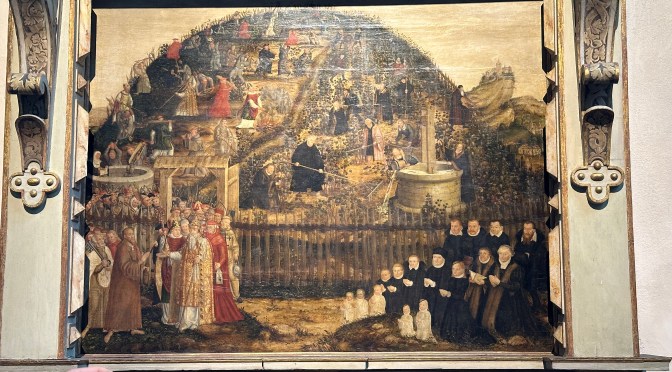
Photo: “The Vineyard of the Lord” from St. Mary’s Church in Wittenberg

The Apocalypse of John the Baptizer’s Community

You may have noticed that for a few weeks now, the titles of my weekly reflections have had mention of Apocalypse in them. You may be thinking that I am starting to sound like one of those Hellfire and Brimstone types. Maybe that is true. However, unlike in the movies, Apocalypse biblically carries a different definition than just the end of the world. Apocalypse comes from the Greek meaning ‘uncovering’ or ‘revealing.’ Apocalyptic literature speaks to the revealing of God’s plan or designs for the world or God’s intention to make right. This lands at the heart of created existence, where this ‘making right’ is contested or in a state of conflict. The Apocalypse or revealing is where God’s Kingdom coming to make the world righteous is in conflict with the powers of sin, death and the devil – forces that we experience in this world that are in opposition to God’s great love for us. 

Phew…

With that understanding of Apocalypse, we pick up with John the Baptist. Who is speaking to the crowds who have come out into the wilderness to hear him and be baptized for repentance and the forgiveness of sins. This follows with the long history of Israel seeking out prophets sent by God in times of crisis and seeking to repent of the ways in which God’s people have turned away from God. John is standing in a role they know and can identify from the Scriptures, and they are seeking to repent just as good people of faith should. 

Yet, they don’t quite get there. John isn’t just preaching repentance like the prophets of old. He is also preaching the coming of another, a Messiah. 

The crowd responds peculiarly. They ask John, “What then should we do?”

They ask this three times: “What should we do?”

In a time of crisis, when the world feels like everything is falling down around them, when the powers are threatening to crush them, when the future feels terribly uncertain, they want to know what they can do. Each of John’s answers is unsatisfying. 

Sounds familiar doesn’t it?

In a time of great uncovering and revealing the deep and uncomfortable truths at the heart of our existence, the apocalyptic conflict between God’s making right and the powers of sin, death and the devil that we can feel palpable in our world… the answers to our wonderings of, “what should we do?” have proven equally unsatisfying.

Maybe that is the point. It seems to be John’s point. Maybe what we need to do isn’t the chief issue. In this moment of Apocalypse, what we do just might be secondary to our salvation. The uncovering of what is really happening to us as God’s people is still in process, still being made known to us. But as we turn to the second half of Advent, I am sure it has something to do with the One we are waiting for, the One who is coming. 

The Messiah is on the way. 

Apocalypse is waiting

This week, we have stepped fully into Advent, the season that begins each liturgical year with waiting and watching for Messiah. Advent is the favourite season of most pastors and deacons, and I know more than a few lay folks who love Advent as well. There is something about those shades of blue that captures the essence of the night sky in this season of darkness. The Advent hymns of hope and longing speak deeply to the reality of our world. Advent doesn’t rush us to the good part of the story… rather, it takes its time unfolding. We are just starting this season now in the Church, whereas many in the world have been celebrating Christmas since November 1st. 

I think this love and connection to Advent is precisely because of the contrast it offers to the expectations of Christmas that begin ramping up in November with Christmas parties, concerts, baking, decorating, Hallmark movies and holiday muzak playing on radios everywhere. Our calendars fill up; we have to summon the energy to be social, to be good guests and hosts, and to be present physically, mentally, and emotionally at events with family, friends, acquaintances and strangers. It can be delightful, difficult, busy, tiring, fun or all of those things at once.

Conversely, Advent is about preparation and anticipation. Not in the frantic getting-the-house-ready-for-company kind of way, but in the quiet-stillness-of- your-own-thoughts-and-a-hot-cup-of-coffee-at-dawn kind of way. Advent calls us to slow down, to be present in our own minds and thoughts, in our bodies and hearts. Advent calls us to watch and listen for God, to prepare our hearts for Messiah, to attend to pregnant possibilities of divine activity in our world. 

In the four weeks of Advent, we journey from big to small. In the first week, we begin in the cosmic and apocalyptic realm, where Jesus calls us to pay attention. God is at work bringing the Kingdom of God to confront the kingdoms of sin, death and the devil. 

In the second week, we hear John the Baptist preach about the Kingdom of Israel, of empires and rulers, of politics and nations. 

In the third week, we keep shrinking down: John addresses the crowds before him on the River Jordan. 

Finally, in the fourth week, we witness an intimate conversation between Elizabeth and her cousin Mary, two women pregnant with miraculous babies. 

In Advent, divine activity is revealed in all the levels of our existence, from the cosmic, to the political, to the communal, down to the intimate. And yet, divine activity begins in this final and special place—in the wombs of our mothers. In this most intimate and closest of relationships we can have as human beings, God enters into creation in order to meet us in Christ. From this smallest and closest of beginnings, Christ proceeds to encounter the fullness of creation, joining God once again in divine fullness to every part of our existence. From incarnation and birth to crucifixion and death, Christ becomes one with us. And then, in the Resurrection, Christ’s apocalyptic renewal and reordering of our world in a new creation, we become one in Christ.